Speed Up Ad Creative Process: Playbook for 2026
Jump to a section
Your team probably isn't short on ideas. You're short on throughput.
A concept gets approved on Monday. Copy changes come in on Tuesday. The editor is waiting on resized footage. Legal wants another pass. Paid media needs variants for Meta by the end of the week, but the final files still aren't exported. Meanwhile, the account is spending against the same few ads, performance is flattening, and everyone says the same thing: we need more creative.
That diagnosis is usually wrong. You don't just need more creative. You need a system that can speed up the ad creative process without turning your test plan into chaos.
Most articles stop at surface-level advice like "write better hooks" or "test more formats." That's useful, but it doesn't fix the underlying bottleneck. Slow creative output usually comes from broken workflow design, unclear handoffs, one-off asset production, and review cycles that force teams to remake work instead of remixing it. In practice, the fastest teams don't behave like a traditional studio. They behave like an operations function with a strong creative standard.
The True Cost of a Slow Creative Process
A slow creative process doesn't just frustrate the team. It hurts media efficiency.
On Meta, ads don't fail only because the idea was weak. They also fail because good concepts stay in market too long, weak replacements arrive too late, and fatigue shows up before the next batch is ready. One industry article notes that the average user sees the same creative 4.2 times across all Meta ad impressions, and more than 19% of impressions show the creative more than four times. The same article says brands with stronger creative velocity can achieve 30% to 50% ROAS improvement and up to 8% higher conversion rates, with refreshes recommended about every two weeks to combat fatigue, according to Logical Position's breakdown of creative velocity on Meta.
That changes the conversation. Creative speed isn't a nice operational upgrade. It's part of performance management.
When teams move slowly, they usually pay for it in a few predictable ways:
- ROAS softens: Winning ads stay live past their useful window because replacements aren't ready.
- CAC drifts up: Media buyers have fewer fresh options to stabilize delivery or reframe the offer.
- Testing quality drops: Teams rush late-stage edits and end up shipping near-duplicates instead of true variations.
- Team energy gets wasted: Designers and editors rebuild the same ad in slightly different forms instead of working from reusable parts.
Slow production creates a hidden tax on every campaign. You buy media with yesterday's creative while tomorrow's assets are still stuck in review.
The fix isn't "work harder." It's to replace ad hoc production with a repeatable system that can produce, version, approve, and launch creative on a cadence the channel demands.
Redesign Your Workflow From Brief to Launch
Most slow teams don't have slow people. They have a slow process.
The common pattern looks like this: paid media asks for ads, creative asks for more context, copy gets revised halfway through editing, and approval happens after the asset is already built. Everyone is busy, but the work still crawls because each handoff resets the project.
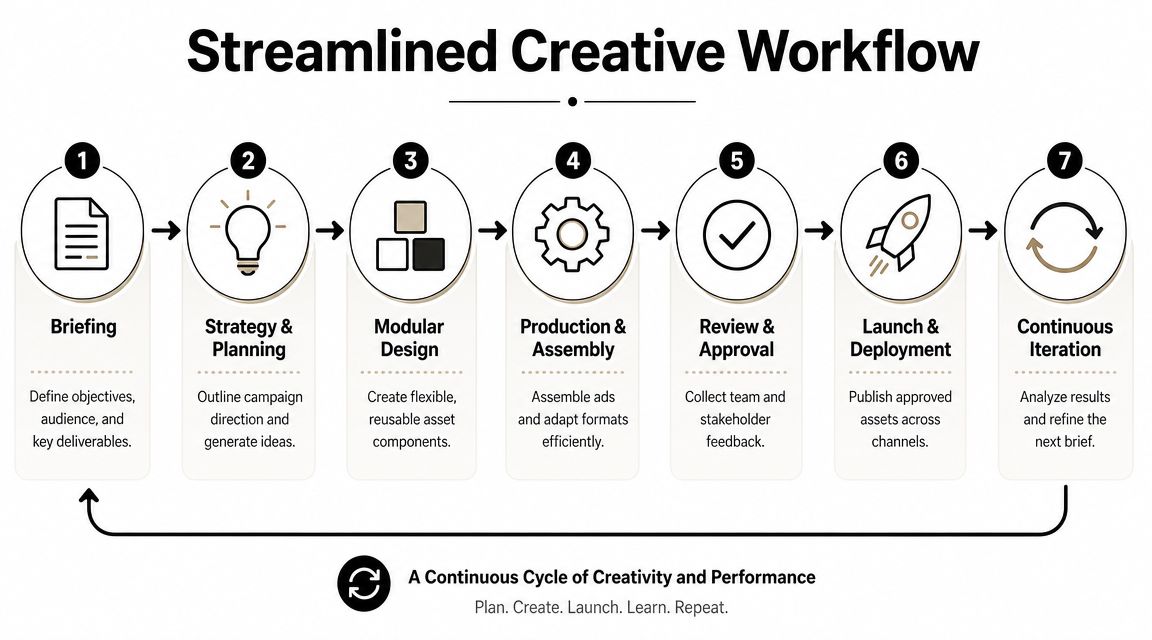
A better model is a structured sprint. Industry guidance says Design Sprints can compress work that would normally take months into five days, and similar creative workflows use 1 to 2 week windows with regular checkpoints to reduce rework, as described in Single Grain's guidance on speeding up creative work.
Start with a brief that removes ambiguity
A brief should act like a contract between the performance team and the production team. If the brief is vague, the ad will drift.
A usable brief doesn't need to be long. It needs to answer the questions that usually create revision loops:
| Brief input | Why it matters |
|---|---|
| Core offer | Keeps every version anchored to the same commercial goal |
| Target audience | Prevents copy and visuals from speaking to everyone and no one |
| Creative angle | Defines the message territory before formats get debated |
| Proof points | Gives editors and copywriters material they can actually use |
| Required outputs | Stops last-minute requests for extra sizes, lengths, or placements |
| Success criteria | Tells the team what the ad needs to do, not just what it should look like |
If your team says "make something UGC-style for this product," that's not a brief. That's a format request. It tells the editor how the ad might look, but not what argument the ad needs to make.
Run work in parallel, not in sequence
Fast teams overlap tasks. They don't wait for one person to finish everything before the next person starts.
A practical sprint often works like this:
Day 1 briefing and angle selection
The UA manager, creative strategist, and copy lead align on audience, offer, angle, and output count.Day 2 asset pull and scripting
Raw footage, prior winners, testimonials, product visuals, and claims get collected while scripts and hooks are drafted.Days 3 to 4 assembly and versioning
Editors build master bodies and variant openings, while design handles overlays and sizing in parallel.Day 5 review checkpoint
Feedback focuses on message clarity, offer alignment, and test logic. It shouldn't become an open-ended taste debate.Final launch prep
Naming conventions, exports, metadata, and handoff to media buying happen before the sprint closes.
Practical rule: Reviews should approve or reject against the brief. They shouldn't reopen the strategy every time someone sees a rough cut.
Define role handoffs before production starts
Teams often lose speed in the gaps between ownership. If nobody owns the transition from concept to production, work sits idle.
A simple split works well:
- UA manager: Owns the business goal, audience, and launch priority.
- Creative strategist: Owns angle selection, messaging structure, and test plan.
- Copywriter: Owns hooks, bodies, and CTA language.
- Editor or designer: Owns assembly, formatting, and visual pacing.
- Approver: Owns final signoff against a fixed checklist.
If you're managing multiple contributors, a dedicated video production project management workflow helps keep tasks visible and approvals contained. That's often the difference between a sprint and a traffic jam.
Adopt a Modular Ad Design System
One-off ads are the enemy of speed.
If every request starts with "make a new video," your team will always be behind. The faster model is modular. You build ads from reusable components, then reassemble those parts into testable variants without recreating the whole asset each time.
Think of your creative library as a system of interchangeable blocks, not a folder of finished files.
Build around hook, body, and CTA
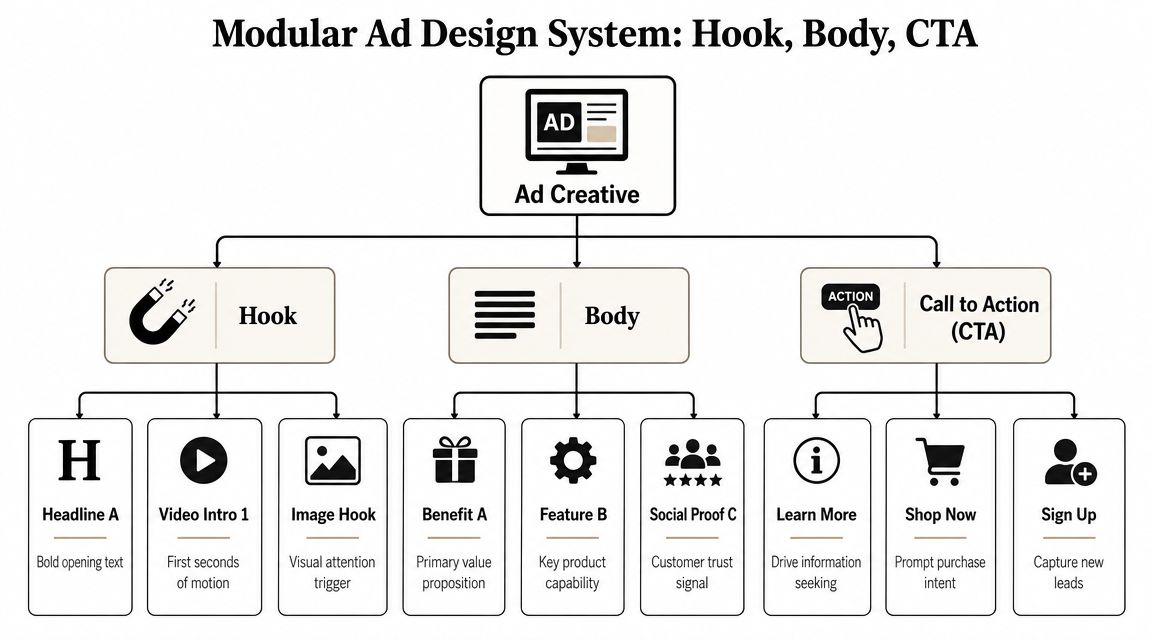
This is the most useful modular structure for performance teams because it maps cleanly to how ads are practically tested.
Hook
The first frames, opening line, headline, or visual interruption that earns attention.Body
The sales argument. This might be a product demo, a user story, a problem-solution sequence, or proof.CTA
The closing instruction and offer framing. Shop now, learn more, install, sign up, or claim the deal.
Once you separate these parts, versioning gets easier. You can hold the body constant and test multiple hooks. You can keep the same angle but swap CTA framing. You can resize and reformat the same narrative without rebuilding the core ad.
A practical asset library might include UGC intros, founder clips, product closeups, testimonial cuts, subtitle styles, offer cards, and end screens, all tagged by role in the sequence.
Multiply output without multiplying production hours
One useful recommendation for high-volume testing is to start with about 20 distinct creatives, then scale output by swapping modular elements. A single ad concept with five hooks becomes five testable variants without a major increase in production effort, based on this practical YouTube walkthrough on creative testing and modular variation.
That's the mindset shift. The final deliverable isn't one polished ad. It's a controlled set of parts that can produce many ads.
To make that work, teams need naming discipline. If the hook is saved as "final_v2_new_real_final," nobody can use it later. Label components by function, angle, audience, and format. Your future self will thank you.
A deeper modular video ad framework is useful if you're trying to operationalize this across a larger team or client roster.
This walkthrough is also worth watching before you redesign your build process:
What modularity doesn't solve on its own
Modularity can go wrong if teams use it as a shortcut for originality.
If every variant uses the same claim, same narrative, and same body with only cosmetic hook changes, you'll get more files but not better learning. Modular production works when the components reflect real strategic variation, not just editing efficiency.
Modular systems should reduce remake work. They shouldn't reduce thinking.
Leverage AI and Automation Tactically
AI helps most when it removes repetitive production work. It helps least when teams expect it to replace strategy.
The useful question isn't whether AI can "make ads." The useful question is which parts of the workflow are mechanical enough to automate without damaging judgment. In most performance teams, that's tagging, organizing, trimming, formatting, captioning, voiceover support, and large-scale version assembly.
Recent 2026 benchmarks reported that AI-assisted campaign development cut average production timelines from 23 days to 5.8 days and reduced creative production budgets by 41.7% on average across the sample covered in Amra and Elma's 2026 AI ad creative statistics summary.
Use automation where repetition is highest
Three use cases consistently matter.
First, asset management. Raw footage becomes much more useful when clips are searchable by transcript, scene, speaker, product mention, or visual type. Without that layer, editors waste time hunting through source files.
Second, creative augmentation. AI can help generate supportive B-roll, draft voiceover options, subtitles, text overlays, or alternate lengths. That matters most when the original footage is strong but incomplete.
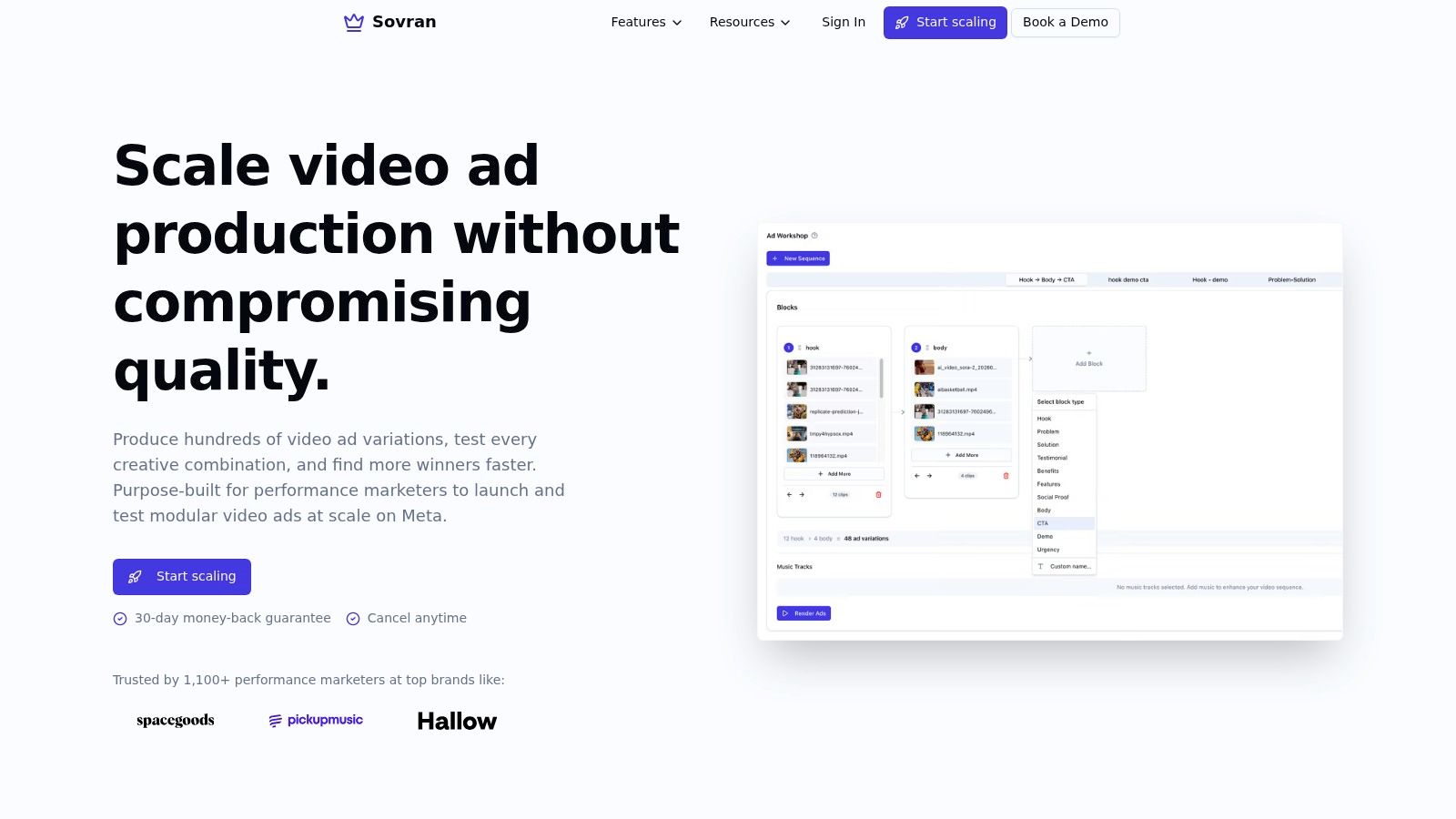
Third, bulk versioning. Here, speed compounds. Once hooks, bodies, CTAs, and overlays are structured as components, automation can assemble many variants far faster than manual editing.
One option for this kind of workflow is Sovran's AI creative automation platform, which supports asset structuring, version assembly, and direct production workflows for modular ad testing.
Keep humans on the strategic decisions
The biggest mistake is automating the wrong layer.
Don't ask AI to decide your audience insight, your angle hierarchy, or the claim that should anchor the campaign. Those choices need a strategist, media buyer, or marketer who understands the business context. Use automation after those decisions are made.
A simple split looks like this:
| Best handled by people | Best handled by automation |
|---|---|
| Choosing the core angle | Tagging clips and transcripts |
| Deciding what to test first | Resizing and reformatting |
| Evaluating message clarity | Generating captions and overlays |
| Reviewing claim accuracy | Assembling bulk variants |
| Interpreting performance patterns | Organizing reusable assets |
If a task requires taste, business judgment, or risk evaluation, keep a person in the loop. If it requires repetition and consistency, automate it.
That balance is how you speed up the ad creative process without flooding the account with low-signal assets.
Implement High-Velocity Testing Methodologies
More tests don't automatically mean better learning.
A team can launch dozens of variants and still learn almost nothing if the experiment design is weak. This happens constantly. Marketers swap colors, captions, or aspect ratios, then treat the result as strategic insight. It isn't. It's cosmetic iteration dressed up as testing.
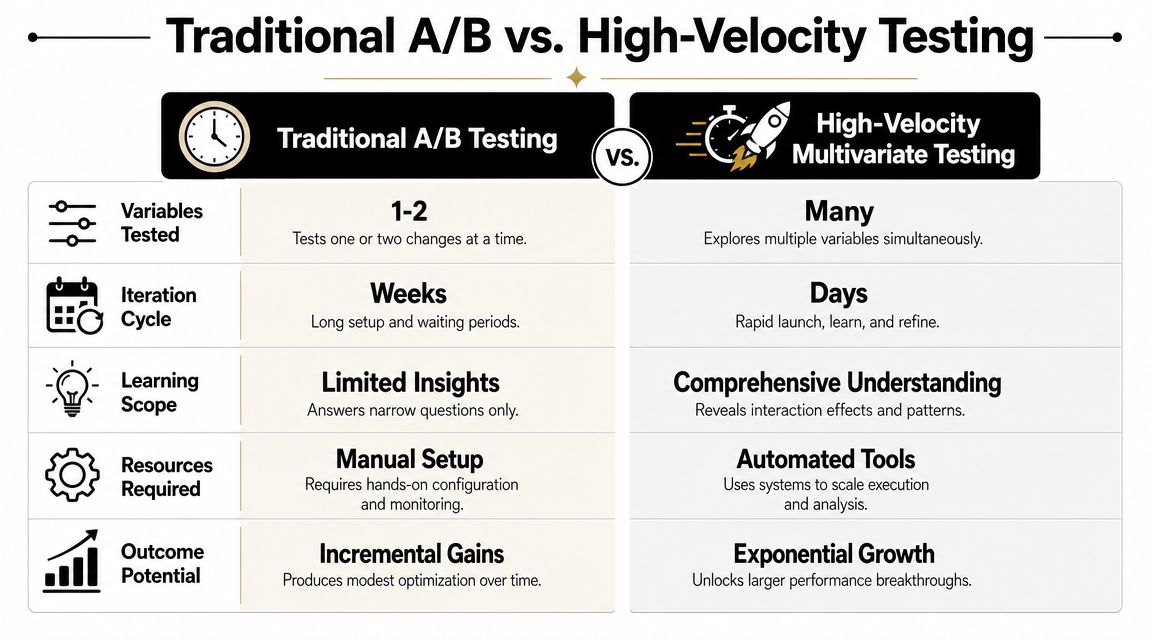
Recent guidance has pushed back on that habit by arguing that creative angle, not format, is the actual performance driver. It also warns that frequent refreshes without narrative change can create false confidence, according to Leadenforce's discussion of why ad creative angle matters more than format.
Test angles first, formats second
An angle is the underlying argument. It could be "save time," "avoid mistakes," "look better," "cost less," or "switch from the old way." Format is how you package that argument.
Teams often reverse the order. They say, "Let's test UGC versus polished brand video." That's usually too shallow. A stronger test asks, "Which argument wins for this audience?" and then packages the winner across formats.
Here's a cleaner testing sequence:
Angle test
Compete distinct narratives against each other.Hook test within the winning angle
Change the opening mechanism while preserving the core argument.Body refinement
Tighten proof, pacing, objection handling, and sequence.CTA and offer framing
Adjust the ask once the message itself is validated.
This preserves signal quality. You learn what matters before you optimize details.
Use multivariate logic with discipline
Modular production makes multivariate testing possible, but that doesn't mean every combination deserves to go live.
A good multivariate setup isolates meaningful variables. For example, if you have several hooks, a few bodies, and multiple CTAs, you can structure variants that reveal which component contributes most to performance. But the variables should be coherent. Random combinations often create noisy reads because the message pieces don't belong together.
A useful rule is to limit each batch to a small set of hypotheses:
- Hypothesis one: Which problem framing gets the strongest response?
- Hypothesis two: Which proof mechanism supports that framing best?
- Hypothesis three: Which CTA fits the audience's readiness?
If your team needs a more structured framework, this guide on how to test video ad creatives is relevant for building experiments around components instead of finished ads.
Fast testing only helps when each variant answers a real question.
What to avoid
The slowest form of testing isn't traditional A/B. It's fake velocity.
That looks like launching many near-identical edits, reading early platform metrics as if they prove messaging fit, and then scaling the wrong idea. If the narrative didn't change, your team didn't test a new concept. You just changed the wrapper.
Create a Data-Driven Iteration Loop
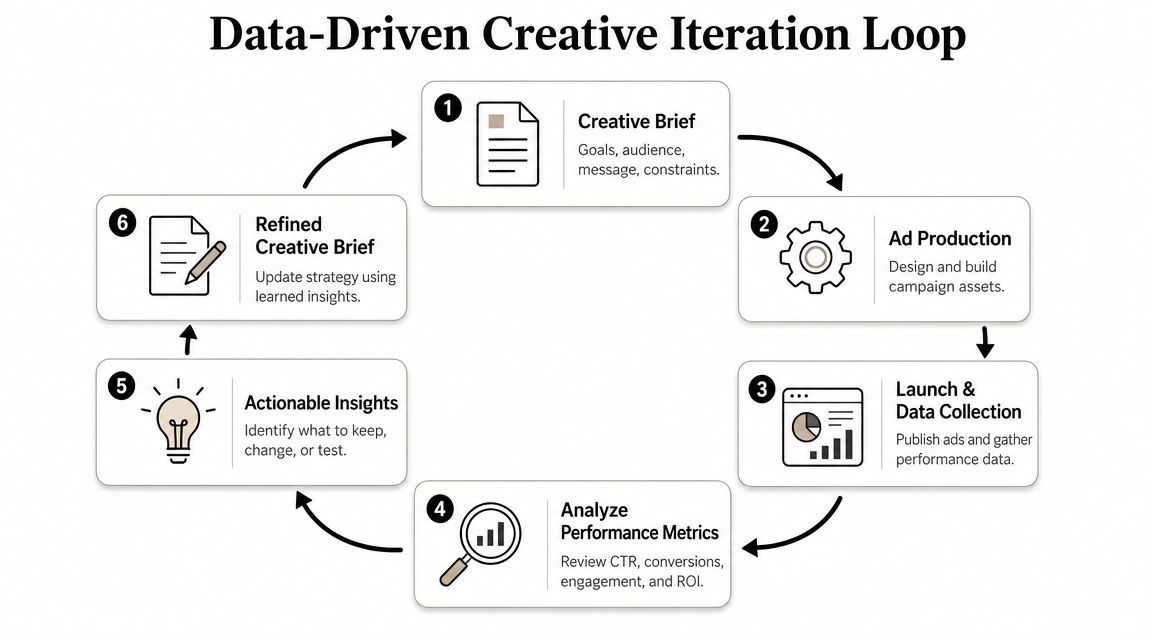
Creative speed matters most when learning feeds the next round of production.
A lot of teams stop at identifying a winning ad. That's useful, but it leaves insight trapped at the asset level. The stronger habit is to ask why the ad won. Was it the opening claim, the type of proof, the pacing, the visual treatment, the offer framing, or the CTA language? If you don't separate those parts, every win looks accidental.
One frequently missed point in creative operations is workflow design itself. Most advice focuses on brainstorming, while the main bottleneck is often the inability to turn one winning concept into many testable variants without slowing approvals or losing organization, as argued in Metalla Digital's piece on creative strategy and high-performing ads.
Review components, not just ads
The most practical post-launch review asks component-level questions:
| Component | Useful review question |
|---|---|
| Hook | Which openings consistently earn attention across audiences? |
| Body | Which proof style keeps the argument credible and clear? |
| CTA | Which closing language matches buyer intent best? |
| Format | Which packaging supports the message without distorting it? |
| Angle | Which narrative keeps producing durable results over multiple iterations? |
This changes the next brief. Instead of saying "make more ads like the winner," you can say "build new variants around this problem-aware angle, keep testimonial proof, and test a stronger direct-response CTA."
That's a much better instruction for a creative team.
Turn approvals into a learning system
Iteration gets stuck when teams treat each campaign as a fresh project. That forces everyone to re-litigate decisions that should already be settled.
A better operating rhythm looks like this:
- Capture the pattern: Record what worked at the component level.
- Translate it into the next brief: Convert observations into testable instructions.
- Preserve the library: Save winning parts in a way the next sprint can reuse immediately.
- Retire weak patterns: Stop reusing hooks, proof structures, or CTA styles that keep underperforming.
Operations and strategy finally meet. The workflow becomes smarter because the team isn't just producing faster. It's reusing knowledge, not just files.
A defined video ad iteration strategy can help teams formalize that loop so every launch produces better inputs for the next one.
The real output of a creative sprint isn't just a batch of ads. It's a better decision set for the next batch.
If you want to speed up the ad creative process in a durable way, don't optimize isolated steps. Redesign the whole loop. Briefs should reduce ambiguity. Workflows should compress handoffs. Assets should be modular. Automation should handle repetition. Testing should prioritize signal quality. Performance reviews should feed the next sprint.
That's how creative production stops being a bottleneck and starts acting like a growth system.
If your team needs a way to turn existing footage into modular testable ads faster, Sovran is built for that workflow. It helps performance marketers structure assets, assemble variations from hooks, bodies, and CTAs, and move from raw footage to launch-ready creative with less manual production overhead.

Manson Chen
Founder, Sovran
Related Articles
Storyboard Development: Scale Video Ad Production in 2026

8 Pattern Interrupt Techniques for Video Ads