How to Choose a Creative Automation Platform: 2026 Evaluation Checklist
Use this creative automation platform checklist to compare video ad workflows, asset banks, modular clipping, brand controls, exports, analytics readiness, and proof before you buy.
Jump to a section
- Creative Automation Platform Comparison: Quick Decision Table
- What Is a Creative Automation Platform?
- Why This Decision Matters In 2026
- Start With The Workflow, Not The Category
- Criterion 1: A Searchable Asset Bank
- Criterion 2: Hook, Body, And CTA Clipping
- Criterion 3: Controlled Variant Generation
- Criterion 4: Brand Control And Review
- Criterion 5: Launch And Export Fit
- Criterion 6: Learning Loop And Analytics Readiness
- How To Choose For Live Service Games And Mobile UA
- Video Creative Automation Platform Checklist
- Watch The Workflow Before You Buy
- Proof Points To Look For
- 30-Minute Demo Script For Evaluating Platforms
- How Sovran Fits
- Final Buying Recommendation

How to Choose a Creative Automation Platform: 2026 Evaluation Checklist
How to choose a creative automation platform comes down to one practical question: can this tool turn your team's approved footage, hooks, bodies, CTAs, proof clips, claims, and offers into more testable ads without making the workflow messier?
If you need the short answer, choose a creative automation platform that can prove six things in a live demo:
- It stores reusable creative assets in a searchable library.
- It splits source videos into hooks, bodies, CTAs, product demos, testimonials, and proof clips.
- It creates controlled ad variations without rebuilding every edit by hand.
- It preserves brand rules, claims, captions, aspect ratios, review states, and naming conventions.
- It exports or launches cleanly into Meta, TikTok, Reels, Shorts, YouTube Shorts, Drive, Dropbox, or your normal handoff path.
- It keeps each variant's creative variables clear enough that performance data is useful later.
That is the difference between a nice AI video tool and a creative automation platform performance marketers can run every week. The best platform is not the one with the longest feature list. It is the one that removes the biggest bottleneck between raw footage and shipped ad tests.
Creative Automation Platform Comparison: Quick Decision Table
Use this table before you book demos. It keeps the comparison focused on the workflow problem instead of vendor language.
| Team Bottleneck | What To Prioritize | Platform Type To Consider | Where Sovran Fits |
|---|---|---|---|
| You have footage but not enough finished ads | Asset bank, modular clipping, bulk variant rendering | Video creative automation platform | Strong fit for turning source footage into Meta, TikTok, Reels, and Shorts ad variants |
| Brand teams need governance across markets | Templates, approvals, localization, permissions | Enterprise creative automation suite | Useful when performance teams need brand-safe video ad modules, but not a full DAM replacement |
| You need new generated scenes or B-roll | Text-to-video, image-to-video, generative model quality | AI video generation tool | Pair with Sovran after generation so approved clips become structured ad tests |
| You launch plenty of ads but cannot read patterns | Creative analytics, naming, spend and performance views | Creative analytics platform | Use Sovran upstream to produce cleaner test cells for analytics to interpret |
| You need quick one-off social edits | Mobile editing, captions, templates, native platform feel | Social video editor | Useful companion for isolated edits; Sovran is better for repeatable paid ad variation |
What Is a Creative Automation Platform?
A creative automation platform is software that helps marketers produce, adapt, approve, and reuse creative assets at scale. For paid social teams, the most valuable version is usually a video creative automation platform: a system for turning raw clips into many campaign-ready ads while keeping the test structure clean.
That matters because modern ad accounts need more than one polished hero video. They need a steady supply of variants: different hooks, bodies, CTAs, proof moments, creator clips, aspect ratios, caption styles, offers, and audience angles.
A lightweight AI editor can help you make one asset faster. A real creative automation platform should help you build a repeatable production system, so the next 30 assets are easier than the first one.
Why This Decision Matters In 2026
Creative volume has become a workflow problem, not just a creative problem. HubSpot's 2026 State of Marketing reports heavy adoption of AI across content and media production, and IAB's Digital Video Ad Spend and Strategy reporting says buyers expect GenAI creative to become a major share of ad production by 2026.
Video teams are already changing how they work. Wyzowl's recent video marketing statistics show more marketers using AI video tools to create or edit marketing videos.
The pressure is not simply to make more assets. It is to make more learnable assets. Motion's 2026 Creative Benchmarks analyzed Meta creative performance at scale and found that a small minority of creatives become clear winners under its spend-based definition.
The takeaway is not "make random volume." It is "make structured variation easier." If every new ad changes five variables at once, the account may find a winner, but your team will not know why.
Start With The Workflow, Not The Category
Before comparing features, map your current creative workflow from raw asset to launched ad. Most teams discover the pain sits in one of five places:
- Asset chaos: footage lives in drives, Slack threads, creator deliveries, old ad accounts, and editor timelines.
- Manual clipping: strong hooks, product demos, testimonials, and CTAs are trapped inside longer videos.
- Slow variation: every new test requires an editor to rebuild the same structure.
- Weak test naming: nobody can tell which hook, body, CTA, offer, or format actually changed.
- Launch drag: files have to be exported, renamed, uploaded, and matched to the right campaign manually.
Pick the platform that attacks your biggest constraint first. A beautiful template library will not help if the real problem is finding approved clips. A generative model will not help if the winning asset is already in your customer footage but nobody can turn it into 20 tests.
Criterion 1: A Searchable Asset Bank
A creative automation platform should make reusable assets easier to find than they are in your current drive folder. At minimum, look for a library that can separate videos by source, campaign, product, creator, format, approval status, and creative role.
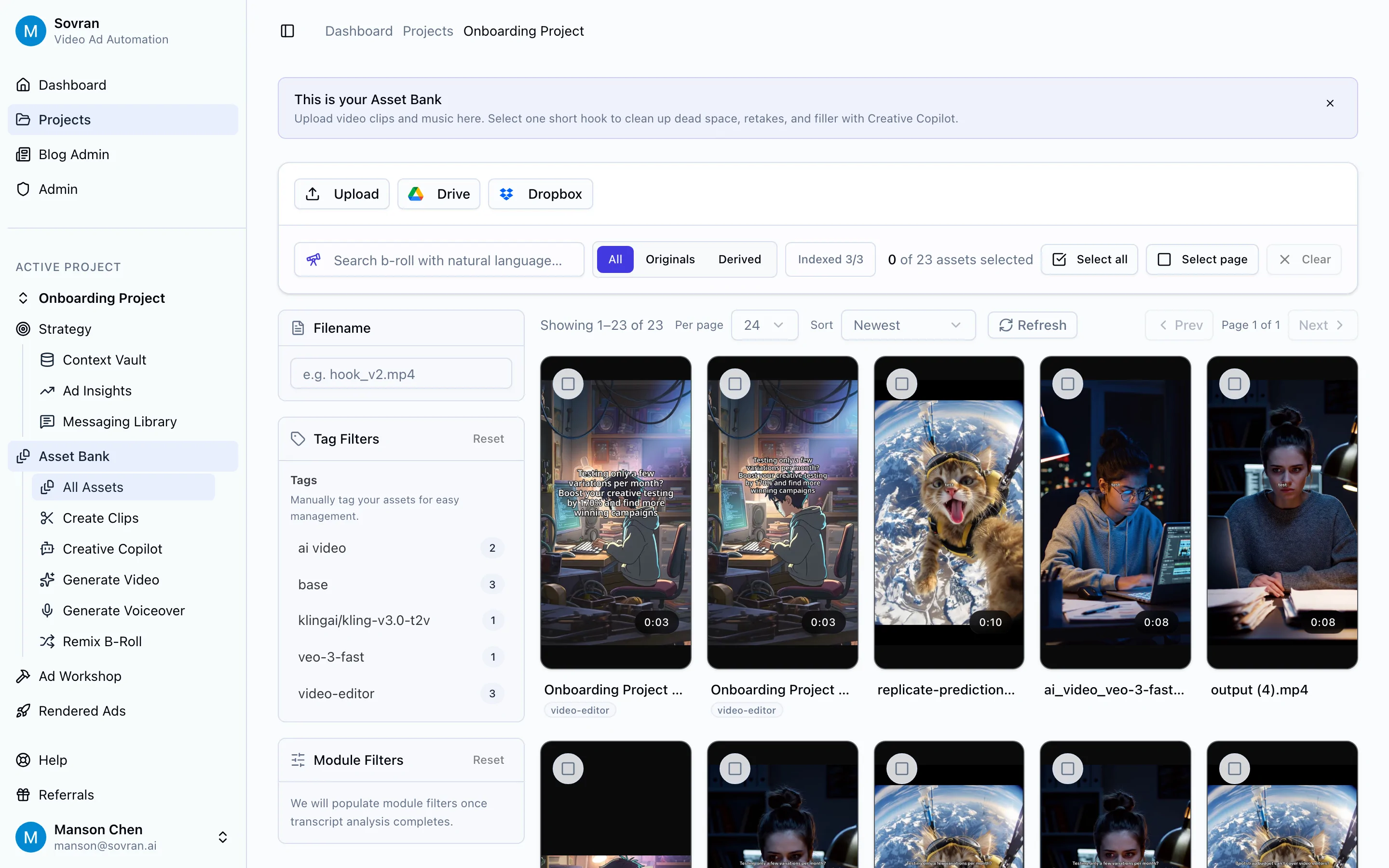
When you review platforms, ask:
- Can the team search by marketer-friendly roles like hook, body, CTA, testimonial, demo, offer, or objection?
- Can creators, editors, and growth leads upload assets without breaking the structure?
- Can you tell which clips are approved, stale, winning, or waiting for review?
- Can one asset feed multiple campaigns without duplicate files everywhere?
If the asset bank is weak, automation usually turns into faster clutter.
Criterion 2: Hook, Body, And CTA Clipping
For performance video ads, modular clipping is often the feature that separates real creative automation from a basic editor. A 45-second creator video might contain three usable hooks, two proof moments, one product explanation, and one CTA. The platform should help you capture those pieces as reusable modules.
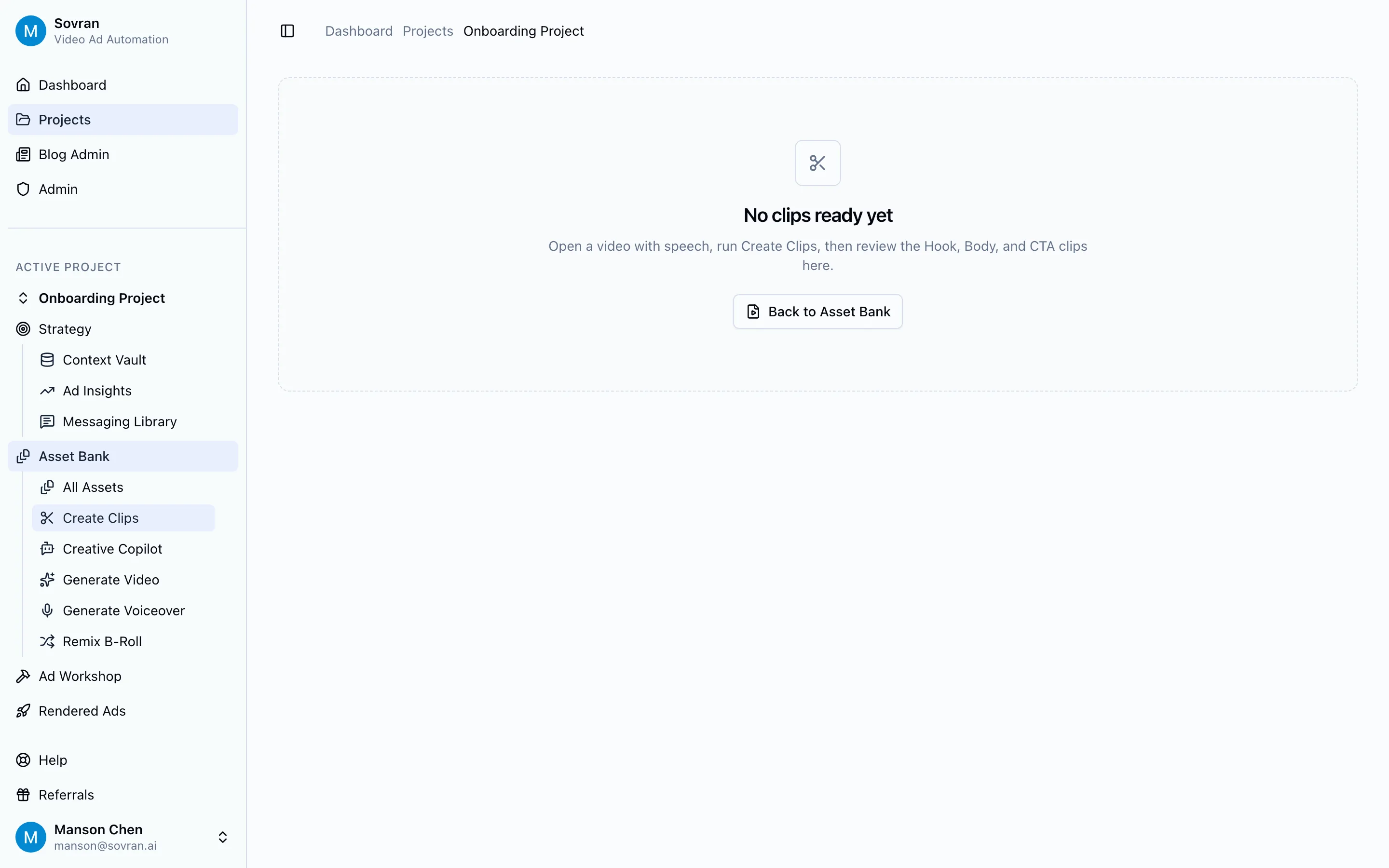
Ask each vendor to show this live. Upload a messy source video and watch how the platform handles transcript analysis, scene detection, timestamps, clip review, export, and reuse. The demo should prove the workflow on your kind of footage, not just on a polished sample file.
Criterion 3: Controlled Variant Generation
The goal of creative automation is not just more output. It is more controlled output. If you have 10 hooks, four bodies, and two CTAs, the platform should help you create meaningful combinations while preserving enough structure to learn from the results.
A good platform should support:
- Keeping one body constant while testing multiple hooks.
- Keeping a winning hook constant while testing different proof sections.
- Exporting variants with naming conventions that match ad account reporting.
- Changing aspect ratios and captions without rebuilding the core edit.
- Batch rendering only the combinations you actually want to launch.
Sovran's State of Video Ad Creation 2026 found that performance teams in its onboarding data produce a median of 20 video ads per month but want to produce 60. That 3x creative velocity gap is exactly what controlled variant generation should address.
Criterion 4: Brand Control And Review
Automation should not mean every campaign starts sounding generic. The platform needs guardrails around approved claims, product language, caption styles, aspect ratios, logos, fonts, offers, and export settings.
For each platform, check whether it can preserve:
- Approved brand voice and banned phrases.
- Product claims that legal or compliance teams have already approved.
- Caption templates and safe-zone rules for Meta, TikTok, Reels, and Shorts.
- Consistent end cards, offers, logos, and CTA language.
- Role-based review so not every teammate can publish unapproved variants.
If your team runs in regulated categories, or if brand trust matters, do not treat review as a nice-to-have. Ask for the exact approval workflow before buying.
Criterion 5: Launch And Export Fit
A platform can make polished videos and still fail the team if launch is painful. Performance marketers need the last mile to be boring: correct file names, correct dimensions, clean exports, and a predictable way to move assets into the channel where they will be tested.
Look for support around:
- Meta and TikTok-ready aspect ratios.
- Export to Drive, Dropbox, or an internal handoff location.
- Ad-account launch or upload workflows when available.
- Naming conventions that preserve hook, body, CTA, creator, product, and campaign variables.
- Version history so the team can trace what changed.
Launch fit is especially important for agencies, founders, and UA teams. A tool that saves three hours in editing but adds three hours in handoff does not really improve creative velocity.
Criterion 6: Learning Loop And Analytics Readiness
Creative automation should make performance analysis easier. Even if the platform is not your analytics system, it should produce assets that analytics systems can understand.
Before buying, ask:
- Can naming conventions identify each creative variable?
- Can the team distinguish hook tests from full-concept tests?
- Can winning clips be reused without losing their performance context?
- Can failed tests be archived without deleting the source asset?
- Can creative strategists quickly find all variants tied to one concept?
This is where creative automation connects back to growth strategy. The platform should help you build a memory of what works, not just a pile of exports.
How To Choose For Live Service Games And Mobile UA
Creative automation for live service games has a slightly different requirement: the content library changes constantly. New events, characters, maps, offers, gameplay clips, creator reactions, seasonal hooks, and social proof moments need to become ads quickly.
For game UA teams, prioritize a platform that can:
- Tag gameplay, UGC, trailers, feature clips, and end cards separately.
- Create fast variants for seasonal events, live ops beats, and localization.
- Protect the difference between real gameplay, cinematic footage, and creator commentary.
- Export vertical 9:16 first for TikTok, Reels, Shorts, and mobile-first Meta inventory.
- Reuse winning structures while swapping the specific gameplay or offer.
The same logic applies to ecommerce, apps, SaaS, and creator-led brands. If the product story changes often, choose the platform that makes swapping proof and hooks easy.
Video Creative Automation Platform Checklist
If the use case is video creative automation, use this checklist during vendor evaluation:
| Capability | Why It Matters | Demo Test |
|---|---|---|
| Asset bank | Keeps raw clips and reusable modules findable | Ask the vendor to find all approved product demos in under 30 seconds |
| Transcript and scene detection | Speeds up clipping and review | Upload a real creator video and split it into hooks, bodies, and CTAs |
| Bulk rendering | Turns modular ideas into shippable variants | Create 20 variants from approved modules during the demo |
| Caption and aspect ratio controls | Keeps ads native across paid social placements | Export the same concept for TikTok, Reels, Shorts, and Meta feed |
| Variable-aware naming | Makes performance reads possible after launch | Confirm each file name shows hook, body, CTA, creator, and campaign |
| Proof reuse | Lets teams scale from proven assets instead of starting over | Turn one customer proof clip into multiple audience angles |
Watch The Workflow Before You Buy
A creative automation platform should be easier to understand when you watch it move. Start with this Sovran walkthrough on systematizing creative production with hook, body, and CTA modules:
Two other useful workflow examples:
- This performance video ad tool helps founders out-produce a bloated marketing team.
- How to remix your video ads and get fresh variations in minutes with Sovran.ai.
Use the videos as a buying filter. If a platform cannot show your team the same path from source footage to structured variants, ask what part of the workflow still happens manually.
Proof Points To Look For
Creative automation tools love to promise speed. Ask for proof that the speed turns into more useful testing or better paid media outcomes.
Sovran allowed us to boost creative testing on our largest UA channel by 170% month-over-month. By exploring new combinations of hooks and body videos, we not only discovered new top-scaling ads but also identified themes that we might not have tested otherwise.
Dan Brosseau, Head of User Acquisition, Rewardify
We supercharged our creative output with Sovran. That velocity helped us cut CAC by 40% and scale spend efficiently.
Jonathan Lee, CEO, Fuelin
Working with Sovran has been a game-changer for our paid media strategy. They helped us streamline our creative testing process, significantly increasing the number of creatives we test. As a result, we were able to scale our monthly media spend while consistently hitting our KPIs.
Dominik Meyer, Head of Growth, Pickup Music
Perfect timing for us as we've just started a new creative process that tests variants like this super heavily and quickly. Will help us save a good amount of time and speed on our next iteration vs having to edit these all together and export 1 by 1.
Evan Laird, Head of Marketing, Hallow
When another vendor gives you proof, look for the same level of specificity: more tests, lower CAC, faster production, stronger launch cadence, or measurable spend scale while holding KPIs.
30-Minute Demo Script For Evaluating Platforms
The fastest way to compare creative automation platforms is to run the same demo script with each vendor. Bring one real source video, one product claim, one offer, and one past winning ad. Then ask the vendor to complete this sequence:
- Upload the source video and tag it into the asset bank.
- Identify at least three hooks, one body, and one CTA.
- Create at least six variants from those modules.
- Apply captions, aspect ratio, and naming rules.
- Show how review and approval would work.
- Export or launch the assets into your normal workflow.
- Show how your team would find the winning hook later.
If the vendor cannot do the workflow on your raw material, treat that as a bigger signal than a polished slide deck.
How Sovran Fits
Sovran is a video creative automation platform for performance teams that need more Meta, TikTok, Reels, Shorts, YouTube Shorts, and paid social ad variants from the footage they already have. It is strongest when your team needs to organize assets, split source videos into reusable modules, and create controlled variations without waiting on manual editing for every test.
Sovran is not trying to replace every creative tool. You may still use ChatGPT or Claude for strategy, Runway for AI-generated source footage, CapCut for native social polish, Motion for creative analytics, and your ad platforms for final performance reads. Sovran sits in the production layer where clips become structured ads.
That is the layer many performance teams are missing. They have ideas, footage, and analytics, but the production workflow between them is too slow.
Final Buying Recommendation
If you are choosing a creative automation platform in 2026, start with the asset and variant workflow. The strongest buying signal is not "can this tool generate something impressive?" It is "can this tool help our team ship more controlled, on-brand tests every week?"
Choose Sovran if your bottleneck is video ad production, modular clipping, and high-volume paid social variation. Choose an enterprise creative suite if global approvals and localization are the center of the problem. Choose a generative video tool if you need net-new footage. Choose an analytics platform if you already have enough launched ads and need better reads.
The right stack may include more than one tool. But the first platform you buy should solve the bottleneck closest to revenue.
Frequently asked questions

Manson Chen
Founder, Sovran
Related Articles

10 Actionable Ad Creative Ideas That Convert in 2026
Discover 10 actionable ad creative ideas for Meta & TikTok. Get hooks, scripts, and testing frameworks to boost your ROAS and combat creative fatigue.
How to Turn Link Into Video: Ads That Convert in 2026
Learn how to turn link into video for Meta & TikTok ads. Leverage AI to scale creation, boost ROI, and succeed in 2026.

8 High-Converting Static Ads Examples for 2026
Discover 8 high-performing static ads examples from top apps. Learn to create text-overlays, testimonials, and lifestyle ads that convert.