Promotional Videos for Companies A 2026 Growth Playbook
Learn how to use promotional videos for companies to drive growth. This guide covers production frameworks, AI tools, and platform-specific strategies for 2026.
Jump to a section
Let's be real—promotional videos aren't just a "nice-to-have" anymore. They are the core engine for growth, especially for performance-focused teams. Think of them as your most effective digital salesperson, working 24/7 on platforms like Meta and TikTok to grab attention, explain your value, and drive sales.
Why Promotional Videos Are Your 2026 Growth Engine
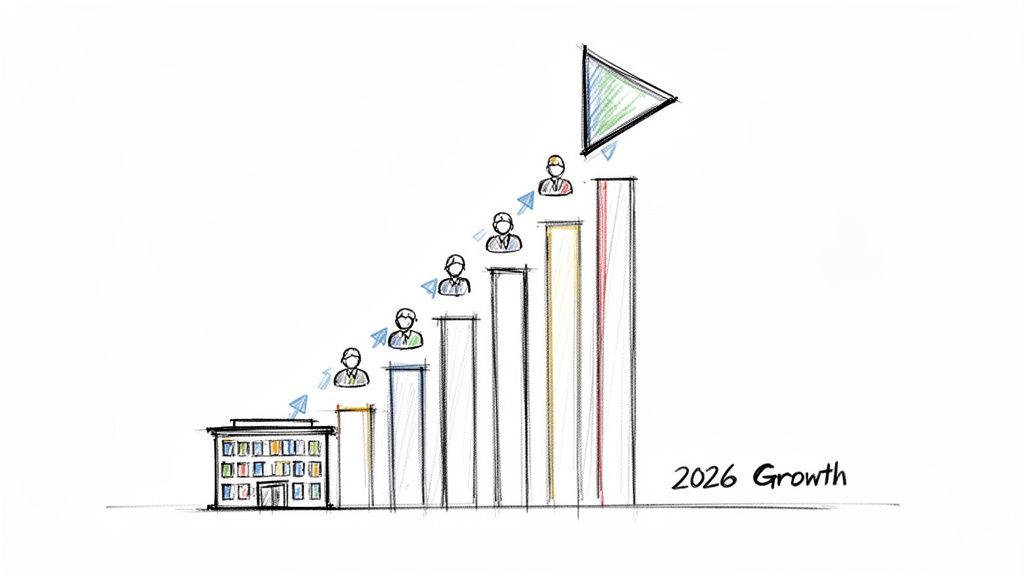
In a world where attention is the most valuable currency, video is how you win. This isn't just about making slick, flashy content; it's about building a direct and scalable pipeline for revenue and brand equity. Top-tier teams on Meta and TikTok have already made the switch, relying almost entirely on video because they know static images just don't cut through the noise anymore.
This isn't just a hunch—the data is overwhelming. The shift to video is backed by some pretty staggering numbers. For instance, 93% of businesses are now using video as a central part of their marketing.
Here’s a quick look at the kind of impact we're talking about.
How Promotional Videos Impact Key Business Metrics
Metric | Reported Impact |
|---|---|
Brand Awareness | 96% of marketers report a significant increase. |
Lead Generation | 86% have seen a direct rise in qualified leads. |
Website Traffic | 87% say video has directly boosted traffic. |
Sales | 81% of marketers directly attribute increased sales to video. |
What's even more impressive is that 99% of people say video helps them understand a product or service better. That’s a game-changer, especially if you’re selling something complex like a SaaS tool or a new mobile app.
The True Value for Modern Marketers
For performance marketers and User Acquisition (UA) managers, promotional videos solve one of the biggest headaches we all face: creative fatigue. Audiences on social feeds crave novelty, and a solid video strategy lets you test different hooks, messages, and calls-to-action at a pace that keeps your campaigns fresh and profitable.
A strong video strategy is the key to hitting your most critical KPIs. It's not just about making one viral hit; it's about building a system that consistently generates high-quality leads and drives sales.
By leaning into video, companies unlock real, measurable results. Fully grasping how to use video as a growth engine means understanding the fundamentals of Video Marketing Social Media Mastery. The benefits are clear and tie directly to the metrics you care about:
Boosted Revenue and Lead Generation: Video’s persuasive power turns viewers into customers, filling your sales pipeline.
Enhanced Brand Equity: A memorable video sticks with people, building trust and making your brand instantly recognizable.
Superior User Understanding: You can break down complex ideas in seconds, helping customers "get" your value proposition almost instantly.
Ultimately, investing in promotional videos for companies isn't just another line item on your budget—it’s a strategic play to lock in future growth. For a deeper dive into putting this into practice, check out our guide on video marketing best practices.
Anatomy of a High-Performing Promotional Video
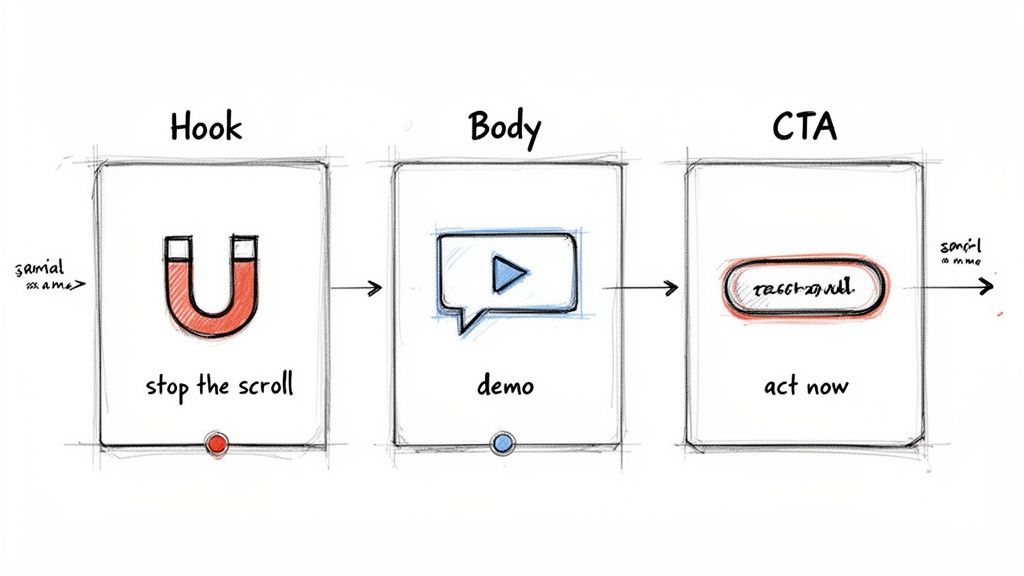
Making promotional videos for companies that actually drive results isn't about getting lucky. It comes down to having a solid, repeatable structure. While there's always room for creativity, the best-performing videos almost always follow a proven pattern designed to grab attention and push the viewer toward a specific action.
To get past the guesswork, we use a simple but incredibly effective mental model: the Hook-Body-CTA framework.
This isn't a rigid formula you have to follow to the letter. Think of it more like a flexible blueprint. It gives you the core components for a killer video, but you can swap out the pieces to create endless variations. By breaking your video into these three parts, you turn the art of creation into a science you can scale.
The Hook: Your First Three Seconds
In the world of infinite-scroll social feeds, you get about three seconds to stop someone from swiping past your ad. That's it. The hook is easily the most important part of your video—if it fails, the rest of your message doesn't even exist. Its only job is to stop the scroll and spark enough curiosity to make someone stick around.
A great hook often works by challenging a common belief, asking a sharp question, or just showing a visual that makes people go, "Whoa." You want to tap directly into your audience's problems, desires, or pain points right away.
Here are a few hook strategies that just plain work:
The Problem Hook: Get straight to the point. Start by calling out a pain point they're all too familiar with. For example, "Tired of spending hours editing video clips one by one?"
The "Wow" Factor Hook: Show off an impressive result or a stunning transformation. A dramatic before-and-after shot is perfect for this.
The Question Hook: Ask a question that makes the viewer pause and want to know the answer. "What if you could launch 100 video ads by tomorrow?"
When you front-load your video with a powerful hook, you massively increase the odds that your real message will actually land.
The Body: Delivering Your Core Message
Okay, you've got their attention. The body of the video is where you deliver the goods. This is your chance to explain your value, build some trust, and show your product or service in action. The format can be anything from a product demo to a customer story, but the goal is always the same: convince the viewer you have the solution they need.
The most effective promotional videos feel less like an advertisement and more like valuable content. They educate, entertain, and solve a problem, which builds a much stronger connection with the audience than a hard sell.
For example, a fast-paced product demo can quickly show how your app crushes a specific problem. That's great for showing tangible benefits clearly. Or, you could use User-Generated Content (UGC) like customer testimonials to add a layer of real-world authenticity that a polished corporate video just can't match. It’s no surprise that research shows 82% of consumers say a video has influenced their buying decision—and authentic stories are a massive part of that.
The CTA: Guiding the Next Step
Finally, we have the Call-to-Action (CTA). This is where the magic happens. A great video can get people excited, but without a clear CTA, all that interest just evaporates. The CTA tells your viewer exactly what to do next. It needs to be simple, direct, and give them a clear reason to act now.
Forget about weak, vague CTAs like "Learn More." They rarely perform well. Instead, be specific and tie the action to a real benefit.
Examples of Strong CTAs:
"Download the app and get your first project free."
"Start your 7-day free trial now."
"Shop the collection before it's gone."
The CTA is the finish line for your video. It turns someone just watching into an active lead or customer, making it the one piece that directly connects your creative work to business results. Mastering this three-part structure—Hook, Body, and CTA—gives you a reliable system for churning out high-performing promotional videos at scale.
Creative Frameworks That Win on Meta and TikTok
Okay, so you have the basic Hook-Body-CTA blueprint down. But what do you actually build with it? On super-fast platforms like Meta and TikTok, the best promotional videos for companies don’t just pop out of random brainstorming sessions. They’re built on proven creative frameworks that hook into viewer psychology and feel totally native to the feed.
Think of these frameworks less like rigid rules and more like pre-tested recipes for engagement. Instead of staring at a blank page wondering, "What should we make today?" you get to ask a much better question: "Which framework is going to crush our goal this week?" It’s how you turn video creation from a total guessing game into a repeatable system that drives real performance.
These frameworks aren't just random either. They’re rooted in classic storytelling and persuasion, just adapted for the goldfish-level attention spans we're all dealing with on social media. They give you a reliable starting point to build stories that actually stop the scroll, show people what you're about, and get them to take action.
The Problem-Agitate-Solution Framework
The Problem-Agitate-Solution (or PAS) framework is one of the most reliable workhorses in any marketer's toolkit. It’s so effective because it taps directly into the viewer’s own experience, making them feel completely seen and understood before you even whisper your product's name. It's like a three-act play that unfolds in less than 30 seconds.
Here's how it works:
Problem: You lead by calling out a specific, super-relatable pain point. Your hook needs to make the viewer immediately think, "Oh god, that's me." For a project management app, you might open with, "Is your team drowning in a nightmare of email chains?"
Agitate: This is where you twist the knife a little. Don’t just state the problem—amplify the frustration and the emotional drain that comes with it. For that same app, you’d follow up with something like, "Deadlines are slipping, tasks are falling through the cracks, and no one has a clue who's doing what."
Solution: Finally, you bring in your product as the hero. You position it as the simple, obvious way to fix all that pain you just agitated. The video would then cut to the app’s clean interface with a voiceover: "Bring your team's entire conversation into one place and never miss a deadline again."
PAS just plain works. It builds up that emotional tension and then gives a satisfying release, positioning your brand as the answer they were looking for.
The Before and After Transformation
Nothing grabs attention quite like a dramatic visual transformation. The Before and After framework does exactly that, showing a clear, powerful change that makes your product's value instantly obvious. It’s all show, no tell.
This framework is a perfect fit for a massive range of products:
Fitness Apps: Show a user's journey from day one to hitting a new personal best.
Beauty Products: The classic "before" shot with skin issues, followed by a glowing, confident "after."
Cleaning Products: A grimy, disgusting surface made sparkling clean in a split second.
Productivity Software: A messy, chaotic spreadsheet transformed into a clean, automated dashboard.
The trick is making the "before" state painfully relatable and the "after" state incredibly desirable. A quick cut or a satisfying wipe transition between the two can make the whole thing feel even more powerful. This framework gives viewers a quick, visual payoff they can understand without a single word of explanation.
UGC and Testimonial Mashups
On social media, authenticity is your most valuable currency. User-Generated Content (UGC) and customer testimonials are your secret weapons for building trust because they offer social proof from real, actual people. A UGC Mashup is simply a collection of short clips from different customers all talking about your product.
Viewers are 2.4 times more likely to view user-generated content as authentic compared to content created by brands. When a customer says your product is amazing, it carries so much more weight than when you say it yourself.
This framework is also incredibly flexible. You can build mashups around a single theme, like "My Favorite Feature" or "How This App Literally Saved Me Hours." The raw, unpolished vibe of phone-shot videos makes the content feel way more genuine and less like a slick, corporate ad.
When you string together multiple positive experiences, you create a powerful chorus of approval that can win over even the most skeptical viewers. If you're just getting started with scripting, checking out some solid ad script examples is a great way to see how these frameworks come to life. Getting these down gives your team a powerful toolkit for cranking out effective promo videos again and again.
The Modern Production Workflow for Video Ads
Let's be honest: traditional video production is dead. The old way—a long, painful process to create one "perfect" video—is a disaster for modern marketing. It just can't keep up with the demands of platforms like Meta and TikTok, where creative fatigue is real and you need to be testing new ideas constantly.
High-performing teams have ditched that rigid, linear model. Instead, they've adopted an agile, modular workflow designed for one thing: speed. This isn't about starting from scratch every time. It's about building a system that lets you churn out winning promotional videos for companies faster than your competitors can even book a studio.
Step 1: Source and Organize Your Creative Assets
The heart of this entire system is a well-stocked asset library. Think of it like a chef's pantry, filled with all the ingredients you need to whip up any dish on demand. Your job is to gather a diverse mix of visuals and audio that can be remixed into endless combinations.
Here’s what you should be collecting:
Raw Footage: Pull in everything you have. Existing product shots, B-roll from old campaigns, and yes, even high-quality clips you shot on a smartphone.
User-Generated Content (UGC): This is gold. Collect customer testimonials, unboxing videos, and any organic social posts where people are using your product.
AI-Generated B-roll: Have a specific shot in mind but no footage? Use AI tools to generate custom clips that perfectly match your script. It's a game-changer for filling visual gaps.
Audio and Music: Create a library of on-brand music tracks, sound effects, and pre-recorded voiceovers.
Once you have these assets, you need to tag and organize them in a central place. An AI-powered system is best, letting you find the perfect clip just by searching for "woman smiling while using our app" or "fast-paced product demo." No more digging through messy folders.
Step 2: Assemble Modular Video Concepts
With your asset pantry fully stocked, it's time to start cooking. We do this using the classic Hook-Body-CTA structure. The best way to think about this is like building with LEGO bricks. You can snap different hooks, bodies, and CTAs together to create dozens of ad variations from a single core idea.
To really nail this, you need to know what's working on platforms like Meta right now. That means getting familiar with different creative frameworks and exploring various brilliant video ad example styles. A timeless one you can build with your modular assets is the Problem-Agitate-Solution (PAS) framework.
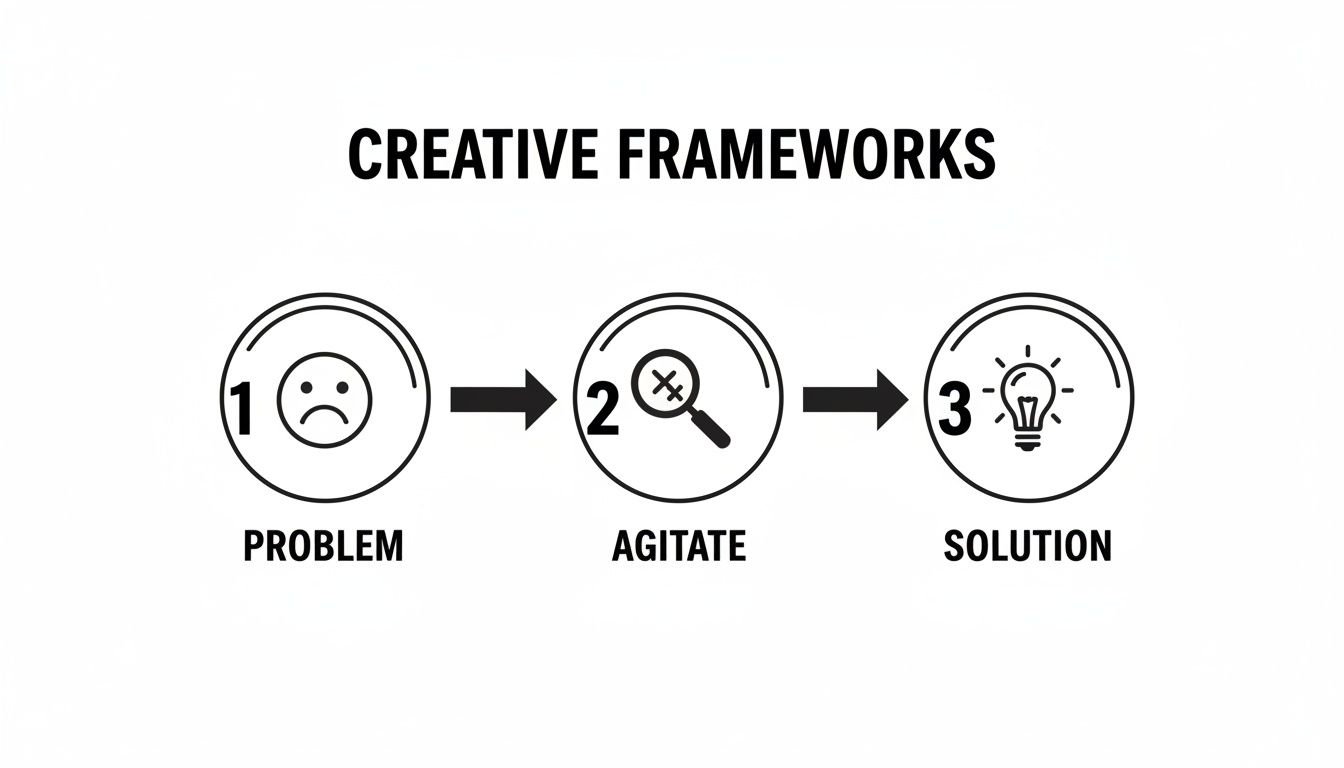
The PAS framework is so effective because it taps directly into viewer psychology. You identify a pain point they can relate to, poke at it to make the frustration real, and then swoop in with your product as the hero.
Using your asset library, assembling this is a breeze:
Problem (Hook): Start with a UGC clip of a customer looking frustrated.
Agitate (Body): Splice in some fast-cut shots showing the negative consequences of that problem.
Solution (CTA): Finish strong with a clean product shot and a direct call-to-action.
This modularity is key. You can test which combinations get the best results without having to re-shoot or re-edit entire videos from the ground up.
Step 3: Iterate and Scale with Automation
This is where the magic really happens. Instead of manually editing every single variation in a tool like CapCut, you use automation to batch-produce hundreds of versions at once. This is how you unlock high-volume testing and find winning ads at scale.
The goal isn't to create one perfect ad. It's to create a system that can rapidly produce hundreds of ad candidates, letting the data tell you which one is a winner. This is how top-performing companies find breakout ads faster than the competition.
With an automated platform, you can take a single video concept and instantly spit out variations with different text overlays, music, hooks, or CTAs. Imagine testing five different hooks against three different body sections and two CTAs. That’s 30 unique video ads ready to launch in minutes, not days.
This agile, automated workflow gets you out of the weeds of scattered files and tedious manual editing. It frees up your team to stop wasting time on repetitive tasks and start focusing on what actually moves the needle: creative strategy and performance analysis.
How AI and Automation Scale Creative Production
That agile workflow we just covered is a game-changer, but trying to run it manually is a recipe for burnout. It’s a massive time sink. This is where AI and automation come in—not as some far-off concept, but as the engine powering today’s most successful marketing teams.
Think of AI less as a replacement for human creativity and more as a force multiplier. It takes over the tedious, repetitive work that grinds your creative team down. This frees up your best minds to do what they do best: focus on strategy and find that next killer concept for promotional videos for companies.
From Manual Chaos to Automated Systems
Most creative asset libraries are a mess. It’s like having a giant box of LEGOs with no organization—you know the perfect piece is in there somewhere, but good luck finding it. Creatives spend hours digging through folders named things like "Final_Ad_V3_USE_THIS_ONE.mp4."
AI-powered platforms change that. They act like a smart assistant that automatically analyzes and tags every asset you upload—every product shot, every UGC clip, all your b-roll.
Suddenly, you have a whole new set of tools at your disposal:
Natural Language Search: Forget remembering cryptic filenames. You can just type what you need, like "woman smiling while using our app" or "fast-paced product demo," and the AI pulls up the right clips instantly.
Intelligent Asset Grouping: The system automatically groups similar assets. Need to find all your best hooks or all your five-star testimonial clips? They’re all in one place.
On-Brand Content Generation: When you feed the AI your brand kit and past performance data, it can even start suggesting which assets are most likely to work for your next campaign.
This turns your scattered assets into an arsenal, ready for battle at a moment's notice.
Combating Creative Fatigue with Scalable Iteration
Creative fatigue is the silent killer of ad campaigns. An ad that was crushing it last week can suddenly tank as your audience gets tired of seeing it. The only defense is a constant supply of fresh creative.
But trying to manually churn out dozens of variations in tools like CapCut just isn't sustainable. It burns out your team and slows your testing cycles to a crawl. This is where automation becomes a non-negotiable part of a modern marketer's toolkit.
The real challenge isn't just making one great video. It's building a system that can produce and test hundreds of variations to find winning ads 10x faster. AI and automation make that system possible.
Platforms like Sovran let you take a single video idea and instantly spin up hundreds of versions. You can programmatically swap out different hooks, body clips, CTAs, text, and music to create a huge batch of test-ready ads in minutes, not weeks. This is the core of what an AI creative automation platform does—it turns iteration from a bottleneck into a superpower.
The numbers don't lie. Promotional videos get results, with 93% of marketers confirming they get a solid return on their investment. With consumers watching an average of 17 hours of online video every week, brands that can quickly test and deploy fresh content are the ones seeing explosive growth. In fact, videos on social media can drive 1,200% more shares than other content. You can dive deeper into these numbers with these 2025 video marketing statistics.
The Future of Creative Is Data-Driven and Automated
AI and automation don't just make production faster—they make it smarter. By plugging directly into ad platforms like Meta, these systems can analyze performance data and feed it right back into the creative process.
This creates a powerful feedback loop:
Bulk Creation: The AI platform renders hundreds of video variations based on your winning frameworks.
Automated Launch: Ads are pushed directly to Meta, using a standardized naming system for clean A/B testing.
Performance Analysis: The system tracks key metrics like CTR, ROAS, and cost per install for every single creative.
Informed Iteration: Insights from winning (and losing) ads tell the AI what’s working. It learns which hooks, visuals, and messages are resonating with your audience, so the next batch is even better.
This data-driven approach takes the guesswork out of creative decisions. You're no longer operating on a marketer's hunch about "what looks good." Instead, you're letting real-world performance data steer your strategy, making sure your ad spend is always backing the creative that’s most likely to deliver.
Clearing Up Your Top Questions About Promotional Videos
Alright, so you’re ready to scale up your video creative. But as soon as you try to move faster and produce more, a bunch of practical questions pop up. We see it all the time with marketers and founders.
How do you actually do this without a Hollywood budget or a huge team? Let's tackle the most common hurdles standing between you and a winning video ad strategy with some straight-to-the-point advice.
How Long Should a Promotional Video Be?
For ads on fast-scrolling platforms like Meta and TikTok, short is almost always better. The sweet spot for top-of-funnel promotional videos is between 15 and 30 seconds.
Your main job is to survive the first three seconds. You need a hook that stops the scroll dead in its tracks. If that hook doesn't land, the rest of your amazing video might as well be invisible. Get your core message and a clear call-to-action in before you lose them.
Sure, longer videos can work for retargeting warmer audiences who already know you. But for finding new customers, short, punchy, mobile-first videos win nearly every time. Success isn’t about being seen—it's about getting your message watched all the way through.
How Do I Create Videos Without a Huge Budget?
This is where things get really interesting. The old idea that you need a pricey agency or a big in-house production team is completely outdated. Today, AI-powered creative platforms are the great equalizer.
These tools let you automate the most expensive and time-sucking parts of video production. You can take assets you already have—seriously, even clips shot on your phone—and let AI quickly spin up hundreds of ad variations using proven frameworks like Problem-Agitate-Solution or UGC mashups.
This means lean teams and solo founders can go head-to-head with the big guys on creative. It completely levels the playing field.
The truth is, a smartphone and some decent natural light are often all you need for professional-looking video. On social media, people care way more about an authentic message that provides value than they do about slick production quality.
What Is More Important: UGC or Polished Shots?
This isn't an "either/or" battle. It's about using the right tool for the right job. Both User-Generated Content (UGC) and polished product shots have crucial, but different, roles to play in your video strategy. The magic happens when you blend them together.
User-Generated Content (UGC): Nothing beats UGC for building authenticity and social proof. It's perfect for hooks and testimonials, especially on a platform like TikTok where raw, relatable content is king. When a real person raves about your product, it just hits different than a brand talking about itself.
Polished Product Shots: These are your go-to for showing your solution clearly and beautifully. You need clean, high-quality shots to help people understand exactly how your product works and what it does for them.
The best-performing promotional videos for companies usually combine both. Picture this: an ad opens with a super-relatable UGC clip that grabs attention, then it cuts to a clean product demo showing how it works, and finally closes with another quick testimonial to drive the point home. A modular creative workflow lets you test these combos at scale and find out what your audience actually responds to.
Ready to stop guessing and start scaling your ad creative? With Sovran, you can automate the entire video production workflow, from asset organization to bulk rendering and campaign launch. Combat creative fatigue and find your next winning ad 10x faster. Start your 7-day free trial of Sovran today.

Manson Chen
Founder, Sovran
Related Articles
How to Turn Link Into Video: Ads That Convert in 2026
Learn how to turn link into video for Meta & TikTok ads. Leverage AI to scale creation, boost ROI, and succeed in 2026.
Your Ultimate Guide to UGC Style Video Ads
Master UGC style video ads for Meta and TikTok. This guide reveals proven frameworks, scripts, and scaling tactics to boost your ROAS in 2026.
10 Actionable Ad Creative Ideas That Convert in 2026
Discover 10 actionable ad creative ideas for Meta & TikTok. Get hooks, scripts, and testing frameworks to boost your ROAS and combat creative fatigue.