10 Video Marketing Best Practices for High-Performing Ads in 2026
Discover 10 actionable video marketing best practices to scale high-performing ads on Meta & TikTok. Learn about hooks, modular architecture, and rapid testing.
Jump to a section
- 1. Hook-First Creative Framework
- 2. Modular Video Asset Architecture
- 3. Platform-Native Creative Optimization
- 4. Rapid A/B Testing and Creative Iteration Cycles
- 5. User-Generated Content (UGC) Integration and Testimonial Mashups
- 6. Strategic Brand Guidelines and Context Vault Systems
- 7. Batch Asset Management with Natural Language Search
- 8. Conversion-Optimized CTA Design and Placement
- 9. Bulk Rendering and AI-Powered B-Roll: Variant Generation and Asset Creation at Scale
- 10. Data-Driven Creative Strategy and Performance Feedback Loops
- 10-Point Video Marketing Best Practices Comparison
- From Best Practices to Best Performance: Your Next Move
In 2026, the gap between video ads that get views and those that drive revenue has never been wider. While platforms like Meta and TikTok reward engaging content with high reach, performance teams know that likes and shares don't pay the bills. Conversions do. The challenge for today's user acquisition managers and growth marketers is no longer just making video; it's scaling a data-driven creative engine that consistently produces winning ads, combats creative fatigue, and finds profitable angles faster than the competition. The old model of creating a few polished videos and hoping for the best is broken.
This listicle breaks down the 10 essential video marketing best practices that top-tier performance teams are using right now to achieve predictable, scalable results. We're moving beyond generic advice like "tell a good story" and diving deep into the specific frameworks, workflows, and platform-native tactics you need to turn your video ad spend into a reliable growth channel. This isn't about chasing viral trends; it's about building a systematic approach to creative performance.
You'll get actionable insights into operational systems that power high-performing campaigns, including:
The Hook-First Creative Framework for stopping the scroll in the first three seconds.
Modular Video Asset Architecture that allows for rapid, cost-effective creative iteration.
Platform-Native Optimization for TikTok and Meta to maximize algorithm favorability.
Rapid A/B Testing Cycles to quickly validate concepts and scale winners.
Get ready to learn the operational playbook for building video ads that don't just get seen, but actually convert. These are the strategies that bridge the gap between creative production and measurable business outcomes.
1. Hook-First Creative Framework
In today's fast-scrolling social feeds, the first three seconds of your video ad are not just important; they are everything. The Hook-First Creative Framework is a foundational video marketing best practice that prioritizes an immediate, attention-grabbing opening. This approach recognizes that viewers make a split-second decision to watch or scroll, making the initial frames the most critical real estate for performance advertisers. The core principle is to lead with your most compelling visual or narrative element before introducing the main body of content or your brand.
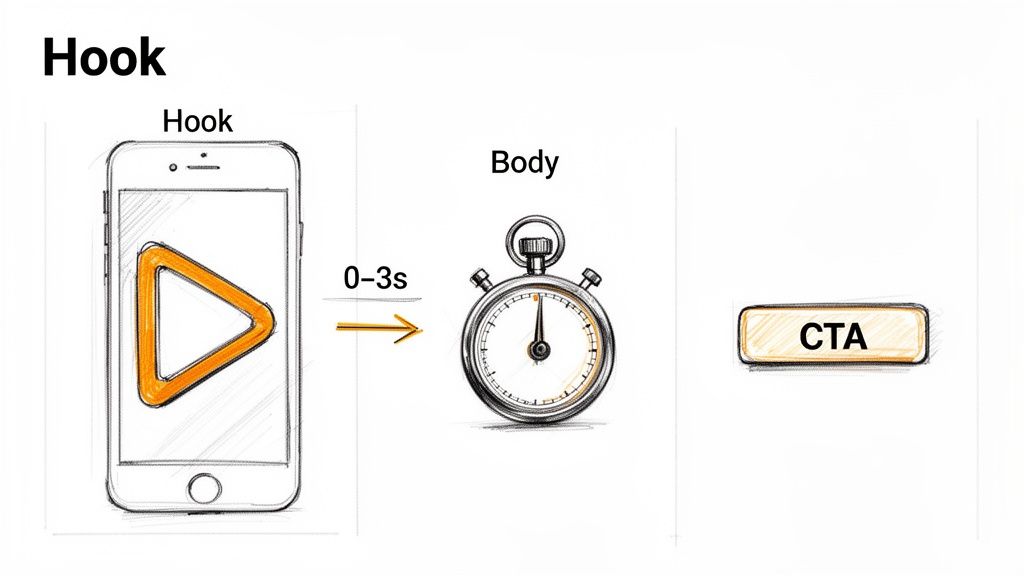
This framework systematically front-loads value to stop the scroll. Think of Dollar Shave Club’s iconic opening shot: a razor slicing across the screen. It’s an immediate product-focused hook. Similarly, Warby Parker often uses a "before-and-after" transition in the first few seconds to instantly demonstrate the value of their eyewear. The goal is to create a pattern interrupt that breaks through the noise of a user's feed.
How to Implement a Hook-First Strategy
To effectively deploy this framework, treat the hook as a separate, testable variable from the rest of your video. This modular approach allows for rapid, high-volume testing to discover what truly resonates with your audience on platforms like Meta and TikTok.
Test Aggressively: Start by brainstorming and producing 5-10 distinct hook variations for a single ad concept. Your initial hooks should test bold, often contrasting, ideas. Pit a surprising statement against a controversial question, or a fast-paced User-Generated Content (UGC) clip against a polished, cinematic shot.
Isolate Your Variable: Keep the body and call-to-action (CTA) identical across all hook variations. This ensures you are isolating the hook's performance and can confidently attribute differences in metrics like thumb-stop rate and click-through rate (CTR) to the opening seconds.
Analyze and Iterate: Monitor early performance data, specifically the 3-second view rate and hook rate (views at 3 seconds / impressions). Identify which thematic categories of hooks perform best (e.g., problem-agitation, surprising statistics, direct-to-camera address) and double down on creating new iterations within those winning categories.
2. Modular Video Asset Architecture
Where the hook-first framework focuses on the initial seconds, Modular Video Asset Architecture applies a component-based philosophy to the entire video creation process. This advanced practice involves deconstructing videos into reusable, tagged components rather than producing monolithic, one-off files. This system transforms your creative library into a searchable database of building blocks like hooks, body segments, testimonials, transitions, and calls-to-action that can be rapidly recombined into thousands of ad variations. It’s a foundational strategy for scaling creative output exponentially without a linear increase in production resources.
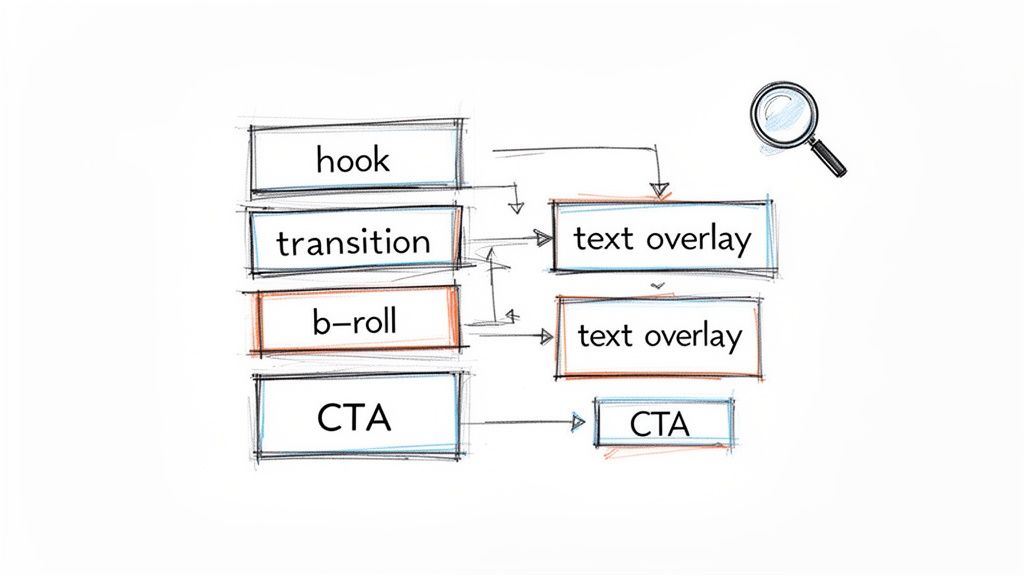
This approach shifts the mindset from "making a video" to "building a video from proven parts." For instance, a high-performing user testimonial can be paired with ten different hooks and five different CTAs, instantly generating 50 unique ad variants for testing. Platforms like Canva and Snap have integrated this modularity into their ad builders, allowing marketers to quickly swap elements and batch-create content. This system is crucial for maintaining a high testing velocity on platforms like Meta and TikTok, where creative fatigue sets in quickly.
How to Implement a Modular Architecture
Adopting a modular system requires a strategic shift in how you organize and tag creative assets. It turns your video production into a systematic, data-driven assembly line rather than a purely artistic endeavor.
Deconstruct Your Winners: Start by analyzing your top 10-20% performing videos. Break them down into their core components: the hook, the problem-solution segment, the primary B-roll, the text overlays, and the CTA. These become your initial library of "proven" assets.
Establish a Clear Taxonomy: Create a consistent naming and tagging convention for every asset. Use metadata to tag components by type (e.g., Hook, Testimonial, CTA), format (e.g., UGC, Animation), emotional tone (e.g., Urgent, Humorous), and associated performance data (e.g., CTR, Hook Rate).
Systematize Recombination: Instead of brainstorming entirely new ads, start by combining your best assets in new ways. Test your best hook with your second-best body segment. This methodical approach allows you to isolate which combinations drive performance, turning creative strategy into a more predictable science.
Document Winning Formulas: As you test, keep a record of which component combinations generate winning ads. This documentation creates a playbook for future creative development, helping you understand the underlying patterns of what resonates with your audience.
3. Platform-Native Creative Optimization
The most effective video marketing best practices recognize that each social platform is its own unique ecosystem with distinct user behaviors, algorithmic priorities, and creative expectations. Platform-Native Creative Optimization is the principle of creating and adapting video ads to feel like they belong on the platform where they appear. This means abandoning a one-size-fits-all approach and instead tailoring aspect ratios, pacing, caption styles, and narrative formats to match what users on that specific platform expect to see in their feeds.
This strategy is crucial because content that feels out of place is immediately identifiable as an ad and is quickly scrolled past. For example, a polished, horizontal YouTube ad will perform poorly as a TikTok post, where fast-paced, vertical, user-generated-style content thrives. Brands like Grammarly master this by running rapid-cut, trend-driven ads on TikTok while using a more cinematic, narrative-driven approach for their YouTube pre-roll campaigns. This native feel significantly boosts engagement and lowers audience resistance.
How to Implement Platform-Native Optimization
Treating each platform as a separate creative brief is the key to executing this strategy. Instead of simply repurposing assets, start by analyzing the organic and paid content that is already performing well on your target channel.
Adapt Technical Specifications: Ensure your video specs align perfectly with each platform's requirements. Prioritize the 9:16 vertical aspect ratio for TikTok and Reels, while testing 4:5 and 1:1 ratios for Meta feeds. Ensuring your video content adheres to platform-specific guidelines is crucial for native optimization; for example, consult a dedicated Creator's Guide to YouTube Dimensions Video Sizes to get it right for that platform.
Match Pacing and Style: Study the native pacing of each app. TikTok and Reels favor quick cuts, immediate action, and trending audio. In contrast, Meta feeds can accommodate a slightly slower, more lifestyle-focused narrative. Adapt your editing style to mirror these native patterns.
Leverage Platform Features: Incorporate platform-specific elements to enhance the native feel. Use TikTok’s text-to-speech voice, interactive stickers on Instagram Stories, or the "Duet" feature. These small additions signal to both the user and the algorithm that the content was made specifically for that environment.
4. Rapid A/B Testing and Creative Iteration Cycles
In performance marketing, the difference between a good and a great campaign often comes down to the speed and rigor of its creative testing. Rapid A/B Testing and Creative Iteration is a systematic process for continuously improving video ad performance. This methodology moves beyond simple one-off tests, establishing a perpetual cycle of hypothesizing, testing, analyzing, and iterating to discover what resonates most deeply with your audience. The core principle is that creative is not a static asset but a dynamic variable that can be optimized through data-driven experimentation.
This approach treats video advertising as a science. Instead of relying on gut feelings, teams create multiple ad variations, isolate specific variables like the hook or call-to-action, and deploy them to gather performance data quickly. For example, a brand like Robinhood might test over 200 ad variants to evolve their creative, while Honey’s performance team is known for testing 50+ new creatives weekly. This high-volume, high-velocity approach accelerates learning, allowing teams to identify winning patterns and reallocate budget toward proven concepts with statistical confidence.
How to Implement a Rapid Iteration Cycle
Building a robust testing framework requires discipline and a structured workflow. The goal is to create a feedback loop where performance data from live campaigns directly informs the next wave of creative production, turning your ad account into a learning machine.
Isolate and Test One Variable: To achieve clean results, test one element at a time. Create variations of just the hook while keeping the body and CTA identical. Once you find a winning hook, use it as the control while you test variations of the body copy, visual style, or CTA. This isolates the impact of each change.
Establish a Testing Budget and Cadence: Dedicate a specific portion of your budget, often 10-20%, exclusively to testing new concepts. Establish a weekly or bi-weekly review cadence to analyze performance, pause underperforming ads, and scale the winners. This ensures testing is a continuous, integrated part of your marketing operations.
Document and Systematize Learnings: Create a centralized, searchable repository (like a Notion or Airtable base) to document the results of every test. Tag each creative with its attributes (e.g., UGC hook, problem-agitation angle, direct CTA) and log its key metrics. This turns isolated findings into a strategic playbook that informs all future creative development and is one of the most crucial video marketing best practices for long-term growth.
5. User-Generated Content (UGC) Integration and Testimonial Mashups
In an advertising landscape saturated with polished, high-production brand messages, authenticity often performs best. User-Generated Content (UGC) Integration is a powerful video marketing best practice that leverages genuine customer content to build immediate trust and social proof. This strategy involves compiling customer reviews, unboxing videos, and organic testimonials into compelling "mashup" narratives that feel more like a trusted recommendation than a traditional ad, driving higher engagement and conversion rates.
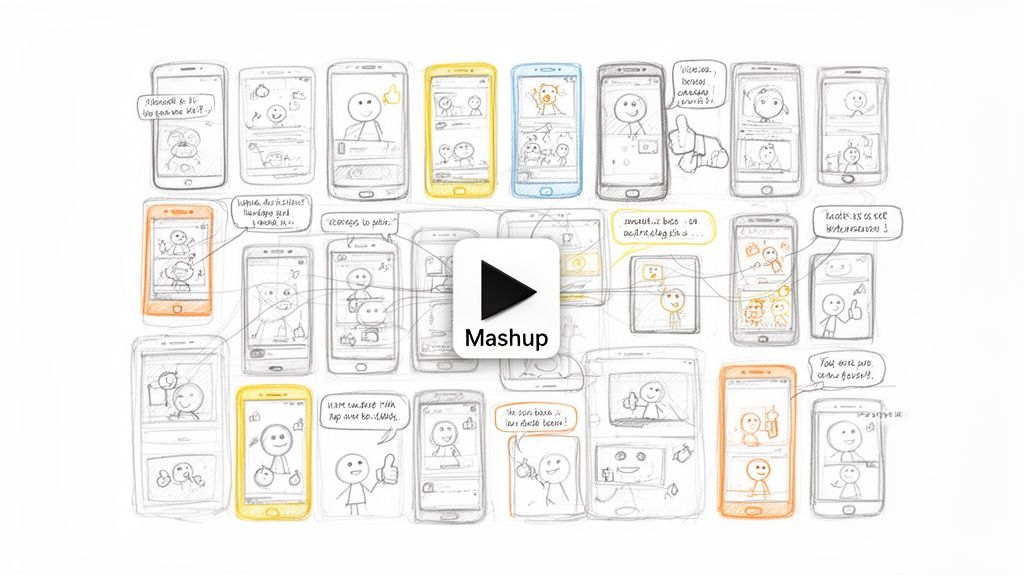
This approach trades studio perfection for raw relatability. Brands like Glossier built their empires on the back of customer-shot photos and videos, creating a community-centric feel. Similarly, many direct-to-consumer skincare brands achieve massive success by mashing up simple, phone-shot "before-and-after" testimonials. The goal is to let your happiest customers become your most effective salespeople, using their authentic voices to validate your product's value proposition in a way that professionally scripted content cannot.
How to Implement a UGC and Testimonial Strategy
Building a scalable system for sourcing and utilizing UGC is key to making this a repeatable part of your creative process. Rather than waiting for content to appear, proactively build a pipeline for authentic customer stories.
Build a Sourcing Engine: Create a permission-first process to collect customer videos. Offer a small incentive like a discount or store credit in post-purchase email flows, or build a private community where engaged users can submit short clips. Define clear, simple instructions for the type of content you need (e.g., "a 30-second video sharing your favorite feature").
Curate for Authenticity: When filtering submissions, prioritize emotional conviction and genuine enthusiasm over perfect lighting or audio quality. A raw, passionate testimonial from a real customer will almost always outperform a polished but sterile one. A well-crafted user-generated content strategy focuses on capturing these authentic moments.
Create Thematic Mashups: Don't just show one testimonial. Combine 3-5 short, impactful clips into a single video that tells a cohesive story. You can organize mashups around a specific pain point, a key product benefit, or a particular customer demographic to create highly targeted ad creatives.
Tag, Test, and Refresh: Organize your library of approved testimonials by tagging them with the customer profile, product mentioned, and pain point addressed. This allows you to quickly assemble new variations. A/B test your UGC mashups against polished brand creative to validate their performance and continuously refresh your library with new customer voices to avoid ad fatigue.
6. Strategic Brand Guidelines and Context Vault Systems
Scaling video creative production from a handful of ads to hundreds of variants introduces a significant risk: brand dilution. A Strategic Brand Guideline and Context Vault System is a crucial video marketing best practice for maintaining visual, tonal, and messaging consistency at scale. This approach moves beyond a simple logo usage guide and creates a centralized, living repository of brand DNA, proven messaging, and customer insights to ensure every video remains both on-brand and conversion-focused.
This system acts as a single source of truth for creative teams, freelancers, and AI tools, preventing the brand's core identity from fracturing as creative volume increases. For example, Mailchimp's extensive voice and tone documentation ensures their quirky-yet-professional personality is consistent everywhere. Similarly, HubSpot maintains a vast database of customer case studies and objection-handling scripts, providing a "vault" of proven, on-brand content for their marketing teams to pull from.
How to Implement a Context Vault System
Building this system is an ongoing process of documentation and refinement. The goal is to create a resource that empowers rapid creative production without constant hands-on brand oversight.
Document Core Identity: Start with a one-page reference sheet that distills your brand's mission, core values, and primary value proposition. This high-level guide ensures every creator understands the strategic "why" behind the brand before diving into tactical execution.
Build a Performance Library: Maintain a "Context Vault" in a tool like Notion or a shared drive. This vault should contain your top 20-50 performing video scripts and ad copy, tagged with performance data (CTR, CVR), the audience they resonated with, and the core message or angle. This creates a data-backed foundation for future creative ideation.
Create an Objection Database: Systematically log common customer objections and hesitations gathered from sales calls, support tickets, and ad comments. For each objection, document proven counter-arguments, social proof, and data points that effectively address the concern. This turns potential friction points into powerful messaging opportunities for your video ads.
Establish a Consistency Checklist: Develop a simple checklist for evaluating new creative against brand standards. Include items like logo placement, color palette adherence, tone of voice check (e.g., "Is the tone confident but not arrogant?"), and core message alignment. This streamlines the approval workflow and empowers junior team members to self-correct.
7. Batch Asset Management with Natural Language Search
As creative teams scale video production, asset chaos becomes a major bottleneck. Batch Asset Management with Natural Language Search is a video marketing best practice that transforms a disorganized folder of clips into a dynamic, searchable library. This system allows creators and editors to find specific footage not by filename, but by describing the content, emotion, or concept they need, drastically accelerating the creative assembly process. Instead of manually scrubbing through hours of footage, a user can simply search for "woman laughing while using phone on a couch" and get relevant results instantly.
This approach moves beyond simple file naming conventions to a more intelligent, metadata-driven workflow. Platforms like Frame.io and Adobe's Creative Cloud ecosystem have popularized this by integrating powerful tagging and search functionalities directly into the creative workflow. The core principle is that every asset, from raw UGC footage to polished b-roll, is a data point. When properly tagged and organized, this data becomes a powerful tool for building higher-performing ads faster.
How to Implement Intelligent Asset Management
Building a searchable asset library requires a disciplined approach to organization and tagging from the outset. This upfront investment pays dividends in production speed and creative flexibility, especially for teams managing high volumes of content.
Establish a Rich Tagging Taxonomy: Go beyond basic keywords. Tag every asset with descriptive metadata including scene type (e.g., unboxing, testimonial), emotion (e.g., surprised, happy), product shown, shot duration, and even associated performance data from past campaigns.
Use Hierarchical Organization: Create a logical folder structure that starts broad and gets specific. For example: [Product Line] > [Campaign Type] > [Asset Type] such as
Skincare > Testimonial > Raw UGC Clips. This complements your tagging system.Leverage AI and Batch Tagging: Use tools that offer AI-powered tagging to automatically identify objects, actions, and even sentiment. Apply tags in bulk to similar assets (e.g., all clips from the same shoot) to save time and ensure consistency.
Curate a "Winners" Library: Maintain a separate, easily accessible library for your top 20% of performing assets. When a specific clip, hook, or b-roll segment consistently drives results, isolate it for quick reuse in future creative iterations.
Archive Underperformers: To keep search results clean and relevant, move underperforming or outdated assets to a separate archive. This prevents your team from accidentally using footage that has historically failed to resonate with your audience.
8. Conversion-Optimized CTA Design and Placement
A high-impact video can drive awareness, but it only generates revenue with an effective call-to-action (CTA). Conversion-Optimized CTA Design is a critical video marketing best practice that treats the CTA not as an afterthought, but as a strategic component designed to match audience intent and maximize response. This approach moves beyond generic prompts like "Learn More" to use action-oriented language, urgency signals, and platform-native features placed at the perfect narrative moment.
The core principle is to align the CTA's message, design, and timing with the value proposition just delivered in the video. For instance, Duolingo often uses playful, specific CTAs like "Get 3 free hearts" instead of a vague "Learn Now." This specific, value-driven CTA directly connects the user's next action to an immediate in-app benefit, reducing friction and increasing the likelihood of a click. Similarly, Robinhood might use urgency-driven CTAs like "Start investing with zero commission" to capitalize on the viewer's interest at its peak.
How to Implement Conversion-Optimized CTAs
Effective CTA implementation requires a systematic testing approach that considers language, timing, and visual presentation. The goal is to discover the precise combination that converts viewers into customers for your specific audience segments.
Test Action-Oriented Language: Create 3-5 CTA variations emphasizing different benefits or actions. A/B test direct, high-intent verbs like "Shop Now" or "Install" against lower-commitment options like "See Collection" or "Explore." Be specific whenever possible; "Download Duolingo" often outperforms "Get started today" because it sets a clear expectation.
Match CTA to Audience Stage: Tailor your CTA to the campaign's objective and the audience's position in the funnel. For top-of-funnel awareness campaigns, a "Learn More" or "Watch How" CTA is appropriate. For retargeting or bottom-of-funnel campaigns, use decisive CTAs like "Buy Now" or "Subscribe & Save."
Optimize Placement and Timing: Test the placement of your CTA. Does a mid-video CTA capture interest at its peak, or does an end-screen CTA give the narrative room to breathe? On platforms like TikTok, test native features like interactive add-ons against on-screen text overlays to see what drives higher engagement and click-through rates.
9. Bulk Rendering and AI-Powered B-Roll: Variant Generation and Asset Creation at Scale
Scaling video creative testing from a handful of ads to hundreds of variants requires a fundamental shift in production workflow. Bulk Rendering and AI-Powered B-Roll is a video marketing best practice that merges template-based automation with on-demand AI asset creation. This powerful combination allows performance teams to programmatically generate vast quantities of video ad variations, systematically testing every component from text overlays to background footage without a linear increase in production time.
This approach treats video creation like a manufacturing process. A base video template is established, and modular components like headlines, captions, clips, and CTAs are automatically remixed and rendered into unique final assets. Tools like Descript automate batch text overlays, while AI platforms like OpenAI’s Sora or Stability AI’s Veo can generate entirely new, custom b-roll footage on demand. This fills critical asset gaps and enables creative concepts that were previously impossible due to resource constraints. For a deeper dive into this technology, explore these insights on AI video ads.
How to Implement Scaled Variant Generation
To effectively integrate this workflow, start by systemizing your template structure and then layer in AI to enhance and expand your asset library. This methodical approach ensures quality control while maximizing creative output.
Establish Modular Templates: Begin by creating 5-10 core video ad templates in a tool like InShot or an internal rendering engine. Define specific, interchangeable "slots" for hooks, body clips, text overlays, and end cards. This structure is the foundation for automated assembly.
Automate Component Swapping: Use scripts or software to feed different assets into your templates. For example, you can programmatically insert 20 different headlines into your 10 templates, instantly creating 200 unique video files. Establish a clear naming convention (e.g.,
TemplateA_Hook3_Headline12_CTA2.mp4) for easy tracking.Leverage AI for Asset Gaps: When a template needs a specific type of background shot or a unique visual transition that you don't have, use generative AI to create it. Start by testing multiple prompt variations to find the right quality and style. Integrate these AI-generated clips as b-roll to complement authentic product footage, maintaining brand integrity while expanding creative possibilities.
Streamline Post-Production Assets: To streamline asset creation at scale, leveraging tools offering features like AI-generated thumbnails is becoming indispensable for optimizing video performance. This extends automation beyond the video itself to other critical campaign components.
10. Data-Driven Creative Strategy and Performance Feedback Loops
High-performing creative isn't a matter of luck; it's the result of a systematic process. A Data-Driven Creative Strategy moves beyond intuition-led design by creating a direct feedback loop between ad performance and creative development. This best practice involves meticulously tagging, tracking, and analyzing creative elements to understand why certain videos succeed. By connecting specific visuals, hooks, or messaging patterns to key performance indicators (KPIs) like ROAS and conversion rates, teams can systematically replicate wins and avoid repeating failures.
This approach transforms creative from a subjective art into a measurable science. For instance, a performance agency might discover that videos featuring user-generated testimonials outperform polished studio shots by 30% for a specific audience. This insight isn't a one-off finding; it becomes a core principle for the next round of creative briefs. Similarly, DoorDash might use cohort analysis to find that creative highlighting speed of delivery resonates in urban markets, while creative focused on restaurant variety performs better in suburban areas. This granular data allows for more intelligent and impactful video marketing.
How to Implement a Performance Feedback Loop
Building this system requires discipline in both data management and creative workflow. The goal is to create a clear, repeatable process that turns raw performance numbers into actionable creative insights.
Systematic Creative Tagging: Before launching any video, tag it with descriptive metadata. This should include attributes like hook type (e.g., "problem-agitation," "testimonial"), visual style (e.g., "UGC," "animation"), CTA (e.g., "Shop Now," "Learn More"), and core message. This structured data is the foundation for meaningful analysis.
Establish a Reporting Cadence: Create a weekly or bi-weekly dashboard that clearly displays top and bottom-performing creative assets, sorted by your primary KPI. Crucially, this report must include your creative tags, allowing you to quickly spot patterns. For example, "Are all our top performers using a direct-to-camera hook?"
Document and Socialize Learnings: Insights are useless if they remain siloed. Create a centralized, searchable repository for your findings, such as an internal wiki or a dedicated Slack channel. Hold a monthly creative review session where strategists, media buyers, and designers analyze trends together and agree on data-backed hypotheses for the next testing cycle. This ensures the feedback loop is closed and continuously informs future video marketing best practices.
10-Point Video Marketing Best Practices Comparison
Approach | Implementation complexity 🔄 | Resource requirements ⚡ | Expected outcomes ⭐ | Ideal use cases 📊 | Key advantages 💡 |
|---|---|---|---|---|---|
Hook-First Creative Framework | Moderate 🔄 (editing + testing) | Low–Moderate ⚡ (short shoots, test budget) | Higher view-through & engagement ⭐⭐⭐ | Short-form social ads; cold-audience grabs 📊 | Immediate attention capture; modular hook testing |
Modular Video Asset Architecture | High 🔄🔄 (taxonomy & tooling) | High ⚡ (asset library, tagging, tooling) | Scales creative volume; faster production ⭐⭐⭐⭐ | Ongoing campaigns; large creative catalogs 📊 | Reuse components; rapid variant assembly |
Platform-Native Creative Optimization | Moderate–High 🔄🔄 | Moderate ⚡ (multiple formats, platform expertise) | Better engagement & organic reach ⭐⭐⭐ | Multi-platform campaigns requiring native feel 📊 | Improved algorithm distribution; platform fit |
Rapid A/B Testing & Iteration Cycles | Moderate 🔄 | Moderate–High ⚡ (budget for significance, analytics) | Faster winner identification; data-driven gains ⭐⭐⭐⭐ | Performance marketing; optimization-first teams 📊 | Statistically validated decisions; rapid learning |
UGC Integration & Testimonial Mashups | Low–Moderate 🔄 | Low–Moderate ⚡ (community mgmt, rights) | Higher trust & conversions (often 3–5x) ⭐⭐⭐⭐ | Trust-driven categories; brands with engaged users 📊 | Authenticity; lower production costs; strong social proof |
Strategic Brand Guidelines & Context Vault | High 🔄🔄 | Moderate–High ⚡ (documentation, governance) | Consistent brand at scale; faster approvals ⭐⭐⭐ | Large teams; high-volume multi-variant programs 📊 | Brand safety, faster onboarding, repeatable scripts |
Batch Asset Management with Natural Language Search | Moderate–High 🔄🔄 | Moderate ⚡ (storage, AI tagging, integration) | Faster asset discovery; reduces redundancy ⭐⭐⭐ | Agencies; multi-brand/multi-campaign libraries 📊 | Rapid search; batch ops; performance-linked metadata |
Conversion-Optimized CTA Design & Placement | Low–Moderate 🔄 | Low ⚡ (copy/design testing) | Improved conversion rates (20–50%) ⭐⭐⭐ | Bottom-funnel ads; direct-response creatives 📊 | Matches CTA to readiness; reduces friction; easy to test |
Bulk Rendering & AI-Powered B‑Roll | High 🔄🔄🔄 | High ⚡ (compute, templates, QA, storage) | Massive variant generation; faster time-to-test ⭐⭐⭐⭐ | High-velocity testing; asset-gap scenarios 📊 | Speed and scale; fills b-roll gaps; reduces manual editing |
From Best Practices to Best Performance: Your Next Move
You've navigated the ten core pillars of modern video advertising, from mastering the first three seconds with a Hook-First Creative Framework to scaling production with Bulk Rendering and AI-Powered B-Roll. The journey from a good ad to a great, scalable creative system isn’t about finding a single silver bullet. Instead, it’s about architecting a machine for continuous learning and improvement. The common thread weaving through all these strategies is a fundamental mindset shift: moving away from monolithic, one-off video production and embracing a modular, data-driven, and highly iterative workflow.
Adopting these video marketing best practices transforms your creative process from an art project into a scientific discipline. You stop guessing what works and start systematically discovering it. By deconstructing your ads into testable components, as outlined in the Modular Video Asset Architecture, you isolate variables and generate clear, actionable insights. You learn precisely which hooks stop the scroll, which user testimonials build trust, and which CTA placements drive conversions. This is the essence of building a robust performance engine.
Turning Theory into Tangible Results
The strategies we've discussed are not just theoretical ideals; they are the proven methodologies used by top-tier performance teams to dominate platforms like Meta and TikTok. The challenge, as many growth marketers know, isn't understanding these concepts. It's the immense operational friction involved in executing them at scale. Manually testing dozens of hooks, localizing assets, or rendering platform-native variants for every ad set is a recipe for creative team burnout and missed opportunities.
This is where your operational toolkit becomes your greatest competitive advantage. The goal is to build a system that supports, rather than hinders, rapid experimentation. Consider these immediate next steps to put these principles into practice:
Deconstruct Your Winner: Take your current best-performing video ad. Break it down into its core modules: the hook, the problem statement, the solution demo, the social proof, and the CTA. Identify which component you believe has the biggest impact.
Launch a Hook Test: Your first, most impactful experiment should be on the hook. Create three to five new hook variations for that winning ad. Keep the rest of the video identical. This focused test will quickly yield clean data on what captures initial attention.
Audit Your Asset Library: Review your existing creative assets. Can you easily find all your 5-star reviews? Your best UGC clips? Your product's "wow" moment? If not, implementing a Strategic Brand Guidelines and Context Vault system is your next priority. Tagging and organizing assets is the foundation for scaling variant generation.
The Future of Creative is Systematized
Mastering this new paradigm of video advertising isn't just about getting better click-through rates or lower CPAs in the short term. It’s about building a durable, long-term competitive moat. While your competitors are stuck in slow, manual production cycles, your team will be launching dozens of structured creative tests every week, compounding your learnings and widening your performance gap.
The ultimate goal is to empower your team to focus their human creativity on what matters most: high-level strategy and ideation. The repetitive, time-consuming tasks of versioning, rendering, and organizing should be automated. By implementing these video marketing best practices, you are not just making ads; you are building an intelligent system that learns, adapts, and consistently delivers bottom-line results. Your next breakthrough campaign is not one brilliant idea away; it’s a better process away.
Ready to eliminate the manual friction and implement these best practices at scale? Sovran is the creative infrastructure platform designed to automate variant generation, asset management, and data-driven iteration for performance teams. Stop spending hours in editing software and start focusing on strategy by exploring what Sovran can do for you.

Manson Chen
Founder, Sovran
Related Articles
10 Actionable Ad Creative Ideas That Convert in 2026
Discover 10 actionable ad creative ideas for Meta & TikTok. Get hooks, scripts, and testing frameworks to boost your ROAS and combat creative fatigue.
- ad-creative-ideas
- video-marketing
- 6 more
How to Turn Link Into Video: Ads That Convert in 2026
Learn how to turn link into video for Meta & TikTok ads. Leverage AI to scale creation, boost ROI, and succeed in 2026.
- ai-video-generation
- link-to-video-ads
- 6 more

Your Ultimate Guide to UGC Style Video Ads
Master UGC style video ads for Meta and TikTok. This guide reveals proven frameworks, scripts, and scaling tactics to boost your ROAS in 2026.
- ugc-video-ads
- social-media-advertising
- 4 more