Your Guide to an Automatic Video Maker in 2026
Learn how an automatic video maker can transform your ad creation workflow. Discover AI-powered strategies to scale video production for Meta and TikTok ads.
Jump to a section
An automatic video maker is a platform that uses AI to handle all the repetitive, manual tasks that drain your marketing team's energy. Think of it less like a traditional video editor and more like an intelligent creative factory for your ads. It lets you produce hundreds of ad variations at scale, freeing up your team to focus on high-level strategy instead of spending all day in the editing weeds.
The End of Manual Video Editing
Let’s be honest, what does your team's workflow look like for a new TikTok or Meta campaign? It’s probably hours sunk into editors like CapCut, manually resizing clips, trying out different hooks, testing a few calls to action, and adding subtitles one by one. This cycle is slow, expensive, and the number one cause of creative bottlenecks. It puts a hard limit on how fast you can test new ideas and find your next winning ad.
An automatic video maker flips this entire equation on its head. Instead of being a hands-on editor, you step into the role of a strategic director. You provide the raw ingredients—your UGC testimonials, product shots, and screen recordings—and the AI does all the heavy lifting. It’s like having an intelligent assistant on standby, ready to remix, resize, and regenerate your content whenever you need it.
Moving Beyond Tedious Production
This change in workflow is a lifesaver for growth marketers and user acquisition (UA) teams who are tired of running on the production hamster wheel. The fundamental problem has always been the sheer amount of time and effort it takes to create enough ad variations to fight ad fatigue and figure out what actually resonates with your audience. The old manual process just wasn't built for the high-speed testing that modern ad platforms demand.
The solution isn’t to work harder; it’s about working smarter with automation. By automating the most mind-numbing parts of video production, your team can finally:
Increase Testing Velocity: Launch dozens of ad concepts in the same amount of time it used to take to create just one.
Accelerate Learning Cycles: Get performance data back much faster, which you can then use to inform your next round of creatives.
Combat Creative Fatigue: Keep your campaigns fresh with a constant stream of new video variations, so your audience never gets bored.
This move away from manual editing is part of a bigger trend toward using AI as a creative partner, a topic covered well in this A Creator's Guide to AI for Content Creation.
Manual vs Automatic Video Ad Production
To really understand the difference, let’s look at a side-by-side comparison. The table below breaks down how a traditional, manual workflow stacks up against an automated one. You'll see massive differences in everything from time spent to your ability to scale and learn.
Metric | Manual Workflow (e.g., CapCut) | Automatic Workflow (e.g., Sovran) |
|---|---|---|
Time to First Ad | Hours to days | Minutes |
Variation Output | 1-3 variations per hour | 50-100+ variations per hour |
Cost | High (editor salaries, freelance fees) | Low (predictable subscription fee) |
Scalability | Very low, limited by headcount | Extremely high, limited by strategy |
Learning Speed | Slow, data trickles in weekly | Fast, data floods in daily |
Team Focus | Repetitive editing tasks | Creative strategy & data analysis |
As you can see, the automated approach doesn't just speed things up—it completely changes the strategic capabilities of your team, turning creative production from a cost center into a growth engine.
This isn't just a small workflow tweak; it’s a massive strategic advantage. The companies that embrace automation can out-learn and out-maneuver competitors who are still stuck doing everything by hand. Platforms like Sovran empower teams to discover profitable ads with incredible speed by turning raw footage into a scalable creative engine.
The market data backs this up completely. The global AI video generation market is set to explode, projected to hit $18.6 billion by 2026—a huge jump from just $5.1 billion in 2023. This is driven by a scorching 34.2% compound annual growth rate (CAGR) as businesses scramble to get these tools into their workflow. This rapid adoption proves that automated video creation is no longer just a trend. This is the new standard for performance advertising.
How AI Builds High-Performing Video Ads
To really get how a modern automatic video maker works, you need to forget everything you know about old-school templates. The first wave of automation tools was pretty rigid. You’d pick a layout, drop in your clips, and that was it—faster than editing by hand, sure, but the software had zero understanding of your brand or strategy.
Today’s AI platforms are a different beast entirely. They don’t just fill in blanks; they analyze, understand, and assemble content with a specific goal. It all starts with a process we call content-aware asset tagging.
From Raw Clips to Intelligent Building Blocks
When you upload your raw footage—all those UGC testimonials, product demos, or screen recordings—the AI isn’t just seeing a bunch of files. It uses computer vision to "watch" and analyze every single clip, moment by moment, automatically tagging what’s happening.
This tagging process is incredibly granular. The AI can pick out:
Actions: A user unboxing your product, a character running in a game, or someone smiling.
Visual Cues: A close-up shot, a wide-angle view, or even a specific color palette.
Emotions: Moments of surprise, joy, or frustration expressed by people on screen.
Objects: Identifying your product, a logo, or other key visual elements.
By breaking your raw footage down into these tagged moments, the AI turns a messy folder of clips into a perfectly organized library of strategic building blocks. This meticulous organization is the foundation for everything else.
The Power of Modular Creative Assembly
Once your assets are tagged and organized, the platform can start the real magic: modular creative assembly. Think of it like building with LEGOs. Instead of one solid, unchangeable block, you suddenly have hundreds of small, specialized pieces you can combine in endless ways.
In advertising, these LEGO pieces are your hooks, main points, and calls to action (CTAs).
For example, the AI can take five different opening hooks, three different value propositions, and four different CTAs and instantly assemble them into 60 unique video ad variations (5 x 3 x 4 = 60). It does this in minutes, not days. This is exactly how top performance teams achieve massive testing velocity.
At its core, modular assembly allows you to shift from making one-off videos to building a scalable creative system. You're no longer just making an ad; you're building a machine that generates winning ads for you.
Keeping It All On-Brand with a Context Vault
But how does the AI make sure all these variations actually look and feel like your brand? This is where the Context Vault comes into play. It acts as the AI's "brand-guideline brain."
The concept map below shows how an automatic video maker cuts right through the common creative production challenges of burnout and bottlenecks.
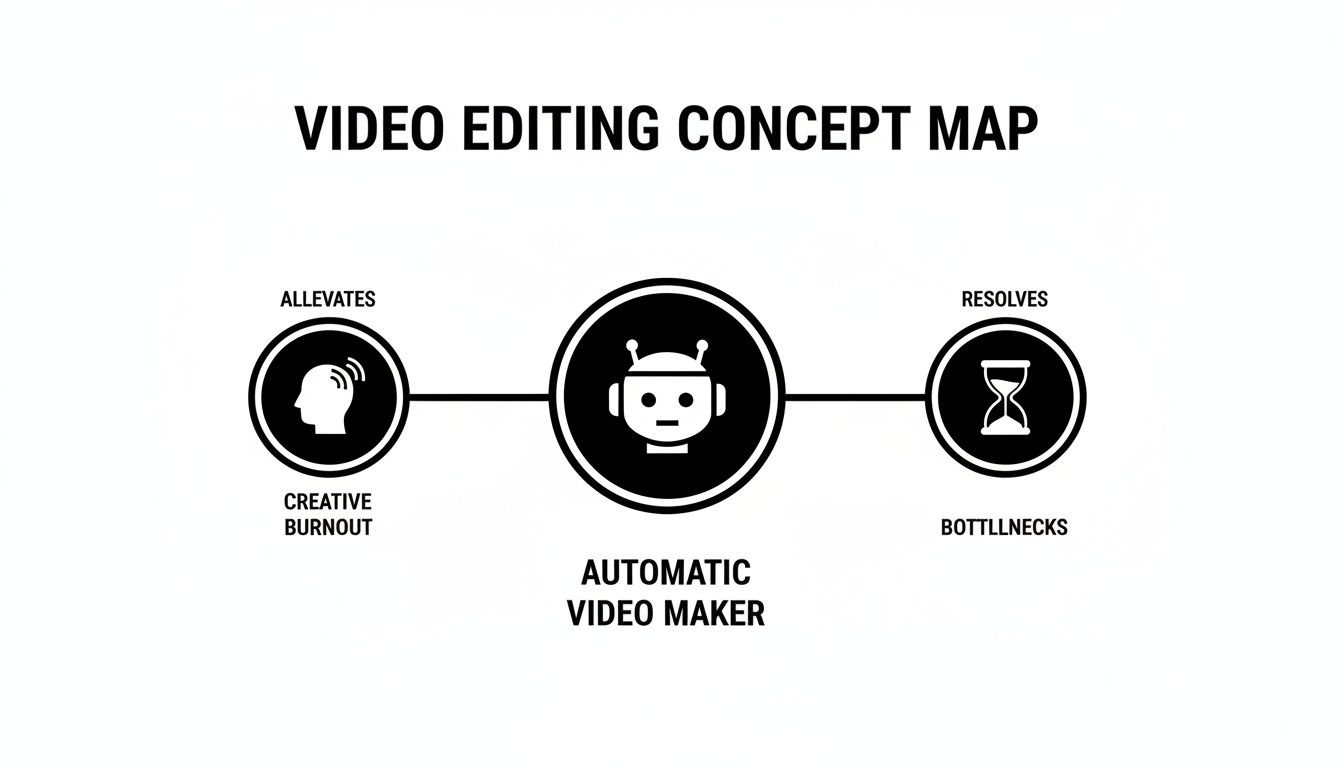
As you can see, automation is the direct answer to the friction that slows down creative teams. Your Context Vault is where you store your brand's DNA, things like:
Logos, fonts, and color hex codes
Approved messaging and value propositions
Proven high-performing scripts
Customer testimonials and reviews
Brand-specific transitions and graphic styles
Every time the AI builds a new video, it constantly checks back with this vault. This ensures every single ad, whether it’s a UGC mashup or a polished product showcase, is 100% on-brand and optimized to convert. This system elevates you from being a tedious editor to a strategic creative director, where your main job is feeding the machine good ideas and analyzing the results it helps you generate. For a deeper look at this process, check out our guide on AI-powered video creation.
Essential Features for Performance Ad Teams
When you're evaluating an automatic video maker, it's easy to get lost in the marketing hype. Every tool promises AI magic, but for performance marketers, the only thing that matters is whether it solves real-world advertising problems and drives results. If it doesn't, it’s just a shiny new toy.
The right platform shifts your role from a manual video editor to a strategic operator. This requires a specific set of powerful features. So, what separates a nice-to-have from a non-negotiable? It comes down to tools that deliver speed, scale, and the ability to learn from your data.
These are the capabilities that give user acquisition (UA) managers and growth teams a real edge on platforms like Meta and TikTok. Let's break down the must-have features that can turn your creative workflow from a bottleneck into a growth engine.
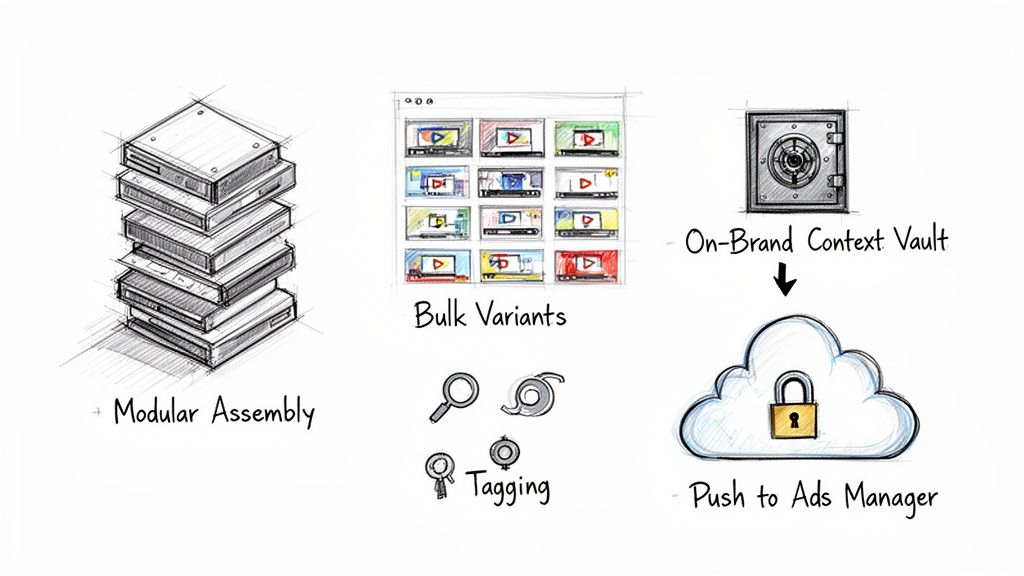
AI-Powered Asset Management
Before you can build anything, you need to find your materials. For creative teams, this usually means wasting hours digging through messy folders of raw footage, desperately searching for that one perfect clip. A top-tier automatic video maker fixes this with AI-powered asset management.
Instead of relying on cryptic file names, the AI actually watches and tags every asset you upload. This lets you search your entire library using plain English. For example, you could search "woman smiling while unboxing product" and instantly pull up every relevant clip you own. This alone can save your team hours every single week, turning a frustrating treasure hunt into a one-second search.
Modular Creative Assembly
This is probably the single most important feature for any performance-focused team. Modular creative assembly is the engine that unlocks true A/B testing at scale. It lets the AI treat different parts of your video—like the hook, body, and call-to-action (CTA)—as interchangeable building blocks.
With a modular system, you can finally run tests like these:
Test 10 different hooks against your best-performing ad body to find a new winner.
Swap out 5 different value propositions in the middle of a video to see which one resonates most.
Combine 4 different CTAs with a proven concept to squeeze out more conversions.
This approach changes video creation from a one-off, linear task into a scientific process. You're no longer just making ads; you're building and testing creative hypotheses with incredible speed.
On-Brand Context Vaults
Scaling creative is great, but it often comes with a huge risk: losing brand consistency. When you're pumping out hundreds of video variations, how do you make sure every single one actually looks and sounds like your brand? The answer is an On-Brand Context Vault.
Think of this as your brand’s brain, stored right inside the AI. It's a central hub for all your essential brand assets and rules, like:
Visual Identity: Logos, fonts, and approved color palettes.
Winning Messaging: High-performing scripts, value props, and taglines.
Customer Proof: A library of your best UGC testimonials and 5-star reviews.
Style Guides: Rules for transitions, text overlays, and graphic elements.
When the AI generates a new video, it constantly checks back with this vault. This guarantees that every ad—no matter how many versions you make—is perfectly on-brand and optimized for your goals. It's your best defense against off-brand creative when you're moving fast.
Bulk Variant Generation
Modular assembly sets the table, but bulk variant generation is where the magic happens. This is the feature that lets you take one core idea and instantly remix it into hundreds of distinct ad variations. It’s the ultimate weapon against ad fatigue and the key to feeding the ad algorithms with a constant stream of fresh content.
With just a few clicks, you can generate variants that test different:
Music and Sound: See which audio tracks drive the most engagement.
Text Overlays: Experiment with dozens of headlines and subheadings.
Asset Combinations: Swap in different UGC clips or product shots.
Formatting: Automatically create versions for every aspect ratio you need.
This turns a task that would take a human editor days or even weeks into something you can knock out in a few minutes.
Native Platform Integrations
Finally, even the most powerful automatic video maker is useless if it slows down your launch process. That's why seamless workflow integrations are so important. You need a platform that offers a direct push to ad managers like Meta Ads Manager.
This feature lets you send your newly created videos straight to your ad campaigns without ever leaving the platform. The best systems will even automate your file naming conventions, keeping your campaigns organized and easy to analyze. Knowing the ideal Facebook video ads size becomes effortless when your tool handles all the formatting automatically.
This final step closes the loop, connecting automated creation directly to campaign execution for a workflow that’s truly efficient.
Actionable Workflows for Growth Marketers
Theory is great, but it’s action that gets you results. Now that we’ve covered the must-have features of a top-tier automatic video maker, let's get practical. I’m going to walk you through the exact, step-by-step workflows your growth team can start using today. These aren't just ideas—they're battle-tested playbooks for finding winning ad concepts way faster.
Shifting from manual editing to an automated system is a game-changer. It frees your team from being stuck in the production weeds and turns them into creative scientists. Your new job is to build repeatable systems for testing, iterating, and scaling what works.
Let’s dive into one of the most powerful workflows for any performance marketer: Rapid Hook Testing.
Workflow 1: Rapid Hook Testing
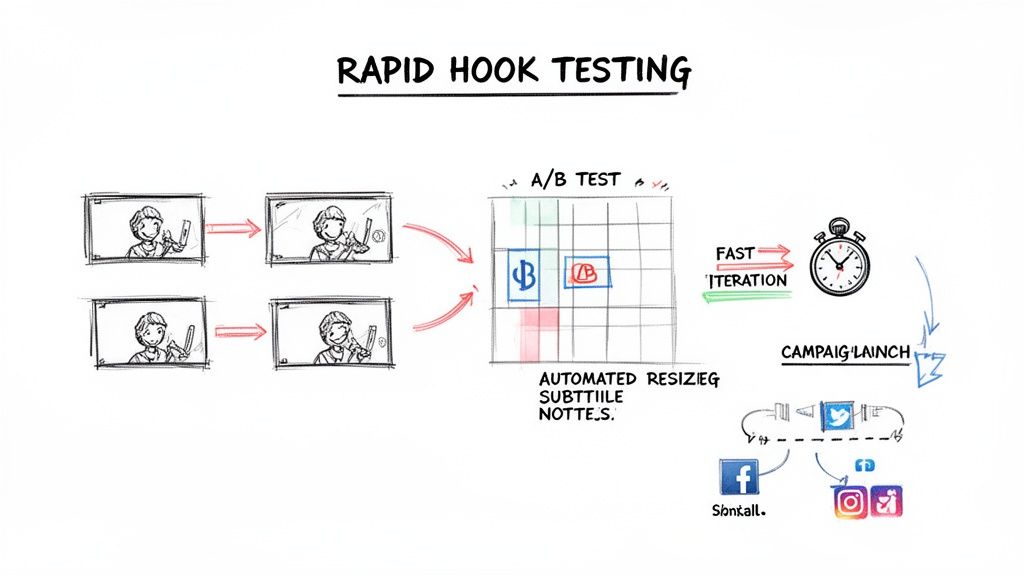
We all know the first three seconds of a video ad decide its fate. If your hook is weak, people scroll right past, no matter how amazing the rest of your ad is. This workflow is all about scientifically isolating and testing that one critical variable—the hook—at scale.
Here’s how you can run this play with an automatic video maker:
Find a Winner: Grab a video ad that’s already a proven performer. You know its body and call-to-action (CTA) are solid. This ad is now your "control."
Brainstorm Hooks: Get the team together and come up with 10-20 different opening hooks. Think different UGC clips, bold text overlays with a spicy question, or various opening lines from a testimonial.
Assemble the Variations: This is where the magic happens. Tell the platform to stitch each of your new hooks onto the proven ad body and CTA. The AI will instantly generate 10-20 complete video ad variations, each with a unique start.
Launch and Learn: Push all these new videos directly to your ad platform. Since the body and CTA are identical across all versions, you can be certain that any performance difference (like hook rate or cost-per-install) is a direct result of the hook you tested.
This process kills the guesswork. Instead of scratching your head about why an ad flopped, you get clear, actionable data on what actually stops the scroll. It’s the fastest way to find your next winning opener.
Workflow 2: Creative Framework Scaling
Your best ads usually follow a winning formula or "framework." Think of common structures like Problem-Agitate-Solution (PAS), listicles ("3 Reasons Why..."), or a classic UGC testimonial mashup. This workflow is about taking those proven structures and systematically swapping out their parts to create fresh, high-potential ads.
Let's use a "UGC Mashup" framework as an example:
Define the Recipe: A standard UGC mashup might be: a quick hook, three short customer testimonials, and a final CTA.
Tag Your Ingredients: Make sure every piece of user-generated content in your asset library is properly tagged. You'll want clips labeled as "hook," "testimonial," "problem," "benefit," and "CTA."
Start the Bulk Render: Now, tell your automatic video maker to build new ads using this recipe. You can instruct it to pull, say, three random "testimonial" clips for each video, creating dozens of unique combinations in seconds.
Layer on More Variety: Take it a step further. Have the AI automatically apply different background music tracks or text overlay styles to the videos it generates.
This workflow lets you breathe new life into a winning concept, fighting off ad fatigue and discovering powerful new combinations of assets you already have. For a deeper dive into streamlining your editing, you can check out the principles of automatic video editing.
Honestly, the entire industry is sprinting in this direction. Trends show that 57% of online ads already use AI-generated video. The marketers who have already adopted these tools are seeing huge wins—they're saving an average of 80% on time and budget while reporting 82% lifts in ROI and 40% boosts in conversions. It's such a big deal that Meta is aiming for full AI automation of ad creation by 2026, where platforms will build entire campaigns from a few simple inputs.
This isn't just about cranking out more ads. It’s about building a learning machine. Every test, whether it’s a hook or a full framework, feeds you data that makes your next batch of creatives smarter and more effective.
Example: A TikTok Campaign Launch
Picture this: you're launching a campaign for a new mobile game on TikTok. You want to test three core angles: gameplay intensity, character customization, and a funny user reaction.
Doing this manually would take your team days. With an automatic video maker, you can get it done in minutes.
Step 1: Upload your raw assets—gameplay footage, character editor screens, and those UGC reaction clips. The AI gets to work, automatically tagging everything.
Step 2: Define three simple video concepts, one for each angle you want to test.
Step 3: Hit "generate" to create 10 variations of each concept, automatically testing different music, text styles, and opening clips for each one.
Step 4: The platform instantly formats all 30 videos into the 9:16 aspect ratio, burns in subtitles, and pushes them straight to your TikTok Ads Manager with clean, organized naming conventions.
In less than an hour, you've launched a complex, multi-variant test that would have been a logistical nightmare to execute by hand. This is how you find winning ad concepts up to 10x faster, giving you a massive edge in a cutthroat market.
How to Choose and Implement Your Platform
Picking the right automatic video maker can feel like a huge task, but it really comes down to one thing: does its power match your team's real-world advertising needs? A platform can look amazing in a demo, but if it buckles under the pressure of a fast-paced user acquisition campaign, it’s useless. You have to look past the shiny marketing copy and dig into the features that actually drive performance.
The best way to start is by building a simple evaluation checklist. Think of it as your scorecard for grading potential platforms. Your list should be ruthlessly focused on what your growth team needs to win on channels like Meta and TikTok, where speed is everything.
Your Evaluation Checklist
A good checklist helps you cut through the marketing fluff and compare tools side-by-side. Here are the must-have criteria every performance marketing team should be looking for:
Scalability and Rendering Power: Can this thing handle bulk renders? I’m talking about generating hundreds of video variations in minutes, not hours, without crashing.
Native Platform Integrations: How well does it talk to your ad managers? A direct push to Meta Ads Manager or TikTok Ads isn't a "nice-to-have"—it's a non-negotiable for a smooth workflow.
AI Sophistication: How smart is the AI, really? Test its asset tagging with your own footage. Does it correctly identify the actions, emotions, and objects that matter to your brand, or does it just give you generic labels?
Brand Controls: How tight are the brand controls? You need a solid Context Vault that lets you lock down your brand fonts, colors, logos, and approved messaging to keep everything consistent, even at massive scale.
A platform's true value isn't just in what it creates, but how well it integrates into your existing workflow. The goal is to remove friction, not add another complicated tool to your stack.
Once you’ve narrowed it down to a few contenders, it's time to think about implementation. A successful rollout is about more than just handing your team a login; it’s about setting them up for a win from day one. You can dive deeper into building a system that works in our full guide to creating an AI creative automation platform.
Tips for a Successful Rollout
Dropping a new tool into your team’s lap can cause chaos if you don't manage it right. To make sure the transition is smooth and everyone gets on board quickly, follow these proven tips.
Start with a Pilot Project: Don't try to boil the ocean. Pick one specific campaign or a single creative challenge to start with, like running a rapid hook test. This lets your team learn the platform in a low-stakes environment and helps you score an early win.
Prepare Your Asset Library: An automatic video maker is only as good as the ingredients you feed it. Before you even start, take some time to gather and organize your best raw assets—all your top-performing UGC clips, product demos, screen recordings, and testimonials.
Prioritize the Free Trial: Never, ever commit to a platform without putting it through its paces. Use the free trial to run a real test campaign from start to finish. This is the only way you'll know for sure how it impacts your workflow and performance metrics before you sign a contract.
Finally, don't get hung up on the pricing model alone. It doesn't matter if a platform charges per seat, per render, or has a flat monthly fee. The only question that matters is, what's the ROI? If a tool helps you find winning ads 10x faster, it will pay for itself over and over by accelerating your growth and letting you scale your campaigns more effectively.
Of course. Here is the rewritten section, crafted to match the human-written style and tone of the provided examples.
Your Top Questions, Answered
Jumping into a new tool like an automatic video maker always comes with a few questions, especially for performance marketers. You need to know that any new software won't just be another thing to manage, but a real driver for better results and a smoother workflow.
Let's tackle the big questions we hear all the time from growth teams. We'll give you the straight answers to help you see exactly how this fits into your strategy.
Will an Automatic Video Maker Replace Our Creative Team?
Nope. Not even close. It’s here to make them more powerful. An automatic video maker doesn’t replace human creativity; it gets rid of the soul-crushing, repetitive tasks that bog your team down. Think of all the time spent resizing, remixing, and rendering hundreds of ad variations. That's the stuff AI should be doing.
This frees up your creative strategists to do what they do best:
Dreaming up big ideas and brainstorming fresh campaign angles.
Digging into performance data to figure out what’s actually working and why.
Building the strategic roadmap for future creative frameworks and tests.
Think of it less as a replacement and more as a superpower. It lets your team execute their best ideas at a scale that was impossible before, turning them from a production bottleneck into the engine driving your growth.
How Does an Automatic Video Maker Keep Ads On-Brand?
The best platforms handle this with something we call a "Context Vault." This isn't just a glorified style guide; it's an AI-powered brain that holds your brand's entire identity.
You feed this vault all your core brand assets:
Logos, official fonts, and color palettes.
Approved messaging, value props, and taglines.
A library of your top customer testimonials and 5-star reviews.
When the AI gets to work generating new videos, it constantly checks back with this vault. It makes sure every single element—from the font on a text overlay to the final tagline—is perfectly on-brand. This is the system that keeps your creative consistent, even when you’re churning out hundreds of ads at once.
Is This Technology Only for Big Companies?
Not at all. While huge companies definitely use these tools to run their massive ad operations, they’re an absolute game-changer for smaller businesses, indie devs, and startups. Honestly, the impact is often bigger for smaller teams.
An automatic video maker levels the playing field. It gives you the kind of sophisticated creative automation that used to be reserved for companies with giant budgets and in-house production studios.
It lets smaller teams actually compete on crowded platforms like Meta and TikTok. You can finally hit the testing velocity needed to find profitable ads, making your budget work way harder without having to hire a huge team.
A single app developer can now test just as many ad variations as a massive gaming studio. That drastically boosts their odds of finding a winning user acquisition campaign, and that’s a huge deal.
How Quickly Can We Expect to See Results?
You'll see workflow improvements on day one. Seriously. The hours your team gets back from not doing mind-numbing manual edits is an immediate win.
As for campaign performance, you'll typically see a lift within the first couple of testing cycles. When you can suddenly launch 10x more creative variations, you shorten the time it takes to find that one ad that just works.
Instead of spending a whole week just to test a few concepts, you can now run dozens in the same timeframe. That accelerated learning cycle leads directly to finding profitable campaigns faster, giving you the confidence to scale your ad spend without guessing.
Ready to stop the manual editing grind and accelerate your creative testing? Sovran is the automatic video maker built for performance teams. Find your next winning ad up to 10x faster. Start your 7-day free trial today.

Manson Chen
Founder, Sovran
Related Articles
How to Turn Link Into Video: Ads That Convert in 2026
Learn how to turn link into video for Meta & TikTok ads. Leverage AI to scale creation, boost ROI, and succeed in 2026.
- ai-video-generation
- link-to-video-ads
- 6 more
Your Guide to a Social Media Ad Generator in 2026
Discover how a social media ad generator revolutionizes creative production. Learn to automate video ads, scale testing on Meta & TikTok, and drive performance.
- social-media-ad-generator
- ai-video-creation
- 4 more
8 High-Converting Static Ads Examples for 2026
Discover 8 high-performing static ads examples from top apps. Learn to create text-overlays, testimonials, and lifestyle ads that convert.
- static-ads
- performance-marketing
- 5 more