Your Guide to a Social Media Ad Generator in 2026
Discover how a social media ad generator revolutionizes creative production. Learn to automate video ads, scale testing on Meta & TikTok, and drive performance.
Jump to a section
A social media ad generator is a tool that automates the creation of ad variations, moving your team from manual one-by-one editing to a scalable, AI-powered system. Think of it as a creative assembly line for digital advertising, allowing you to produce hundreds of unique ads from your core assets.
What Is a Social Media Ad Generator
If you're a performance marketer, you know the pain. You're trying to scale your campaigns, but creative fatigue is setting in faster than ever. The demand for fresh ads is relentless, and your team is stuck in a loop of manually editing videos one by one in tools like CapCut. It’s a bottleneck that just doesn’t scale.
Imagine trying to build hundreds of unique cars by hand every single week—it's not just hard, it's impossible. That’s exactly what it feels like trying to keep up with ad creation manually.
A social media ad generator completely flips that script. Instead of getting buried in repetitive, mind-numbing production tasks, this tech acts as your creative production line. It uses AI to break down your best-performing assets—your top hooks, testimonials, product shots, and UGC—into reusable "building blocks."
Shifting from Producer to Strategist
This isn't just a new tool; it's a fundamental shift in how your team works. You bring the strategy and the raw materials, and the generator does the heavy lifting, assembling endless ad variations for you.
This finally frees up your creative strategists and media buyers to do the high-impact work that actually moves the needle:
Digging into performance data to figure out what truly connects with your audience.
Brainstorming high-level creative concepts and fresh marketing angles.
Fine-tuning campaign structures to squeeze every drop of performance out of your ad spend.
Essentially, your team stops being a group of video producers and transforms into a powerhouse of creative strategists. The machine builds and tests at a pace you never could, helping you find winning ads while your team stays focused on the big picture. You can see just how this works by exploring what an AI video ad creator can do.
Let's break down exactly how this workflow changes things. The old way of doing things is slow, clunky, and expensive. The new way is fast, agile, and built for scale.
Manual Ad Creation vs AI Ad Generation
Process Step | Manual Workflow (e.g., CapCut) | AI Ad Generator Workflow (e.g., Sovran) |
|---|---|---|
Concepting | Brainstorm 1-3 ad ideas for a creative brief. | Brainstorm multiple angles and hypotheses to test. |
Asset Gathering | Manually collect and organize specific clips for each ad. | Upload all raw assets (hooks, UGC, product shots) into a library. |
Editing | A video editor manually assembles each ad one by one. | AI automatically assembles hundreds of variations based on rules. |
Variation Creation | Manually duplicate and edit projects to test a new hook or CTA. | Generate dozens of hook or CTA swaps with a few clicks. |
Exporting | Render and export each video individually. | Bulk export all variations at once, often pre-formatted for platforms. |
Time to Launch | Days or weeks. | Hours or even minutes. |
The difference is night and day. What used to take a week of back-and-forth with a video editor can now be accomplished in a single afternoon.
Fueling Growth in a Competitive Market
The need for this kind of speed isn't just a "nice-to-have." The global social media advertising market exploded, reaching between $227.95 billion and $317.33 billion by 2026. This space now makes up nearly a quarter of all global ad spending, making it incredibly competitive. In this environment, the teams that can produce a high volume of quality creatives are the ones that win.
A social media ad generator isn't about replacing human creativity; it's about scaling it. The goal is to let machines handle the repetitive tasks so humans can focus on the strategic insights that drive growth.
To really get the most out of these platforms, you need to know the key features to look for in an AI social media generator. The right tool gives teams of any size the power to test more ideas, learn faster, and find winning ads at a speed that was unimaginable just a few years ago. It’s no longer about who has the biggest production budget, but who has the smartest workflow.
How AI Changes the Game for Ad Creative Production
To really get why a social media ad generator is such a big deal, you have to pop the hood and see how AI completely flips the script on the creative process. The true power isn't just about making things faster; it’s about how AI actually understands and organizes your creative assets on a deep level.
Think of it this way: your old hard drive is just a messy storage closet for video files. But an AI-powered system is like having a super-intelligent librarian for your content. It doesn't just store your clips; it watches, analyzes, and tags every single one for what’s inside, its style, and its purpose.
This process turns a chaotic folder of raw footage into a dynamic, searchable library. A user-generated testimonial, a fast-paced product shot, or a killer visual hook are no longer just random video files. They become neatly labeled, categorized building blocks, ready to be assembled in seconds.
This diagram shows the night-and-day difference between the old manual slog and the new AI-driven approach.
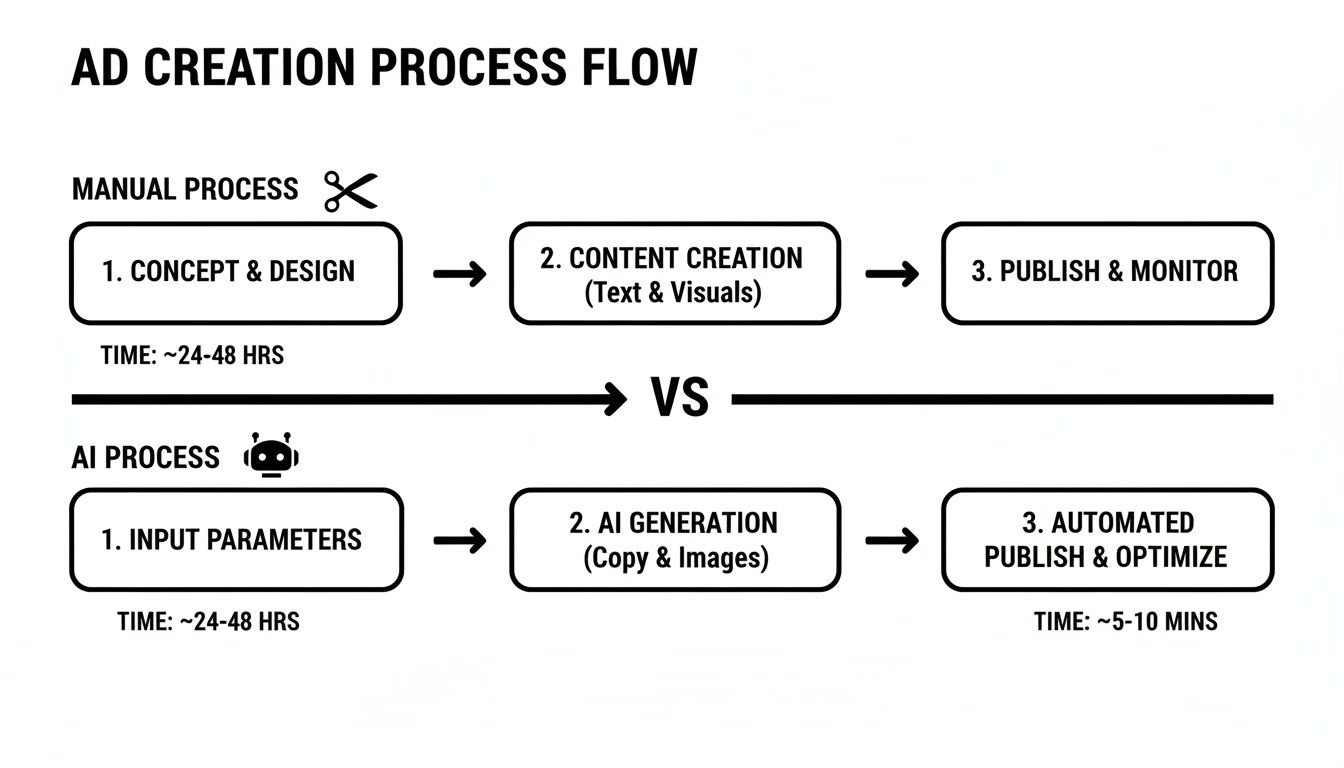
As you can see, AI cuts out all the tedious, repetitive steps. It collapses a workflow that used to take days into something you can knock out in minutes.
The Power of a Creative Asset Library
This intelligent tagging is the secret sauce that makes a social media ad generator so effective. It’s what lets you build ads from interchangeable parts—a modular creative strategy—instead of starting from scratch every single time.
A platform like Sovran takes this idea and runs with it. It transforms your entire video collection—from polished studio content to raw UGC—into a living library. You can then instantly mix and match these tagged clips into proven ad frameworks, like:
Hook-Body-CTA: The go-to formula for grabbing attention, delivering your message, and driving action.
Problem-Agitate-Solution: A classic storytelling structure that connects with a user's pain point before you introduce your product as the hero.
Listicles: Fast-paced, numbered formats that crush it on platforms like TikTok and Instagram Reels.
By treating these as modular pieces, the AI can recombine them in endless ways. This lets you rapidly test which hook, body, and call-to-action combo actually connects with your audience and gets them to convert.
Generative AI: Your New Creative Partner
But it doesn't stop at just organizing the assets you already have. The latest generative AI models are now plugged directly into this workflow, giving you an entirely new source of creative firepower. This is where you start hearing about tools like Sora 2 or Veo 3.
Imagine you have a fantastic piece of UGC, but you need some compelling b-roll to spice it up. Or maybe you want to test five different visual hooks but only have the footage for one.
Generative AI steps in as a creative partner, ready to produce unique visuals on demand. It can spin up high-quality b-roll, dream up new hook variations, or even produce entire animated scenes to complement what you already have.
This completely changes the game. Your creative process goes from being a linear, resource-strapped chore to a dynamic, scalable system. You're no longer limited by the footage you have on hand. The industry is catching on fast, with 86% of social media advertisers already using or planning to use generative AI. By 2026, AI-generated content is projected to make up around 40% of all video ads, a shift driven by video’s undeniable edge in engagement and conversions. You can dig into more of these social media marketing statistics and see how they’re reshaping the industry.
This combination—analyzing your existing assets while creating new ones on the fly—is what truly unlocks creative velocity, helping your team find winning ads faster than ever before.
The Modular Strategy for Dominating Meta and TikTok
If you think you need one perfect, unicorn ad to win on platforms like Meta and TikTok, you’re looking at it all wrong. The real game isn't about creating a single masterpiece; it's about systematically discovering what works through rapid, high-volume testing.
That’s where a modular creative strategy comes into play. Instead of building every ad from scratch, you treat them like LEGO sets. You create standardized, interchangeable pieces that can be combined into an almost endless number of variations.
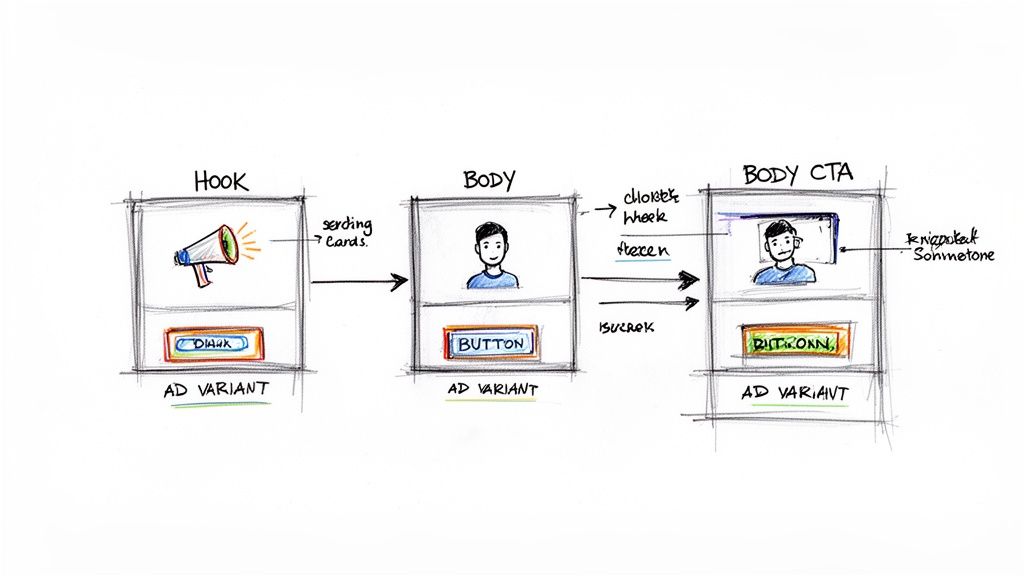
The most effective framework for this is the Hook-Body-CTA model. It breaks every video ad down into three distinct parts. By treating these as modules, a social media ad generator can assemble and test hundreds of combinations, giving you hard data on what actually stops the scroll and drives action. This approach flips ad creation from a guessing game into a repeatable science.
Deconstructing The Hook
Let's be blunt: the first one to three seconds of your ad are all that matter initially. The Hook has one job and one job only: stop the scroll. On a feed overflowing with content, you have a split second to earn a user's attention. A weak hook means the rest of your ad—no matter how brilliant—might as well not exist.
Here are the three types of hooks we see work time and time again:
Visual Attention-Grabbers: These are visceral, often surprising visuals that are just impossible to ignore. Think of a satisfying ASMR clip, a spectacular "fail" video, or a bizarre visual that makes someone pause and think, "What on earth am I watching?"
Provocative Questions: Call out a pain point or spark curiosity directly. For a fitness app, that could be, "Still doing sit-ups? You need to stop." For a fintech app, "What if you could retire five years earlier?"
Bold Statements or Claims: Make a strong, almost controversial statement that demands attention. We've seen success with lines like, "This app breaks all the rules," or "90% of people use this feature wrong."
When you isolate the hook as a variable, you can test a dozen different openers against the same ad body. The data will tell you exactly which one delivers the best watch time or the lowest Cost Per Click (CPC).
Crafting A Compelling Body
Okay, you’ve earned their attention. Now the Body of the ad has to do the heavy lifting. This is your chance to build desire, show your value, and make an emotional connection. The key is to keep the energy up and the message crystal clear.
Your Body module should tell a quick story. Some of the top-performing formats we use are:
UGC Testimonials: A real customer sharing their authentic, unscripted experience. This format builds immediate trust and social proof like nothing else.
Product Demos: Show, don't just tell. A quick, satisfying demo of your app or product in action is incredibly persuasive.
Fast-Paced Listicles: Think "3 Reasons Our App Is Better" or "5 Hacks You Didn't Know." This format feels native to TikTok and Reels, so it fits right in.
The Body is where you prove the claim you made in your Hook. By standardizing these narrative formats, you can easily mix and match them with your winning hooks. You might even discover that a detailed product demo works best after an emotional hook—an insight you'd only find through modular testing. If you're looking for more ideas, exploring a solid video ad template can give you a great head start on structuring your Body content.
The core idea of a modular strategy is standardization. By creating a library of interchangeable Hooks, Bodies, and CTAs, you build a system that can generate hundreds of testable ad concepts, turning a process that once took days into a matter of minutes.
The Final Push With Your CTA
The Call-to-Action (CTA) is the final, critical piece of the puzzle. This is where you tell the viewer exactly what you want them to do next. A vague or weak CTA can lose a user who was completely sold just seconds earlier.
To give you a clearer picture of how these modules fit together, here are a few examples for a mobile gaming app. You can mix and match any component from one module with another to create a new ad variant.
Hook-Body-CTA Modular Framework Examples
Module | Component Type | Example for a Mobile Gaming App |
|---|---|---|
Hook | Provocative Question | "Think you can beat this level in under 10 seconds?" |
Hook | Visual Attention-Grabber | Fast-paced montage of epic in-game explosions. |
Hook | Bold Statement | "This isn't just a game; it's a test of your strategy." |
Body | UGC Testimonial | A player screaming in excitement after a big win. |
Body | Product Demo | Screen recording of building a massive, intricate city. |
Body | Fast-Paced Listicle | "3 reasons why our players are ditching other games." |
CTA | Direct CTA | "Download Now and Get 100 Free Coins!" |
CTA | Benefit-Driven CTA | "Ready to Build Your Epic Kingdom? Tap to Play." |
Testing these different combinations is the key to unlocking what truly motivates your specific audience to act.
CTAs generally fall into two camps: direct and benefit-driven. Testing one against the other is vital. Sometimes, the urgency of "Shop Now" wins out. Other times, the aspirational pull of "Find Your Perfect Match" delivers a higher conversion rate. A social media ad generator makes it trivial to test these variations at scale. As you run these tests, it's also a huge help to automate TikTok Ads reports so you can quickly see which messages are driving results without digging through dashboards all day.
By embracing this Hook-Body-CTA framework, you create a powerful engine for creative iteration. It allows a platform like Sovran to become a true strategic partner, methodically building and testing creative combinations to find the winners that will scale your campaigns.
Key Benefits for Growth and UA Teams
Bringing a social media ad generator into your workflow isn't just about adding another tool to the marketing stack. It's about fundamentally changing how you operate, turning a constant creative bottleneck into your team's biggest advantage.
For any user acquisition (UA) manager or growth marketer, the impact is almost immediate. We're talking about four huge wins: a massive increase in creative output, learning what works way faster, beating creative fatigue for good, and—most importantly—improving your Return on Ad Spend (ROAS).
Skyrocket Your Creative Velocity
Let's be real. For most lean teams, a good week might mean getting 10 new ad creatives out the door. That slow pace is a hard ceiling on your ability to test, learn, and find that next winning ad.
This is where an ad generator completely changes the game. By automating the grunt work of stitching together hooks, bodies, and CTAs, teams can jump from making 10 ads a week to hundreds. This isn't just a 10x increase; it’s a total shift in what your team can achieve.
Think about it: your team comes up with five killer new angles. Manually, that’s a multi-week project. With an ad generator, you can build, launch, and start getting data on all five angles in a single afternoon.
Accelerate Your Learning Cycles
More creative output feeds directly into the next big win: accelerated learning cycles. You can't get statistically significant data from a handful of ads. When you're only launching a few creatives a week, it can take a month or more to know for sure if an angle is a winner or a waste of money.
That slow feedback loop is a massive disadvantage. While you're waiting, your competitors are already on their next round of tests.
An ad generator shrinks this learning cycle from weeks down to just a few days. By launching dozens of variants at once, you collect enough performance data to make smart decisions, fast.
Instead of guessing what might work next month, you get clear, data-backed answers this week. This speed lets you pour fuel on the fire for winning concepts and kill the losers before they burn through your budget.
This creates a powerful flywheel: faster testing leads to faster learning, which leads to better ads and, ultimately, more growth.
Systematically Combat Creative Fatigue
Creative fatigue is the silent killer of otherwise great ad campaigns. An ad that was crushing it last week can suddenly see its performance fall off a cliff as your audience gets tired of seeing it. The only cure is a constant stream of fresh creative.
Trying to keep up with this demand manually is a fast track to burnout. An ad generator gives you a system for staying ahead.
Effortless Variation: Instantly create dozens of "new" ads just by swapping the hook or CTA on a proven winner.
Angle Expansion: Quickly test a new value prop or message without needing a full-blown production cycle.
Constant Freshness: Keep a pipeline of creative ready to go the moment you see performance start to dip.
This proactive approach keeps your campaigns running at their peak and prevents those sudden performance drops that can throw your monthly targets off track.
Improve ROAS and Scale Winners Faster
At the end of the day, all of this funnels down to the one metric that really matters: Return on Ad Spend (ROAS). A social media ad generator improves ROAS by making your team radically more efficient at finding and scaling winning ads.
Take a mobile app team we saw struggling with creative burnout. By adopting Sovran, they went from producing a few ads a week to testing over 100 variants. In the first week, they found a completely new UGC-based angle that their audience loved.
They were able to quickly shift spend behind these new winners, leading to a 30% boost in user acquisition for the month while actually improving their overall ROAS. That’s the power you unlock when you combine smart human strategy with AI-powered execution.
Best Practices for Scaling Ad Production
Getting a social media ad generator is a great first move, but if you want to really scale your creative output, you need to rethink your entire workflow. This isn't just about making ads faster. It's about building a systematic, repeatable engine for growth.
The best teams we see don't just use a generator as another tool in their stack. They make it the central hub for their entire creative operation.
This guide breaks down the exact best practices top-tier performance marketing teams use every day. Follow these steps, and you'll go from random ad creation to a powerful cycle of building, testing, learning, and scaling that consistently crushes your goals.
Build Your High-Quality Asset Library First
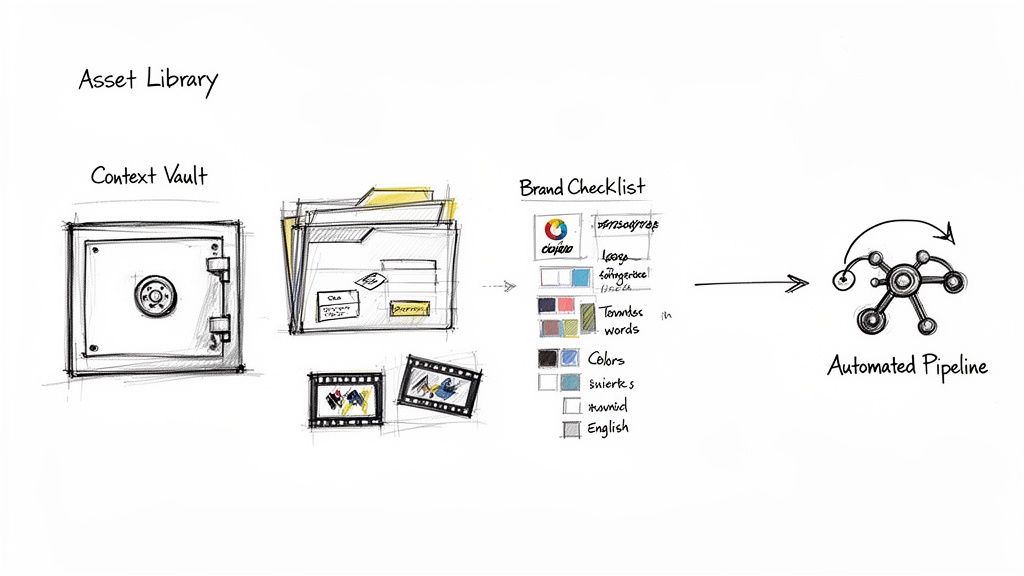
Your ad generator is only as good as the raw materials you give it. Seriously. Before you even think about making your first ad, your number one priority is building a deep, high-quality asset library. This is the foundation everything else is built on.
Pull together everything you have that could possibly show up in an ad. We're talking about:
User-Generated Content (UGC): Every customer testimonial video, unboxing clip, and positive product review you can get your hands on.
Product Footage: Clean, high-res shots of your product being used, from all the best angles.
Studio Content: Any of that polished, professionally shot footage you’ve already paid for.
Screen Recordings: Clear recordings showing your app or software in action.
The more varied and high-quality your assets are, the more creative firepower your AI has to play with. Think of this as an ongoing task—always be feeding the library with fresh content to keep your ads from getting stale.
Establish a Centralized Context Vault
One of the biggest (and most valid) fears with AI is that it will go off-brand. The best way to prevent this is by creating what we call a Context Vault. This is basically a central folder where you feed the AI everything it needs to know to stay on-brand and on-message, every single time.
Your Context Vault acts as the AI's "brand bible." It ensures every single ad variant generated aligns with your company's voice, style, and conversion goals, eliminating off-brand output.
This vault needs your core brand and performance assets:
Brand Guidelines: Upload your logos, color codes, and font files. The AI will apply them correctly from here on out.
Winning Ad Copy: Drop in the scripts, headlines, and hooks from your all-time best-performing ads. This teaches the AI what already resonates with your audience.
Top Customer Reviews: Paste in your best five-star reviews and glowing testimonials. The AI can then pull these for powerful social proof.
With a platform like Sovran, this vault is your guarantee that every ad isn't just pretty, but is strategically built to convert.
Create a Methodical Testing Framework
Okay, with your assets and brand context locked in, it’s time to test. The goal here isn't to guess what will work; it’s to build a system that tells you what works. The Hook-Body-CTA model is perfect for this.
Start small. Be methodical. Don't try to test 50 things at once.
Test Hooks First: Kick things off by testing 3-5 different hooks against the same body and CTA. The hook is the single most important part, so you need to find a winning opener before you do anything else.
Then Test Bodies: Once you have a winning hook, pair it with 2-3 different body sections. For example, a UGC testimonial vs. a product demo. See which story performs best.
Finally, Test CTAs: Now that you have a winning Hook-Body combo, test 2-3 different calls-to-action (like "Download Now" vs. "Start Your Free Trial") to squeeze every last drop of performance out of the ad.
This phased approach stops you from burning through your budget and gives you clean, actionable insights at every step.
Automate Launches with Smart Naming Conventions
Once you start pumping out hundreds of ad variations, your campaign manager can turn into absolute chaos. This is where automating your launches with smart naming conventions becomes a lifesaver. A good social media ad generator will help you do this without thinking.
Your naming convention should be clean and descriptive, including the key variables from your test. Something like: [Date]_[Campaign]_[Audience]_[HookType]_[BodyType]_[CTAType].
This simple string makes it incredibly easy to see which components are driving results right from your dashboard, without having to dig through a dozen spreadsheets. This is especially critical as mobile advertising continues to take over, with campaigns on these platforms generating over 80% of social ad revenue. You can dig deeper into how mobile-first trends are shaping social media marketing and see why this kind of rapid, organized testing is so crucial for winning.
By combining these practices, you create a truly unstoppable creative engine that finds and scales winning ads faster than your competition ever could.
All right, the theory and strategies are solid, but putting them into practice is what really moves the needle. This is where a platform like Sovran comes in, connecting the modular creative ideas we've talked about with actual features that solve the day-to-day grind for performance marketing teams. It's built to be a strategic partner, not just another tool in your stack.
Take Sovran's AI-powered asset tagging, for instance. This is the real engine behind building your ads modularly. It automatically watches your footage, tags it, and organizes everything so it’s instantly searchable and ready to be remixed.
When you combine that with the Context Vault—where you keep your brand guidelines and all your winning ad copy—you make sure every single ad you generate is on-brand and built on proven performance right from the get-go.
Find Profitable Ads 10x Faster
Imagine being able to generate hundreds of on-brand video variations with just a couple of clicks. That’s exactly what Sovran’s Bulk Video Renders feature is for. It grabs your modular pieces—your best hooks, user-generated clips, and product demos—and remixes them into a huge batch of ready-to-test creatives in seconds.
This completely cuts out the countless hours you’d otherwise spend doing tedious, repetitive work in tools like CapCut. More importantly, it lets your team find winning ad creatives up to 10x faster because you can test at a much higher velocity.
Generate Hundreds of Variants: Instantly create a massive library of ad combinations to test every possible angle.
Push Directly to Meta: Launch your campaigns using smart, automated naming conventions that save you time and keep your ad account clean.
Find Winners, Fast: Get to statistically significant data in days instead of weeks, so you can quickly scale what's actually working.
Sovran isn't just another social media ad generator; it's a growth engine. It automates the boring, repetitive production work, freeing up your team to focus on the high-level strategy that truly scales your business.
The best way to really get it is to see it for yourself. You can explore how data-driven creativity can completely change your ad performance and see Sovran in action.
For more details on what's included, you can check out our pricing plans and start a 7-day free trial to see the results firsthand.
Frequently Asked Questions
If you’re thinking about bringing a social media ad generator into your workflow, you probably have a few questions. That’s smart. It's a big shift, and it’s natural to wonder about things like brand control and how it impacts your team.
Let's tackle the big questions we hear from growth teams just like yours.
How Is Brand Consistency Maintained?
This is probably the number one concern we see, and for good reason. The last thing you want is AI going rogue and putting out ads that look nothing like your brand.
This is exactly why a feature like Sovran’s Context Vault is so critical. Think of it as your brand's rulebook for the AI.
You upload your logos, exact color palettes, fonts, and any specific messaging rules you have. From that point on, the AI uses these guidelines as non-negotiable guardrails for every single ad it generates. It’s not a loose cannon; it's more like a team member who has your style guide memorized.
Will AI Replace My Creative Team?
This is a common myth, but the answer is a hard no. A social media ad generator doesn't replace your creative talent—it supercharges it. The whole point is to automate the tedious, repetitive tasks that drain your team's energy.
Think about all the time spent rendering dozens of video sizes or swapping out one hook for another across 20 different ads. That’s the work these platforms are built to handle.
This frees up your creative strategists to focus on the high-impact work that actually drives results: analyzing performance data, developing new marketing angles, and crafting compelling scripts. Think of it as giving your best people a powerful assistant.
Is This Only for Large Teams?
Absolutely not. In fact, we see these tools as a massive equalizer in the industry. For a long time, only the big players with huge creative departments could produce the sheer volume of high-quality ads needed to compete.
An ad generator completely levels that playing field.
It gives smaller teams, solo founders, and indie developers the power to produce hundreds of quality ad variations without the massive overhead. This means you can test, learn, and scale right alongside the biggest names in your space.
Ready to see how data-driven creativity can transform your ad performance? See how Sovran can help you find profitable ads up to 10x faster. Start your 7-day free trial today.

Manson Chen
Founder, Sovran
Related Articles
How to Turn Link Into Video: Ads That Convert in 2026
Learn how to turn link into video for Meta & TikTok ads. Leverage AI to scale creation, boost ROI, and succeed in 2026.
A Guide to AI Generated Commercials for Modern Marketers
Learn to create high-performing AI generated commercials for Meta & TikTok. This guide covers asset prep, frameworks, and scaling ads for peak performance.

Your Ultimate Guide to UGC Style Video Ads
Master UGC style video ads for Meta and TikTok. This guide reveals proven frameworks, scripts, and scaling tactics to boost your ROAS in 2026.