Scale Ad Creative with Automatic Editing Video
Discover how automatic editing video helps you produce and test ad creative at scale. Learn AI-powered workflows to dominate Meta and TikTok campaigns.
Jump to a section
At its core, automatic video editing is about using smart software to piece together, tweak, and finalize video ads with very little hands-on effort. It takes raw footage and turns it into polished, ready-to-launch ads by automating all the tedious, repetitive stuff. This lets marketers crank out hundreds of ad variations in minutes, not days—a total game-changer for scaling creative and beating ad fatigue on platforms like Meta and TikTok.
What Is Automatic Video Editing?
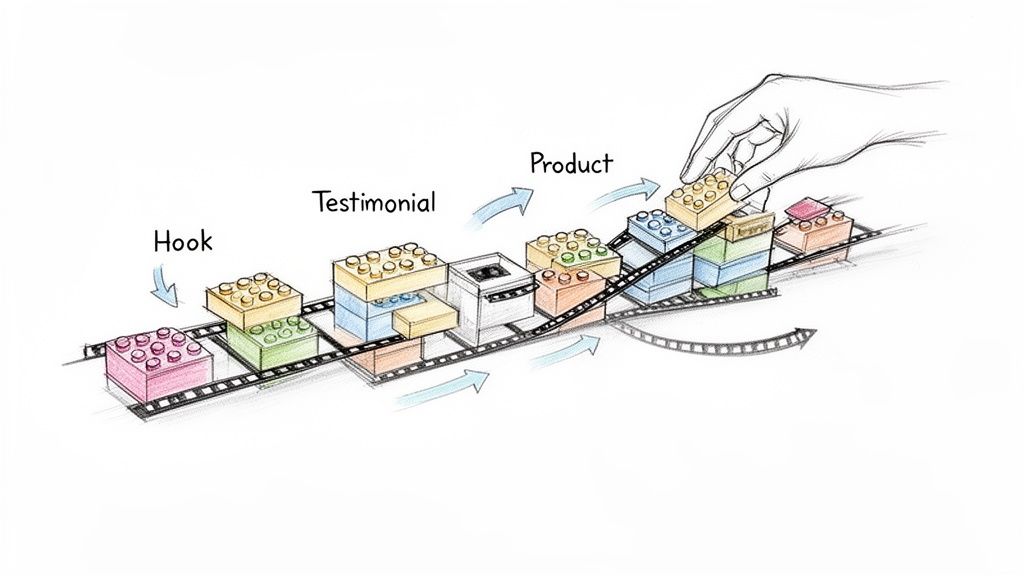
Think of it like building with a massive box of digital LEGOs. Instead of digging through the pile for every single brick you need, you have a clever assistant who instantly finds, sorts, and clicks them together for you based on a blueprint. That’s the big idea behind automatic video editing. It completely flips the script, moving from a slow, one-by-one editing process to a fast, modular system.
From Manual Labor to Modular Assembly
Traditional video editing is a slog. An editor has to wade through hours of footage, slice up clips, slap on some text, and line up the audio, all for a single video. If you want to test a slightly different version—maybe with a new hook or a different call-to-action—you're often stuck starting over or making painstaking tweaks.
Automatic editing technology throws that whole workflow out the window. It breaks down your raw footage into smart, reusable pieces.
Intelligent Asset Tagging: The AI scans your videos, automatically spotting and tagging key parts like hooks, testimonials, product demos, and user-generated content (UGC).
Modular Frameworks: These tagged clips become your building blocks. You can then use proven ad structures (like Problem-Agitate-Solution) to instantly assemble countless new combinations.
Scalable Production: Instead of editing one video at a time, you just set the rules. The system then generates hundreds of unique variations for you by mixing and matching these components.
This modular way of working directly tackles the biggest headache for performance marketers: the painfully slow pace of producing and testing new creative.
The real magic of automatic video editing isn't just about speed. It's about being able to test creative ideas at a scale that was once unthinkable, helping you find winning ad formulas much, much faster.
Solving the Creative Fatigue Puzzle
Let's be real—audiences on Meta and TikTok get bored fast. An ad that's crushing it today could be dead in the water a week from now. This is creative fatigue, and the only way to beat it is with a constant flow of fresh, interesting content.
Trying to produce that much content manually is a huge lift for most teams. Automatic editing is the answer because it makes iteration incredibly fast. If a hook starts to fizzle out, you can swap in a new one across dozens of ads with just a few clicks. This agility keeps you one step ahead of audience burnout and helps maintain strong campaign performance over the long haul. A simple example of this in action is how an AI video summarizer can instantly turn hours of raw footage into short, punchy highlights—one of the many practical ways this technology works.
How AI Puts Your Video Workflow on Autopilot
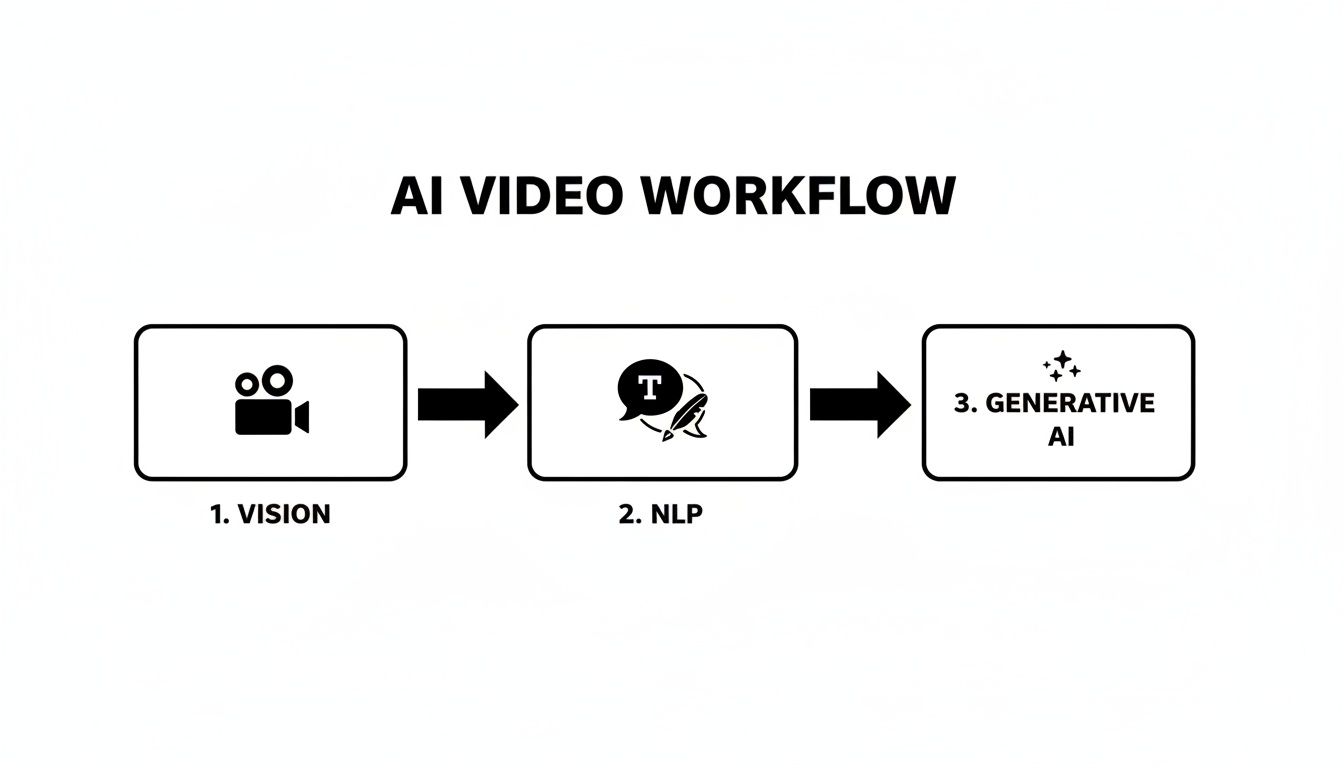
To really get what automatic video editing does, you have to look under the hood. It’s not some single magic button, but more like a hyper-efficient production team made up of different AI specialists. Each one has a specific job, and together, they turn your raw footage and assets into a massive library of ready-to-test ad creatives.
The whole process kicks off with computer vision. Picture this AI as an expert analyst who can watch every frame of your videos and instantly know what’s going on. It spots faces, objects, actions, and even the vibe of a clip. This is how the system can automatically tag your content, telling the difference between a powerful user testimonial and a slick product shot without you lifting a finger.
Next up, natural language processing (NLP) gets to work on all the audio and text. NLP listens to every spoken word, transcribes it, and makes your entire video library searchable. It can pick out key phrases, brand mentions, and customer pain points from a script, essentially turning spoken words into structured data you can build ads from.
The Core AI Building Blocks
These technologies don't just work in isolation; they team up to deconstruct your videos into their core components. This makes your whole creative process modular and incredibly scalable. Instead of being stuck with one finished video file, you suddenly have a collection of intelligent, reusable assets.
Vision AI for Tagging: This is the tech that automatically sorts your clips into categories like Hooks, Bodies, and CTAs. For example, it sees a person looking right at the camera at the beginning of a video and knows, "Hey, that's a potential Hook."
NLP for Search and Scripts: NLP is what lets you type "this changed my life" into a search bar and instantly find that exact moment across hours of customer interviews. It’s a game-changer.
Generative AI for B-Roll: Ever find yourself needing a quick visual to fill a gap? Generative AI can create entirely new, on-brand b-roll footage from a simple text prompt, plugging creative holes in seconds.
By breaking down videos into these smart components, AI isn’t taking over creative strategy. It’s giving you the tools to execute that strategy at a speed and scale that just wasn't possible before. You can turn ideas into testable ads almost instantly.
The industry is catching on fast. The AI video editing market is expected to explode from USD 0.9 billion in 2023 to USD 4.4 billion by 2033. This growth is all driven by the relentless need for faster, more efficient ways to produce content. You can dig into the numbers in the full AI video editing market report.
At the end of the day, automating the workflow frees up your team from the mind-numbing, repetitive tasks. This lets them focus on what actually moves the needle: analyzing performance data, getting inside the audience's head, and dreaming up the next big creative concept. To see how these pieces fit together in a real tool, check out our guide on finding the right AI video ad tool for your team.
Produce Hundreds of Ad Variations in Minutes
Forget the days of grinding it out in CapCut, duplicating projects over and over just to swap a single hook or call-to-action. We’ve all been there. That old-school manual process is a massive bottleneck, completely killing your ability to test and learn at the speed Meta and TikTok demand. It’s a slow, linear slog; making one ad variation can feel like it takes forever, and cranking out ten feels like a monumental effort.
The modern approach, powered by automatic video editing, completely flips that script. It’s not about working faster; it’s about working smarter. Instead of editing one video at a time, you’re building a system. You start by dumping all your raw assets—customer testimonials, UGC, product shots, screen recordings—into one central hub.
This is where the platform starts doing the heavy lifting. The AI gets to work deconstructing and reassembling your raw footage into structured, usable assets.
This shift is what unlocks true creative scale.
The New Blueprint for Ad Production
Once everything is uploaded, the AI analyzes and tags all your clips. It intelligently sorts them into logical buckets like Hooks, Bodies, and CTAs, making every piece of content instantly searchable and ready to assemble into something new. This is where the real magic happens. You can now use modular ad frameworks to stitch together fresh concepts in seconds.
Find Assets with Natural Language: Need a clip where a customer says the phrase "life-changing"? Just type it into the search bar. The AI will pinpoint that exact moment across every video you've ever uploaded.
Apply Overlays in Batches: Want to add a "50% Off" banner to 50 different videos? You can apply text overlays, branding, and other graphics across hundreds of variations at once.
Generate Subtitles Automatically: The system transcribes the audio from all your clips and generates perfectly synced subtitles—a non-negotiable for social ads—without you lifting a finger.
The big shift here is moving from tedious manual editing to a modular, automated system. It’s not about making one video a little bit faster; it’s about generating hundreds of ready-to-test variations with a single click.
From Hours to a Handful of Clicks
To put this into perspective, let's compare the traditional workflow against an automated one for producing 50 video ad variations.
Manual vs Automatic Video Editing Workflow Comparison
Task | Manual Workflow (e.g., CapCut) | Automatic Workflow (e.g., Sovran) |
|---|---|---|
Asset Prep & Upload | 1-2 hours (organizing folders) | 30 minutes (bulk upload) |
Clip Selection & Trimming | 4-6 hours (scrubbing timelines) | 15 minutes (AI-tagging & search) |
Creating Variations | 8-10 hours (duplicating projects) | 10 minutes (modular assembly) |
Applying Graphics/Text | 2-3 hours (one by one) | 5 minutes (bulk application) |
Adding Subtitles | 2-3 hours (manual transcription) | 1 minute (auto-generation) |
Rendering & Exporting | 1-2 hours (individual exports) | 15 minutes (bulk render queue) |
Total Estimated Time | 18-26 hours | ~1.5 hours |
The efficiency gains are staggering. Automation drastically cuts down the time and effort needed to create ad variations, which directly impacts your ability to scale Facebook ads effectively. A task that would take a human editor a full day—like creating 20 unique ad variations with different hooks, music, and text—can now be done in minutes.
This workflow doesn't just save you time; it completely changes your creative strategy. It empowers your team to go from producing a handful of ads per day to potentially hundreds per hour. This sheer volume allows for aggressive testing, much faster learning cycles, and a more agile response to performance data.
When you start looking into your options, you'll find that the right video ad automation software can be an incredible ally. By embracing automatic editing, you’re not just speeding up a task; you’re building a scalable engine for creative growth.
The Impact on Your Meta and TikTok Campaigns
Alright, let's shift from the "how" to the "why." The real magic of automatic video editing isn't just about making your life easier; it's about the cold, hard metrics that drive your business forward. This tech directly tackles one of the biggest performance killers on Meta and TikTok: ad fatigue.
We’ve all seen it happen. An ad starts strong, but then engagement drops off a cliff as people get tired of seeing it. Your cost per acquisition (CPA) starts creeping up, and suddenly your profitable campaign is in the red.
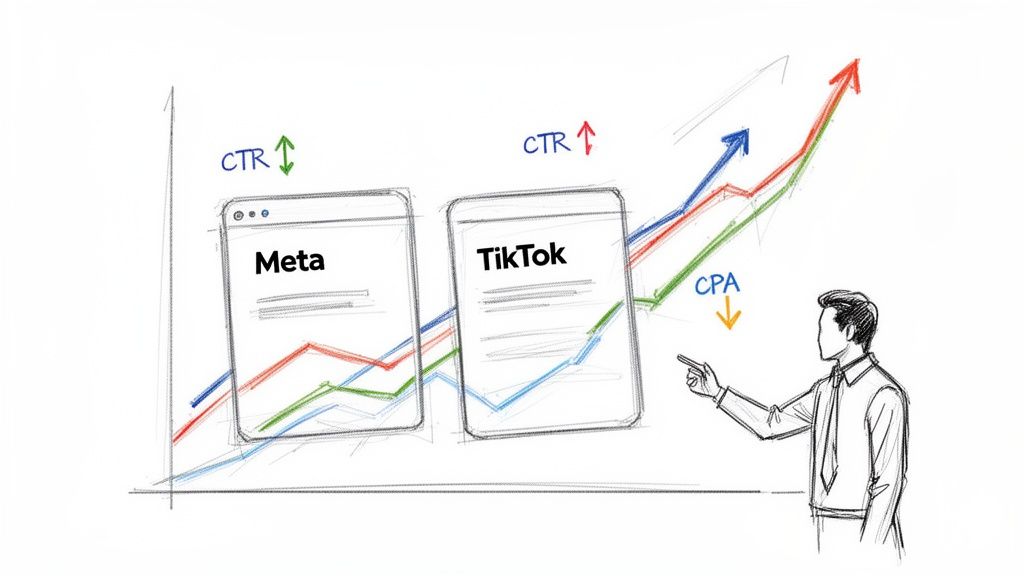
By churning out a high volume of creative variations, you can constantly swap in fresh ads. This keeps your content from getting stale, which is key to maintaining lower, more stable CPAs. Instead of one ad burning out, you’ve got a whole bench of alternatives ready to sub in.
Accelerate Your Testing Velocity
Finding a winning ad can feel like searching for a needle in a haystack. When you're editing manually, that search is slow and expensive. You're forced to place big bets on just a few ideas and hope one sticks.
Automation completely flips that script. It lets you test dozens of hypotheses at once with barely any extra effort.
Hook Testing: Want to know which opener grabs the most attention in the first three seconds? Pit five different hooks against each other and let the data decide.
CTA Variations: Experiment with different calls-to-action to see which phrasing actually gets people to click.
Audience-Creative Match: Quickly spin up tailored ads for different audience segments, making your creative more relevant and boosting performance.
This kind of rapid experimentation slashes the money you waste on ads that just don't connect. You find what works faster, so you can confidently put your budget behind proven winners.
When you speed up your creative testing, you stop guessing what might work and start knowing what does. This data-first approach is the bedrock of any scalable, profitable ad campaign on today's competitive platforms.
Create Faster Learning Cycles
Beyond just finding winners, automation creates much faster learning cycles for your entire team. When you can launch hundreds of creative tests in the time it used to take for ten, you’re gathering performance data at a wild pace.
This constant flow of information allows your team to analyze results, spot trends, and iterate on winning ideas more effectively. You're not just reacting; you're proactively shaping your creative strategy based on real-time feedback.
This rapid feedback loop is quickly becoming non-negotiable for modern advertising. In fact, the automated video editing software market is projected to grow from USD 7.50 billion in 2025 to USD 12.40 billion by 2030. That’s not just a random stat; it’s a massive signal showing how critical automation is becoming for teams that need to pump out more creative without burning out their resources. You can dig into more data on the video processing platform market's expansion.
Ultimately, a faster learning cycle means your creative strategy evolves faster. Your team gets more attuned to what your audience actually responds to, leading to smarter, more impactful ad concepts down the line.
When to Use Automation for Maximum Impact
While the power of automatic video editing is undeniable, it's not a magic wand for every video project. It’s a specialized tool. Think of it like a high-performance race car—absolutely unbeatable on the track, but you wouldn't take it to pick up groceries.
Knowing when to deploy automation is the real secret to unlocking its value.
The sweet spot for automation is high-volume performance marketing. If your goal is to churn out and test dozens, or even hundreds, of ad variations to find a winner on Meta or TikTok, automation is your new best friend. It demolishes the manual bottlenecks that stop you from testing different hooks, value props, and CTAs at scale.
Ideal Scenarios for Automation
This tech really comes alive when your creative strategy is all about iteration and volume. Instead of pouring all your resources into one perfect "hero" video, you're building a system to let the data tell you what your audience actually wants to see.
Here's where it truly shines:
High-Volume A/B Testing: Need to test ten different hooks against five unique testimonials? Doing that by hand is a nightmare. Automation makes this kind of granular testing not just possible, but downright simple.
Repurposing User-Generated Content (UGC): Turn that goldmine of customer videos into a never-ending stream of powerful testimonial ads. The system can automatically pull the best clips and quotes to create countless fresh combinations.
Creative Localization: Got a winning ad concept? Use automation to rapidly adapt it for different countries by swapping out text, voiceovers, and culturally relevant footage—all without starting from scratch.
This lines up perfectly with where the industry is heading. Teams are more distributed than ever, and the demand for efficient, cloud-based tools is exploding. In fact, the market for real-time collaborative video editing is projected to hit USD 5.15 billion by 2030, largely because of the need for tools that support AI-driven workflows and remote teamwork.
When Manual Editing Still Wins
But let's be clear: automation isn't the answer for everything.
For those big, brand-defining "hero" campaigns where every frame is about nuanced storytelling, emotional punch, and beautiful cinematography, the traditional, hands-on production process is still king. You can't automate that kind of artistry.
Use automation for testing and iterating at scale. Use manual, craft-driven editing for your flagship brand statements. The two are complementary, not competitors.
By knowing when to use each, creative strategists can put their time and budget where they’ll have the most impact. For a deeper look at how this fits into a bigger picture, check out our guide on the benefits of an AI creative automation platform. It's all about using the right tool for the right job to maximize both efficiency and creative firepower.
Common Pitfalls to Avoid with Automation
Jumping into automatic video editing can feel like you've unlocked a creative superpower, but it’s easy to stumble if you’re not careful. The biggest mistake we see is a classic one: "garbage in, garbage out."
Automation isn’t a magic wand that fixes bad source material. If you feed the system blurry, poorly lit, or badly framed clips, that's exactly what your final ads will look like. Think of the AI as a world-class assembler, not a miracle worker. Always start with high-quality, well-shot footage to give your automated workflow a real shot at producing professional, engaging videos.
Overlooking Brand Guidelines
Another major tripwire is failing to bake your brand guidelines into the platform from the start. Without any rules, the AI might start pairing clips, text, and music in ways that feel completely random and off-brand. You can end up with a chaotic mess of ad variations that have no consistent look or message.
Automation should scale your brand identity, not dilute it. Setting up rules for fonts, colors, logo placement, and tone of voice ensures every video variation feels cohesive and authentically yours.
This is a crucial preventative step. Taking the time to input your brand kit and creative guardrails upfront will save you countless hours of fixing off-brand videos down the line.
Relying on AI for Core Strategy
Finally, it’s a critical error to expect the AI to do your strategic thinking for you. Automation is a tool for execution and testing, not for big-picture ideation. It can't figure out your unique selling proposition or what emotional triggers will actually connect with your audience.
Your team’s insights, experience, and strategic direction are what make the magic happen. Use automatic video editing to test your hypotheses at scale, find winning combinations faster, and execute your vision with incredible efficiency. Just never outsource your core strategic thinking to the machine.
Got Questions? We've Got Answers
Jumping into automatic video editing can feel like a big step, and you probably have a few questions floating around. Let's tackle some of the most common ones we hear from marketing teams.
Will My Video Ads End Up Looking Generic?
That's a fair question, and the short answer is no—not if you're doing it right. Good automatic editing video platforms aren't just pumping out cookie-cutter content. Think of them less as a creative director and more as a hyper-efficient assembly line for your brand assets.
The system works with what you give it: your unique customer testimonials, your proven scripts, and your brand's visual identity. Because the final ads are built from your authentic creative, every single variation still looks and feels like it came directly from your team.
Is This Too Complicated for a Small Team to Handle?
Actually, it's the other way around. Modern platforms are built specifically for teams who don't have a massive production crew. The whole point is to simplify things.
You just upload your existing clips, the AI helps tag them, and you use simple modular frameworks to piece together ad concepts. It takes the most tedious, time-sucking parts of editing off your plate so your team can stop worrying about technical details and get back to thinking about creative strategy.
How Does This Work for Different Ad Platforms?
This is where this approach really shines. Advanced systems are designed from the ground up for multi-platform campaigns. They can automatically reformat your videos into the right aspect ratios, like 9:16 for TikTok or 4:5 for the Meta feed, without you lifting a finger.
You can even set up different rule-based templates for each platform. This lets you tweak the pacing, text overlays, and CTAs to fit what works best on each channel. The result? You can generate tons of platform-native creative from a single set of assets, saving an incredible amount of time.
Ready to stop wasting hours on manual editing and start scaling your ad creative? Sovran gives you the power to produce hundreds of high-performing video ad variations in minutes, not days. Find winning ads faster and leave creative fatigue in the dust. Start your free 7-day trial today!

Manson Chen
Founder, Sovran
Related Articles
How to Turn Link Into Video: Ads That Convert in 2026
Learn how to turn link into video for Meta & TikTok ads. Leverage AI to scale creation, boost ROI, and succeed in 2026.
8 High-Converting Static Ads Examples for 2026
Discover 8 high-performing static ads examples from top apps. Learn to create text-overlays, testimonials, and lifestyle ads that convert.
Your Guide to a Social Media Ad Generator in 2026
Discover how a social media ad generator revolutionizes creative production. Learn to automate video ads, scale testing on Meta & TikTok, and drive performance.