Your Guide to an AI Video Ad Creator
So, what exactly is an AI video ad creator?Think of it as a platform that uses artificial intelligence to automatically build and test video ads on a massive...
Jump to a section
So, what exactly is an AI video ad creator?
Think of it as a platform that uses artificial intelligence to automatically build and test video ads on a massive scale. It takes all your existing brand assets—video clips, images, logos, and text—and remixes them into hundreds of unique ad variations, all ready to go live. This lets marketing teams test creative ideas way faster than any manual production workflow could ever allow.
The New Reality of Video Advertising
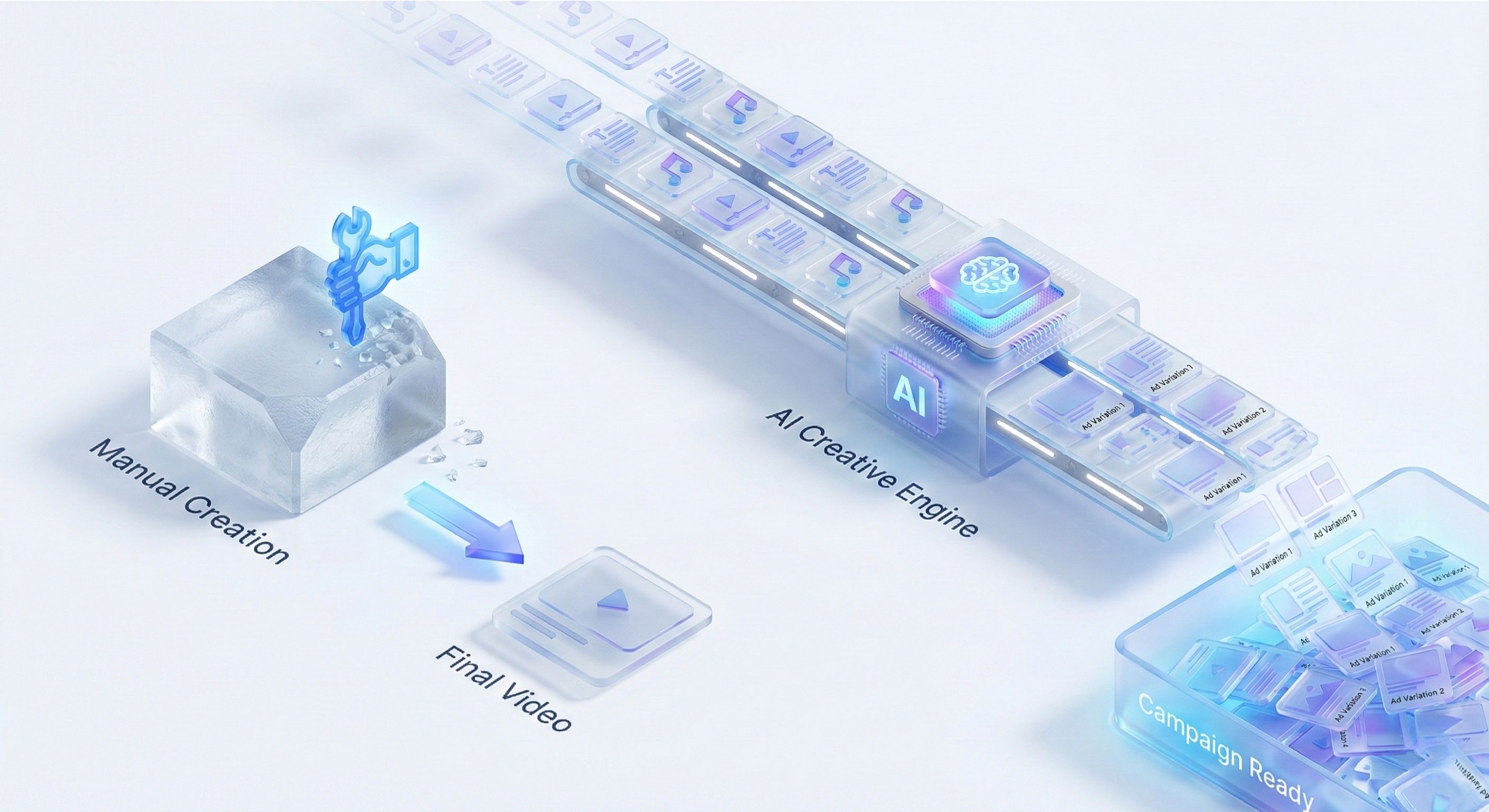
If you're on a modern marketing team, you know the pressure is always on to deliver fresh, high-performing video ads. But the cycle of brainstorming, shooting, editing, and launching is often slow, expensive, and a huge bottleneck to growth. Every new ad feels like a high-stakes gamble, with a ton of resources poured in before you even know if it will actually convert.
The old way of doing things is like a craftsman hand-building one car at a time. The process is careful and slow, and you end up with a single, polished vehicle. The quality might be amazing, but you can't possibly produce enough to meet demand or test which car designs people actually want to buy.
Shifting from Craft to Scale
An AI video ad creator completely flips this model on its head. It’s like upgrading from that lone craftsman to a fully automated factory. Instead of painstakingly building one car, you can now churn out thousands of customized vehicles all at once. The tech automates the repetitive, time-sucking production tasks, finally breaking the creative bottleneck.
This shift allows performance teams to stop trying to perfect a single ad and start testing hundreds of them. The benefits are pretty clear:
Massive Scalability: Generate a nearly endless stream of ad variations from your core assets to combat creative fatigue.
Increased Velocity: Launch new campaigns and tests in a matter of hours, not weeks. Your learning cycle just got a whole lot faster.
Data-Driven Decisions: Let actual performance data—not just your gut feeling—decide which creative concepts win.
Reduced Production Costs: Slash the cost per creative, which opens the door for much broader experimentation.
The Market is Already Moving
This isn't just a cool concept; it's a market that's blowing up. The global AI video market was valued at USD 3.86 billion in 2024 and is on track to grow at a compound annual growth rate (CAGR) of 32.2% through 2033. This kind of explosive growth is a huge signal that the industry is making a major shift toward automated creative.
This isn't about replacing creative strategists. It's about giving them a tool that can finally execute their ideas at the speed of modern ad platforms.
For a closer look at how this space is evolving, check out the latest trends and insights on the Tubentum Blog. Moving to AI-powered ad creation isn't just about being more efficient—it's quickly becoming a critical competitive edge.
How AI Video Ad Creators Actually Work
When you first hear about an "AI video ad creator," it’s easy to picture some mysterious black box that spits out ads from thin air. The reality is a lot less magic and a lot more strategic. It's not about an AI inventing concepts from scratch; it's a powerful system built for control, speed, and massive-scale creative testing.
Think of it like working with a master chef who has an army of assistants. You provide the raw ingredients—your video clips, product shots, logos, and taglines. The AI, acting as the chef, knows thousands of recipes (advertising frameworks) and directs the assistants to assemble those ingredients into countless unique dishes, each plated perfectly for a specific audience.
The Core Engine: It's All About Modular Assembly
At its heart, an AI video ad creator is built on a simple but powerful idea: modular assembly. It takes all your creative assets, breaks them down into individual components (or modules), and then figures out the best ways to mix and match them.
Here’s a look under the hood:
Asset Ingestion and Tagging: First, you upload all your raw creative—product shots, user-generated content (UGC), screen recordings, and brand graphics. The AI doesn’t just store these files; it analyzes and tags each one with descriptive metadata. A sunny beach clip might get tagged with "outdoor," "lifestyle," and "summer," so the AI understands its content and context.
Template Application: The system uses proven advertising frameworks as its blueprints. These aren't rigid, cookie-cutter templates but flexible structures like "Problem-Agitate-Solution" or the classic "Hook-Body-CTA." The AI knows exactly which types of assets fit into each part of the framework.
Dynamic Assembly: This is where the real horsepower kicks in. The AI takes your assets and frameworks, then follows your rules and hypotheses to generate a massive number of unique combinations. For example, you could test ten different hooks against five body sections and three calls-to-action, and the system will instantly create 150 distinct video ads from that single set of assets.
The goal isn't just to make one "perfect" video. It's to create a diverse portfolio of ad concepts, allowing real-world performance data to tell you which combinations of messaging and visuals actually work.
This whole process is guided by a deep understanding of what works on each platform, ensuring every ad is optimized right out of the gate.
Adapting Creatives for Every Platform
An ad that kills it on YouTube Shorts is likely to flop on Instagram Stories or TikTok. A smart AI video ad creator gets this and automatically tailors every single output for the platform it's destined for.
This platform-specific intelligence means the AI handles all the tedious adjustments, like:
Aspect Ratios: It automatically reformats videos from horizontal (16:9) for YouTube to vertical (9:16) for TikTok and Reels. No more manual resizing.
Pacing and Edits: It creates faster cuts and more dynamic transitions for short-form platforms where you have seconds to earn attention. A TikTok ad might have cuts every 1-2 seconds, while a YouTube ad can let shots breathe a little longer.
Safe Zones: It makes sure your critical text, logos, and CTAs aren't hidden by the platform’s UI elements like usernames, captions, or like buttons.
By taking care of these technical details, the AI frees up your team to think about what really matters: creative strategy. It’s a systematic approach that swaps painful manual editing for intelligent automation, turning your existing assets into a powerful engine for scalable, data-driven advertising.
Building a High-Performance Workflow
Knowing how the tech works is one thing. Actually using it to get results? That’s where the magic of an AI video ad creator really kicks in. A high-performance workflow isn't just about cranking out more ads. It's about systematically testing creative ideas to figure out what actually drives conversions. The best teams build this process around a classic, battle-tested advertising formula.
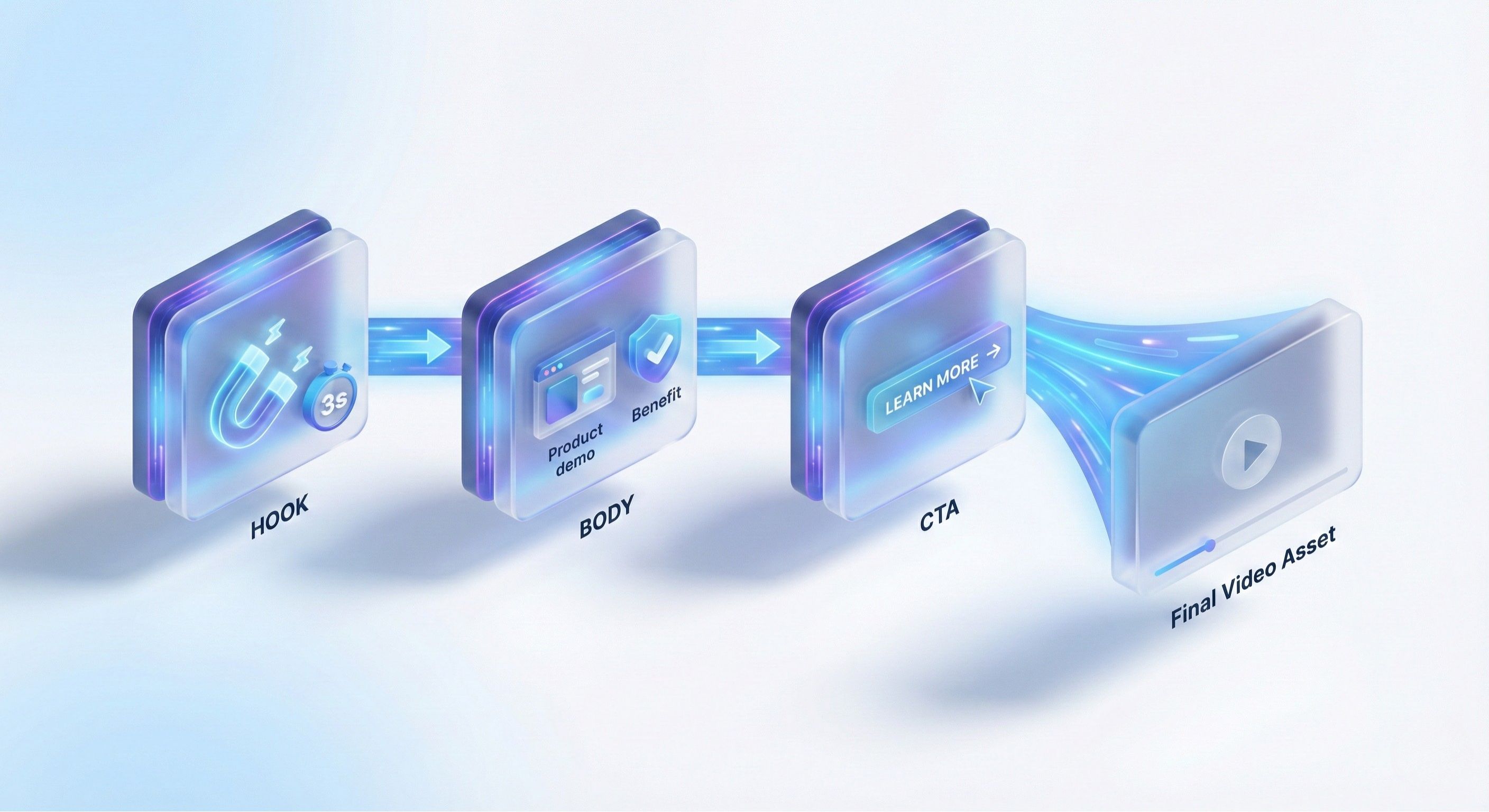
This structured approach lets you break down every ad into its core pieces—the Hook, the Body, and the Call-to-Action (CTA)—and use AI to test endless variations of each one. It's a methodical way to learn precisely what clicks with your audience at every point in the ad experience.
Deconstructing Your Ad Into Testable Components
Stop thinking about your video ad as one monolithic thing. Instead, think of it as a team of three specialists, each with a distinct job. An AI video ad creator gives you the power to optimize each specialist independently and then assemble your all-star team.
The Hook (First 3 Seconds): This part has one job and one job only: stop the scroll. You can pit a raw, user-generated content (UGC) style opening against a polished studio shot or a bold text overlay to see what grabs more eyeballs.
The Body (The Middle): This is where you deliver the goods and communicate value. The AI can instantly swap in different product feature demos, powerful user testimonials, or compelling problem-solution stories.
The CTA (The End): This is your closer. It drives the action. You can test a direct offer like "Shop Now" against a softer CTA like "Learn More," or even experiment with different discount codes to see what seals the deal.
By treating these as separate modules, you can generate hundreds of unique ads from just a handful of core assets. For example, if you test five hooks, five body variations, and three CTAs, you get 75 unique video ads ready to deploy.
This modular strategy flips ad creation from a high-stakes guessing game into a scientific process of discovery. You're no longer banking on a single "hero" creative to work; you're letting the data from 75 variants point you to the winning formula.
This whole process is as simple as it sounds. You feed the AI your raw inputs, it works its magic, and you get a ton of diverse video outputs ready for testing.
The big idea here is shifting from a slow, one-and-done production line to a fast, cyclical system. Your creative inputs are constantly being remixed into new, optimized ads based on what the data tells you.
The Context Vault: Your Single Source of Truth
To manage this kind of creative scale without everything descending into chaos, top-tier teams rely on what we call a Context Vault. This isn't just some messy folder of media files. It’s a smart, centralized library that acts as the single source of truth for your entire brand.
The Context Vault is where you house all your approved brand assets, making sure every single ad variation the AI pumps out is perfectly on-brand.
What goes into a Context Vault?
Brand Guidelines: Logos, color palettes, and fonts. These are the non-negotiables the AI must follow.
Approved Footage: All your raw video clips, product shots, and UGC—often tagged by the AI so you can find exactly what you need in seconds.
Winning Copy: Ad copy that has already proven itself, rave customer reviews, and taglines that stick.
Scripts and Frameworks: Pre-built templates for different ad structures, like listicles or problem-solution formats. Our guide on crafting a compelling script for advertising is a great place to start building these assets.
Having this repository means brand governance is baked right into your workflow. The AI operates within the guardrails you’ve established, so every ad is on-brand, legally compliant, and strategically sound, no matter how many versions you create.
This systematic approach is fueling some serious growth. The AI-generated video market is projected to expand at a staggering annual rate of 35%, on track to hit $14.8 billion by 2030. Why? Because brands need a way to produce personalized, short-form video ads at lightning speed without sacrificing brand integrity.
From Asset to Ad in Minutes
Once your Context Vault is organized, the workflow becomes incredibly fast. A creative strategist can brief the AI with a simple hypothesis, like: "Let's test UGC hooks from female creators against our studio product demos for the new skincare line."
The AI then dives into the vault, pulls the right assets, and assembles dozens of on-brand ad variations in minutes. That's a task that would've tied up a human video editor for days. This speed doesn't just make your team more efficient; it fundamentally changes how fast you can learn and optimize, helping you find profitable ad concepts up to 10x faster.
Choosing the Right AI Video Ad Creator
With so many AI tools popping up, picking the right AI video ad creator for your team can feel like a shot in the dark. It’s easy to get distracted by a long list of shiny features, but the best platform isn't just about cool tech. It's about finding a partner that actually gets your growth goals and fits into your workflow.
The truth is, not all AI tools are built the same. Choosing the wrong one can lead to a ton of frustration and, even worse, wasted ad spend. The key is to look past the generic sales pitch and focus on what directly impacts your campaign performance and your ability to scale.
For performance-driven teams, that means finding a tool that helps you do more than just make videos—it needs to help you learn faster and operate smarter.
Evaluating Core Platform Capabilities
When you’re comparing options, you have to dig deeper than just asking, "Can it make a video?" The real questions reveal how a tool will actually slot into your daily grind and contribute to your bottom line.
A truly great AI video ad creator should be built for performance marketing from the ground up. This boils down to a few critical pillars:
Scalability and Speed: How fast can the platform churn out a high volume of ad variations? Your goal is to test hundreds of ideas, so a tool that slowly creates one video at a time is a non-starter. Look for things like bulk rendering that can turn one brief into dozens of unique ads in minutes.
Brand Governance: Can you lock in strict brand rules that the AI has to follow? A platform without strong brand guardrails is a recipe for off-brand creative that can hurt your reputation. Features like a "Context Vault," where you can store logos, colors, and approved copy, are non-negotiable for keeping things consistent at scale.
Platform-Specific Integrations: Does the tool play nice with the ad platforms you live in, like Meta and TikTok? Direct integrations are a massive time-saver. They streamline your launch process, handle naming conventions automatically, and get your tests live way faster. Manually exporting and uploading is a workflow killer.
These are the fundamentals that separate the basic tools from the professional-grade platforms. If you want to see what a leading example looks like, check out the vidito AI video ad creator.
Key Differentiators for Performance Teams
Beyond the basics, a few advanced features can completely change the game for your team. These are the capabilities that elevate an AI video creator from a simple production tool into a strategic growth engine.
One of the most powerful is creative analytics. Does the platform give you any insight into which creative elements are actually driving performance? The best tools don't just spit out ads; they help you understand why certain ads win. That feedback loop is what supercharges your learning and leads to smarter, data-backed decisions for your next campaign.
A great AI partner doesn't just give you more shots on goal; it analyzes every shot to help you improve your aim for the next one. It transforms creative from an art into a science.
For a deeper look at what features really move the needle, our guide on the top AI video creation tools breaks down what matters most for performance marketers.
Basic Tools Versus Advanced Platforms
To really spell it out, let’s compare what you get from a simple, entry-level tool versus a more advanced AI video ad creator built for performance.
The right choice comes down to what you need to achieve your goals. This table should make it clear where the biggest differences lie.
Feature Comparison for Selecting an AI Video Ad Creator
Evaluation Criteria | Basic AI Tool | Advanced AI Ad Creator (e.g., Sovran) |
|---|---|---|
Creative Scalability | Generates one video at a time with limited variation. | Renders hundreds of unique ad variants from a single brief in minutes. |
Brand Governance | Requires manual review to ensure brand consistency. | Uses a "Context Vault" to enforce brand rules (logos, fonts, colors) automatically. |
Platform Integration | Requires manual export and upload to ad platforms. | Pushes ads directly to Meta and TikTok with automated naming conventions. |
Asset Management | Simple media library with basic folder organization. | AI-powered asset tagging and natural language search for finding clips instantly. |
Creative Analytics | No performance insights; you only see final video files. | Analyzes creative elements to identify winning patterns and inform future strategy. |
At the end of the day, picking the right AI video ad creator is an investment in a system, not just a piece of software. It’s about finding a platform that amps up your team's strategic power, accelerates your testing velocity, and gives you the data you need to consistently beat the competition.
Launching Your First AI-Powered Campaign

Alright, this is where the theory ends and the real learning begins. Kicking off your first campaign with an AI video ad creator is all about starting with a focused, manageable project that teaches you the ropes.
Don't try to boil the ocean here. Your goal isn't to hit a grand slam on day one. It's to get a feel for the workflow—briefing the AI, generating a batch of creative, and seeing what the data says.
This first launch requires a pretty big mental shift. You’re moving away from the old model of painstakingly perfecting a single video. Instead, you're embracing a system where you can launch dozens of variants and let the cold, hard numbers tell you which one actually works.
Your Pre-Launch Implementation Checklist
Before you generate a single video, a little prep work will save you a ton of headaches. A smooth launch starts with having all your assets organized and your goals crystal clear. This groundwork is what gives the AI everything it needs to churn out high-quality, on-brand creative right out of the gate.
Here are the essential steps to take before you hit "go":
Get Your Context Vault Organized: This is ground zero. Pull together all your approved brand assets—logos, hex codes, fonts, product clips, UGC, you name it—and drop them into one central library. This becomes the AI's single source of truth, making sure every ad variant stays perfectly on brand.
Define a Clear Test Hypothesis: Start with one simple, focused question. A great first test could be something like, "For our TikTok audience, does a raw, UGC-style hook crush a polished studio shot?" This kind of clarity makes your brief super specific and your results easy to read.
Prep Your Core Creative Brief: Write a short, punchy brief for the AI. Make sure you include the target audience, the main goal of the campaign (like app installs or lead gen), and the key value props you need to hit.
Think of this first campaign as a controlled experiment. Your mission is simple: validate one creative hypothesis, learn the platform's rhythm, and build your confidence in this new process.
Nailing this setup is what sets you up for a successful and insightful first run.
Briefing the AI for Optimal Results
The quality of your output is a direct reflection of how you talk to the AI. Vague prompts get you generic, useless videos. But a specific, well-structured brief turns the AI video ad creator into a hyper-efficient creative partner.
When writing your brief, think in modular components:
For the Hook: Get granular. Ask for "three variations of a 3-second hook using UGC clips that feature female creators under 30."
For the Body: Be specific about the message. Request variations that show "the product setup process" or "customer testimonials talking about how easy it is to use."
For the CTA: Test different offers. Ask for versions with "a 20% discount code" against a version with a "free trial offer."
This level of detail gives the AI clear guardrails, so it produces a set of ad creatives that are diverse but still strategically aligned. You're not just asking for videos; you're asking for specific tests of your core ideas. This entire process is the heart of what makes dynamic creative optimization tools so powerful—it’s all about testing different ad components to find the winning combination.
Letting Data Decide the Winner
The video ad space is exploding, with spending projected to hit a massive $214.76 billion globally in 2025. To get a piece of that pie, savvy marketers are leaning on AI for content editing (49%) and personalization (45%) to scale their campaigns without burning out their teams.
Once your campaign is live, the final and most important step is to simply listen to the data. Your creative preferences? They don't matter anymore. The winning ad is the one with the lowest CPA or the highest ROAS. Full stop.
This data-first mindset is what really unlocks the power of an AI video ad creator. It replaces guesswork with certainty and lets you iterate and improve with every single campaign you launch.
Common Questions About AI Video Creation
Jumping into any new tech brings up a lot of questions. That’s completely normal. When it comes to something like an AI video ad creator, marketing leaders are smart to ask how it's really going to affect their teams, their brand, and their bottom line.
Let's cut through the noise and tackle those big questions head-on. The goal here is to give you straight, honest answers so you can see this tech for what it is—a strategic tool, not some mystery box.
Will This Technology Replace My Creative Team?
This is usually the first question on everyone's mind, and the answer is a hard no. An AI video ad creator isn't here to replace your creative talent; it’s here to supercharge it. Think of it less as a replacement and more as a powerful assistant that takes on the grunt work.
It automates the mind-numbing task of churning out endless ad variations—a job that used to tie up talented editors and designers for days. This frees up your creative experts to do what they do best: thinking up big ideas, developing original concepts, and finding the amazing raw assets that fuel the whole process.
The AI handles the repetitive production work, while your team provides the creative soul and strategic brainpower. It’s a partnership that lets your best ideas get tested at a scale that was never possible before.
Your team’s role shifts from being hands-on producers to strategic directors, guiding the AI to test smarter ideas and learn from the results.
How Do I Ensure AI-Generated Ads Are On-Brand?
Keeping brand consistency across hundreds, or even thousands, of ad variations might sound like a recipe for disaster. But the truth is, the best AI platforms are built from the ground up with brand safety in mind. This isn't about letting an AI go rogue with your brand assets.
The secret is a feature often called a "Context Vault" or brand library. This is your command center where you lock in the non-negotiable rules for your brand. You upload your official logos, define your exact color palettes, set your approved fonts, and input your messaging guidelines. From that point on, the AI is hard-wired to operate only within those guardrails.
This system actually ends up improving brand consistency. It eliminates the small human errors—the wrong hex code here, an old logo there—that inevitably happen with manual production. Every single ad, from the first to the five-hundredth, is guaranteed to be 100% on-brand.
What Kind of Performance Lift Can I Expect?
The main performance boost you'll see from an AI video ad creator comes down to one thing: testing on a massive scale. Forget pouring your budget behind a couple of "hero" creatives and crossing your fingers. Now, you can test hundreds of variations to find out what actually connects with your audience.
This data-first approach lets you systematically improve every piece of your ad.
Test ten different hooks to see which one truly stops the scroll.
Swap out five value props to see which one gets the most clicks.
Experiment with three different CTAs to learn what actually gets people to convert.
Teams who adopt this methodology often see major improvements in key metrics like Return on Ad Spend (ROAS) and Cost Per Acquisition (CPA). Why? Because they're constantly fine-tuning their ads based on real performance data, not just gut feelings.
Is This Only for Large Enterprise Companies?
While it’s true that big enterprise companies were the first to jump on this tech, that's not the world we live in anymore. The market has grown up, and AI-powered creative tools are now well within reach for businesses of all sizes.
Many platforms offer flexible pricing plans built specifically for SMBs and startups. In fact, for smaller teams with fewer resources, the efficiency boost can be even more of a game-changer.
An AI video ad creator gives a small team the power to produce the volume and quality of creative that used to be reserved for companies with huge in-house studios or massive agency contracts. It completely levels the playing field, letting you compete with the big guys without needing a massive budget. It’s all about moving faster, learning quicker, and punching way above your weight in a crowded ad space.
Ready to stop guessing and start testing? With Sovran, you can transform your existing assets into hundreds of on-brand ad variations in minutes. Accelerate your creative testing, discover what truly drives performance, and find your next winning ad up to 10x faster. Start your 7-day free trial today.

Manson Chen
Founder, Sovran
Related Articles
Master AI Video Ad Production Workflow
Imagine whipping up a video ad in minutes, without sacrificing quality. That’s the promise of AI video ads—they draft scripts, select visuals, handle...
10 High-Impact Marketing Video Examples for Your 2026 Strategy
In performance marketing, scrolling is the enemy. On platforms like Meta and TikTok, you have less than three seconds to stop a potential customer from swiping...
How to Create Ads with AI That Actually Convert
Creating ads with AI is all about combining your brand's unique creative assets with an intelligent platform to generate, test, and scale winning ad...