AI Powered Video Creation: Your Ultimate Guide
What if you could ditch the endless cycle of high costs and slow turnarounds that plague traditional video ad production?Picture this: instead of waiting weeks...
Jump to a section

What if you could ditch the endless cycle of high costs and slow turnarounds that plague traditional video ad production?
Picture this: instead of waiting weeks for a single video, you can generate hundreds of high-quality, personalized ad variations at lightning speed. This isn't some far-off concept—it's the new reality of AI-powered video creation, and it’s completely changing the game for brand communication.
We're moving away from old, inefficient workflows and into an era of rapid, data-driven creative.
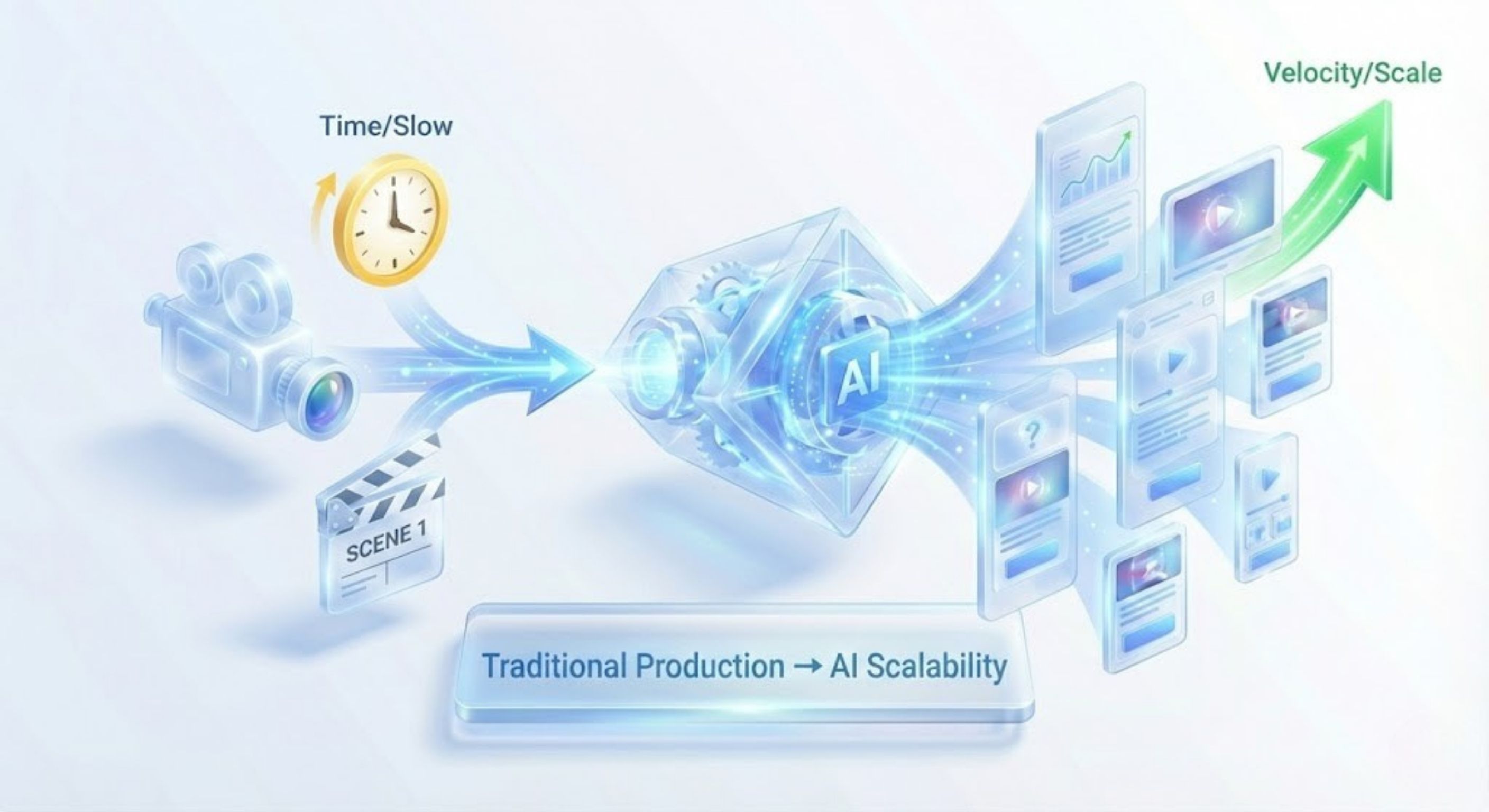
This guide will break down how AI automates everything from scriptwriting to final rendering, solving some of the biggest headaches in modern marketing.
Solving the Scalability Problem
Let's be honest, traditional video production is painfully linear and slow. A single video ad can take weeks to create, which makes testing different creative angles nearly impossible. You just can't move fast enough.
AI platforms flip this model on its head. They modularize the entire process, letting teams mix and match components—hooks, visuals, calls-to-action—to instantly generate a ton of variations.
This directly tackles a core challenge for performance marketers: creative fatigue. With AI, you can constantly feed your campaigns fresh, relevant content, keeping your audiences engaged and your ad performance from tanking. It's the shift from a one-size-fits-all approach to hyper-personalized communication that actually scales.
A Market on the Rise
The explosive growth of this industry tells the whole story. The global AI video generator market was valued at USD 614.8 million in 2024 and is on track to hit USD 2.56 billion by 2032.
That’s a compound annual growth rate of about 20%, fueled by marketers, corporate trainers, and entertainment companies all realizing the massive cost and scalability benefits.
By taking over the repetitive tasks, AI frees up creative teams to do what they do best: focus on strategy and big ideas. The real win isn't just making more videos, but making smarter, data-backed videos that deliver measurable results.
This guide is your roadmap for leaving outdated production methods behind. We'll cover the core tech, practical implementation, and even dive into specific applications like AI avatar videos explained. Get ready to completely rethink your approach to video advertising.
How AI Video Creation Actually Works
So, how does this all come together? It’s tempting to think of AI video creation as some kind of black-box magic, but it’s much more practical than that. Think of it less like a magic wand and more like a highly intelligent digital assembly line.
On this line, different specialized AIs work together, each handling a specific part of the production process. This teamwork is what turns a folder of raw assets and a few simple instructions into a finished, polished video—all without you needing a degree in video engineering.
At its core, the whole operation runs on a few powerful technologies that are getting incredibly good at mimicking human creative and analytical skills. They don't just blindly follow commands; they interpret, create, and organize, forming the real engine that drives this new wave of video production.
The Three Core AI Technologies
Let’s break down the key players on this assembly line.
First up is Generative AI. This is the one grabbing all the headlines, the tech that can create entirely new content from simple text prompts. Think of it as the on-demand artist. You can ask it to generate a stunning visual of a "futuristic cityscape at sunset," and it will produce a unique video clip that fits the bill. This is a game-changer for creating b-roll, abstract backgrounds, or specific shots you just don't have lying around. If you want to get good at this, there are great guides on how to create videos with AI like a pro that dive into prompt engineering and style.
Next, we have Natural Language Processing (NLP). You can think of NLP as both the scriptwriter and the voiceover artist. It’s the AI's ability to understand, interpret, and generate human language. This is what powers features that can:
Write ad scripts from nothing more than a product description and target audience.
Generate lifelike voiceovers in different languages, accents, and tones.
Create subtitles automatically by listening to and transcribing the audio.
NLP is the bridge between your ideas (typed in plain English) and the machine’s ability to bring them to life. It makes the whole process feel surprisingly intuitive.
Finally, there’s Computer Vision. This technology is the super-powered librarian or asset manager of the whole system. It analyzes images and video clips to understand what’s in them, automatically identifying objects, scenes, and even emotions. This allows it to tag your entire library of creative assets, making everything instantly searchable. You can literally ask the platform for "all clips showing happy customers using our product," and computer vision will pull them up in seconds. No more digging through folders!
To really understand the roles these technologies play, here’s a quick breakdown:
Core AI Technologies in Video Creation
A breakdown of the key AI technologies and their specific roles in the video creation process.
AI Technology | Function in Video Creation | Practical Example |
|---|---|---|
Generative AI | Creates new visual content (video clips, images, backgrounds) from text prompts. | Typing "a cinematic shot of a coffee bean roasting" to generate a unique B-roll clip for a cafe ad. |
Natural Language Processing (NLP) | Understands, interprets, and generates human language for scripts, voiceovers, and subtitles. | Automatically generating five different ad scripts and a voiceover track from a product description. |
Computer Vision | Analyzes and understands the content of existing images and videos for automated tagging and search. | Uploading 100 video clips and having the AI automatically tag them with keywords like "outdoors," "smiling person," or "product in use." |
As you can see, each technology has a distinct job, but their real power comes from working together.
Assembling the Final Video
These three technologies don't just operate in silos. A modern AI video platform weaves them into a smooth, logical workflow. Let's walk through a real-world example: creating a video ad for a new running shoe.
Asset Analysis: First, you upload your existing product photos and video clips. Computer Vision gets to work, scanning and tagging everything it sees—"running on a trail," "close-up of shoe," "person tying laces."
Script and Voiceover: You provide a simple brief about the shoe's benefits. NLP takes it from there, generating a compelling script and a dynamic voiceover to match.
Visual Generation: You decide you need a dramatic shot of a mountain sunrise to open the video, but you don't have one. No problem. You use Generative AI to create this clip from a text prompt.
Modular Assembly: The platform now pulls all these pieces together. It combines the generated sunrise clip, your tagged footage of the shoe in action, the NLP-generated voiceover, and finishes it off with branded text overlays and background music.
This modular approach is the secret to scaling your creative output. By treating every element—the hook, the product shot, the call-to-action—as a swappable component, the AI can remix them into hundreds of unique variations for A/B testing in just a few minutes.
This whole process is worlds away from the slow, manual slog of traditional video editing.
It's not just about making one video faster; it’s about building a system that can produce an endless stream of creative variations whenever you need them. For a deeper look at the specific tools making this happen, check out our guide on automated video editing software.
Driving Performance with a Creative Intelligence Platform
Knowing the core AI technologies is one thing, but the real magic happens when you put them to work in a performance marketing campaign. This is where a Creative Intelligence Platform steps in. It's not just another tool; it's the central nervous system for your entire ad production process.
Think of it as a strategic hub where your creative assets, brand rules, performance data, and AI-powered production tools all live and work together. This setup is crucial for cracking the scalability problem that every marketer faces. It turns creative from a gut-feel art form into a measurable engine for growth.
The market is exploding to meet this need. The artificial intelligence video market was valued at USD 7.6 billion in 2024 and is expected to hit a staggering USD 156.57 billion by 2034. This insane growth, driven by our hunger for video, shows a clear shift toward smarter, more scalable ways to produce content. You can see the full market analysis on Precedenceresearch.com to get the bigger picture.
The Brand Brain: The Context Vault
At the heart of any solid Creative Intelligence Platform is what we at Sovran call a Context Vault. Picture it as your brand's institutional memory—its digital brain. This isn't just a fancy Dropbox folder; it's an active system that stores and understands the context behind all your marketing.
The Context Vault holds the mission-critical info that guides every single creative the AI generates. This includes stuff like:
Brand Guidelines: Your logos, color palettes, fonts, and tone of voice are locked in, ensuring every video is 100% on-brand, every time.
Performance Data: It pulls in data on what’s worked before—your best hooks, winning visuals, and highest-converting calls-to-action—to make smarter decisions for the next campaign.
Customer Insights: You can feed it customer reviews, testimonials, and survey responses so the AI has rich, authentic material to build persuasive ad copy.
Proven Scripts: Your greatest-hits ad scripts and messaging frameworks are stored here, ready for the AI to adapt and spin into new variations.
By centralizing all this knowledge, the Context Vault makes sure every AI-generated video isn't a random shot in the dark. It's an educated, data-backed move designed to connect with your audience and stay true to your brand.
Modular Assembly for Limitless Testing
With the Context Vault providing the smarts, the platform's production engine uses a technique called Modular Assembly. This approach completely flips the script on creative testing. Instead of building one video at a time, you’re building a system of interchangeable parts.
Imagine your video ad is made of LEGO bricks:
The Hook (Brick A): The first 3 seconds that stop the scroll.
The Body (Brick B): Your core message or product demo.
The Call-to-Action (Brick C): The final nudge that gets the click.
A traditional workflow gives you one combination: A1-B1-C1. But with modular assembly, the AI can take five different hooks (A1-A5), five body variations (B1-B5), and five CTAs (C1-C5) and instantly build them into 125 unique video ads.
This is where all the underlying tech comes together.
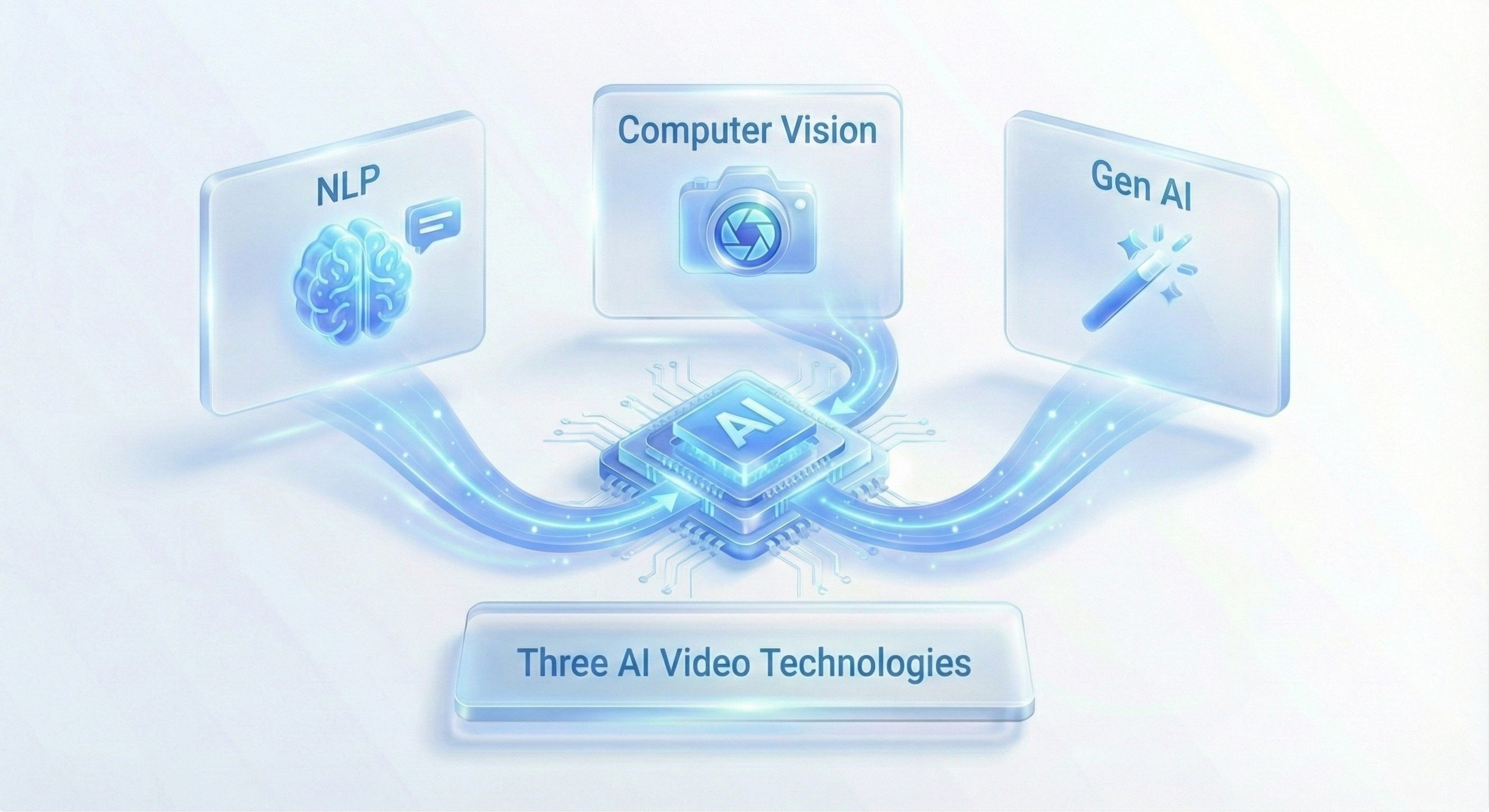
NLP acts as the scriptwriter, Computer Vision organizes your assets, and Generative AI creates new visuals—all feeding into this modular system.
The key takeaway: Modular assembly lets you test creative variables at a scale that's physically impossible for a human team. You're no longer guessing which hook works best; you're systematically testing all of them to find the data-proven winner.
A Unified and Intelligent Workflow
A Creative Intelligence Platform pulls all of these pieces into a single, seamless workflow. It's where your team manages assets, builds modular video templates, launches campaigns, and analyzes results without having to jump between a dozen different disconnected tools.
For performance marketers, this is huge. You can finally connect creative production directly to campaign outcomes. To see how this integrated approach works in practice, check out our deep dive on using AI for ads. This unified system is the secret to turning your creative strategy from a bottleneck into your biggest competitive advantage, letting you learn faster and run more profitable campaigns.
So, What’s the Real Upside (and Downside) for Marketers?
Bringing AI-powered video creation into your workflow isn’t just about getting a new piece of software. It’s a completely different way of thinking about how your marketing team works. For anyone on the performance side of things, constantly chasing results, this tech offers some massive advantages. But let's be real—it’s not a silver bullet. You need to go in with a clear head about what it can and can’t do.
The biggest, most immediate win is the sheer speed and scale you get. We all know traditional video production can be a painful bottleneck. Getting just a handful of ad variations can drag on for weeks. AI platforms just blow that problem away, letting you spin up hundreds of unique, on-brand video ads from one set of assets in literally minutes. This is what an aggressive and effective testing culture actually looks like in practice.
And that speed directly fuels performance. When you can test more creative variables—different hooks, visuals, calls-to-action—you find the winning combos way faster. You stop relying on gut feelings and start making decisions backed by hard data, which ultimately means higher conversion rates and a much healthier Return on Ad Spend (ROAS).
The Strategic Upside of AI Video
Beyond just moving faster, AI brings a level of personalization that was basically a fantasy at scale until now. By plugging into product feeds and customer data, these platforms can generate video ads tailored for specific audience segments, showing them the exact products or messages that will hit home. You move from shouting at a crowd to having a precise, one-to-one conversation.
Other key advantages are pretty compelling:
Slashed Production Costs: You’re automating the most labor-intensive parts of the job—editing, voiceovers, rendering. This dramatically lowers the cost per video. A recent Adobe study even pointed out how these AI tools free up budgets by eating up all that time-consuming work.
Rock-Solid Creative Consistency: When you have brand kits and guidelines locked into a system like a Context Vault, every single video that comes out is guaranteed to be on-brand. No more rogue creative slipping through the cracks.
A Cure for Ad Fatigue: The ability to constantly refresh your campaigns with new creative variations keeps your audience from tuning out. It's the ultimate weapon against performance decay.
AI basically acts as a creative multiplier. It doesn't just make the production line faster; it expands what your team is capable of. By handling all the repetitive grunt work, it frees them up to think about high-level strategy and analyze what’s actually working.
Navigating the Current Limitations
Okay, so AI-powered video creation isn’t perfect, and it’s important to know the current boundaries to set the right expectations. The most common critique is the "creative uncanny valley"—that feeling you get when AI-generated visuals or voiceovers are just… a little off. They might lack the genuine nuance of something shot by a human. While the tech is getting better at an insane pace, it still has a hard time convincingly portraying complex human emotions.
Another big thing to watch out for is brand dilution. If you’re not careful, the ease of pumping out hundreds of videos can lead to a firehose of generic, uninspired content. The AI is a fantastic executor, but it still needs a human with a strong creative strategy to give it vision and direction.
And finally, while AI is a genius at iterating on existing concepts and assets, it’s not yet going to come up with your next big, game-changing campaign idea out of thin air. That initial spark, that truly groundbreaking creative concept, still comes from the human brain. The teams that win with this tech see AI not as a replacement for their creative people, but as a powerful collaborator that executes and tests their best ideas at a scale that was never before possible.
To put it all in perspective, here’s a quick breakdown of where AI video creation shines for performance marketers today—and where you still need to be mindful of its limits.
AI Video Creation Pros and Cons for Performance Marketing
Aspect | Benefit (Pro) | Limitation (Con) |
|---|---|---|
Speed & Scale | Generate hundreds of ad variations in minutes, not weeks, enabling rapid testing. | Risk of creating a high volume of generic content without strong creative direction. |
Cost Efficiency | Dramatically reduces per-video production costs by automating manual tasks. | Initial setup and subscription costs for advanced platforms can be a consideration. |
Creative Testing | A/B test hooks, visuals, and CTAs at a massive scale to find winning combinations faster. | AI is better at iterating on existing ideas than generating brand-new, original concepts. |
Personalization | Create tailored ads for specific audience segments using product feeds and data. | Can lack the nuanced, emotional depth of high-end, human-shot content. |
Brand Consistency | Enforce brand guidelines automatically across all generated video assets. | Over-reliance on templates can lead to a uniform look that doesn’t stand out. |
Ad Fatigue | Easily refresh creatives to keep campaigns engaging and prevent performance dips. | The "uncanny valley" effect can sometimes make AI-generated elements feel slightly off. |
By understanding this balance, you can use AI to amplify your team's strengths, automate the tedious work, and drive real, measurable growth.
Getting AI Video Plugged Into Your Marketing Workflow
Bringing AI-powered video creation into your day-to-day isn't like flipping a switch. It’s more like building a new, much smarter production line for your ads. To get it right, you need a solid game plan that starts with the fundamentals before you even think about creative work or optimization. Get the setup right, and you'll see results way faster.
It’s easy to get excited and want to jump straight into making videos. But if you don't have clear goals and a library of organized assets, you'll just be spinning your wheels. Think of it like setting up a factory—the better the initial blueprint and setup, the smoother the whole operation runs.
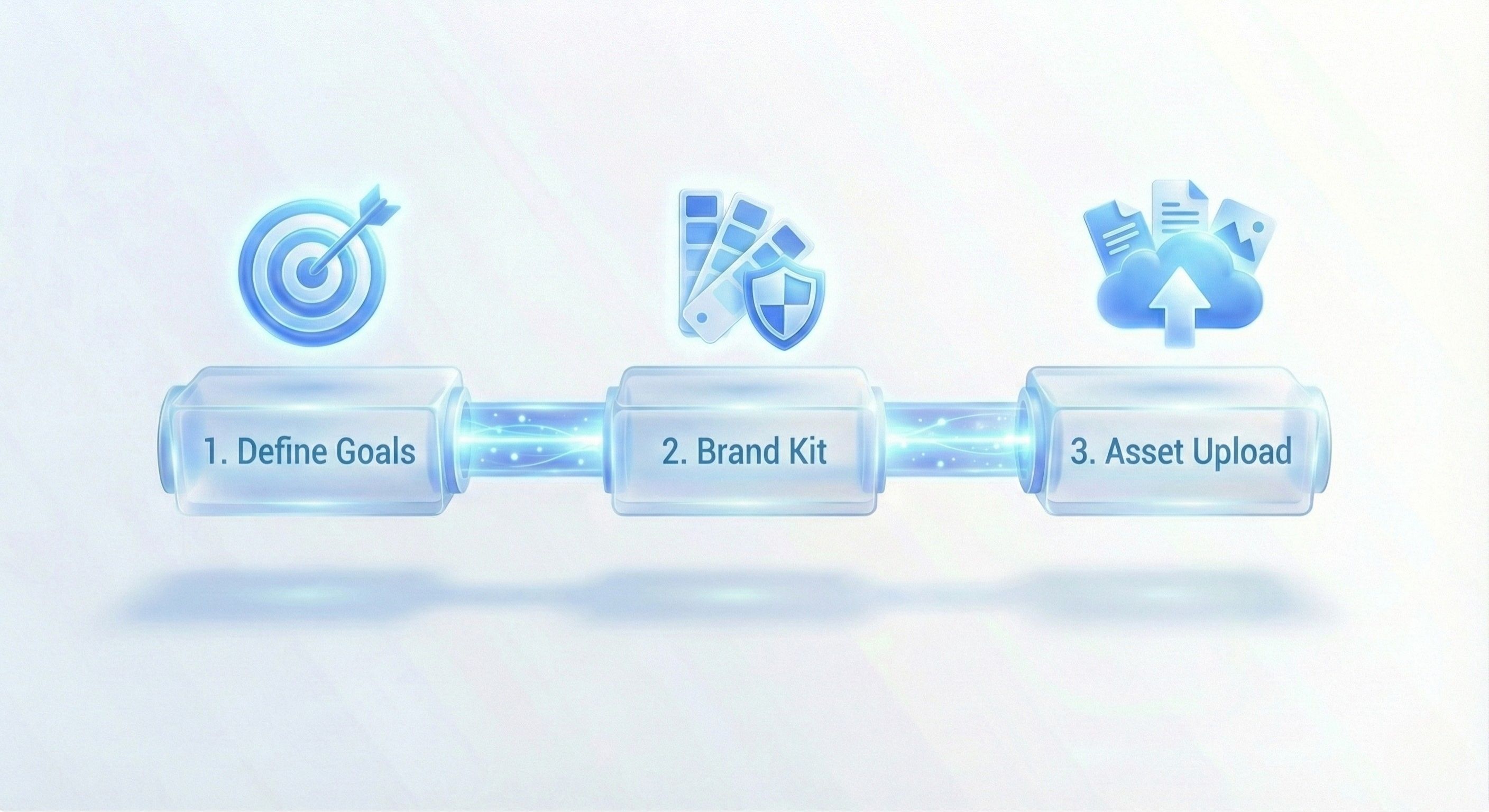
This first phase is all about defining what a "win" looks like and feeding the AI the raw materials it needs to do its job.
Laying the Foundation for Success
Before you create a single frame, you need to get your house in order. This really comes down to three key steps that will make or break the quality and consistency of your AI-generated ads.
Define Clear Goals: What are you actually trying to do here? Maybe your goal is to ramp up creative testing by 5x, or perhaps you want to slash your cost-per-video by 40%. Setting specific, measurable targets gives the whole project a clear purpose.
Lock In Your Brand Kit: This one is non-negotiable if you care about brand consistency. Get your logos, color palettes, fonts, and any other branded graphics uploaded into the platform. A system like Sovran’s Context Vault uses this kit to make sure every single video feels like it came from your in-house team.
Upload and Tag Your Best Assets: Round up your greatest hits—top-performing video clips, slick product shots, authentic UGC, and powerful customer testimonials. As you upload them, the platform’s computer vision will start auto-tagging, but you should add your own strategic tags to organize everything by funnel stage, product line, or even emotional tone.
When you do this foundational work, you’re not just uploading files. You’re actively teaching the AI your brand’s visual language and what winning looks like for your campaigns.
Building a Process for Creative and Testing
With your assets and brand rules locked in, you can shift your focus to the creative side of things and let your team and the AI start working together. This is where your human strategists direct the AI’s incredible production power. Start structuring your creative briefs with a modular approach, breaking down the different hooks, body sections, and CTAs you want to test.
This new workflow lets your team act more like architects than construction workers. They design the campaign blueprint—setting the core message and target audience—and the AI handles the grunt work of assembling hundreds of ad variations. If you want to go deeper on this, check out the specifics of AI Integration in Post-Production.
From there, it all becomes a continuous feedback loop. Launch structured A/B tests to isolate specific variables, like pitting a problem-focused hook against a benefit-focused one. As the performance data comes back, you feed it right back into the platform. This is how the system learns which creative ingredients drive real results, helping it make smarter suggestions and improve the performance of the next batch of videos.
Measuring Success and Proving ROI
Let's be real. Adopting any new tool, especially something as core as AI-powered video creation, has to come with a clear business case. You can't just show off cool demos; you need to prove its value with cold, hard numbers.
The trick is to shift your focus from vanity stats to the performance metrics that actually move the needle. This means getting past simple view counts and digging into the key performance indicators (KPIs) that your CFO cares about. When you track these metrics across all your video variations, you build an undeniable case for your investment and draw a straight line from creative work to revenue.
Core Performance Metrics to Track
When you’re suddenly able to generate dozens or even hundreds of video ads, your biggest advantage becomes your ability to measure performance with incredible precision. You're no longer just launching one ad and crossing your fingers. Now, you can run structured experiments to figure out exactly what makes your audience tick.
Your main focus should boil down to these three pillars of performance marketing:
Click-Through Rate (CTR): This tells you how good your video is at stopping the scroll and getting someone to take that first step. With AI, you can test a ton of different hooks to see which visuals and opening lines are most effective.
Conversion Rate: This is the ultimate gut check for your ad. Are people actually doing what you want them to do, like buying something or signing up? Testing different calls-to-action (CTAs) and value props will show you what truly drives people to act.
Return on Ad Spend (ROAS): This is the metric that pays the bills. ROAS measures how much money you make for every dollar you spend. By systematically improving your CTR and conversion rates, you directly boost your ROAS, proving the financial upside of your creative strategy.
Introducing New Operational KPIs
Beyond the classic ad metrics, AI video workflows bring a few new operational KPIs to the table that show off your newfound efficiency. These metrics help you put a number on the speed and scale that were previously out of reach.
One of the most important is Creative Velocity. This is simply the number of new, unique ad creatives your team can produce and launch per week or per campaign. A higher velocity means you're testing more ideas, fighting off ad fatigue faster, and keeping your campaigns fresh.
The point isn't just to make more ads for the sake of it. The goal is to speed up your learning cycle. More Creative Velocity means you get performance data back faster, find winning ad formulas sooner, and leave competitors in the dust while they're stuck in slow, manual production.
Another key metric is your Customer Acquisition Cost (CAC). When you automate production, you slash the operational costs tied to making each ad. Combine that lower overhead with higher-performing creatives (thanks to all that testing), and your overall CAC naturally starts to drop.
This makes your whole marketing engine more profitable. The market is catching on, too—the AI video creation market hit USD 1.3 billion in 2023, and some projections show AI could generate 40% of all online video content by 2030. Learn more about these AI video generation statistics.
Common Questions About AI Video Creation
Jumping into any new tech brings up questions, and when it’s something that touches your creative process, you need real answers. We hear a lot of the same concerns from teams: Will this AI mess with our creative roles? How do we know our brand assets are safe?
Let’s get straight to it and tackle these common worries. The idea isn't to throw out what’s working, but to give your team a serious upgrade in a way that’s both smart and secure.
Will AI Replace Our Creative Team?
This is usually the first thing people ask, and the answer is a hard no. Think of an AI platform as the ultimate production assistant, not a creative director. It’s here to handle the grunt work that drains your creative team's energy.
AI is brilliant at the repetitive stuff—spitting out hundreds of ad variations, handling all the rendering, and keeping assets organized on a massive scale. This frees up your creative pros to nail the things they’re best at:
Dreaming up high-level strategy and killer campaign concepts.
Focusing on original ideas and sharp scriptwriting.
Digging into performance data to figure out what the next big creative idea should be.
The teams who really crush it use AI to get their best ideas into the market and start testing them in minutes, not weeks. It’s about executing their vision faster and on a bigger scale than ever before.
How Secure Is Our Brand Data and Assets?
Handing over your brand’s crown jewels to a new platform is a big deal, and security should absolutely be on your mind. Any legitimate Creative Intelligence Platform is built on a foundation of enterprise-grade security. Your assets, your performance data, your secret sauce—it all has to be locked down and confidential.
When you're looking at different platforms, grill them on their security protocols. Ask about data encryption and any compliance certifications they have. You'll want to see things like secure cloud infrastructure and role-based access controls, which means only the right people on your team can get into a secure, sandboxed environment.
How Long Does It Take to Get Started?
Today’s AI platforms are built to get you moving fast. While every setup is a bit different, you can generally be up and running within a few weeks. The first step is usually loading in your brand kit, uploading your core assets, and linking up your ad platforms.
You can expect to be churning out your first AI-powered videos within the first month. And the results? You'll start seeing performance data from A/B tests almost right away. Most teams feel the workflow get a whole lot smoother within the first quarter and can point to real, measurable lifts in metrics like ROAS in just one or two campaign cycles.
Ready to see how an AI-powered platform can speed up your creative testing and drive better performance? Sovran automates the entire video ad production process, letting you find winning creatives up to 10x faster. Start your free 7-day trial today.

Manson Chen
Founder, Sovran
Related Articles
How to Create Videos with AI: How to Create Videos with AI, Quick Wins
Making videos with AI isn't some black box magic. It really boils down to a few key moves: getting your brand assets in order, picking a proven ad format,...

How to Make UGC: Fast and Effective Methods for 2026
Learning how to create UGC that actually converts starts way before you hit record. It’s all about laying the right groundwork—nailing down your goals, getting...
Master AI Video Ad Production Workflow
Imagine whipping up a video ad in minutes, without sacrificing quality. That’s the promise of AI video ads—they draft scripts, select visuals, handle...