Automated Video Editing Software: AI Tools for Marketing
So what exactly is automated video editing software? Think of it less like a tool and more like a powerful creative partner. It’s software that uses artificial
Jump to a section
So, what exactly is automated video editing software?
Think of it less like a tool and more like a powerful creative partner. It’s software that uses artificial intelligence to take over all the repetitive, manual, and frankly, boring parts of video production. This lets creators and marketing teams produce way more high-quality video content, much faster. It handles the grunt work, freeing you up to focus on the big picture and creative strategy.
From Manual Craft to Automated Power
Imagine the difference between a lone artisan hand-crafting a single chair versus a modern, automated factory churning out thousands. That’s the leap video editing is making right now.
We're moving away from the old-school, tedious process of frame-by-frame adjustments and stepping into the efficiency of automated systems. This isn’t just a cool new trend; it’s a direct response to some massive shifts in the market.
The demand for short-form, mobile-first video on platforms like TikTok and Meta is absolutely relentless. This puts huge pressure on performance marketers and user acquisition (UA) teams. To even stand a chance, you have to be constantly testing new ad creatives, localizing campaigns for different regions, and swapping out ads to fight creative fatigue. Doing all that manually? It's just not possible to keep up.
Manual vs Automated Video Editing At a Glance
To put this shift into perspective, let's break down the core differences between the old way and the new way of producing video ads at scale.
Aspect | Manual Editing (Traditional) | Automated Editing (Modern) |
|---|---|---|
Workflow | Linear, one-off projects. Each new video is a fresh start. | Modular and parallel. Create hundreds of versions from a single template. |
Speed | Slow. Takes hours or even days to create a few variations. | Fast. Generates hundreds of unique videos in minutes. |
Scalability | Low. Scaling requires more editors and more time. A true bottleneck. | High. Effortlessly scale creative output without adding headcount. |
Testing | Limited. Can only test a handful of ideas due to time constraints. | Extensive. Enables massive A/B testing of hooks, CTAs, and more. |
Cost | High per video. Labor-intensive process drives up costs. | Low per video. Dramatically reduces the cost of producing creative assets. |
Consistency | Inconsistent. Brand guidelines can be missed across different editors. | Consistent. Templates ensure brand consistency across all variations. |
As you can see, the move to automation isn't just about saving a bit of time—it fundamentally changes what's possible for a marketing team.
The Driving Forces Behind Automation
A few key factors are pushing this change forward. The global video editing software market was valued at around $3.09 billion in 2023 and is on track to hit $5.13 billion by 2032. That explosive growth is being driven by AI and the desperate need for content solutions that can actually scale.
This isn't just happening in video editing, either. It’s a wave sweeping across the entire creative industry, with all sorts of AI tools for content creators changing how production gets done. For marketing teams, automation is the clearest path to working smarter and getting better results.
Automation is no longer about just saving time—it's a strategic necessity for creating high-quality video content at the scale required to win in today's performance marketing landscape.
A New Strategic Advantage
Automated video editing software flips the script, turning your creative workflow from a major bottleneck into a powerful growth engine.
Instead of burning days just to edit a handful of ad variations, your team can now generate hundreds of versions in the time it takes to grab a coffee. This is a game-changer for running effective A/B tests and figuring out what actually connects with your audience.
For example, a UA manager can simultaneously test dozens of different hooks, calls-to-action, and background music options. The insights you get from those tests lead directly to higher conversion rates and a much better return on ad spend (ROAS). If you want to see this in action, check out our guide on how to automate Facebook video ads that actually convert.
Ultimately, embracing automation isn't about replacing human creativity. It's about amplifying it. It lets your team offload the heavy lifting to the software so they can focus their brainpower on strategy, new ideas, and the next big win.
How Automated Video Editing Software Works
So, how does this all actually work?
Think of automated video editing software as a hyper-efficient production crew living inside your computer. Instead of a single person painstakingly tackling every little task—finding the right clips, cutting scenes, adding text—the software deploys a team of specialized AI assistants that handle each step at the same time. This is the secret sauce that lets you crank out hundreds of video variations in minutes, not days.
Artificial intelligence is the engine driving this whole process. It’s what gives the software the smarts to understand your content, pinpoint key moments, and stitch everything together based on a structure you define. This isn’t just a niche trend; by 2025, it's estimated that 77% of video editing tools will have some form of AI automation built-in, slashing production time by up to 70% for certain tasks. We're talking about everything from automatically detecting scenes to adding smart transitions and generating subtitles on the fly. You can dive deeper into these video editing statistics on Gudsho.com.
Modular Video Assembly: The Building Block Approach
One of the coolest and most powerful concepts here is modular video assembly. Picture a giant box of LEGOs. You’ve got all sorts of different shapes, sizes, and colors that you can combine in endless ways to build whatever you want. That's exactly how modular video works.
Instead of starting from a blank slate every time, you feed the software a library of pre-approved "building blocks," which can be anything like:
Hooks: Short, punchy clips for the first 3 seconds to grab attention.
Body Segments: The main message, product demos, or user testimonials.
Calls-to-Action (CTAs): End cards with your specific offer or instructions.
B-Roll: Extra footage that adds visual flavor and context.
Text Overlays: Headlines, feature callouts, or key benefits.
The software then acts like a master builder, snapping these pieces together based on templates you create. You could tell it to build 100 videos, each with a different hook but the same body and CTA. Just like that, you have a massive A/B test ready to go, all to find out which opening line works best.
Intelligent Asset Management and AI Tagging
Now, a LEGO set is pretty useless if all the pieces are just tossed into one big pile. To build anything good, you need your bricks sorted. This is where intelligent asset management steps in. When you upload your raw footage, the system’s AI doesn't just store it—it actually analyzes it.
The AI acts like a super-meticulous librarian, watching every single frame and automatically slapping descriptive tags on everything. It can identify objects, speakers, actions, and even the emotional vibe of a scene. For a performance marketer, this is huge. You can instantly search your entire library for "woman smiling while using a phone" or "unboxing a product" without having to manually scrub through hours of footage.
This tagging is what makes the whole modular assembly thing so quick and effective. The system knows exactly what’s in every clip, allowing it to grab the perfect "brick" for the right part of your video template, every single time.
By turning your raw footage into a searchable, structured database, automated video editing software transforms your asset library from a messy folder into a strategic creative arsenal.
Bulk Renders and Platform Integrations
Okay, your templates are set and your assets are tagged. The last piece of the puzzle is producing everything at scale. This is where bulk rendering comes into play. Instead of exporting videos one by one, you can queue up hundreds—or even thousands—of unique variations to be rendered all at once in the cloud.
This completely frees up your computer and your team. While the renders are chugging away, you can get back to planning your next campaign or analyzing results.
Finally, the best automated video tools close the loop with direct platform integrations to ad networks like Meta and TikTok. This means you can push your freshly baked video ads straight into your campaigns, complete with automated naming conventions for easy tracking. The entire workflow, from uploading an asset to launching a campaign, becomes one smooth, connected process. That end-to-end automation is what really lets marketing teams ramp up their testing velocity and find winning ads faster than ever before.
Winning Use Cases for Marketing Teams

Knowing the features of automated video editing software is one thing. Seeing how it actually drives results is another. For performance marketing and user acquisition (UA) teams, this isn't just a "nice-to-have"—it's a direct line to faster, smarter, and more profitable campaigns.
We're going to move past the abstract and dive into real-world scenarios where automation gives you a serious competitive edge. These aren't just theories; they're proven plays that top marketing teams run every single day to stay ahead.
Each one of these examples breaks down how these platforms solve the real headaches marketers face, letting teams operate at a scale and speed that's flat-out impossible with manual editing.
High-Velocity Creative A/B Testing
Let's say you're launching a new campaign. You have a hunch that a raw, user-generated content (UGC) style hook will crush a polished, studio-shot intro. If you were doing this manually, creating just a handful of variations would take hours, maybe days. Your test would be small, and the data, limited.
Now, picture this with an automated platform. You set up a single video template and just feed it different assets for each part of the ad:
Hooks: 10 different UGC-style intros
Body: 5 different product demo clips
Calls-to-Action: 4 different end cards with unique offers
The software takes over, assembling every single possible combination. In minutes, you have 200 unique video ads (10 x 5 x 4) ready to launch. You can push this massive test live, get performance data back in hours, and know with certainty which formula works. This is how you learn and iterate at an incredible speed, which is a massive advantage in today's ad auctions. You can see more on this in our guide on how to scale paid growth with modular video ads.
Effortless Campaign Localization
Going global is a huge creative challenge. An ad that kills it in the United States might completely bomb in Japan or Brazil because of language and cultural nuances. Manually re-editing every single ad for every new country? That's a logistical nightmare.
Automated video editing turns this chore into a simple task. You take a winning video template and instantly spin up localized versions just by swapping out a few key pieces.
Just change the text overlays to the local language, drop in a new voiceover track, and replace any B-roll footage that doesn't feel right for the culture. The core of the ad is the same, but the final video feels like it was made specifically for that audience.
This lets a small team run a global ad presence without multiplying their workload. Your campaigns stay relevant and hit hard in every market, without drowning your creative team in repetitive work. For marketers wanting to level up their efficiency, checking out the best AI tools for marketing can uncover other powerful strategies.
Overcoming Ad Fatigue at Scale
Ad fatigue is the silent killer of good campaigns. People get tired of seeing the same ad over and over, your click-through rates drop, and your acquisition costs skyrocket. The only cure is to constantly feed the algorithm fresh, engaging variations.
This is where automation is a total game-changer. Instead of building new ads from the ground up, you can generate hundreds of subtle variations of a proven concept. Simply change the background music, reorder a few clips in the body, or tweak the text animations, and you've got a stream of fresh content.
This proactive approach keeps your campaigns from going stale and extends the life of your best-performing ideas. It lets your creative team stop being reactive and start being strategic, making sure you always have a fresh batch of ads ready to go before performance ever starts to dip.
Choosing the Right Automated Video Platform
Picking the right automated video software is less like buying a tool and more like bringing on a new strategic partner. They're not all created equal, and the platform you choose will set the ceiling for your team’s speed, scale, and creative freedom. The trick is to look past the flashy bells and whistles and lock in on the core features that actually drive results for performance teams.
Get this wrong, and you're looking at painful workflow bottlenecks and, even worse, wasted ad spend. For instance, a platform without direct ad network integrations throws you right back into the manual upload grind, killing half the point of automating in the first place. Or a system with a clunky asset manager means your team spends more time digging for clips than building campaigns.
This section gives you a straightforward, actionable way to size up and choose the best automated video platform for what you actually need. We'll break down the absolute must-haves for any serious marketing team and show you how to measure a solution's features against those needs.
Your Evaluation Checklist for Performance Teams
To make a smart call, you need a checklist that puts performance marketing workflows first. Think of it like the inspection you'd run on a high-performance car; you're checking what's under the hood, not just the paint job. A top-tier platform has to crush it in three key areas that are the lifeblood of a high-velocity testing environment.
Here are the non-negotiables you should be looking for:
Direct Ad Platform Integration: The power to push finished videos straight to platforms like Meta and Google is a must. This closes the automation loop, getting rid of the slow, mistake-prone task of manually downloading and re-uploading hundreds of creatives.
True Bulk Rendering: Your platform has to be able to spin up hundreds of unique video variations from a single template in one shot. This is the engine that drives creative testing, letting you launch massive A/B tests to find the winning mix of hooks, CTAs, and messaging.
Sophisticated Asset Management: Look for a system that uses AI to automatically tag and sort your clips. This turns your asset library into a searchable database, letting you find the perfect shot in seconds instead of scrubbing through hours of footage.
These aren't just "nice-to-haves." They're the very foundation of a creative operation that can actually scale. It's what separates a basic online video maker from a professional-grade automated video platform built for growth.
How a Real-World Solution Stacks Up
Let’s get practical and see how a real platform like Sovran measures up against this checklist. This gives you a concrete example of how a solution should solve the core problems a UA or performance team faces every single day.
When you're shopping around, a clear checklist is your best friend. It helps you cut through the marketing noise and get a real sense of whether a platform can truly handle the relentless pace of a modern, data-driven marketing team.
Feature/Capability | Why It Matters | Example (Sovran) |
|---|---|---|
Direct Ad Platform Integrations | Kills Manual Workflows: This is the last mile of true end-to-end automation. It saves a massive amount of time and slashes the risk of human error when you’re pushing huge creative tests live. | Push Directly to Meta: Sovran lets you send finished video ads straight to your Meta Ads Manager, complete with automated naming rules for dead-simple tracking and analysis. |
Bulk Video Renders | Unlocks High-Velocity Testing: Being able to generate hundreds of variants in minutes is a total game-changer. It means you can test more ideas, learn faster, and find winning ads before the competition does. | One-Click Variant Generation: From one template, you can remix your assets into hundreds of unique combinations in seconds. This lets you test every hook, body, and CTA variation you can dream up. |
Intelligent Asset Management | Makes Creative Assembly Fast: A smart system that auto-tags your content makes finding the right clip a breeze. This radically speeds up the whole process of building and iterating on your video templates. | AI-Powered Tagging: When you upload footage, Sovran’s AI analyzes and tags it, making your entire library searchable with plain English. Finding that perfect "UGC testimonial" shot is instant. |
By using a checklist like this, you can methodically break down any automated video software you’re looking at. You’ll be able to see past the hype and figure out if the platform is really built for the job.
Choosing a platform isn't about finding the most features; it's about finding the right features that solve your biggest bottlenecks and unlock new levels of creative scale and testing velocity.
How to Measure Your Automation ROI
Making the switch to an automated video editing software is a big move. And when you make a big move, you've got to prove it was worth it. Sure, "time saved" is a nice talking point, but the people signing the checks want to see how it hits the bottom line. Calculating your return on investment (ROI) is all about connecting the dots between automation, efficiency, and cold, hard performance metrics.
This means you have to look past the simple stuff and focus on the KPIs that actually dictate your ad spend and revenue. It's about building a data-backed case that shows automation isn't just another line item on the budget—it's an engine for growth.
Moving Beyond Hours Saved
"Time saved" is an efficiency metric, not a business outcome. Its real value is in what you and your team do with all that reclaimed time. So, instead of just bragging about fewer hours spent in an editing tool, let's track how automation actually moves the needle on your core marketing goals.
The best way to do this is by measuring the direct impact on your campaign performance. An automated video editing software platform lets your team test way more creative ideas, way faster. This explosion in creative velocity is what really fuels better campaign results.
Before Automation: Maybe you could test 5-10 ad variations a week. Tops.
After Automation: You're suddenly launching 50-100+ variations in the exact same amount of time.
That massive jump in testing capacity means you find your winning ads faster, learn what your audience actually wants more quickly, and can scale your campaigns with a level of precision you just couldn't hit before.
Tracking Key Financial Metrics
The real proof is always in the numbers that define your budget and profitability. When you're building your case for ROI, zero in on how automation impacts these three critical areas.
Lower Cost Per Acquisition (CPA): When you can rapidly test hundreds of creative variations, you quickly weed out the ads that don't convert. By killing the underperformers and scaling the winners faster than your competition, you can bring down the average cost of getting a new customer. It's that simple.
Higher Return On Ad Spend (ROAS): A lower CPA naturally pumps up your ROAS. As your ads get more effective through constant testing and iteration, every single dollar you spend on advertising starts working harder and generating more revenue.
Increased Creative Testing Velocity: Okay, this isn't a direct financial metric, but it's the catalyst for the other two. Track the number of unique video ads you launch per week or month. A spike in velocity is a leading indicator that your financial performance is about to improve.
You need to be able to tell a clear story with your data. Something like: "By increasing our creative testing velocity from 10 to 100 ads per week, we found a new winning creative that lowered our CPA by 20% and boosted our ROAS by 0.5 points."
A Simple Framework for Calculating ROI
To make a compelling case, you need a straightforward way to compare the old way of doing things with the new. This simple framework will help you put a real dollar value on automation's impact.
First, figure out your Manual Production Cost. Add up the hourly wages for everyone involved—editors, creative strategists, UA managers—and multiply it by the hours they spent making a batch of videos. Don't forget to toss in any freelance costs.
Next, measure the Performance Uplift. Run clean A/B tests pitting your old, manually produced "control" ads against the new ones made with automation. Quantify the improvement in CPA or ROAS. For example, seeing your CPA drop 15% from $20 to $17 is a clear financial win you can take to the bank.
Finally, you can calculate the actual ROI. Just compare the software subscription cost to the combined value of saved production hours and the financial gains from better ad performance. This gives you a complete, defensible picture of how automated video editing software pays for itself and starts actively contributing to growth.
Implementing Your First Automated Workflow
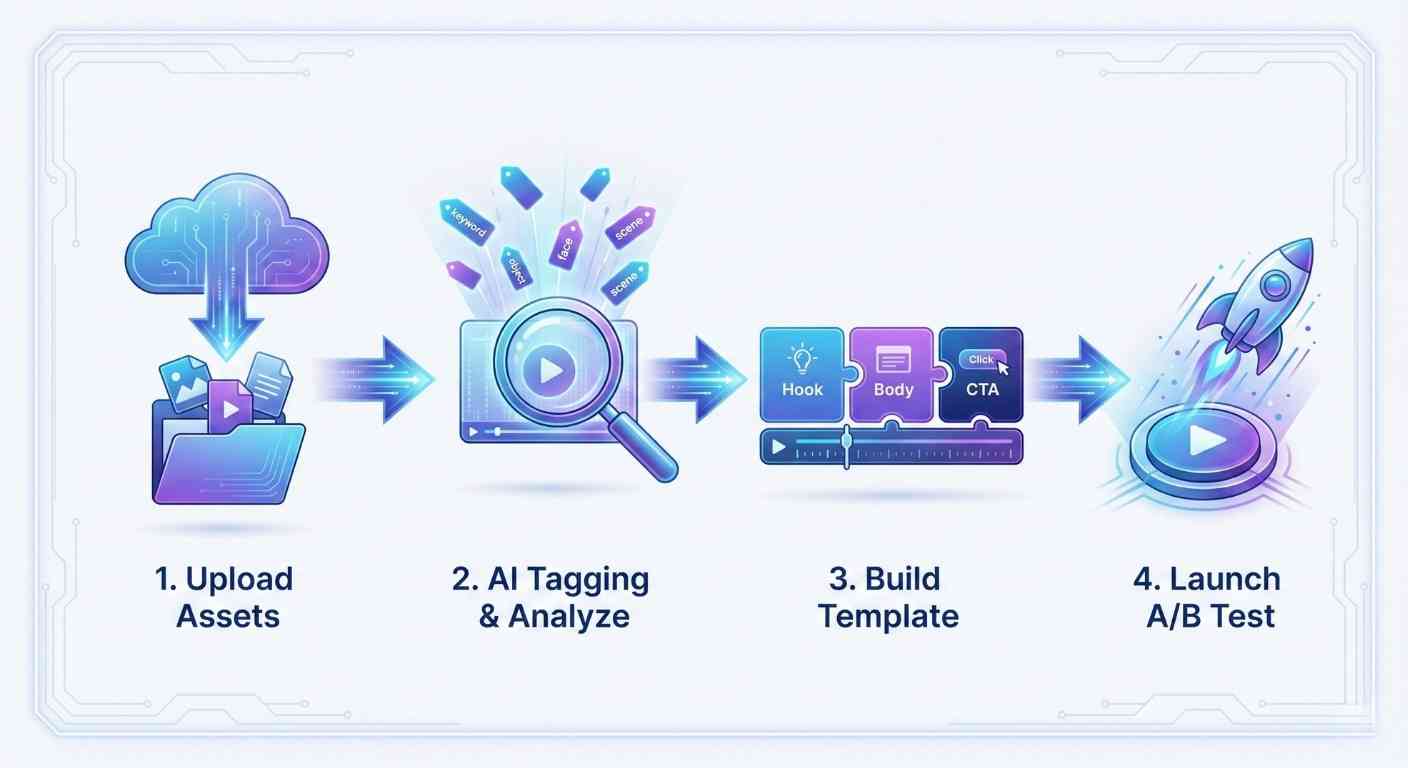
Alright, let's get your hands dirty. Jumping into your first automated workflow is less about being a tech wizard and more about being organized. The whole point is to stop talking about it and start seeing real results—to set up a simple, repeatable process that churns out video variations fast.
First things first: think of your existing video assets as a library, not a chaotic downloads folder. You need structure. Start by gathering your best-performing assets—your killer hooks, product demos, top testimonials, and strongest calls-to-action—and get them uploaded into the platform.
Organizing and Tagging Your Core Assets
Once everything's uploaded, the real fun begins. The automated video editing software gets to work, using its AI to analyze and tag your content so every clip becomes instantly searchable. This is your chance to fine-tune things. Make sure your best clips are tagged correctly so you can pull them up in a snap.
With your asset library in order, it’s time to build your first video template. Think of this as the master blueprint for your ads. You’ll define the structure—say, a 3-second hook, a 10-second body, and a 2-second CTA—which the software will use to piece together the final videos. We actually break down this exact structure in our walkthrough on automating Hook-Body-CTA ad variations.
Generating Your First A/B Test
Now for the payoff. Let's generate a small batch of variations for an A/B test. Pick one body and one CTA, but tell the system to use five different hooks. In just a few minutes, you’ll have five unique ads ready to go, giving you a lightning-fast way to see which opening line actually grabs your audience.
This first test isn’t just about finding a winning ad; it’s about proving the workflow works. The goal is to make the whole process feel less abstract and build your team's confidence to create and test at a much faster rhythm.
This entire process leans heavily on cloud-based collaboration, which is exploding right now. The global media editing software market is expected to jump from $1.05 billion in 2024 to $1.17 billion in 2025, largely thanks to cloud tools that let remote teams work together without missing a beat.
By following these simple steps, you can get your first automated workflow up and running and start seeing results almost immediately. You're turning a complicated concept into a simple, powerful part of your everyday marketing strategy.
Got Questions About Video Automation? We've Got Answers.
When teams start looking into automated video editing software, a few practical questions always pop up. It's one thing to see the potential, but it's another to figure out how it fits into your actual day-to-day workflow.
Let's tackle some of the most common questions we hear. Think of this as the no-fluff guide to what video automation really means for your team.
Will Automation Replace My Creative Team?
Not a chance. It’s better to think of automation as a powerful assistant for your creative team, not a replacement. The software is built to take on the grunt work—the repetitive, soul-crushing tasks like resizing a hundred assets, churning out ad variations, and managing massive render queues.
This frees up your human editors and creative strategists to focus on what they do best: thinking up big ideas, refining storytelling, and figuring out the next killer campaign angle. The software automates the production so your team can perfect the creation.
The goal isn't to kill the creative spark. It's to get rid of all the manual friction that slows it down. This lets you test brilliant ideas at a speed that was impossible before.
How Much Technical Skill Do I Need?
Honestly, not much. Most modern automation platforms are designed with marketers and user acquisition managers in mind—the people who actually need to get the ads out the door. You’ll usually find intuitive, template-based systems with simple drag-and-drop interfaces.
While knowing the basics of what makes a good video is helpful, you definitely don’t need to be a professional video editor to produce high-quality creatives at scale. The whole point is to make powerful video production accessible to the teams who need to test, learn, and grow quickly.
Is This Kind of Software Only for Huge Companies?
While big enterprises certainly get a lot out of the massive scalability, many platforms have pricing plans that work perfectly well for small-to-medium-sized businesses and startups. It all comes down to the return on investment.
If your team is burning hours on repetitive video tasks or can't produce enough creative variations to test properly, an automated solution can be a game-changer, no matter how big your company is. It’s less about the scale of your headcount and more about the scale of your ambition.
Ready to stop the manual grind and start scaling your creative output? Sovran automates the entire video ad production workflow, from asset management to bulk rendering and direct campaign launches. See how much faster you can find winning ads with a 7-day free trial on sovran.ai.
For the broader AI tool stack behind this workflow, see our best AI tools for content creation guide.

Manson Chen
Founder, Sovran
Related Articles
Automatic Video Editing for Performance Marketing A Complete Guide
Here's the simple truth: Automatic video editing is like having a production assembly line for your ad creatives. Instead of a designer building every single...
A Modern Guide to Automatically Edit Videos at Scale
Welcome to the new reality of advertising. The days of spending weeks perfecting a single video ad are long gone. To actually win on platforms like Meta and...
Master AI Video Ad Production Workflow
Imagine whipping up a video ad in minutes, without sacrificing quality. That’s the promise of AI video ads—they draft scripts, select visuals, handle...