Automatic Video Editing for Performance Marketing A Complete Guide
Here's the simple truth: Automatic video editing is like having a production assembly line for your ad creatives. Instead of a designer building every single...
Jump to a section
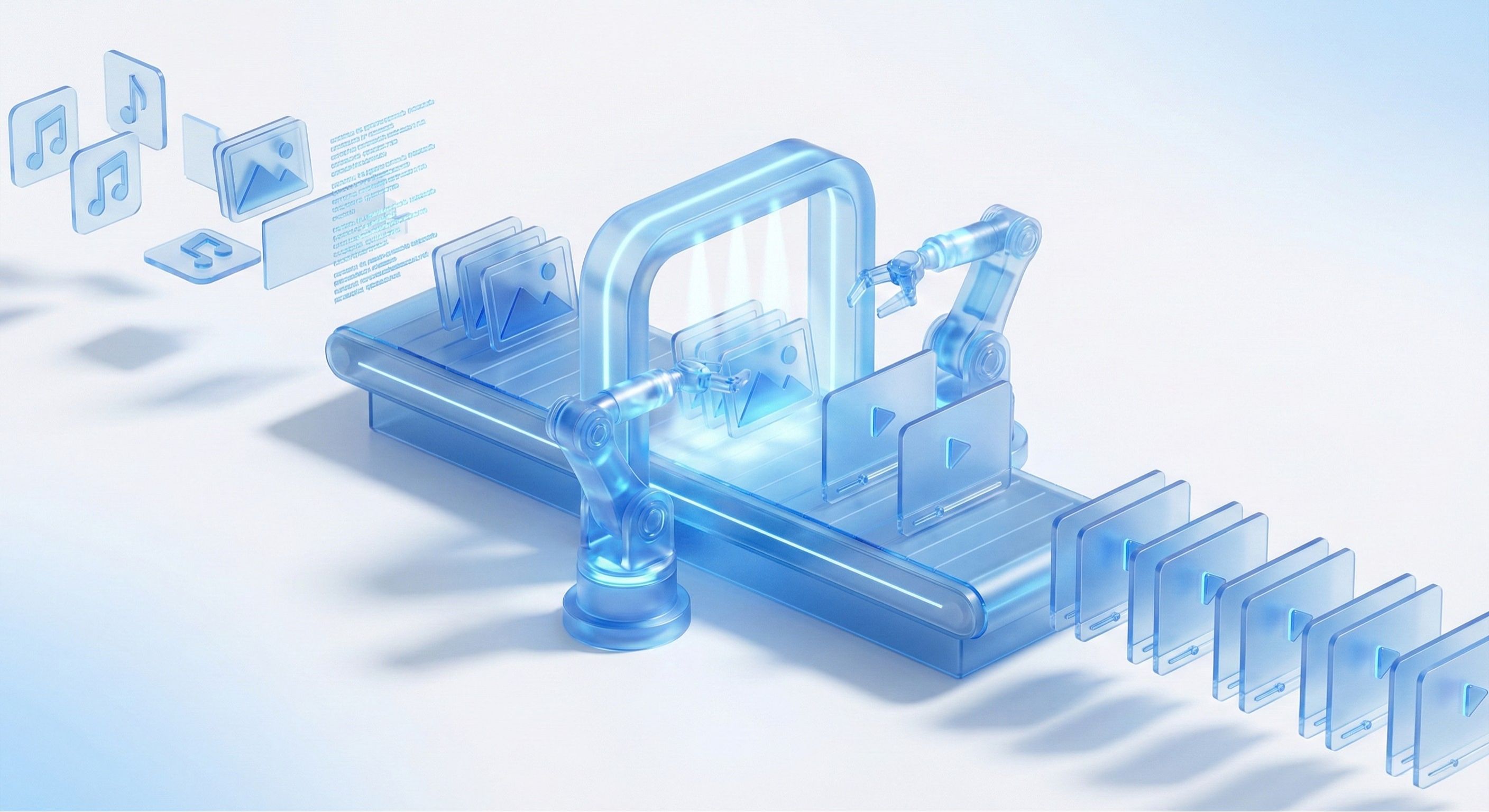
Here's the simple truth: Automatic video editing is like having a production assembly line for your ad creatives. Instead of a designer building every single video by hand, this technology takes over the repetitive stuff—resizing, versioning, and piecing together ads—letting you generate hundreds of unique variations in just a few minutes.
The New Era of Creative Production
Think about trying to build a modern car from scratch, piece by piece. That's pretty much what traditional video editing for performance marketing feels like—it's slow, requires a ton of manual labor, and is a nightmare to scale. Every new ad variation means a designer has to manually tweak formats, swap out clips, and render files. This process creates a massive bottleneck, limiting how many ideas you can actually test and how fast you can jump on market trends.
Now, imagine a fully automated assembly line churning out hundreds of cars, each one perfectly customized for a specific driver. That’s the huge shift automatic video editing brings to the table. This isn't about replacing human creativity; it's about amplifying it by handling all the grunt work.
From Manual Labor to Automated Workflows
Making the jump from manual to automated workflows unlocks speed and scale you just can't get otherwise. By letting technology handle the repetitive tasks, marketing teams can stop fussing over tedious production details and start focusing on high-level strategy and brainstorming creative concepts.
This new way of working empowers teams to:
Move Faster: Launch campaigns in hours, not weeks.
Test More: Generate hundreds of ad variations to pinpoint the winning combinations.
Scale Efficiently: Churn out creatives for every single audience segment and platform without needing to hire more people.
The industry is clearly catching on. The global market for AI-powered video editing software was valued at USD 563 million and is expected to hit USD 953 million by 2032. This growth is all thanks to AI tools that can handle things like scene detection and automated transitions, which can cut down manual editing time by a whopping 40-50%. You can explore more about these market trends and see how they're reshaping content creation.
The core benefit is simple: you can generate hundreds of ad variations in the time it used to take to create one. This gives you a critical advantage in the fast-paced world of digital advertising.
Comparing Production Methods
To really grasp the difference this makes, it helps to see a side-by-side comparison.
The table below breaks down just how different the two approaches are. One relies on a linear, person-by-person process, while the other is all about running things in parallel with systemic intelligence.
Aspect | Manual Video Editing | Automatic Video Editing |
|---|---|---|
Process | Linear, one video at a time. | Parallel, generates hundreds of variations at once. |
Speed | Slow and labor-intensive (days or weeks). | Extremely fast (minutes or hours). |
Scalability | Very difficult; requires more people. | Highly scalable; tech handles the workload. |
Iteration | Cumbersome; each change is a manual task. | Effortless; test new hooks, copy, and assets instantly. |
Focus | On tedious production tasks (resizing, rendering). | On high-level strategy and creative concepts. |
Cost | High labor costs, agency fees. | Lower operational cost through subscription models. |
Output | A handful of final video assets. | A massive volume of testable creative variations. |
As you can see, the shift isn't just an upgrade—it's a fundamental change in how creative teams can operate and what they can achieve. This new model is redefining what’s possible for performance marketing.
How AI and Automation Power Modern Video Creation
Automatic video editing can feel like magic, but it’s really just a smart, systematic process. Think of it like a master chef running a high-tech kitchen. Instead of chopping every vegetable by hand, the chef outlines the final dish, and an expert team instantly pulls the right ingredients and assembles them perfectly.
In our world, AI and automation are that expert team. You provide the raw ingredients—your creative assets—and the recipe—your strategic goals. The system then whips up a massive volume of finished video ads without all the tedious manual work.
This isn't about just blindly stitching clips together. It's an intelligent system that first understands your assets, then creates something new. Let’s pull back the curtain and see how it all works.
The Key Technological Ingredients
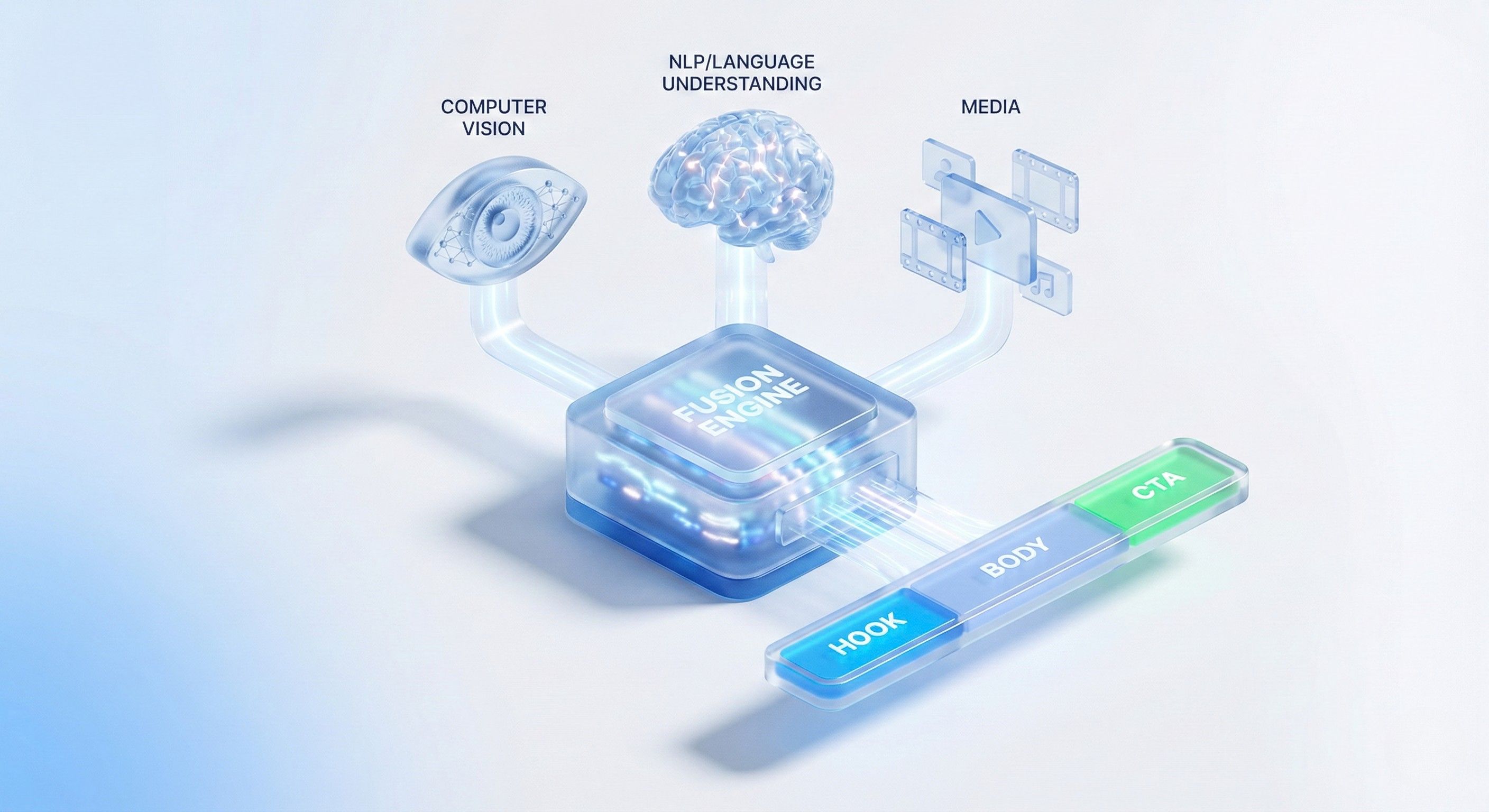
At its core, automatic video editing runs on a few key AI disciplines that act as the system's eyes, ears, and brain. Each one has a specific job: deconstruct your assets, understand what they mean, and figure out how to put them back together for maximum impact.
Here are the technologies doing the heavy lifting:
Computer Vision: This is the system's set of eyes. It scans every frame of your videos and images to identify objects, scenes, actions, and even the emotional tone. It’s what tags a clip of someone smiling as "happy" or a shot of a product being opened as "UGC unboxing."
Natural Language Processing (NLP): This is the part of the brain that understands language. NLP reads your ad copy, customer reviews, and scripts to get the meaning, sentiment, and key selling points. This allows it to match a headline about "fast relief" with a visual of someone looking relaxed and comfortable.
Machine Learning (ML) Algorithms: This is the strategic part of the brain. ML models analyze performance data to learn what combinations actually work. Over time, they can start to predict which hooks are most likely to stop the scroll or which calls-to-action will drive the most conversions.
When you put these together, you turn a messy folder of assets into an intelligent, searchable database. To see how these concepts are being applied at the highest level, you can explore how AI is already changing AI TV commercial production.
Building Videos with a Modular Framework
Having an intelligent database of assets is the foundation. But the real magic happens when you apply a modular framework. Instead of thinking about a video as one long, rigid file, this approach breaks it down into interchangeable building blocks.
For performance ads, the most common and effective structure is the Hook-Body-CTA framework:
The Hook: The first 1-3 seconds designed purely to grab attention. The system can test dozens of different hooks—a surprising question, a bold claim, or a jarring visual.
The Body: The middle of the ad that delivers the core message or shows off the value proposition. This might be a product demo, a user testimonial, or a quick list of benefits.
The Call-to-Action (CTA): The final piece that tells the viewer exactly what to do next—"Shop Now," "Learn More," or "Download."
This modularity is the secret to scaling your creative output. By defining these blocks, an automatic video editing platform like Sovran can mix and match thousands of your approved assets—clips, music, text, and logos—to generate a virtually endless stream of unique ad combinations.
This structured method keeps everything on-brand and strategically sound. The system isn't just randomly throwing clips together; it's building ads based on proven formulas and your specific brand guidelines. For a closer look at the different platforms out there, our guide on AI video creation tools offers more context. This approach gives you creative diversity while you maintain total control over the final output.
Unlocking Scale and Speed for Performance Marketers
For any performance marketer, the chasm between a killer creative idea and a live campaign is usually filled with agonizing prod
Uploading image...
uction delays. Automatic video editing bridges that gap. It turns the entire creative workflow from a frustrating, manual slog into a high-speed engine for growth. This isn't just a nice-to-have; it's a technology that translates directly into real business results, letting teams operate on a level that just wasn't possible before.
The benefits here aren't small tweaks. We're talking about a fundamental shift in how marketing teams can operate. By automating the grunt work of video assembly and versioning, you get four massive advantages that directly boost campaign performance and profitability. Each one feeds into the next, creating a powerful system for real, sustained growth.
Supercharge Your Creative Velocity
In performance marketing, speed is everything. A trend can blow up and fizzle out in less than a week, but traditional video production can take much longer. That lag means you're constantly missing the boat. Automatic video editing fixes this by cranking up your creative velocity—the raw speed at which you can pump out and launch new ad assets.
Instead of waiting days or even weeks for one video, you can spin up hundreds of launch-ready variations in just a few hours. Picture a D2C brand that sees a competitor's ad go viral. With an automated system, they can immediately riff on that concept, test a dozen different hooks and angles, and get their own ads live on Meta and TikTok before the trend is yesterday's news. That kind of agility is a massive competitive edge.
Achieve Hyper-Personalization at Scale
Let's be honest, generic, one-size-fits-all ads are dead. Today's customers expect content that speaks directly to them, their problems, and their interests. Hyper-personalization at scale means creating truly tailored video ads for dozens of specific audience segments without making your team work around the clock.
An automated platform is what makes this a reality. Think about a fitness app. They could create totally distinct video ads for a bunch of different user types:
For busy professionals: Ads featuring quick, effective workouts they can do at home.
For new moms: Ads that focus on post-natal recovery programs.
For marathon runners: Ads that highlight advanced, performance-focused training plans.
The system just pulls the right clips, copy, and testimonials for each segment, stitching together unique videos that hit home way harder than a generic ad ever could.
Drive Rapid Iterative Learning
The best performance marketers think like scientists. They form a hypothesis, run an experiment, analyze the data, and then iterate. Automatic video editing puts this whole process on steroids, turning it into a high-speed learning cycle. You can finally stop testing just two or three ad concepts and start testing hundreds of tiny variations all at once.
By systematically testing every single piece of your ad—the hook, the value proposition, the call-to-action—you let actual performance data tell you what's working. This data-first approach takes the guesswork out of the equation and puts you on the fast track to finding those winning ad combos.
This rapid-fire iteration is a total game-changer. The insights you get from testing a huge array of creative elements feed right back into your strategy, making every campaign smarter than the last. This shift is often accelerated by massive cost savings, as shown in a detailed cost-benefit analysis of traditional versus AI photoshoots.
Drastically Reduce Manual Workload
Finally, one of the most immediate and satisfying benefits is cutting out the soul-crushing manual work. Your creative team is your biggest strategic asset, but they often burn countless hours on mind-numbing tasks like resizing videos for different placements, swapping out logos, or making tiny text edits.
Automating these jobs frees up your talented designers and strategists to focus on what actually moves the needle: dreaming up new campaign ideas, digging into performance trends, and building a compelling brand story. This isn't just about boosting team morale; it's about making sure your best people are focused on solving your biggest marketing challenges. This trend is already reshaping content creation, with 72% of YouTubers now using AI for thumbnails, leading to a 38% jump in click-through rates. You can find more insights on the impact of AI on video creation and see how it's driving efficiency across the board.
Implementing an Automated Creative Workflow
Okay, let's move from theory to practice. This is where the real magic of automatic video editing happens. Setting up your own creative assembly line isn’t about flipping a single switch. It’s a step-by-step process of organizing your assets, defining your ad structures, and setting the rules of the road. Get this right, and you'll turn your creative production from a slow, manual chore into a high-speed growth engine.
To make this tangible, let's walk through the essential steps. We’ll follow a hypothetical e-commerce brand, "GlowUp Cosmetics," as they build their automated workflow from the ground up.
Step 1: Prepare Your Creative Assets
The entire foundation of a killer automation strategy is a well-organized asset library. Your AI is only as good as the ingredients you feed it. So, the first move is to get your media in order. This is way more than just dumping files into a folder; it’s about smart organization and tagging so the system actually understands what each asset is and when to use it.
GlowUp Cosmetics starts by pulling together all their visuals:
User-generated content (UGC) showing customers unboxing their new lipstick.
Clean, crisp studio shots of their skincare products.
Lifestyle clips of models applying makeup in a real-world setting.
Brand assets like logos, animated end cards, and pre-approved music tracks.
Next, every single asset gets tagged with descriptive keywords like ugc, unboxing, product-demo, lifestyle, or testimonial. This metadata is absolutely crucial. It’s what allows the system to intelligently grab the right clips for the right ad concept. For a deeper dive into organizing your media, check out our complete guide on setting up a video asset management system.
Step 2: Build Your Modular Templates
With your assets tidy and tagged, it's time to create the blueprints for your videos. These modular templates are flexible structures—often built on the classic Hook-Body-CTA framework—that map out the sequence and timing of your ads. Think of them not as rigid video files, but as dynamic recipes the AI uses to cook up endless variations.
GlowUp decides to build a few core templates for their first campaigns. A popular one is a "Problem-Solution" framework designed to highlight their new foundation.
Hook (2 seconds): A short, punchy clip tagged as
problem-focused, like someone struggling with uneven skin tone.Body (6 seconds): A sequence showing the product in action, pulling from clips tagged
product-demoorapplication.CTA (2 seconds): A branded end card with text like "Get Flawless Skin Now."
These templates are built with placeholders for the video clips, text overlays, and music. By defining these structures, GlowUp ensures every single video the AI generates follows a proven advertising formula that just works.
A modular template is like a powerful recipe. You define the structure and the type of ingredients needed, and the automation platform becomes the master chef that can cook up thousands of unique, delicious meals at a moment's notice.
This approach is what fuels true creative scaling and, ultimately, business growth.
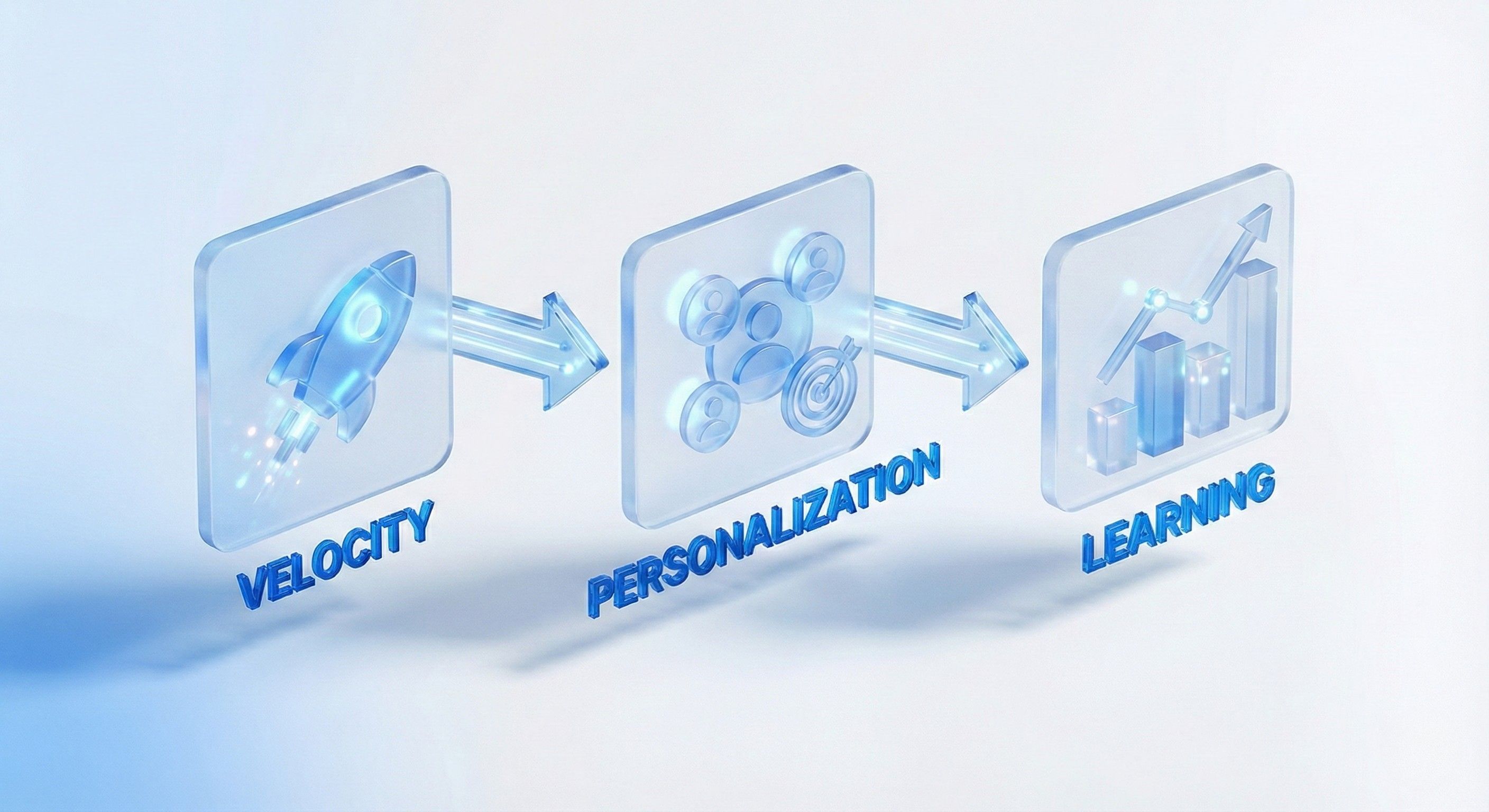
This process shows how increasing your velocity allows for deeper personalization, which then speeds up the learning cycles that drive performance.
Step 3: Establish Clear Brand Guardrails
Scale is completely useless if it destroys your brand identity. That’s why setting up brand guardrails is a non-negotiable step. These are simply the rules and constraints you bake into the automation platform to make sure every single video is 100% on-brand.
For GlowUp, this means locking in a few key elements within their templates:
Fonts: Only the brand's approved typeface can be used for headlines and CTAs. No exceptions.
Color Palette: The system is restricted to GlowUp's official brand colors.
Logo Placement: The company logo must always appear in the top-right corner for the final three seconds.
Music: The AI can only pull from a pre-approved library of upbeat, licensed music.
These guardrails create a safe sandbox for the AI to play in. It has the freedom to experiment endlessly with different combinations of clips and copy, but it can never, ever produce a video that looks or feels off-brand.
Step 4: Launch and Manage A/B Tests Systematically
Alright, your assets are prepped, templates are built, and guardrails are in place. You're ready to launch. The final step is to use this newfound production power to run systematic A/B tests. This is where automatic video editing closes the loop, turning creative production into a data-driven growth machine.
GlowUp wants to figure out which type of hook performs best. Using their "Problem-Solution" template, they tell the system to generate 50 video variations. These versions all share the same body and CTA but test five different hook categories (10 videos each): UGC clips, polished studio footage, animated text, influencer testimonials, and simple product shots.
They launch all 50 ads at once in a controlled test. Within 48 hours, the data is crystal clear: the UGC hooks have a 35% higher click-through rate. With that insight, GlowUp immediately pivots its creative strategy, turning a quick experiment into a measurable performance win.
Measuring Success in Automated Video Production
Switching to an automated creative workflow is more than just a change in tools; it’s a strategic bet on growth. But how do you actually know if it’s working? The ultimate goals are still Return on Ad Spend (ROAS) and Cost Per Acquisition (CPA), but those numbers are lagging indicators. They don't tell you why your campaigns are improving.
To get the full picture, you need to look upstream at the operational metrics that fuel those business outcomes. These aren't vanity stats. They measure the raw power of your creative engine—your speed, diversity, and learning capacity—giving you a clear way to prove the ROI of your new system.
Your New North Star Metrics
To really see what your automated workflow can do, you need to zero in on a few core operational KPIs. Think of them as the vital signs of your creative production health.
Here are the big three to start tracking:
Creative Velocity: This one’s simple but powerful. It’s the total number of unique, ready-to-launch ads your team can crank out in a week or a month. More velocity means you can jump on trends and test more ideas, faster.
Creative Learning Cycle Time: How long does it take to go from a creative hypothesis (like "UGC hooks will beat our studio shots") to getting a statistically significant answer from a live campaign? This KPI measures that speed. Shorter cycles mean you find your winners in days, not weeks.
Creative Asset Diversity: This isn't just about volume; it's about variety. Are you testing two ad variations, or are you testing ten different hooks against five value props and three CTAs? More diversity dramatically increases your odds of finding a breakout star.
And the industry is catching on. The market for AI video editing tools is set to jump from $1.6 billion in 2025 to a massive $9.3 billion by 2030. Why? Because teams need to produce more content, faster, without sacrificing quality. This growth proves that automation is becoming the standard for staying competitive.
Connecting Operational Speed to Business Growth
Tracking these metrics is the first step, but the real magic happens when you connect them back to your bottom line. When you can draw a straight line from operational gains to better campaign performance, the investment in automation becomes a no-brainer.
Imagine a mobile app company using a platform like Sovran. Their Creative Velocity skyrockets from 10 new ads per week to 150. This massive increase in output lets them slash their Creative Learning Cycle Time from two weeks down to just 48 hours.
Because they could test a much wider range of hooks and messages so quickly, they discovered that testimonial-driven ads delivered a 25% lower CPA for their target audience. That's the money shot: operational speed directly led to more efficient ad spend and higher profits.
To help you get the most out of this rapid testing, we've put together a breakdown of the key metrics that matter.
Key Performance Indicators for Automated Creative Workflows
Here’s a look at the essential metrics for tracking the effectiveness and efficiency of your automatic video editing strategy.
KPI | What It Measures | Why It Matters for Performance Marketing |
|---|---|---|
Creative Velocity | The number of unique ad creatives produced per week/month. | Higher velocity allows for more A/B testing, quicker response to trends, and less creative fatigue. |
Creative Learning Cycle Time | The time from creative hypothesis to data-validated insight. | A shorter cycle means you find winning ad formulas faster, minimizing wasted ad spend on underperformers. |
Creative Asset Diversity | The variety of hooks, bodies, CTAs, and concepts being tested simultaneously. | Greater diversity increases the probability of discovering a high-impact, "breakout" creative that scales. |
Cost Per Creative | The total cost (tools, labor) divided by the number of creatives produced. | Automation should drastically lower this cost, proving its operational efficiency and freeing up budget. |
Win Rate | The percentage of new creatives that outperform the current control or baseline ad. | A rising win rate shows your team is getting better at generating hypotheses and creating effective ads. |
Time to Statistical Significance | The duration a test needs to run to gather enough data for a confident decision. | Faster creative production feeds tests with more variants, helping you reach significance quicker. |
Tracking these KPIs gives you the data you need to not only justify your investment but also to continuously refine your strategy. This ability to test and learn at speed is a massive competitive advantage.
Of course, to effectively analyze these tests, you need a rock-solid reporting setup. For a detailed guide on that, check out our post on how to measure your creative tests in Facebook Ads reporting. By tying operational metrics to performance data, you create a powerful feedback loop that constantly dials in your strategy and maximizes ROI.
Common Questions About Automatic Video Editing
Jumping into any new tech brings up questions, and when it’s something that touches your creative workflow, it’s smart to be a little skeptical. Performance marketers and creative teams usually have the same handful of worries when they first hear about automatic video editing.
Let's get right to it and tackle these questions head-on. We'll clear up the confusion and show you what this is all really about.
Will Automatic Video Editing Replace Our Creative Team?
This is always the first question, and the answer is a hard no. Automatic video editing is here to supercharge your creative team, not replace them. Think of it like giving a world-class chef a fully staffed kitchen—they can finally stop chopping onions and focus on designing the Michelin-star menu.
The tech handles the grunt work—all the repetitive, soul-crushing tasks like resizing videos for every platform, manually swapping out clips, or creating hundreds of tiny variations. This gets your human creatives out of the production weeds so they can focus on what actually moves the needle:
High-level strategy: Digging into market trends and figuring out what makes your audience tick.
Big ideas: Brainstorming the concepts for your next killer campaign.
Brand storytelling: Building the narratives that actually connect with people.
Bottom line: this tech gives your team the power to run more sophisticated plays and test more ideas than they ever could before.
How Can We Ensure AI-Generated Videos Stay On Brand?
Keeping your brand consistent is everything, and modern automation platforms are built around that reality. The AI doesn't just run wild; it operates inside a strict set of rules that you lay out from day one.
You set up firm "brand guardrails" by creating pre-approved modular templates. These templates lock in your brand’s core elements, making sure every single video is perfectly on-point. This includes things like:
Specific fonts for all your text overlays.
Approved color palettes for backgrounds and graphics.
Locked logo placements and animations.
Curated music libraries that fit your brand’s vibe.
The system works only within these boundaries you’ve set. It's all about getting massive scale inside a safe, brand-controlled playground, guaranteeing every video variation is 100% compliant with your brand guidelines.
Is This Technology Only For Large Enterprises?
Not anymore. While big companies definitely get huge value from automation, this tech is becoming more accessible and essential for businesses of all sizes. The real value is efficiency and better ROI—something that’s arguably even more critical for leaner teams on tighter budgets.
By automating production, a small marketing team can pump out the creative volume of a much larger department, leveling the playing field. When you add up the real costs of traditional video production—freelance fees, agency retainers, and endless hours of your team's time—an automation platform often turns out to be way more cost-effective. You just need to look at what your current creative bottlenecks are costing you and weigh that against the gains in speed, testing, and performance.
What Kind Of Assets Do I Need To Get Started?
You should start with what you already have. Seriously. You don't need to go out and shoot a mountain of new content to get going. A smart automated workflow is built on the creative assets you’ve already got in your library.
Pull together all your current materials:
Product images and studio shots.
Existing video clips (UGC, B-roll, testimonials, etc.).
Brand logos and style guides.
Approved ad copy for headlines and CTAs.
The most important first step is just getting organized. Automation platforms run best on a well-tagged and structured media library. For example, tagging video clips by what's in them (like "unboxing," "product in use," or "customer review") or tagging images by product SKU is huge. A clean, organized library is the fuel for the automation engine, letting it intelligently pull the right pieces to build thousands of relevant, high-quality video ads.
Ready to eliminate creative bottlenecks and scale your ad performance? Sovran gives you the power to automate video production, launch hundreds of creative tests, and find winning ads up to 10x faster. Start your free 7-day trial and see the difference today.

Manson Chen
Founder, Sovran
Related Articles
A Modern Guide to Automatically Edit Videos at Scale
Welcome to the new reality of advertising. The days of spending weeks perfecting a single video ad are long gone. To actually win on platforms like Meta and...
Automated Video Editing Software: AI Tools for Marketing
So what exactly is automated video editing software? Think of it less like a tool and more like a powerful creative partner. It’s software that uses artificial
A Guide to Facebook Automated Ads That Drive Real Results
So, what exactly are Facebook's Automated Ads? Think of them as Meta's AI-powered system designed to take the guesswork out of running campaigns. It automates...