A Guide to Video for Advertising in 2026
Master video for advertising with this guide to proven frameworks, platform specs, and AI-powered workflows that scale winning campaigns on Meta and TikTok.
Jump to a section
Let's be honest, using video for advertising isn't some new-fangled strategy anymore. It's the absolute baseline for modern digital marketing. With consumer eyeballs glued to platforms like Meta and TikTok, growth teams are in a constant race to churn out fresh, high-performing video creatives just to capture a sliver of attention and fend off ad fatigue.
Why Video for Advertising Is No Longer Optional
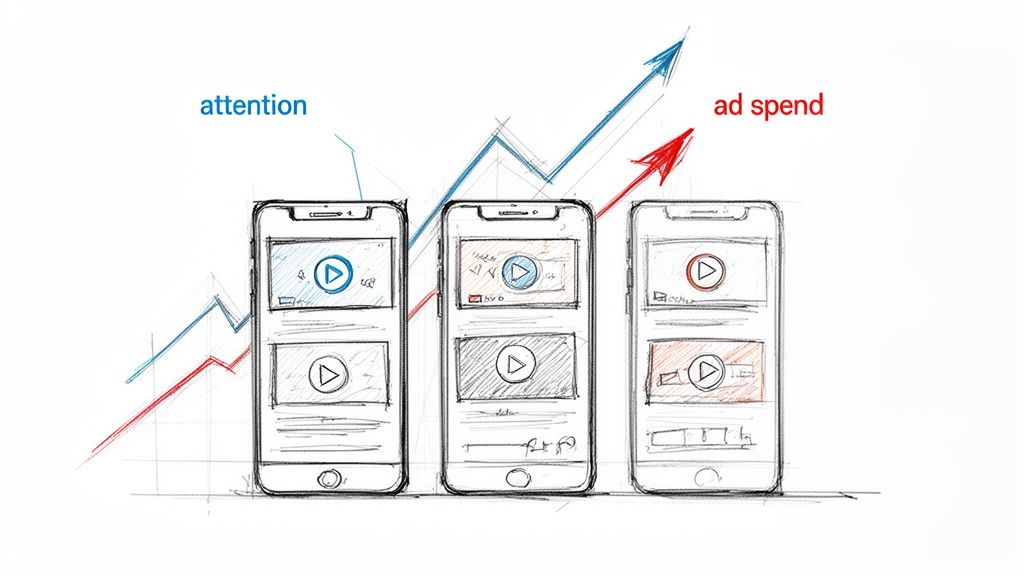
The digital ad world has voted with its wallet, and the verdict is in: video is king. The days of debating static images versus video are long gone. The real conversation today is about how on earth you can produce enough high-quality video to feed the insatiable appetite of these platforms and keep up with shrinking attention spans.
The ad spend figures alone tell the story. Global spending on digital video ads blew past $190 billion in 2024 and is on track to hit over $207.5 billion in 2025. This isn't just growth; it's a fundamental market shift. In fact, U.S. businesses are now funneling more money into digital video than into traditional TV ads. You can dig deeper into these video marketing trends and what they mean for the industry.
The Mobile-First Creative Challenge
This video-first reality creates a massive headache for user acquisition (UA) managers and growth marketers, especially anyone working with mobile apps. The main battleground for attention is on mobile social feeds, where creative novelty is the only currency that matters.
An ad that's crushing it one week can see its metrics completely tank the next. This is creative fatigue, and it forces teams into a relentless cycle of brainstorming, producing, and testing just to maintain performance—let alone scale it.
The pressure is on. To even stay in the game, you have to find a way to break through creative bottlenecks and just move faster. That means ditching the slow, manual editing workflows for something far more agile and scalable.
The core challenges are pretty clear:
Volume: You need to pump out a high quantity of video variations to test every hook, angle, and call-to-action imaginable.
Velocity: You need to get new creative concepts from idea to live campaign in days, not weeks.
Variety: You need to generate a diverse mix of ad formats and styles to keep your campaigns feeling fresh and engaging.
This guide is your practical roadmap for tackling these challenges head-on. We're going to skip the high-level theory and give you actionable frameworks for building a modern video for advertising engine that actually works.
Optimizing Your Ad Formats for Meta and TikTok
Getting your video ad format right isn't just a technical box to check—it’s a crucial decision that can make or break your campaign. If you’ve ever seen a killer ad get awkwardly cropped or completely ignored, you know what I'm talking about. The wrong aspect ratio or length is a surefire way to have your ad skipped by users and buried by the algorithm.
Think of it like this: you wouldn't use a hammer to saw a piece of wood. In the same way, you shouldn't force a landscape video into a vertical-only space like Reels or TikTok. Each placement is its own world with its own audience expectations. To win, you have to create ads that feel like they belong there, which means ditching the one-size-fits-all approach for good.
Mastering Meta Ad Placements
Meta's ad ecosystem is packed with high-impact video placements, and every performance marketer needs to know the unwritten rules for each one.
Meta Reels: This is a pure, 9:16 vertical, sound-on environment built for short-form entertainment. Your ad needs to grab attention instantly and feel like it belongs in the feed. Polished, cinematic ads often get skipped in favor of authentic, user-generated content (UGC) that blends in with what people are already watching.
Meta Stories: Also 9:16, Stories are fast and fleeting. People tap through them at lightning speed, so your message has to land in just a few seconds. While interactive elements like polls and stickers are great for engagement, make sure your core message is crystal clear even with the sound off.
Meta In-Feed: This is the classic feed where users scroll through content from friends, groups, and brands. The recommended aspect ratio is 4:5 vertical for mobile, which gives you more screen real estate. Videos here can be a bit longer, giving you more room for storytelling or a product demo.
The big takeaway here? You have to match your video's style to the user's mindset. Someone scrolling Reels wants quick, fun content. Someone in their main feed might be open to a slightly longer, more informative ad.
Winning on TikTok with Native Formats
TikTok has its own culture, and success there is all about fitting in. The phrase "Don't Make Ads, Make TikToks" is more than just a catchy slogan—it's the only strategy that actually works.
In-Feed Ads: This is your bread and butter for TikTok advertising. These ads slide right into a user's "For You" page and need to be 9:16 vertical videos. The best ones use trending sounds, popular filters, and a raw style that looks just like the top-performing organic videos.
TopView Ads: This is a premium placement that shows up as the first video a user sees when they open the app. It's a huge opportunity for mass awareness, giving you up to 60 seconds of full-screen, sound-on attention. But even with this prime spot, your creative still needs to feel like a genuine TikTok.
To get the most out of your assets, learning to effectively repurpose video content for social media is a must-have skill.
For a quick reference on the most important technical specs, here's a cheat sheet we put together.
Meta vs. TikTok Video Ad Spec Cheat Sheet 2026
Placement | Aspect Ratio | Recommended Length | Max File Size | Key Consideration |
|---|---|---|---|---|
Meta Reels | 9:16 | 15-30 seconds | 4 GB | Must feel native and entertaining. UGC-style is king. |
Meta Stories | 9:16 | <15 seconds | 4 GB | Deliver your message fast; optimize for sound-off viewing. |
TikTok In-Feed | 9:16 | 9-15 seconds | 500 MB | Use trending sounds/effects. Authenticity beats high production. |
This table covers the most common placements, but specs are always changing. To make sure your creatives are always pixel-perfect and ready to perform, you can bookmark our complete guide to social media video specs.
Building Your High-Converting Creative Playbook
Let's be real—creating a video for advertising that actually converts isn't about waiting for a lightning strike of creative genius. It's more like being a chef. The best performance creative teams I know operate from a "playbook" of proven, modular frameworks that consistently kill it on platforms like Meta and TikTok.
Think of these frameworks as your recipes for success. They give your message a reliable structure, making sure you stop the scroll, deliver your point, and drive action every single time. Instead of starting from scratch with every ad, you're using battle-tested building blocks. This approach doesn't just save you a ton of time; it dramatically stacks the odds in your favor.
The Cornerstone Framework: Hook-Body-CTA
The most fundamental recipe in any video ad playbook is the Hook-Body-CTA structure. It’s the simple, brutally effective formula behind nearly every ad you see crushing it on social media. For any growth team, mastering this is non-negotiable.
The Hook (0-3 seconds): This is it. Your one and only shot to stop the scroll. In a feed that moves a mile a minute, you have less than three seconds to give someone a reason to care. A great hook could be a sharp question, a shocking stat, a weirdly satisfying visual, or a direct callout to a specific pain point.
The Body (3-15 seconds): You've earned their attention—don't waste it. The body is where you deliver the goods. Show the product, explain its value, or tell a quick story. Keep it tight, focused, and visually interesting.
The CTA (Final 2-3 seconds): The call-to-action is your closer. It needs to be crystal clear and tell the viewer exactly what to do next. Use strong, direct language like "Download Now," "Shop the Collection," or "Start Your Free Trial," and make sure you back it up with on-screen text.
It's basically a three-act play built for the modern attention span. You grab them, you hold them, and you give them a clear next step.
Advanced Frameworks for Driving Performance
While Hook-Body-CTA is your bread and butter, you need more than one play to win the game. Expanding your playbook with other frameworks lets you hit different marketing angles and connect with your audience in fresh ways. Building a top-tier creative playbook means understanding the latest actionable and effective video marketing best practices.
Here are a few powerful frameworks we see performing consistently well right now:
1. Problem-Agitate-Solution (PAS)
This framework is a classic for a reason—it taps directly into your audience's pain points with surgical precision.
Problem: Kick things off by clearly identifying a problem your target customer is dealing with.
Agitate: Don't just state the problem. Poke the bruise. Amplify the frustration and the feeling behind it.
Solution: Once the pain is real, introduce your product as the obvious, immediate solution.
Example (for a language app):
Problem: "Tired of language apps that feel like homework?" (Shows someone looking bored out of their mind, scrolling on their phone).
Agitate: "You spend weeks memorizing grammar but still can't hold a real conversation." (Shows an awkward, silent interaction on a trip).
Solution: "Our app gets you speaking from day one. Download now and have your first conversation tonight." (Shows someone confidently ordering coffee abroad).
2. UGC Testimonial Mashups
User-generated content (UGC) is pure gold for building trust and social proof. A testimonial mashup is exactly what it sounds like: a rapid-fire edit of short, impactful clips from multiple happy customers.
The recipe is simple. Find several video testimonials, slice them down to their most powerful one-liners, and cut them together in a fast-paced, high-energy sequence. Slap some text overlays on to highlight the key quotes and finish with a strong CTA. This format feels incredibly authentic and lets your customers do the selling for you, making it a must-have for your video for advertising strategy.
3. Engaging Listicles
People love lists. They’re scannable, easy to digest, and promise a quick hit of value. You can turn almost any product benefit or feature into a compelling listicle ad.
"3 Reasons Our Skincare Serum Works So Fast"
"5 Hacks for Organizing Your Kitchen with This Product"
"Top 4 Features You Didn't Know Our App Had"
Structure the video with quick cuts, bold text overlays for each number on the list, and a pace that feels native to the feed. This format is great for ads that educate while they sell, positioning your brand as a helpful expert while simultaneously showing off what your product can do.
Adopting a Modern Video Production Workflow
If you’re still creating video ads one by one, you’re not just moving slowly—you’re falling behind. The old production model, where a single video takes weeks to brainstorm, shoot, edit, and launch, is completely broken for high-volume performance marketing. It's like trying to build a skyscraper with a hammer and nails instead of a full construction crew.
Top-performing growth teams have moved on. They operate more like a modern creative factory, using agile, AI-powered workflows to produce, test, and learn at a scale that was impossible just a few years ago. This approach turns video production from a tedious, manual chore into a systematic engine for growth.
The Modern Creative Factory Blueprint
The core idea is to stop creating one-off video ads and start assembling them from reusable, modular parts. Think of it less like painting a masterpiece and more like building with a custom Lego set for video ads. Each "brick" is a pre-approved, high-quality asset—a clip, a soundbite, a text overlay, or a call-to-action.
Here’s how this modern workflow breaks down:
Ingest Raw Assets: Kick things off by uploading all your video footage, customer testimonials, screen recordings, and product shots into a central library.
Intelligent Tagging: This is where the magic happens. An AI platform automatically analyzes and tags every clip based on its content and purpose. A clip might be tagged as a "Hook," "Problem," "Solution," or "Testimonial."
Modular Assembly: Using proven creative frameworks like Hook-Body-CTA or Problem-Agitate-Solution, you can now rapidly piece together new ad concepts by combining these tagged "bricks."
Batch Rendering: Once you have a few core concepts, you can generate hundreds of variations in seconds. The system automatically swaps out different hooks, changes the background music, and tests various text overlays, creating a massive batch of ready-to-test ads.
This process is built on the simple structure of a high-performing ad, which is the foundation of modern video advertising.
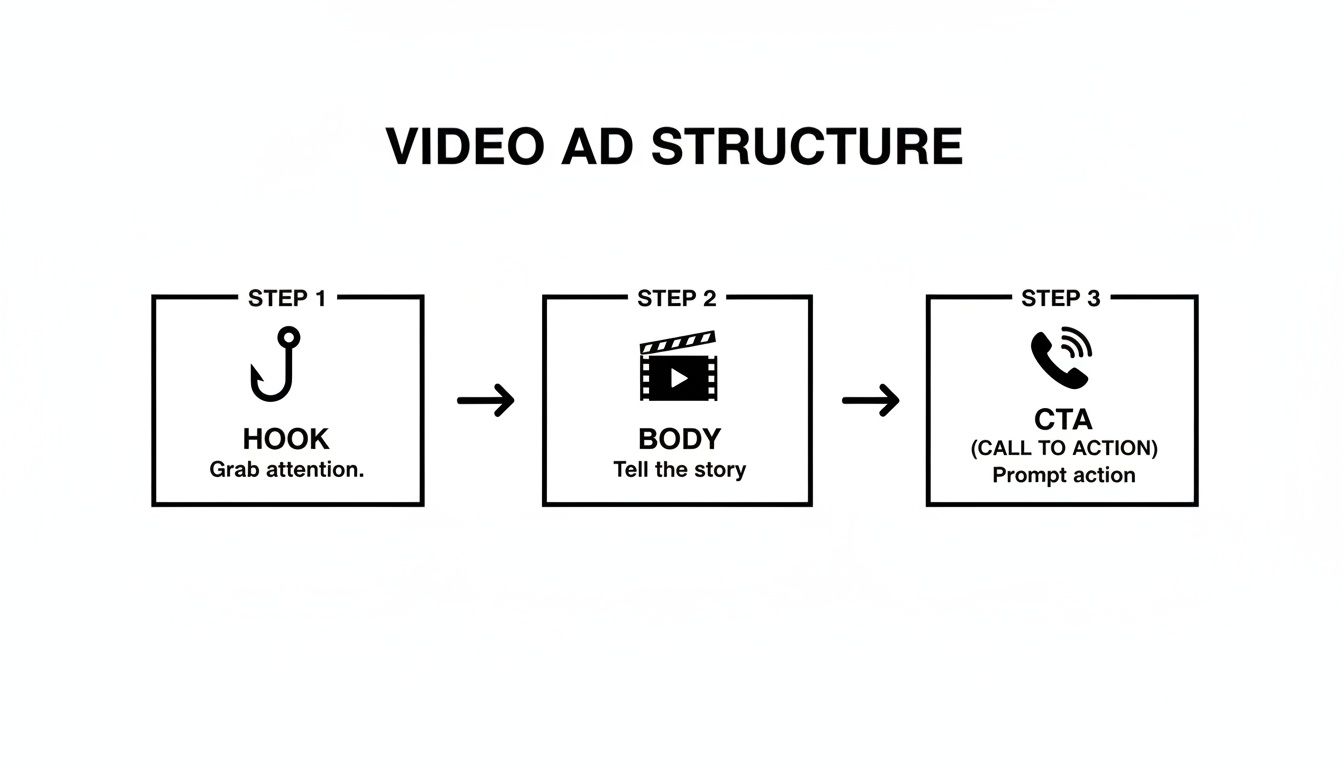
This graphic illustrates the core Hook-Body-CTA framework—the essential building block for nearly every successful social media video ad.
Solving the Biggest Production Headaches
This factory-style approach directly tackles the most common pain points that slow down creative teams and hurt campaign performance. It's a system built for speed and, more importantly, for learning.
The goal isn’t just to make more ads; it’s to build a feedback loop where you’re constantly learning what works and reinvesting those insights into your next batch of creatives. This is how you find profitable winners 10x faster than your competitors.
Here are the key problems this workflow solves:
Tedious Manual Edits: Instead of a video editor spending hours in a tool like CapCut to create one variation, an AI-powered system can render hundreds in minutes. This frees up your creative team to focus on big-picture strategy, not repetitive busywork.
Wasting Time on Asset Search: How much time do you lose digging through folders for that one perfect clip? With AI tagging, you can search your entire library using natural language, like "show me all clips of a customer smiling" or "find all hooks under three seconds."
Time-Sucking Subtitle Creation: Manually transcribing and timing subtitles is a massive time sink. A modern workflow automates this, generating accurate subtitles and text overlays that are perfectly synced to your video ads.
Adopting this system is a strategic shift. You move from guessing what might work to systematically discovering what does work through high-volume testing. You can explore our deep dive on how to build your own AI video ad factory for a more detailed look at this process. This method turns your video for advertising efforts into a predictable, data-driven machine built for scaling.
How to Scale Performance with Smart Testing
Making a great video ad is a solid first step, but honestly, that’s only half the battle. The real money is made when you know exactly what works, why it works, and how to do it again. If you want to scale, you need a disciplined, data-first approach to testing—especially when you’re juggling a high volume of creatives.
Think of it like a high school science experiment. You wouldn't mix five different chemicals together and expect to understand the reaction. The same goes for your video for advertising efforts. Smart testing is all about isolating one element at a time so you get clean, actionable data that tells you what to do next.
Structuring Your Creative Tests for Clarity
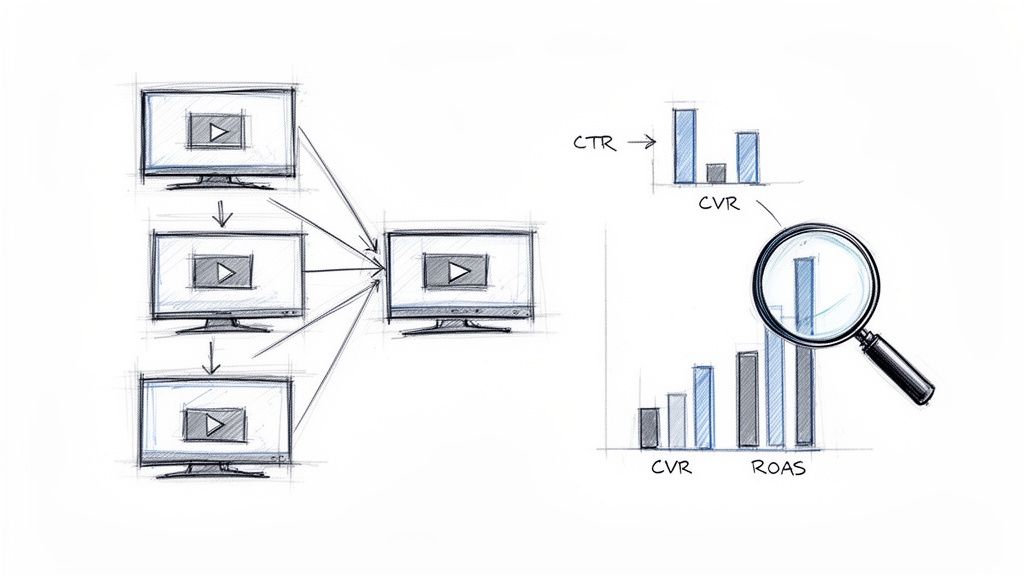
The most effective way to test is to change just one variable per campaign. A simple but powerful method is testing different hooks while keeping the rest of the ad identical. For example, you might have one ad “body” and one call-to-action (CTA), but test them against five completely different hooks.
This approach gives you a clear winner. If one hook gets a way higher click-through rate (CTR), you’ve found a killer opener you can now pair with other ad concepts.
Here’s a simple testing structure you can steal:
Round 1: Hook Test: Create 5 different hooks for 1 core ad concept. Run them to find the winning hook based on those crucial first-impression metrics.
Round 2: Body Test: Take your winning hook and test it against 3 different ad bodies. This helps you find the most compelling message for the middle of your ad.
Round 3: CTA Test: Now that you have a winning hook and body, test 3 different CTAs to see which one actually drives the most conversions.
This methodical process eliminates the guesswork. You’re no longer wondering if it was the hook, the testimonial, or the offer that made an ad work. You know exactly which piece moved the needle. For teams looking to put this on repeat, an ad creative experimentation tool can give you the framework to manage high-volume tests without losing your mind.
Keeping Your Data Clean with Naming Conventions
Once you start scaling your tests, your ad account can become a disaster zone. Fast. Without a system, analyzing results is a nightmare. This is where automated naming conventions become non-negotiable for any serious performance marketer.
Think of a clear naming system as a set of built-in tags for every single ad you run. It lets you instantly filter and segment your performance data without manually digging through campaigns.
A strong naming convention tells a story. At a glance, you should be able to identify the audience, placement, creative concept, and variable being tested for any ad.
A good naming structure might look something like this:Date_CampaignObjective_Audience_Placement_CreativeConcept_Variable
Example:20261028_Conversions_USA-25-34-F_Reels_UGC-Testimonial_Hook3
This name immediately tells you the ad was launched on October 28, 2026, for conversions, targeted 25-34 year old women in the USA, ran on Reels, used a UGC testimonial, and was testing the third hook variation.
Interpreting Key Metrics to Find Winners
With your tests running and your data clean, the final step is to close the learning loop by reading the results. Focus on the metrics that tie directly back to your campaign goals. The numbers don't lie: social media videos can generate 1200% more shares than text and images combined, making this channel a goldmine for data. As you analyze performance, remember that video is projected to account for 82% of all global internet traffic by 2026, a trend driven by short-form content that delivers 2.5 times more engagement than long-form. You can dig into more of these powerful video marketing statistics.
Click-Through Rate (CTR): This tells you how good your ad is at grabbing attention. A high CTR, especially in a hook test, is a huge green flag for a winning creative.
Conversion Rate (CVR): This measures how well your ad convinces people to take action after they click. It’s the ultimate test of your message and your offer.
Return on Ad Spend (ROAS): This is the bottom line. It tells you whether or not your ad is actually making you money.
By analyzing these metrics together, you can pinpoint winning elements and scale them across your campaigns. This creates a powerful feedback loop: you create, you test, you learn, and you reinvest those learnings to find profitable winners faster than ever before.
Answering Your Video Advertising Questions
Alright, let's get into the nitty-gritty. As you start putting these video advertising principles into practice, you’ll naturally run into some common roadblocks. This section is your go-to for quick, straight-up answers to the questions we see growth marketers and UA managers ask all the time.
How Many Video Ad Creatives Should I Test Per Week?
This is a classic "it depends" question, but here’s a real-world baseline. For most teams, a good starting point is testing 5 to 10 new concepts per week. But don't get hung up on the number itself. The real goal is to get to statistical significance fast enough to make smart decisions and not waste your budget.
This is exactly where modern production workflows make a huge difference. Top-tier teams aren't just testing a handful of concepts anymore. With AI-driven platforms, they're scaling up to hundreds of unique variants weekly. That kind of speed shrinks your creative learning cycle from weeks down to a matter of days, giving you an almost unfair advantage.
What Is the Best Way to Source UGC for My Ads?
There's no single magic bullet here. The most effective way to get a steady stream of high-quality user-generated content (UGC) is to build a system with multiple channels working together. Relying on just one method is a recipe for running dry.
Here are a few tactics that work great in tandem:
Direct Outreach: Just ask! Reach out to your happiest customers and see if they’d be willing to film a quick video review for you.
Incentivize Creation: Run contests or campaigns that reward your users for creating and sharing content that features your product.
Partner with Micro-Influencers: Team up with smaller, niche creators who have a genuine, authentic bond with their audience.
You can also get that authentic, UGC-style feel without actual user footage. Take your best text-based customer reviews and testimonials and use them as scripts for videos you shoot yourself. This gives you way more control and makes it easier to scale.
How Can I Prevent Creative Fatigue in My Campaigns?
Creative fatigue is the silent killer of many great campaigns. It's what happens when your audience has seen your ad one too many times, and you start seeing your CTR and conversion rates take a nosedive. The best way to fight it is with continuous iteration and creative refreshment.
The most efficient strategy is to build a modular creative system. Think of your ads as being made of interchangeable parts: hooks, bodies, and CTAs. By breaking them down, you can quickly remix these components to generate a constant flow of ads that feel fresh to your audience. This lets you deploy new variations without starting from scratch every single time, keeping your campaigns humming along for much longer.
Ready to stop wasting time on manual video edits and start scaling your ad performance? Sovran automates your entire creative workflow, from AI-powered asset tagging to batch-rendering hundreds of ad variations in seconds. Find your winning ads 10x faster and leave creative fatigue behind by visiting https://sovran.ai to start your free trial.

Manson Chen
Founder, Sovran
Related Articles
How to Turn Link Into Video: Ads That Convert in 2026
Learn how to turn link into video for Meta & TikTok ads. Leverage AI to scale creation, boost ROI, and succeed in 2026.
- ai-video-generation
- link-to-video-ads
- 6 more

Your Ultimate Guide to UGC Style Video Ads
Master UGC style video ads for Meta and TikTok. This guide reveals proven frameworks, scripts, and scaling tactics to boost your ROAS in 2026.
- ugc-video-ads
- social-media-advertising
- 4 more
Your Guide to a Social Media Ad Generator in 2026
Discover how a social media ad generator revolutionizes creative production. Learn to automate video ads, scale testing on Meta & TikTok, and drive performance.
- social-media-ad-generator
- ai-video-creation
- 4 more