Your Ultimate Guide to UGC Style Video Ads
Master UGC style video ads for Meta and TikTok. This guide reveals proven frameworks, scripts, and scaling tactics to boost your ROAS in 2026.
Jump to a section
Let's cut to the chase. A UGC style video is content a brand pays for that’s designed to look and feel like a real customer made it. It throws out the high-gloss production and embraces the raw, unfiltered vibe you’d expect to see on your friend's TikTok or Instagram feed.
What Is UGC Style Video and Why Does It Work So Well
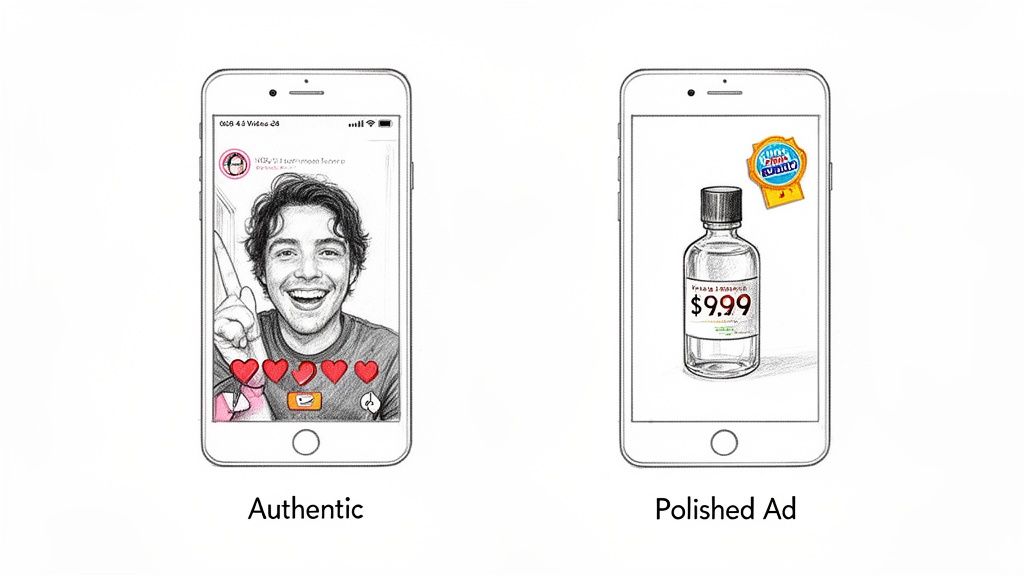
Think of UGC style video as the perfect cure for ad fatigue. It’s an ad that’s been masterfully disguised to not look like an ad. Instead of a slick, corporate pitch, you get a casual unboxing, a genuine-seeming testimonial, or a quick "get ready with me" video that just happens to feature a product. The strategy is built on a simple human truth: we trust other people way more than we trust brand logos.
This style of video performs so well because it perfectly mirrors the native content on platforms like TikTok and Meta. When someone is scrolling through their feed, a UGC style ad doesn't trigger their "I'm being sold to" alarm. It just blends in, feeling more like a cool discovery or a recommendation from a friend. This approach immediately builds trust and disarms the viewer's natural skepticism toward advertising.
UGC Style Video vs. Traditional Branded Video
To really understand the difference, let’s break it down. While both have their place, UGC style creative is purpose-built for the fast-paced, trust-driven world of social media advertising.
Attribute | UGC Style Video | Traditional Branded Video |
|---|---|---|
Feel & Vibe | Raw, authentic, relatable | Polished, professional, cinematic |
Creator | Looks like a real customer | Clearly a brand or production company |
Goal | Build trust, blend in, drive action | Build brand image, impress, announce |
Platform Fit | Native to TikTok & Instagram Reels | Better for YouTube pre-roll, TV |
Viewer Perception | "A recommendation from a peer" | "An advertisement from a company" |
Cost | Lower production costs | High production costs |
Performance | High engagement, high conversion | Lower engagement, focuses on reach |
Ultimately, UGC style video speaks the language of social media. It connects with viewers on their level, making the brand feel more human and the product more desirable.
The Power of Authenticity and Social Proof
The real magic behind this format is how it manufactures instant social proof. When potential customers see someone who looks and talks just like them using and loving a product, it feels incredibly believable. It's the digital version of a word-of-mouth recommendation, which has always been the single most powerful form of marketing.
The numbers don't lie. Just picture scrolling through TikTok and seeing a raw, unedited video from a creator—that’s UGC style video in action, and it absolutely crushes traditional ads. We've seen that social media posts with this kind of content drive 10.38x higher conversion rates compared to polished, brand-created ads. This isn't just a minor lift; it's a fundamental shift because 80% of people trust UGC more than they trust traditional advertising. For Gen Z, the effect is even stronger, with 80% relying on UGC videos to make buying decisions.
Key Takeaway: The core strength of UGC style video isn't its production value—it's the perceived authenticity. It cuts through the noise of polished marketing by giving consumers what they actually want: real, seemingly unbiased opinions.
Why It Resonates With Modern Consumers
Today’s consumers, especially younger generations, are incredibly smart. They grew up online and can sniff out an inauthentic marketing campaign from a mile away. They don’t want to be sold to; they want content that is relatable, helpful, and transparent.
This is exactly where UGC style video shines. It provides real value by showing a product being used in a real-world context, answering common questions, and highlighting benefits that actually matter. It’s less about a hard sell and more about building a genuine connection. If you want to go deeper, check out our complete guide on building a user-generated content strategy.
By embracing this format, brands can hit several key objectives at once:
Build Trust Faster: The raw, unfiltered style makes your message feel more honest and believable.
Increase Engagement: Content that feels native to the platform naturally gets more likes, comments, and shares.
Drive Higher Conversions: When you combine trust with engagement, you get a powerful formula for driving purchases.
Combat Ad Fatigue: This style provides a welcome break from the repetitive, high-polish ads that viewers have learned to tune out.
Proven Frameworks for High-Performing UGC Ads
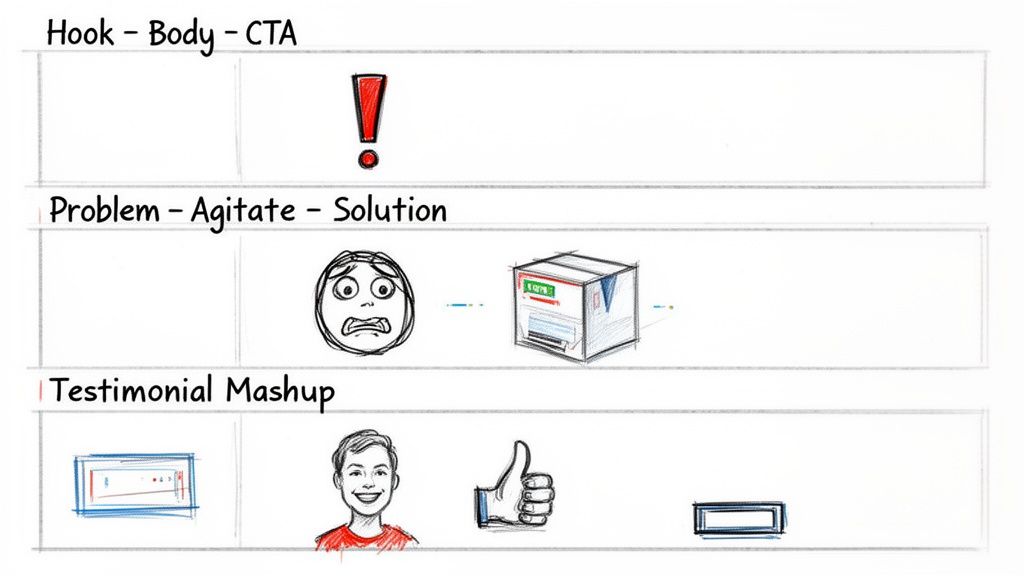
It’s one thing to get why UGC-style video works, but it’s another game entirely to crank out ads that actually convert, day in and day out. To get from theory to real-world results, you need a few go-to creative frameworks. Think of them less as strict rules and more as reliable storytelling recipes you can pull out for any product.
These frameworks give you a proven structure for combining your core ingredients—the hooks, product shots, benefits, and calls-to-action. You stop guessing and start building on a foundation that’s designed for systematic testing.
And here’s where it gets really powerful. Because these frameworks are modular, you can take a library of raw clips and rapidly assemble dozens of ad variations. This is the secret to scaling creative output, especially when you bring automation into your workflow. Let's dig into three of the most effective frameworks we use for high-performing UGC-style ads.
The Classic Hook-Body-CTA Framework
This is your workhorse. The Hook-Body-CTA is the most direct and versatile framework, which makes it the perfect place to start. It’s the bread and butter of direct response because it follows a straight line from grabbing attention to driving a specific action.
Hook (1-3 seconds): You have one job here: stop the scroll. Hit them with a provocative question, a surprising visual, or a bold claim that makes them pause. For a skincare brand, a great hook might be, "You've been applying your moisturizer all wrong."
Body (5-15 seconds): Now you deliver the goods. This is where you quickly show the product in action, explain its biggest benefit, or flash a "before and after" that proves your point. The entire focus should be on solving a problem or fulfilling a desire.
CTA (1-3 seconds): Tell them exactly what to do next. Don't be shy. "Download now to get started," "Shop the link in my bio," or "Swipe up to get yours."
This simple structure is a reliable blueprint for any UGC-style video. It keeps your ad focused, punchy, and built to get an immediate response.
The Problem-Agitate-Solution Framework
The Problem-Agitate-Solution (PAS) framework is a persuasion machine. It works by tapping into a viewer's real pain points, turning up the heat on that problem, and then positioning your product as the perfect escape. This emotional arc is incredibly good at creating a real need for your solution.
Here’s how it plays out in a UGC-style ad:
Problem: You start by showing a struggle everyone recognizes. For a meal-planning app, picture a creator staring into a sad, empty fridge, saying, "I never know what to make for dinner."
Agitate: Next, you twist the knife a little. The creator might add, "I just end up ordering expensive takeout again, which is killing my budget and my diet." This makes the problem feel bigger and more urgent.
Solution: Finally, you bring in the hero: your product. The creator's whole vibe changes as they say, "But then I found this app! It plans all my meals and builds a shopping list in seconds. Now, dinner is easy and healthy."
Pro Tip: The PAS framework is so effective because it connects your product to a genuine emotional pain. The more authentic the "problem" feels, the bigger the relief your "solution" provides.
The Testimonial Mashup Framework
Social proof is one of the strongest levers you can pull for conversions, and the Testimonial Mashup puts it on full display. This framework is all about stitching together short, rapid-fire clips from different creators or customers who are all raving about your product. The effect is a powerful wave of authentic validation.
Instead of relying on one person's opinion, you hit the viewer with a quick sequence of positive feedback from multiple sources. It’s a fantastic way to build overwhelming trust and credibility in just a few seconds.
Imagine an ad for a language-learning app that cuts between five different users:
User 1 (on a train): "I finally feel confident ordering coffee in Spanish!"
User 2 (at home): "The lessons are so fun, they don't even feel like studying."
User 3 (walking outside): "I'm learning more in 10 minutes a day than I did in a whole semester of high school."
This barrage of positivity creates a serious sense of "fear of missing out" (FOMO) and makes your product’s value feel undeniable. It's one of the most direct ways to use a UGC-style video to make a bulletproof case for your brand.
Understanding the ROI of Short-Form UGC Video
While creative frameworks give you a roadmap, every performance marketer ultimately needs to answer one question: what’s the return? The shift toward authentic, short-form video isn't just a trend; it's a direct response to consumer behavior that has a measurable impact on your bottom line.
When you invest in a UGC style video strategy, you're not just making ads. You're driving tangible business outcomes, from lower costs to higher revenue.
The logic is simple. When your ads look less like ads and more like the content people already love, they just perform better. This isn't some vague concept—it shows up loud and clear in your ad account metrics. You’ll see higher click-through rates (CTR), better conversion rates (CVR), and a much stronger return on ad spend (ROAS).
These gains are all rooted in how people consume content today. The era of long, drawn-out video ads is over. Viewers on platforms like TikTok and Meta have short attention spans and an even lower tolerance for being sold to. They want quick, valuable, and entertaining content that gets straight to the point.
The Data Behind Short-Form Dominance
The numbers don't lie. Statistics consistently show that short-form video reigns supreme, making it the perfect format for UGC. In fact, 85% of marketers now say short-form video is the most effective format on social media, pulling in 2.5x more engagement than its long-form counterparts.
This isn’t just a passing preference; it’s a fundamental shift in how people research and buy. A whopping 63% of consumers now prefer videos between 30 seconds and two minutes when they're looking into new products. If you want to dive deeper into these numbers, you can explore the full 2026 report on Kapwing.com.
This demand for brevity and authenticity is what fuels its superior ad performance.
On TikTok, UGC-style creative can deliver a staggering 159% higher engagement for brands, even when the cost per thousand impressions (CPM) is identical to polished studio ads. The raw, creator-led vibe simply connects better.
And this boost isn't just a TikTok thing. Across the board, UGC campaigns see engagement jump by 28%. It’s why 65% of marketers now prioritize UGC style video for hitting their top-funnel brand awareness goals (50%) and bottom-funnel sales objectives (38%).
Connecting Creative to Key Performance Indicators
So, how does all this creative talk translate into the metrics that matter to a growth marketer? By making creative that aligns with what users want to see, you create a domino effect that improves your entire marketing funnel.
Here’s a breakdown of the direct impact:
Lower Cost Per Click (CPC): Higher engagement tells algorithms your content is relevant and high-quality. Platforms like Meta and TikTok reward this with better ad distribution, which almost always leads to a lower CPC.
Higher Click-Through Rate (CTR): Authentic UGC-style ads stop the scroll and build immediate trust. This makes viewers far more likely to click your call-to-action. We’ve seen UGC ads achieve 4x higher CTRs than traditional studio-produced ads.
Improved Conversion Rate (CVR): The trust built by UGC doesn't stop at the click. Viewers who land on your page are already primed to believe your product claims, which means they are much more likely to convert—whether that’s a purchase, an app install, or a sign-up.
By focusing on short-form UGC, you’re not just making ads that people tolerate; you’re creating content they genuinely want to watch. This alignment is the core driver of its impressive ROI, turning your creative budget into a reliable engine for scalable growth.
How to Run UGC Style Campaigns on Meta and TikTok
Okay, so you've created some killer UGC style videos. Now what? Just throwing them out there won't cut it. You need to deploy them strategically, and for this kind of creative, Meta (Facebook and Instagram) and TikTok are the natural habitats.
But here’s the thing: you can’t treat them the same. Each platform has its own algorithm, its own audience, and its own unspoken rules. To get real results, you have to play by their specific playbooks.
On Meta, it’s all about placements. Your ad will show up in the Feed, in Stories, and in Reels, and you need to think about what each one is for. Reels are for grabbing attention with fast, trendy content, while Stories are perfect for that behind-the-scenes, interactive feel. The algorithm rewards anything that feels native and gets people talking.
TikTok's philosophy is even more direct: "Don't Make Ads, Make TikToks." Your video has to look and feel like it belongs on the For You Page. That means jumping on trending sounds, using the platform's own text effects, and maybe even participating in a challenge. A slick, corporate-style ad? It’ll get scrolled past in a heartbeat.
Platform-Specific Execution Tips
To squeeze every last drop of performance out of your ads, you have to tailor your creative for each platform. What crushes it on Instagram Reels might need a few tweaks to land on TikTok, and vice versa.
Here are a few quick tips to get you going:
Front-Load Your Hook: You've got less than three seconds to stop the scroll. No joke. Hit them with your most powerful claim, a burning question, or a can't-look-away visual right at the start. On TikTok, this isn't a suggestion—it's a requirement.
Use Native Text Overlays: Both platforms have their own distinct text styles. Use them. It’s a simple trick that makes your ad feel like a piece of organic content, not an interruption. This alone can do wonders for authenticity.
Choose the Right Call-to-Action (CTA): Be direct. A "Shop Now" button is a workhorse on Meta for e-commerce brands. But on TikTok, a softer CTA like "Learn more at the link in bio" can sometimes feel more natural and less jarring, depending on your video's vibe.
Optimizing for Meta Campaigns
When you're running UGC style video ads on Meta, you’ve got two huge advantages: powerful audience targeting and a variety of ad placements. The algorithm is a beast at finding people ready to convert, but you have to feed it the right creative fuel.
Think about your placements as a complete funnel strategy:
Reels: Use these for top-of-funnel awareness. Create entertaining, high-energy videos that introduce your brand’s personality and stop the scroll.
Stories: This is your spot for mid-funnel engagement. Use interactive elements like polls, quizzes, and "tap for more" stickers to connect with users who already know who you are.
Feed: The Feed is your conversion engine. This is where you run your direct-response UGC ads—think problem-solution formats or powerful testimonials—to drive sales from your warmer audiences.
A key insight for Meta is that the algorithm rewards signals of authenticity. Videos that look like they were shot on a phone, feature genuine reactions, and use native-feeling text overlays often see lower CPCs and higher CTRs.
Mastering the TikTok Approach
TikTok is all about culture and speed. Your UGC style video can’t just be an ad; it has to be part of the ongoing conversation. Success here isn't about perfect production—it's about being culturally relevant and fast.
Here’s how you win on TikTok:
Embrace Trends: Using trending audio and video formats is the fastest way to get in front of eyeballs. The algorithm is literally designed to push content that taps into what's hot right now.
Stitch and Duet: Don't just post; participate. Stitching a popular video to position your product as the solution is an incredibly powerful and native way to advertise.
Authenticity Above All: Raw, unpolished, and even slightly messy videos often perform best. An overly produced ad is a red flag that tells users to keep scrolling.
Getting a handle on what each platform demands is a game-changer. For a deeper dive into aligning your content with your business goals, check out our guide on effective video product marketing. By adapting your strategy, you can turn your UGC-style creative into a high-performing machine on any social channel.
How to Scale Creative Production with AI
Knowing the right creative frameworks is a great starting point. But for any performance marketer in the trenches, the real headache is churning out enough UGC-style video to keep campaigns from going stale. Manually editing video after video is a brutal time-sink, leading to slow tests and ads that burn out way too fast.
This is exactly where AI stops being a buzzword and starts making a real impact on your bottom line. When you connect your creative strategy to an automated workflow, you can finally break through the biggest production bottlenecks: time, money, and scale. Imagine turning a messy folder of creator clips into hundreds of test-ready ad variations in minutes, not days. That’s what an AI-driven process makes possible.
This flowchart breaks down how a modern UGC campaign works, showing where automation speeds up everything from asset placement to testing.
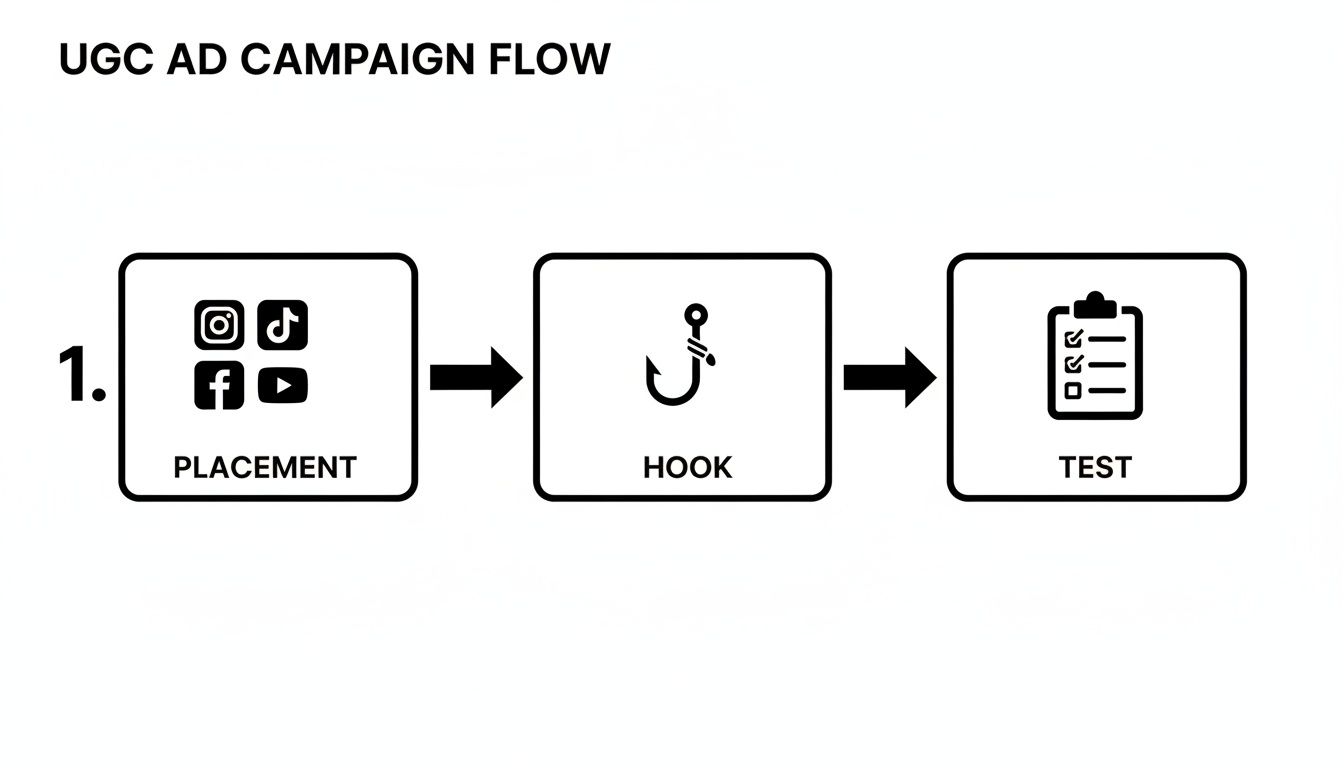
As you can see, AI can turn what used to be a slow, step-by-step process into a high-speed cycle of creating, testing, and learning.
From Manual Edits to Automated Assembly
The old way of making video ads is painfully slow and linear. You brief a creator, they send you clips, you pass them to an editor, wait for a draft, give feedback, and maybe—if you’re lucky—get a couple of variations back. That manual workflow makes it almost impossible to keep up with the demands of platforms like Meta and TikTok.
AI completely flips this model around. Instead of editing one video at a time, you're building a system to assemble countless videos at scale. The new way of thinking is all about modularity, where every hook, demo, and testimonial becomes a reusable block in your creative arsenal.
Key Insight: The goal is to stop thinking like a video editor and start thinking like a system builder. Your job isn't to cut one perfect ad; it's to build an engine that produces hundreds of "good enough" ads to find the winners through data.
Platforms like Sovran are built specifically for this. You can dump all of your raw footage into the platform at once, and our AI immediately gets to work. It automatically watches and tags every single clip based on what’s inside—identifying hooks, product demos, testimonials, or calls-to-action. This turns a chaotic pile of files into a structured, searchable asset library.
Building Your Creative Testing Matrix with AI
Once your clips are all tagged and organized, you can start using frameworks like PAS or Hook-Body-CTA as your templates. From there, the AI can rapidly mix and match these tagged components to assemble a huge volume of new ads.
Here’s what that looks like in practice:
Step 1 - Upload: Drop in 5 different hook clips, 3 body clips (like product demos), and 2 CTA clips.
Step 2 - Tag: The AI automatically identifies and tags each part for you.
Step 3 - Assemble: Tell the AI to create all possible combinations using your Hook-Body-CTA framework.
Step 4 - Render: In minutes, you suddenly have 30 unique video ads (5 x 3 x 2) ready to go live.
This is a level of automation that’s just not possible with manual editing tools. It allows you to find winning ad concepts up to 10x faster simply because you can gather performance data across a much wider set of creative combinations. To get the most out of this approach, it helps to use specialized AI tools for video editing.
The market is already shifting hard in this direction. The global UGC market, which was $7.6 billion in 2023, is projected to explode to nearly $44 billion by 2031. For performance marketers, automating UGC production isn't a "nice to have" anymore—it's a core skill for staying competitive.
Integrating Generative AI and Streamlining Launches
The best AI platforms don't just stop at assembly. They integrate generative models to fill in any creative gaps you might have. Missing a specific type of shot? You can generate new B-roll or even entire hook concepts just by typing a text prompt, saving you from having to reshoot or find new content.
Finally, the whole process comes together when the system automates the launch. Once your video variations are rendered, they can be pushed directly to your ad manager with clean, standardized naming conventions.
This ensures your tests are organized from the start, making it simple to analyze the results and feed those insights right back into your next round of creative. To see this in action, check out our guide on using an automatic video maker. By automating the entire lifecycle—from production to launch and analysis—you turn your creative process into a powerful, data-driven growth engine.
Alright, so you're sold on UGC-style video, but you've got some practical questions before you dive in. It’s one thing to know this ad style works, but it's another to get the details right—from finding content to actually measuring if it's making you money.
Let's clear up the most common questions that trip up performance marketers and creative strategists. We'll get these answered so you can start scaling your campaigns with confidence.
How Do I Get UGC Content if I Am Just Starting?
This is the classic chicken-and-egg problem for new brands. No customers, no content. Right? Not exactly. The good news is you don't need a huge audience to get the ball rolling.
You have a few solid options right out of the gate:
Run a Giveaway or Contest: Give your first few customers a real reason to submit videos. Offer a juicy prize like a big gift card, a free product bundle, or a shot at something even bigger. A clear incentive is all it takes to get people filming.
Partner with UGC Creators: This isn’t your typical influencer marketing. Platforms like TikTok Creator Marketplace, Billo, and Insense are full of creators who are experts at making authentic, native-looking content for a flat fee. Their entire job is to make videos that feel real.
Activate Your Happiest Customers: Dig through your product reviews, social media comments, and support tickets. Find those glowing reviews and reach out directly. A small gift card or a discount on their next order is often more than enough to get a short, honest video testimonial.
The secret to getting great content is a dead-simple creative brief. Be specific. Tell creators exactly what you want, like, "a 15-second video showing how you use our app to plan your week." This ensures you get clips you can actually use.
Is UGC Style Video Only for B2C Brands?
It's a common myth that this casual video style is just for direct-to-consumer brands selling skincare or clothes. While B2C made it famous, the core ingredients—authenticity and social proof—are just as powerful for B2B and mobile apps. The execution just looks a little different.
Think about these scenarios:
For a B2B SaaS Company: Imagine a simple screen recording where a client walks through how your software solves a massive headache for them. A quick testimonial filmed on a laptop webcam can feel far more trustworthy than a slick, high-budget case study.
For a Mobile App: Don't just show screen recordings of your UI. Get users to show how your app actually fits into their day. A video of someone using a fitness app in the gym or a language app on their commute feels way more relatable and real.
The goal isn't to copy a TikTok trend perfectly. It's about capturing that raw, person-to-person vibe that builds trust, no matter what you're selling.
How Do I Measure the True Impact of My UGC Ads?
For a performance marketer, likes and views are vanity metrics. We need to connect creative directly to revenue. Measuring UGC-style video is about focusing on the numbers that actually drive business results.
Your must-track KPIs are:
Click-Through Rate (CTR): Are your videos good enough to stop the scroll and earn a click? We've seen UGC-based ads pull in 4x higher click-through rates compared to standard ads.
Conversion Rate (CVR): Of the people who click, how many are actually buying, installing, or signing up?
Cost Per Acquisition (CPA): How much does it cost you to get a new customer with these ads? The whole point is to drive this number down.
Return on Ad Spend (ROAS): This is the bottom line. For every dollar you put in, how many are you getting back?
To track this stuff properly, you need a rigid naming convention for your campaigns (e.g., TikTok_UGC_Testimonial_USA_Q3). This makes it easy to filter and analyze performance in your ad manager. Always A/B test your UGC-style creative against your polished studio ads to prove the lift and show your team the real value of authenticity.
What Legal Rights Do I Need to Use Customer Videos?
Pay close attention here, because this is the one question that can land you in serious legal trouble. You must always have explicit, written permission to use a customer's or creator's video for any commercial purpose, especially paid ads.
Never assume you can just grab a video because someone tagged your brand or used your hashtag. They created it, they own it.
Here’s how to do it by the book:
Use a Release Form: When you source content, have the creator sign a simple digital release form. It should clearly state that you have the rights to use their video in organic posts, paid ads, on your website, and in other marketing—forever.
Check Platform Terms: If you're using a UGC platform, read their terms of service. Most of them have built-in agreements that grant you the usage rights you need as part of the deal.
Get it in Writing: If you're sourcing directly from a customer, a simple email where they explicitly agree to your terms can work in a pinch. But a formal digital release is always the safest and most professional way to go.
Ready to stop wasting time on manual editing and start scaling your creative output? With Sovran, you can turn raw clips into hundreds of test-ready ad variations in minutes. Find your winning ads 10x faster and never worry about creative fatigue again. Start your free 7-day trial of Sovran today.

Manson Chen
Founder, Sovran
Related Articles
8 High-Converting Static Ads Examples for 2026
Discover 8 high-performing static ads examples from top apps. Learn to create text-overlays, testimonials, and lifestyle ads that convert.
A Guide to Video for Advertising in 2026
Master video for advertising with this guide to proven frameworks, platform specs, and AI-powered workflows that scale winning campaigns on Meta and TikTok.
How to Turn Link Into Video: Ads That Convert in 2026
Learn how to turn link into video for Meta & TikTok ads. Leverage AI to scale creation, boost ROI, and succeed in 2026.