Your Video Product Marketing Playbook for Meta and TikTok
Master video product marketing for Meta & TikTok. Learn how to plan, produce, test, and scale winning video ads 10x faster with a modern AI-powered workflow.
Jump to a section
Product marketing through video isn't just about slapping together a demo and hoping for the best. It's a specific strategy: using video to walk customers through your product's features, show them the benefits, and really drive home its value. This is a massive leap from old-school ads. We're talking about building compelling stories and showcases that actually get people to engage and buy, especially on fast-moving platforms like Meta and TikTok.
The New Reality of Video Product Marketing
Welcome to the modern playbook for video product marketing. Forget the generic advice you've read before. This is a deep dive into solving the real, day-to-day headaches that user acquisition and growth teams are up against—creative fatigue, the nightmare of scaling ad production, and the constant pressure for fresh, high-performing content.
The old method? Sinking a huge budget into a few polished videos and letting them run for months? That just doesn't cut it anymore in the hyper-speed worlds of Meta and TikTok.
Today's game is all about velocity. Winning requires a system, a machine. Your team’s focus needs to shift from painstakingly crafting one-off videos to building a powerful engine that can churn out hundreds of testable ad variations. This isn't just about making more ads; it’s about making smarter ads, and doing it way faster.
Why a Modular Approach Is Essential
The entire foundation of this new strategy is modularity. Instead of treating every video as a single, massive project, we're going to break them down into their basic building blocks: hooks, body content, and calls-to-action (CTAs).
Think of it like LEGOs. This lets you mix and match different pieces to create a huge volume of unique combinations without having to start from zero every single time. For any team that's serious about growth, this is the only way to operate.
To really get this, you need to have the basics down pat. This step-by-step guide on how to create product videos offers a solid foundation that's critical before you jump into the more advanced, scalable strategies we're covering here.
This method gives you some serious advantages:
Rapid Iteration: Got a new idea or angle? You can test it in hours, not weeks.
Creative Efficiency: Squeeze every last drop of value out of your existing assets and slash production costs.
Data-Driven Insights: Find out exactly which hooks or CTAs are hitting home with your audience, and do it fast.
Overcoming Modern Marketing Hurdles
The two biggest walls performance marketers hit today are speed and relevance. Ad fatigue is brutal and sets in faster than ever. We've seen top-performing creatives burn out in just a couple of weeks. The only way you can stay ahead of the curve is to have a constant pipeline of new creative ready to deploy and test.
The most successful teams don't just create ads; they build a system for creative discovery. They understand that finding a "winner" is a numbers game, and the more shots you take, the more likely you are to find a profitable campaign.
This playbook is going to walk you through an AI-driven workflow built for this exact purpose. You'll learn how to build an intelligent asset library, use proven frameworks to piece together killer narratives, and roll out a testing cadence that turns your creative output into measurable, bottom-line growth.
If you want to go even deeper, check out our guide on video marketing best practices for more insights.
Building Your Modular Video Asset Library
If you want to scale your video marketing, you have to stop thinking about creating one-off, finished videos. It's time to think more like a chef prepping for a crazy dinner rush. You don't cook every dish from scratch; you have a pantry full of ingredients, ready to be combined into dozens of unique meals on the fly.
This is exactly what a modular video asset library is for your marketing. It’s the absolute foundation for producing creative at high velocity.
The whole approach is about deconstructing your existing content—every last bit of it—into its smallest, most reusable parts. That killer UGC clip? That slick product demo? Even those simple screen recordings? They're all goldmines. The goal is to chop them up into purpose-driven clips you can mix and match endlessly.
This is the big shift from the old way of doing things to a modern, scalable system.
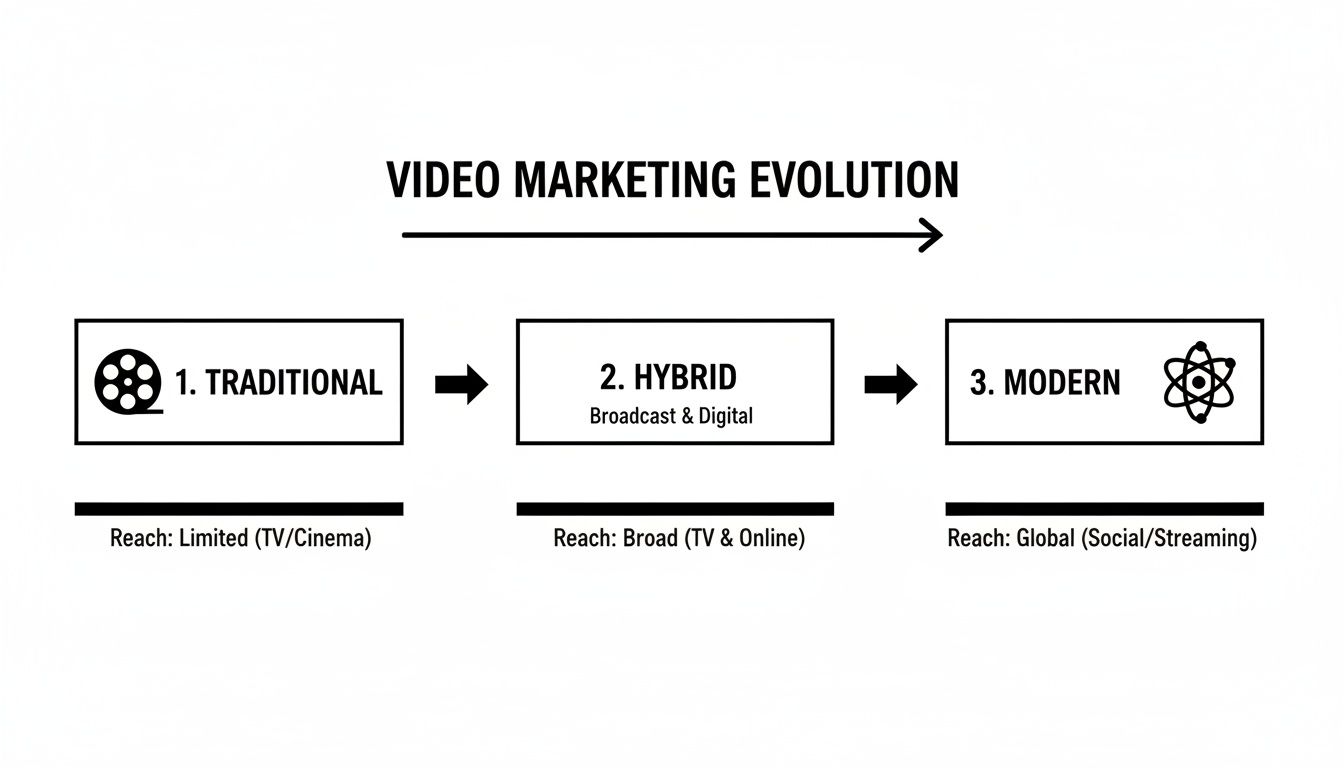
As you can see, the modern approach isn't about making a single perfect video. It’s about building a system that can generate countless variations, which is exactly what you need for the rapid-fire testing that platforms like Meta and TikTok demand.
Deconstructing and Tagging Your Assets
Now, just having a folder full of clips isn't enough. The real power comes from organizing it intelligently. Every single clip you add to your library needs to be strategically tagged based on the role it would play in an ad. This isn't just about file naming; it's about building a searchable database that an AI can actually understand and use to assemble new ads.
Start by sorting every clip into three main buckets:
Hooks (1-3 seconds): These are your scroll-stoppers. Think of a surprising customer reaction, a bold text overlay, or a question that makes people curious.
Body (5-15 seconds): This is where you deliver the goods. It could be a feature demo, an explanation of benefits, social proof, or a customer testimonial.
CTAs (2-5 seconds): These are your closers. A clean "Download Now" screen, a shot of a user swiping up, or a clear verbal command to take action.
Take a 30-second customer testimonial, for instance. That’s not just one asset. A powerful one-liner from it can become a hook. A segment where they explain a key benefit becomes a body clip. Their final endorsement could be another body clip. Suddenly, one video can yield 5-10 unique, modular assets. Properly organizing these pieces is the core of a powerful video asset management system that will completely change your production workflow.
Introducing The Context Vault
If your video clips are the "what," the Context Vault is the "how" and "why." Think of it as a central hub for all the non-visual information that keeps every AI-generated video on-brand, on-message, and focused on conversion. It’s essentially the brand's brain, providing the guardrails for any automated creative process.
Your Context Vault absolutely must contain:
Brand Guidelines: Logos, color palettes (with #hex codes), approved fonts, and rules on tone of voice.
Proven Scripts: Your top-performing ad scripts and messaging frameworks—the ones you already know connect with your audience.
Customer Reviews & Pain Points: A collection of direct quotes from reviews, support tickets, and surveys. This is raw, authentic language that highlights real customer problems and desires.
Product Information: Official feature names, approved benefit statements, and current pricing details.
By feeding this information to an AI platform, you ensure that even when it spits out hundreds of video variants, each one feels like it came directly from your marketing team. It’s your safety net against off-brand visuals or weird messaging sneaking into your ad campaigns.
From Chaos to a Single Source of Truth
Look, building this library takes some real effort upfront. But the payoff is huge. You’ll go from a chaotic mess of scattered files and inconsistent messaging to a single source of truth for all your video marketing.
Instead of your team asking, "Hey, where's that one UGC clip we used last quarter?" they can just search for "testimonial hook showing excitement." This methodical approach transforms your creative process from a reactive, manual grind into a proactive, scalable engine.
With this foundation in place, you're no longer just making ads. You're building a system that discovers what works and lets you replicate that success at scale, over and over again. Your library becomes your single most valuable creative asset.
How To Assemble and Scale Creatives with AI
Alright, once you've got your modular asset library and Context Vault dialed in, it's time to move from prep to production. This is where you really start to see the speed of your video product marketing pick up. Forget spending hours in editors like CapCut manually stitching together one video at a time. Now, you can assemble and scale high-impact creatives with AI.
This workflow lets you graduate from thinking about single concepts to entire frameworks. Proven narrative structures like Problem-Agitate-Solution (PAS) or testimonial mashups become simple recipes. Your tagged assets—hooks, body segments, and CTAs—are just the ingredients. AI is the chef that can instantly whip them up into hundreds of unique combinations.
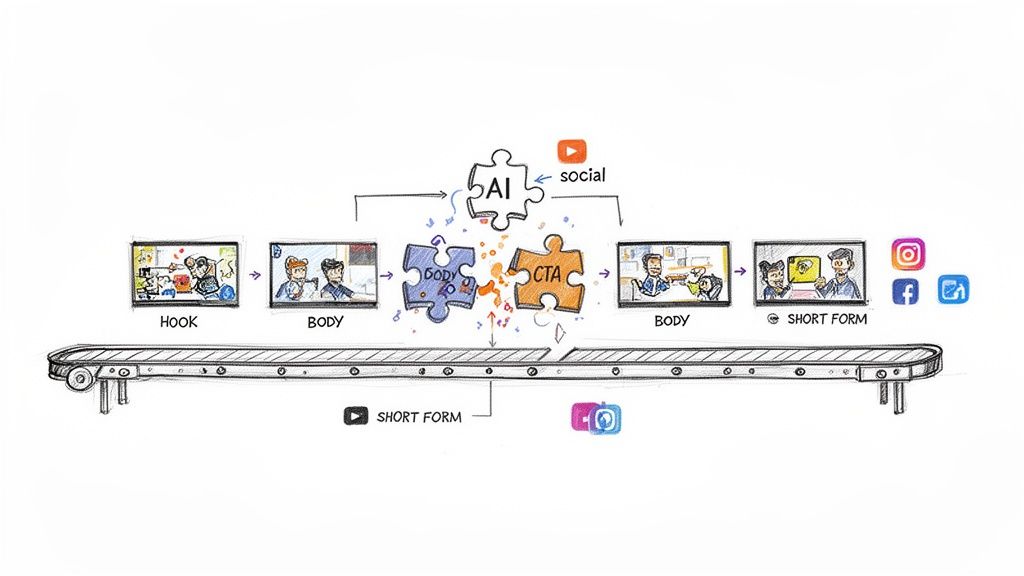
This modular approach isn't just about going faster; it’s a fundamentally smarter way to produce creative for platforms like Meta and TikTok.
Automating Framework-Based Assembly
Let’s say you want to test the PAS framework. Manually, that means digging through folders to find a clip that shows a customer pain point, another that agitates it, and a final one positioning your product as the hero. With an AI-powered system, the whole process looks completely different.
You simply tell the AI: "Create 20 video ads using the Problem-Agitate-Solution framework."
The system immediately gets to work, pulling from your library:
It grabs assets tagged as "problem" or "pain point" for the opening hook.
It finds clips tagged as "agitate" or "struggle" for the body.
It wraps it all up with clips tagged as "solution" or "product demo."
And because your Context Vault has all your brand guidelines and approved copy, the AI automatically slaps on the correct text overlays, fonts, and brand colors for every single variant. You get on-brand consistency at a massive scale.
This is the leap from being a manual laborer to a strategic overseer. Your team’s job shifts from video editor to creative director, guiding the AI to pump out on-brand, on-message ads in minutes, not days.
Leveraging Natural Language and AI B-Roll
Modern platforms are taking this even further by integrating natural language search and generative AI. The tedious task of sifting through folders of poorly named files is gone. Instead, you can find the perfect asset with a simple command.
For instance, you could search for things like:
"Find UGC clips where a user looks surprised or happy."
"Show me all product demos of the new checkout feature."
"Pull up all testimonials that mention 'easy to use'."
The AI actually understands the content and context of your clips, making your library instantly searchable and way more valuable. But what if you have a gap in your creative library? This is where generative AI becomes a real game-changer. If you need a specific shot—say, a quick clip of someone looking frustrated at their laptop—you can generate supplementary B-roll on the fly. No more organizing a full shoot for a few seconds of footage.
This blend of asset management and AI generation creates a workflow that just flows. If you want to learn more about how to bring this to your team, check out what a purpose-built AI video ad creator can do for performance marketing.
Achieving Massive Creative Volume with Bulk Renders
The final piece of this puzzle is scaling your output. Once your frameworks are defined and your asset library is rich with content, the bulk render feature becomes your superpower. This is the function that takes one creative idea and explodes it into hundreds of testable variants.
You could set up a simple rule: "Take these 5 hooks, combine them with these 10 body clips and these 4 CTAs."
That's 5 x 10 x 4, which gives you 200 unique video ads rendered automatically. The system handles all the rendering, subtitle generation, and even formatting for different aspect ratios (like 9:16 for TikTok and Reels). It's this massive jump in creative volume that fuels a high-velocity testing machine.
The market for these tools is blowing up for a reason. The AI video generator space is projected to swell from $534.4 million in 2024 to over $2.5 billion by 2032. This explosion is happening because teams are finding they can discover winning ads up to 10x faster by testing hundreds of variants in seconds—something that was manually impossible just a few years ago. You can find more stats on the growth of video marketing tools at SellersCommerce.
By arming your team with these tools, you're not just making more ads. You're building a system for relentless testing and learning, making sure you can consistently find—and scale—the winning creatives that actually drive performance.
Implementing a High-Velocity Creative Testing Cadence
So, you've got hundreds of video variants ready to go. Great. But that volume is just noise without a smart, structured way to test them. This is where your video product marketing strategy pivots from just making stuff to making stuff that works. You need a high-velocity testing cadence—a real engine that finds your winners, gathers solid data, and tells you exactly what to build next.
This whole process is about turning your creative output into performance insights you can actually use. It's how you figure out which hooks genuinely stop the scroll and which CTAs get people to convert, not just click.
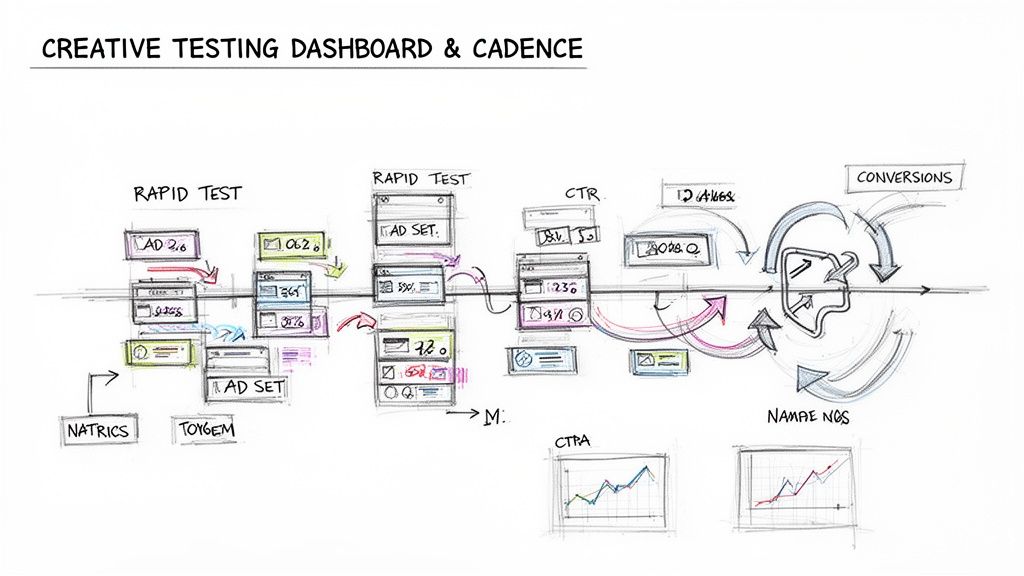
The name of the game is moving fast, learning faster, and scaling your winners with total confidence.
Structuring Campaigns for Creative Testing
First thing's first: stop dumping your new creative tests into your scaled, evergreen campaigns. That’s a surefire way to get messy data and burn through your budget. For clean, effective testing on Meta and TikTok, you need dedicated campaigns built for rapid learning. The go-to method we've seen work time and again is the Creative Testing Campaign (CTC).
This structure isolates your new ad variants, giving them a fair shake without having to compete against your proven top performers.
Here’s a battle-tested setup that just works:
Campaign Level: Use Meta’s Advantage Campaign Budget to let the algorithm do the heavy lifting, automatically shifting spend to the best-performing ads. A modest daily budget of $100-$200 is usually plenty to get the data you need without going broke.
Ad Set Level: Keep your audience broad. I know it's tempting to get granular, but the goal here is to test the creative, not the targeting. A broad audience lets the ad itself find its people.
Ad Level: This is where the action is. Drop 3-5 new video variants into each ad set. This is the sweet spot—enough to get a good read on performance without spreading impressions too thin.
This isolated sandbox gives you a clean room to see how each new creative performs on its own merit.
Establishing a Reliable Testing Cadence
"High velocity" shouldn't mean chaos. It’s all about having a consistent, repeatable rhythm for launching, analyzing, and iterating. If your testing schedule is all over the place, your results will be inconclusive, and your learning cycle will grind to a halt.
For a typical growth team, a practical weekly cadence might look like this:
Launch (Monday): Get a fresh batch of 10-20 creative variants live in your CTC. This gives them the whole week to cook and collect data.
Monitor (Wednesday): Do a quick check-in. You're looking for early signals—strong hook rates, high CTR, maybe some early conversions. Don't be afraid to kill any obvious duds that are just eating budget.
Analyze (Friday): By now, you should have enough data to make some calls. Pinpoint the top 1-3 performers based on your main KPI, whether that's ROAS, CPA, or something else.
Iterate & Scale (Friday/Weekend): Now, move the winners out of the testing campaign and into your main scaling campaigns. Just as important, figure out why they won. Was it the hook? The specific testimonial? Feed those learnings back to your creative team (or your AI platform) to make the next batch even better.
This weekly cycle creates an incredibly powerful feedback loop. You're not just finding winners; you're building a library of knowledge about what actually moves your audience, making every creative sprint smarter than the last.
Moving Beyond Surface-Level Metrics
Look, metrics like CTR and Cost Per Click (CPC) are fine for a quick pulse check on engagement, but they don't pay the bills. A super catchy hook might get a ton of clicks, but if none of those people convert, the ad is a failure. Your testing framework has to prioritize the metrics that directly impact your bottom line.
When you're analyzing performance, zero in on these KPIs:
Return on Ad Spend (ROAS): This is the ultimate truth serum for profitability. It tells you exactly how much revenue you're making for every dollar you spend.
Cost Per Acquisition (CPA): How much are you paying for a new customer? This is fundamental to knowing if your campaigns are actually sustainable.
Conversion Rate (CVR): What percentage of people who click your ad actually take the action you want them to? A high CVR means your ad and landing page are perfectly in sync.
Focusing on these numbers helps you avoid the classic trap of scaling "engaging" ads that don't actually grow the business. This is what separates good video product marketing from the truly great stuff—it's about making sure every dollar spent is an investment in finding and scaling real, profitable winners.
How To Measure Performance and Scale Winners
Turning a heap of creative test results into a scalable, profitable campaign is where the real money gets made. This is the moment that matters most—transforming raw data into smart decisions that actually fuel growth.
You’ve launched your variants, the initial numbers are rolling in, and now you need a system. A way to interpret that data, understand not just what worked but why, and confidently push your budget to the winners.
The goal isn't just to find a single high-performing ad. It’s to build a continuous feedback loop where insights from today’s tests directly inform the next wave of creative. This is how your strategy gets sharper, more efficient, and more effective over time.
Digging Into the Creative to See What’s Actually Working
First things first: you have to get past surface-level vanity metrics. A high click-through rate is nice, but it’s completely useless if it doesn't lead to conversions. To really understand what's going on, you have to dissect your winning ads piece by piece.
Break down your analysis by the modular components you tested:
Hooks: Did one specific UGC hook absolutely crush all the others in thumb-stop ratio? Maybe a question-based hook drove higher-quality clicks than a direct statement did.
Body Content: Did your testimonial mashups lead to a better ROAS than the product-focused demos? It's time to pinpoint the value props that are clearly hitting home with your audience.
Calls-to-Action: Was a direct, hard-sell CTA ("Shop Now") more effective than a softer approach ("Learn More")? Sometimes a tiny change right here can have a massive impact on your conversion rate.
By tagging every winning element, you start to build a library of proven creative DNA. You’re no longer guessing; you’re making data-backed decisions about what your audience truly responds to.
This level of detailed analysis shows you exactly which creative levers are driving your key business outcomes. This is where the true power of a modular video marketing approach really shines.
Creating a Powerful Feedback Loop
Once you've identified winning elements, the next step is to feed those insights directly back into your production system. This creates a powerful, self-improving cycle. For instance, if you discover that hooks featuring user-generated content with pets consistently outperform others, you can instruct your system to prioritize those assets in the next batch of renders.
This process is all about systematically doubling down on what’s proven to work. You're basically teaching your creative engine what success looks like, which makes each following round of testing much more likely to deliver profitable results. It’s a huge advantage, especially when you consider that 85% of people have been convinced to buy something after watching a brand's video.
Beyond tracking basic engagement, it's crucial to effectively measure social media ROI to connect your creative efforts directly to business growth. This is how you make sure you’re optimizing for profit, not just for clicks or views.
Scaling Winners and Beating Ad Fatigue
With clear winners identified, it’s go-time. Move your top-performing ads out of your testing campaign and into your main scaling campaigns with bigger budgets. Keep a close eye on them to ensure performance holds as you ramp up the spend. A creative that works wonders with a $100 daily budget might behave differently at $1,000.
But scaling winners is only half the battle. Ad fatigue is inevitable, and even your best creative will eventually burn out. The key is to be proactive, not reactive.
Here’s a practical way to approach it:
Scale the Winner: Give your top ad the budget it deserves to drive results right now.
Iterate on the Winner: Immediately use your insights to create new variations of the winning ad. Try testing different hooks or CTAs with the body content you already know works.
Plan the Next Test: As you scale, your feedback loop should already be informing the next full-scale creative test.
This three-pronged strategy ensures you’re squeezing maximum returns from your current winners while simultaneously discovering the next generation of top performers. It’s a system that keeps you one step ahead of creative fatigue, allowing you to maintain campaign performance and scale your video marketing efforts for the long haul.
Common Questions We Get
Even with a solid playbook, jumping into a high-speed video workflow is bound to bring up some questions. Here are some of the most common ones we hear from teams just like yours.
How Much Video Do I Actually Need to Get Started?
You'd be surprised. You don’t need a massive library of professionally shot content to get the ball rolling. In fact, you can kickstart this entire process with just a handful of solid core assets.
For instance, pulling together 5-10 strong customer testimonials, 3-4 clear product demo clips, and a few lifestyle shots is plenty. The name of the game is quality over quantity. An AI platform can chop these up into dozens of reusable hooks, body segments, and CTAs, so you can start generating variants right away. You can always add to your library later or even use AI-generated B-roll to fill in the gaps.
Can a Small Team (or Even Just Me) Really Do This?
Absolutely. You could argue this AI-driven workflow is even more valuable for smaller teams or solo marketers. When you don't have a big creative department, the manual grind of video production becomes a massive bottleneck that just kills your growth.
By automating the whole remixing and rendering process, one person can crank out the creative volume that would normally take a whole team. This system gives you back your most valuable asset—time. It lets you shift your energy from tedious editing tasks in tools like CapCut to big-picture strategy and performance analysis. That's where the real growth happens.
This approach completely levels the playing field. It empowers lean teams to compete on creative speed and testing smarts, not just on headcount or budget. It’s all about working smarter.
How Do I Keep AI-Generated Videos On-Brand?
That's a great question, and it’s mission-critical. Making sure hundreds of video variations don't go off-brand is a real concern. This is exactly why a feature like a "Context Vault" is so essential. Think of it as the AI's brand bible.
Before you generate anything, you load it up with your core brand identity:
Official logos and how to use them
Your specific brand color palettes (hex codes and all)
Approved fonts and typography rules
Pre-approved messaging and key value props
The AI then uses this vault as a strict set of guardrails, making sure every single variant it pumps out follows your brand standards to a T. This mix of creative automation and tight brand control is what makes the system powerful enough for established brands to trust.
What’s a Realistic Budget for Creative Testing?
Your testing budget is always going to tie back to your target CPA and business goals, but a good rule of thumb is to set aside 10-20% of your total monthly ad spend just for creative testing.
The goal here isn't to spend a ton on any single ad. The strategy is to spend a little bit across a lot of different variants to get data back quickly. For example, you could run 10-20 new creative variants in a Meta Advantage Campaign Budget campaign with a daily budget of $100-$200. This kind of volume helps you hit statistical significance way faster, so you can spot the winners and scale them up without burning cash on ads that are going nowhere.
Ready to stop the manual grind and start scaling your video product marketing? Sovran automates the entire creative workflow, from asset management to bulk rendering and campaign launching. Find your next winning ad up to 10x faster. Start your 7-day free trial today!

Manson Chen
Founder, Sovran
Related Articles
Your Guide to a Social Media Ad Generator in 2026
Discover how a social media ad generator revolutionizes creative production. Learn to automate video ads, scale testing on Meta & TikTok, and drive performance.
How to Turn Link Into Video: Ads That Convert in 2026
Learn how to turn link into video for Meta & TikTok ads. Leverage AI to scale creation, boost ROI, and succeed in 2026.

Your Ultimate Guide to UGC Style Video Ads
Master UGC style video ads for Meta and TikTok. This guide reveals proven frameworks, scripts, and scaling tactics to boost your ROAS in 2026.