Restaurant Facebook Ads: A 2026 ROI Playbook
Master restaurant Facebook ads with real-world tactics to boost reservations, optimize targeting, and maximize ROI.
Jump to a section
- Why Your Restaurant Needs Facebook Ads in 2026
- Building Your Foundational Ad Campaigns and Audiences
- Designing Ad Creative That Makes People Hungry
- Nailing Your Offers and Ad Copy
- Scaling Your Ads with AI-Powered Creative Production
- Your Top Restaurant Facebook Ad Questions, Answered
- Create Restaurant Video Ads That Drive Reservations
If you’re running a restaurant, you know that great food isn't always enough. You need to get people in the door. That's where Facebook ads come in. By targeting diners right in your neighborhood with mouth-watering photos and videos, you can turn a small ad budget into a steady flow of new customers and online orders. It’s about being proactive, not just posting on your page and hoping for the best.
Why Your Restaurant Needs Facebook Ads in 2026
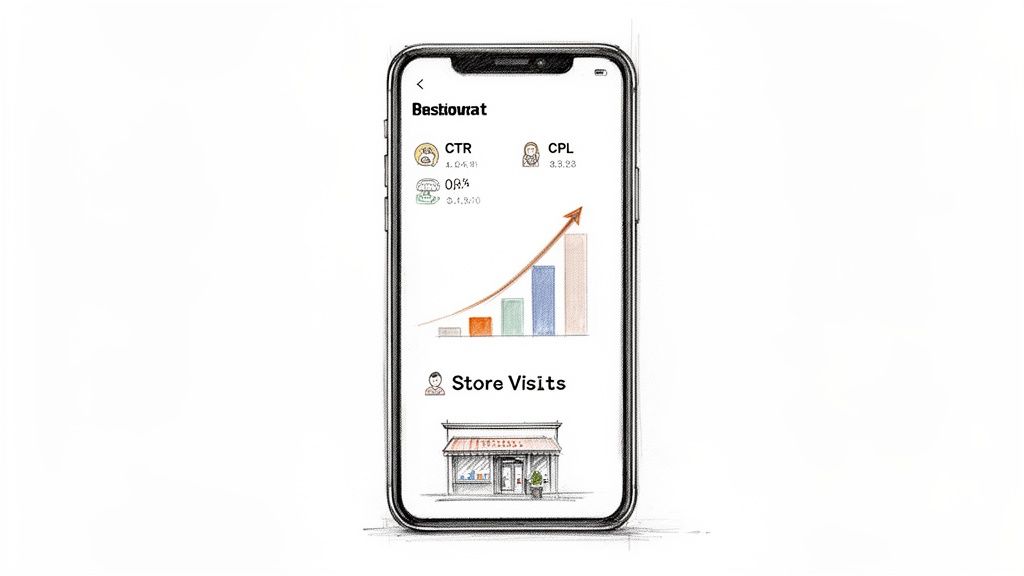
Let's be real—relying on word-of-mouth alone is a slow, unpredictable way to grow your business. In a crowded market, you need a direct line to the people who are most likely to eat at your place. Facebook and Instagram give you exactly that. They offer a measurable way to reach locals and turn them into regulars.
This isn't just a hunch. The data proves it.
The Numbers That Matter
Restaurants have a massive, built-in advantage on Meta’s ad platforms. Unlike businesses selling cars or software, you’re selling something people buy multiple times a week. This makes your ads incredibly relevant and timely.
The numbers from 2025 speak for themselves. Food and restaurant ads on Facebook saw an impressive click-through rate (CTR) of 1.67% and a cost per click (CPC) of just $0.72.
But here's where it gets really good. Lead generation campaigns for restaurants hit a conversion rate (CVR) of 18.25%. That's a mind-blowing 341.52% higher than the average for all other industries on the platform. The cost to get a lead was as low as $3.16, crushing the performance of almost every other sector. We've compiled more data on general Facebook advertising best practices if you want to see how these benchmarks stack up.
The bottom line is simple: Restaurant ads don't just get seen; they drive real, high-intent customers at a fraction of the cost you'd pay in other industries. It's a no-brainer for any modern restaurant.
Beyond Clicks to Creative Fatigue
Now, just because the potential is huge doesn't mean success is guaranteed. The single biggest roadblock we see performance marketers hit is creative fatigue. This is what happens when your audience gets tired of seeing the same ad over and over. Your performance tanks, and your costs skyrocket.
This is a huge deal for restaurants because your ads live and die by their visuals. That amazing video of a sizzling steak might be a winner today, but after a few weeks, it's going to lose its magic. To keep your return on ad spend (ROAS) healthy, you absolutely need a system to churn out and test new creative ideas.
That's what this guide is all about. We’ll go beyond the basics and give you a repeatable playbook for creating ad variations quickly. This is the secret to staying ahead of ad burnout and keeping your campaigns profitable month after month.
Building Your Foundational Ad Campaigns and Audiences
Setting up your restaurant's Meta ads correctly from day one is the difference between filling tables and burning cash. It all starts with choosing the right campaign objective. Think of this as your GPS—it tells Meta's algorithm exactly what you want to achieve.
A common mistake is defaulting to the "Traffic" objective. While it sounds logical, you'll often end up with low-quality clicks from people who are just browsing, not actually looking to dine. You need to align your objective with a real-world business outcome.
Choosing the Right Campaign Objective for Your Restaurant Goal
So, how do you pick the right one? It’s all about matching your marketing goal to the objective Meta is built to deliver. This is the first—and most critical—step in building campaigns that actually work.
This simple table breaks down which objective to use for common restaurant goals and the metric you should be watching.
Restaurant Goal | Recommended Meta Objective | Primary KPI |
|---|---|---|
Increase foot traffic | Store Visits | Estimated Store Visits |
Drive online orders/reservations | Sales | Purchases, Leads (Reservations) |
Build social proof & community | Engagement | Post Engagements, Page Likes |
Stay top-of-mind with locals | Reach or Awareness | Reach, Cost Per 1,000 People Reached |
Choosing the right objective tells the algorithm what success looks like, which is key to getting the results you want for your restaurant.
For most brick-and-mortar restaurants, the Store Visits objective is a game-changer. It uses phone location data (with user permission, of course) to serve ads to people near your business. More importantly, it then tracks how many of them physically walk into your restaurant after seeing the ad.
Hyper-Local Targeting to Reach Nearby Diners
Once your objective is locked in, you need to decide who sees your ads. Broad, generic targeting is the fastest way to waste your budget. For a local business like a restaurant, your most valuable audience is almost always within a few miles of your front door.
Start by dropping a pin right on your restaurant's address and setting a tight radius. For most spots in urban or suburban areas, a 3-5 mile radius is the sweet spot. If you’re in a super dense city like New York, you might even shrink that down to a 1-2 mile radius. This ensures every ad dollar is spent reaching people who can realistically become customers tonight.
From there, you can layer on interests and behaviors to zero in on your ideal customer.
Interests: Think "Foodie," "Fine dining," "Craft beer," or even the Facebook pages of your direct competitors.
Behaviors: Target "Engaged shoppers" or people who frequently dine out.
Demographics: This is great for promotions. You can target users who have an upcoming birthday or anniversary.
The real power of the platform is in layering these options. You can target people within 3 miles who also like "fine dining" and have an anniversary in the next 30 days. Now that’s a high-intent potential customer. For a deeper dive into audience building, check out our guide on how to scale Facebook ads with more advanced strategies.
Unlocking Powerful Custom and Lookalike Audiences
While interest targeting is great for finding new people, your most profitable audiences are often the ones who already know you. This is where Custom Audiences come into play. You can build these high-value groups from several sources:
Your Customer List: Upload an email or phone number list from your reservation system, POS, or loyalty program. Meta will match these details to user profiles, letting you serve ads directly to your past customers.
Website Visitors: With the Meta Pixel installed, you can create audiences of people who visited your website, viewed your menu, or started but didn't finish making a reservation.
Page Engagers: This lets you target anyone who has liked, commented on, shared, or saved one of your posts on Facebook or Instagram.
Pro Tip: Your customer list is pure gold. Create a Custom Audience from your top 20% of spenders. Then, create a Lookalike Audience from that list. Meta’s algorithm will analyze the traits of your best customers and find brand-new people in your area who behave just like them.
This two-pronged approach—finding new customers and nurturing existing ones—is incredibly effective. The data backs this up, too. Research shows Facebook is still the number one platform for restaurant discovery, with 59% of diners using it to find new places to eat. This leads to real revenue, as 40% of people will try a new restaurant after seeing enticing food photos. You can discover other critical restaurant social media statistics to see just how important this is.
Designing Ad Creative That Makes People Hungry
Once your audiences are dialed in, it’s time to focus on the fun part: making ads that stop the scroll and make people instantly crave your food. On a crowded feed, your ad creative is your digital storefront. A blurry photo or a boring video isn't just a missed opportunity; it directly reflects on the experience a customer will expect at your restaurant.
To really win with restaurant ads on Meta, your visuals have to be magnetic. You're not just selling a meal. You’re selling a solution to "What's for dinner?", an experience, and a future memory. Getting the visuals right and pairing them with a solid ad structure is what turns passive scrollers into paying customers.
The Hook-Body-CTA Video Framework
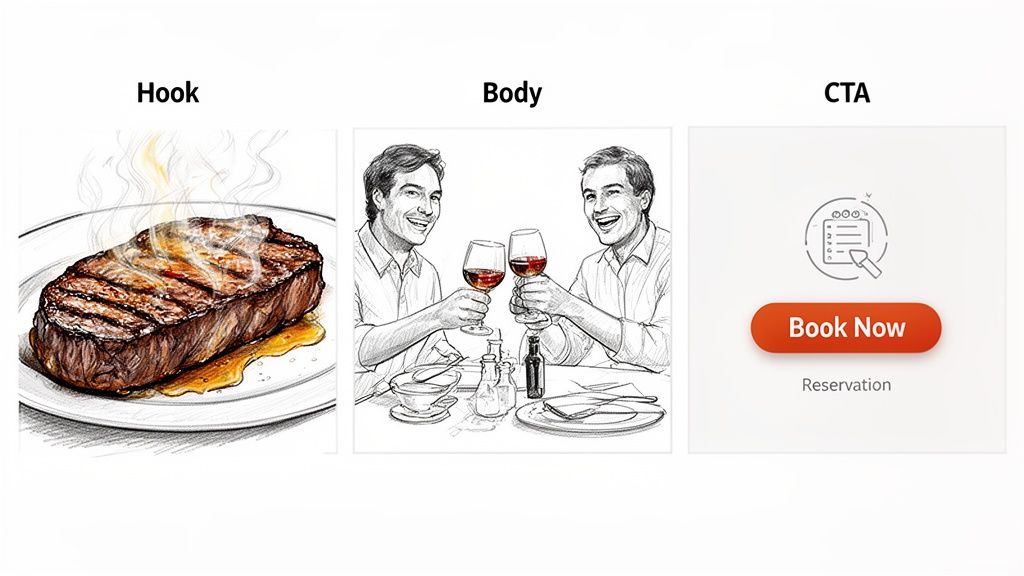
For video ads, we’ve seen one structure outperform everything else time and time again: a simple, three-part story. Hook, Body, and Call-to-Action (CTA). It’s designed to grab attention in the first three seconds and smoothly guide the viewer toward making a reservation or placing an order.
Hook (1-3 seconds): This is your scroll-stopper. It needs to be visually arresting. Think of a close-up cheese pull, a sizzling steak, or sauce being drizzled in glorious slow motion.
Body (5-10 seconds): Now that you have their attention, show them the experience. This could be quick cuts of happy diners clinking glasses, your chef plating a dish with precision, or the vibrant buzz of your dining room.
CTA (1-2 seconds): End with a crystal-clear instruction. This is usually a text overlay or an end card with your offer and a button like "Book Now" or "Order Online."
Let’s say you’re a modern bistro. You could run a 15-second Reel ad that looks like this:
Hook: A knife slicing into a perfectly cooked salmon, revealing a flaky, pink interior.
Body: Rapid shots of friends laughing at a table, a bartender mixing a colorful cocktail, and an aerial view of a beautifully set table.
CTA: A final shot of the salmon dish with bold text: "Your Table Is Waiting. Book Now."
This formula works because it perfectly matches how people consume content on social media—quickly and visually.
Creative Concepts That Consistently Work
Beyond the basic framework, we see certain creative angles that are consistent winners for restaurants. You don't need to reinvent the wheel. Start with these proven ideas.
Top-Tier Creative Angles for Restaurant Ads
Behind-the-Scenes with the Chef: Showing the passion and skill behind your food builds a ton of authenticity and human connection. Film your chef explaining the inspiration for a signature dish or sourcing fresh ingredients from a local market.
The "Top 5" Listicle: People love lists. Create a quick video or a carousel ad titled "Our 5 Most Instagrammable Dishes" or "Top 3 Cocktails You Have to Try This Weekend." This format is super shareable and feels like an insider tip.
Authentic User-Generated Content (UGC): Repurposing photos and videos from your actual customers is marketing gold. A real diner genuinely losing their mind over a meal is often more persuasive than the most polished ad. Just remember to always ask for permission!
The data doesn't lie: video is essential. Meta Reels impressions have surged and now account for 37.5% of ad formats. The food and restaurant industry also boasts an above-average click-through rate of 2.19%, proving that strong visual content gives you a serious edge. You can find out more about the latest Facebook ad statistics and see how video is shaping performance.
Best Practices for Static Image Ads
While video is king, high-quality static images still have a huge role to play, especially in retargeting campaigns and carousels. A single, mouth-watering photo can be incredibly effective if you nail a few key principles.
We eat with our eyes first, especially online. Your food photography needs to make someone look at their phone and immediately think, "I need that right now."
Key Tips for Powerful Food Photography
Use Natural Light: Ditch the harsh overhead lighting or your camera's flash. Position the dish near a window to get that soft, natural light that makes food look fresh and vibrant.
Focus on the Hero: The food is the star. Use a tight, close-up shot that highlights texture and detail—think glistening sauce, melted cheese, or the perfect char on a grilled steak.
Incorporate Social Proof: Don't just show the food on its own. Add a killer customer review as a text overlay. A stunning photo of your burger paired with a quote like, "The best burger I've had in years!" is an unbeatable combination.
By combining these creative strategies, you can start building a library of high-performing assets. The next challenge is producing enough variations to keep your ads fresh and avoid creative fatigue—a problem that platforms leveraging AI for ad creative in food and beverage are specifically built to solve.
Nailing Your Offers and Ad Copy
Even the most beautiful, mouth-watering video ad will go nowhere without a compelling reason for someone to take action. Your offer is the real engine of your restaurant's Facebook ads. It's the immediate hook that gets a passive scroller to stop, get hungry, and actually book a table or place an order.
The trick is to be strategic. Don’t just throw random discounts into the void. You need to design your offers to achieve a specific goal, whether that’s bringing in brand-new faces, getting tables to spend more, or building a loyal base of regulars.
High-Converting Restaurant Ad Offer Matrix
Different offers pull different levers. Thinking about your primary business goal first is the key to picking the right incentive. Are you trying to get first-time customers in the door on a slow Tuesday? Or are you trying to build a customer list for long-term marketing?
We've run hundreds of campaigns for restaurants, and these offer types consistently deliver. Here's a quick matrix to help you match the right offer to your audience and business goal.
Offer Type | Best For (Audience) | Primary Business Goal |
|---|---|---|
Free Item with Purchase | New Customers | Customer Acquisition |
Percentage/Dollar Off Over a Threshold | New & Existing Customers | Increase Average Order Value (AOV) |
Two-for-One Deals | Couples / Groups | Drive Mid-Week Traffic |
Join a "VIP Club" for an Incentive | All Customers | Build a Customer Database / Loyalty |
Happy Hour Specials | Local Workers / Young Professionals | Attract a Specific Demographic |
Choosing the right tool for the job makes all the difference. An offer to acquire a new customer should feel generous and low-risk, while an offer to increase order value needs to incentivize a specific spending behavior.
Writing Ad Copy That Sells an Experience
Once the offer has their attention, your ad copy needs to close the deal. For restaurants, this means you have to get sensory. You're not just selling food; you're selling an experience, a memory, a craving.
Forget just listing ingredients. You’re not selling a steak; you’re selling a 28-day dry-aged, hand-cut New York strip, sizzling on a cast-iron plate.
Think about how you can use words to tap into taste, smell, and texture.
Instead of "cheeseburger," try: "A juicy, flame-grilled patty with perfectly melted cheddar and our secret sauce on a toasted brioche bun."
Instead of "salad," describe it as: "Crisp, chopped romaine tossed in our zesty, house-made caesar dressing with garlic croutons."
This helps your audience mentally taste the food before they even step through your door, making the urge to visit almost impossible to ignore. Keep your copy tight and punchy. Lead with the good stuff—the offer and the experience.
And once you’ve hooked them, make sure your ad sends them to a page that converts. Employing strong landing page design best practices is critical. The landing page should echo the offer from the ad and make it incredibly simple for them to claim it.
Match Your Call-to-Action to Your Goal
This is one of the simplest yet most frequently overlooked details. Your Call-to-Action (CTA) button needs to be a perfect match for your campaign goal. It removes any guesswork for the user and tells them exactly what to do next. A vague CTA like "Learn More" is a massive wasted opportunity.
Be direct. Be clear. Your CTA is the final instruction.
Primary Campaign Goal | Recommended CTA Button | Why It Works |
|---|---|---|
Drive online orders | Order Now | This is the most direct command for anyone craving takeout or delivery. No confusion. |
Increase reservations | Book Now | It sends a clear signal that their next step is to lock in a table. |
Promote foot traffic | Get Directions | Perfect for location-aware ads targeting people who are already nearby. |
Showcase your menu | View Menu | A lower-commitment CTA for discovery campaigns where the goal is just to pique interest. |
When your offer, your ad copy, and your CTA all line up perfectly, you create a seamless and powerful journey for the customer. This is how you transform your restaurant Facebook ads from simple announcements into finely-tuned machines that drive real, measurable results.
Scaling Your Ads with AI-Powered Creative Production
Let's be honest. The real bottleneck in running high-performing restaurant ads on Facebook isn't finding the right audience or tweaking your bids. It’s the creative. You find a winning ad, it works for a while, and then performance inevitably tanks. This is creative fatigue, and it forces you back onto the hamster wheel of manually editing new videos.
This slow, grind-it-out process is exactly where campaigns fizzle out and lose profitability.
The fix isn't to work harder; it's to work smarter. You need to stop seeing your ads as one-off, static videos. The breakthrough comes when you start thinking in terms of modular creative. It’s a complete shift in mindset where you break your ads down into reusable, interchangeable building blocks. Instead of one finished video, you have a library of hooks, body segments, and calls-to-action ready to be deployed.
The Automated Modular Workflow
Imagine you just did a quick shoot in your kitchen. You've got clips of a chef plating a beautiful pasta dish, a juicy close-up of a sizzling steak, and a group of happy customers clinking glasses.
Normally, you’d face hours in a video editor. With an AI-powered system, you just upload that raw footage. The AI gets to work, analyzing and tagging each clip into a structured library. That sizzling steak becomes a "hook," the happy customers become a "body," and a clean shot of your logo becomes a "CTA."
This is where the real magic happens. Instead of painstakingly scrubbing through timelines, you can build new ads in seconds.
Pick a Framework: Start with a proven ad structure, like the Hook-Body-CTA model we’ve been talking about.
Mix and Match: Drag and drop different "hook" clips with various "body" scenes and end cards.
Generate Dozens of Ads: The platform can then render out dozens of unique video combinations in minutes, not days.
This approach flips video production from a time-sucking art project into a scalable, data-driven machine.
The core problem is that manual video editing is just too slow for the pace of performance advertising. An AI-driven modular workflow can 10x your testing velocity, helping you find your next winner before your current one even starts to fade.
This process diagram breaks down the simple but powerful flow for creating your ad visuals and copy.
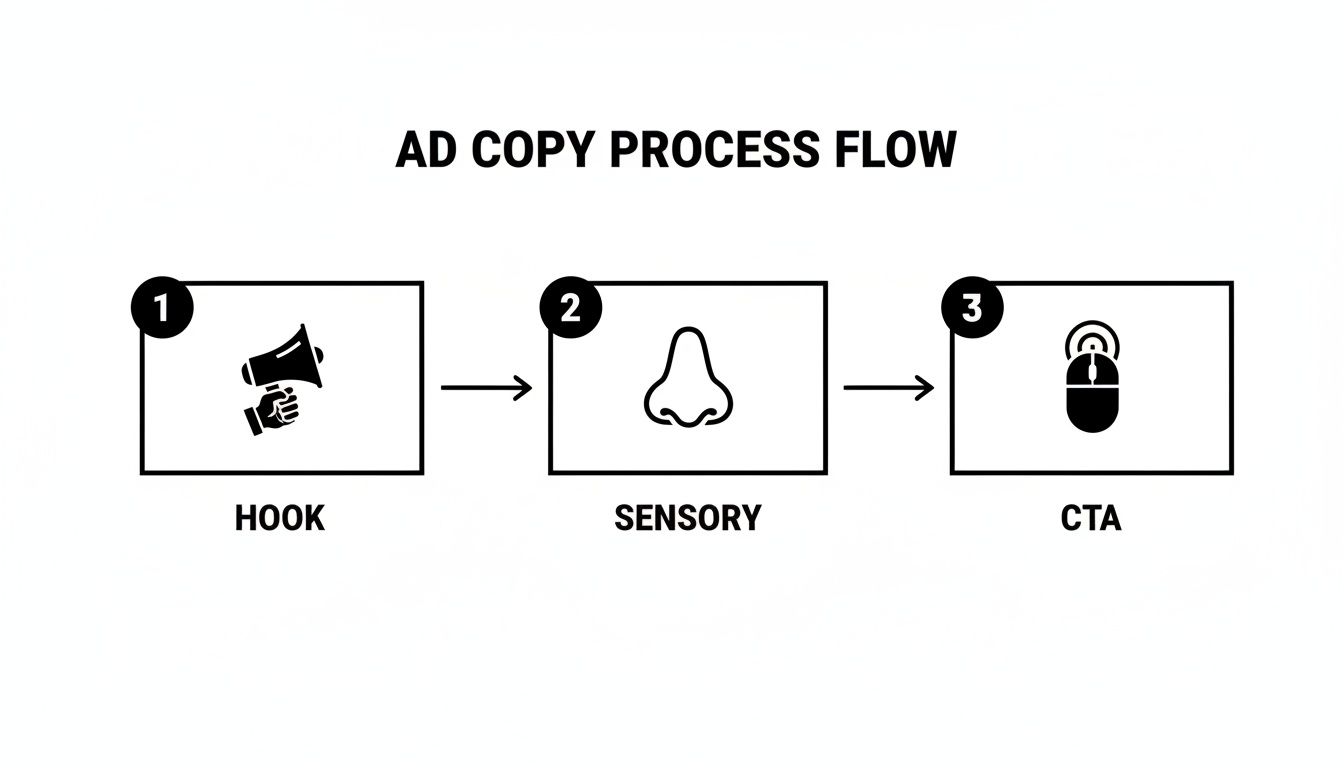
It all comes back to this critical three-part structure: grab their attention, make them feel something (or smell or taste it!), and then tell them exactly what to do next.
Powering Production With a Context Vault
True automation is more than just stitching clips together. The most sophisticated AI platforms use a Context Vault to store your brand’s unique DNA—a central hub for all your key marketing assets.
Think of it as your brand's brain. This vault can hold:
Your brand kit (logos, fonts, color codes)
A library of your best-performing headlines and ad copy
Your top customer reviews and testimonials
Details on all your current and past promotional offers
When the AI generates new ad variations, it pulls directly from this Context Vault to make sure every single video is perfectly on-brand. It can automatically overlay approved text, grab a real 5-star review about your tacos, and pop in your official logo at the end—all without you lifting a finger. To really ramp up production and explore endless creative angles, an AI Ad Generator becomes an indispensable part of this workflow.
Generating New Visuals on Demand
So what happens when you’ve used all your raw footage? In a traditional workflow, you'd be stuck. You’d have to schedule another expensive, time-consuming video shoot just to get fresh B-roll.
With modern AI, you can generate entirely new video assets on the fly.
Imagine you need a new hook for your pizza ad but have no good shots left. You could simply prompt an AI video model with: "Create a hyper-realistic, slow-motion video of cheese pulling from a slice of pepperoni pizza, with steam rising." Within seconds, you have a brand-new, high-quality clip ready to be dropped into your modular system.
This capability shatters the creative ceiling. You're no longer limited by the footage you happen to have. You can test new concepts, visual styles, and wild ideas with incredible speed, ensuring your restaurant's Facebook ads never feel stale. This is how you out-test and outmaneuver competitors who are still stuck editing one video at a time.
Of course. Here is the rewritten section, following all your instructions and matching the provided expert style.
Your Top Restaurant Facebook Ad Questions, Answered
Even with the best playbook, you're going to have questions once you get your campaigns running. That's a good thing—it means you're in the trenches. I’ve put together answers to the questions I hear most often from restaurant owners to clear up any confusion and get you moving faster.
How Much Should a Restaurant Spend on Facebook Ads?
There’s no magic number here, but a solid starting point is 5-10% of your total marketing budget.
Practically speaking, I always recommend starting with a daily budget of $20-$50 per campaign. The key is to run this budget within a tight geographic radius around your restaurant. This isn't about blanketing the city; it's about owning your neighborhood first.
This initial spend is your data-gathering phase. You'll get your first look at real-world Cost Per Click (CPC) and Cost Per Result. Once you see a positive return on ad spend (ROAS), you can start scaling up with confidence.
The rule is simple: focus on profitability. If you're putting $1 in and getting $5 back in orders, you should spend as much as you can without that ratio breaking. You can use Meta's industry data—which shows CPCs around $0.72—as a loose benchmark to know if you're in the right ballpark.
Are Image or Video Ads Better for a Restaurant?
Both can work, but if you're planning for 2026 and beyond, your focus has to be on video. Short-form video for Reels and Stories is just unbeatable for grabbing attention and telling a quick, compelling story. Use it to show the sizzle on the grill, the steam coming off a plate, happy customers, and the general vibe of your place.
That said, don't throw out your static images. A killer, high-quality photo of your most beautiful dish is still incredibly powerful, especially for retargeting campaigns or in a carousel ad showcasing different menu items.
Here’s the winning combo we see work time and time again:
Lead with attention-grabbing video ads to find new customers (prospecting).
Follow up with mouth-watering static images in retargeting ads to remind them of that dish they were just looking at.
This one-two punch captures their initial interest and then closes the deal.
How Do I Actually Measure the ROI of My Restaurant Ads?
This is the question that separates the pros from the amateurs. Measuring your return on investment (ROI) is everything. The right method really just depends on what you're trying to achieve.
For online orders, it's a direct line. The Meta Pixel on your website will track purchases and revenue straight from your ads. This gives you a clean, hard number for your ROAS.
For reservations, you can track clicks on your "Book Now" button, especially if you use a unique tracking link for your ad campaigns. A low-tech but effective method? Just add a simple "How did you hear about us?" dropdown to your booking form.
To drive foot traffic, things get a bit more creative. You can use Meta's "Store Visits" campaign objective, which uses location data to estimate how many people saw an ad and later visited you. A more direct way is to run an ad with a unique promo code that can only be redeemed in-store. This lets you tie offline sales directly back to a specific campaign.
What Are the Most Common Mistakes I Should Avoid?
I see restaurants making the same few, very expensive mistakes all the time. Just avoiding these will put you way ahead of the game.
First, targeting too broadly. Stop targeting an entire city or state. Your money is best spent in a tight 3-10 mile radius around your physical location. Every dollar you spend on someone 30 miles away who will never visit is a dollar wasted.
Second, using bad creative. Grainy, poorly lit phone photos or shaky videos make your restaurant look cheap. Your ads are a direct reflection of your food and dining experience. Invest in making them look good. It's not a "nice-to-have"; it's essential.
And finally, having no clear offer or call-to-action (CTA). Don't just show a picture of your amazing burger and hope for the best. Tell people exactly what you want them to do and give them a reason to do it now. Something as simple as "Order Now for 10% Off!" can make all the difference.
Ready to stop the manual grind and scale your creative production? Sovran is an AI platform that automates the creation and iteration of high-performing video ads for Meta and TikTok, helping you find winning creatives up to 10x faster. Start scaling with Sovran today.
Create Restaurant Video Ads That Drive Reservations
Video ads are the top-performing format for restaurants on Meta. Sovran's AI creative tools help you turn food photos and clips into scroll-stopping video ads with voiceover, captions, and CTAs - no video editing skills required.
Publish directly to Meta and start testing which creative drives the most reservations and orders. Start scaling with Sovran.
Frequently asked questions

Manson Chen
Founder, Sovran
Related Articles
How to Turn Link Into Video: Ads That Convert in 2026
Learn how to turn link into video for Meta & TikTok ads. Leverage AI to scale creation, boost ROI, and succeed in 2026.
- ai-video-generation
- link-to-video-ads
- 6 more
8 High-Converting Static Ads Examples for 2026
Discover 8 high-performing static ads examples from top apps. Learn to create text-overlays, testimonials, and lifestyle ads that convert.
- static-ads
- performance-marketing
- 5 more
A Performance Marketer's Guide to Video to Flipbook Conversion
Learn to convert video to flipbook formats that boost engagement. This guide covers actionable methods for ads, content, and scaling creative with AI in 2026.
- video-repurposing
- performance-marketing
- 4 more