10 Facebook Advertising Best Practices to Scale Performance in 2026
Master these 10 Facebook advertising best practices for 2026. Get actionable insights on creative, targeting, and testing to scale your Meta ad campaigns.
Jump to a section
- 1. Implement Hook-First Creative Strategy
- 2. Leverage User-Generated Content (UGC) and Testimonial Mashups
- 3. Master Video Hooks Using Problem-Agitate-Solution (PAS) Framework
- 4. Strategic Testing: A/B, Multivariate and CTA Optimization
- 5. Optimize for Mobile-First Viewing and Vertical Video Format
- 6. Build and Maintain a Context Vault for Brand Consistency at Scale
- 7. Implement Strategic Audience Segmentation and Layered Testing
- 8. Leverage Listicle and Sequential Format for Multi-Benefit Messaging
- 9. Combat Creative Fatigue Through Systematic Variation and Refresh Cycles
- 10. Implement Conversion-Focused Production Workflow with Direct Platform Integration
- Top 10 Facebook Advertising Best Practices Comparison
- Systematize Your Success: From Best Practices to a High-Performance Engine
In 2026, succeeding with Meta advertising requires more than just launching campaigns; it demands building a systematic, high-velocity creative engine. While many marketers get bogged down by surface-level tactics like tweaking audience interests or adjusting button colors, sustainable growth is rooted in mastering the fundamental frameworks that drive consistent performance. This guide bypasses the generic advice and dives straight into 10 actionable Facebook advertising best practices that top-tier performance marketers and agency teams use to dominate the platform.
We will move beyond theory and provide a practical playbook for combating creative fatigue, accelerating learning cycles, and unlocking profitable growth. This is not another list of obvious tips. Instead, you'll get detailed blueprints for implementing modular video frameworks, systematic testing protocols, and automated workflows that transform creative production from a bottleneck into a predictable, scalable system. We will cover specific strategies like leveraging User-Generated Content (UGC) mashups, mastering the Problem-Agitate-Solution (PAS) framework for video hooks, and implementing a "Context Vault" to maintain brand consistency at scale.
To truly unlock this level of performance and move beyond incremental gains, understanding the mechanics of expansion is paramount. This guide provides the strategic creative and testing frameworks, which are the essential fuel for any growth effort. For a deeper dive into the budget and bidding side of expansion, understanding how to scale Facebook ads profitably provides a complementary financial perspective. Whether you are a user acquisition manager, an agency strategist, or a DTC brand founder, these strategies will equip you with the operational blueprint needed to build a resilient and high-performing Meta advertising program designed for today's competitive environment.
1. Implement Hook-First Creative Strategy
The first three seconds of your video ad are the most critical real estate you own on Meta's platforms. In a sound-off, autoplay environment, you have a fleeting moment to stop a user's scroll. A "Hook-First" creative strategy focuses entirely on designing this initial window to capture attention visually and psychologically, compelling viewers to continue watching. This approach treats the hook not as an intro, but as the most important variable for ad performance.

This method moves beyond a single, linear video narrative. Instead, you create a core video body and develop multiple, modular hook variations that can be attached to it. This allows for rapid, systematic testing of different storytelling angles without re-shooting the entire ad, making it a cornerstone of modern facebook advertising best practices.
How to Implement a Hook-First Strategy
To execute this, focus on creating distinct hook archetypes that resonate with your audience.
Pattern Interrupts: Use jarring visuals, fast cuts, or unexpected text overlays. An e-commerce brand might open with a vibrant color splash against a black-and-white scene.
Benefit Visualization: Show the ideal outcome immediately. A language-learning app could start with a user confidently ordering coffee in a foreign country, not with the app's logo.
Curiosity Gaps: Pose a question or make a bold statement. A DTC brand could use text like, "This kitchen tool replaces 5 of your gadgets..." to make users want to see the reveal.
Direct-to-Camera Address: Have a creator look directly at the viewer and speak, using captions for sound-off viewing. This personal approach builds instant connection.
By tracking metrics like 3-second video plays and ThruPlay rate, you can identify which hook types drive the highest engagement at the lowest cost. Systematically testing these variations is key to combating creative fatigue and finding winning combinations faster.
2. Leverage User-Generated Content (UGC) and Testimonial Mashups
User-generated content (UGC) and customer testimonials are the currency of trust in digital advertising. Instead of a polished brand message, this approach features authentic content from real customers, which inherently feels more credible and less "salesy" to a skeptical audience. By collecting and showcasing genuine reviews, unboxing videos, and success stories, you leverage powerful social proof that resonates deeply on platforms where native, authentic-feeling creative excels.
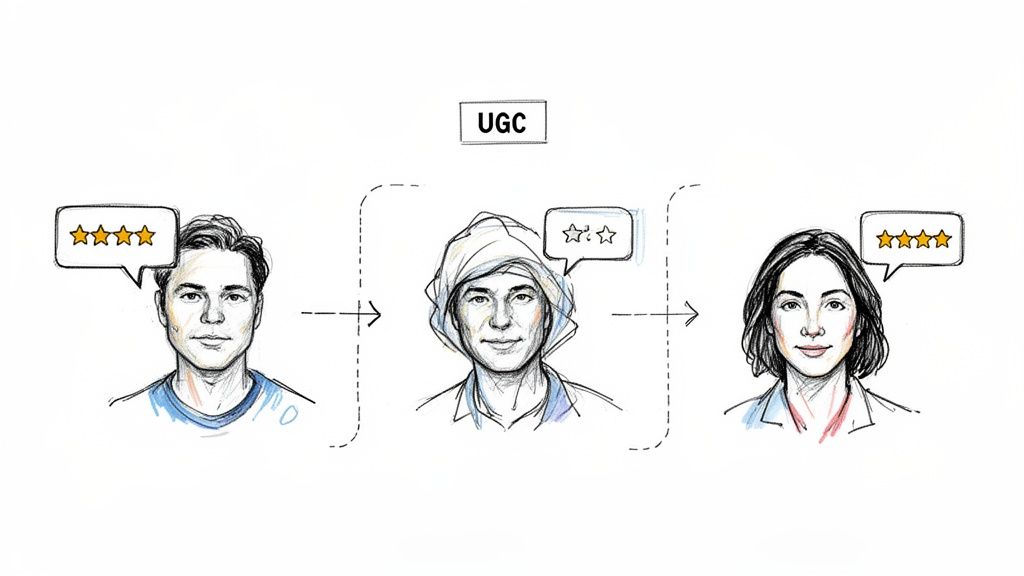
This strategy moves beyond single-person testimonials into dynamic "mashups," where you combine multiple customer stories into one cohesive ad. This technique amplifies social proof by showing a chorus of satisfied users rather than just one. Integrating UGC is a fundamental aspect of high-performing facebook advertising best practices, as it builds trust and drives conversions by letting your happiest customers become your most effective advocates.
How to Implement UGC and Testimonial Mashups
Executing a UGC strategy requires a system for collection, organization, and creative production.
Incentivize Submissions: Create a clear program to encourage customers to submit video content. Offer discounts, gift cards, or free products in exchange for high-quality, authentic testimonials.
Create Testimonial Mashups: Combine clips from 2-4 different customer videos into a single, fast-paced ad. A fitness app, for example, could splice together quick transformation shots and positive reactions from several users to show widespread success.
Organize Your Assets: Store and tag all UGC in a content library. Note the customer's name, product used, and the specific results they achieved for easy access when building campaign-specific ads.
Ensure Legal Compliance: Always obtain explicit written permission from the creator to use their content in paid advertising. Include any necessary disclosures or disclaimers to maintain transparency.
To maximize your results, it's beneficial to understand the nuances of launching User-Generated Content (UGC) campaigns, which can provide a deeper framework for your efforts. A well-organized UGC pipeline provides a sustainable source of high-performing, authentic creative that can significantly lower customer acquisition costs. A deeper dive into a complete user-generated content strategy can further refine your approach.
3. Master Video Hooks Using Problem-Agitate-Solution (PAS) Framework
The Problem-Agitate-Solution (PAS) framework is a classic copywriting formula perfectly adapted for modern video advertising. It creates a powerful narrative arc that captures attention by first tapping into a viewer's pain points, amplifying the emotional frustration associated with that problem, and then positioning your product as the clear and satisfying resolution. This psychological sequence is highly effective for building resonance and driving conversions.
This approach transforms a simple product showcase into a compelling story. Instead of just listing features, you’re connecting with the audience's real-life struggles, making the eventual solution feel not just helpful, but necessary. For advertisers, this narrative structure is a repeatable model for creating high-impact creative, making it an essential component of any successful facebook advertising best practices playbook.
How to Implement the PAS Framework
To execute this, structure your video creative into three distinct, yet seamless, acts.
Problem (First 20-30%): Open by clearly identifying a specific, relatable problem your target audience faces. A productivity app ad could show a user buried under a mountain of sticky notes, looking overwhelmed.
Agitate (Amplify the Pain): Use emotional language and visuals to intensify the frustration of the problem. For the productivity app, this could be quick cuts showing missed deadlines, stressful notifications, and the feeling of falling behind.
Solution (Introduce Your Product): Present your product as the hero that resolves the agitated state. The productivity app ad would then transition to a clean, organized dashboard, showing tasks being checked off effortlessly, and the user looking calm and in control.
By dedicating the initial portion of the ad to the problem, you ensure viewers self-identify and feel understood. Introduce the solution around the 50-60% mark to maintain engagement before concluding with a strong call-to-action that reinforces the primary benefit. This framework provides a reliable blueprint for crafting video ads that consistently perform.
4. Strategic Testing: A/B, Multivariate and CTA Optimization
Moving beyond guesswork, a strategic testing framework systematically identifies the creative elements that drive performance. This involves isolating variables like hooks, headlines, thumbnails, and call-to-action (CTA) buttons to understand their direct impact on conversions. By running disciplined A/B and multivariate tests, advertisers can make data-driven decisions, turning creative optimization from an art into a science and ensuring ad spend is allocated to proven winners.
This methodical approach is a cornerstone of effective facebook advertising best practices. It allows you to build a library of high-performing components that can be mixed and matched to combat ad fatigue and scale campaigns confidently. Instead of launching one ad and hoping for the best, you launch a structured experiment designed to yield actionable insights.
How to Implement a Strategic Testing Framework
Begin by isolating one primary variable per test to ensure you can attribute performance changes accurately.
Isolate Creative Variables: Test distinct elements one at a time. For an e-commerce brand, this could mean testing a pattern interrupt hook against a product demonstration hook while keeping the CTA ("Shop Now") and body copy consistent.
Systematically Test CTAs: Don't just stick with the default. An app install campaign should test "Install Now" vs. "Try Free" vs. "Get Started." Document which action-oriented words like "Get," "Start," or "Try" perform best for different audiences.
Optimize Visual Components: Test thumbnail variations, text overlay placements, and even the color of your CTA button against the video's background to maximize contrast and click-through rate.
Run High-Volume Variations: To achieve statistical significance quickly, aim to create at least 3-5 variations for each element you test. Establish clear sample size and performance thresholds before declaring a winner.
By documenting every test result, you create an internal playbook for what resonates with your audience, from the most compelling hooks to the highest-converting CTA language. For a deeper dive into structuring these experiments, explore our guide on Facebook ad creative testing.
5. Optimize for Mobile-First Viewing and Vertical Video Format
The vast majority of Facebook and Instagram users engage with content on a mobile device, holding their phones vertically. A mobile-first approach means designing your ads for this native viewing experience from the ground up, not as an afterthought. This strategy prioritizes the vertical (9:16) aspect ratio to maximize screen real estate, ensuring your creative is immersive and captures the full attention of the user without them needing to turn their phone.
This is a fundamental principle of modern facebook advertising best practices. Ads that fail to fill the vertical screen appear small and unprofessional, surrounded by black bars or truncated feed content. By designing specifically for the vertical format, you create a seamless user experience that feels native to the platform, which directly correlates with higher engagement, better click-through rates, and improved overall ad performance.
How to Implement a Mobile-First Vertical Strategy
To properly execute a mobile-first creative approach, every element must be considered through the lens of a vertical screen.
Frame for Vertical Composition: Shoot or design your creative in a 9:16 aspect ratio. For e-commerce, this means using tight, product-focused vertical shots. For beauty brands, this allows for full-face close-ups that are highly engaging.
Prioritize Text Readability: Use large, bold fonts for any text overlays. Keep copy concise and place it within "safe zones" away from the top and bottom edges where platform UI elements (like the username or call-to-action button) can obstruct it.
Design for Sound-Off Viewing: Assume most users will view your ad without sound. Use captions, text overlays, and strong visual storytelling to convey your entire message. The visuals alone should communicate the core benefit.
Place Key Elements Strategically: The center and top two-thirds of the vertical frame receive the most attention. Position your most critical visuals, value propositions, and branding in this prime area to ensure they are seen immediately.
By adopting a vertical-first mindset, you align your creative with user behavior, reducing friction and making your ads more effective at stopping the scroll and driving action.
6. Build and Maintain a Context Vault for Brand Consistency at Scale
High-volume creative production often leads to brand dilution, where messaging, visuals, and tone become inconsistent across campaigns. A "Context Vault" is a centralized, living repository of your most critical brand and performance assets. It serves as the single source of truth for your creative team, freelancers, and AI-powered generation tools, ensuring every ad feels cohesive and on-brand, regardless of who creates it.
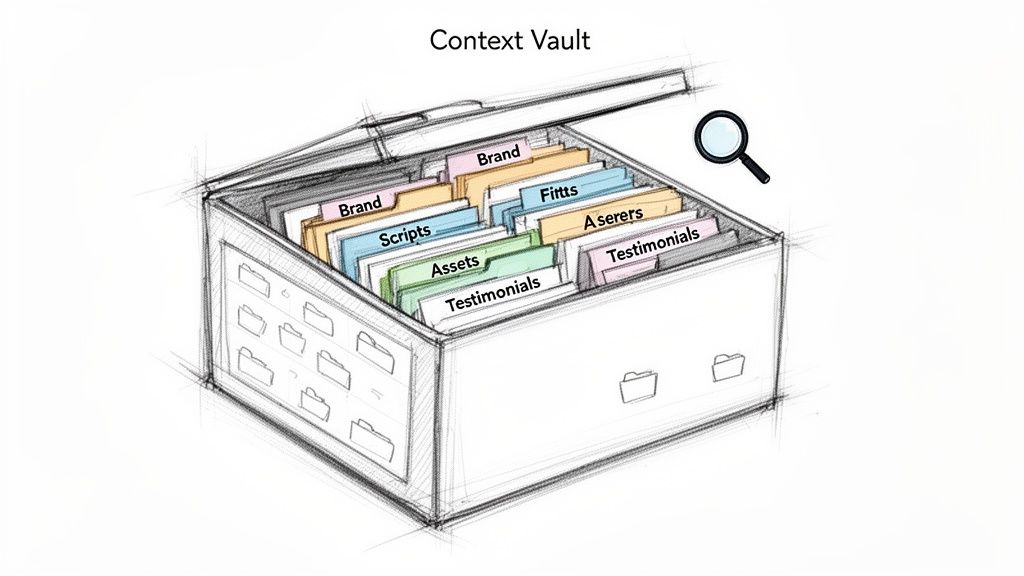
This system goes beyond a simple asset folder. It strategically organizes everything from logos and color codes to proven ad scripts, customer testimonials, and performance data. This structured approach is a core component of effective facebook advertising best practices, as it enables rapid, scalable creative development without sacrificing the brand integrity that builds long-term customer trust. For a deeper dive into organizing these resources, explore these digital asset management best practices.
How to Implement a Context Vault
Begin by creating a centralized location (like a shared drive or a dedicated platform) and organizing it with the following key components.
Document Brand Voice & Style: Write a 200-300 word guide defining your brand’s tone, personality, and style. Is it witty, authoritative, or empathetic? Include specific examples of what to say and what to avoid.
Compile Visual Identity Assets: Store high-resolution logos, brand fonts, and official color codes (HEX, RGB). For e-commerce, this includes a library of approved product photography and lifestyle imagery.
Curate Performance-Proven Copy: Maintain a list of top-performing headlines, primary text, and calls-to-action (CTAs). Note which variations work best for different audiences or objectives.
Organize Social Proof: Create a database of 20-30 customer testimonials, user-generated content, and positive reviews. Tag each piece by the product, feature, or benefit it highlights for easy access.
Store Creative Learnings: Document what works. Note that "testimonial hooks outperform benefit-focused hooks by 15%" or that "dashboard screenshots drive higher CTRs for SaaS ads." Review and update this vault quarterly to keep it relevant and effective.
7. Implement Strategic Audience Segmentation and Layered Testing
Broad, monolithic audiences often dilute your message and increase acquisition costs. Strategic Audience Segmentation involves dividing your potential customers into distinct groups based on behavior, intent, or demographics. This allows you to deploy tailored creative that speaks directly to their unique motivations, creating a more relevant and persuasive ad experience. The core of this best practice is to stop treating your audience as one entity and start communicating with its specific subsets.
This method goes beyond simple targeting. It creates a framework for "layered testing," where you test specific creative angles within each audience segment. Instead of just finding a single "best" ad, you discover which ad works best for each high-value group. This systematic approach is fundamental to advanced facebook advertising best practices, enabling you to lower CAC and scale more efficiently by maximizing relevance across your entire potential market.
How to Implement Audience Segmentation and Layered Testing
To execute this, begin by identifying your most valuable customer personas and developing tailored messaging for each.
Identify Core Segments: Define 3-5 key audience segments based on your data. For a productivity app, this could be "Power Users," "Newcomers," and "Team Collaborators."
Develop Segment-Specific Angles: Create distinct messaging that addresses the unique pain points of each group. Show "Power Users" advanced integrations, while showing "Newcomers" how simple the app is to set up.
Structure Layered Tests: Within an Advantage+ campaign, use audience signals or create separate ad sets targeting each segment. Run your segment-specific creative variations within these structures to see which ad resonates most with which audience.
Analyze and Scale: Allocate 20-30% of your budget to these initial tests. Track performance metrics like CPA and ROAS for each segment-creative combination. Once you identify winning pairs, you can shift a larger portion of your budget to scale them confidently.
By documenting which creative approaches win for each segment, you build an invaluable repository of insights. This allows you to move faster and with greater precision, ensuring your ad spend is always directed at the most resonant message for the right person.
8. Leverage Listicle and Sequential Format for Multi-Benefit Messaging
When your product or service offers multiple compelling benefits, cramming them all into a single narrative can overwhelm and confuse viewers. The listicle and sequential ad format solves this by breaking down your value propositions into a digestible, numbered sequence. This structure taps into the brain's natural desire for pattern completion, keeping users engaged as they anticipate the next point in the series.
This approach organizes your message into a clear, scannable progression, much like a written article. By presenting each benefit as a distinct "item" in a list (e.g., "3 Reasons This Is the Last Skincare Product You'll Ever Buy"), you guide the viewer through a logical story. This is a powerful tool in modern facebook advertising best practices because it allows you to communicate depth without sacrificing clarity or pacing, making complex offerings easy to understand.
How to Implement a Listicle Ad Format
To build a high-performing listicle video ad, focus on structure, pacing, and psychological sequencing.
Isolate Key Benefits: Identify the 3-5 strongest, most distinct benefits of your product. For a productivity app, this might be "1. Automate Your Schedule," "2. Integrate All Your Tools," and "3. Share Progress with Your Team."
Order for Impact: Structure your list using the primacy and recency effect. Place your second-strongest benefit first to grab attention, and save your absolute strongest benefit for last to create a powerful final impression.
Maintain Visual Consistency: Use a consistent visual treatment for each numbered item. This can include the same text overlay style, color scheme, or a recurring graphical element that signals a transition to the next point.
Control the Pace: Keep each segment brief, ideally between 8-12 seconds. This maintains a brisk pace and prevents viewers from dropping off before they see your most compelling final point. Clear, numbered text overlays (e.g., "1," "2," "3") are essential for guiding the viewer.
Systematically test the order of your benefits to discover the sequence that drives the highest conversion rate. A benefit you assume is secondary might prove to be a more effective opener for your specific audience.
9. Combat Creative Fatigue Through Systematic Variation and Refresh Cycles
Creative fatigue is the inevitable decline in an ad's performance after its target audience has been exposed to it too many times. A once-winning ad sees its click-through rate plummet and cost-per-result skyrocket. Combating this requires a proactive, systematic approach to creative refresh and variation, ensuring your campaigns maintain novelty and continue to resonate with users. This strategy moves beyond reactive ad swaps and establishes a structured workflow for generating, deploying, and retiring creative.
This methodical process is a cornerstone of sustainable facebook advertising best practices, preventing performance cliffs by treating creative as a constantly evolving asset. Instead of waiting for an ad to fail, you build a pipeline of fresh variations based on proven concepts, ensuring you always have new assets ready to deploy. This maintains campaign momentum and allows for more consistent scaling.
How to Implement Systematic Creative Refreshes
To execute this, build a clear process for monitoring performance and refreshing assets.
Establish Performance Thresholds: Set clear rules for when an ad should be retired. For example, retire any creative once its CTR drops 25% below its peak 7-day average or when its frequency score exceeds a platform-specific benchmark. This takes the guesswork out of creative management.
Schedule Proactive Refreshes: Don't wait for metrics to decline. Implement a regular refresh cadence, such as introducing 5-10 new creative variations every Monday morning. For e-commerce brands in peak season, this might accelerate to every few days.
Systematize Variation Creation: Build new ads by remixing winning components from a "hall of fame" of your best-performing creative. Combine a proven hook from one ad with a compelling call-to-action from another. This de-risks the creative process and increases the probability of success.
Monitor Engagement Decay: Weekly, track key metrics like frequency, CTR, and ThruPlay rate for your top-spending ads. Early detection of a downward trend allows you to swap in fresh creative before performance significantly degrades, protecting your budget and results.
By transforming creative management from a reactive scramble into a structured, proactive system, you can extend the life of your winning concepts and maintain stable performance over the long term.
10. Implement Conversion-Focused Production Workflow with Direct Platform Integration
The speed at which you can ideate, produce, and test new ad creative is a significant competitive advantage. A conversion-focused production workflow is a systematic approach that bridges the gap between creative production and media buying, enabling teams to launch and learn from ads in hours instead of days. This involves standardizing asset naming, implementing metadata tagging, and using tools that integrate directly with Meta Ads Manager for seamless deployment.
This methodology transforms the creative process from a linear, manual slog into an agile, data-driven engine. By automating the logistical steps of naming, organizing, and uploading assets, teams can spend more time on strategy and analysis. This system is a core component of modern facebook advertising best practices for any team serious about scaling its testing velocity and operational efficiency.
How to Implement a Conversion-Focused Workflow
Building this system requires a focus on standardization and automation to minimize manual errors and speed up deployment.
Establish a Clear Naming Convention: Create a standardized, non-negotiable naming structure for every creative asset. A common format is
[Product]_[Framework]_[Variable]_[Version], for example,BlueWidget_UGC_HookA_v1. This ensures every ad can be instantly identified and its performance tracked back to specific strategic elements.Use Metadata Tagging: Go beyond the filename by applying metadata tags to each asset. Tag elements like the hook type (e.g., "Problem-Agitate"), CTA language ("Shop Now" vs. "Learn More"), or the specific audience segment it was designed for. This allows for deeper performance analysis across different creative components.
Leverage Direct API Integration: Use creative production platforms that connect directly to Meta Ads Manager. This allows you to batch-upload dozens of creative variations with their proper naming conventions and push them live into specific campaigns and ad sets with a single click, eliminating tedious manual setup.
Create Performance Dashboards: Connect your ad account data to a business intelligence tool. Structure your dashboard to pull in the asset names and metadata tags. This allows you to analyze performance not just by ad ID, but by the creative elements themselves, revealing which hooks, CTAs, or formats drive the best conversions and ROAS.
Top 10 Facebook Advertising Best Practices Comparison
Strategy | Implementation Complexity 🔄 | Resource Requirements ⚡ | Expected Outcomes ⭐📊 | Ideal Use Cases 💡 | Key Advantages |
|---|---|---|---|---|---|
Implement Hook-First Creative Strategy | Medium — needs rapid hook ideation & modular assets | Moderate — continuous short-form production and editing | ⭐⭐⭐⭐ + 📊 Higher view-through rates, lower CPV/↑CTR | UA managers, indie developers, autoplay/sound-off contexts | ⭐ Fast attention capture; 🔄 Modular A/B testing; ⚡ Reduces CPV |
Leverage UGC & Testimonial Mashups | Medium-High — collection, rights, sequencing workflows | Low production cost but needs UGC intake, tagging, legal | ⭐⭐⭐⭐⭐ + 📊 Strong credibility and lower CPA | Performance buyers, agencies, e‑commerce, SaaS | ⭐ High trust; ⚡ Lower production cost; 📊 Conversion lift |
Master PAS Video Hooks | Medium — scripting emotional arc carefully | Moderate — writing, targeted shooting/edits | ⭐⭐⭐⭐ + 📊 Strong engagement and clearer conversions | Growth marketers, conversion-focused campaigns | ⭐ Psychological tension; 🔄 Repeatable templates; 📊 High comprehension |
Strategic Testing: A/B, Multivariate & CTA Optimization | High — experimental design, stats, documentation | High — ad spend, tooling, automation and analysis time | ⭐⭐⭐⭐ + 📊 Data-driven wins; identifies high-impact variants | UA managers, high-velocity experiment teams | 📊 Removes guesswork; ⚡ Finds big uplifts from small changes |
Optimize for Mobile-First & Vertical Video | Low-Medium — format-first design rules | Moderate — vertical reshoots, large text overlays, optimization | ⭐⭐⭐ + 📊 Higher mobile engagement and completion rates | In-house teams, indie devs, mobile-first campaigns | ⚡ Native format = better completion; ⭐ Improved readability |
Build & Maintain a Context Vault | Medium — heavy initial setup; ongoing curation | Moderate — asset curation, tagging, governance | ⭐⭐⭐ + 📊 Consistent brand at scale; faster output | Agencies, in-house teams scaling creative volume | ⭐ Brand consistency; ⚡ Speeds production; 🔄 Reduces approvals |
Audience Segmentation & Layered Testing | High — complex campaign structure and tracking | High — larger budgets, analytics, setup overhead | ⭐⭐⭐⭐ + 📊 Higher relevance and lower segment CPA | Growth marketers with budgets, sophisticated agencies | 📊 Tailored messaging; ⭐ Identifies audience-specific winners |
Listicle & Sequential Multi-Benefit Messaging | Low-Medium — requires clear benefit selection | Moderate — assets to illustrate multiple benefits | ⭐⭐⭐ + 📊 Higher VTR; communicates multiple benefits quickly | Feature-rich products, SaaS, product marketing | ⚡ Scannable structure; 🔄 Easy to reorder/test sequences |
Combat Creative Fatigue via Systematic Refresh | Medium — scheduling, monitoring, variation workflows | Moderate-High — frequent creatives or automation tools | ⭐⭐⭐ + 📊 Maintains CPM/CPC and prevents sudden drops | Always-on campaigns, agencies, UA managers | 📊 Prevents decay; ⚡ Sustains performance via refresh cadence |
Conversion-Focused Production Workflow & Integration | Medium-High — naming standards + API integrations | Moderate — dev/integration effort, batch rendering tools | ⭐⭐⭐⭐ + 📊 Much faster time-to-live; higher testing velocity | In-house creative teams, performance buyers | ⚡ Batch render & deploy; 🔄 Metadata-driven analysis; ⭐ Reduces manual errors |
Systematize Your Success: From Best Practices to a High-Performance Engine
Navigating the complex landscape of Meta's advertising platform can feel like a constant battle against algorithm updates, creative fatigue, and rising costs. The ten best practices we've explored are not just a collection of individual tactics; they are the fundamental components of a modern, high-performance advertising system. Moving beyond sporadic wins to achieve consistent, scalable growth requires a paradigm shift from one-off campaign efforts to building a sophisticated, repeatable operational model.
The core theme connecting everything from a Hook-First Creative Strategy to a Conversion-Focused Production Workflow is systematization. The most successful advertisers don't rely on guesswork or a single "hero" creative. Instead, they build engines that are designed to learn, adapt, and outperform the competition through structured processes and relentless optimization.
From Checklist to Engine: Operationalizing Your Learnings
Think of each best practice as a gear in a larger machine. Your goal is to assemble these gears into a smoothly running engine that transforms strategic insights into measurable results. Merely acknowledging these concepts isn't enough; the real value is unlocked through their systematic implementation.
Systematize Creative Development: Instead of creating ads one by one, build a modular system. A well-maintained Context Vault ensures brand consistency, while frameworks like the Problem-Agitate-Solution (PAS) model provide a repeatable formula for compelling video hooks. This approach turns creative production into a predictable, scalable process.
Systematize Audience & Testing: Random A/B tests yield random results. Adopting a Strategic Audience Segmentation and layered testing framework allows you to isolate variables and generate clean, actionable data. This methodical approach transforms your ad account into a powerful learning tool, ensuring every dollar spent contributes to deeper audience understanding.
Systematize Iteration & Refresh: Creative burnout is inevitable, but it doesn't have to be catastrophic. By implementing a Systematic Variation and Refresh Cycle, you can proactively combat ad fatigue. This involves creating a backlog of creative variations and scheduling refreshes before performance dips, maintaining momentum and efficiency.
Mastering these Facebook advertising best practices is about more than just launching better ads; it's about building a more intelligent, resilient, and efficient marketing operation. It’s the difference between manually pushing a boulder up a hill and building a conveyor belt to do the heavy lifting for you.
Your Path to Unlocking Peak Performance
The journey from good to great on Facebook Ads is paved with structure and discipline. Start by identifying the biggest bottleneck in your current workflow. Is it the slow pace of creative production? A disorganized approach to testing? Or a reactive scramble to combat creative fatigue?
Select one or two of the strategies discussed, such as implementing a UGC and Testimonial Mashup pipeline or optimizing for a truly Mobile-First Vertical Video Format, and focus on turning them into a repeatable process. Document the steps, create templates, and train your team. As you solidify one system, move on to the next.
This operational discipline is what separates top-tier performance marketers from the rest. By embracing these frameworks, you stop simply running campaigns and start engineering a growth machine. You'll move faster, generate more valuable insights, and ultimately drive superior business outcomes with greater predictability and control. The future of advertising isn't about finding a single silver bullet; it's about building the engine that can consistently produce them.
Ready to transform these best practices from a manual checklist into an automated, high-velocity engine? Sovran is purpose-built to operationalize modern creative strategy, helping you generate, manage, and deploy systematic creative variations at scale. Stop wasting time on repetitive tasks and start building the systems that drive sustainable growth by visiting Sovran today.

Manson Chen
Founder, Sovran
Related Articles
10 Actionable Ad Creative Ideas That Convert in 2026
Discover 10 actionable ad creative ideas for Meta & TikTok. Get hooks, scripts, and testing frameworks to boost your ROAS and combat creative fatigue.
- ad-creative-ideas
- video-marketing
- 6 more
How to Turn Link Into Video: Ads That Convert in 2026
Learn how to turn link into video for Meta & TikTok ads. Leverage AI to scale creation, boost ROI, and succeed in 2026.
- ai-video-generation
- link-to-video-ads
- 6 more

Your Ultimate Guide to UGC Style Video Ads
Master UGC style video ads for Meta and TikTok. This guide reveals proven frameworks, scripts, and scaling tactics to boost your ROAS in 2026.
- ugc-video-ads
- social-media-advertising
- 4 more