How to Create an AI Influencer: A Practical Guide
Learn how to create an AI influencer with this guide. Get a practical workflow for persona design, tech stacks, and scaling content for Meta and TikTok.
Jump to a section
Building an AI influencer isn't just about playing with new tech. It’s a full-on playbook: you design a personality, pick your creation tools (like Midjourney for visuals and ElevenLabs for voice), and then you build a machine for pumping out ad content at scale.
Why AI Influencers Are Reshaping Performance Marketing
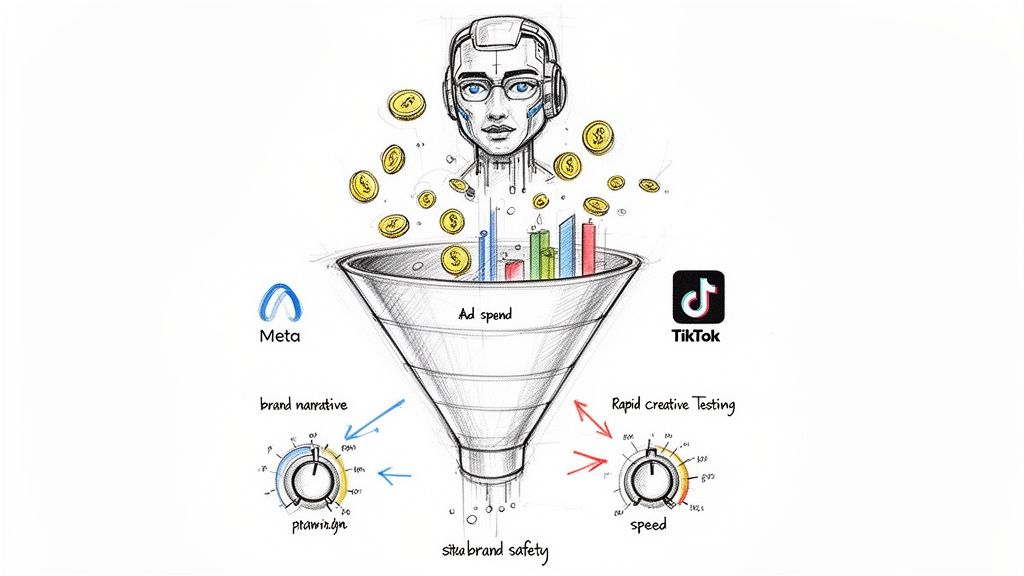
Let's be real—the rise of AI influencers is a huge deal for anyone running paid ads on Meta and TikTok. This isn't just some gimmick. It's a smart answer to the headaches that come with traditional influencer marketing. The sharpest growth marketers are figuring out how to build their own AI talent, and it's giving them a serious edge.
The biggest win? You get 100% control over the brand story. A human creator can go off-script, get into a public spat, or just deliver C-tier content. An AI influencer is an asset you own and direct completely. No more worrying about a campaign going sideways because of a partner's messy breakup or a poorly-worded post.
Gaining a Competitive Edge in Advertising
For performance teams, the real magic of an AI influencer is the speed and scale it brings to creative testing. Getting content from human creators is a slow, expensive grind.
You know the drill:
Endless back-and-forth with creators and their agents.
Sky-high production costs for a single photoshoot or video.
You end up with just a handful of assets for all that effort.
That old way of doing things makes it impossible to churn out the volume of creative needed to beat ad fatigue and find what actually works on platforms that move at lightning speed. AI influencers flip the script.
Once your AI persona is locked in, you can pump out hundreds of ad variations in a day—testing different hooks, calls-to-action, and visuals. This is how you find winners fast, letting you scale your ad spend without just guessing.
Solving Persistent Marketing Problems
AI influencers also fix some of the most annoying problems that have been bugging marketers for years. The biggest one is human unpredictability. Creators miss deadlines, ignore the brief, or get caught up in controversies that make your brand look bad. An AI influencer works 24/7, never gets into drama, and keeps your brand safe.
And then there's the money. As the influencer space gets more crowded, rates have gone through the roof. Building your own AI persona is a one-time setup cost that keeps paying off with every piece of content you generate. Your cost-per-asset plummets over time.
To really get a handle on where this is all going, it’s worth checking out analysis on the future of influencer marketing, with a focus on AI. This isn't just a novelty; it’s about building a marketing engine that’s more resilient, scalable, and ruthlessly efficient. You’re basically de-risking your entire creative pipeline while building a long-term competitive advantage.
Crafting a Resonant AI Influencer Persona

Before you touch a single piece of tech, you have to give your AI influencer a soul. A slick-looking avatar is just an empty shell if there's no real character behind it. This is the foundational work—where you build the backstory, voice, and core values that make every ad feel genuine and actually connect with your audience.
Here’s the thing about authenticity for an AI: it’s not about tricking people into thinking it’s human. It's all about consistency. If your AI's personality, opinions, and style are rock-solid across every piece of content, your audience will build trust. Nail this, and you're on your way to creating an AI influencer that actually moves the needle.
Defining Your Audience and Brand Alignment
Your influencer’s persona can't be random; it has to be a direct reflection of your brand and the people you're trying to reach on Meta and TikTok. The first step is to get inside your ideal customer's head. What content are they already binging? Which creators do they follow? What are their pain points, dreams, and even the inside jokes they use?
Once you have that customer profile down, you can start designing a character that speaks their language. This is so much more than just demographics—it’s about matching their vibe and their values.
For a mobile gaming app: You might create "Alex," a witty, competitive, and slightly chaotic 22-year-old who’s obsessed with esports and memes. His tone would be super informal, packed with gaming slang, and always reacting to the latest trends in the community.
For a sustainable DTC skincare brand: The persona could be "Solana," a calm, knowledgeable, and eco-conscious 30-year-old. Her content would feel more polished, centered on mindfulness, clean living, and the science behind the ingredients, all delivered in a serene, trustworthy voice.
A well-defined persona acts as your North Star for all creative decisions. It's the difference between creating generic ads and building a character people actually want to follow and buy from.
Building the Persona Document
You absolutely need a detailed persona document. This is non-negotiable. Think of it as a character bible for a movie—it’s where you codify your AI's entire identity. Trying to wing it leads to inconsistent content that confuses your audience and tanks campaign performance.
This document becomes the single source of truth for anyone creating content, including the AI itself. A tool like Sovran's Context Vault is perfect for this. You can drop all these rules in, and the AI will reference them constantly to make sure every script, voice line, and scene stays true to the character you’ve built.
Your document should nail down these specifics:
Backstory: Where did they come from? What's their "origin story"? What gets them out of bed in the morning?
Personality Traits: Are they funny, serious, nerdy, adventurous? List out 5-10 core traits.
Voice and Tone: How do they talk? Define their vocabulary, their cadence, and any catchphrases they use.
Values and Beliefs: What do they stand for? Just as important, what topics are completely off-limits?
Aesthetics: What's their fashion sense? What kind of places do they hang out in?
This framework is your defense against "personality drift." It ensures that as you start pumping out content at scale, your AI influencer remains a consistent, believable character.
When you've defined the visual and personality traits in this much detail, using an AI character generator becomes a much more focused and powerful process. You’re not just hoping for something good; you’re guiding the tool to bring your specific vision to life. This upfront work is what separates a forgettable avatar from an AI influencer that can build a real community and drive measurable results for your business.
Choosing Your Tech Stack: Synthetic Media vs. Avatars
Alright, you’ve got your AI influencer’s persona nailed down. Now for the fun part: deciding how to actually bring them to life on screen. This isn't just a technical choice; it's a strategic one that will define your entire content pipeline, budget, and how fast you can scale.
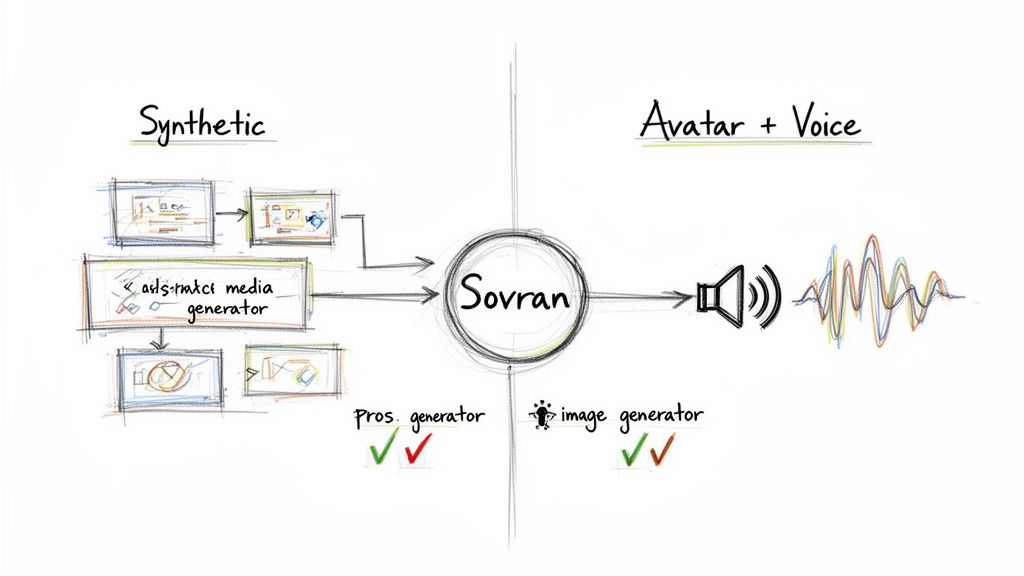
You're looking at two main roads here. The first is the avatar-plus-voice model, which is modular, controllable, and the workhorse for most performance advertisers right now. The second is dipping your toes into fully synthetic media, where you generate entire video scenes from a simple text prompt.
Each has its place, and the right one for you depends entirely on what you're trying to achieve on platforms like Meta and TikTok.
The Avatar-Plus-Voice Model
This is, by far, the most practical and popular route for performance marketers today. It’s pretty straightforward: you generate a static image of your character and then animate it using a separate AI voice. It’s the perfect blend of creative control and production speed.
Think of it like creating a "digital puppet" that you can direct with any script you write. You might use a tool like a dedicated AI character generator to craft the perfect look based on your persona, then feed a script into a voice AI like ElevenLabs to generate the audio in your character's unique tone.
The big wins with this method are:
Total Consistency: Your character's face is locked in. Viewers will recognize them instantly across every single ad, which is huge for building brand recall.
Massive Scalability: You can pump out hundreds of video variations just by generating new voiceover scripts. It’s incredibly fast and cost-effective.
Pinpoint Control: You have command over every single word, the tone of voice, and the delivery. Nothing is left to chance.
The main knock against it is that the visuals can feel a bit static, often ending up as a "talking head." But that’s easily solved. You just edit in dynamic b-roll, text overlays, and other visuals to keep things interesting—a workflow that platforms like Sovran are built to automate at scale.
Pro-Tip: The avatar-plus-voice model is your best friend if you're running high-volume, direct-response campaigns. It's perfect for delivering clear, script-driven messages for frameworks like Problem-Agitate-Solution or customer testimonials, where the narrative is king.
Fully Synthetic Media Generation
The other option is to use text-to-video models like Sora or Veo to generate entire video clips from scratch. This approach is insanely powerful for creating mind-blowing visuals that would be way too expensive or just plain impossible to shoot in real life. Want your AI influencer hiking on Mars or showing off a product in a magical forest? This is how you do it.
The major advantage here is the potential for near-unlimited creative freedom. If you can describe it, you can (in theory) create it. This makes it a great fit for top-of-funnel brand awareness campaigns where the goal is to simply stop the scroll and wow your audience.
But this cutting-edge tech has its own headaches. It's generally more expensive and the results can be unpredictable. Getting your character to look exactly the same across multiple generated clips is still a massive challenge; the AI often spits out slight variations. It's also much harder to control the precise timing needed for a hard-hitting direct-response ad. If this is all new to you, digging into an in-depth guide to AI avatar videos can really help clear up the technical weeds.
Making the Right Choice for Your Brand
So, which way do you go? The decision really comes down to your campaign goals, your budget, and how much control you need.
Factor | Avatar-Plus-Voice Model | Fully Synthetic Media Model |
|---|---|---|
Best For | High-volume performance ads, direct response, consistent branding. | Brand awareness, viral-style content, unique lifestyle scenes. |
Control | High. Precise control over script, voice, and character appearance. | Low to Medium. Less predictable, relies heavily on prompt engineering. |
Scalability | Excellent. Easily create hundreds of ad variants with new scripts. | Moderate. Slower and more expensive to generate consistent videos at scale. |
Cost | Lower. More affordable tools and faster production cycles. | Higher. Computationally intensive and often requires premium tools. |
Honestly, the smartest play is often a hybrid approach. Use the avatar-plus-voice model as your workhorse for cranking out scalable, direct-response ads. Then, sprinkle in a few wild, fully synthetic clips for eye-catching hooks or unique B-roll. When you bring all these assets into a central hub like Sovran, you can mix and match elements to get the best of both worlds.
Alright, you’ve got your AI influencer’s persona mapped out and picked your tech. Now it's time to build the factory. This is where we shift from a cool concept to a content machine that can pump out hundreds of ad variations for your Meta and TikTok campaigns. The goal isn’t just making a few videos; it’s about building a ruthlessly efficient production engine.
The process starts by feeding your raw assets into one central system. These are the building blocks for every ad: the generated visuals of your influencer, their AI-cloned voiceovers, and any B-roll you’ve shot or sourced. Trying to organize all this manually is a fast track to chaos.
This is exactly the problem a platform like Sovran was built to solve. Once you upload your assets, the AI gets to work, automatically analyzing and tagging everything. This goes way beyond simple file names—it’s about understanding the function of each piece of content within an ad.
Modular Frameworks for Rapid Ad Assembly
The real secret to scaling creative production is to stop thinking in terms of complete videos and start thinking in modules. The most successful ads almost always follow proven formulas. When you break your content down into reusable parts, you can assemble brand-new ads in minutes, not hours.
The core components are pretty simple:
Hooks: The first 1-3 seconds designed to stop the scroll. Think of a provocative question, a surprising visual, or a bold statement.
Bodies: The main event. This is where you tell your story, explain the product, or build on the hook's promise. You might use a Problem-Agitate-Solution framework here or a quick listicle.
CTAs (Calls-to-Action): The closer. This is where you tell the viewer exactly what to do next, like "Download now" or "Shop the collection."
By tagging your assets into these buckets, you create a library of interchangeable parts. Imagine you have 10 hooks, 10 bodies, and 5 CTAs ready to go. You can instantly combine them to create 500 unique ad variations without any new production. This modular approach is how you get the creative velocity needed to win at performance marketing.
An AI content engine transforms your creative strategy from a slow, one-by-one process into a dynamic, combinatorial one. You stop thinking "one video at a time" and start thinking "how many winning combinations can I test this week?"
Automating the Manual Grind
The manual work of video editing is what kills speed and blows up budgets. Adding subtitles, creating text overlays, and rendering out dozens of slightly different versions is tedious, time-consuming, and honestly, a poor use of a creative’s time. This is where automation gives you a massive competitive edge.
Brands are catching on fast. In fact, a staggering 86% of creators now use generative AI for content creation, from brainstorming and image generation to polishing final videos. This shift is slashing production timelines from weeks down to hours. As you can see in this breakdown of AI's impact on marketing, this trend perfectly mirrors the 66.4% of marketers who report getting better influencer campaign results thanks to AI.
Using a system like Sovran automates these painful post-production steps.
Automatic Subtitles: Generate and burn in subtitles across hundreds of videos with a single click. This ensures your ads are always optimized for sound-off viewing, which is critical on social feeds.
Bulk Text Overlays: Need to test different headlines or benefit callouts? Add them to entire batches of videos at once without ever opening an editor.
Mass Rendering: Once you’ve set up your modular combinations, the platform can bulk render every single final video file for you, complete with structured naming conventions that make campaign setup a breeze.
This level of automation frees your team from soul-crushing tasks and lets them focus on what actually moves the needle: strategy, analysis, and coming up with the next big creative idea. If you want to dive deeper into the audio side, check out our guide on creating compelling AI character voices that truly connect with your audience.
Ultimately, building an AI content production engine is about creating a system that works for you, not the other way around. By using modular frameworks and automating the most repetitive tasks, you empower your team to test more, learn faster, and consistently find those winning creatives that drive profitable growth.
Putting Your AI Influencer to Work: Launch and Scale
You’ve built your library of ad creatives. Now the real fun begins. It’s time to shift gears from creator to performance marketer, launch your AI influencer on Meta and TikTok, and start figuring out which ads actually make you money.
Forget about finding one perfect ad. The goal here is to launch dozens of variations and let the data tell you what works. Using a platform like Sovran, you can push entire batches of ads directly to Meta, complete with structured naming conventions. This kind of organization is a lifesaver for clean A/B testing, making it dead simple to see which hook, body, or CTA is actually driving performance.
From Launch to a Non-Stop Learning Loop
Your first launch is just the starting line. Once your ads are live, your job is to become obsessed with performance data. You’re no longer guessing what feels right—you’re looking at hard numbers to see what your audience is responding to.
Here are the metrics that matter most:
Click-Through Rate (CTR): This tells you if your hook is actually stopping the scroll. If your CTR is in the gutter, your first three seconds are failing.
Cost Per Acquisition (CPA): This is the bottom line for your creative. How much does it cost to get a customer?
Return on Ad Spend (ROAS): The ultimate measure of whether an ad is profitable. A high ROAS means your creative isn't just getting attention; it's driving valuable sales.
This simple graphic breaks down the production workflow that makes this kind of scaled testing possible.

It’s all about having a system. When you can move from assets to organized, rendered ads this smoothly, you have the foundation for a truly scalable campaign.
Let the Data Guide Your Next Creative Sprint
This data isn't just for pretty reports. It's your playbook for the next round of creatives. You’re looking for patterns in your top-performing ads so you can double down on what works.
Let’s say you notice that ads starting with a "Problem" hook have a 25% higher CTR than those using a "Benefit" hook. That's your signal. Now you can dive back into your content library and quickly assemble a new batch of ads, pairing that winning hook with different "Solution" bodies and CTAs. You’re creating a new set of creatives based on a proven formula.
This is how you beat ad fatigue and learn at warp speed. Instead of waiting weeks for a design team to dream up a new concept, you can react to performance data in a matter of hours, constantly refreshing campaigns with better and better variations.
This approach is more than just a nice-to-have; it's becoming a necessity. The global influencer marketing industry is on track to hit a massive $32.55 billion by 2026. And with 66.4% of marketers saying AI is improving their campaign results, the writing is on the wall. You can find more details in this deep dive into influencer marketing growth statistics.
For user acquisition managers and indie app developers, an AI influencer is a game-changer. It slashes costs and lets you find winning ads up to 10x faster. By systematically testing and iterating, you stop guessing and start building a real, data-driven engine for growth. That’s the true power of an AI influencer: turning creative insights into real dollars, faster than your competition can keep up.
Navigating the Ethical and Legal Landscape
When you build an AI influencer, you're not just creating another ad asset. You're stepping onto a new frontier, and with it comes a fresh set of rules. Getting this right isn't just about avoiding legal hot water; it’s about building trust and protecting your brand from the kind of damage that can kill a project before it even gets off the ground.
The playbook is still being written, but some hard lines have already been drawn.
Being transparent isn't just about ethics—it’s smart business. Your audience is savvy, and they'll eventually figure it out. You want them to feel like they're in on the innovation, not that they've been duped. Always, always disclose that your influencer is AI-generated.
Core Compliance Checklist
Let's get one thing straight right away: never create deepfakes of real people without their explicit, written consent. This is a non-negotiable red line. Crossing it is a fast track to serious legal trouble and a PR nightmare you don’t want. Your AI personality has to be a completely original creation, not someone's unauthorized digital twin. For a deeper dive into the tech and its responsible use, check out our guide on deepfake video makers.
Beyond that bright line, your primary rulebook comes from the platforms themselves. Both Meta and TikTok have very specific guidelines for synthetic media. Follow them to the letter. These rules exist to stop misinformation and protect users, and ignoring them is a quick way to get your account shut down.
Here’s your essential checklist to stay compliant:
Clear Disclosure: Don’t hide it. Use hashtags like #AIinfluencer, #VirtualInfluencer, or #MadeWithAI in your bios and captions. Make it obvious.
Platform Policy Adherence: Make it a habit to regularly review Meta's and TikTok's terms of service for AI-generated content. These policies change often.
Data Privacy: If your AI interacts with users or collects any data, you have to be compliant with regulations like GDPR and CCPA. Be completely transparent about what info you’re gathering and why.
Think of these guidelines not as creative handcuffs, but as the foundation for long-term success. When you build on a bedrock of trust, your AI influencer has staying power and creates positive brand association. That’s far more valuable than any short-term spike in engagement you might get from being deceptive. An ethical approach is your best defense against future regulations and audience backlash.
Common Questions & Final Thoughts
Even with a solid plan, a few questions always pop up before diving into the world of AI influencers. We see the same ones from marketers all the time.
Let's get straight to the point and tackle the big ones so you can move forward with confidence.
How Much Does It Cost To Run An AI Influencer Campaign?
It’s probably less than you’re imagining. You can actually get started with a simple avatar-and-voice setup for under $100/month. All it takes are tools like Midjourney for the visuals and ElevenLabs for the audio.
Sure, a fully synthetic video avatar is a bigger investment, but those prices are falling fast.
The real savings, though, come from the sheer efficiency of production. When you use a platform like Sovran to automate ad creation, you sidestep the high costs of creative agency retainers or traditional influencer fees. That frees up a massive chunk of your budget to put right back into media spend, which is where it belongs.
Can An AI Influencer Actually Feel Authentic?
Absolutely. Here’s why: authenticity isn't about being human, it's about being consistent. A human influencer might have an off day or post something that feels totally off-brand. An AI's personality, on the other hand, is completely locked in.
Authenticity is built when a character’s actions perfectly match its established identity, every single time.
When you invest time in building a detailed persona—complete with a backstory, values, and a distinct voice—your AI can build a more trustworthy presence than most human creators. Using a tool like Sovran’s Context Vault to enforce those rules just makes it foolproof. This kind of predictable, reliable behavior is the bedrock of audience trust.
How Do I Measure The ROI Of An AI Influencer?
You measure it exactly like you would any other piece of performance creative. Keep your eyes on the core metrics you already live by: CPA, ROAS, and CTR. Nothing changes there.
The game-changing advantage is the massive volume of creative you can test. Instead of waiting a week for a new hook, you can generate dozens of variations in minutes. This lets you rapidly find the most profitable angles, scale them with confidence, and ultimately drive a much higher ROI over the life of the campaign.
Ready to build a content engine that scales? Sovran automates the entire process, from creative assembly to campaign launch. Start your 7-day free trial and see how much faster you can find winning ads.

Manson Chen
Founder, Sovran
Related Articles
How to Turn Link Into Video: Ads That Convert in 2026
Learn how to turn link into video for Meta & TikTok ads. Leverage AI to scale creation, boost ROI, and succeed in 2026.
10 Actionable Ad Creative Ideas That Convert in 2026
Discover 10 actionable ad creative ideas for Meta & TikTok. Get hooks, scripts, and testing frameworks to boost your ROAS and combat creative fatigue.
Your Ultimate Guide to UGC Style Video Ads
Master UGC style video ads for Meta and TikTok. This guide reveals proven frameworks, scripts, and scaling tactics to boost your ROAS in 2026.