10 Actionable Ad Creative Ideas That Convert in 2026
Discover 10 actionable ad creative ideas for Meta & TikTok. Get hooks, scripts, and testing frameworks to boost your ROAS and combat creative fatigue.
Jump to a section
- 1. Hook-Body-CTA Framework
- 2. Problem-Agitate-Solution (PAS) Copywriting
- 3. User-Generated Content (UGC) Testimonial Mashups
- 4. Listicle Format Ads
- 5. Before-After Visual Transformation
- 6. Micro-Moment Storytelling
- 7. Carousel and Interactive Ad Formats
- 8. Trend-Jacking and Cultural Moment Advertising
- 9. Negative/Reverse Psychology Ads
- 10. Performance-Driven A/B Testing Creative Frameworks
- Top 10 Ad Creative Ideas Comparison
- From Ideas to Impact: Automating Your Creative Workflow
In the hyper-competitive arenas of Meta and TikTok, generic ads are a guaranteed way to burn your budget. The key to scalable growth isn't just more spending; it's smarter, faster, and more strategic creative development. The difference between a 1x and a 10x ROAS often comes down to the quality and variety of ad creative ideas you test.
Creative fatigue sets in faster than ever, demanding a systematic approach to ideation, production, and iteration. This guide moves beyond vague advice, providing 10 specific, battle-tested frameworks that top performance marketers are using to win right now. To stay ahead, it's essential to regularly learn how to analyze Facebook ad creatives and competitor strategies to uncover emerging trends and successful approaches. This article gives you the foundational concepts to act on those insights.
We'll break down each framework with actionable elements, including:
Specific hooks and script outlines.
Visual templates and shot lists.
UGC and AI-generation prompt examples.
Guidance for rapid testing and measurement.
This is your playbook for building a high-velocity creative engine. We'll explore everything from the foundational Problem-Agitate-Solution formula and UGC Testimonial Mashups to more advanced concepts like Negative Psychology Ads and Micro-Moment Storytelling. Forget the content graveyard; prepare to turn your ad account into a reliable source of high-intent conversions by mastering these effective ad creative ideas.
1. Hook-Body-CTA Framework
The Hook-Body-CTA framework is the foundational structure for most high-performing video ads, especially on short-form platforms like TikTok and Meta Reels. This modular approach segments your ad into three distinct parts: a hook to capture attention, a body to deliver the core message, and a call-to-action (CTA) to guide the next step. Its power lies in its simplicity and effectiveness, as it directly addresses the rapid drop-off in viewer retention after the first few seconds.
, you can rapidly test numerous opening scenes or lines without needing to reshoot the entire video. A winning hook can be paired with different body sections or CTAs to find the most effective combination. This structured approach moves creative testing from guesswork to a data-informed process, making it one of the most essential ad creative ideas for any performance marketer.
Key Insight: The primary goal is to find winning components, not just winning ads. A high-performing hook can be reused across multiple campaigns, while a strong CTA can be applied to new creative concepts, creating a library of proven assets.
Actionable Tips for Implementation
Front-load Your Best Content: Your first three seconds are the most valuable. Use your most visually arresting shot, surprising statement, or intriguing question right at the start to maximize the "stop rate."
Systematize Your Testing: Create a naming convention to track your assets. For example, tag hooks by their angle (e.g., "ProblemAgitation," "BenefitDriven," "UsVsThem") and CTAs by their offer ("FreeTrial," "ShopNow20Off"). This makes it easy to analyze performance and assemble new variations.
Isolate Variables: When testing, change only one component at a time. Test 5-10 hook variations against the same body and CTA to find a clear winner. Once you have a winning hook, test different CTAs with it to see which one drives the most conversions.
Automating this process can significantly accelerate your testing velocity. Mastering how to automate Hook-Body-CTA video ad variations will allow your team to unlock much more advanced workflows. This approach not only improves campaign results but also builds a sustainable system for ongoing creative optimization.
2. Problem-Agitate-Solution (PAS) Copywriting
The Problem-Agitate-Solution (PAS) framework is a classic persuasive formula from direct response copywriting, adapted for the rapid-fire nature of social video ads. It works by first identifying a specific pain point a customer experiences, then intensifying the frustration or emotional consequence of that problem, and finally presenting the product as the clear and immediate resolution. This narrative structure is exceptionally effective for mobile app acquisition because it creates psychological urgency and positions a product as an essential fix.
How It Works
PAS taps into a core human driver: the desire to move away from pain and toward relief. By starting with a relatable problem, you earn immediate attention and empathy from the viewer. The "agitate" phase is crucial; it’s where you amplify the negative feelings associated with the problem, making the need for a solution feel more pressing. This emotional build-up primes the audience to be highly receptive to your product when it's introduced as the solution. This is one of the most reliable ad creative ideas for converting viewers who are problem-aware.
Key Insight: People are more motivated to solve a problem they feel acutely than to chase a vague benefit. PAS makes the problem feel urgent and your product feel indispensable, not just "nice to have."
Actionable Tips for Implementation
Mine Reviews for Problems: Your best source for authentic pain points is customer reviews (both for your product and competitors). Look for recurring complaints and use the exact language your audience uses to describe their frustrations.
Make the Agitation Tangible: Show, don’t just tell. Instead of saying "work is stressful," show an inbox overflowing with unread emails or a character sighing over a complex spreadsheet. For example, Grammarly shows the real-time embarrassment of sending a typo-filled email to a boss.
Ensure a Direct Solution: The solution you present must directly solve the specific problem you agitated. If the problem is sleeplessness (like in a Calm ad), the solution should be a sleep story, not a general meditation feature. The connection must be immediate and obvious.
Test Problem Angles: Your audience may have multiple pain points your product can solve. Create ad variations that test different problems. You might find that "fear of missing out" converts better than "feeling disorganized," or vice versa, leading to new targeting insights.
3. User-Generated Content (UGC) Testimonial Mashups
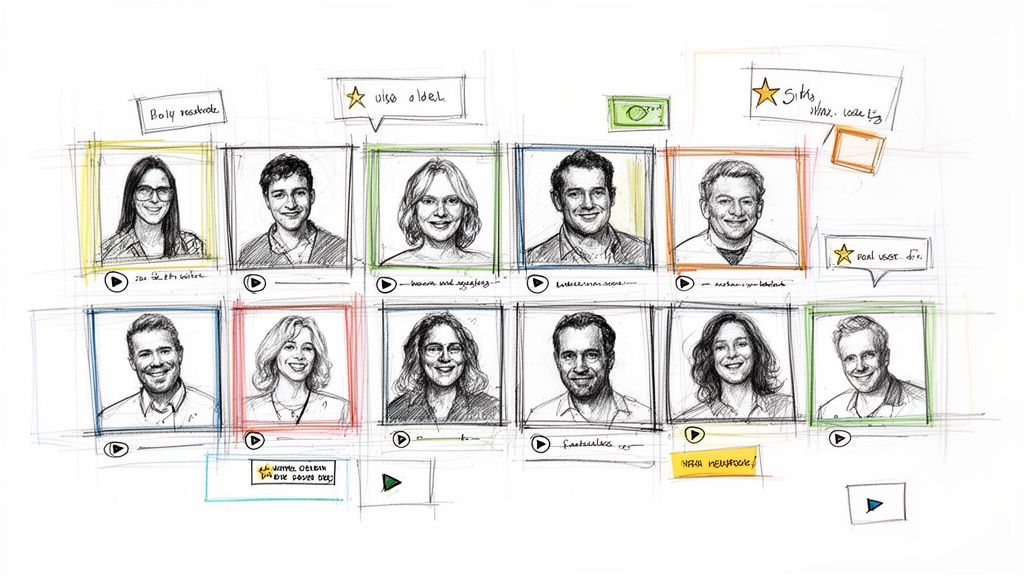
A UGC testimonial mashup is a powerful ad format that splices together rapid-fire video clips from multiple authentic customers. This approach compresses several user voices into a single, compelling 15-60 second spot, creating a strong consensus effect. By featuring real people instead of professional actors, brands like Supergoop and Olaplex build instant credibility and social proof, which is critical for driving conversions on platforms saturated with polished ads.
How It Works
This technique focuses on creating a "chorus of approval" around your product. Instead of a single, long-form testimonial, you collect short, punchy clips (8-15 seconds each) from a diverse group of customers and edit them into a fast-paced montage. The rapid cuts and multiple faces keep viewers engaged while reinforcing the same core message from different perspectives. This makes UGC mashups one of the most effective ad creative ideas for showing widespread customer satisfaction and overcoming purchase hesitation.
Key Insight: The collective voice is more persuasive than a single one. Seeing multiple, unrelated people rave about a product makes the claims feel more objective and trustworthy. Raycon earbuds, for example, found their UGC ads outperformed branded content by 4x.
Actionable Tips for Implementation
Recruit from Your Customer Base: Offer incentives like discounts or free products to existing customers in exchange for a short video testimonial. This ensures authenticity and provides a steady stream of content.
Provide a Loose Brief: Guide creators to mention one or two specific benefits but encourage them to use their own words and style. This preserves the genuine, non-scripted feel that makes UGC effective.
Optimize for Mobile: Instruct creators to film vertically. When editing, add bold, clear captions to highlight key phrases, as most users watch with the sound off. Mastering effective captioning is a fundamental skill for maximizing the impact of these mashups.
Batch and Systematize: Collect testimonials quarterly to build a deep library of assets. This allows you to quickly assemble new ad variations for testing by mixing and matching different faces, demographics, and benefit callouts.
By focusing on a well-rounded user-generated content strategy, you can consistently produce high-performing ads that build both brand trust and a strong return on ad spend. This method provides a scalable system for generating authentic social proof.
4. Listicle Format Ads
Listicle format ads transform educational or entertaining content into a powerful sales tool by structuring the narrative around a numbered list, such as "5 Ways to..." or "7 Mistakes You're Making..." This format excels on social platforms by catering to users' preference for scannable, value-driven content. It provides genuine information upfront while subtly weaving the product into the narrative, positioning it as a natural solution.
This approach builds trust by offering tangible value before asking for a sale. For example, a productivity app might create an ad titled "5 Ways to Organize Your Life," with the final point showcasing how the app automates the process. The format inherently creates chapter breaks, using on-screen numbers to keep viewers engaged and anticipating the next point, which helps improve video retention rates.
How It Works
This method is rooted in content marketing principles, turning an advertisement into a mini-educational resource. The structure is simple: present a series of numbered tips, hacks, or mistakes related to a viewer's pain point. The product is then introduced either as the final, ultimate solution or integrated throughout the list as a tool to accomplish each point.
By leading with authentic value, you disarm the viewer's natural skepticism towards ads. They stick around for the tips and, in the process, learn about your product in a non-intrusive context. This strategy is one of the most effective ad creative ideas for SaaS, education, and finance brands that need to explain a product's utility.
Key Insight: The primary goal is to provide enough standalone value that the viewer feels they've learned something, regardless of whether they purchase. This positive association makes the final product pitch feel earned and helpful rather than forced.
Actionable Tips for Implementation
Lead with Genuine Value: Dedicate the first few items in your list to providing real, actionable advice that doesn't depend on your product. For a five-item list, introduce your product solution at item #4 or #5.
Use Clear Visual Cues: Display large, clear numbers on-screen for each point. Use bold text overlays to announce the title of each tip (e.g., "Tip #3: Automate Your Tasks"). This makes the ad easy to follow even with the sound off.
Keep the Pace Snappy: Do not spend more than 10-15 seconds on any single list item. The goal is to deliver quick, digestible insights that maintain momentum and keep the viewer watching until the end.
Test List Length: Experiment with different list lengths to find the optimal format for your audience. Shorter lists (3-5 items) work well for quick, high-impact messages, while longer lists (7-10 items) can establish deeper authority but risk higher drop-off.
5. Before-After Visual Transformation
The Before-After Visual Transformation is a classic yet powerful ad creative format that proves a product's value by showing a clear, tangible result. This approach visually demonstrates impact through side-by-side or sequential imagery, immediately communicating efficacy without needing extensive copy. It is exceptionally effective for products with visible outcomes, such as those in the fitness, beauty, home improvement, or design software categories.
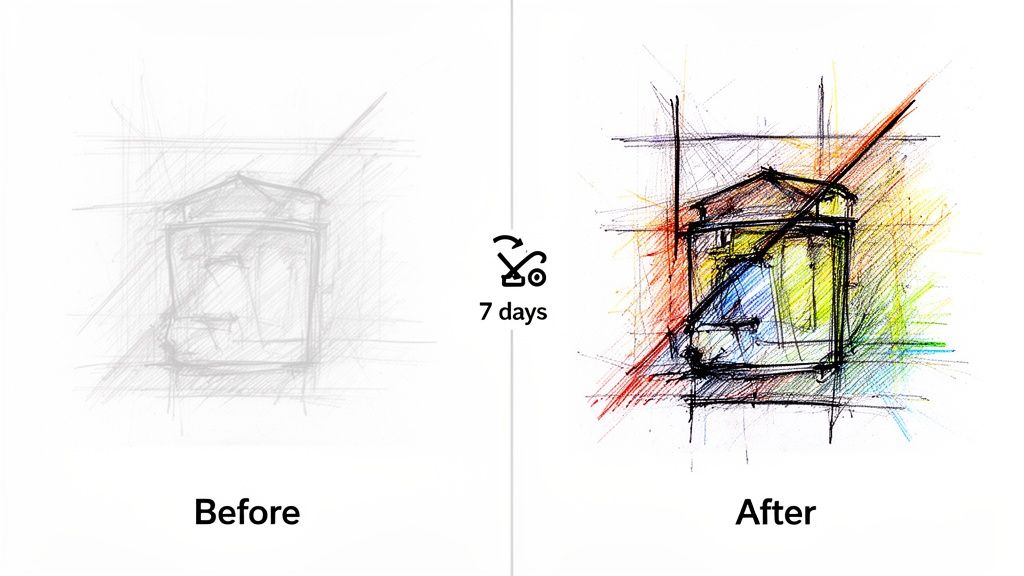
The format’s strength is in its simplicity and universal understanding. Viewers instantly grasp the "problem" (the 'before' state) and the "solution" (the 'after' state provided by the product). This immediate payoff is perfect for fast-paced social feeds where attention is scarce, making it one of the most reliable ad creative ideas for demonstrating clear product benefits.
How It Works
This creative strategy relies on the brain's preference for visual proof over text-based claims. By presenting two contrasting states, the ad creates a compelling narrative of change that viewers can easily process. For example, a skincare ad might show a split-screen of skin before and after using a retinol cream. A design tool like Canva can show a blank, intimidating canvas evolving into a professional-grade graphic in seconds.
Key Insight: The power of the before-after creative is its ability to make the product's primary benefit undeniable. It shifts the burden of proof from words to visuals, building trust and desire by showing, not just telling.
Actionable Tips for Implementation
Maintain Visual Consistency: Shoot the 'before' and 'after' shots from the exact same angle with identical lighting. Inconsistencies can make the results seem manipulated and undermine viewer trust.
Use Split-Screens for Impact: For mobile feeds, vertical split-screens often perform better than sequential cuts. This allows viewers to compare both states simultaneously, making the transformation more dramatic and immediate.
Specify the Timeframe: Add text overlays like "After 1 week" or "In just 60 seconds" to manage expectations and add credibility to the result. This context makes the benefit feel more attainable.
Adapt for Digital Products: For apps or software, show a screenshot of the 'problem state' (e.g., a messy spreadsheet, a confusing interface) next to the 'solved state' (a clean dashboard, an organized project). This translates the concept effectively for non-physical products.
6. Micro-Moment Storytelling
Micro-Moment Storytelling is an advertising strategy that builds short, narrative ads around emotionally resonant customer moments. Instead of leading with features, this approach shows relatable life scenarios where the product becomes essential to solving an immediate pain point. These 15-30 second stories create a powerful emotional connection and frame the product as a source of relief or satisfaction in everyday life.
How It Works
This method focuses on showing, not telling. The narrative captures a specific, high-stakes moment that the target audience instantly recognizes, like a parent trying to watch their child's recital from afar (Apple AirPods) or a colleague arriving late and needing to catch up fast (Slack). The product is introduced organically as the solution, not the hero. This technique is one of the most effective ad creative ideas for building brand affinity because it connects the product directly to a positive emotional outcome, like relief, joy, or satisfaction.
Key Insight: The product's value is demonstrated through its role in resolving a familiar, emotionally charged situation. Viewers connect with the feeling of the problem being solved, which they then associate with your brand, making the ad highly memorable and persuasive.
Actionable Tips for Implementation
Lead with the Emotional Moment: Start the ad with the relatable problem. For an Uber Eats ad, this could be a frantic late-night search through an empty fridge. The product should appear as the natural resolution, not the initial focus.
Mine for Authentic Scenarios: Look through customer reviews, support tickets, and social media comments to find genuine pain points. These real-world examples provide the most authentic and impactful story ideas.
Keep Dialogue Minimal: Use visuals and context to tell the story. Let the character's expression of frustration, followed by relief, carry the narrative. Heavy product explanations will break the emotional connection.
A/B Test Emotional Tones: Create variations of your ad that explore different emotional resolutions. Test a humorous take against one focused on simple relief or another on quiet joy to see which tone resonates best with your audience segments.
7. Carousel and Interactive Ad Formats
Carousel ads are interactive, multi-card advertising units that allow users to swipe through a sequence of images or videos within a single ad placement. Instead of relying on one static message, carousels invite active participation by presenting distinct product angles, benefits, or features on each card. This format is especially powerful for telling a sequential story, showcasing a range of products, or breaking down complex features into digestible parts, making it one of the most versatile ad creative ideas available.
How It Works
This format turns a passive viewing experience into an active one. Users are encouraged to swipe, which inherently increases time spent with the ad and signals deeper interest. Each card acts as its own mini-advertisement, allowing you to highlight different value propositions. For example, Airbnb can show multiple unique properties, while a SaaS company like Figma can demonstrate different collaborative features in sequence. The behavioral data from these swipes reveals which benefits or products capture the most attention, providing valuable insights for future creative iterations.
Key Insight: The primary benefit isn't just showing more content; it's about understanding user priorities. If users consistently swipe to the third card featuring "free shipping," you've discovered a key value proposition that should be elevated in other ad formats.
Actionable Tips for Implementation
Lead with Your Strongest Card: Place your most emotionally resonant image or compelling benefit on the first card to grab attention and encourage the first swipe. Test different opening cards to see what works best.
Ensure Visual Distinction: Make each card look unique enough that swiping feels rewarding. Use different images, background colors, or bold headlines to create a sense of discovery as the user scrolls.
Include Clear Swipe Cues: Don't assume users know it's a carousel. Add visual indicators like arrows or text such as "Swipe to see more" on the first card to prompt interaction.
Design for Mobile Interaction: Use large, clear text and ensure each card communicates a single, simple message. Remember that users are interacting with their thumbs, so make the experience smooth and intuitive.
Carousel ads are one of the core ad types on platforms like Meta, offering a structured way to present more information without overwhelming the user. They are a powerful tool to include alongside other Meta ad formats in your broader campaign strategy.
8. Trend-Jacking and Cultural Moment Advertising
Trend-jacking is a real-time marketing strategy that involves aligning your brand with trending audio, hashtags, challenges, or unfolding cultural moments. This approach positions products as culturally relevant and contemporary by tapping into conversations already happening on platforms like TikTok and Instagram. It capitalizes on the algorithmic preference for trending content, creating ads that feel native to the user experience and less like disruptive advertising. This is one of the fastest and most organic ad creative ideas to gain relevance.
How It Works
This method is about speed and cultural awareness. Instead of creating content in a vacuum, your team actively monitors social platforms for emerging trends and quickly produces creative that participates in them. For example, a trending audio clip or a new meme format becomes the vehicle for your product message. Think of Ocean Spray's massive success when its juice was featured in the viral "Dreams" skateboarding TikTok. The brand didn't start the trend, but its quick and authentic participation cemented its place in that cultural moment.
Key Insight: The goal is not just to use a trend, but to integrate your product into it in a way that feels authentic and adds to the conversation. Success depends on acting quickly and understanding which trends align with your brand’s voice and audience.
Actionable Tips for Implementation
Establish Rapid Workflows: Trends have a short lifespan, often just a few days. Create an internal approval process that allows for 30-minute to 2-hour turnarounds from concept to launch to capture the peak of a trend's momentum.
Assign a Trend Spotter: Designate a team member to spend time daily monitoring the "For You" pages on TikTok, Instagram Reels, and X (formerly Twitter). Their job is to identify rising sounds, formats, and conversations.
Create Adaptable Templates: Have pre-approved creative templates ready. These might include simple backgrounds, product placements, or text overlay styles that can be quickly adapted to fit a new trending audio or visual format.
Participate Early: The algorithm rewards early adopters. Aim to jump on a trend within its first 24-48 hours to maximize organic reach and impact before it becomes oversaturated. Avoid trends that feel completely disconnected from your product category to maintain authenticity.
9. Negative/Reverse Psychology Ads
Negative or reverse psychology ads are a powerful strategy that intentionally uses contrarian messaging, anti-marketing language, or acknowledges product limitations to build credibility. By breaking conventional advertising rules, such as "always be positive," these ads create cognitive surprise and perceived authenticity. This approach is highly effective with audiences who are skeptical of traditional, polished marketing, making it one of the most distinctive ad creative ideas available.
For example, a brand might acknowledge a minor flaw by stating their product is 'not perfect,' which instantly builds trust and highlights their actual strengths.
How It Works
This method works by subverting audience expectations. When a brand says something self-deprecating or points out a flaw, it immediately disarms the viewer's natural skepticism. This perceived honesty makes the positive claims that follow seem far more believable. For example, Dollar Shave Club’s "Our Blades Are F***ing Great" ad mocked expensive, over-engineered razors, positioning their simple, affordable product as the common-sense alternative. It focused on industry excess rather than directly attacking competitors, building a tribe around its irreverent brand voice.
Key Insight: The goal isn't to be truly negative about your product; it's to be negative about the industry norms or transparent about your product's specific trade-offs. Honesty about a small limitation builds immense credibility for your core value proposition.
Actionable Tips for Implementation
Acknowledge Real Limitations: Be transparent about a trade-off. An ad for Away luggage could say, "This is not a perfect suitcase... it won't do your laundry, but it will charge your phone and survive baggage handlers." This makes the benefits more credible.
Focus on Industry Norms: Instead of attacking a competitor, critique the category. Liquid Death’s anti-corporate, anti-marketing stance ("Murder Your Thirst") resonates with people tired of hyper-sincere wellness brands.
Use Calculated Irreverence: Ensure your contrarian messaging is authentically aligned with your brand values. A sudden shift to an edgy tone can feel inauthentic if your brand is typically conservative. Test the angle on a small, specific audience segment before scaling.
Pair with Genuine Benefits: The reverse psychology hook must lead back to a genuine product benefit. After admitting a flaw or mocking the industry, clearly state why your product is the better choice.
10. Performance-Driven A/B Testing Creative Frameworks
Performance-driven A/B testing frameworks apply the scientific method to creative development, moving beyond gut feelings to make statistically sound decisions. This systematic approach isolates individual creative elements-such as hooks, visuals, copy, or calls-to-action-to precisely measure their impact on key performance indicators. It treats each component as a testable variable within a controlled experiment, allowing marketers to quantify what actually drives conversions and build a library of proven creative assets. Its value comes from building a reliable, repeatable process for improvement.
How It Works
This method is about creating controlled experiments for your ads. You start with a "control" creative and then develop variations where only one element is changed. For example, an e-commerce brand might test the same video ad with three different product image backgrounds to see which context performs best. By directing equal traffic to each variation, you can determine with statistical confidence which change led to an uplift in metrics like click-through rate or cost per purchase. This rigorous process is one of the most effective ad creative ideas for teams aiming to scale their spend efficiently.
Key Insight: True A/B testing is about isolating variables, not just launching different ads. Testing a video with new music against one with a different hook and CTA tells you nothing about what caused the performance change. Clean, single-variable tests provide clear, actionable feedback.
Actionable Tips for Implementation
Establish a Control Baseline: Always run your new test variant against your current best-performing ad (the control). This provides a benchmark to measure against and ensures you're aiming for genuine improvement, not just novelty.
Isolate and Document Rigorously: Change only one variable per test to get clean data. For example, test 'Sign Up' vs. 'Get Started' on the same exact creative. Document every test result, including the hypothesis, variable, results, and statistical significance, in a shared database to spot long-term patterns.
Prioritize Tests by Impact: Sequence your tests strategically. Since the hook has the largest impact on scroll-stop rate, start by testing hook variations before investing time in optimizing the body or end card. Allocate 20-30% of your creative budget to testing new ideas and the rest to scaling proven winners.
Top 10 Ad Creative Ideas Comparison
Framework | Implementation Complexity 🔄 | Resource Requirements ⚡ | Expected Outcomes ⭐📊 | Ideal Use Cases | Key Advantages 💡 |
|---|---|---|---|---|---|
Hook-Body-CTA Framework | Medium 🔄🔄 — modular tagging & assembly | Medium ⚡⚡ — library + tooling upfront | High ⭐⭐⭐ — improved retention & measurable lifts 📊 | Short-form performance ads, rapid iteration | Modular testing, scalable assembly, clear component metrics 💡 |
Problem-Agitate-Solution (PAS) Copywriting | Medium-High 🔄🔄🔄 — needs research and tone control | Medium ⚡⚡ — customer research and scripts | High ⭐⭐⭐ — strong emotional engagement & qualified leads 📊 | Direct response, SaaS onboarding, acquisition funnels | Drives urgency, clarifies problem→solution, converts motivated prospects 💡 |
User-Generated Content (UGC) Testimonial Mashups | Low-Medium 🔄🔄 — curation & edit workflow | Low ⚡ — relies on customer footage; editing effort | Very High ⭐⭐⭐⭐ — social proof drives ROAS uplift 📊 | DTC, beauty, value-oriented products, social proof campaigns | Cost-effective authenticity, trust-building, rapid scalable variants 💡 |
Listicle Format Ads | Medium 🔄🔄 — content planning per item | Medium ⚡⚡ — content development & graphics | Good ⭐⭐⭐ — high completion & shareability 📊 | Educational/SaaS, awareness, value-led ads | Scannable structure, provides utility, chaptered retention 💡 |
Before-After Visual Transformation | Low-Medium 🔄🔄 — production consistency required | Medium-High ⚡⚡⚡ — quality photography/video & real results | Very High ⭐⭐⭐⭐ — strong trust and emotional impact 📊 | Beauty, fitness, home improvement, visual-result categories | Clear visual proof, cross-cultural effectiveness, minimal copy needed 💡 |
Micro-Moment Storytelling | High 🔄🔄🔄 — requires narrative craft | Medium ⚡⚡ — cast, scenarios, authentic execution | High ⭐⭐⭐ — memorable brand affinity & shares 📊 | Lifestyle products, brand-building, social platforms | Emotional resonance, organic reveal, positions product as essential 💡 |
Carousel and Interactive Ad Formats | Medium-High 🔄🔄🔄 — card strategy & ordering matters | High ⚡⚡⚡ — multiple assets per unit | High ⭐⭐⭐ — engagement + behavioral insights 📊 | E‑commerce, multi-product showcases, feature comparisons | Multi-angle testing, interaction data, mobile-first engagement 💡 |
Trend-Jacking and Cultural Moment Advertising | Medium 🔄🔄 — rapid monitoring & approvals | Low-Medium ⚡⚡ — fast edits and templates | Variable ⭐⭐ — short-term reach spikes; volatile 📊 | Real-time relevance, Gen Z engagement, viral participation | Algorithmic boost, low production friction, high virality potential when timely 💡 |
Negative/Reverse Psychology Ads | Medium-High 🔄🔄🔄 — brand voice risk management | Low-Medium ⚡⚡ — strong copy + confident creative | High (niche) ⭐⭐⭐ — memorable but polarizing 📊 | Disruptive DTC, crowded categories, youth-focused brands | Differentiation, perceived authenticity, conversation-driving creative 💡 |
Performance-Driven A/B Testing Creative Frameworks | High 🔄🔄🔄 — statistical design & control | High ⚡⚡⚡ — traffic, budget, tracking tools | High ⭐⭐⭐ — validated winners and compounding learnings 📊 | Growth teams, high-traffic funnels, data-driven scaling | Removes guesswork, builds institutional knowledge, scalable validation 💡 |
From Ideas to Impact: Automating Your Creative Workflow
Having explored a deep well of ad creative ideas, from the structural integrity of the Hook-Body-CTA framework to the psychological nuance of reverse psychology ads, one truth becomes clear: a great idea is only the beginning. The real challenge, and where top-tier brands truly excel, is in the relentless execution, testing, and iteration of those ideas. The true engine of growth isn’t a single viral video; it’s a system built for speed and learning.
This article provided a blueprint for what to create, covering everything from UGC testimonial mashups that build authentic social proof to A/B testing frameworks that isolate winning variables. The common thread weaving through all these concepts is modularity. Each format, whether it's a Problem-Agitate-Solution script or a Before-After visual, is composed of distinct, swappable parts: a hook, a core benefit, a user's face, a call to action. This inherent modularity is the key to unlocking scalable creative production.
Bridging the Gap Between Concept and Campaign
The transition from a list of promising ad creative ideas to a live, high-performing campaign is where many teams falter. The manual process of editing dozens of variations in traditional software like CapCut or Premiere Pro creates a bottleneck that stifles momentum. You might have ten brilliant hooks, five compelling body sections, and three different CTAs, but manually combining them into 150 unique video ads is an operational nightmare.
This is why the future of performance creative is inextricably linked to automation. The goal isn't just to make more ads, but to build a more intelligent creative process. By systematizing production, you free up your creative strategists and media buyers to do what they do best: analyze performance data and generate strategic insights.
Key Insight: Winning at performance marketing isn't about finding a single "golden" creative. It's about building a machine that can consistently produce a high volume of "good enough" creatives to find what works right now, and then rapidly scale the winners.
Building Your Creative Assembly Line
Adopting a system-driven approach means treating your creative assets as a library of reusable components. Think of it as an assembly line for your ads:
Component Library: Your raw assets (UGC clips, product shots, screen recordings, voiceovers, text overlays) become a tagged and organized library.
Structural Templates: Proven frameworks like PAS or the Listicle Format become reusable templates or "recipes" for ad construction.
Automated Assembly: A dedicated platform combines these components according to your strategic templates, generating hundreds of ready-to-test ad variants in minutes, not days.
This shift moves your team away from being manual video editors and toward becoming architects of a growth engine. The primary focus becomes strategy-what new hooks should we test? Which audience pain point is resonating most? How does this winning angle translate to TikTok?
Ultimately, the ad creative ideas discussed in this article are your strategic inputs. An automated workflow is the operational output that turns those strategies into measurable results. By closing the loop between ideation, production, and performance analysis, you create a compounding cycle of learning. Each campaign, successful or not, feeds valuable data back into the system, making your next batch of creatives smarter and more effective. This is how you move beyond sporadic creative wins and build a predictable, scalable engine for sustainable growth.
Ready to stop manually editing ad variations and start building a scalable creative engine? Sovran is a creative automation platform designed to turn your best ad creative ideas into hundreds of testable video assets in minutes. Explore Sovran and discover how to automate your production workflow, so you can focus on strategy and growth.

Manson Chen
Founder, Sovran
Related Articles
How to Turn Link Into Video: Ads That Convert in 2026
Learn how to turn link into video for Meta & TikTok ads. Leverage AI to scale creation, boost ROI, and succeed in 2026.
Your Ultimate Guide to UGC Style Video Ads
Master UGC style video ads for Meta and TikTok. This guide reveals proven frameworks, scripts, and scaling tactics to boost your ROAS in 2026.
8 High-Converting Static Ads Examples for 2026
Discover 8 high-performing static ads examples from top apps. Learn to create text-overlays, testimonials, and lifestyle ads that convert.