A Modern Playbook for AI for Advertisers
For advertisers, AI isn't some far-off, futuristic idea. It's a toolkit you can use right now to automate creative production, deliver personalization that...
Jump to a section
- How AI Is Redefining Advertising Workflows
- Understanding the Core Capabilities of Advertising AI
- Building Your AI-Powered Performance Campaign
- Measuring the True Impact of AI on Your ROI
- How a Platform Like Sovran Puts This Into Practice
- Common Pitfalls to Sidestep When Using AI in Your Ads
- Got Questions About AI in Advertising? Let's Clear Things Up.
For advertisers, AI isn't some far-off, futuristic idea. It's a toolkit you can use right now to automate creative production, deliver personalization that actually scales, and get predictive insights that were once impossible.
It turns the old, manual slog of campaign work into a high-speed, data-driven operation. The goal? To help you create, test, and find winning ads way faster than ever before.
How AI Is Redefining Advertising Workflows

Think about the traditional way of making ads. It was like manual craftsmanship. Every single variation—a new hook, a different call-to-action—took careful, time-consuming effort. Launching a simple A/B test could eat up hours, and scaling that up to dozens of variations felt completely out of reach.
Now, picture a high-precision assembly line. That’s the new reality with AI for advertisers.
Instead of building each ad by hand, you define the core components—the hooks, the body copy, the visuals, and the CTAs. Then, AI assembles hundreds of unique combinations in minutes. This is the fundamental change AI brings to the table: a move from manual creation to automated assembly.
The Shift from Manual Work to Strategic Oversight
This doesn't mean human creativity is obsolete. Far from it. It just redirects it.
Your role evolves from being the "doer" to being the "director." You're the one providing the strategic vision, the brand guidelines, and the core messaging. AI handles the repetitive, grunt work, which frees you up to focus on what really matters: high-level strategy, analyzing results, and understanding your audience on a much deeper level.
The financial world has certainly taken notice. The global AI in advertising market was valued at USD 8.6 billion in 2023 and is on track to hit around USD 81.6 billion by 2033. That explosive growth shows just how quickly teams are grabbing AI tools for everything from campaign planning to audience targeting. You can dig into more of the numbers in this AI advertising market growth report from market.us.
At its core, AI for advertisers is about achieving creative velocity. It’s the ability to test more ideas, learn from data faster, and consistently stay ahead of creative fatigue, ensuring your campaigns remain fresh and effective.
This guide is your roadmap for putting AI into practice. We’ll break down its core capabilities, walk through actionable workflows for platforms like Meta and TikTok, and show you exactly how to measure the real-world impact on your bottom line.
Understanding the Core Capabilities of Advertising AI
To really get what AI can do for advertisers, it helps to look past the hype and see what it actually does. Don't think of AI as a single magic button. Instead, picture it as a system with four distinct, practical capabilities that work together to make your campaigns better.
Creative Generation and Iteration
At its heart, AI is an engine for producing variety at an incredible speed. A human creative might come up with a handful of ad variations in a day. An AI can spit out hundreds. It can swap out hooks, remix video clips, tweak calls-to-action, and generate new copy concepts in just a few minutes.
This isn't about replacing human ideas—it's about scaling them. You bring the core concept, that winning angle or customer testimonial, and the AI handles the grunt work of creating every possible version for testing. This completely changes your workflow from manual creation to automated assembly, letting you test way more ideas, way faster.
Intelligent Asset Tagging
Okay, so you have hundreds of creatives. Now what? How do you know what’s actually working? This is where intelligent asset tagging comes in. AI scans every single component of your ads—from the visual elements in a video to the emotional tone of the copy—and tags them with descriptive labels.
Suddenly, your creative library isn't just a folder of files; it's a searchable, analyzable database. You can quickly see which backgrounds, speakers, or product shots are driving the highest ROAS.
Instead of just guessing which ad performed best, you can pinpoint the exact elements that made it a winner. This kind of granular insight is the foundation for a data-driven creative strategy and a huge part of how AI helps you find profitable ads.
Hyper-Personalization at Scale
Personalization has always been the holy grail for advertisers, but actually doing it for thousands of users has been a massive headache. AI makes it possible by dynamically assembling ads for individual users or tiny audience segments on the fly. It mashes up your tagged assets with user data to serve the most relevant creative in real time.
For example, an e-commerce brand can use AI to show a user an ad with the exact product they just looked at, using copy that references their city or a recent sale. It’s no wonder that, according to Nielsen, 59% of global marketers see AI-driven personalization as the most impactful trend for 2025. It’s all about creating ads that feel like they were made for just one person.
Predictive Analytics
Finally, AI gives advertisers a peek into the future. By chewing through historical performance data and market trends, AI models can forecast which creative concepts are most likely to hit before you even spend a dime. This helps de-risk your campaign launches big time.
At the core of this is some pretty advanced machine learning. If you want to go deeper on how these models work, check out this guide on Machine Learning for Forecasting. AI can even spot early signs of creative fatigue and suggest new angles to test, keeping your campaigns fresh and effective. We cover these concepts in more detail in our complete guide on using AI for ads.
Comparing Traditional vs AI-Powered Advertising Workflows
To really see the difference, let's put the old way and the new way side-by-side. The table below breaks down how AI fundamentally changes the day-to-day grind for advertisers, turning manual chores into strategic opportunities.
Advertising Task | Traditional Manual Approach | AI-Powered Approach |
|---|---|---|
Creative Production | A designer manually creates 5-10 ad variations over several hours. | AI generates 100+ variations from a single concept in minutes. |
Ad Copywriting | A copywriter writes a few different headlines and body text options. | AI writes dozens of hooks, angles, and CTAs based on top-performing formulas. |
Performance Analysis | Manually reviewing ad-level metrics (CTR, CPA) to guess what worked. | AI tags and analyzes every asset to identify which elements drive performance. |
Audience Targeting | Building broad audience segments based on static demographic data. | Dynamically personalizing ads for micro-segments or individuals in real time. |
Campaign Planning | Launching campaigns based on past performance and educated guesses. | Using predictive models to forecast creative success and reduce wasted spend. |
As you can see, the shift is dramatic. It’s less about doing the same tasks faster and more about unlocking entirely new ways to strategize, test, and personalize your advertising efforts.
Building Your AI-Powered Performance Campaign
Alright, let's move from theory to the real world. This is where AI actually starts making a difference for advertisers. Putting together a winning AI-driven campaign for platforms like Meta or TikTok isn't about throwing things at the wall and seeing what sticks. It's about following a smart, repeatable workflow that’s baked in data.
Let's break down the blueprint for structuring your campaign, from that first spark of an idea all the way to the final performance report. The whole point is to learn faster and pump out more creative at every single step, turning the old, slow process into a high-speed system built for intelligent testing.
AI-Assisted Ideation and Production
First up: brainstorming. Instead of staring at a blank screen, you can feed an AI with your best audience insights, transcripts from top-performing ads, and even customer reviews. The system will then kick back a whole range of angles, hooks, and scripts that already align with your brand's voice.
Once you land on a core concept, AI is what helps you get to massive scale. Tools like an AI video ad creator can take one single idea and spin it into dozens of unique ad variations in minutes. This is the engine of a high-velocity testing strategy. It lets you explore way more creative territory than you ever could manually.
Key Takeaway: The goal here is to stop manually building a handful of ads and start directing an automated system that generates hundreds of testable variations. This frees you up to spend more time on high-level strategy and less on the repetitive grunt work.
This flow chart nails the core four-step loop that powers an AI-driven advertising strategy.
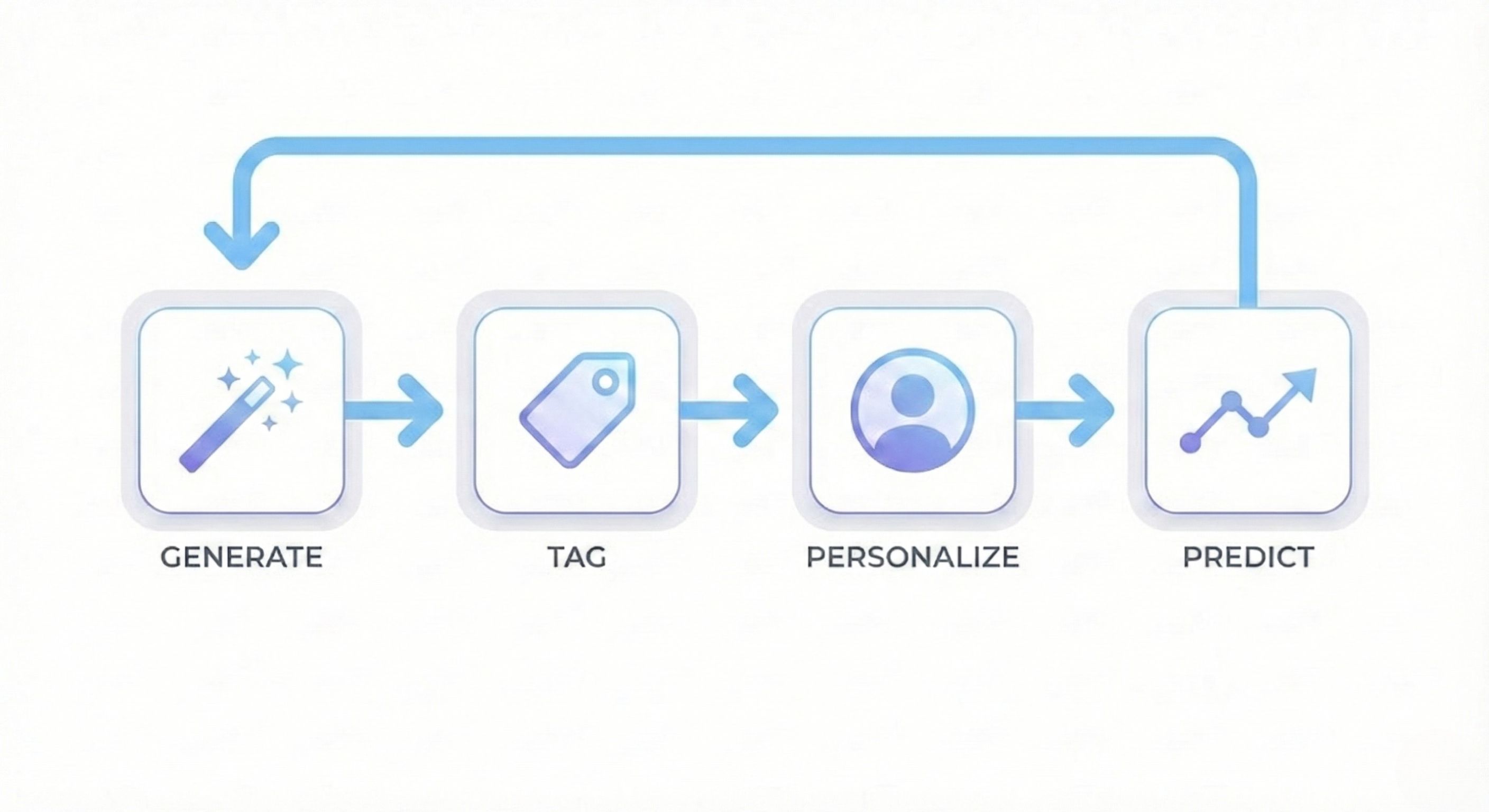
It’s a continuous cycle: creatives are generated, automatically tagged for analysis, personalized for different audiences, and then used to predict what will work next.
Automated Organization and Intelligent Testing
When you're dealing with a flood of new creatives, organization is everything. AI automatically tags every single asset—from the background music to the call-to-action—creating a clean, structured database. This gets your ads ready for deep analysis, so you can see exactly which elements are driving results, not just which ad was the winner. A huge part of this is using AI-powered customer segmentation strategies to make sure your ads hit home with the right people.
This detailed tagging is what fuels your testing plan. You can set up really structured experiments to test specific questions, like:
Does a user-generated content (UGC) style hook work better than a direct-to-camera one?
Which background color gets a higher click-through rate for this audience segment?
Does a CTA focused on a discount lead to a lower cost-per-acquisition?
Finally, AI dashboards give you performance analysis in real-time. No more waiting weeks to dig through spreadsheets. You get immediate feedback on which creative ingredients are resonating with your audience. This constant feedback loop is what allows you to iterate and improve at an incredible pace, turning campaign management into a much more scientific process.
And this isn't some future-state fantasy; it's happening right now. Research shows that 88% of marketers already use AI in their day-to-day roles. The most common use case? Content optimization, which is exactly what this workflow is about, used by 51% of marketing teams.
Measuring the True Impact of AI on Your ROI
Bringing any new tech into your workflow means you have to answer one question: what’s the ROI? With AI for advertisers, you need to get past vague promises of "better efficiency" and nail down the hard numbers that hit your bottom line. Adopting AI isn't just about moving faster; it's about hitting business goals in a way you can actually measure.
To make the case for the investment, you need to be tracking the right Key Performance Indicators (KPIs). Think of these as the bridge connecting what the AI does to your actual financial results. It's not enough to say AI spits out creatives quickly. You have to measure how that speed directly impacts your campaign performance and budget.
Tracking Creative Velocity and Production Costs
The first thing you’ll notice is a huge jump in creative velocity. This isn’t just a nice-to-have metric. It’s about how many distinct ad variations you can generate and test in a single week. Doing it manually, you might get through 5-10 concepts if you're lucky. With AI, testing over 100 in that same period becomes the new normal.
That speed has a direct, positive impact on your creative production costs. AI automates all the repetitive, time-sucking tasks—resizing assets, adding subtitles, creating simple variations. This slashes the hours you need from designers and video editors, freeing up budget that can go right back into ad spend to amplify your reach.
Boosting ROAS and Lowering CPA
At the end of the day, it all comes down to Return on Ad Spend (ROAS) and Cost Per Acquisition (CPA). This is where AI's ability to analyze and personalize at scale really pays off. By constantly testing hundreds of creative elements, the AI can rapidly pinpoint which hooks, visuals, and calls-to-action are actually driving results.
Imagine discovering that ads with a specific background color and a testimonial-style hook generate a 25% higher ROAS. AI gives you that kind of insight by crunching thousands of data points, letting you pour your budget into scaling only the absolute top-performing combinations.
This data-first approach has a massive effect on customer acquisition. Research from Google shows that advertisers who turn on AI features in their search campaigns see, on average, 14% more conversions at a similar CPA. Why? Because the AI is relentlessly culling the ads that don’t work and doubling down on the winners, making sure every dollar of your budget is working as hard as it can.
The value here is crystal clear. When you tie AI-driven creative testing directly to core financial metrics, the impact is impossible to ignore. Higher creative velocity cuts costs, while smarter personalization and rapid testing drive up ROAS and push down CPA—building a powerful case for making AI a core part of your strategy.
How a Platform Like Sovran Puts This Into Practice
Okay, so the theory is great. But what does this actually look like in your day-to-day workflow? This is where specialized platforms like Sovran come in, acting as a central command center for your entire creative process. The goal is to make the promise of AI for advertisers a practical reality by focusing on two things that truly move the needle: making more creative, faster, and getting smarter about testing.
The first big win is a massive boost in creative velocity. If you've ever manually built dozens of ad variations, you know it's a soul-crushing, resource-draining slog. Sovran flips the script by treating every creative element like a Lego block. You upload your assets once, and its AI gets to work tagging every single component—hooks, body clips, calls-to-action. This lets you assemble hundreds of unique combinations in minutes. Seriously, minutes, not days.
Finally, a Real System for Creative Testing and Analysis
Beyond just moving faster, Sovran brings a disciplined, data-driven system to your creative testing. Because every single asset is intelligently tagged from the start, your performance analysis becomes incredibly granular. You stop asking "Which ad won?" and start asking "Which hook drove the lowest CPA?" or "Which visual style had the best thumb-stop rate?"
That’s the kind of detailed insight that builds a truly smart creative strategy. Instead of guessing, you're looking at clear, actionable data showing you what’s working. You can double down on the winning formulas and kill the stuff that's burning your budget. For anyone managing a high volume of assets, getting this organized is non-negotiable. You can get a head start with our guide on digital asset management best practices.
Think of it as a perpetual feedback loop. The platform helps you generate tons of variations, analyzes the performance of each tiny component, and then feeds those insights right back into your next creative brief.
This dashboard from Sovran gives you a sense of how AI pulls everything together to show you what’s really driving performance.

You can see how the AI connects all these different data points to give you one clean, unified view of what’s actually working.
By pulling creative generation, asset tagging, and deep analytics into one seamless workflow, platforms like Sovran give teams the power to test more, learn faster, and consistently find those unicorn ads. It turns the manual craft of ad creation into a high-speed, data-informed science. This is how modern teams fight creative fatigue, stay ahead of the competition, and actually scale performance.
Common Pitfalls to Sidestep When Using AI in Your Ads
Jumping into AI for advertising can feel like you've suddenly got superpowers, but it's not a magic wand. If you're not careful, it's easy to make a few common mistakes that burn through your budget, waste time, and spit out creative that’s totally off-brand. Success isn’t about just flipping a switch; it's about knowing how to fly the plane.
One of the biggest traps is letting the AI run wild without a human in the loop. Treating it like a "set it and forget it" vending machine is a recipe for disaster. Without a creative strategist feeding it the right inputs and checking the outputs, the AI can quickly drift from your brand voice, creating generic or just plain weird ads that completely miss the mark with your audience.
Here's the deal: Think of AI as an incredibly smart and fast co-pilot, not the pilot. Its job is to execute and scale your creative ideas at a speed you could never match. But the strategy, the vision, and the final quality check? That has to come from you. Your expertise is what makes the tech work.
Set Your Targets and Pick the Right Tools
Another classic mistake is diving in without defining what success even looks like. If you don't know what you’re aiming for—whether it's a lower CPA, a higher ROAS, or just testing creative faster—you have no way of knowing if the AI is actually helping. Vague goals just lead to scattered efforts and a shrug when you look at the results.
Before you even start, set specific, measurable KPIs.
Goal: I want to test more creative, faster.
Metric: Track the number of unique ad variations we test each week. Let's aim for a 5x or 10x increase.
Goal: I want better ad performance.
Metric: Measure the ROAS or CPA for campaigns using AI creative versus our old, manual process. Let’s see a real difference.
Lastly, a lot of teams stumble by grabbing generic, one-size-fits-all AI tools instead of a platform built specifically for the chaos of advertising. Sure, a general AI writer can string words together, but it knows nothing about Meta's ad policies, TikTok's native formats, or how to integrate with your performance data. That’s a huge blind spot for high-stakes campaigns.
Picking a tool designed for performance marketers—like Sovran—means every feature is built with one goal in mind: driving real business results. This kind of specialized approach saves you a ton of frustration and helps you unlock the actual power of AI for advertisers way faster.
Got Questions About AI in Advertising? Let's Clear Things Up.
As advertisers start dipping their toes into AI, a few key questions always pop up. Getting straight answers is the best way to feel confident you're using these tools smartly and not just chasing the next shiny object. Let's tackle the big ones.
Will AI Replace My Creative Team?
Nope. Think of AI as a collaborator, not a replacement. It's like having a tireless assistant who can churn out hundreds of ad variations without getting bored. This frees up your creative team to do what they do best: think big, dream up original concepts, and dig into performance data to find the next winning idea.
The human touch is still the secret sauce. Understanding brand nuance, cultural context, and telling a story that connects with people—that's where your team shines. AI is brilliant at scaling the execution of a great idea, but the idea itself still needs that human spark.
How Much Technical Skill Do I Actually Need?
This is a huge one, but the reality is that modern AI for advertisers is built for marketers, not coders. Platforms like Sovran are designed to be intuitive. If you can navigate your way around a social media ads manager, you've already got the skills you need to get started.
You don't need to understand algorithms or know how to write a line of code. The focus is on your strategic input—giving the AI solid brand guidelines, uploading your best creative assets, and telling it what your campaign goals are. The AI handles all the heavy lifting behind the scenes.
How Can I Start If I'm on a Small Budget?
You absolutely don't need a massive budget to see what AI can do. A great way to start is to take one of your best-performing video ads and use an AI tool to generate 10-20 new variations just by swapping out the hook. It's a small, focused test that doesn't cost much but can quickly show you if a different opening can seriously lift your performance.
Ready to stop guessing and start scaling your creative with data? Sovran automates creative production and testing, helping you find profitable winning ads up to 10x faster. Start your 7-day free trial today.

Manson Chen
Founder, Sovran
Related Articles
Master AI Video Ad Production Workflow
Imagine whipping up a video ad in minutes, without sacrificing quality. That’s the promise of AI video ads—they draft scripts, select visuals, handle...
10 High-Impact Marketing Video Examples for Your 2026 Strategy
In performance marketing, scrolling is the enemy. On platforms like Meta and TikTok, you have less than three seconds to stop a potential customer from swiping...
How to Create Ads with AI That Actually Convert
Creating ads with AI is all about combining your brand's unique creative assets with an intelligent platform to generate, test, and scale winning ad...