AI Talking Head Videos for Scaling Ad Creative
Jump to a section
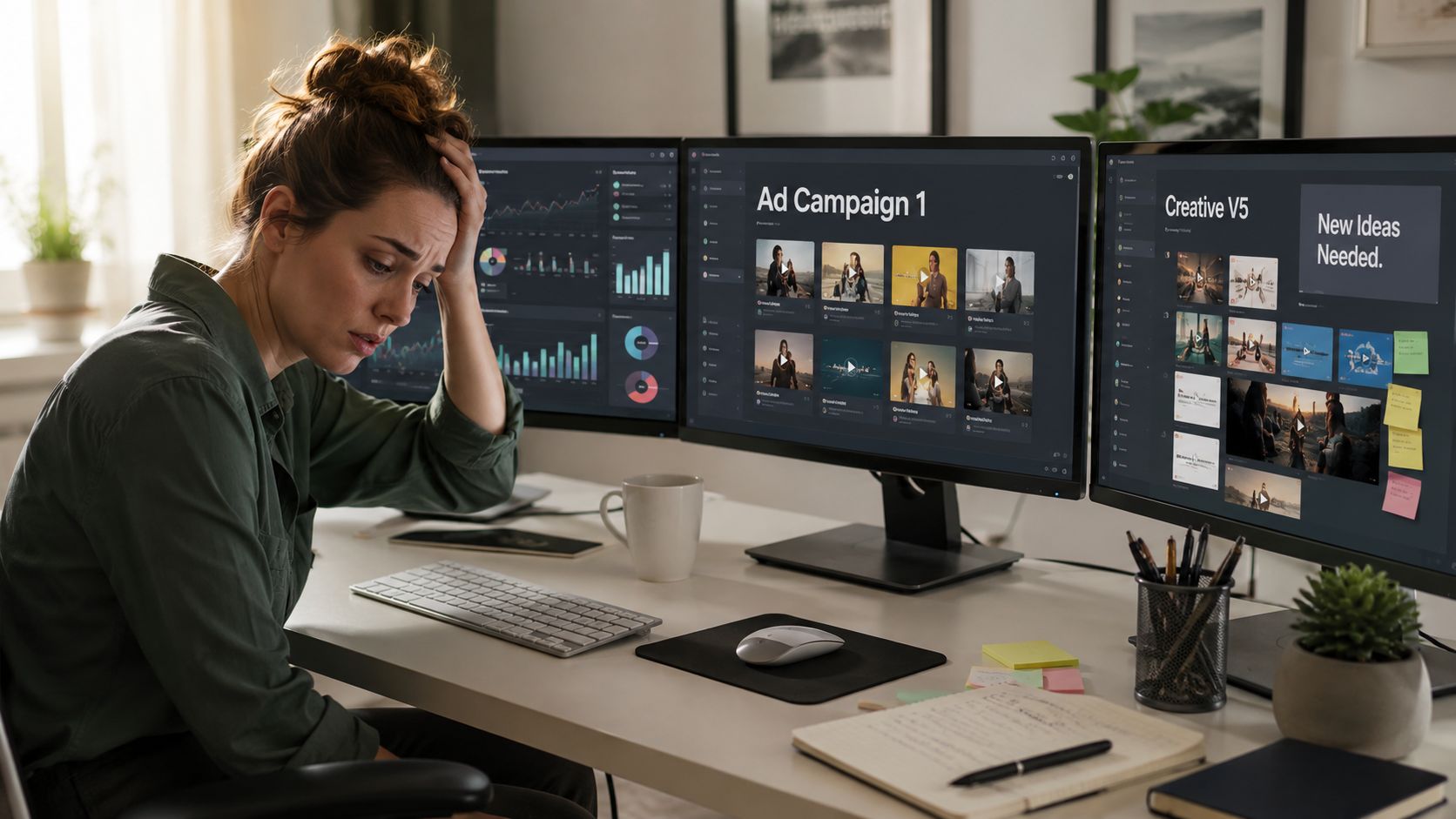
You already know the pattern. Meta needs fresh video. The first few ads work. Then frequency climbs, thumb-stop rates soften, CPAs drift, and the creative team gets pinned between media demand and production reality.
The bottleneck usually isn't strategy. It's throughput.
You have hooks to test, audiences to segment, offers to rotate, and angles to localize. But every new variation seems to require another shoot day, another edit round, another approval loop. By the time the asset is ready, the moment that justified the test has passed. That's where AI talking head workflows have become useful for performance teams. Not as a novelty, and not as a replacement for every live shoot, but as a practical way to create more testable video without rebuilding production from scratch each time.
The Challenge of Scaling Video Ad Creative
A typical UA team doesn't run out of ideas first. It runs out of executable creative.
A strategist has ten viable hooks. A buyer wants separate versions for broad, retargeting, and a new interest cluster. The founder wants to try a direct-response angle. Legal needs a wording change. Product wants a revised value prop. Suddenly one concept turns into a backlog of edits, pickups, and export requests.
Traditional talking-head production breaks when the testing cadence speeds up. The problem isn't that filmed creative stopped working. The problem is that filming every variation is too slow and too expensive for the volume modern ad systems reward. If you're trying to lower creative overhead, it's worth reviewing practical ways teams reduce video production costs before they expand testing volume.
Where the real bottleneck shows up
The pressure usually hits in three places:
- Hook iteration slows down: The first three seconds need constant refreshes, but even small script changes often trigger re-edits or reshoots.
- Message testing gets delayed: Teams know they should test pain-point framing against feature-led framing, but production queues push those ideas out.
- Localization becomes optional: New languages, accents, and market-specific intros are valuable, yet they often get deprioritized because manual production can't keep up.
Most ad teams don't have a testing problem. They have an asset generation problem.
That's why AI talking head content has become relevant to paid social. It gives teams a way to separate script variation from production logistics. When that's done well, creative strategy moves faster because the operational drag is lower.
What creative fatigue looks like in practice
Creative fatigue rarely arrives as a dramatic collapse. It shows up as a series of smaller compromises. The team stops exploring edge-case angles. It recycles the same editor-built structure. It keeps the body of the ad intact because changing it takes too much effort. Over time, performance marketers start making media decisions around what production can support, instead of what the market is signaling.
That trade-off is costly. The strongest teams now treat scalable production as part of media strategy, not as a downstream service function.
What Is an AI Talking Head
An AI talking head is best understood as a digital presenter that can deliver a script on demand. Instead of filming a person every time you need a new message, you use software to generate a video of a human-like avatar speaking that message with synchronized facial movement, voice, and expression.
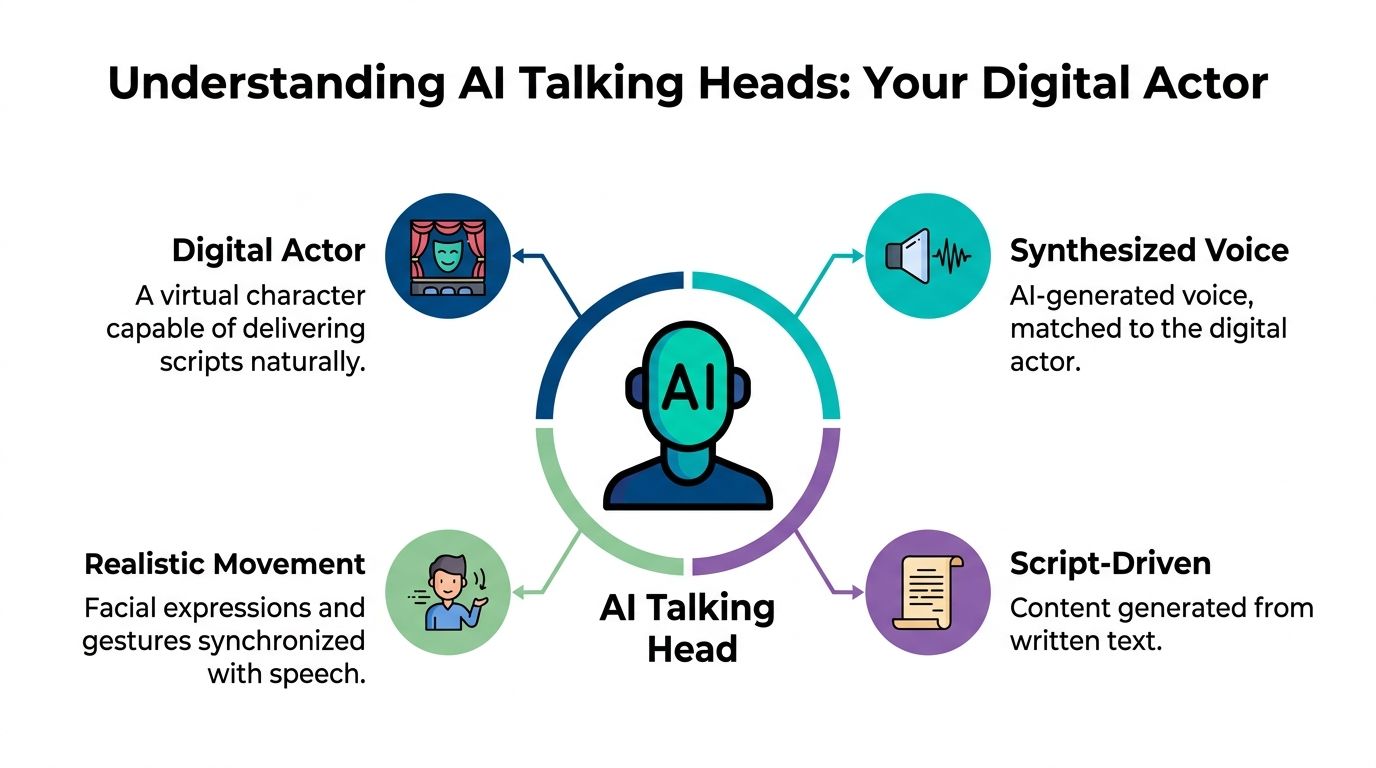
That sounds simple, but the strategic shift is bigger than it first appears. You're no longer tying every new video to another filming session. The messenger becomes reusable.
Think of it as a reusable on-screen actor
A useful analogy is a studio actor who never needs rebooking. You choose the face, voice, and script, then render the version you need. Some platforms use stock avatars. Others let you create a clone based on a real person. The point isn't the novelty of the avatar. The point is that the message can change quickly while the on-screen presence stays consistent.
The biggest unlock is this: once the presenter is digitized, script testing stops depending on camera time.
That matters for ad accounts where one concept may need many introductions, many offers, and many CTAs before you find a winner. It also matters for brands that need consistency across regions, products, or channels. If you want a broader primer on formats and use cases, this breakdown of AI avatar videos is a useful companion.
Why marketers care now
The economics changed. The global market for AI video generators is forecasted to reach $1.76 billion by 2030, and AI talking heads are part of that shift. The same source notes that these tools cut average video production costs by approximately 45%, which is why more teams can produce polished video without traditional filming resources, as outlined by Tavus on AI talking head video generators.
That isn't just a budgeting story. It's a testing story.
Platforms like Synthesia offer over 240 distinct AI talking head avatars, which shows how far customization has moved for teams that need different ages, accents, languages, and presentation styles for global marketing. In practice, this gives performance marketers more room to align message delivery with audience context, instead of forcing every market into one generic video style.
What an AI talking head is good at
AI talking heads are especially useful when you need:
- Rapid script swaps: New hooks, claims, intros, and offer framing without rebuilding the whole asset.
- Presenter consistency: The same face and tone across many variants.
- Localized delivery: Different languages, accents, and audience-specific versions from one workflow.
- Repurposing: Existing scripts, product pages, or ad concepts converted into presentable video quickly.
They're less useful when the concept depends on live physical acting, environmental realism, or highly spontaneous emotion. For those cases, a camera still wins.
Comparing AI Talking Head Approaches
Not every AI talking head workflow solves the same problem. Some are built for speed. Some are built for brand consistency. Some are stopgaps that work only when the audience doesn't look too closely.
If you're evaluating options for ad testing, the choice usually comes down to how much realism you need versus how quickly you need to ship. That's the trade-off.
Three common ways teams use them
The first path is the stock avatar. You pick from a built-in library and move fast. This is usually the easiest entry point for teams that want to validate messaging before investing more heavily in custom production.
The second is a custom digital clone. This uses a real person, often a founder, creator, or spokesperson, as the basis for the generated presenter. It takes more setup, but it can align more closely with brand voice and audience familiarity.
The third is a photo-animated avatar. You start from a still image and animate it into a speaking face. This can work for low-stakes use cases, but it often feels less natural in direct-response ads where viewers are quick to detect anything off.
AI Talking Head Approaches Compared
| Approach | Best For | Pros | Cons |
|---|---|---|---|
| Stock avatars | Fast creative testing, internal explainers, early-stage ad iteration | Quick to launch, no filming required, wide selection of looks and voices | May feel generic, weaker brand distinctiveness, less persuasive for founder-led or creator-led messaging |
| Custom digital clone | Founder ads, spokesperson-led campaigns, branded education content | Stronger brand alignment, reusable on-screen identity, easier to maintain continuity across campaigns | Requires setup, approval, and quality control. Poor source footage can reduce realism |
| Animated photo | Lightweight social content, simple announcements, experimental formats | Minimal input required, useful when no video footage exists | Often the least convincing, limited movement quality, higher risk of uncanny output in paid ads |
For teams reviewing platforms, this roundup of AI video creation tools helps map product capabilities to actual production needs.
What works in performance marketing
For high-velocity testing, stock avatars are often underrated. They aren't always the most memorable, but they're operationally efficient. If you're pressure-testing angles before moving budget behind them, speed matters more than perfect likeness.
Custom clones work best when the presenter itself is part of the ad's persuasion. Founder-led DTC, app explainers with a recognizable spokesperson, and trust-sensitive offers usually benefit from this route. The person on screen carries part of the conversion weight, so generic talent can weaken the message.
What usually doesn't work
Photo-based avatars tend to disappoint in media buying environments where small quality issues hurt retention. A still image brought to life may look acceptable in a demo. In-feed, against polished native content, those artifacts become more obvious.
Another mistake is choosing a custom clone before you've stabilized your messaging framework. If you don't yet know which positioning angles deserve scale, a custom setup can become expensive distraction. In that phase, speed and iteration usually matter more than likeness fidelity.
Pick the approach that matches the decision you're trying to make. If the question is "Which hook works?", optimize for speed. If the question is "Which presenter can carry the brand?", optimize for alignment.
The Technology Behind AI Avatars
For those in marketing, a research-paper-level understanding of avatar generation isn't necessary. They do need to know why some outputs look sharp and natural while others drift into stiff lip sync, odd blinking, or plastic skin. The answer usually sits in the input quality and the rendering pipeline.
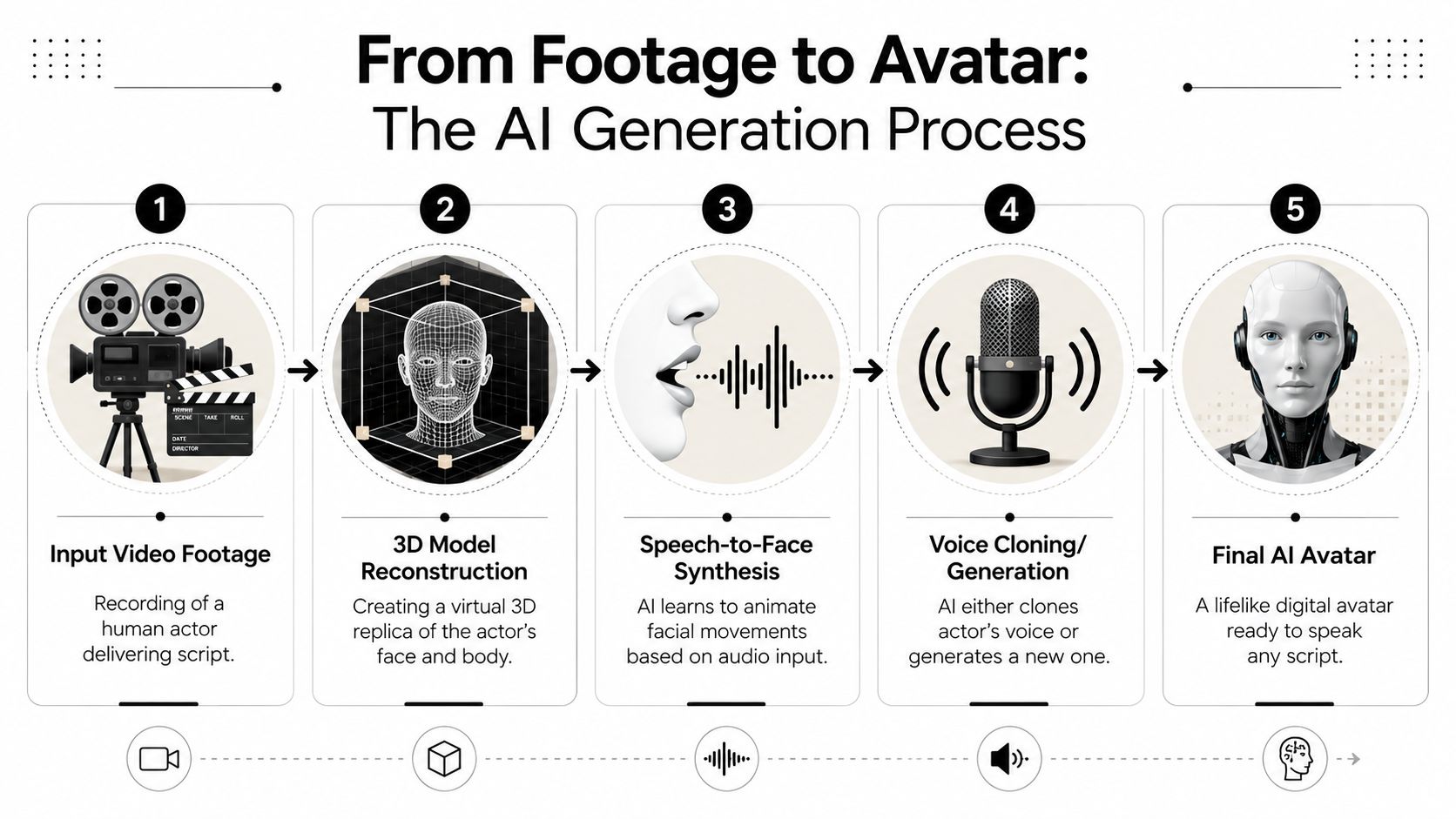
The process starts with source footage
High-fidelity AI talking heads typically use a two-stage pipeline. First, 15 to 30 minutes of clear video is analyzed to build a textured 3D model. Then machine learning maps mouth movements to synthesized speech, and neural rendering animates the avatar so expressions stay synchronized, as described in EDM Sauce's overview of AI talking head generators.
That first stage explains why setup quality matters so much. If the footage is poorly lit, compressed, or missing enough varied expression, the model has less useful material to work from. Teams often blame the platform when the actual issue started at capture.
Why some avatars feel off
Common problems usually come from one of four places:
- Weak source material: Low-resolution footage limits facial detail and expression modeling.
- Flat script delivery: Even a strong model can feel robotic if the script reads like on-page copy instead of spoken language.
- Voice mismatch: A polished face with an unnatural voice creates immediate friction.
- Aggressive expectations: Some concepts need live-action nuance that a generated presenter still can't fully reproduce.
A short product demo can help make the pipeline more tangible:
What this means for marketers
You don't need to become technical. You do need to ask better production questions. Was the source footage captured specifically for cloning? Was there enough variation in expression and head movement? Does the vendor let you review outputs against different script styles?
That evaluation mindset also shows up in adjacent AI categories. For a simpler example of how visual quality and use-case fit get compared in another market, this article on comparing AI dating solutions is useful because it focuses on practical output quality rather than hype.
If you're building AI-led video workflows inside a broader creative stack, this guide to AI-powered video creation covers the larger production context around these systems.
A Practical Workflow for Scaling Video Ads
Teams often misuse AI talking heads by treating them like one-off video generators. That's too narrow. Their real value appears when you plug them into a modular testing system.
The simplest useful model is still hook, body, CTA. Keep the persuasive middle of the ad stable. Swap the opening angle. Change the close. Turn one core concept into many testable combinations.
Start with the body, not the hook
Teams usually begin by brainstorming hooks. For modular testing, that's backwards. First lock the body section that explains the product, shows the mechanism, or carries the proof point. That middle segment is your control. It should be good enough to survive multiple intros.
Once that exists, use an AI talking head to generate alternate opens:
- Problem-aware opening for users who already feel the pain.
- Curiosity-led opening for colder traffic.
- Objection-handling opening when the product needs credibility upfront.
- Benefit-led opening when speed and clarity matter more than story.
The CTA can then branch again. One version asks for a trial. Another pushes app install. A third frames urgency around a launch window or offer.
Why this model fits modern UA
The lifelike quality of current AI talking head tools lets brands generate new B-roll, voiceovers, and captions at scale, turning existing footage into testing pipelines that can launch over 100 variations in clicks rather than hours, according to CourseClout's review of AI talking head technology. That's the part most relevant to Meta buying. The speed isn't just operational convenience. It changes how many meaningful combinations you can get live.
Practical rule: Don't generate random volume. Generate structured variation against a stable hypothesis.
That means every batch should answer a question. Which pain frame pulls stronger intent? Which opening earns more hold rate? Which CTA qualifies traffic better? Without that structure, modular production becomes clutter.
A workable weekly cadence
A practical workflow often looks like this:
- Monday: Pull learnings from live ads. Identify what failed in the first seconds versus what failed later in the pitch.
- Tuesday: Write a new batch of hooks around one specific angle cluster.
- Midweek: Generate AI presenter intros, plus fresh text overlays, voiceovers, or captions where needed.
- Thursday: Pair those hooks with one or two stable bodies and a limited set of CTAs.
- Friday: Launch and tag cleanly so performance can be read by component, not just by final ad ID.
This same modular logic applies outside ecommerce or apps. For example, anyone building local market video campaigns can borrow ideas from this guide to real estate content strategy, then adapt the angles into hook variations instead of treating every idea as a net-new production job.
What to avoid
Three mistakes show up repeatedly:
- Changing everything at once: If the hook, body, CTA, presenter, and visual structure all change together, you learn almost nothing.
- Using AI only for top-of-funnel novelty: The stronger use case is message iteration, not gimmick creative.
- Skipping creative taxonomy: If assets aren't tagged by angle, audience, and structure, the test volume becomes impossible to interpret.
The teams that scale this well don't just produce more ads. They produce cleaner learning loops.
Ethical Use and Best Practices
AI talking heads are useful. They also introduce risks that ad teams shouldn't treat casually.
The obvious misuse is deceptive cloning or fake endorsements. The less obvious problem is gradual trust erosion. If a brand uses synthetic presenters carelessly, audiences may not complain directly. They just stop believing the message.
The baseline rules are simple
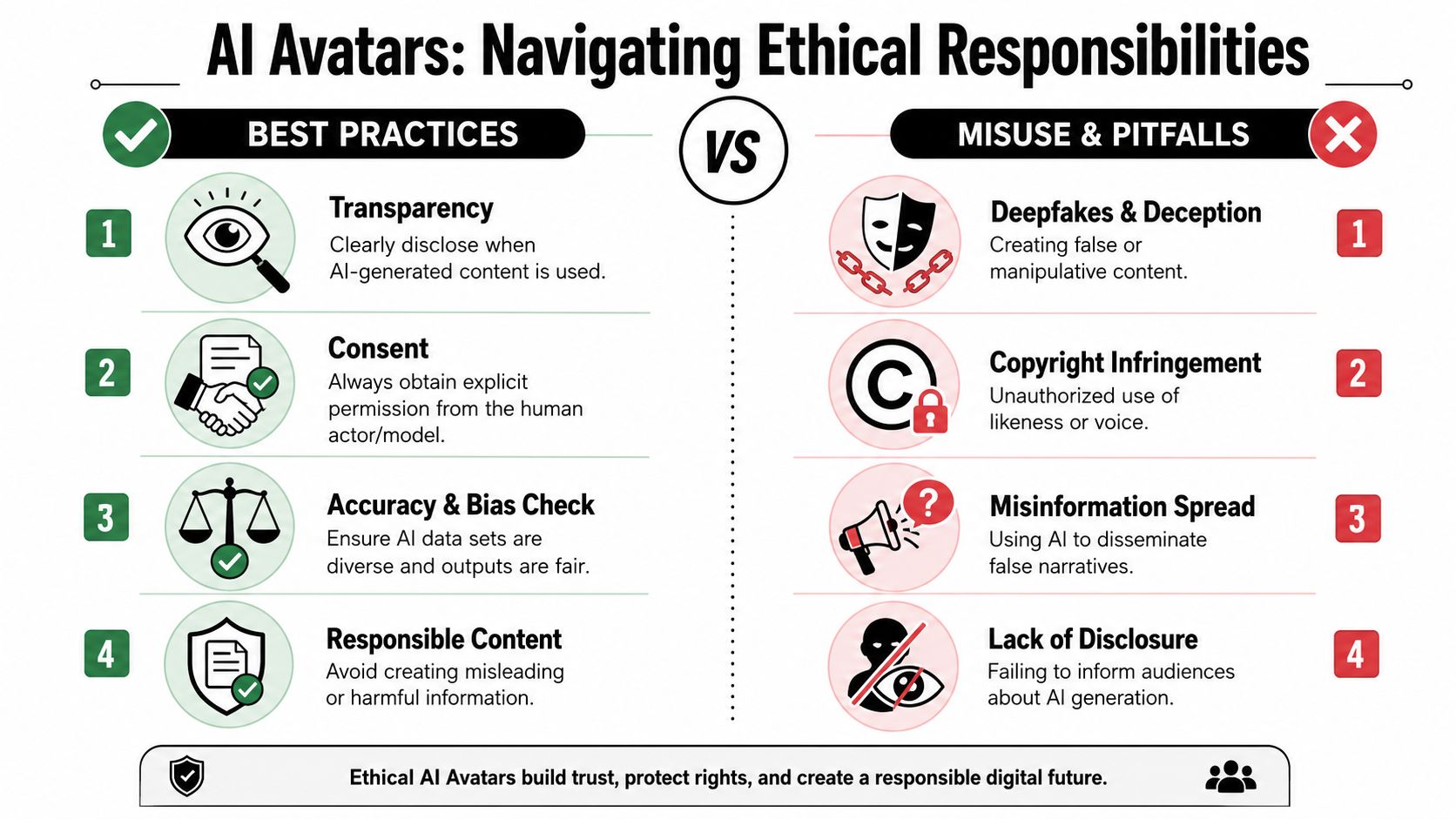
If you're cloning a real person, get explicit permission. If the video is AI-generated, disclose it in a clear but lightweight way. If the script makes sensitive claims, review it with the same scrutiny you'd apply to a live-action ad.
There is also a broader consumer-risk backdrop here. One mental health publication highlighted a severe underserved issue around dependency on AI interactions, including the suicide of 14-year-old Sewell Setzer III after a 10-month dependency on Character.AI chatbots, and described rising cases of paranoia, delusions, and social withdrawal in vulnerable groups in this discussion of AI and mental health impacts. That example sits outside paid social creative, but it reinforces the same point. Human-like AI systems can affect people more profoundly than product teams often assume.
Best practices that hold up in real campaigns
- Disclose responsibly: A small on-screen note or caption-level disclosure is usually enough to avoid misleading the audience.
- Use consent as a hard requirement: Treat likeness and voice rights like any other production release. No shortcuts.
- Keep scripts authentic: Don't use an AI presenter to over-polish weak messaging. If the claim feels evasive in copy, it will feel worse in synthetic video.
- Review for bias and mismatch: Make sure avatar choice, accent, and delivery fit the audience without leaning on stereotypes.
- Set red lines internally: Prohibit fake customer testimonials, executive impersonation, or any content designed to hide synthetic origin.
For marketers thinking through manipulation risk specifically, this overview of a deepfake video maker is useful because it frames the difference between legitimate creative tooling and deceptive use.
Ethical use isn't a legal footnote. It's part of performance. Once users feel tricked, your creative loses persuasive power.
The job is changing too
A lot of marketers still frame AI as a replacement question. That's too shallow. The more important shift is in the work itself. As noted by Sundas Khalid's analysis of agentic AI trends, creative strategists are increasingly managing asset banks, multivariate workflows, and AI-generated B-roll instead of only planning shoots and giving edit feedback.
That's already visible in performance teams. The skill set now includes prompt direction, modular asset planning, output QA, and learning extraction across larger test sets. The creative strategist who thrives won't be the person who resists these systems. It'll be the person who can direct them without lowering brand trust.
The Future of AI in Creative Production
AI talking head workflows aren't replacing creative strategy. They're exposing where strategy was never the bottleneck.
The teams that benefit most are the ones that already know how to write angles, structure tests, and read signal from noisy ad accounts. AI helps them execute more of those ideas without turning every new variation into a production event. That's why this technology fits performance marketing so well. It compresses the distance between insight and launch.
The same pattern is showing up across adjacent visual formats. In real estate, for example, newer presentation formats like Zillow Showcase AI tours reflect the same broader shift toward scalable, presentation-ready media that can be adapted faster than traditional manual workflows.
What's next isn't just better avatars. It's better creative operations. More reusable presenters. Cleaner asset libraries. Faster localization. Stronger tagging. Tighter feedback loops between strategy, production, and media buying.
Used well, AI talking head production gives marketers more shots on goal without forcing lower-quality thinking. That's the right way to frame it. Not as a gimmick, and not as a replacement for every camera-led shoot. It's a strategic tool for the parts of video production that should already be modular.
Sovran helps performance teams turn that modular approach into an actual workflow. If you need to produce and test high volumes of video creative for Meta without losing control of hooks, bodies, CTAs, and asset organization, take a look at Sovran.

Manson Chen
Founder, Sovran
Related Articles
8 Pattern Interrupt Techniques for Video Ads
Customer Journey Mapping for Performance Marketing