How to Reduce Production Costs: A Playbook for Video Ads

Jump to a section
Most advice about how to reduce production costs is aimed at factories. Negotiate suppliers. Trim material waste. Improve line efficiency. That logic works when your bottleneck is inventory, labor, or plant utilization.
It breaks fast in paid social.
For performance marketers, production cost isn't just what you spend to shoot an ad. It's what you spend to keep the account learning. It's the cost of creative fatigue, the cost of slow refresh cycles, the cost of manual reformatting, and the cost of producing one polished asset that never earns back what it took to make it. If your Meta program needs constant testing, then a cheap shoot can still be expensive if it produces only a handful of usable iterations.
The teams that lower cost in 2026 don't think like film producers first. They think like systems operators. They build workflows that turn existing footage into more testable creative, faster, with less manual handling and less dependence on another expensive hero shoot every time performance slips.
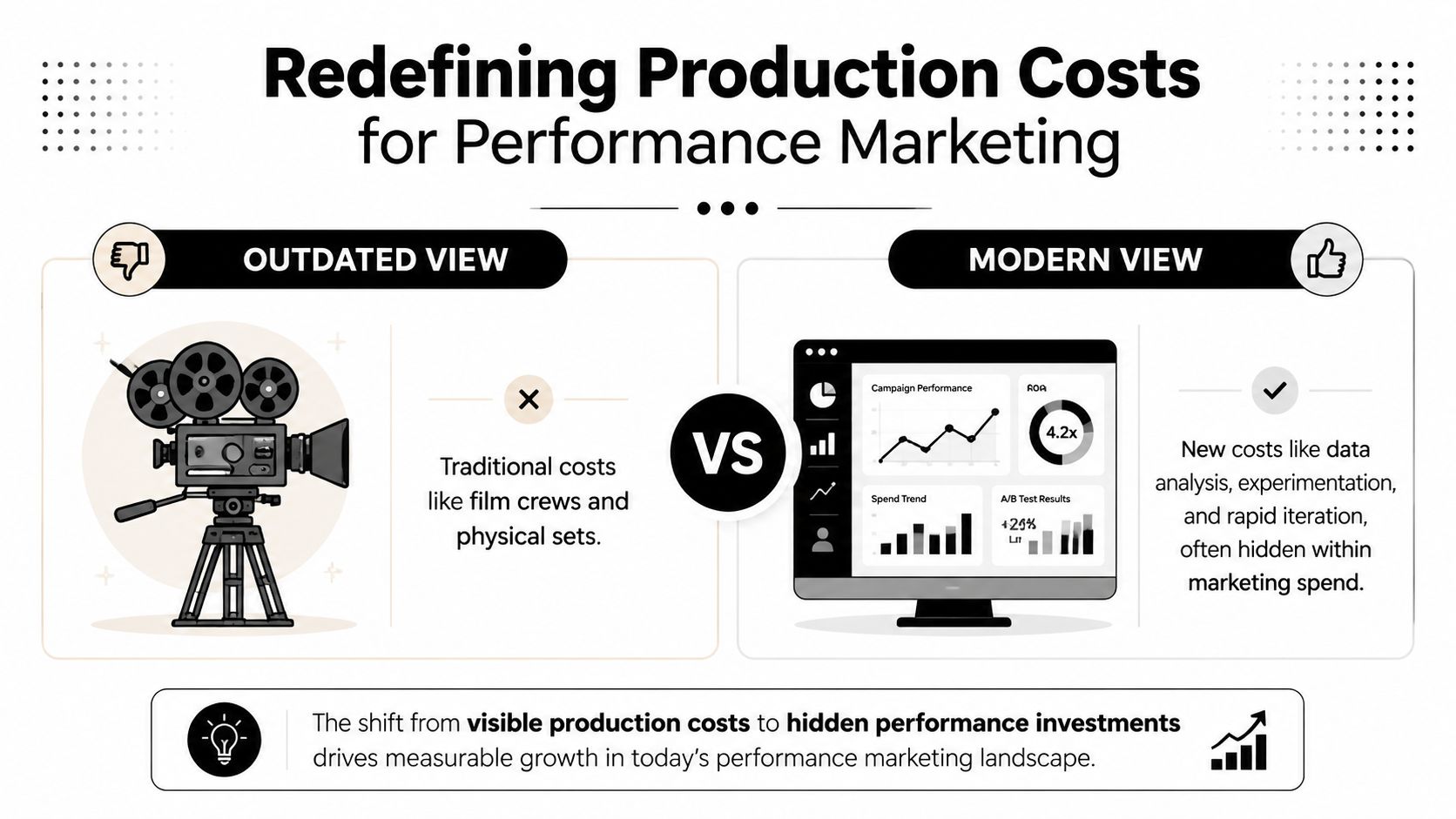
Redefining Production Costs for Performance Marketing
Cheap production is often the most expensive option in a Meta account.
A low-cost shoot that gives your team one edit, one angle, and no room to iterate does not reduce production cost. It shifts spend into other buckets. You pay for faster fatigue, slower testing, and more replacement work the moment performance softens. For app marketers, DTC teams, and agencies managing paid social at volume, production cost is really the cost of maintaining creative output that keeps the account learning.
The expensive part is often failure, not creation
I have seen brands spend heavily on a polished hero asset, then get almost no usable testing surface from it. The footage looks great. The media team still ends up stuck with one hook, one pacing structure, one offer framing, and one CTA treatment. If the ad misses, the whole system asks for another shoot instead of getting more value from what already exists.
That is the wrong unit of analysis.
Performance teams should look at production through three cost drivers that matter more in 2026 than day rates alone:
- Creative fatigue cost. The spend required to replace assets before performance decays.
- Asset failure cost. Budget and team hours tied to concepts that never become scalable ads.
- Workflow cost. Manual editing, resizing, versioning, approvals, and trafficking work that slows refresh cycles.
This reframing changes the question. The useful question is not how to shave a few points off a shoot budget. It is how to turn one source shoot, one UGC batch, or one testimonial session into enough viable variations to test angles, hooks, formats, and offers without rebuilding from zero every time.
The fastest way to waste budget is to fund new content before you have exhausted the usable combinations inside the footage already in your library.
That is why I would not start with cost per video. I would start with cost per usable variation, time to refresh, and the percentage of produced assets that make it into live testing. Those numbers show whether the team is buying output or buying optionality.
What to measure instead
A baseline still matters. A tool like this video production cost calculator for marketing teams helps quantify the visible spend. Then layer in the operating costs finance sheets often miss:
- Creative replacement cost. What it takes to refresh fatigued ad sets with new angles and formats.
- Asset failure cost. Time, edit labor, and media spend attached to concepts that never clear performance thresholds.
- Variation cost. The cost to turn one raw asset set into multiple launch-ready ads across placements.
- Workflow drag. Hours lost between approved footage and live delivery because the process still depends on manual handling.
Once you define production this way, cost reduction becomes a systems problem. The goal is more useful ads from the same inputs, faster refresh cycles, and fewer expensive resets caused by a weak creative pipeline.
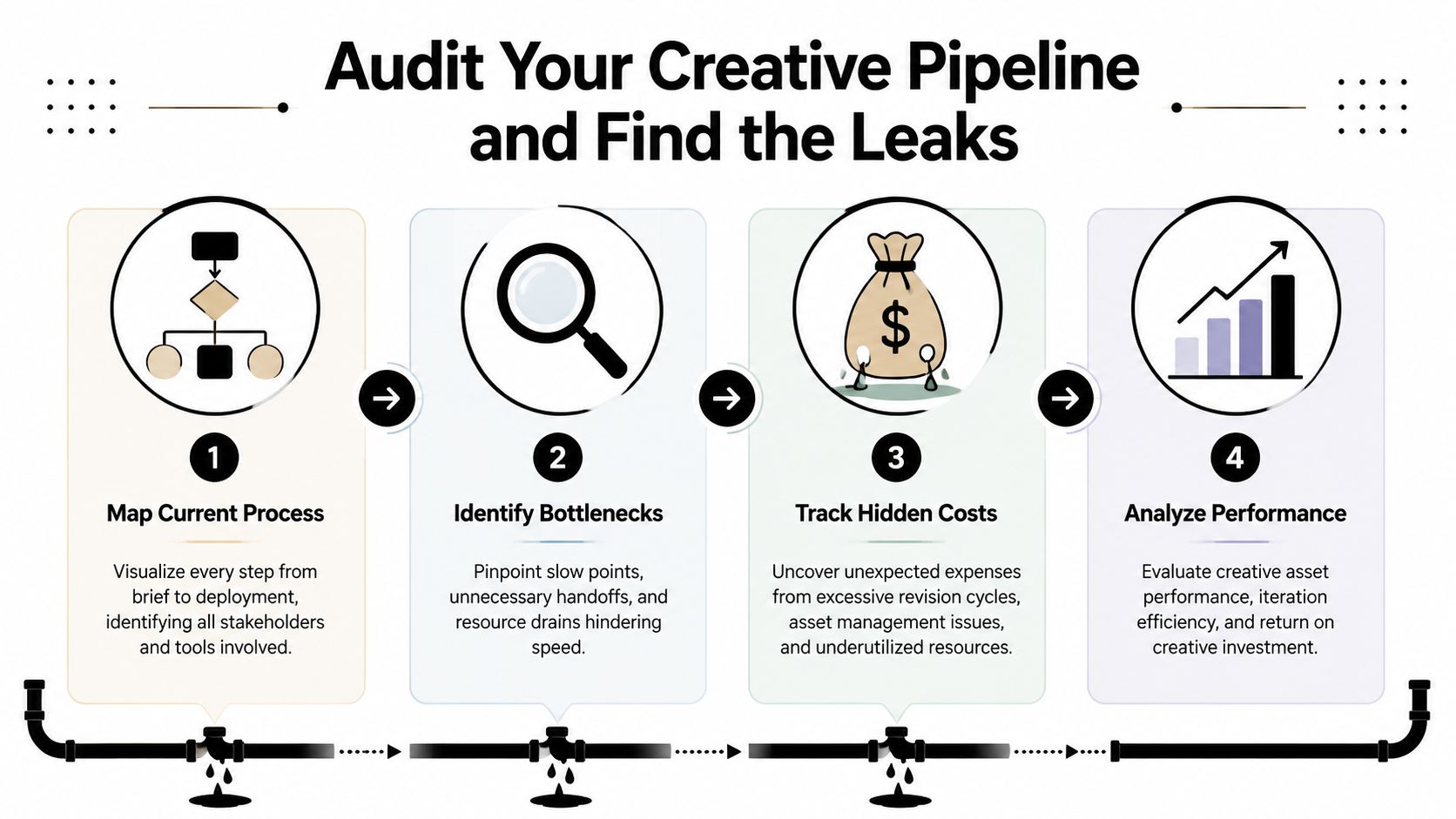
Audit Your Creative Pipeline and Find the Leaks
Production costs usually do not blow up on set. They blow up in the handoffs after the footage exists.
That is the shift many performance teams miss. They can quote a shoot day, an editor day rate, and a creator fee. They cannot tell you how many hours disappear into chasing files, rebuilding aspect ratios, relaying feedback across three tools, or hunting for the one testimonial clip that already worked six weeks ago.
For a Meta team, that hidden spend matters more than the shoot invoice. If creative refresh is slow, fatigue hits sooner. If versioning is manual, fewer angles make it into market. If assets are hard to find, teams reshoot problems they already paid to solve.
Map the actual workflow, not the ideal one
Pull one recent ad. Follow it from brief to launch.
Use timestamps if you can. Open the Slack thread, the Drive folder, the review tool, the edit project, and Ads Manager. You want the messy version of events, including late script changes, missing assets, duplicate exports, and the moment trafficking got blocked because nobody knew which cut was final.
Track every handoff:
- Brief intake. Who writes it, who approves it, and what changes after editing starts.
- Asset collection. Where UGC, product footage, creator files, prior winners, and brand elements live.
- Edit and version control. What gets cut in Premiere, CapCut, or Resolve, how files are named, and how revision requests come in.
- Resizing and adaptation. How the team turns one concept into 9:16, 4:5, 1:1, short cutdowns, captioned versions, and placement-safe variants.
- Approval and trafficking. Who signs off, who uploads, and where the queue stalls.
The goal is simple. Find the moments where paid social speed gets traded for admin work.
I pay close attention to phrases like “Which version are we using?” or “Can someone resend that export?” Those are not minor annoyances. They are symptoms of a system that burns labor on retrieval and clarification instead of testing new creative.
Separate value-adding work from maintenance work
Some production work improves performance. Recutting the first three seconds, tightening the proof sequence, or swapping a weak CTA can lift output.
Other work just keeps a messy machine running.
Look for these cost leaks:
- Manual tagging and logging. Editors or coordinators label clips by hand because footage is not searchable by transcript, scene, product claim, or creator.
- Repeat exports. The same ad gets transcoded several times for different placements because templates and output presets are inconsistent.
- Channel-by-channel rebuilds. Captions, text safe zones, and overlays are recreated for Meta, TikTok, YouTube Shorts, and display instead of generated from a shared base file.
- Feedback spread across tools. Comments sit in email, Slack, Frame.io, docs, and meetings, so editors waste time reconciling conflicting notes.
- Asset rediscovery. Team members scrub old footage from scratch because there is no index for hooks, testimonials, demos, or objections.
If someone repeats the same search, formatting, or labeling task every week, that task belongs in a template, an automation, or a better asset system.
Teams trying to tighten that layer usually need clearer ownership, fewer review surfaces, and a more disciplined file structure. A stronger video production project management process fixes more waste than another round of freelancer negotiations.
Audit strategy leaks too
Cheap production can still be expensive if the output fails in market.
Performance marketers need a different audit compared to brand teams. The question is not just “How efficiently did we make the asset?” It is “How many testable, distinct variations did this process produce before fatigue forced another reset?”
Ask:
- How many ads launched from one source shoot or creator batch?
- How many were meaningfully different in hook, proof, pacing, or offer?
- How many reused proven components instead of starting from zero?
- How long did it take to turn a winning comment, objection, or audience insight into a new live variation?
- What percentage of edited assets never made it into testing?
That last one matters. A high asset failure rate is a production cost, even if finance never labels it that way.
I have seen teams cut shoot spend and still lose efficiency because every concept stayed bespoke. They saved on inputs and destroyed throughput. The better model is a pipeline that can turn one raw session into many launch-ready tests with minimal friction. Nereo's content scaling guide is useful on that point, especially for teams trying to increase volume without adding matching operational drag.
Build a leak report people can act on
Do not end the audit with a vague summary. Write a one-page leak report with named problems, cost impact, and the first fix.
| Leak | What it looks like | Why it costs money | What to change first |
|---|---|---|---|
| Asset chaos | Clips sit across drives, folders, creator portals, and chat threads | Search time increases, duplicate edits happen, prior winners get missed | Centralize storage and enforce naming rules |
| Format friction | Each placement version is exported and checked manually | Editors spend time on resizing instead of creative iteration | Use master templates and standard output presets |
| Review loops | Feedback comes from multiple people in multiple tools | Revision cycles get longer and final approvals slip | Set one review tool and one decision-maker |
| Low variation yield | One shoot produces only a few usable tests | Creative refresh gets expensive and fatigue arrives faster | Plan shoots around modular components, not finished ads |
| Insight lag | Winning hooks or objections take days to turn into new ads | Media spend keeps running on stale concepts | Create a fast path from performance signal to new version |
Once these leaks are visible, cost reduction stops looking like “make cheaper ads.” It becomes a throughput problem. Fix the system, and you usually get lower labor waste, more test coverage, and longer life from the footage you already paid for.
Build a Modular System for Scalable Creative
Cutting production cost on Meta rarely starts on set. It starts with how many usable variations a team can get from the footage it already paid for.
That is the shift. Production cost for performance marketers is not just crew day rates, locations, or edit hours. It is the cost of creative that burns out fast, the cost of assets that never make it into testing, and the cost of rebuilding ads manually every time a hook drops in performance. Teams that still organize production around one polished deliverable usually end up paying more per winner.
Build creative from parts that can be recombined
A modular system treats an ad as a structured set of interchangeable components:
- Hooks for different awareness levels, pain points, and buying triggers
- Bodies for demo, proof, objection handling, founder story, or offer explanation
- CTAs matched to intent, from soft click drivers to direct purchase asks
That sounds basic. The operational discipline is not.
In practice, this means the team stops briefing “three new ads” and starts briefing a package of parts. One creator day might capture six hooks, three proof sections, two objections, and four CTA reads. One product demo can support prospecting, retargeting, and catalog creative if the surrounding components are swapped with intent. That is how you reduce the effective cost per test without starving the account of freshness.
I have seen the opposite many times. A brand spends heavily on a hero shoot, gets one beautiful 30-second cut, then asks editors to force variations out of footage that was never captured for recombination. Performance drops, fatigue hits early, and the team goes back into production sooner than planned.
What to capture during the shoot
A modular shoot plan needs coverage for assembly, not just a single narrative arc.
Capture these on purpose:
- Opening options. Pain-led hook, benefit-led hook, surprising statement, direct offer, social proof open
- Middle blocks. Product demo, testimonial, founder explanation, before-and-after framing, objection answer
- CTA variants. Shop now, learn more, limited-time prompt, trial offer, low-commitment next step
- Visual support. Product in hand, UI flow, lifestyle use, close-ups, reaction shots, packaging, environment
The key trade-off is creative elegance versus output range. A tightly scripted hero ad can look better in isolation. A modular shoot usually wins on total account value because it creates more testing surface and gives media buyers more chances to match message to audience.
Standardize the system before volume breaks it
Modularity only lowers cost if the parts are easy to find, understand, and reuse.
Set a structure for every asset:
- Name clips by function. Hook, proof, demo, objection, CTA
- Tag by audience and angle. New customer, retargeting, price-sensitive, problem-aware
- Store approved variations in one library with clear version control
- Use repeatable edit templates for ratio, captions, safe zones, and end cards
- Log winning combinations so the next round starts from evidence
Many teams find themselves stalled. They adopt the language of modular creative, but the footage still lives in random folders, feedback still happens in chat, and no one knows which hook-body-CTA combination won. The result is more content with the same old friction.
A practical modular video ad framework helps teams define the building blocks before they scale output. Nereo's content scaling guide is also useful for teams trying to design the operating model around higher content velocity.
Capture for optionality first. Polish matters, but recombination pays the bills.
Here's a live example of the mindset behind variation-based production:
The trade-off is straightforward. You give up some bespoke craft and get a system that produces more tests, faster refresh cycles, and lower cost per usable asset. For performance teams in 2026, that is usually the better deal.
Automate Your Workflow with AI and Smart Tooling
Cheap production is a trap if the workflow still burns hours between shoot and launch.
I've seen teams cut shoot budgets, then give the savings right back through manual versioning, scattered feedback, duplicate exports, and asset searches that take longer than the edit itself. For performance marketers, that is the actual production tax in 2026. The cost sits in delay, failed refreshes, and too many assets dying before they get a fair test.
A modular system only pays off when operations match the strategy. If editors are still resizing ratio by ratio, buyers are still requesting swaps in Slack, and footage still lives in folders no one trusts, the team has not built a production system. It has built a faster way to create chaos.
What smart tooling should do
The stack needs to remove repetitive work from the daily path to launch:
- Asset detection. Identify scenes, spoken words, products, and visual moments so footage is searchable.
- Version assembly. Recombine hooks, bodies, proof points, and CTAs without rebuilding a timeline each time.
- Format adaptation. Resize, caption, and place overlays for Meta, Stories, Reels, and other placements.
- Bulk output. Render batches of variants without an editor babysitting the queue.
- Delivery readiness. Keep naming, metadata, and exports clean enough for ad ops to traffic quickly.
The point is not convenience. The point is throughput with control. Manufacturing companies have used automation for years to strip out repetitive labor and free specialists for higher-value decisions. Creative teams can apply the same operating logic without pretending ad production works like a factory floor. The useful parallel is simple: automate repetition, keep judgment human.
Where AI cuts cost in ad production
The best savings come from dull tasks no one wants to defend.
Auto-tagging turns a footage archive into a working asset bank. Editors can search for "testimonial with pricing objection" or "founder close-up in kitchen" instead of scrubbing timelines. Transcript-based search speeds up hook mining. Bulk captioning removes hours of hand-keying. Template-driven assembly makes it practical to swap intros, proof blocks, and end cards across dozens of variants. Synthetic voiceover, simple motion graphics, or AI-generated supporting B-roll can extend an asset when the brief does not justify a reshoot.
That changes the economics of testing. A team no longer needs every new hypothesis to trigger a new production cycle. It can start with existing footage, generate variations faster, and reserve fresh shoots for angles that have already shown signal.
Some teams handle this with a patchwork of tools. Others consolidate around a platform built for creative operations. Sovran's system for scaling ad creative production is one example. It organizes footage into an asset bank, supports multivariate assembly, generates supporting elements, and fits Meta-oriented delivery workflows. That is an operating choice. Fewer handoffs usually mean lower cost per usable asset.
Good automation protects creative judgment by removing the repetitive work around it.
What fails in practice
Three mistakes show up constantly:
| Mistake | Why teams make it | Why it fails |
|---|---|---|
| Buying point tools only | Each task gets a separate fix | The team still spends time stitching tools together by hand |
| Automating before standardizing | Speed feels more urgent than process discipline | Bad naming, loose templates, and unclear approvals scale the mess |
| Using AI without review rules | Early outputs look fast and cheap | Quality drifts, brand risk rises, and approvals get slower |
The right question is not whether AI can make content. Ask whether your stack removes search time, versioning labor, formatting work, and handoff friction from the weekly production cycle. That is where cost comes down without choking performance.
The In-House vs Outsourcing Decision Framework
Once the system is clear, the staffing question gets easier. Organizations often don't need a philosophical answer on in-house versus agency. They need a practical one based on volume, speed, and control.
The wrong decision usually comes from evaluating production only on headline cost. A cheaper vendor can become expensive if they can't turn around variations quickly. A full in-house team can become bloated if your testing cadence doesn't justify the fixed load.
Production Model Decision Framework
| Factor | Fully In-House | Hybrid Model | Fully Outsourced (Agency) |
|---|---|---|---|
| Creative volume | Best when output is constant and frequent | Strong when volume fluctuates | Better for periodic campaigns or launches |
| Iteration speed | Fastest when strategist, editor, and buyer sit close together | Fast if ownership is clear | Often slower because requests move through account layers |
| Brand control | Highest control over message and nuance | Shared control with internal oversight | Depends heavily on brief quality and agency immersion |
| Specialized craft | Limited to your team's range | Flexible because specialists can be added as needed | Strong if the agency has deep vertical experience |
| Cost structure | Higher fixed overhead, lower marginal cost per additional variation | Balanced fixed and variable cost | Lower fixed commitment, but per-request costs can climb |
| Workflow ownership | Internal team owns process changes | Shared process can work if documented well | Process is often externalized and less transparent |
| Best fit | Brands with ongoing testing demands | Teams in transition or multi-brand setups | Companies with low internal bandwidth |
When in-house is the right call
If your account depends on continuous refresh, in-house usually wins on speed. The strongest version is often small: one creative strategist, one editor or motion designer, one media buyer, and a system that lets them produce iterations without waiting on a separate vendor queue.
That's especially true for app growth, DTC, and gaming teams where ad fatigue shows up quickly and learning cycles matter more than cinematic polish.
When hybrid is stronger than either extreme
Hybrid is underrated. It works well when the internal team owns strategy, testing priorities, and asset taxonomy, while external partners handle source footage capture, overflow editing, or specialty formats.
This model avoids a common trap. You don't outsource your learning loop, but you also don't force your internal team to do everything. For brands trying to decide how agencies fit into a modern workflow, this video ads agency perspective is a useful reference point.
Outsource execution layers if you want. Don't outsource the logic that tells you what to make next.
When full outsourcing still makes sense
Agency-led production can work if your needs are campaign-based, your internal team is thin, or your category demands specialized creative direction. It also works when the agency has already adopted modular production rather than charging as if every variation were a net-new edit.
The key trade-off is responsiveness. If you need daily or near-daily creative iteration, full outsourcing often struggles unless the process is tightly integrated with your media team.
Your Implementation Roadmap and Success Metrics
You don't need a full reorg to start. You need one disciplined quarter.
Organizations can move from ad-by-ad production to a modular system in 90 days if they treat it like an operating change rather than a creative brainstorm.
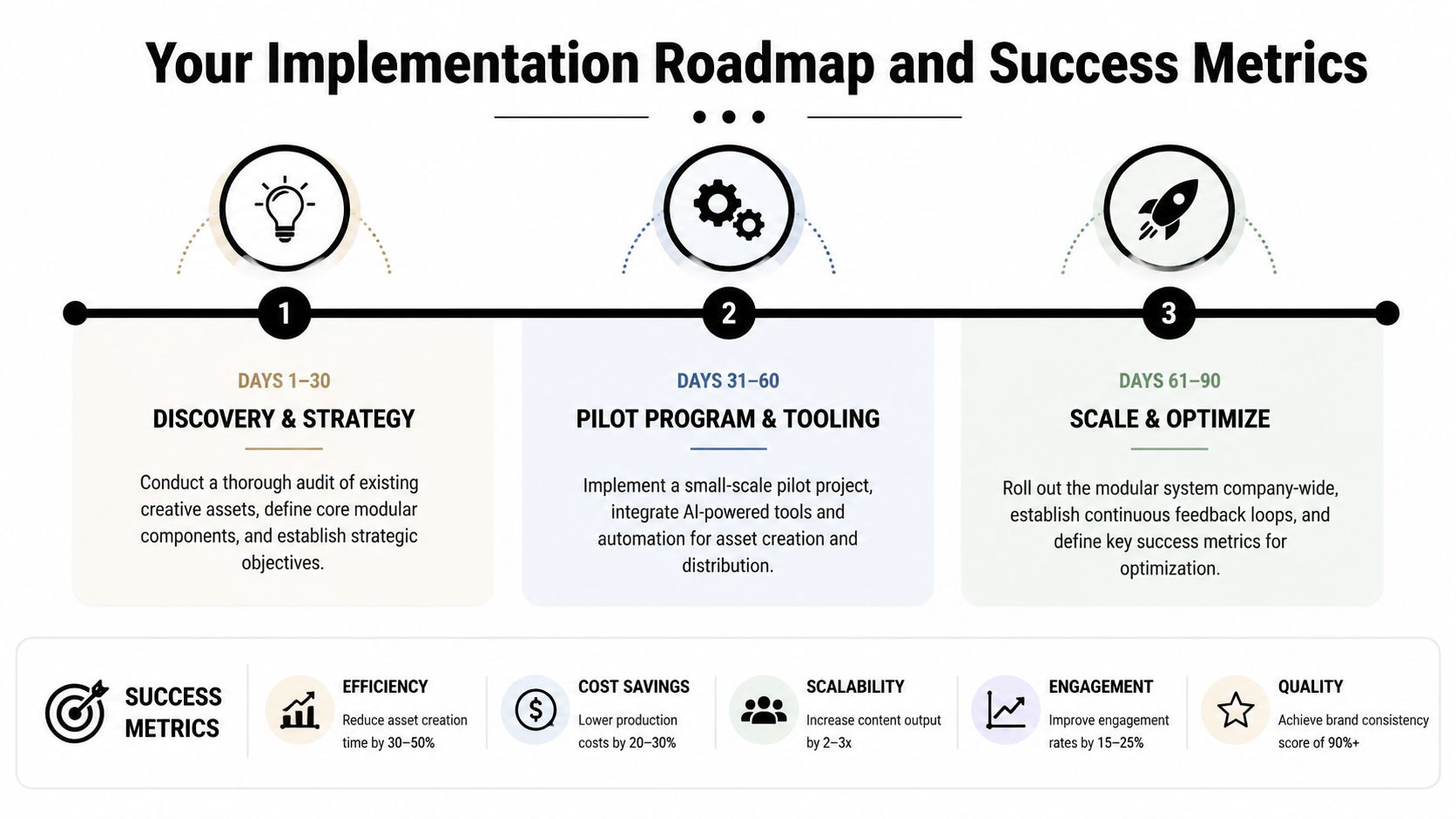
Days 1 to 30
Start with an audit and a tool decision.
Review recent winners, losers, and stalled assets. Identify what footage is reusable. Define your modular taxonomy. Decide how hooks, bodies, CTAs, testimonials, demos, and offers will be tagged. Then choose the production environment where that system will live.
Use a short checklist:
- Map one live workflow from brief to launch
- List all current asset sources across drives, folders, and vendor handoffs
- Name the top recurring manual tasks
- Set approval rules so versioning doesn't spiral
- Pick one pilot campaign with enough volume to test the new model
Days 31 to 60
Run a pilot with existing footage.
Don't wait for the perfect reshoot. Build your first modular library from footage you already own. Pull apart top performers into openings, proof sections, and closes. Then create structured variations with intentional differences, not cosmetic edits.
Track a few operational metrics weekly:
- Time to first winning creative
- Cost per variation
- Creative refresh rate
- Percentage of output built from existing assets
- Approval turnaround time
Days 61 to 90
Scale what worked and tighten the weak spots.
By this point, the biggest gaps will be obvious. Maybe the asset bank is strong but approval is slow. Maybe the team can generate lots of versions but still lacks a consistent naming system. Fix the bottleneck that blocks launch velocity, not the one that's easiest to discuss.
A good final review asks:
| Question | Healthy signal |
|---|---|
| Are variations easy to assemble? | Editors and strategists can build new combinations quickly |
| Can the team find footage fast? | Search replaces timeline scrubbing and folder hunting |
| Is refresh proactive? | New creative goes live before fatigue forces a scramble |
| Is production tied to learning? | New variants are based on prior performance, not taste alone |
If your process still requires a new shoot every time performance softens, you haven't reduced production cost. You've just delayed it.
If your team needs a system for turning existing footage into modular test assets, Sovran is built for that workflow. It helps marketers organize footage into a searchable asset bank, recombine hooks, bodies, and CTAs into many variations, and move those outputs into Meta-focused testing pipelines with less manual production overhead.

Manson Chen
Founder, Sovran
Related Articles

8 Pattern Interrupt Techniques for Video Ads
- pattern interrupt techniques
- video ad hooks
- 3 more

Customer Journey Mapping for Performance Marketing
- customer journey mapping
- performance marketing
- 3 more
Production Schedule Optimization for Scalable Ad Testing
- production schedule optimization
- creative testing
- 3 more