Choosing a Video Ads Agency That Scales Your Campaigns
Unlock scalable growth with the right video ads agency. Learn how to choose a partner, measure ROI, and create campaigns that deliver real performance.
Jump to a section
A video ads agency is basically a specialized team you bring in to handle everything video-related, from brainstorming creative ideas to buying the ads and tweaking them for better performance. Think of them as strategic partners who take your business goals and turn them into high-performing ads on platforms like TikTok and Meta, helping you scale up and fight off the dreaded creative fatigue.
What Does a Video Ads Agency Actually Do?
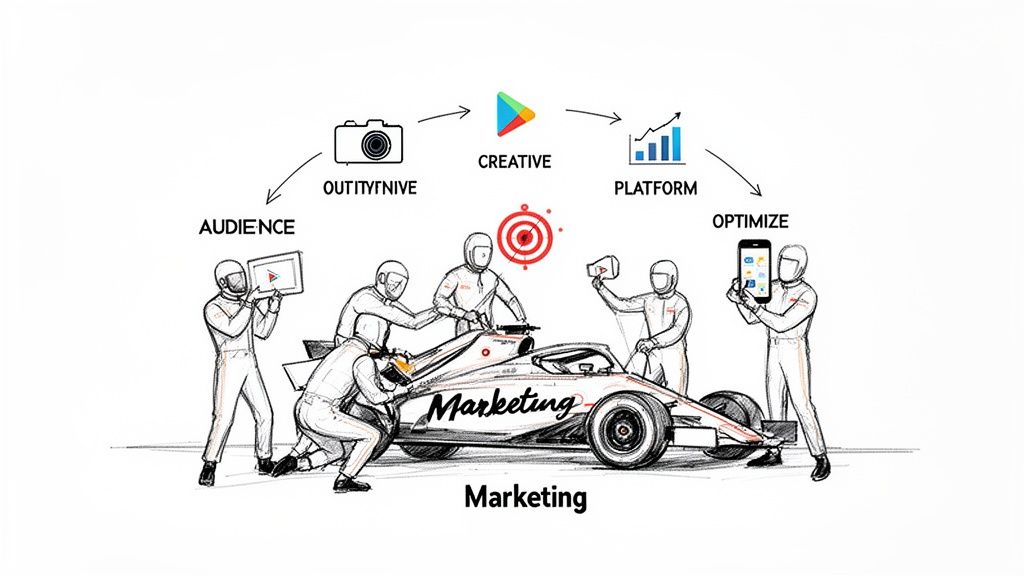
Imagine your marketing efforts are a Formula 1 race. Your in-house team sets the overall strategy—they know the track, the target lap times, and the end goal. A top-tier video ads agency is your specialist pit crew. They're the ones handling the high-performance tuning, making lightning-fast adjustments during the race, and managing the complex mechanics of creative and platform execution needed to cross the finish line first.
This relationship goes way beyond just getting a few cool videos made. It’s about building a sustainable system for growth in a world where attention is scattered and the rules of the ad game change every other week.
Core Functions That Drive Results
A true performance agency doesn't just work on one piece of the puzzle. They integrate several key jobs into a single, smooth workflow. Each step feeds into the next, creating a powerful feedback loop that keeps improving your campaigns and, ultimately, your return on ad spend (ROAS).
These core functions almost always include:
Audience Intelligence and Research: They go deep, digging into your target market's data, online behavior, and what makes them tick. This is where they find the raw insights that become killer creative angles.
Creative Strategy and Concepting: The agency then takes those audience insights and turns them into actual video ideas and stories designed to get a specific action—a click, a purchase, a sign-up—not just a vague sense of "brand awareness."
High-Velocity Production: They run the entire production show. Scripting, storyboarding, shooting, editing, you name it. A key part of this is cranking out multiple variations of an ad so you have plenty of ammo for testing.
Platform-Specific Media Buying: This isn’t just about hitting the "boost" button. These experts are in the trenches of the ad auctions on Meta, TikTok, and YouTube, fine-tuning bids and budgets on the fly.
Rigorous Performance Analysis: Once the ads are live, they're glued to the data. They track key metrics like Cost Per Acquisition (CPA) and Click-Through Rate (CTR) to spot the winners, kill the losers, and pour gas on what's working.
A Strategic Necessity for Growth
We live in an era of creative fatigue. An ad that's crushing it today could see its performance tank in just a few weeks. The only way to survive is to be able to test and iterate fast. An experienced video ads agency brings the process, the people, and the tech to keep up that pace. Their laser focus means they’re always on top of algorithm updates and the latest creative trends.
A great agency doesn't just deliver ads; they deliver learnings. Their real value is in building a repeatable process for discovering what your audience loves and turning that knowledge into scalable performance.
For most businesses trying to ramp up user acquisition, partnering with a specialist isn't a luxury anymore. It's a strategic must-have to even stay in the game. While agencies provide this expert-led service, many are now using AI-powered tools to make their own workflows even faster. You can learn more about how agencies can scale creative operations with modern platforms. This mix of human strategy and automated execution is setting a new bar for performance marketing, making it an exciting time for any brand looking to grow.
What You're Really Paying for with a Performance Agency
So, what exactly do you get when you bring a top-tier video ads agency on board? It's a whole lot more than just a couple of slick-looking videos. A true performance agency offers a connected system of services designed to be a complete growth machine, turning your ad spend into real, measurable results like a lower CPA and a higher ROAS.
Think of it as a cycle. The insights from one stage feed directly into the next, creating a loop of constant improvement. It’s a methodical way of cracking the code on what actually makes your audience click and convert.
Below is a quick breakdown of what these core services look like and how they directly impact your bottom line.
Core Services of a High-Impact Video Ads Agency
Service Component | Description | Impact on Performance |
|---|---|---|
Audience & Persona Mapping | Deep-dive research into your ideal customers, going beyond demographics to understand their motivations, pain points, and online habits. | Prevents wasted ad spend by ensuring every video is aimed at the right people with the right message, right from the start. |
Conversion-Focused Creative | Developing storyboards, scripts, and producing assets (live-action, animation, UGC) engineered specifically to drive an action, not just to look pretty. | Creates ads that don't just get views, but actively persuade viewers to click, download, or buy, directly improving ROAS. |
High-Velocity Post-Production | Taking raw footage and transforming it into dozens of testable ad variations by changing hooks, CTAs, music, and on-screen text. | Allows for rapid A/B testing to quickly find the "winning" ad formulas and kill underperformers before they burn through your budget. |
Iterative Testing & Optimization | Systematically launching ad variations, analyzing performance data, and using the insights to create even better "champion" ads. | Fights creative fatigue and keeps campaigns scaling profitably by constantly feeding the ad platforms fresh, high-performing content. |
This table gives you the 30,000-foot view, but let's get into the nitty-gritty of how each of these pieces works in the real world.
Granular Audience and Persona Mapping
Everything starts with knowing exactly who you're talking to. Before a single frame is shot, a good performance agency goes deep on audience research. They aren’t just looking at age and location; they’re building out detailed user personas based on what makes people tick—their problems, their habits, and their online behavior.
This isn't guesswork. It's a process that involves:
Data Analysis: They’ll dig through your own first-party data (like purchase history) and platform analytics to find the common threads among your best customers.
Competitor Research: They’ll reverse-engineer what’s working for your competitors, see who they’re targeting, and find the gaps you can swoop in and own.
Persona Development: This is where they create profiles of your ideal users. For a mobile game, this isn't just "women 25-40." It's "Casual Commuter Chloe," who plays puzzle games for 15 minutes on the train, versus "Competitive Colin," who streams for hours on the weekend.
This level of detail ensures every creative choice is backed by data. The goal is to pinpoint the exact emotional triggers and value props that will hit home with each audience segment.
Conversion-Focused Creative Development
With a crystal-clear picture of the audience, the agency then moves into creative strategy. This isn't about making a video that might win a fancy award; it’s about engineering an ad that gets someone to do something.
This is where the storyboarding, scripting, and production happen, whether it's a full-scale live-action shoot or slick animations. A huge piece of this puzzle is audio. A high-quality voiceover is one of those things that can instantly boost brand credibility and make sure your message lands. In fact, there are many benefits of using a professional voice over service that have a direct impact on how much a viewer trusts your ad.
The best video ads aren't just seen; they're felt. An effective agency knows how to combine narrative, visuals, and sound to create a compelling story that guides the viewer from passive observer to active customer.
This conversion-first mindset also dictates the style of production. We live in a mobile world. Mobile is set to account for the lion's share of the video ad market at $55.87 billion in 2025, and over 75% of all video views are already happening on a phone.
This means your agency has to think mobile-first: strong visual hooks in the first three seconds, clear text overlays, and vertical formats that feel native to the feed.
High-Velocity Post-Production and Testing
Once the raw footage or assets are in hand, the real performance work kicks into high gear. A single video concept is never launched as just one ad. A smart video ads agency will turn it into dozens of variations to test against each other.
This is a systematic A/B testing process that breaks down like this:
Variable Isolation: They create different versions by changing just one key element at a time—the hook, the call-to-action (CTA), the background music, or the headline.
Platform Versioning: Ads are then re-edited and reformatted for the specifics of each platform. You can't just run a 16:9 YouTube ad on TikTok and expect it to work. They’ll create 9:16 versions for TikTok and Reels, 4:5 for the Meta feed, and so on.
Creative Iteration: They watch the data from the initial tests like a hawk, identify the winning elements, and then combine them to create new, even stronger "champion" ads.
This rapid, iterative loop is the heartbeat of a performance-driven strategy. It lets the agency quickly kill what’s not working, pour fuel on what is, and constantly feed the ad platforms fresh creative to prevent ad fatigue and keep your campaigns scaling.
Agency vs In-House vs AI Platforms
For any performance marketer, deciding how to produce video ads is a massive fork in the road. Do you build your own crew, hire outside guns, or lean into automation? This choice between going in-house, hiring a video ads agency, or using an AI platform will shape everything—your workflow, your budget, and how fast you can actually scale.
There’s no magic bullet here. Each path has its own set of trade-offs, and the "best" answer really just comes down to what fits your specific team, budget, and goals right now.
The Case for a Video Ads Agency
Bringing on an agency is like hitting the fast-forward button. You instantly get a team of seasoned specialists who live and breathe this stuff. You’re tapping into high-level strategic thinking, years of hard-won experience, and a crew that knows the ins and outs of every platform algorithm.
This route is perfect for teams that need to offload the heavy lifting and want proven expertise without the headache and overhead of building an entire department from the ground up.
An agency really shines when it comes to:
Strategic Guidance: They bring that crucial outside perspective, helping you see the forest for the trees and sidestep the common mistakes everyone else makes.
Expert Execution: From the first storyboard sketch to the final media buy, they have dedicated pros for every single step.
Access to Tools and Talent: They show up with a full arsenal of professional-grade software, production gear, and a deep network of creators.
If what you need is a deep strategic partner to handle the day-to-day campaign grind, an agency is a powerful choice.
The Benefits of an In-House Team
Building your own creative team in-house gives you something no agency ever can: total brand immersion and lightning-fast agility. Your internal team is your brand. They get the voice, the product, and the audience on an instinctual level.
This closeness means communication is seamless and you can pivot on a dime, without the formal back-and-forth you'd have with an external partner.
The key advantages are clear:
Brand Consistency: With a team dedicated solely to you, every single ad feels authentic and perfectly on-message.
Rapid Iteration: Feedback loops are ridiculously short. You can walk over to someone's desk (or hop on a quick Slack call) and get changes made almost instantly.
Knowledge Retention: Every lesson learned and every creative insight stays inside the company, building a powerful asset over time.
You can dig deeper into the pros and cons of in-house vs. agency vs. hybrid models. The in-house path is often the go-to for more mature companies that have the resources to invest in top talent and are playing the long game.
This decision tree helps visualize that core choice based on what you need most right now.
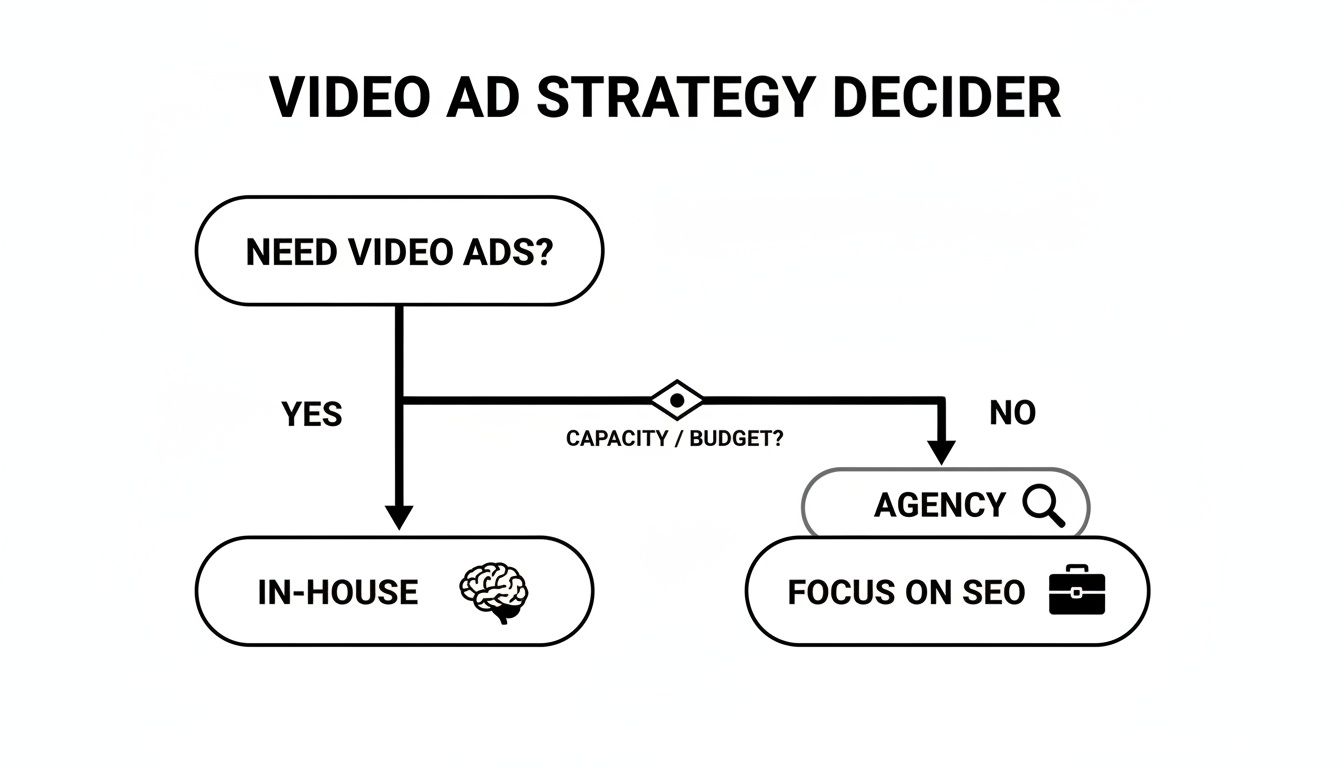
As the flowchart shows, it really boils down to whether you have the creative muscle in-house or need to bring in experts from the outside.
The Rise of AI Creative Platforms
A new player has entered the game, one that directly tackles the biggest pain points of the other two models: AI creative platforms. Tools like Sovran were built for a single, focused purpose—to give performance teams the power to create, test, and scale video ads at a speed that was once unimaginable.
AI platforms don’t replace strategy; they accelerate it. They automate the tedious, time-sucking manual parts of video production, freeing up marketers to do what they do best: analyze performance and come up with brilliant creative ideas.
This model is a godsend for performance-driven teams who are constantly battling creative fatigue and need to test a ton of new concepts to find the next big winner. It offers unmatched speed, volume, and cost-efficiency for creative iteration.
The market is screaming for this. With U.S. digital video ad spend hitting $64 billion in 2024 and the global market projected to hit a mind-boggling $417.9 billion by 2030, the demand for fresh video content is exploding. AI tools are a force multiplier, letting a small team produce the output of a massive one.
If your biggest bottleneck is simply the sheer volume of ads you need for rigorous A/B testing, an AI creative automation platform can completely change the game. By automating tasks like generating variations, adding subtitles, and rendering videos, you can massively scale your learning cycles and boost your ROAS.
Decision Matrix for Video Ad Creation
So, how do you choose? This table breaks down the key factors to help you find the right fit for your team.
Factor | Video Ads Agency | In-House Team | AI Platform |
|---|---|---|---|
Speed | Moderate | Slow to Fast | Extremely Fast |
Cost | High | High (upfront) | Low (subscription) |
Strategic Depth | High | High (over time) | Low to Moderate |
Scalability | Moderate | Limited by headcount | Extremely High |
Ultimately, the choice hinges on your priorities. If you need deep strategic partnership, an agency is your best bet. If you have the resources and a long-term vision for brand control, building an in-house team is a powerful move. But if your goal is raw speed, volume, and cost-effective testing, an AI platform is built for you.
How to Choose the Right Agency Partner
Picking a video ads agency is one of the most important marketing decisions you’ll make. The right partner can feel like a true extension of your growth team. The wrong one can burn through your budget with little to show for it. To find a winner, you need to dig deeper than a slick portfolio and an impressive client list.
You're not just hiring a production house; you're hiring a team of growth-focused marketers who use video as their weapon of choice. This means their entire process—from the first brainstorm to the final report—has to be laser-focused on hitting your core business objectives, not just creating flashy reels.
Beyond the Portfolio: Questions to Ask
A good portfolio shows you what an agency has done. Your job is to find out what they can do for you. This means asking specific, process-oriented questions that pull back the curtain on how they think, operate, and measure success.
Here are the key areas to probe during your vetting process:
Creative Testing Methodology: How do they systematically test creative variables? Ask them to walk you through a real example of how they isolated a winning hook or call-to-action for a past client.
Platform-Specific Strategy: What's their approach to creating for Meta versus TikTok? A top agency will have a distinct strategy for each, knowing full well that what crushes it on one platform often face-plants on the other.
Learning and Iteration Loop: How do they use performance data from one campaign to inform the creative strategy for the next? A great partner will show you a clear process for turning numbers into actionable ideas.
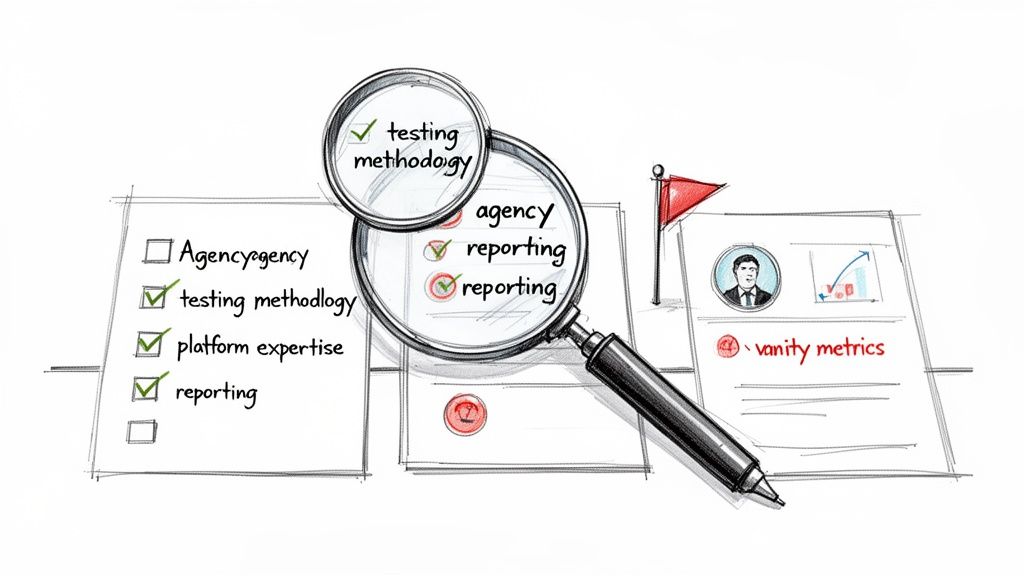
Reporting and Communication: What does their standard performance report look like? Ask for a sample. You want to see if they focus on business metrics like ROAS and CPA or get distracted by vanity metrics like views and likes.
These questions shift the conversation from past results to future process, which is a much better indicator of a successful partnership. A confident agency will welcome this level of scrutiny.
Scrutinizing Their Creative Process
Drilling down into their creative workflow is absolutely essential. You want a partner who thinks like a direct-response marketer, not a brand advertiser. Their goal should be to build a scalable system for finding winning ads, not just to produce a single "hero" video.
Ask them directly: "Walk me through your entire process, from a new client brief to a fully scaled campaign."
Listen for these key stages in their answer:
Audience and Competitor Research: They should start by digging into your audience data and analyzing what's already working (and not working) in your market.
Hypothesis-Driven Concepting: Concepts should be built on specific hypotheses. For example, "We believe a problem-focused hook will outperform a benefit-focused hook for this audience, and here's why."
High-Volume Variation Production: A modern agency should be built for speed and volume, capable of turning one core concept into dozens of testable variations.
Structured Campaign Launches: They need a clear methodology for launching tests, managing budgets, and identifying statistically significant winners without burning cash.
Insight-Driven Iteration: Finally, they must have a system for taking those winning elements and rolling them into the next round of creative, creating a continuous improvement cycle.
A focus on vanity metrics is the biggest red flag. If an agency leads with impressions, views, or engagement rate, they are not a performance partner. True growth partners talk about CPA, ROAS, and customer lifetime value.
Red Flags to Watch Out For
Just as important as knowing what to look for is knowing what to avoid. A few warning signs can save you from a costly mistake. Be cautious if a potential video ads agency shows any of these behaviors:
A "One-Size-Fits-All" Approach: They pitch you the same strategy they seem to use for everyone else. Your business isn't a template, and their strategy shouldn't be either.
Vague Reporting Promises: They can't show you a sample report or are fuzzy about which metrics they prioritize.
Focus on Awards Over Results: Their pitch is full of creative awards but light on case studies with hard business numbers. Awards don't pay the bills.
Lack of Direct Platform Experience: The people you talk to seem to have a superficial understanding of the ad platforms themselves. You want practitioners, not just theorists.
Ultimately, choosing the right agency is about finding a team whose process and mindset align with your growth goals. You need a partner who is just as obsessed with your numbers as you are.
Cracking the Code on Agency Pricing Models
For any performance marketer, getting your head around how a video ads agency structures its fees is ground zero for building a healthy partnership. Those numbers on a proposal aren't just pulled out of thin air; they’re a window into the agency's business model, how much risk they're willing to take on, and the value they think they can bring to the table. Nailing this down from the get-go saves a world of headaches later and makes sure everyone’s on the same page about what success looks like—and how the bills get paid.
You'll usually run into a few common ways agencies charge. Each has its own logic and is better suited for different situations, whether you're a scrappy startup needing flexibility or a big brand that needs costs locked in tight.
The Monthly Retainer Model
This is the old faithful of agency pricing. You pay a fixed fee every month for a specific scope of work. It’s predictable for both you and the agency, which makes budgeting a breeze.
Think of it like putting a specialist on your team without the HR paperwork. That retainer is reserving a slice of the agency's brainpower—strategists, creators, media buyers—for your account each month.
Typically, a retainer gets you:
Dedicated Team Time: You've got your crew, ready to jump on your campaigns.
Defined Deliverables: The scope might be something like, "four new video concepts and 12 ad variations per month, plus campaign management."
Strategic Counsel: You're not just buying videos; you're buying access to experts for regular meetings, reports, and advice.
This model is perfect for businesses looking for a long-term, steady partner to handle consistent creative output and campaign oversight. The big catch? You have to be crystal clear on the scope of work. Otherwise, you risk paying for time and resources you're not even using.
The Project-Based Fee Model
Got a one-off mission? A project-based fee might be your best bet. This model is built around a single, well-defined project with a clear start and finish line. Maybe you need a batch of 10 new video ads for a huge product launch next quarter. Perfect.
You pay one flat fee for the whole shebang. This is a great way to go for:
Testing an Agency: It’s like a first date. You can see how an agency works and if you vibe with them before committing to a long-term retainer.
Specific Campaigns: Ideal for seasonal pushes, breaking into a new market, or launching a feature where you just need a big burst of creative assets.
Budget Control: The cost is locked in upfront. No nasty surprises at the end of the month.
The only real downside is that it’s purely transactional. Once they hand over the videos, the job is done. There’s no ongoing optimization or strategic input built into the deal.
The Performance-Based Partnership
This is where things get interesting. A performance-based model ties a chunk of the agency's pay directly to the results they get for you. It’s often a hybrid approach, and it creates some powerful alignment—the video ads agency only makes more money when you do.
A performance model flips the script, turning your agency from a simple vendor into a true partner. When their fee is tied to your ROAS or CPA, their goals are your goals. Simple as that.
This usually takes one of a few forms:
Percentage of Ad Spend: The agency takes a cut (say, 10-20%) of the total media budget they're managing.
Revenue Share: A more aggressive model where the agency earns a percentage of the revenue that’s directly tracked back to their campaigns.
CPA/ROAS Targets: The agency might get bonuses for crushing specific KPI targets that you both agree on.
This model is almost always paired with a smaller base retainer to cover their basic operational costs. It's a fantastic setup for growth-stage companies that need to know their agency has some serious skin in the game. The key is to set ambitious but realistic targets right from the start.
Measuring Success and Maximizing Agency ROI
The campaigns are live and the agency is doing its thing. Now for the most important part: turning all that activity into results you can actually measure.
To get the most out of your investment, you need a solid framework for judging your agency's performance. That means focusing on the metrics that actually move the needle for your business. Forget vanity metrics like views and likes; real success lives in the hard numbers that drive growth.
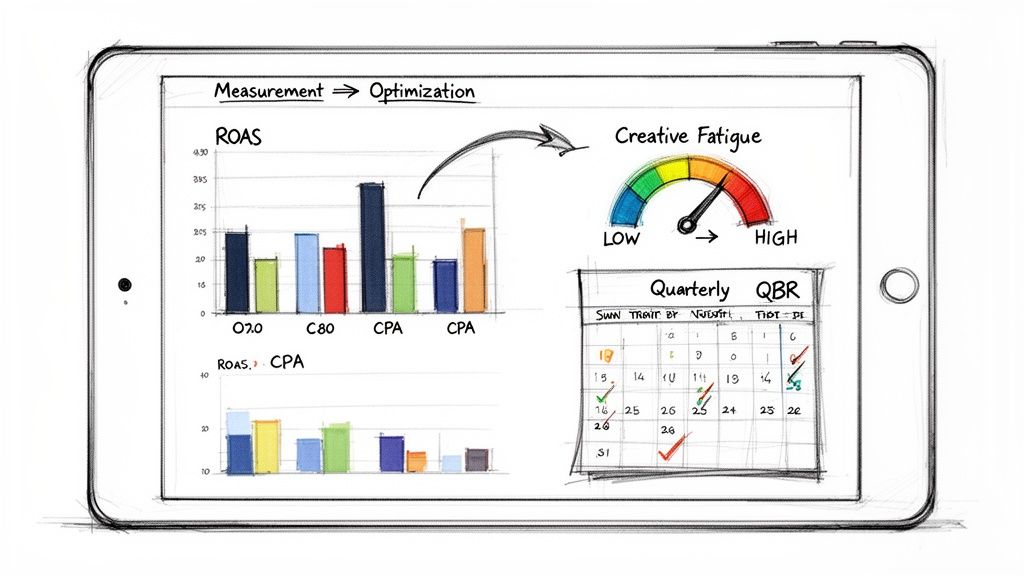
It all comes down to shifting the conversation to the KPIs that matter. The health of your partnership should really be judged on one thing: its ability to improve your Return on Ad Spend (ROAS) and lower your Cost Per Acquisition (CPA). These are the north-star metrics that tie your ad spend directly to revenue, making sure your agency’s work is actually helping you grow.
Establishing Data-Driven Goals
Success starts with clear expectations. From day one, you and your video ads agency need to agree on specific, data-driven goals. This isn't about setting fuzzy targets like "increase brand awareness." It's about defining concrete objectives that are both ambitious and grounded in reality.
Your goal-setting framework should lock in a few key things:
Baseline Performance: First, figure out your current CPA, ROAS, and conversion rates before the agency even touches anything. This gives you a clear starting line to measure from.
Tiered Targets: Set realistic goals for the first 30, 60, and 90 days. For instance, you could aim for a 10% CPA reduction in the first month and a 20% ROAS improvement by the end of the quarter.
Creative Performance Metrics: Keep an eye on creative fatigue by tracking the CTR and conversion rates of individual ads over time. This is your signal for when it’s time to swap in fresh creative.
Setting goals this way turns the relationship from a simple vendor agreement into a true growth partnership. This is a huge deal, especially when you consider that video is projected to make up 82% of all internet traffic. And with social video getting 1200% more shares than text and images combined, you need a partner who knows how to make that trend work for you. You can find more stats about the rise of video marketing on insivia.com.
Running Effective Quarterly Business Reviews
The Quarterly Business Review (QBR) is your single most powerful tool for accountability and strategic alignment. Think of it less as a routine check-in and more as a deep-dive session to review what worked, what didn't, and what you're going to do next.
A great QBR focuses less on what was done and more on what was learned. It's the engine for continuous improvement, ensuring that every dollar spent makes the next dollar spent even smarter.
To make your QBRs count, build them around these core components:
Performance Against Goals: Kick things off with a scorecard. Did you hit the ROAS and CPA targets? Where did you crush it, and where did you fall short?
Creative Insights: Dig into the creative. What were the biggest wins and losses? Break down the specific hooks, angles, and formats that really connected with your audience. Having a proven creative testing roadmap is a game-changer for structuring these learnings.
Strategic Recommendations: Based on the data, what’s the plan for next quarter? Your agency should come to the table with clear, data-backed ideas.
Goal Setting for Next Quarter: Use what you've learned to set the next round of ambitious, measurable goals.
By managing the agency relationship with this kind of focus, you ensure their work consistently delivers a real, positive impact on your bottom line.
Got Questions? We've Got Answers
Stepping into the world of video ad agencies can feel a bit like learning a new language. You've probably got a ton of questions floating around. Let's tackle some of the most common ones we hear from performance marketers just like you.
So, How Much Does a Video Ads Agency Actually Cost?
This is the big one, right? The honest answer is: it varies wildly. The cost really depends on what you need and the agency's pricing model.
For a monthly retainer, you could be looking at anything from $5,000 to over $25,000. If you're just after a one-off project, say a batch of new creatives, that might run you somewhere between $10,000 and $50,000.
Many agencies also work on a performance model, taking a percentage of your ad spend. My advice? Always demand a proposal that spells out every single deliverable and its price tag. No surprises.
What’s the Onboarding Process Usually Like?
A good agency won't just throw you into the deep end. They'll have a structured onboarding process designed to get things moving quickly and make sure everyone's on the same page from day one.
It typically looks something like this:
Discovery Call: This is the initial "get to know you" chat where you'll hash out your brand, audience, and what you're trying to achieve.
Asset Collection: The agency will need all your goodies—brand guidelines, logos, and any creatives you're already running.
Strategic Kickoff: This is a dedicated session to brainstorm the first campaign's creative strategy and overall direction.
Account Access: Getting them the keys to your ad accounts and analytics platforms so they can work their magic.
A sharp video ads agency can get all of this done and be ready to roll in about one to three weeks.
How Do I Make Sure Their Creatives Don't Wreck My Brand Vibe?
This is a huge, valid concern. The absolute best thing you can do is hand them a detailed brand guidelines document right out of the gate. I'm talking specifics: logo usage, official color codes, your brand's tone of voice, and even a mood board of visuals you love.
The real secret sauce for brand alignment is a solid, consistent feedback loop. Set up regular creative reviews. Give them your honest input. A great agency partner will guard your brand identity like it's their own.
When Can I Expect to Actually See Results?
Patience is a virtue here, but not too much of it. You'll see some early signs, like click-through rates (CTR), pop up within a few days. But the results that really matter—like a better ROAS or a lower CPA—take a bit of time to bake.
You should expect to see some initial performance data within the first 30 days. But a clear picture of real, meaningful impact? That usually starts to emerge after about 60-90 days. That's enough time for the agency to collect data, ditch what's not working, and start pouring fuel on the winning creative concepts.
Ready to scale your creative output without the agency price tag? Sovran is an AI platform that automates video ad production, helping you test more, learn faster, and find winning ads up to 10x quicker. Start your free trial today at https://sovran.ai.

Manson Chen
Founder, Sovran
Related Articles
8 High-Converting Static Ads Examples for 2026
Discover 8 high-performing static ads examples from top apps. Learn to create text-overlays, testimonials, and lifestyle ads that convert.

Your Ultimate Guide to UGC Style Video Ads
Master UGC style video ads for Meta and TikTok. This guide reveals proven frameworks, scripts, and scaling tactics to boost your ROAS in 2026.
How to Turn Link Into Video: Ads That Convert in 2026
Learn how to turn link into video for Meta & TikTok ads. Leverage AI to scale creation, boost ROI, and succeed in 2026.