A Modern Guide to High-Performing Facebook Ad Creative
Struggling with Facebook ad creative? This guide reveals proven frameworks, scripting formulas, and AI workflows to create ads that actually convert.
Jump to a section
A powerful Facebook ad creative isn't just a piece of the puzzle anymore—it is the puzzle. It's the whole package: the visual, the message, and the hook that stops someone mid-scroll and convinces them to act in a feed packed with distractions.
Why Your Ad Creative Is the New Targeting
Remember the good old days? We'd spend hours painstakingly building hyper-specific lookalike audiences and layering interests, trying to nail down that perfect customer profile. While targeting and bidding still matter, the game has completely changed.
Privacy updates, especially the big one from iOS 14.5, pulled the rug out from under granular tracking. This forced a massive shift in how we have to approach advertising.
The new king of any campaign is the creative itself. Facebook's algorithm has become so ridiculously smart that it can find the right audience for you, if you feed it the right creative. Think of your ad as a signal you're sending to the algorithm. A generic, bland ad sends a weak, confusing signal, which leads to bad audience matching and wasted money. But a compelling, high-impact ad? That tells the algorithm exactly who it's for.
The Power of Broad Targeting
This is why, time and time again, we're seeing broad targeting absolutely crush those old, narrow, layered strategies. The data doesn't lie.
In a post-iOS 14.5 world, broad targeting now outperforms lookalikes by a staggering 49% ROAS. And with Facebook costs jumping 80% since 2020, you can't afford not to get your creative right. It's the key to efficiency.
Your job is no longer to find the perfect audience for your ad. Your job is to create the perfect ad for your audience and let the algorithm find them for you.
Embracing Creative Diversity
Success in this new era hinges on one thing: creative diversity. You need an entire arsenal of ads. Ads that hit different pain points, show off various features, and use distinct visual styles.
This approach gives the algorithm a ton of different angles to test, letting it discover which pockets within a broad audience respond best. Having a single "winner" just doesn't cut it anymore. You need a portfolio of high-performing creatives to fight ad fatigue and scale your campaigns effectively. For a deeper dive, check out our guide on creative diversity for Facebook ads.
Honestly, this shift is a huge opportunity. The advertisers who stop obsessing over audience settings and instead pour their energy into producing a high volume of strategic, data-informed Facebook ad creative are the ones who are going to win. They're the ones who will unlock better performance, lower costs, and find sustainable growth.
Building Your Creative Strategy Before You Hit Record
Let's be real: winning Facebook ads don't just happen. The creatives that consistently crush it—we're talking low CPAs and sky-high ROAS—are the result of a rock-solid strategy, long before a camera ever gets turned on. Guessing is the most expensive thing you can do in this game. Strategy is your best investment.
It all starts with getting uncomfortably familiar with two things: your audience and your competition. And I don't mean just knowing their age and location. You need to get into their heads. What really keeps them up at night? What have they already tried that didn't work? What specific words do they use to talk about their problems?
Go lurk in the places they hang out online. Reddit threads, Amazon reviews, and niche forums are pure gold. This is where you find the raw, unfiltered language you need to echo in your ads. You're not just looking for what to say, but how to say it so your audience feels like you're reading their mind.
Uncovering Competitive Angles
While you're playing detective with your audience, you also need to become a student of your competitors' ads. The Facebook Ad Library should be your homepage. Don't just glance at what they're running; break it down.
What's their angle? Are they hammering on features? Selling an emotional outcome? Touting benefits?
What's the vibe? Is it super polished and corporate, or are they leaning into that raw, user-generated content (UGC) feel?
How do they hook people? Look at the first three seconds. Are they asking a question? Making a bold claim? Showing a frustrating problem?
The point here isn't to copy anyone. It's to find the gaps. If every competitor is screaming about features, maybe you can win by telling a compelling story. If everyone's ads look like a TV commercial, your lo-fi, authentic approach might be exactly what cuts through the noise.
Forming a Core Creative Hypothesis
All this digging around should lead you to a creative hypothesis. This is your north star—a simple, testable statement connecting an audience insight with a creative direction. Think of it as your "if-then" formula for what you're about to build.
Here’s a solid example: "If we show busy moms how our meal prep service gives them back 5 hours a week with a fast-paced, UGC-style video, then they will feel a sense of relief and be more likely to sign up for a trial."
Boom. That single sentence gives your team everything they need. It defines the audience (busy moms), the format (UGC), the core promise (saves 5 hours), and the target emotion (relief). Now, every decision you make—from scripting to editing—has a clear purpose.
When you have a strong hypothesis, the focus shifts from endlessly tweaking audiences to building the perfect creative for an audience. This flips the old model on its head.
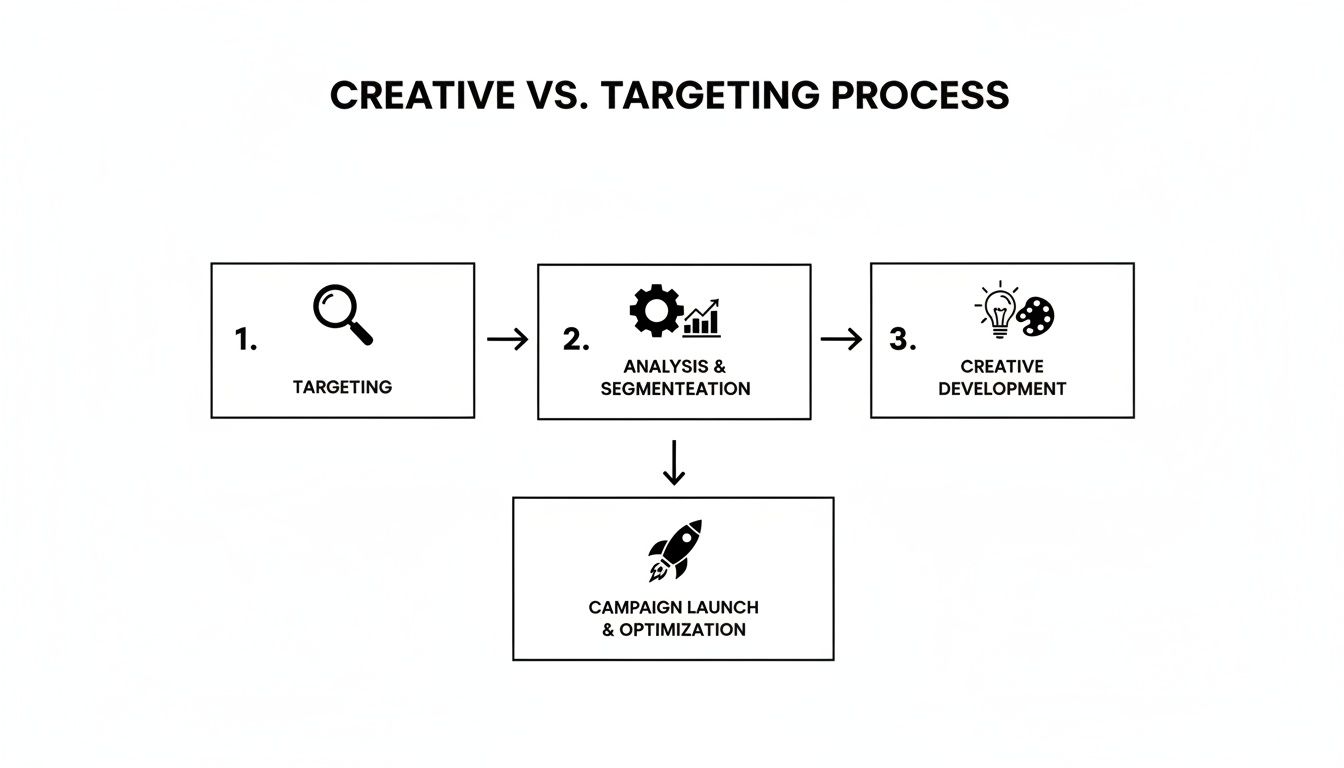
The chart says it all: your main job now is to make ads so good that they tell Facebook's algorithm exactly who to show them to.
Systematizing Your Approach with Asset Tagging
Okay, so you have your hypothesis. Before you even think about shooting, you need a system to measure if you were right. This is where asset tagging comes in, and it's a non-negotiable for anyone serious about scaling.
Think about a basic video ad. It really has three parts:
The Hook (0-3 seconds): Grabs their attention.
The Body (3-15 seconds): Delivers the message.
The CTA (15+ seconds): Tells them what to do next.
Instead of making one video, your plan should be to create multiple versions of each part. You might shoot three different hooks, two different ways to explain the product in the body, and two distinct CTAs.
By tagging each of these clips before you edit (e.g., Hook_Question, Hook_BoldStatement, Body_Demo, Body_Testimonial), you create a library of assets. Now you can mix and match them to systematically test which combinations actually drive results.
This modular approach builds a testing framework right into your production process. It saves you from the pain of having a single, expensive ad that flops. Every piece of Facebook ad creative you make becomes an intentional experiment, designed to give you clear, actionable insights for the next round. This is how you stop hoping for a winner and start engineering one.
Scripting Video Ads That Stop the Scroll
A great video ad is your best salesperson, working 24/7 in the feed. But without a script that connects instantly, it’s just expensive noise. The script is the blueprint for every high-performing Facebook ad creative; it sets the pace, the message, and the emotional journey your viewer goes on.
Let's start with a cold, hard truth: you have less than three seconds to earn someone's attention. If your opening doesn't immediately stop their thumb, the rest of your brilliant ad might as well not exist. Forget the long, branded intros or slow, cinematic pans. Your hook has to be brutally efficient.
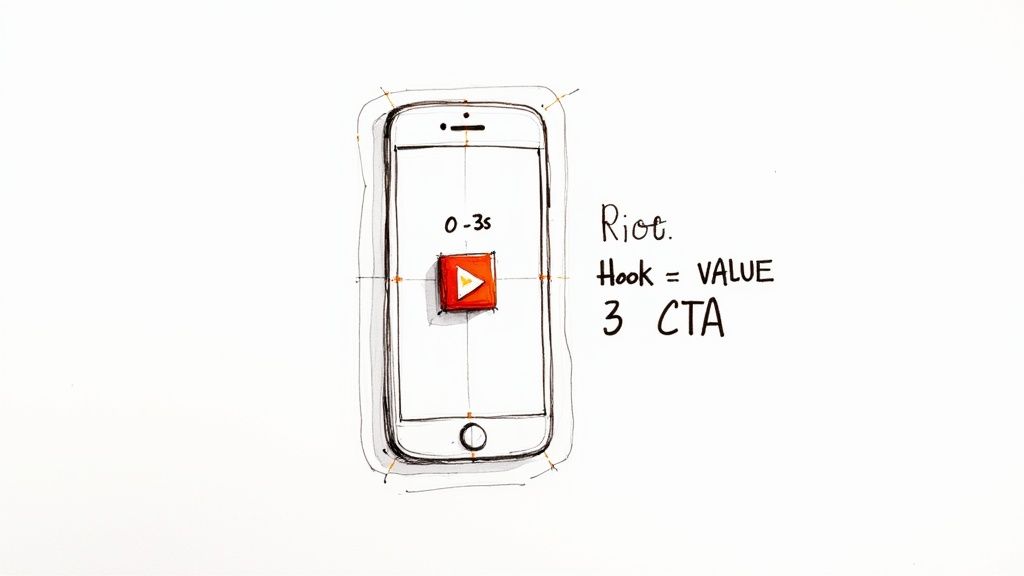
This means leading with high energy, a disruptive visual, or a question that piques curiosity. The goal is to create an immediate information gap or an emotional tug that forces the viewer to pause and ask, "Wait, what is this?"
Mastering Proven Scripting Formulas
You don’t have to reinvent the wheel every time you script an ad. Some of the most successful ads are built on timeless persuasion frameworks that have been perfectly adapted for the speed of social media. These structures give you a reliable roadmap for your message.
One of the most dependable is the Problem-Agitate-Solution (PAS) formula. It’s a simple, three-act structure that just works because it mirrors how we think and make decisions.
Problem: Kick things off by calling out a specific pain point your audience knows all too well. For instance, "Tired of spending hours editing a single video clip?" This immediately grabs the attention of anyone who feels that frustration.
Agitate: Don't just mention the problem—twist the knife. Describe the negative feelings and consequences that come with it. "It's tedious, it kills your creative flow, and it puts you hours behind schedule."
Solution: Now, swoop in with your product as the clear, obvious answer. "Sovran’s AI takes over, letting you render hundreds of ad variations in minutes, not days."
This structure is so effective because it builds tension and then offers a satisfying release. By the time you introduce your solution, the viewer is already primed to see its value.
A great script doesn't just sell a product; it sells a solution to an emotional problem. Focus on the transformation your customer will experience, and the features will sell themselves.
Crafting Compelling Hooks
The hook is the single most critical part of your script. Even when using a framework like PAS, you should be testing dozens of hook variations to find what truly grabs your audience. Don't just write one opener and call it a day; brainstorm multiple angles.
Here are a few hook ideas you can adapt:
The Bold Claim: "This is the last video editing tool you will ever need." It's polarizing, but it gets people to stop and listen.
The Question: "What if you could produce a month's worth of video ads in one afternoon?" This forces the viewer to imagine a better reality.
The "Us vs. Them": "Stop manually editing ads like it's 2014. Here's what top media buyers are doing instead." This creates a sense of insider knowledge and FOMO.
Once you have your script locked in, make sure the final video file is ready for the platform. It's crucial to know how to compress video for Facebook properly to maintain quality without bogging down load times.
Weaving in Authentic Narratives
Another powerful approach is the classic before-and-after story. This works wonders for any product that delivers a visible or tangible transformation. The trick is to make it feel genuine, not like a slick, corporate case study.
Instead of only showing a perfect outcome, show the struggle. Use visuals that depict the "before" state in a way people can relate to. For a fitness app, maybe it’s a quick shot of someone looking unmotivated on their couch. The "after" should then feel earned and aspirational.
If you want to go even deeper on structuring your message, check out our in-depth article on building a winning script for advertising.
Ultimately, your script is a blueprint for persuasion. By using proven formulas like PAS, testing a variety of powerful hooks, and telling authentic stories, you can create a Facebook ad creative that doesn’t just get views—it gets results.
Using AI To Fire Up Your Creative Workflow
Creative velocity—the raw speed at which you can dream up, produce, test, and learn from your ads—is the real engine of performance marketing today. But let's be honest, the old-school manual process of scripting, editing, and versioning dozens of ads is a massive bottleneck. It’s slow, tedious, and kills momentum.
This is where AI flips the script entirely. It turns that slow, one-by-one process into a rapid, scalable system.
Platforms like Sovran are built specifically to shatter those bottlenecks. Instead of seeing each Facebook ad creative as a standalone project, AI helps you build a system of reusable parts, brand intelligence, and automated production. You multiply your output without having to multiply your effort. It’s all about working smarter, not just grinding harder.
The point isn't just to make more ads. It's to get more strategic shots on goal. More tests mean more data, which leads to faster learning loops and finding your home-run campaigns a whole lot quicker.
Building Your AI-Powered Context Vault
All your brand knowledge is your most valuable asset. The huge problem is that it's usually scattered everywhere—in Google Docs, random Slack channels, and living inside different team members' heads. Sovran’s Context Vault changes that by acting as a centralized AI brain for your entire creative operation.
Think of it as the ultimate source of truth for your brand. You simply feed it everything you've got:
Brand Guidelines: Your exact fonts, color codes, and logo usage rules.
Audience Personas: Deep dives into your customers' biggest pain points, what they truly want, and the language they use.
Winning Ad Copy: All your best-performing headlines, hooks, and CTAs from past campaigns.
Customer Reviews: Real, authentic testimonials and user-generated content that are perfect for turning into new scripts.
Once this info is in the vault, the AI doesn't just store it; it actually understands it. From that point on, every new ad concept, script, or text overlay it creates will automatically align with your established brand voice and messaging. This is how you get consistency and quality at scale, wiping out all that tedious back-and-forth of manual reviews.
Unleashing The Power Of Asset Management
Seriously, how much time do your editors waste scrubbing through hours of footage just to find that one perfect 5-second clip? AI-powered asset management makes that whole problem disappear. As soon as you upload raw footage to a platform like Sovran, the AI gets to work.
It automatically watches every video and applies descriptive tags based on what's happening. A clip of someone unboxing a product gets tagged unboxing. A shot of a user smiling while using an app gets tagged positive emotion. Just like that, you have a searchable, intelligent library of your best visual assets.
Now, instead of digging through folders, your team can use simple, natural language to find exactly what they need. A search like, "Show me all clips of a customer looking frustrated before using our product" instantly pulls up the perfect footage for a classic problem-agitate-solution ad. That simple shift in workflow saves an unbelievable amount of time.
By automatically organizing your raw clips, the platform makes it dead simple to find and repurpose your best-performing content on the fly. You're turning a messy folder of video files into a dynamic, searchable creative engine.
Generating Variations With Bulk Rendering
Okay, this is where the magic really kicks in. You've used AI to generate a script from your Context Vault and found the perfect clips with asset management. Now, you need to create dozens of variations for testing. This is where bulk rendering becomes your superpower.
From a single script and a set of tagged assets, you can generate an entire testing matrix in minutes.
Select Your Script: Grab a proven formula, like a PAS script you know works.
Choose Your Assets: Pick three different hooks, two body variations, and two CTAs from your asset library.
Click Render: The AI instantly gets to work, assembling every single possible combination. In this case, it would create 3 x 2 x 2 = 12 unique video ads.
The system will also spit out variations with different text overlays, background music, and subtitles automatically. A task that would take a human editor a full day is done in the time it takes to grab a coffee. This is how you achieve true creative velocity. For more practical insights, explore the possibilities of utilizing AI ad creative generators to further boost your campaigns.
Adopting these tools fundamentally changes your approach to creating a Facebook ad creative. To learn more about this approach, read our guide on how to build a high-performing AI video ad. You stop being a manual ad factory and become a strategic campaign architect. You let the AI handle the repetitive grunt work so you can focus on what actually moves the needle: strategy, analysis, and growth.
Running an A/B Test That Delivers Clear Winners
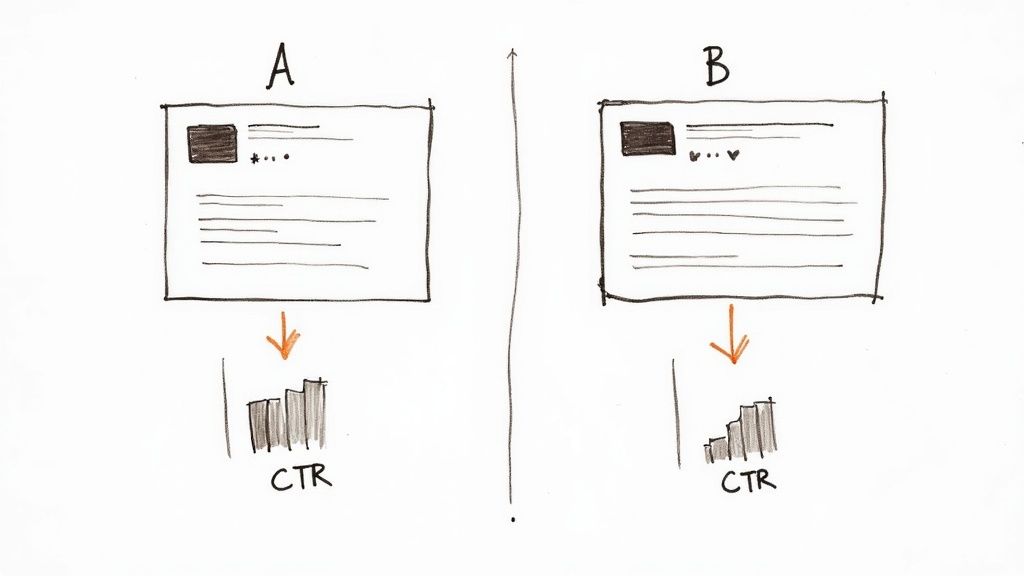
Great creatives aren't just a happy accident; they're discovered through methodical testing. Tossing a bunch of ads against the wall to see what sticks is a fantastic way to burn through your budget while learning next to nothing. The real secret to scaling is building a structured A/B testing process that gives you clean, actionable data on what actually moves the needle.
Think of it as creating a continuous feedback loop. The insights you get from one test should directly shape the hypotheses for your next round of creatives. This is how you systematically chip away at your customer acquisition costs and scale your campaigns with confidence, not just hope.
Isolating Your Test Variables
The golden rule of any good A/B test is brutally simple: change one major thing at a time. Seriously. If you test a new video that also has new copy and a new headline, you’ll have no clue which element was the hero. Was it that killer hook in the first three seconds, or was it the witty headline? You'll never know for sure.
Instead, you have to isolate your variables to get clean results. Start with the elements that have the biggest potential impact on your Facebook ad creative performance.
The Hook: Test completely different opening concepts. Pit a bold claim against a raw, user-generated testimonial. Those first three seconds are everything.
The Core Visual: Try a polished, studio-shot video versus a gritty, authentic-looking piece of UGC. The vibe can make all the difference.
The Ad Copy: Test long-form, story-driven copy against short, punchy, benefit-focused text. See what your audience responds to.
The Call-to-Action: Experiment with different offers or angles. Something as simple as "Shop Now for 20% Off" versus "Get Free Shipping Today" can have a massive impact.
By focusing on one of these core components per test, you guarantee the results are unambiguous. You’ll know with certainty that your winning ad won because of the hook, not some other random factor you threw in.
Building Your Testing Matrix
To keep your experiments from spiraling into chaos, you need a testing matrix. This is just a simple way to plan your tests, track variables, and compare performance systematically. It’s what turns your testing from a messy guessing game into a clear, data-driven process.
Imagine you've got a control ad that’s doing okay, but you have a gut feeling a stronger hook could really crank up its click-through rate (CTR). Your matrix would be set up to test only new hook variations, while keeping everything else—the body of the video, the ad copy, the headline—exactly the same.
Your goal isn't just to find a winning ad. It's to understand why it won. A testing matrix helps you deconstruct performance down to the element level, giving you insights you can apply across all future campaigns.
To put this into practice, here’s a simple example of what a testing matrix could look like. In this scenario, we're trying to figure out which visual style resonates most with our audience.
Creative Testing Matrix Example
This is a structured approach to testing different creative elements against a control version to identify top performers.
Test Variable | Control (Ad A) | Variation 1 (Ad B) | Variation 2 (Ad C) | Key Metric to Watch |
|---|---|---|---|---|
Visual Creative | Polished studio video | Authentic UGC video | Animated explainer | CTR & CPA |
Ad Copy | "Copy Version 1" | "Copy Version 1" | "Copy Version 1" | (Remains constant) |
Headline | "Headline Version 1" | "Headline Version 1" | "Headline Version 1" | (Remains constant) |
This structure makes it a clean experiment. If Ad B crushes the others, you can confidently attribute that win to the power of UGC-style visuals for your specific audience. It's an insight you can run with.
Interpreting the Results and Iterating
Once your test has gathered enough data (I usually aim for at least 1,000 impressions and a statistically significant number of conversions), it’s time to dig in. But don't just glance at one metric and call it a day. A high CTR is awesome, but not if it comes with a sky-high Cost Per Action (CPA).
You need to look at the whole story:
Click-Through Rate (CTR): How well did the ad grab attention?
Cost Per Click (CPC): What did that initial attention cost us?
Cost Per Action (CPA): This is the bottom line. How much did it cost to get a conversion?
Return on Ad Spend (ROAS): Is the ad actually making us money?
When you find a winner, your job isn't over—it’s just getting started. The next step is to iterate. If the UGC-style video won, your next test could be pitting two different UGC creators against each other. Or maybe you test that winning UGC video with two new hooks. This is how you build a library of proven creative elements, turning your ad account into a predictable engine for growth.
Your Top Questions About Facebook Ad Creative, Answered
Jumping from creative strategy to actually launching ads on Facebook can bring up a ton of questions. It's totally normal to get bogged down in the details of testing, ad formats, and figuring out what's really working.
Let's cut through the noise. Here are the clear, actionable answers to the questions we hear from advertisers every single day.
How Many Ad Creatives Should I Actually Test at Once?
For most ad accounts, the sweet spot is testing 3-5 genuinely different creative concepts in a single ad set. This gives you enough variety to get meaningful data without stretching your budget so thin that you never exit the learning phase.
The trick is to be methodical. You want to test one major variable at a time. For instance, you might pit three completely different video hooks against each other but keep the ad copy and the rest of the video identical.
Once you find a clear winner, that's when you start iterating. Test smaller tweaks on that winning concept—things like different headlines, background music, or maybe a new call-to-action. It’s all about structured testing, not just throwing a dozen random ads at the wall and hoping something sticks.
What’s the Perfect Length for a Facebook Video Ad?
There’s no magic number, but the data consistently points to videos between 15 and 45 seconds as the top performers for most goals. What's not up for debate, though, is the first 3-5 seconds. If you don't grab their attention there, you've already lost.
For top-of-funnel campaigns where you're just trying to build brand awareness, short and snappy videos (often under 15 seconds) are king. They’re built for quick consumption and easy recall.
If you’re running consideration or conversion campaigns, you can afford to go a bit longer because you need to explain your product or service. Just make sure every second is packed with value. The story has to keep moving, otherwise, they'll scroll away before you even get to your CTA.
How Can I Tell When My Ad Creative Is Fatigued?
Creative fatigue is a real budget-killer. It’s that point when your audience has seen your ad so many times it just becomes background noise in their feed. Your metrics will tell you everything you need to know.
Keep a close eye on these specific trends:
Rising Cost-Per-Result: Your CPA (Cost Per Action) or CPC (Cost Per Click) starts creeping up day after day.
Falling Click-Through Rate (CTR): People just aren't clicking like they used to, even though impressions are steady.
High Frequency: The average number of times each person has seen your ad is getting out of hand. Once it starts pushing past 3-4 in a short window, you’re in the danger zone.
When you see these three things happening at once, it's a blaring alarm. Your audience is over it. It's time to pause that ad and swap in fresh Facebook ad creative to keep your campaigns efficient and your results coming in.
Should I Really Be Using User-Generated Content in My Ads?
Absolutely. UGC shouldn't just be part of your strategy; it should be a cornerstone of it. User-generated content is hands-down one of the most persuasive tools you have.
Why? Because it provides instant social proof and feels authentic. People are tired of slick, corporate ads. When they see something that looks like it was made by a real customer, it feels more native to the feed, which builds trust and drives way more engagement.
You can get your hands on this content in a few ways:
Find existing customers who are already posting about your product.
Work directly with creators who can produce that authentic, lo-fi content for you.
Create it yourself in-house, but make sure you’re mimicking that raw, genuine UGC style.
No matter how you source it, UGC-style creative is a killer way to cut through the noise and turn scrollers into actual customers. It makes your brand relatable, and in this game, that’s everything.
Ready to speed up your creative process and find winning ads faster? With Sovran, you can use AI to automate production, generate hundreds of ad variations in minutes, and manage all your assets in one place. Ditch the manual grind and start scaling with data-driven creativity.

Manson Chen
Founder, Sovran
Related Articles
How to Turn Link Into Video: Ads That Convert in 2026
Learn how to turn link into video for Meta & TikTok ads. Leverage AI to scale creation, boost ROI, and succeed in 2026.
8 High-Converting Static Ads Examples for 2026
Discover 8 high-performing static ads examples from top apps. Learn to create text-overlays, testimonials, and lifestyle ads that convert.
A Performance Marketer's Guide to Video to Flipbook Conversion
Learn to convert video to flipbook formats that boost engagement. This guide covers actionable methods for ads, content, and scaling creative with AI in 2026.