Quality Assurance in Production: The 2026 Guide
Jump to a section
- When QA Breaks at the Speed of Modern Ad Production
- What Quality Assurance in Production Actually Means
- The Four Pillars of a Production-Ready QA System
- The End-to-End QA Workflow for Video Ad Pipelines
- Where a Platform Like Sovran Fits in the QA Stack
- Common QA Failure Modes in Modular Creative Pipelines
- Proving QA ROI Beyond Defect Counts
You've probably felt this already. A campaign looks clean in the tracker, the deck says the variants are approved, and the team launches a big batch of modular ads only to discover a few hours later that the wrong CTA slipped into a body, a caption drifted off-script, or a policy issue hid inside a recombined version that nobody saw in review. In high-velocity creative operations, quality assurance in production isn't a polite final check, it's the difference between scalable testing and expensive noise.
The old checklist model breaks fast when the unit of production stops being a single finished ad and becomes a stream of recombined hooks, bodies, CTAs, formats, and overlays. That's why the key question isn't whether QA exists, but whether the system can catch errors before spend, before fatigue, and before silent compliance issues make the campaign look weaker than it is. The framework below is built for that reality, especially when creative output behaves more like a modular pipeline than a factory line.
A useful reference point is how teams try to speed up production without building the QA system to match. Sovran's guide on how to speed up the ad creative process is a practical reminder that velocity only matters when the output still survives review.
When QA Breaks at the Speed of Modern Ad Production
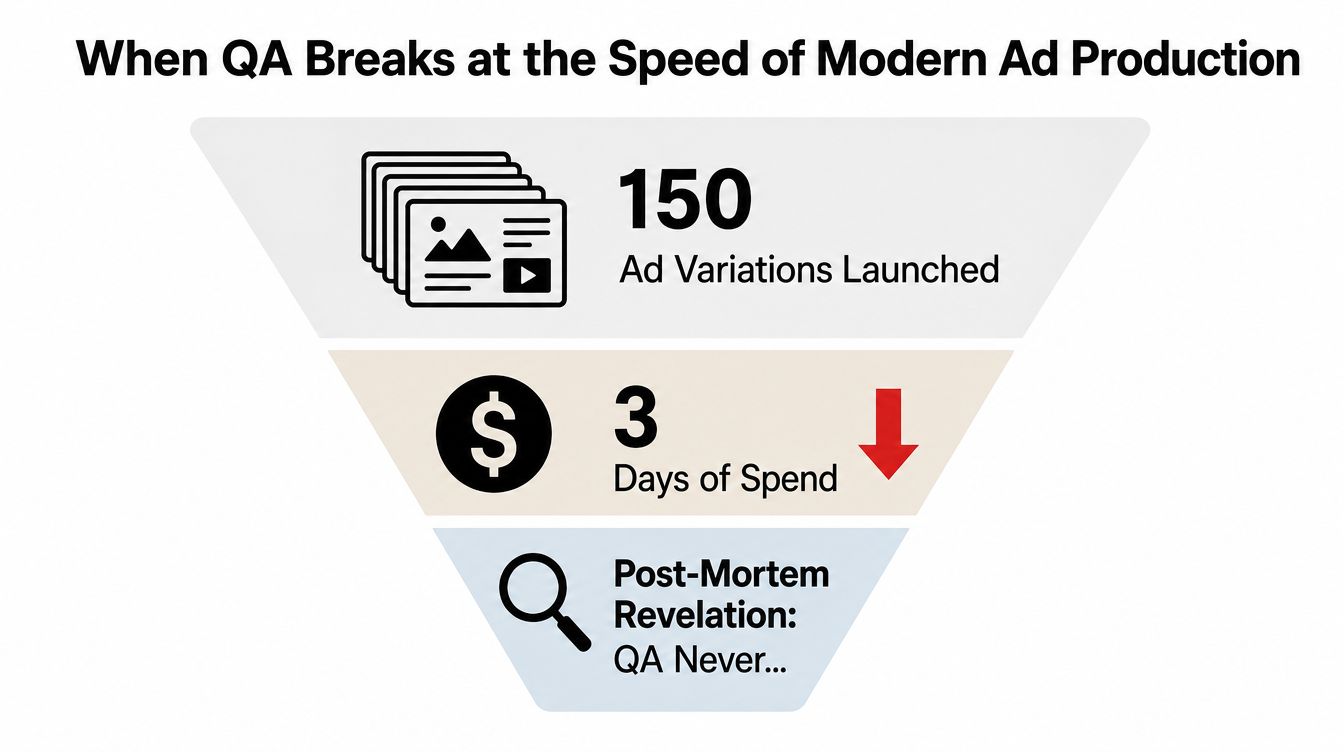
A UA manager pushes 150 or 200 variations live, the dashboards are green for a moment, and then performance collapses for reasons that look vague at first. A mislabeled CTA is only the visible mistake. The deeper problem is that the QA process was designed for a few finished ads, not for a modular system where every output is a recombination of approved parts.
That's the point where traditional end-of-line review stops being useful. When creative is assembled from reusable hooks, bodies, captions, and calls to action, the review burden shifts upstream, because the error isn't usually a broken file, it's a bad combination, a stale claim, or a policy conflict hidden inside a variant that looked fine in isolation. A team can inspect final renders all day and still miss the pattern that caused the launch failure in the first place.
Practical rule: if QA only happens after the variation is rendered, you're already paying for the mistake.
Walter Shewhart's original insight still matters here because modern quality assurance in production is about controlling variation, not sorting bad units at the end. If you want the creative version of that thinking, Sovran's article on a video asset management system fits the same logic, because the asset layer has to carry quality information before assembly starts.
The shift is simple to state and hard to operationalize. Quality assurance prevents defects, quality control inspects outputs, and creative pipelines need both, but not in the same place or at the same time. The systems that hold up under scale are the ones that make bad combinations hard to assemble in the first place.
What Quality Assurance in Production Actually Means
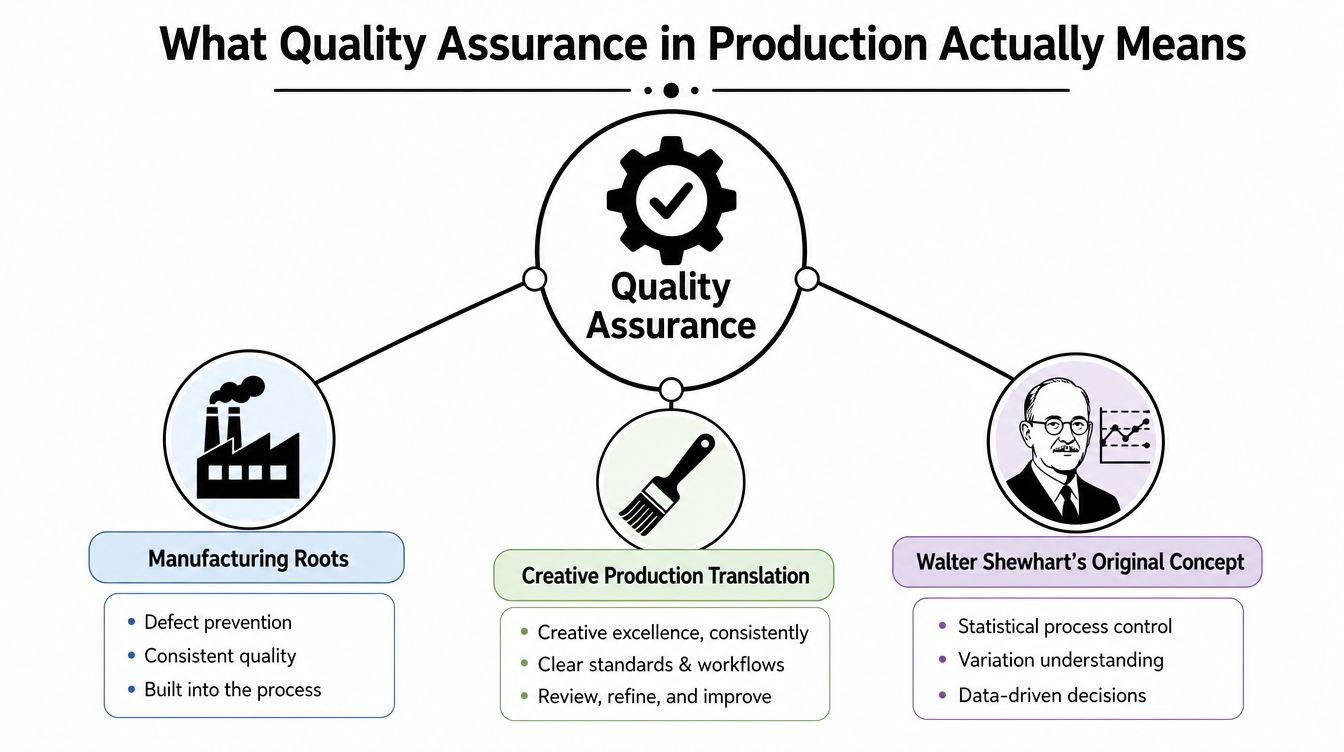
Quality assurance in production is a process-control system. In manufacturing, that idea goes back to Walter A. Shewhart at Bell Labs in the 1920s and 1930s, and by 1931 he had formalized the control-chart method that became the foundation of modern statistical quality control, according to Symestic's summary of statistical quality control (Symestic). The important move was conceptual; quality stopped being only a final inspection step and became ongoing monitoring of variation.
That historical shift maps cleanly to modular ad production. When each output is assembled from hooks, bodies, CTAs, and variants, the process is part of the product. You're not just checking whether the ad is “good,” you're checking whether the system that made the ad is stable enough to keep producing acceptable combinations.
QA and QC are not the same job
Quality assurance builds the system so defects are less likely to happen. Quality control checks finished output and catches the ones that slipped through. Teams get into trouble when they conflate the two, because then they review every render manually and call that a quality strategy.
In production terms, QA means defining the rules for recombination, approval, and handoff. QC means inspecting the assembled output against those rules. That distinction matters because a modular pipeline can create hundreds of valid-looking outputs that are still wrong in context.
The economic case is just as direct. The American Society for Quality has reported that quality-related costs commonly consume 15% to 20% of revenue, with average organizations around 15% and top cases reaching 40% (UNCTAD PDF). That's why QA is a profit issue, not a paperwork issue.
A strong QA system doesn't just catch defects, it reduces the number of chances you give those defects to exist.
A practical definition helps keep the work grounded. In production, QA is the structured system for preventing defects, controlling variation, and reducing the financial burden of poor quality at scale. That's true on a factory floor, and it's just as true in a creative operation where the “finished product” is really a sequence of modular decisions.
The Four Pillars of a Production-Ready QA System
A production-ready QA system doesn't start with software. It starts with rules, ownership, and a way to tell whether the process is drifting before the campaign has already spent itself into a corner. In a modular creative workflow, those four pillars need to support recombination, not just fixed deliverables, which is why so many old SOPs feel too rigid the minute variation count goes up.
Checklists and SOPs set the floor
Checklists matter, but only as the floor. They define the essentials, like brand-safe language, approved claims, required disclaimers, export specs, and who signs off on what. The trap is treating a checklist as the whole QA strategy, because a checklist can confirm that a task was done without proving that the pipeline still makes sense.
That gap gets worse when creative output is modular. A checklist written for one finished ad won't reliably catch a risky recombination unless it also defines the rules for what can be paired with what. The value comes from encoding the logic of assembly, not just the traits of the final file.
Roles and ownership prevent end-loaded review
QA fails when one person becomes the final gate for everything. That reviewer becomes a bottleneck, and bottlenecks invite shortcuts. The better model is specialist ownership, where the creative lead, brand manager, motion editor, and media buyer each validate the piece they're qualified to judge.
Sovran's creative workflow management software is relevant here because modular systems need clean ownership as much as clean files. If the same person has to approve hook logic, caption accuracy, policy risk, and platform formatting, the system is already overloaded.
Metrics need to tell you whether QA is helping or just slowing work down
A good QA dashboard separates leading indicators from lagging ones. Leading indicators are things like review cycle time, variation throughput, and policy flag rate. Lagging indicators are outcomes like CPA, ROAS, refund rate, or post-launch fixes.
The reason to keep them separate is practical. If review gets slower but launch quality doesn't improve, the process is probably adding friction instead of safety. If flagged issues rise because the team is finally catching them earlier, that's a healthier sign than an apparently “clean” pipeline that lets problems escape.
Automation turns QA into a filter, not a fire drill
Automation should remove repetitive checking where rules are clear. Asset tagging, transcript generation, format validation, and policy scanning are all good candidates because they catch obvious mismatches early and free humans to focus on judgment calls. In modular creative production, that means the system can screen a hook, body, or CTA before it ever reaches assembly.
Good automation doesn't replace judgment, it preserves it for the parts that actually need a human.
A high-functioning QA stack usually combines all four pillars. Checklists set standards, roles distribute accountability, metrics show whether the system is improving, and automation catches predictable errors at scale. That combination matters even more in variable production environments, where each new output is technically unique but still governed by repeatable assembly rules.
The End-to-End QA Workflow for Video Ad Pipelines
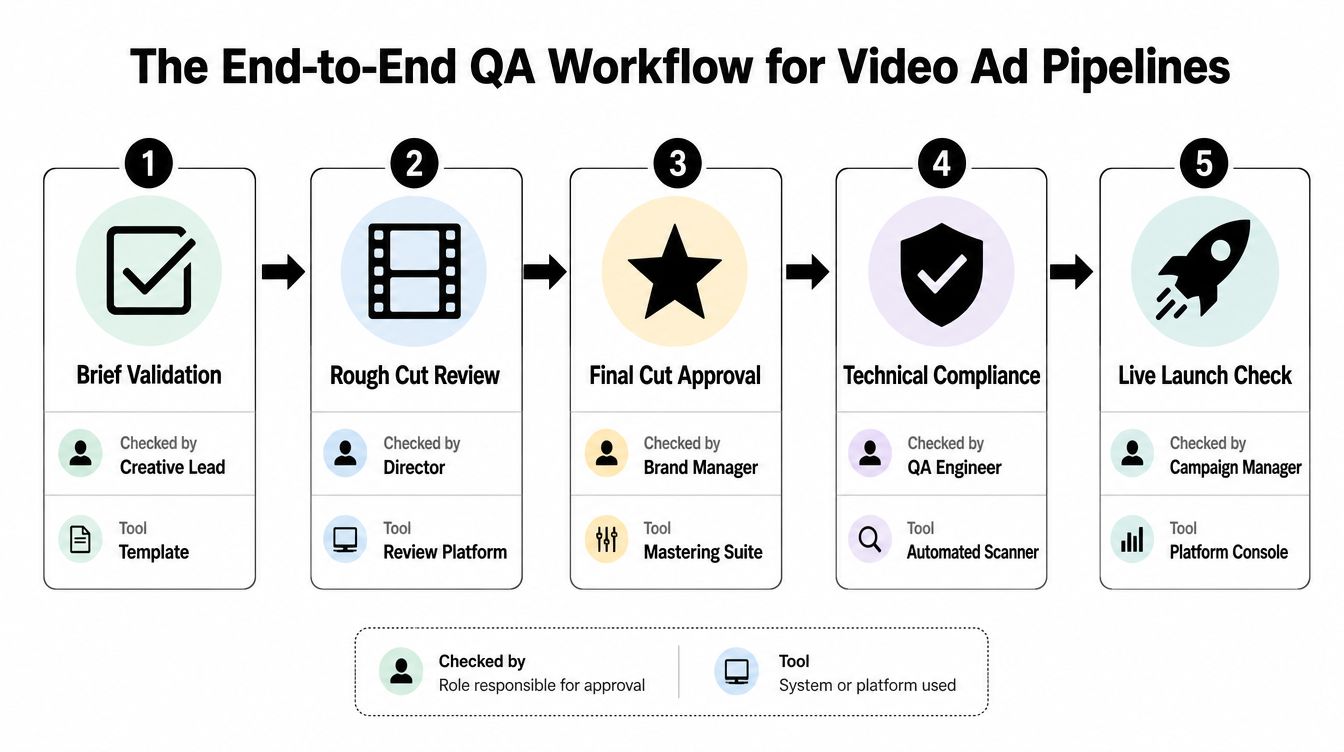
The cleanest video QA workflows treat quality as a chain of gates, not a single sign-off. That starts with the brief, because if the brief is fuzzy, every later review becomes damage control. A strong brief check catches mismatched positioning, unsupported claims, missing platform constraints, and the basic question of whether the requested creative can be built from the assets on hand.
From there, the workflow needs to split module-level review from assembled variation review. The asset ingest stage is where auto-tagging, transcript capture, and library organization matter most, because the team can't review what it can't find. Once the system knows which clip contains which scene, line, or product shot, reviewers stop scrubbing footage and start checking meaning.
The next checkpoint is assembly. The hook, body, and CTA are judged as a unit, not just as separate assets. This stage also requires policy and brand compliance scans, because a recombined variation can create risk that was invisible in the source assets.
Video format validation belongs later in the chain, after the cut is locked. Captions should be burned in correctly, audio levels should be clean, safe zones should be respected, and export settings should match the target placement. For format and timing checks, a straightforward resource like Simply Tech Today's explanation of frame rate helps teams align technical review with delivery expectations without turning QA into guesswork.
The last gate is pre-launch comparison against historical winners. That isn't about copying old ads. It's about asking whether the new variation keeps the traits that already proved useful, while still testing something meaningful. In creative operations, a technically valid asset can still be commercially off-message, so human review has to stay in the loop for tone, cultural nuance, and offer framing.
The technical layer also needs to respect playback realities. If a campaign depends on precise timing, frame structure, or motion pacing, the team should align the edit spec with the actual delivery format, not with a generic export preset. Sovran's AI video ad workflow fits naturally into that kind of pipeline because the assembly step and the review step stay close to the assets themselves.
A common mistake is inserting human review too late and automation too early. Humans should decide whether the message is right, whether the offer is commercially sane, and whether the variation makes sense for the audience. Machines should catch the repeatable technical and structural errors before anyone wastes time on a manual pass.
Where a Platform Like Sovran Fits in the QA Stack
A platform like Sovran belongs in the production layer, not as a replacement for QA but as the system that makes QA workable at scale. The reason is straightforward. If the team is building modular ads from existing footage, then the library itself has to support review, not just storage.
Sovran's asset bank auto-detects scenes, transcripts, and structures clips into searchable assets, which changes the review experience from hunting to auditing. That matters because a reviewer can validate a clip, a line, or a scene without scrubbing through full video files every time. The QA work gets tighter, faster, and less dependent on memory.
Module-level approval changes the workflow
Once a hook, body, or CTA is approved, the approval should live with the module, not just with one finished render. That way, the same approved hook can be reused across variations without re-litigating the entire element each time. The review burden moves to the recombination, which is where most creative risk appears.
That's a better fit for high-velocity testing than reviewing every output as if it were a brand-new campaign asset. It also makes it easier to separate stable components from experimental ones. The team can reuse known-good material while still testing fresh combinations against it.
Cleaner handoffs reduce launch errors
Direct Meta Ads Manager integration matters because handoff errors are a major source of launch friction. A file can be approved in one place and still get misapplied, mislabeled, or uploaded incorrectly somewhere else if the final transfer is manual. When the platform pushes assets directly into the ad account workflow, the number of places an error can hide drops sharply.
Shared workspaces and role-based access also help. Agencies, brands, and internal teams can keep review responsibility clear without turning the process into a maze of forwarded files and unclear approvals. That's not a glamorous feature, but it's the kind that prevents launch-day confusion.
What still has to stay outside the platform
No platform can replace human judgment on tone, offer fit, or audience sensitivity. A variation can be technically correct and still feel off for the market. That's why the best use of a production platform is to make the mechanical parts reliable so reviewers can spend their judgment where it matters.
Sovran's modular video ads capability is most useful when the team wants to test many combinations without losing track of what was approved, what changed, and what still needs human review. The platform handles the scale problem, while the QA process still owns the standard.
Common QA Failure Modes in Modular Creative Pipelines
The failures that hurt modular ad pipelines most are rarely dramatic. They're usually quiet, easy to miss, and expensive because they survive several layers of review. The pattern is familiar, a variant looks fine in the editor, the launch happens, and the problem only becomes obvious once the spend or the comments start telling the truth.
Silent policy violations
A recombined body can pair with an unapproved claim even if each source asset looked fine by itself. The early signal is usually a mismatch between the approved claim list and the final assembled copy. That issue tends to slip through when the review focuses on assets in isolation instead of on the full combination.
Asset mismatches
Wrong logo, wrong product shot, wrong locale flag, wrong subtitle version. These are the kinds of errors that happen when teams move fast and rely on memory instead of structured asset naming and tagging. Automated metadata checks catch a lot of this before manual review ever starts.
Transcript drift
Caption generation can introduce factual errors that visual QA won't catch. If the reviewer only checks framing and pacing, a misleading line can sit in the transcript and survive to launch. The fix is a transcript check against the approved script, not just against the video image.
Creative fatigue disguised as QA trouble
Sometimes the system isn't failing the asset. The audience is saturated. If performance drops and the creative still passes every technical review, the issue may be fatigue, not quality. That's why QA needs to sit next to testing logic, not apart from it.
The best troubleshooting question is often not, “Did the ad render correctly?” but “Did this variation change anything meaningful enough to deserve spend?”
A practical response is to map each failure to the point where it should have been caught, then make that checkpoint non-optional. Silent policy issues need recombination review, asset mismatches need tagging and validation, transcript drift needs text verification, and fatigue needs testing discipline. That's how a team keeps debugging from becoming a permanent state of production.
Proving QA ROI Beyond Defect Counts
Defect counts matter, but they don't tell leadership whether QA is helping the business move faster or just helping it avoid embarrassment. In modular creative production, the better question is whether the QA system improves the economics of learning. If it reduces rework but also slows launch cadence so much that winning concepts arrive late, the trade-off isn't as clean as the dashboard suggests.
The most useful indicators are operational and commercial at the same time. Review cycle time per variation shows whether QA scales linearly or compounds into delay. Winning-ad throughput shows whether the pipeline is producing marketable tests fast enough to matter. Policy flag turnaround shows whether risky versions are getting stopped before they spend.
Here's the decision rule I use. If the campaign is entering a new market, launching a sensitive claim, or changing a major offer, optimize for prevention first. If the team already knows the message is safe and the main challenge is finding better combinations faster, optimize for speed of learning without relaxing the controls that protect the account.
The broader point is that better QA is not automatically better economics. In some setups, more inspection just creates more cycle time, more labor, and the same commercial outcome. In others, the right mix of automation and human review lowers total quality cost because the team stops paying for preventable rework and can ship more useful variations with less thrash.
A simple planning checklist helps keep this honest.
- Track review time by variation: If the queue grows faster than output, the process is too manual.
- Watch approval patterns: If the same error keeps reappearing, the system is missing a structural control.
- Measure launch usefulness, not just launch volume: More ads don't matter if none of them are worth scaling.
- Separate technical compliance from commercial fit: An asset can pass both and still be a bad ad.
- Audit the handoff points: Most avoidable mistakes happen between tools, not inside them.
Good QA in production should make the next round of testing clearer, faster, and more reliable. If it only makes the review meeting longer, the system needs to be redesigned.
If your creative pipeline is already moving in modular batches, treat QA as infrastructure, not a late-stage cleanup task. Sovran can help you organize assets, review recombinations, and push approved variations into launch workflows without losing track of what changed. Visit Sovran to see how a production layer built for modular video testing can support faster launches with fewer avoidable errors.

Manson Chen
Founder, Sovran
Related Articles

8 Pattern Interrupt Techniques for Video Ads
- pattern interrupt techniques
- video ad hooks
- 3 more
Customer Journey Mapping for Performance Marketing
- customer journey mapping
- performance marketing
- 3 more
Production Schedule Optimization for Scalable Ad Testing
- production schedule optimization
- creative testing
- 3 more