Highlights Video Maker: The Ad Scaling Playbook for 2026
Jump to a section
- Beyond Clips A Scalable Ad Production Engine
- The Foundation Strategic Ingestion and AI Powered Tagging
- Modular Assembly Building High Impact Ad Sequences
- Enhancing at Scale With Captions Voiceovers and AI B Roll
- Multivariate Testing From Creation to Campaign Launch
- Measuring Success and Optimizing the Winners
You probably have a folder full of footage right now. Founder clips, UGC, product demos, testimonials, gameplay, screen recordings, old winning ads, maybe a few creator variants that performed for a week and then died.
The usual answer from the team is simple: test more creative. The actual workflow is not. Someone has to find usable moments, trim them, resize them, add captions, swap hooks, export versions, name files, and then upload everything into Meta. That's where efficiency often decreases. Not at strategy. At production.
A good Highlights Video Maker fixes that only if you treat it as more than a clipping tool. The useful model is a production engine built for modular ads. Instead of asking the software to find “the best moments,” you use it to generate reusable parts that map to a job inside the funnel: hook, explanation, proof, objection handling, CTA. That's what makes scaled testing possible.
Beyond Clips A Scalable Ad Production Engine
Manual editing breaks first when spend grows. A team can tolerate hand-building a few variants when budgets are small. Once Meta needs constant freshness, that workflow starts leaking time everywhere.
The market is moving in the same direction. The global AI video generator market is projected to reach $847 million in 2026, up from $716.8 million in 2025, and more than 124 million people use AI video platforms every month, which reflects how AI tools for editing, script generation, and voiceovers have become part of high-volume modular production workflows, according to NGram's AI video statistics for 2026.
That matters because the winning setup isn't “make better videos.” It's “build more relevant combinations faster than your fatigue curve.”
What changes when you use a highlights video maker correctly
A clipping workflow creates finished ads.
A scalable workflow creates components.
That sounds like semantics until you're inside a weekly testing cycle. If your team exports one polished ad at a time, every revision requires another trip through the full edit. If your team stores separate hooks, benefit sections, proof clips, and CTA endings, you can rebuild the same concept for different audiences without starting over.
Three practical changes usually make the difference:
- You stop editing from scratch: Every new ad pulls from an asset bank rather than from raw footage.
- You decide the job of each clip before assembly: A creator intro can be a top-of-funnel hook in one ad and a social-proof bridge in another.
- You produce for variation, not perfection: The point isn't one masterpiece. The point is enough structured inventory to learn quickly.
The fastest creative team usually isn't the one with the biggest edit bay. It's the one that can recombine proven parts without losing message clarity.
If you want a deeper look at the operating model behind this, the best framing is a scalable ad creative production workflow. The important shift is mental. A highlights video maker isn't your finishing tool. It's the center of your ad assembly line.
The Foundation Strategic Ingestion and AI Powered Tagging
Teams often start editing too early. They upload footage, scrub for usable moments, and build whatever stands out first. That feels productive, but it creates a messy library that gets harder to use every week.
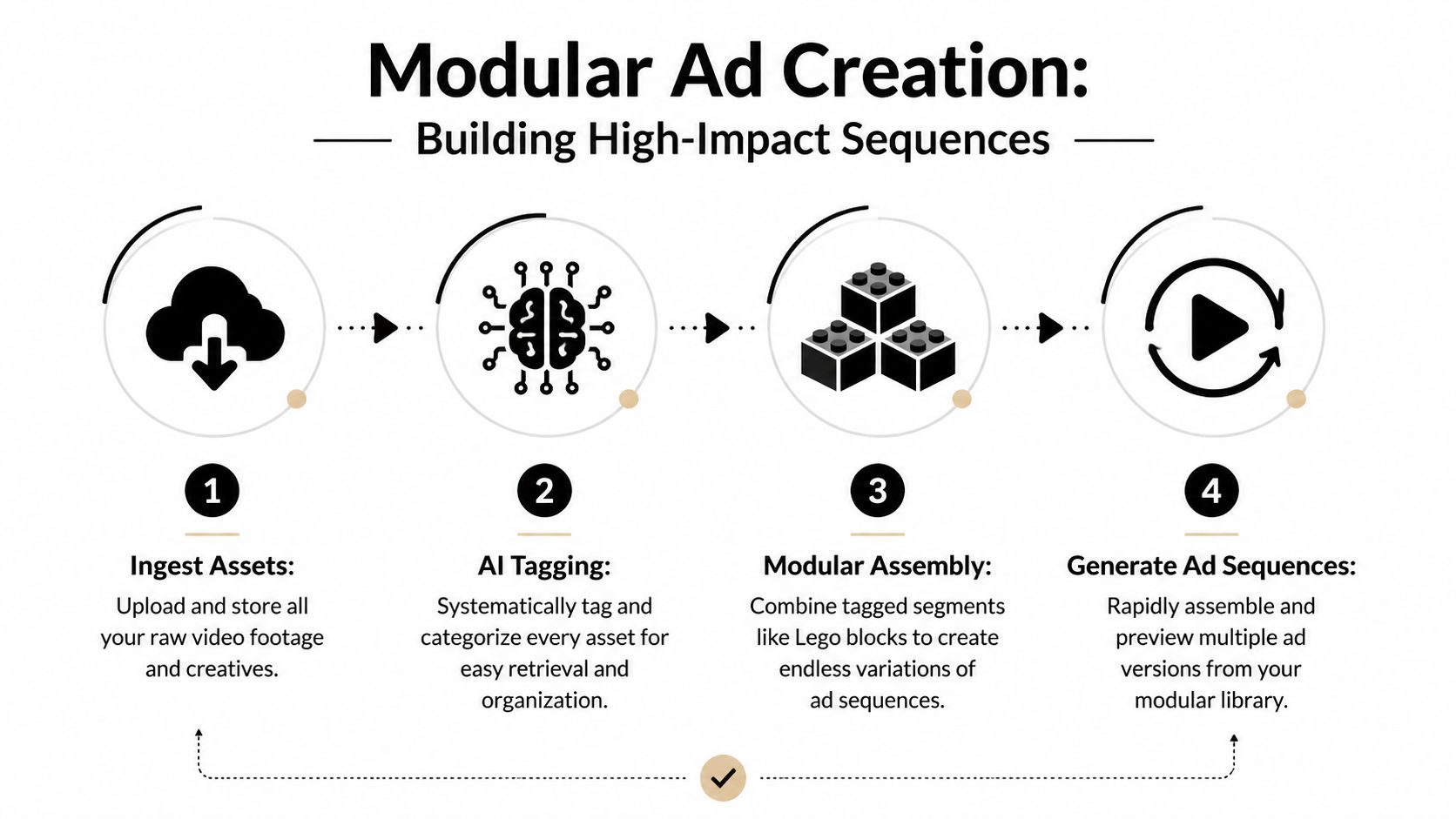
The better approach starts with ingestion. Before anyone touches the timeline, you want raw footage converted into a searchable asset bank with transcripts, scene cuts, and tags that tell you not just what appears in the clip, but what strategic role that clip can play.
Tag for purpose, not just content
A lot of highlight tools fail here. They can detect a face, product, background, or spoken phrase. Useful, but incomplete.
The strategic gap is audience-defined relevance. Most highlight guides focus on automatic extraction of “best moments,” but what counts as valuable depends on the viewer's intent. The underlying problem is visible in the data: 73% of marketers repurpose long-form content for specific funnel stages, yet only 12% plan clips by conversion goal before editing, as noted in Flowjin's guide on making highlight videos.
That means the tagging schema has to reflect marketing jobs. Not just visuals.
A weak tag library looks like this:
- woman smiling
- product in hand
- app screen
- close-up face
- warehouse shot
A useful tag library looks like this:
- Problem-aware hook for users who know the pain but not the solution
- Demonstration proof showing the product in use
- Social proof from a customer or creator
- Objection handling for price, setup time, or trust
- Direct response CTA for retargeting or bottom-funnel traffic
A practical ingestion standard
When I'm setting up a footage library for paid social, I want every clip tagged across more than one dimension. That's what makes retrieval fast later.
Use a structure like this:
| Tag type | What it captures | Why it matters |
|---|---|---|
| Format tag | selfie, screen recording, studio, interview, UGC | Helps match native platform feel |
| Message tag | pain point, outcome, feature, credibility, offer | Lets you build message-led variants |
| Funnel tag | top, mid, bottom | Prevents mismatched sequencing |
| Audience tag | new user, competitor-aware, warm retargeting, niche persona | Keeps relevance high |
| Visual utility tag | hook visual, explainer visual, B-roll filler, CTA frame | Speeds assembly |
The point isn't to create taxonomy for its own sake. The point is to make the next brief executable.
Practical rule: If a buyer asks for “three new top-funnel angles with stronger social proof,” your editor should be able to retrieve candidate clips in minutes, not by rewatching old files for half a day.
What good ingestion prevents
A structured asset bank saves you from common failure modes:
- Duplicate editing effort: Different editors won't keep re-cutting the same source material.
- Random clip selection: You won't rely on whatever looks emotionally strong but says nothing useful.
- Bad funnel alignment: Top-of-funnel ads won't open with heavy product detail that only warm users care about.
- Creative drift: New variants stay anchored to a message architecture instead of becoming disconnected fragments.
Teams that need operational rigor should treat ingestion like media buying hygiene. The cleaner the upstream system, the easier it is to scale downstream production. In this context, asset management best practices for creative teams become a real performance issue, not an ops side note.
Modular Assembly Building High Impact Ad Sequences
Once your library is tagged properly, the timeline stops being a blank canvas. It becomes a sequence builder.
That shift matters because paid social ads don't need one elegant narrative. They need repeatable structure with enough flexibility to test different entry points, proof formats, and endings. The simplest framework that holds up under scale is still hook, body, CTA. The mistake is treating that as a script formula instead of a modular assembly system.
Front-load the strongest material
Sports recruiting has a useful rule here. A proven athlete highlight methodology says the first 20 to 30 seconds should contain the top 4 to 5 plays, because coaches decide within the first minute whether to keep watching. It also uses the 5-second rule, which means including 5 seconds of buildup and follow-through around the play for context, according to NCSA's highlight video guidance.
That logic maps cleanly to ad creative.
On Meta, the opening moments decide whether the viewer gives you any attention at all. Your best hook footage can't sit in the middle because “the story builds there.” This isn't documentary editing. It's interruption-based persuasion.
Use your strongest opening material first:
Pattern break first
Start with the visual or line that interrupts feed behavior. That might be a bold claim frame, an unexpected demo result, a creator facial reaction, or a friction-heavy pain point stated cleanly.
Proof second
Once attention is there, move into a body segment that earns the right to keep talking. Product use, before-and-after framing, testimonial fragments, gameplay payoff, or side-by-side comparison all work here.
Instruction or ask last
Finish with one clear CTA. Not two. Not a laundry list of options. Just the next action that matches the campaign objective.
The 5-second rule for ads
The sports example matters for another reason. A lot of ad editors cut too tightly around the “moment” and remove the context that makes the moment persuasive.
If you clip only the punchline, you often lose the setup that tells the viewer why they should care. In product terms, that usually means deleting the friction, the use case, or the immediate outcome. The result is a sharp-looking ad that feels vague.
Don't just show the payoff. Show enough of the setup that the payoff makes sense.
That's where the 5-second rule becomes useful as a creative discipline. Not strictly for every paid social cut, but conceptually. Preserve enough before-and-after context so the viewer can decode what happened.
A practical ad sequence might look like this:
- Hook module: “I thought this would take forever.”
- Context slice: quick visual of the old process or pain
- Body module: product in action solving the problem
- Proof insert: creator reaction, testimonial line, or on-screen result framing
- CTA module: install, shop, sign up, or learn more
Build interchangeable parts, not one timeline
The biggest enabler is treating each sequence block as reusable inventory.
Create libraries such as:
- Hooks: pain point openers, curiosity opens, creator reactions, stateless demos
- Bodies: walkthroughs, objection handling, testimonials, feature proof
- CTAs: urgency-driven, benefit-led, low-friction, retargeting-specific
Then pressure-test whether each block works with multiple neighbors. If a hook only works with one exact body clip, it's not very modular. If it can lead into three different proof sections without feeling broken, you've built usable inventory.
For teams that want a stronger operating model, a modular video ad framework is the right lens. It turns editing from an artisanal process into a repeatable system.
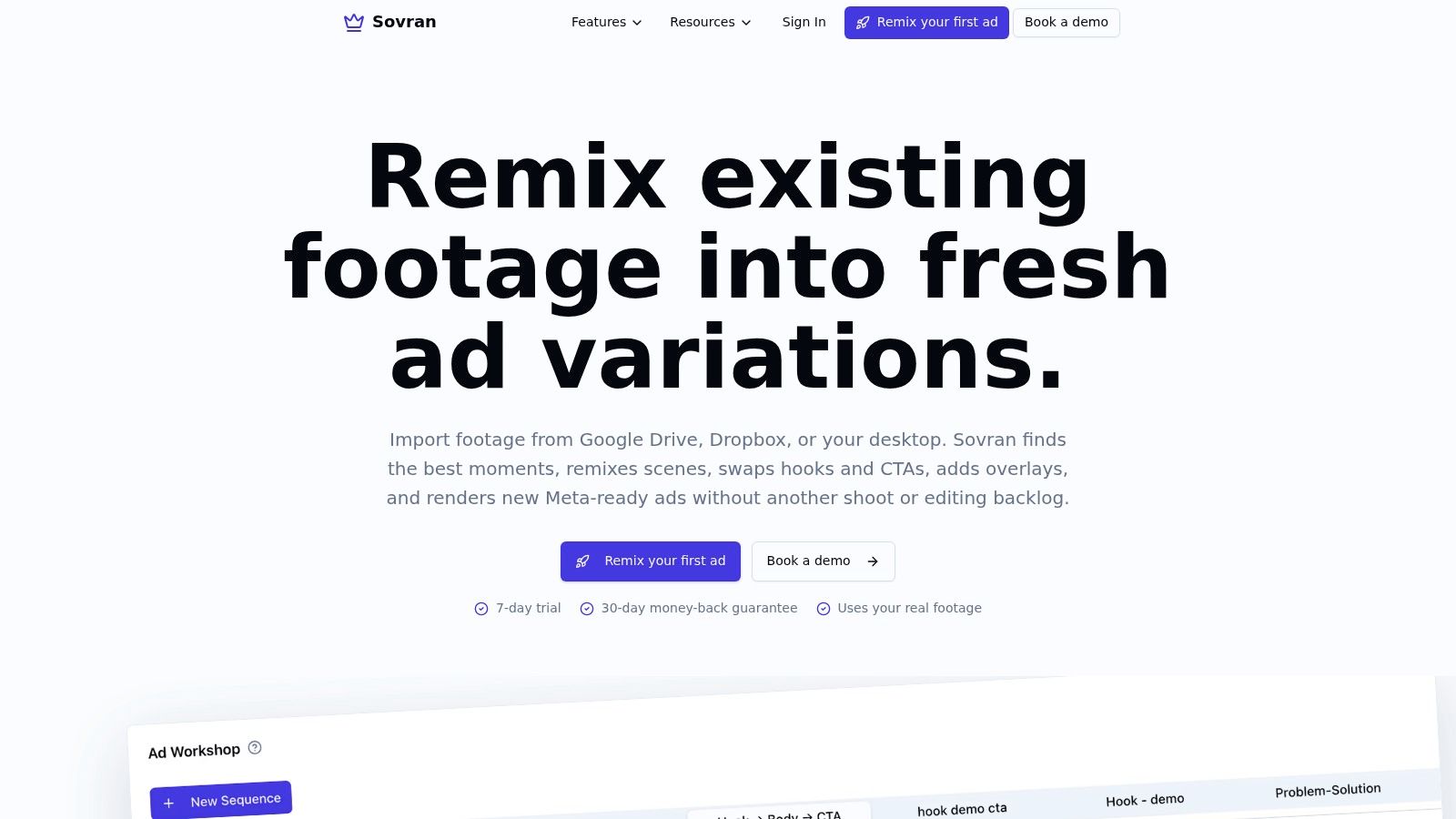
A quick visual example helps:
Enhancing at Scale With Captions Voiceovers and AI B Roll
A clean sequence still won't scale if every enhancement requires specialist labor. Most single-person creative teams find themselves stalled at this stage. Not at cutting clips, but at all the finishing tasks that pile onto each variation.
Captions, voiceovers, and B-roll are the main force multipliers because they remove the exact bottlenecks that slow iteration.
Captions are production infrastructure
On Meta, you can't assume sound-on behavior. That means burned-in captions aren't cosmetic. They carry the sales argument when the voice track gets ignored.
The practical issue is consistency. If you're testing many variants, manually styling subtitles for each export creates drag fast. Good highlight workflows auto-generate captions, let you correct the transcript quickly, and apply one visual system across every version.
If your team still handles subtitle files manually for certain channels or localization workflows, this guide to making subtitle files is a useful reference because it breaks down the structure cleanly without overcomplicating it.
A few rules keep captions useful instead of noisy:
- Prioritize spoken meaning: Clean up filler words if they clutter the read.
- Design for scan speed: Short chunks read better than long sentence blocks.
- Use emphasis selectively: Highlight a key benefit, objection, or CTA phrase. Don't color every other word.
- Keep safe zones in mind: Platform UI can cover low text placement.
Voiceovers unlock script velocity
Voiceover testing used to be expensive in the wrong way. Not just money. Time. Scheduling, briefing, pickups, revised pacing, and file management all slow down concept iteration.
AI voiceovers change that because they let you test script direction before you commit production resources. If the same visual sequence works better with a direct founder-style read than with a creator-style read, you can learn that quickly. If the body needs a clearer objection-handling line, you can swap the read without rebuilding the ad.
That doesn't mean synthetic voice is always the final asset. It means it's a fast path to message validation.
Here's where teams usually get value:
| Enhancement | Typical bottleneck it removes | Best use |
|---|---|---|
| Captions | Manual transcription and styling | Feed ads, retargeting, silent autoplay |
| AI voiceovers | Recording delays and rewrite friction | Script testing, localized variants, concept validation |
| AI B-roll | Missing visual coverage | Benefit explanation, abstract claims, transition support |
A lot of “creative strategy” problems are actually footage coverage problems. The copy is fine. The ad just has nothing relevant to show while the copy is talking.
AI B-roll fills the expensive gaps
A strong highlights video maker becomes more than an editor. You'll often have a strong line in the script with no matching visual. Maybe the VO says setup is simple, but all your footage is close-up product glamor. Maybe the testimonial mentions speed, but the only asset you have is a static founder clip.
AI-generated B-roll gives you a bridge. You can prompt for contextual supporting visuals, use them as transitions, reinforce benefit language, or maintain movement during talking-head sections.
The key trade-off is restraint. B-roll should clarify, not decorate. If the generated visual looks generic or disconnected from the offer, it weakens trust. Use it where coverage is missing, not where real footage already carries the point better.
That's why the best use of AI B-roll workflows isn't replacing primary footage. It's patching visual gaps so your ad can maintain clarity and pace across many variants.
Multivariate Testing From Creation to Campaign Launch
Once your hooks, body sections, and CTA endings exist as modular inventory, the math changes. You're no longer choosing between five finished ads. You're deciding how many combinations are worth testing without creating upload chaos.
That's the operational advantage. Modular creative gives you testing volume without requiring linear editing time for every single variant.
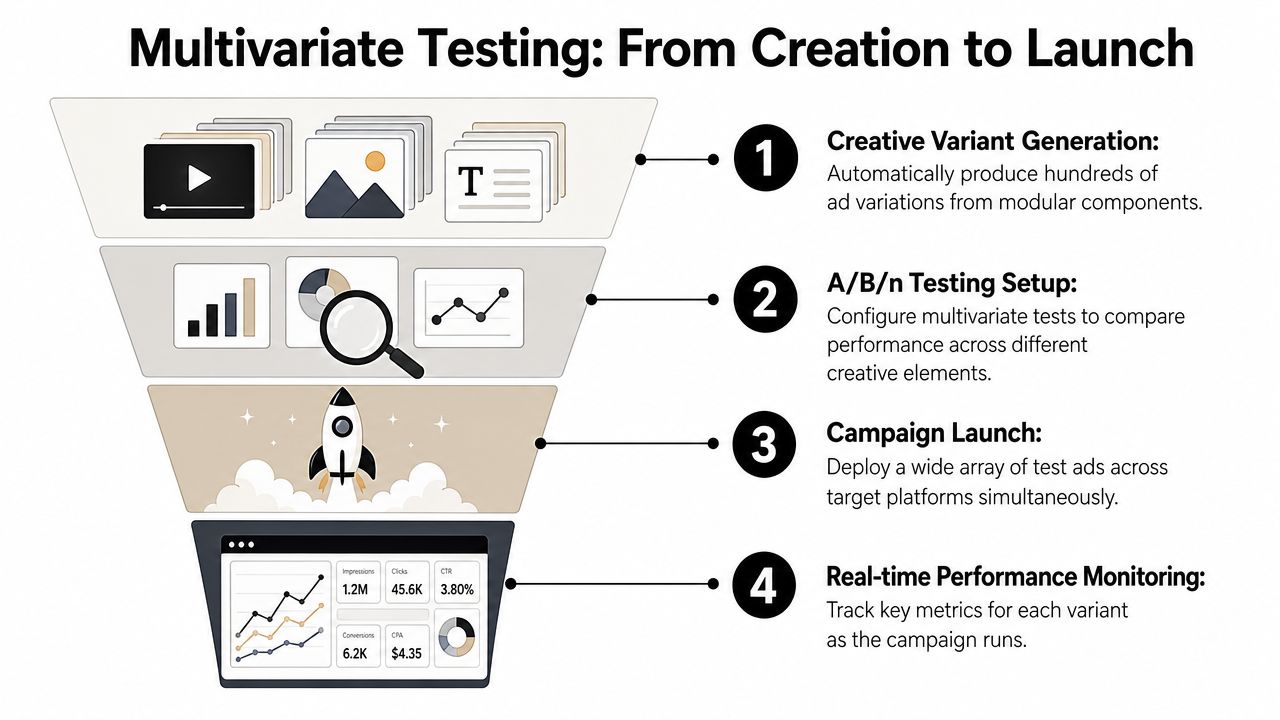
Volume only helps if structure is strong
A lot of teams hear “test more creative” and respond by launching a pile of barely differentiated edits. Same footage, same pacing, same message, slightly different text. That's not multivariate testing. That's duplication.
The reason structure matters is visible in benchmark data. Highlight videos with specific structural elements can increase engagement by up to 80%, and 25-highlight reels perform at roughly double the success rate of 10-highlight reels, which suggests that a sufficient volume of well-structured content beats thin, underdeveloped output, according to this benchmark summary on highlight video performance.
The useful lesson for ad workflows isn't “make longer videos.” It's this: you need enough structured creative material for the pattern to emerge. Too few variants and you learn nothing. Too many sloppy variants and you learn the wrong lesson.
What to vary and what to hold constant
When launching modular tests, separate variables by role. If everything changes at once, the read becomes muddy.
A practical matrix looks like this:
- Vary hooks when you want to test audience entry point
- Vary body proof when you want to test message credibility
- Vary CTA framing when you want to test next-step motivation
- Hold offer and landing page steady if you want the read to stay creative-led
That keeps your analysis clean enough to act on.
One useful approach is to batch tests in waves:
Hook wave
Same body and CTA. Different openings. You're diagnosing attention.
Proof wave
Keep the winning hook. Swap body styles like demo, testimonial, creator narration, screen capture, or objection handling.
CTA wave
Once the top sequence is stable, test the ask. “Shop now” versus “See how it works” can produce very different post-click quality even when top-of-funnel engagement looks similar.
The launch workflow matters more than people admit
Creative teams often solve production and then lose hours on export naming, file routing, ad duplication, and platform setup. That handoff kills speed.
A proper workflow pushes assembled variants into campaign-ready form with consistent naming, clear version logic, and fast deployment into the ad platform. That's what turns modular creative into an actual UA advantage.
If your team can build variants quickly but can't launch them cleanly, you still have a bottleneck. It just moved downstream.
The practical standard is simple:
| Launch step | Bad workflow | Better workflow |
|---|---|---|
| File naming | random exports like final_v7_newest | names tied to hook, body, CTA, angle |
| Campaign mapping | manual guesswork | predefined mapping by audience and objective |
| Testing logic | mixed variables in one batch | one primary variable per wave |
| Platform handoff | upload one-by-one | batch-ready deployment |
That's the kind of discipline a multivariate ad testing workflow should support. The goal isn't more complexity. It's reducing the friction between creative idea and clean campaign launch.
Measuring Success and Optimizing the Winners
Launch isn't the finish line. It's the start of the only feedback loop that matters.
The reason modular creative is so powerful isn't just that it helps you produce more ads. It creates cleaner data about which component is doing the work. When you can isolate the hook, body, and CTA, you stop making vague statements like “that ad worked” and start making usable ones like “that problem-first hook earned attention, but the demo body lost people.”
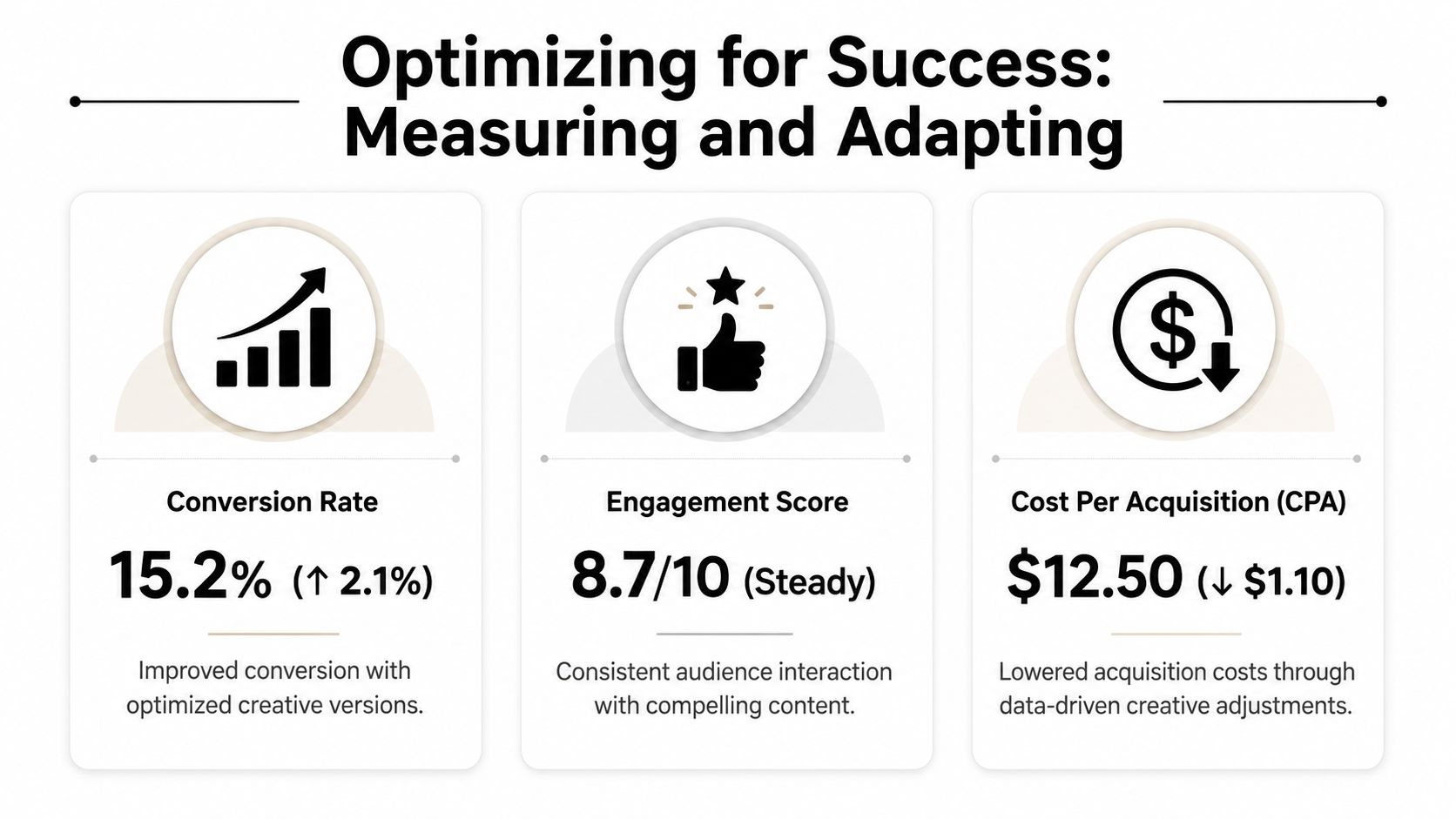
Track diagnostic metrics, not just top-line results
Analysis typically involves spend, CPA, CTR, and perhaps thumbstop behavior. Useful, but incomplete on their own.
What helps more is creating internal diagnostic ratios that explain where the ad succeeds or fails. Two of the most practical are:
- Hook Rate = 3-second video views ÷ impressions
- Hold Rate = ThruPlays ÷ 3-second video views
These formulas aren't magic metrics. They're management tools. Hook Rate tells you whether the opening earns attention. Hold Rate tells you whether the ad keeps enough of that attention once the audience has sampled it.
A simple interpretation framework looks like this:
| Pattern | Likely issue | Next action |
|---|---|---|
| Low Hook Rate | weak opener, poor first frame, unclear audience signal | rebuild the first seconds |
| Strong Hook Rate, weak Hold Rate | body doesn't pay off the promise | replace the middle section |
| Strong view metrics, weak conversion quality | CTA mismatch or weak offer framing | test a new ending and landing alignment |
Read performance at the component level
In this process, many teams waste winning information. They pause underperforming ads and move on without preserving the asset-level insight.
Don't review by ad only. Review by component family.
For example:
- Which hook category wins more often: pain point, curiosity, social proof, or visual demo?
- Which body style keeps attention: creator narration, app walkthrough, testimonial, or side-by-side comparison?
- Which CTA framing produces better post-click behavior: direct purchase, low-friction explainer, or offer-led close?
That lets your next production sprint start with evidence instead of opinion.
The useful output from testing isn't a winner file. It's a pattern library.
Build the flywheel
A scalable workflow gets stronger when the team feeds insights back into the asset bank. Winning hooks should become templates. Losing body segments should be retired or recut. CTA phrasing should evolve by audience, not by gut instinct.
That cycle usually looks like this:
- Launch modular variants
- Read diagnostics by component
- Promote strong modules into reusable inventory
- Brief the next batch around what held attention and converted
The compounding benefit is organizational. Buyers, strategists, editors, and producers start using the same language. Instead of “make it punchier,” the feedback becomes “our curiosity hooks earn views, but testimonial middles hold better for this audience.” That's actionable.
When a highlights video maker supports that process, it stops being an editing utility. It becomes a system for creative learning. And in paid social, that learning loop is what keeps accounts from stalling when the market demands fresh ads every week.
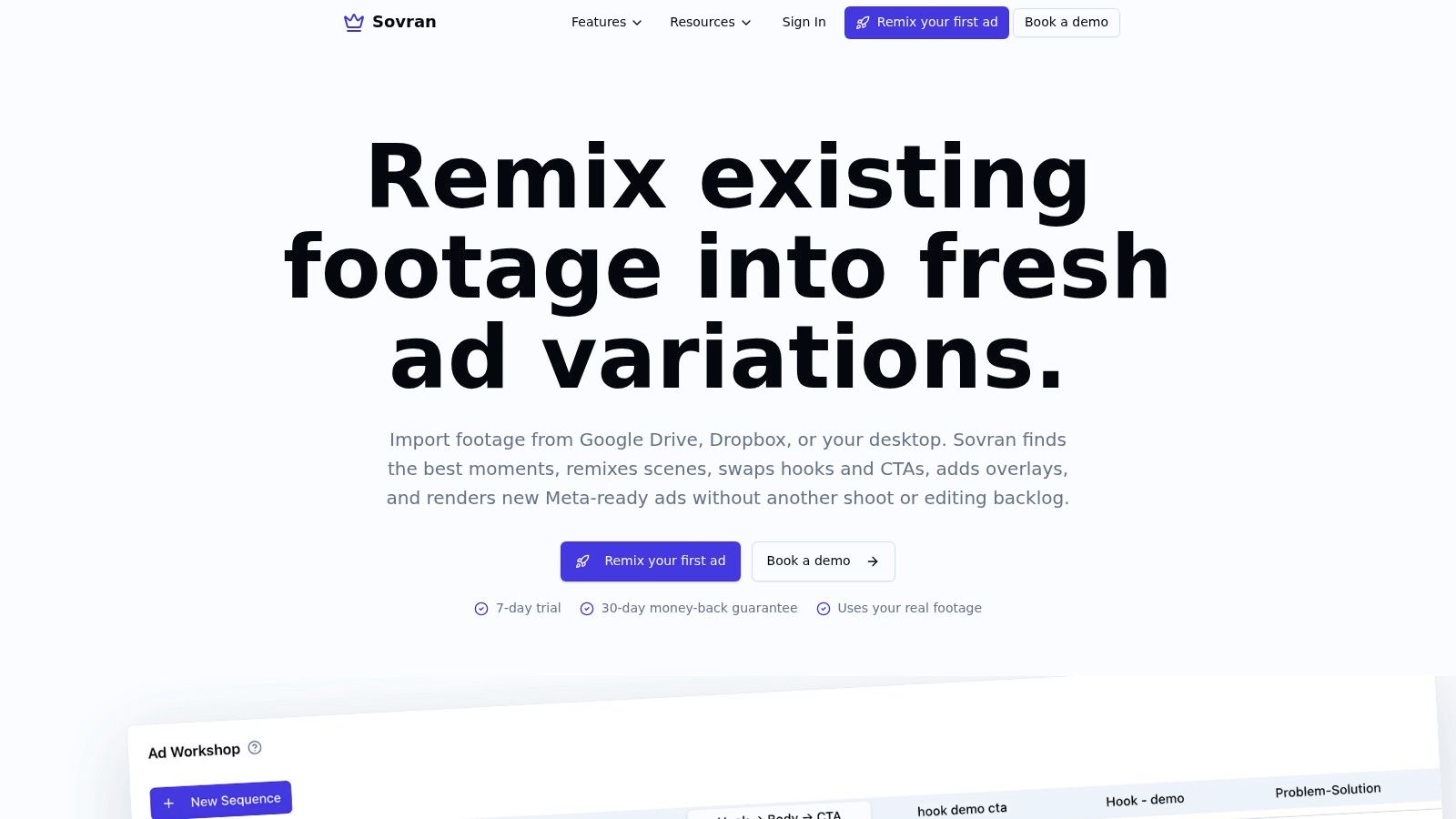
If your team needs a faster way to turn raw footage into modular ad variations, Sovran is built for that exact workflow. It helps performance marketers organize footage into reusable assets, assemble hooks, bodies, and CTAs at scale, generate captions, voiceovers, and B-roll, and push high volumes of creative into Meta without the usual manual bottlenecks.

Manson Chen
Founder, Sovran
Related Articles

8 Pattern Interrupt Techniques for Video Ads
Customer Journey Mapping for Performance Marketing