A Marketer's Guide to Choosing a Multivariate Ad Testing Tool
Struggling with ad creative? This guide breaaks down how a multivariate ad testing tool can amplify your campaign performance on Meta and TikTok.

Jump to a section
- Why Multivariate Testing Is a Performance Marketer's Secret Weapon
- Evolving from A/B Testing to True Multivariate Ad Strategy
- Must-Have Features in Your Multivariate Ad Testing Tool
- How to Design and Launch Your First Multivariate Ad Test
- Common Pitfalls in Multivariate Testing and How to Avoid Them
- Accelerating Your Creative Workflow with the Right AI Tool
- Frequently Asked Questions
At its core, a multivariate ad testing tool is a platform built for performance marketers. It lets you test multiple ad components all at once—think headlines, images, and CTAs—to find the absolute best-performing combination. It's the quickest way to figure out why certain creatives are winners and scale your campaigns with confidence.
Why Multivariate Testing Is a Performance Marketer's Secret Weapon
If you're constantly fighting creative fatigue, unpredictable ad spend, and seeing your returns dwindle on platforms like Meta and TikTok, you're definitely not alone. The hard truth is that pitting one ad against another—the classic A/B test—just doesn't cut it anymore. It doesn't give you the deep insights you need for real, scalable growth.
This is exactly where multivariate testing comes in and changes the game. Think of a baker trying to create the perfect cookie. An A/B test is like baking one batch with chocolate chips and another with walnuts to see which one sells better. It's a straightforward, one-to-one comparison.
A More Sophisticated Approach to Creative Insights
Multivariate testing, on the other hand, is like that same baker testing multiple ingredients simultaneously. They’d bake different combinations using various flours (whole wheat vs. all-purpose), sugars (brown vs. white), and mix-ins (chocolate chips vs. walnuts vs. raisins). This approach doesn't just tell them which cookie is best; it reveals the winning recipe. They might discover that the magic combination is all-purpose flour, brown sugar, and chocolate chips.
That's precisely what a multivariate ad testing tool does for your campaigns. Instead of just knowing which ad won, you find out which specific components are driving all the performance.
This strategic shift gets you out of the guessing game and into a data-driven creative process. You learn not just what works, but why it works, giving you a repeatable formula for success.
Moving Beyond Basic Ad Comparisons
Sure, A/B testing can tell you if a blue button beats a green one. But multivariate testing uncovers the synergy between all your creative elements. This is crucial on platforms like Meta and TikTok, where an ad's success hinges on the perfect interplay between the hook, the visual, and the call-to-action.
By testing these elements together, you can finally answer the complex questions that actually drive impact:
Which hook works best with which visual? Does a raw, UGC-style hook crush it when paired with a polished product shot or a lifestyle video?
How does the CTA affect the headline's power? Does "Shop Now" convert better with a headline focused on price or one that highlights a key benefit?
What are our most powerful creative assets? You can pinpoint your top-performing hooks and visuals to reuse and repurpose in future campaigns.
An AI-powered multivariate ad testing tool automates this entire discovery process. It dramatically shortens your learning cycles, giving you the insights to conquer creative fatigue and unlock breakthrough campaign performance.
Evolving from A/B Testing to True Multivariate Ad Strategy
Most marketers know and love A/B testing. It's the go-to method for comparing two different ads to see which one works better. While it’s great for making big, directional calls, it barely scratches the surface of what’s possible with creative optimization. To really understand the DNA of a winning ad, you need to level up your strategy.
This is about shifting your mindset. Stop asking, "Which ad won?" and start asking, "Which components make an ad win?" That single question is what separates good campaigns from truly great ones, and it's the foundation of a real multivariate ad strategy. Think of it as the difference between picking a finished car off the lot and understanding exactly how the engine, tires, and aerodynamics work together to make it a champion.
A Tale of Two Tests
Let's say you're launching a new running shoe for an e-commerce brand. The goal is simple: maximize conversions for a new Meta campaign.
An A/B test would probably look something like this:
Ad A: A slick, professionally shot video of the shoe in a studio.
Ad B: A raw, user-generated-style video of someone running on a trail.
You run the test, and Ad B pulls in a 20% higher conversion rate. Great news, right? But what did you actually learn? You learned that this specific UGC-style ad beat that specific studio ad. You have no idea if it was the hook, the runner, the scenery, or the call-to-action that truly moved the needle.
Now, let's approach this with a multivariate test. Instead of pitting two finished ads against each other, you break them down into their core components:
3 Headlines: "Engineered for Speed," "Conquer Any Trail," "Your New Personal Best."
4 Visuals: The studio video, the UGC trail video, a lifestyle photo, and a close-up product shot.
3 CTAs: "Shop Now," "Learn More," "Get Yours Today."
By testing these elements at the same time, a multivariate ad testing tool creates and analyzes all 36 possible ad combinations (3x4x3). The insights you get are exponentially more powerful. You might discover that the "Conquer Any Trail" headline paired with the UGC video and the "Shop Now" CTA is the absolute killer combination.
This granular approach reveals the interplay between elements. You move beyond picking winners to understanding the recipe for creating them from scratch, allowing you to build a library of proven creative components for future campaigns.
The broader A/B testing software market has seen huge growth, expanding from $517.9 million in 2021 and is on track to hit $1,916.2 million by 2033. This shows a massive industry investment in optimization. For performance marketers on platforms like Meta and TikTok, multivariate testing represents the most advanced frontier of this trend. You can learn more about the growth of the A/B testing software market.
A/B Testing vs Multivariate Testing At a Glance
The right approach really depends on what you're trying to achieve. One test gives you a simple winner, while the other gives you a detailed instruction manual for building future winners. The table below breaks down the key differences.
Aspect | A/B Testing (Univariate) | Multivariate Testing (MVT) |
|---|---|---|
Primary Goal | To determine which of two or more distinct versions of an ad performs better overall. | To identify which combination of individual elements creates the highest-performing ad. |
Complexity | Simple. You are comparing Page A vs. Page B. | Complex. You are testing many elements at once (e.g., headline, image, CTA). |
Insight Level | High-level. You learn which ad won. | Deep and granular. You learn why an ad won by seeing each component's impact. |
Traffic Needs | Lower. Fewer variations mean statistical significance is reached faster. | Higher. More combinations require more traffic and a longer test duration to be reliable. |
Ultimately, choosing between them comes down to your objective. If you need a quick directional answer on two completely different concepts, A/B testing is your tool. But if you want to build a deep, lasting understanding of what makes your audience tick, MVT is the only way to go.
Must-Have Features in Your Multivariate Ad Testing Tool

Picking the right multivariate ad testing tool isn't about finding the one with the longest feature list. It's about finding one that actually solves the real-world headaches that performance marketers deal with every single day.
The best tools aren't just for testing. They're the command center for your entire creative operation, handling everything from organizing your assets to launching your campaigns. They're built to smash through production bottlenecks, keep your branding tight, and most importantly, speed up how fast you learn what works.
Let's dig into the non-negotiable features that separate a truly game-changing tool from a basic utility.
AI-Powered Creative Assembly
Let’s be honest, the biggest wall you hit with multivariate testing is the insane number of ad variations you need to get good data. For a small team, manually building hundreds of ads just isn't going to happen. This is where AI-driven assembly is a lifesaver.
A top-tier tool should slurp up your raw assets—video clips, images, headlines, copy—and intelligently remix them into a ton of unique ad combinations. It's not just random shuffling; it's about applying proven creative frameworks (like Problem-Agitate-Solution or UGC-style testimonials) to generate testable ads at scale. What used to be a week of painful work can now be done in minutes.
This is the only way to move at the speed Meta and TikTok demand. For a deeper dive, check out our complete guide on dynamic creative optimization tools.
Modular Asset Libraries
Your creative assets are gold, but they're worthless if you can't find and reuse them. A modern multivariate ad testing tool needs a modular asset library that treats every single component like a reusable Lego block.
Think of it as a digital warehouse where every hook, body clip, CTA, and music track is tagged and organized. This solves a massive organizational headache and makes you incredibly fast. Need to find every UGC hook you've ever used that mentions "easy setup"? A quick search should pull them up instantly, ready to be dropped into a new test.
A solid asset library should have:
Automatic Tagging: The AI should analyze and tag assets when you upload them, saving you hours of grunt work.
Natural Language Search: The ability to search using simple phrases like "woman smiling with product."
Performance Data Integration: Linking assets directly to their performance stats so you can instantly spot and reuse your winners.
Automated Bulk Rendering
Video editing is a notorious time-suck in creative production. A powerful tool should automate this whole process. Instead of dragging clips around in a video editor for hours, you should be able to pick your components, choose a framework, and let the platform render hundreds of unique videos all at once.
This one feature can easily give your team back dozens of hours every week. It turns the creative process from a slow, one-by-one chore into a strategic, high-volume operation. You test more ideas, you find winning ads faster.
Seamless Platform Integration
The last step—getting your ads live—should be dead simple. A great tool doesn't just help you make ads; it helps you launch them. That means direct, native integrations with the big ad platforms like Meta and TikTok.
With a few clicks, you should be able to push hundreds of ad variants straight into your ad accounts. This absolutely must include automated, structured naming conventions. A clean naming system (e.g., Campaign_Audience_HookID_VisualID_CTAID) is crucial for making sense of the data later. Without it, you’ll have a messy ad account and analytics that are nearly impossible to decipher.
Centralized Brand Intelligence
Finally, your tool should be the single source of truth for your brand's creative strategy. At Sovran, we call this the Context Vault—a central hub for all your essential brand knowledge.
This is where you store your brand guidelines, customer personas, top-performing scripts, and key performance data. When the AI generates new ad concepts, it pulls from this vault to make sure every single variant is on-brand and built on the foundation of what’s worked before. This smart approach stops your brand from getting diluted and ensures that even when you're creating at massive scale, your ads stay consistent and effective.
The demand for this kind of data-driven advertising is exploding. The global market for multivariate testing platforms was valued at US$947 million and is on track for serious growth through 2032. Features like on-brand script vaults are a direct answer to this need, helping teams find profitable winners up to 10x faster.
How to Design and Launch Your First Multivariate Ad Test
Diving into your first multivariate ad test can feel like a big leap, but it’s more straightforward than you might think. With a solid roadmap, you can go from a simple idea to a data-packed experiment that gives you real answers. It’s all about being methodical.
This isn’t about just tossing random creative elements out there and hoping for the best. It's a disciplined process. Think of it less like a chaotic brainstorm and more like a science experiment where you’re carefully controlling the variables to figure out what actually makes your audience tick.
Step 1: Formulate a Strong Hypothesis
Every great test kicks off with a strong, measurable hypothesis. This is your core question—the assumption you're trying to prove or disprove. A fuzzy goal like "get better ad results" is a non-starter. You have to get specific about what you're testing and what outcome you're banking on.
A well-crafted hypothesis names the variable and predicts its effect. For example:
Hypothesis: "Using user-generated content (UGC) video hooks will result in a lower cost-per-install (CPI) than our polished, studio-shot hooks because they feel more authentic to our audience."
Hypothesis: "Headlines that create urgency, like 'Limited Time Offer,' will drive a higher click-through rate (CTR) than our usual benefit-focused headlines, like 'Save Time and Money.'"
Getting this right gives your entire test a clear focus. You’ll know exactly what success looks like before you even build the first ad.
Step 2: Isolate Your Test Variables
Once you’ve got your hypothesis, it’s time to pick which creative elements you want to put under the microscope. The goal here is to isolate the variables you believe will make the biggest difference. Just remember, the more elements you test, the more combinations you create, which means you’ll need a bigger budget and more traffic to get clear results.
Start small and focus on the high-impact stuff. Common variables include:
Headlines: Test different angles—are you focusing on the problem, presenting the solution, or asking a question?
Visuals: Pit different creative types against each other. Think UGC vs. professional video, or lifestyle photos vs. clean product shots.
Calls-to-Action (CTAs): Try out different action phrases. Does "Shop Now" outperform "Learn More" or "Download Free"?
A good multivariate ad testing tool lets you treat each of these components like a modular block, making it simple to swap them in and out.
Step 3: Plan Your Budget for Statistical Significance
This is where a lot of marketers trip up. Running a test without enough budget is like trying to finish a marathon by only running the first half—you won't have a reliable winner. You need to set aside enough ad spend to reach statistical significance, which is just a fancy way of saying you have enough data to be confident your results aren't a fluke.
A good rule of thumb is to aim for at least 100-200 conversions per ad variation. So, if your test has 20 unique ad combinations, you’ll want to budget for 2,000 to 4,000 total conversions to get data you can trust.
Don't let the numbers scare you. Planning this upfront ensures you're spending your money to get insights you can actually use. You can get a much deeper look into this process with our guide on a proven creative testing roadmap for winning Meta ads.
Step 4: Create a Scalable Naming Convention
This might sound like a tiny detail, but trust me, a structured naming convention will be your best friend when it's time to analyze everything. Without it, you’ll be lost in a messy spreadsheet, trying to figure out which headline or visual actually moved the needle.
Create a simple, logical system with codes for each variable. Something like:Campaign_Audience_HookID_VisualID_CTAID
In the real world, it would look something like this:SummerSale_Prospecting_UGC01_ProductShot04_ShopNow
This clean structure makes it incredibly easy to filter and sort your data, so you can instantly see which individual pieces were part of your winning ads.
Step 5: Launch and Monitor Key Metrics
With your plan locked in, it’s time to go live. Let the ads run without jumping in to make changes too early. You have to give the ad platform’s algorithm time to exit the learning phase and collect enough data.
Keep a close eye on your main KPI—whether that's CPA, CTR, or ROAS—but don't ignore the secondary metrics. Sometimes an ad might have a lower CTR but a much higher conversion rate, which tells you it's pulling in a more qualified audience. Patience is everything here. Wait for statistical significance before you call a winner and start applying those hard-won insights to your next campaign.
Common Pitfalls in Multivariate Testing and How to Avoid Them
Multivariate testing is a seriously powerful tool, but its complexity can also open the door to some costly mistakes. Get it wrong, and you'll burn through ad spend and end up with misleading results. But understanding these common pitfalls is the first step to running clean, insightful experiments that actually move the needle.
Think of it like navigating a maze. One wrong turn can get you completely lost. But if you know the layout ahead of time, finding your way to the finish line is a whole lot easier. The same idea applies here—if you know what to watch out for, you can sidestep these errors entirely.
The diagram below shows the basic flow of a well-planned ad test.
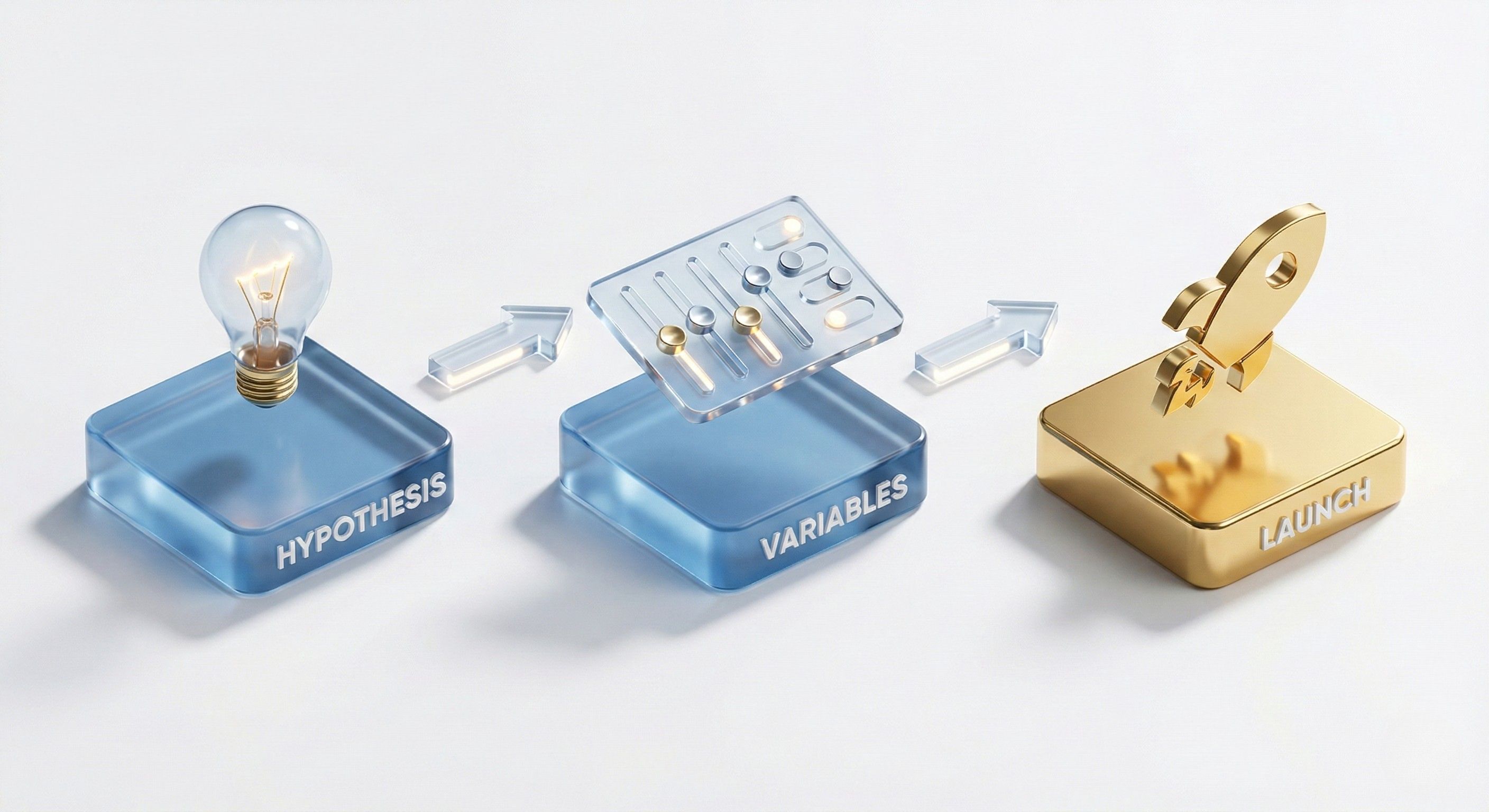
This process really highlights the key checkpoints—Hypothesis, Variables, and Launch—where things can go sideways if you're not careful. Let’s break down the most common traps.
Testing Too Many Variables with Too Little Budget
This is the classic mistake. It’s so tempting to get ambitious and test ten headlines, ten visuals, and five CTAs all at once. But that creates 500 unique ad combinations, and suddenly your budget is spread paper-thin.
Each of those variations needs enough spend to gather meaningful data. If you don't give them that, you’ll never hit statistical significance, and you'll just be guessing which elements really drove performance.
Solution: Start with a focused test on your highest-impact variables. Pick 3-4 key elements for each component (like 3 headlines and 3 visuals) and make sure your budget can support at least 100-200 conversions per variation. As the AB testing software market is projected to hit USD 4.4 billion by 2035, the cost of getting this wrong will only go up. Discover more insights about this growing market and why smart testing is critical.
Calling a Test Too Early
Patience is a virtue in testing. We've all been there—you see one ad pulling ahead after a day or two and you're itching to declare a winner. Don't do it.
Ad platforms need time to optimize delivery, and user behavior changes dramatically from a Tuesday morning to a Saturday night. Ending a test prematurely often means you’re just scaling the ad that got lucky, not the one that's truly better.
Solution: Let your test run for at least one full 7-day cycle. This helps smooth out performance by capturing both weekday and weekend behavior. More importantly, don't make a call until your results reach statistical confidence—usually 95% or higher.
A winning ad should prove its worth with data, not just an early lead. Patience ensures your decisions are based on reliable patterns, not random noise.
Ignoring the 'Why' Behind the Winner
Another huge mistake is focusing only on the "what" (which ad won) and forgetting about the "why" (the customer insight behind its success).
Let's say a raw, UGC-style video crushes your polished studio ad. The lesson isn't just "make more UGC." The real insight might be that your audience is craving authenticity, wants more social proof, or connects with relatable scenarios. A good multivariate ad testing tool should give you the data to see these patterns.
Without digging into the why, you miss out on foundational learnings that can guide your entire creative strategy for months to come.
Solution: Treat every winning element like a clue. What was the underlying theme, tone, or psychological trigger? Did the winning headline spark curiosity? Did it create urgency? Document these insights and start building a creative playbook for what resonates with your audience.
Overlooking a Structured Naming System
This last one sounds simple, but it can completely derail your analysis. Without a clean, consistent naming convention for your ads, your results report will be an absolute mess.
Trying to figure out which components drove performance is impossible when you're sorting through hundreds of ads named "Ad 1," "Ad 2," and "Test_Final_v3."
Solution: Set up a scalable naming convention before you launch anything. A simple, descriptive structure makes all the difference.
Format:
Campaign_Audience_HookID_VisualID_CTAIDExample:
Q4Promo_Lookalike_Hook03_ProductDemo_ShopNow
This little bit of discipline upfront turns a chaotic spreadsheet into a clear roadmap of what actually works, making your analysis fast, accurate, and infinitely more valuable.
Accelerating Your Creative Workflow with the Right AI Tool
Let's be honest. The single biggest thing holding teams back from truly embracing multivariate testing is the sheer manual effort involved. It's a massive bottleneck. The answer isn't a fancier spreadsheet; it's about fundamentally changing how ads get made, managed, and deployed. This is where a purpose-built multivariate ad testing tool, supercharged with AI, comes in to automate the grindiest parts of the workflow.
Imagine uploading hours of raw footage and watching as AI instantly chops, analyzes, and tags every single clip. Suddenly, you have a library of reusable hooks, body segments, and calls-to-action at your fingertips. Instead of digging through endless folders, your team can slap together new ad concepts in minutes. This is how you build a scalable creative engine.
From Manual Labor to Automated Scale
The right tool does more than just speed things up—it transforms your entire production process. Platforms like Sovran, for example, use a central Context Vault to keep all your brand guidelines, customer personas, and best-performing scripts in one place. This means every AI-generated ad is automatically on-brand and built on a foundation of what’s already proven to work. No more guesswork or brand compliance headaches.
This kind of system solves the most common production pain points head-on:
Bulk Video Renders: Need to create hundreds of video variants for a test? That's no longer a week-long task for an editor. AI can remix your tagged assets into every possible combination and render them all at once.
On-Brand Generation: The AI doesn't just create randomly; it actively uses your brand intelligence, ensuring every one of those hundreds of creatives looks and feels like it came from your team.
Seamless Launching: Finished ads are pushed directly to platforms like Meta with clean, structured naming conventions, making the analysis phase a breeze.
This is how you break free from creative burnout. Automation lets your team step back from the repetitive production tasks and focus on what really matters: high-level strategy and digging into the test results.
A Gaming App Mini Case Study
Think about a gaming app team trying to scale its user acquisition on Meta. In the past, creating just ten ad variations was a full week of work for their video editor. After bringing in an AI-powered multivariate ad testing tool, their entire world changes.
They upload a batch of gameplay footage and user testimonials one time. The AI gets to work, tagging everything. Now, using the platform's interface, they select three compelling hooks, four different body segments, and two CTAs.
Within minutes, the tool bulk-renders all 24 unique ad combinations. These are then pushed straight to their Meta ad account, perfectly named and ready to launch. They went from concept to a full-scale test in a tiny fraction of the time, letting them find winning ads exponentially faster.
As you look for ways to pump out content faster, specialized AI banner generator tools can also be a huge help for producing static ad variations at scale. For a deeper dive, check out our guide on how AI is helping advertisers build more powerful campaigns.
Frequently Asked Questions
When you start digging into multivariate testing, a bunch of questions usually pop up around budget, tools, and how long to run things. Let's tackle the most common ones I hear from performance marketers so you can get started with smarter, more effective tests.
How Much Budget Do I Really Need for a Multivariate Test?
Your budget really just comes down to your Cost Per Acquisition (CPA) and how many different ad combinations you're testing.
A good rule of thumb is to set aside enough budget for at least 100-200 conversions per ad variant. You need that much data to feel confident that your results are statistically sound and not just a fluke.
So, if you're launching a test with 20 unique ad variations, you should be planning for a total of 2,000 to 4,000 conversions. A solid multivariate ad testing tool will usually have a built-in calculator to help you figure this out. This is a lifesaver, as it prevents you from making the classic mistake of ending a test too early before it gives you anything you can actually trust.
Can I Just Use Meta's Dynamic Creative Instead?
Look, Meta's Dynamic Creative Optimization (DCO) is a great tool, but it's built for one thing: performance. It’s not built for learning.
Think of it as a "black box." It's fantastic at finding the winning combination of your assets, but it won’t tell you why that specific combo worked. This leaves a huge hole in your creative strategy. You get a win for today, but you don't learn anything for tomorrow.
A dedicated multivariate testing tool, on the other hand, is designed from the ground up to give you insights. It gives you clean, component-level data that shows you exactly which headlines, visuals, or CTAs are pulling the weight. This is the kind of information you need to build a real, long-term creative strategy, not just find a one-off winner.
How Long Should My Multivariate Ad Test Run For?
Let the data decide, not the calendar. The goal here is to run the test until each variation hits statistical significance. That’s the only way to confirm your results are reliable and not just random noise.
This might take a couple of days, or it could take over a week. It really depends on your daily ad spend and how quickly you're racking up conversions.
That said, it’s also a best practice to let your test run for at least one full seven-day cycle. This helps smooth out any weirdness from weekday vs. weekend user behavior, giving you a much truer picture of how your creative will perform in the wild.
Ready to stop guessing and start scaling with data-backed creative insights? Sovran automates the entire ad testing workflow, from creative production to launch. Find your winning ads up to 10x faster. Start scaling with Sovran today.
For a broader tool shortlist, see our ad testing software comparison for creative testing platforms, analytics tools, and video ad workflows.

Manson Chen
Founder, Sovran
Related Articles

How to Turn Link Into Video: Ads That Convert in 2026
Learn how to turn link into video for Meta & TikTok ads. Leverage AI to scale creation, boost ROI, and succeed in 2026.
- ai-video-generation
- link-to-video-ads
- 6 more
10 Actionable Ad Creative Ideas That Convert in 2026
Discover 10 actionable ad creative ideas for Meta & TikTok. Get hooks, scripts, and testing frameworks to boost your ROAS and combat creative fatigue.
- ad-creative-ideas
- video-marketing
- 6 more

8 High-Converting Static Ads Examples for 2026
Discover 8 high-performing static ads examples from top apps. Learn to create text-overlays, testimonials, and lifestyle ads that convert.
- static-ads
- performance-marketing
- 5 more