Understanding Value Proposition for High-Velocity Video Ads
Jump to a section
- Introduction to Value Proposition in Performance Marketing
- Defining Value Proposition with User-Centered Analogy
- Why Value Propositions Matter for Ad Performance
- Key Frameworks and Components of Value Propositions
- Examples and Templates for Ad Creatives
- Crafting and Testing Value Propositions in Video Ads
- Conclusion and Next Steps for High-Velocity Testing
You're staring at a stack of video ads that all look competent, none of them are pulling their weight, and the budget still has to go out the door. The hook is getting the view, the edit looks clean, but the audience isn't leaning in, and ROAS keeps flattening after the first round of learning. That's usually the point where teams start changing thumbnails, trimming intros, and swapping CTA text, while the core challenge is a layer deeper, the value proposition isn't sharp enough to give the creative a reason to matter.
Introduction to Value Proposition in Performance Marketing
A video ad can look polished and still miss the mark if the promise is fuzzy. In performance marketing, understanding value proposition means being clear about what your ad is promising, who that promise is for, and why it should feel more relevant than the alternatives. That clarity matters because Harvard Business School describes a value proposition as a concise statement of what a brand does, how it differs, and what customer job it serves, with the added test that it should be superior, sustainable, measurable, and profitable to both customer and company. For UA managers, that gives a practical filter, the creative should not only look good, it should make a specific promise that matches a real need.
For video ads, that promise has to register quickly. A viewer decides in seconds whether the message sounds like a generic claim or a real solution, and that judgment shapes engagement, conversion quality, and the rest of the funnel. If the offer is unclear, creative fatigue shows up earlier because each new edit still feels like the same ad. If the promise is sharp, the hook, the body, and the CTA all pull in the same direction.
Practical rule: if the offer is unclear, creative fatigue shows up earlier, because every new edit still feels like the same ad.
That is why value proposition work belongs inside the creative workflow, not tucked away in a strategy deck. UA teams need to treat it like a live input to production and testing, especially in high-velocity video ad workflows where small message shifts can change performance fast. For a clear view of how hooks, bodies, and CTAs fit together in video structure, see this breakdown of performance video ad anatomy. Once the proposition is defined cleanly, it becomes much easier to test across formats and isolate what changed.
Defining Value Proposition with User-Centered Analogy
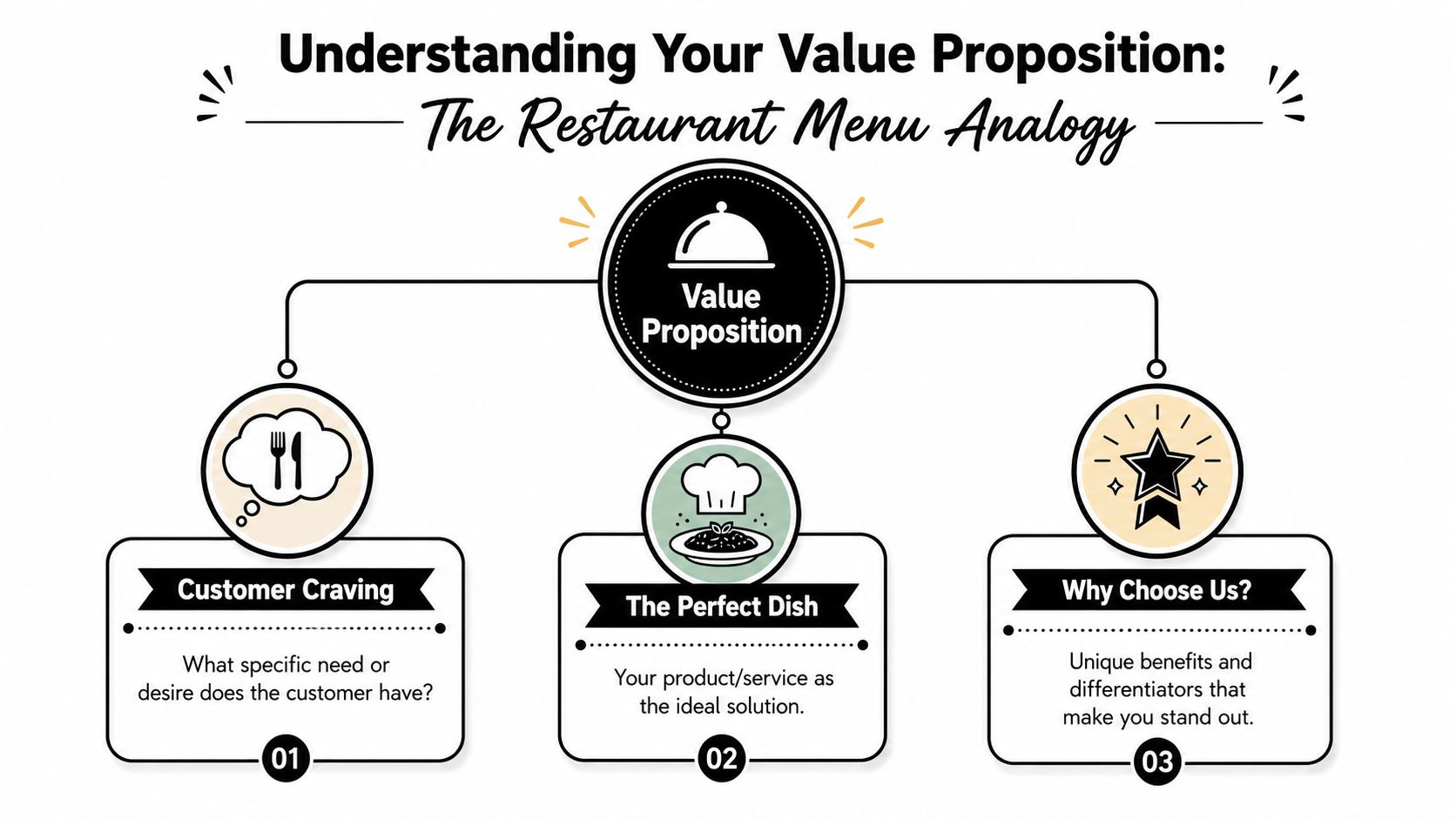
A value proposition starts with the customer's job to be done. It explains what outcome the person is trying to reach, what your product or service does to help, and why your solution is a better fit than the nearby alternatives.
That definition matters because UA managers need more than a clever line. They need a message that can be built into ads, understood fast, and tested against other message options without losing the customer's point of view.
The three parts that matter
Customer need. This is the outcome, pain point, or job the person is already trying to solve. If you skip it, the message turns inward and starts listing features that may be accurate but do not help the buyer decide.
Your offer. This is the product or service translated into a result the customer can use. Harvard Business School's guidance is useful here, because the proposition should explain what the brand does and how it differs, not just describe what is inside the product. HBS value proposition guidance
The reason to choose you. This is the difference that makes your offer worth considering instead of a similar one. Speed, ease, fit, quality, or proof can all work here, as long as the reason is credible and tied to the customer's situation.
A simple way to check the message is to write it as one sentence, then cut every word that does not help the buyer decide. If the sentence drifts into jargon, the value proposition is still too vague for creative testing. That matters even more in high-velocity video workflows, where the proposition has to stay clear while the team is building multiple hooks and variations. For a practical ad-build reference, this guide to Facebook ad creative shows how the message has to stay readable inside the creative itself.
A useful test is whether someone scrolling quickly could repeat the promise in plain language after a single exposure. If they cannot, the proposition may still be interesting, but it is not yet ready to guide production or multivariate testing.
Why Value Propositions Matter for Ad Performance
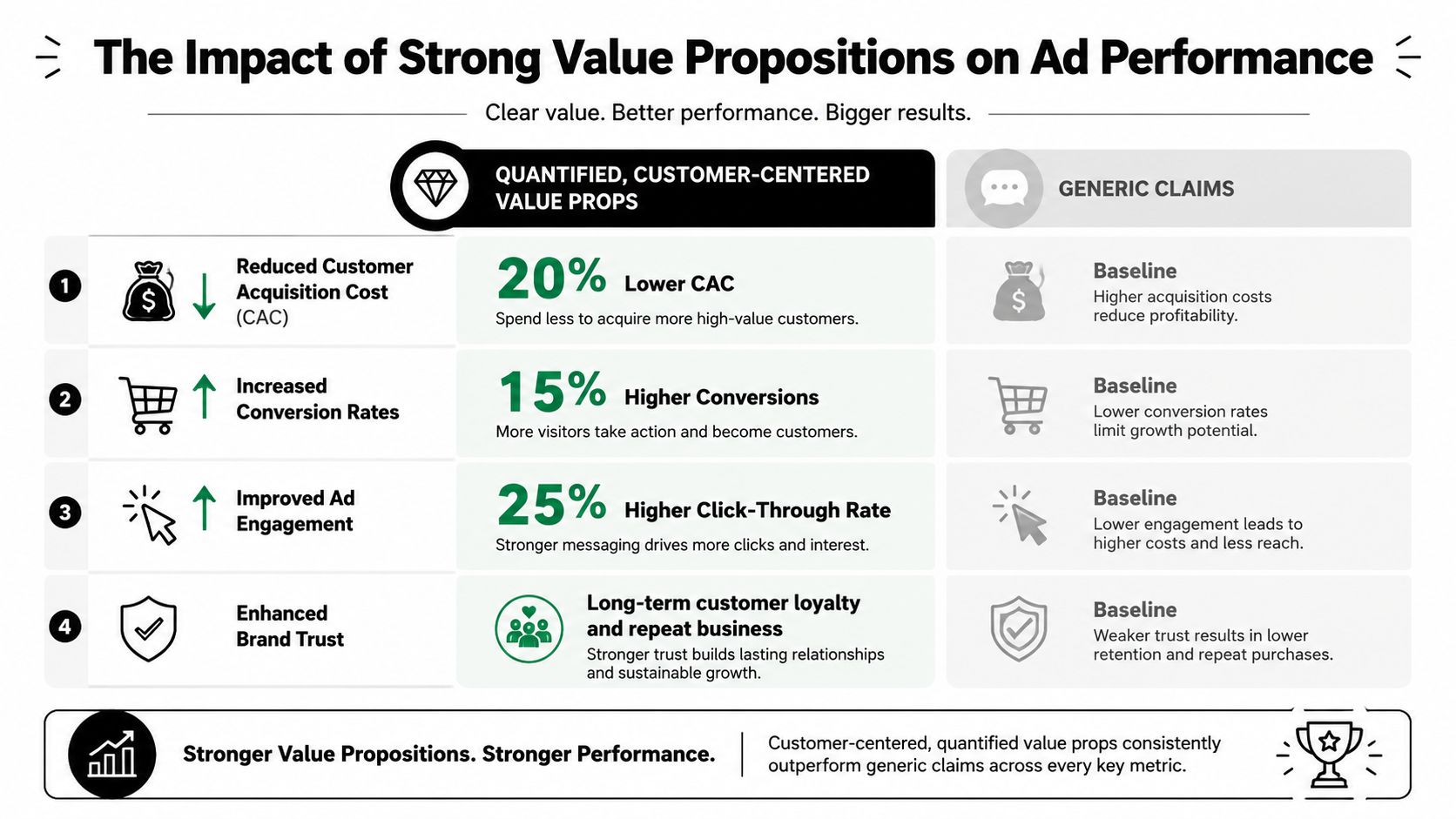
A weak proposition rarely fails in an obvious way. It usually slips into lower interest, softer clicks, and creative that never quite earns a second look. Performance marketers need to quantify the value proposition, extend existing business metrics, and ask customers to measure results, because strong propositions rest on numbers that show impact instead of descriptive language alone. MarketingProfs on quantifying value propositions
Performance platforms reward clarity, so a specific promise helps the right viewer decide quickly whether the ad applies to them. A generic promise does the opposite. It draws attention without direction, which lowers intent and makes the click less useful. In other words, the value proposition starts shaping ad quality before the user reaches the landing page.
Why generic claims waste learning cycles
Generic claims force the market to do the interpretation work. “Best solution,” “smarter workflow,” and “all-in-one platform” may sound broad enough to fit many audiences, but that is also why they are easy to ignore. A quantified, customer-centered proposition narrows the meaning and gives the viewer a reason to compare your offer with their current process.
Buyers don't reward effort, they reward relevance.
That is especially true in crowded categories where many ads look structurally identical. If the message does not define the outcome in the customer's terms, A/B tests end up measuring color changes, pacing changes, or editing polish instead of real positioning differences. The team learns which frame is prettier, not which promise is stronger. For video teams building many variants at speed, hook-body-CTA video ad structure proves useful, because the hook has to carry the promise clearly enough for the rest of the edit to support it.
What this means for CAC and ROAS thinking
You do not need a new creative style every week, you need better message hypotheses. A proposition that ties a feature to a concrete result helps reduce wasted impressions because it speaks to a specific pain point. It also improves the odds that the clicker understands what they are getting before they reach the landing page, which is where a lot of avoidable drop-off starts.
The practical takeaway is simple. Define the promise before you polish the edit. If the proposition is wrong, the ad can still look good and still underperform. If the proposition is right, even a plain execution can outperform a flashy one because the market finally sees itself in the message.
Key Frameworks and Components of Value Propositions
A value proposition works best when you can trace it from the buyer's side to the product's side without losing the thread. On one side, you have the customer's jobs, pains, and gains. On the other side, you have the product's features, the problems those features remove, and the results they create. Strategyzer's model is useful because it keeps those pieces in the same frame, so teams can check whether the promise matches what the audience wants.
How the layers fit together
Jobs-to-be-done is the task the customer is trying to complete. In UA work, this is the behavior you want to influence before you start writing about features.
Pains are the friction points, risks, and bottlenecks that make the current process slow, costly, or frustrating. If an ad does not speak to a pain the buyer already feels, the message is easy to ignore.
Gains are the outcome the customer wants to reach, the better state they are trying to get to. Strong creative speaks to those gains in plain language, without turning the promise into hype.
The product side follows the same logic. Features only matter when they remove a pain or create a gain in the customer's words. Proof points matter because buyers need evidence that the claim is real, not just polished copy. Canva's value proposition guidance pushes teams to turn features into measurable outcomes and proof points, which is the kind of evidence buyers look for before they trust a message. Canva's value proposition guidance
A useful hierarchy for video testing
Start with the customer job. Then identify the pain the product removes. Then identify the gain it creates. After that, choose the proof point that can carry the claim in an ad. That sequence keeps teams from opening with a feature the audience does not care about yet.
For video ads, that hierarchy gives each part of the edit a clear job. The hook can name the job, the body can show the pain relief, and the CTA can repeat the gain in a direct way. If you want a practical reference for those parts, this hook, body, and CTA guide helps connect the framework to the edit itself.
Rule of thumb: if you cannot map a feature to a customer pain or gain, it probably belongs in a different ad.
B2B marketing teams often get stuck because internal language sounds like capability language, while buyers think in outcome language. A product team may describe what a tool does, but the audience wants to know what changes in their day, their cost, or their result. The translation step is the work. Skipping it is why many ads sound accurate on paper and flat in market.
Examples and Templates for Ad Creatives
A good ad value proposition should sound like a promise a buyer can test, not a slogan they have to decode. In practice, that means the line has to stay short enough for a hook, clear enough for a quick read, and specific enough that a buyer can restate it in their own words. The strongest versions also make the outcome visible, so the message feels grounded rather than polished for its own sake.

Three templates you can adapt
DTC template. “For [audience] who want [outcome], [product] helps them [main benefit] without [common frustration].”
This format works well when the buyer is motivated by a clear personal gain and the problem can be named in plain language. It gives the creative team a clean promise to test in the opening line.
Gaming template. “If you're tired of [pain], [game/app] gives you [reward] with [distinctive feature].”
Use direct wording here. Players respond quickly to friction, fun, and speed, so the value proposition should read like an immediate payoff, not a brand statement that needs extra interpretation.
B2B template. “For teams that need [business outcome], [product] turns [feature] into [measurable result] with [proof point].”
This structure works well for performance teams because it keeps the claim tied to evidence. A clear outcome, paired with a proof point, gives the ad a stronger chance of surviving scrutiny from technical buyers and internal stakeholders.
Why this structure helps creative teams
Each template gives you a different starting point for a hook, body, and CTA combination. Instead of rewriting the whole ad from scratch, you can change one promise while keeping the rest of the structure stable. That makes testing easier, because you are isolating the proposition instead of mixing it with unrelated edit changes.
For a closer look at how ad sequencing gets assembled, this video ad template guide is a useful reference. It helps teams move from a message idea to a concrete build without losing the original promise along the way.
Keep the language close to how the customer already describes the problem. If they would not say it, do not lead with it.
The best teams treat these templates as starting points, not scripts. They use them to generate variants, then watch which phrasing gets the strongest response from the target segment. That approach fits video work especially well, because the proposition can be swapped into hooks, body copy, and CTAs while the rest of the creative stays controlled for multivariate testing.
Crafting and Testing Value Propositions in Video Ads
The fastest way to test a value proposition is to treat it like a sequence of small decisions, not one giant launch. First, segment the audience. Then write one clear hypothesis per segment, build the message into modular creative elements, test them together, read the winner signals, and iterate. That's the cleanest path when you're trying to move quickly without confusing message testing with editing changes.
A simple workflow for UA teams
Segment audience. Start with one customer group, not five. If you mix motives, the test results get muddy fast.
Draft hypotheses. Write down what pain, gain, or outcome you think will resonate most. The sentence should be specific enough that a teammate can disagree with it.
Integrate into modular creatives. Build hooks, bodies, and CTAs so they can be recombined. That lets you test the proposition instead of rebuilding the whole ad each time.
Launch multivariate tests. Compare multiple message angles at once when the setup is stable enough to support it.
Analyze winner signals. Look for the proposition that changes behavior, not just the edit that looks cleanest.
Iterate rapidly. Keep the winning customer insight and refine the expression around it.
One underserved point in value proposition work is proving it with evidence rather than phrasing alone. The RedF workshop overview notes that most guidance skips how to validate urgency, unmet need, and willingness to pay through experiments like fake-sales tests and keyword campaigns, which is exactly the gap UA teams run into when they jump straight to production. RedF workshop on value proposition evidence
What to watch during testing
Don't let the creative team call a proposition “winning” because it looks polished. Look for the message that changes response from the segment you care about. If possible, keep the test clean enough that you can tell whether the hook, the body, or the CTA did the work.
Treat the first round as a positioning test, not an art critique.
That mindset keeps teams from overreacting to weak early data. A good proposition can be buried by poor execution, and a slick execution can hide a weak proposition for a while. The goal is to separate those two layers as early as possible, then scale the message that proves itself in the market.
If you're already running creative experiments, this guide to testing video ad creatives is a practical companion for building a cleaner testing cadence.
Conclusion and Next Steps for High-Velocity Testing
A strong value proposition is not a tagline exercise, it is the spine of the ad. Buyers respond to promises that are specific, measurable, and credible, which is why the best frameworks all point back to the same basics, a clear customer problem, a concrete promise, and proof that the promise can hold up in market. In performance marketing, that matters because the value proposition is not just something you write once. It becomes something you test, refine, and use to guide the next creative decision.
For your next test cycle, audit three things first, the customer job, the proof point, and the exact outcome language in the hook. If any of those are vague, the creative will probably measure noise instead of message. Keep the workflow tight, one segment, one hypothesis, one measurable response. That is how UA teams separate a real message signal from a polished edit that only looks persuasive.
High-velocity video testing works best when value proposition design is part of the workflow, not a step that happens before production and disappears after launch. Treat each cut like a structured message test, where the hook, the body, and the CTA each carry a different part of the promise. The point is to learn which promise the market wants, then feed that learning back into the next round of variants.
When that discipline is built into the process, testing gets simpler and the signal gets clearer. You stop asking which version looks best and start asking which version makes the intended audience respond for the right reason.

Manson Chen
Founder, Sovran
Related Articles
Storyboard Development: Scale Video Ad Production in 2026

8 Pattern Interrupt Techniques for Video Ads