A Guide to Performance Video Ad Anatomy
Jump to a section
Let's get straight to it. A high-performing video ad isn't just a pretty piece of creative; it’s an engineered asset built for one thing: conversions. The strategic framework behind it is what we call performance video ad anatomy. This isn't some fluffy creative checklist. It's a blueprint where every single component—the hook, the body, and the call to action—is designed to work together to drive your return on ad spend (ROAS) through the roof.
What Is Performance Video Ad Anatomy?
Think of your video ad less like a painting and more like a high-performance engine. Sure, aesthetics matter, but every single part in that engine has a critical job that contributes to the final output. The ignition, the pistons, the exhaust—they all have to fire in perfect harmony. It’s the exact same with a video ad. Your hook, body, and CTA are engineered to grab attention, build genuine interest, and push for a specific action.
Once you get this, you can stop guessing why an ad failed and start diagnosing the real problem. Most of the time, it isn't one big catastrophic failure. It's usually one of the core components falling flat.
A weak hook tanks your view-through rates. A boring body destroys engagement. A muddled CTA kills your click-through rate. Each part has a job, and knowing this lets you pinpoint exactly where things went wrong.
The Core Components and Their Roles
On the surface, the framework looks simple. But beneath that simplicity are deep strategic layers that can make or break your campaigns. It’s all built on three critical parts, and mastering how they work together is essential for winning on fast-moving platforms like Meta and TikTok.
To make this crystal clear, here’s a quick-reference table breaking down each component and its function.
Core Components of a High-Performing Video Ad
| Component | Primary Function | Key Metric Impacted |
|---|---|---|
| The Hook | Stop the scroll and earn attention in the first 1-3 seconds. | Hook Rate, View-Through Rate (VTR) |
| The Body | Demonstrate value, build trust, and create desire. | Average Watch Time, Engagement Rate |
| The Call to Action (CTA) | Drive a specific, immediate action from the viewer. | Click-Through Rate (CTR), Conversion Rate (CVR) |
As you can see, each piece has a distinct objective and a direct, measurable impact on your campaign's bottom line.
Here’s a closer look at what each part does:
The Hook: This is all about the first 1-3 seconds. Its only job is to stop the scroll and buy you a few more seconds of the viewer's time. A killer hook is the difference between an ad that gets watched and one that’s instantly forgotten.
The Body: This is the middle of your ad, where you deliver the goods. You have to prove your product's value, build enough trust, and create a compelling reason for the viewer to even consider taking the next step.
The Call to Action (CTA): This is your closing argument. It needs to be painfully clear, direct, and persuasive. You have to tell the viewer exactly what to do next and give them a good reason to do it now.
A deep understanding of this anatomy is what separates the pros from the amateurs. It’s how you move from just making ads to engineering them. This is also your secret weapon against creative fatigue because you can systematically test and iterate on each piece. Got a winning ad? Try testing three new hooks against that same body and CTA to find your next top performer. This modular approach is the heart of modern advertising, a concept that a performance creative platform is built to accelerate.
Ultimately, this framework gives you a reliable system for creating, testing, and scaling your video creative. It turns ad-making from an unpredictable art form into a data-driven science, making sure every dollar you spend is on ads built from the ground up to convert.
The Science of an Unskippable Hook
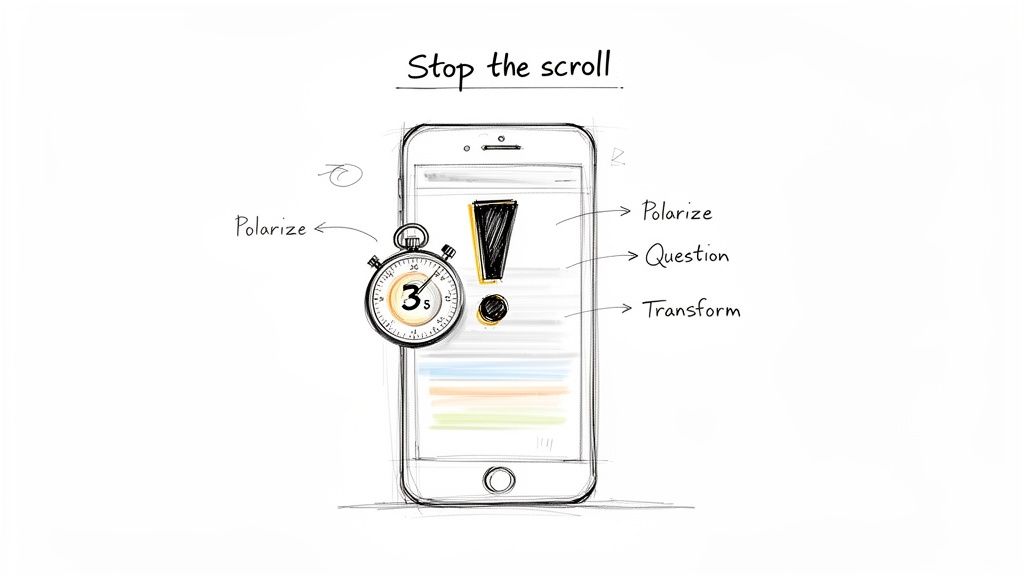
Let's be real: the first three seconds of your video ad are everything. On platforms like Meta and TikTok, users scroll with ruthless efficiency. You aren’t gently asking for their attention; you’re in a bare-knuckle brawl to earn it.
Your hook is your opening punch. Its only job is to make someone stop scrolling. If it fails, the rest of your ad—no matter how creative or compelling—is completely invisible.
This isn't random. It’s pure psychology. A great hook hijacks a viewer’s brain by breaking their mindless scrolling pattern. Think of it as a friendly but firm tap on the shoulder in a crowded room. It has to be just jarring enough to snap them out of the feed and command their focus.
An ad's fate is sealed in the first few seconds. A strong hook wins the thumb-stop; a weak one gets scrolled into oblivion. Nail this, and you've won half the battle.
A hook that works disrupts expectations. It shatters the visual and narrative rhythm of the social feed, forcing the brain to hit the brakes and figure out what it just saw. We’re not starting from scratch here; there are proven formulas designed to stop the scroll cold.
Proven Hook Formulas to Capture Attention
The best marketers don't reinvent the wheel every time. They rely on a toolbox of proven formulas that tap into predictable human psychology. Think of these as reliable starting points for any campaign.
Here are three powerhouse hook formulas you can start using today:
The Polarizing Statement: Kick things off with a bold, counter-intuitive claim. A fitness app, for example, might lead with, "Cardio is making you gain weight." This creates instant cognitive dissonance, and people will stick around just to see you back it up.
The Provocative Question: Ask a question that hits a nerve, targeting a specific pain point or desire. An ad for a budgeting app could open with, "Are you one paycheck away from being broke?" This forces a moment of self-reflection and makes the ad feel immediately personal.
The Dramatic Transformation: Show a jaw-dropping "before and after" in the very first frame. This could be a grimy rug turning spotless or a chaotic desktop becoming perfectly organized. The visual payoff is instant and deeply satisfying, promising a clear solution.
These formulas aren't just creative fluff. They are strategic weapons in the intricate machine of performance video ad anatomy. Choosing the right one is all about knowing your product and, more importantly, your audience.
The 'Pattern Interrupt' and Other Advanced Hooks
Going beyond the basics, the "Pattern Interrupt" is one of the most potent techniques in the game. This involves showing something so bizarre or unexpected that it short-circuits the viewer's scrolling muscle memory. Imagine an ad for a blender opening with someone dropping a brand-new smartphone into it. The shock value makes it impossible to look away.
Here are a few more advanced hooks to add to your arsenal:
Direct Benefit Hook: This one cuts straight to the chase. An ad for a language-learning app might start with, "Speak Spanish in your first week, guaranteed." It’s confident, result-oriented, and speaks directly to viewers who want solutions, not stories.
Problem-Agitate Hook: This is the opening volley of the classic "Problem-Agitate-Solution" framework. The hook starts by calling out a common problem ("Tired of messy spreadsheets?") and then twists the knife ("They're costing you hours and causing mistakes."). This builds the tension that the rest of your ad will resolve.
How to Systematically Test Your Hooks
You should never, ever guess which hook will work best. The only way to know for sure is to test them relentlessly. A data-driven approach means creating multiple hook variations and running them against the same ad body and call to action.
This modular testing is critical for optimizing your ad spend. By isolating the hook as the only variable, you get clean data on which opener drives the highest 3-second view rate and the lowest cost-per-result. For anyone serious about this, learning how to test video ad hooks scientifically is a non-negotiable step toward scaling profitably.
This is exactly what platforms like Sovran were built for. We allow you to rapidly assemble dozens of ad variations by mixing and matching different hooks with your core creative. This system turns creative ideation into a scientific learning loop, ensuring every dollar you spend is on hooks that are statistically proven to win attention.
Crafting the Ad Body to Build Purchase Intent
Your hook’s only job is to earn you the next few seconds. That's it. But now, the body of your ad has to do the heavy lifting. This is where you move from just grabbing attention to actually building genuine interest and intent.
Think of it this way: if your hook gets them to stop scrolling, the body is what makes them care. A weak or confusing body wastes the precious attention your hook fought for. Viewers will drop off, your watch time tanks, and your ad simply won’t persuade anyone.
The key is to deliver your message clearly and convincingly. We're guiding the viewer from a state of curiosity to one of serious consideration. To do that, we rely on a few proven narrative frameworks that are practically baked into a buyer's decision-making process.
The Problem-Agitate-Solution Framework
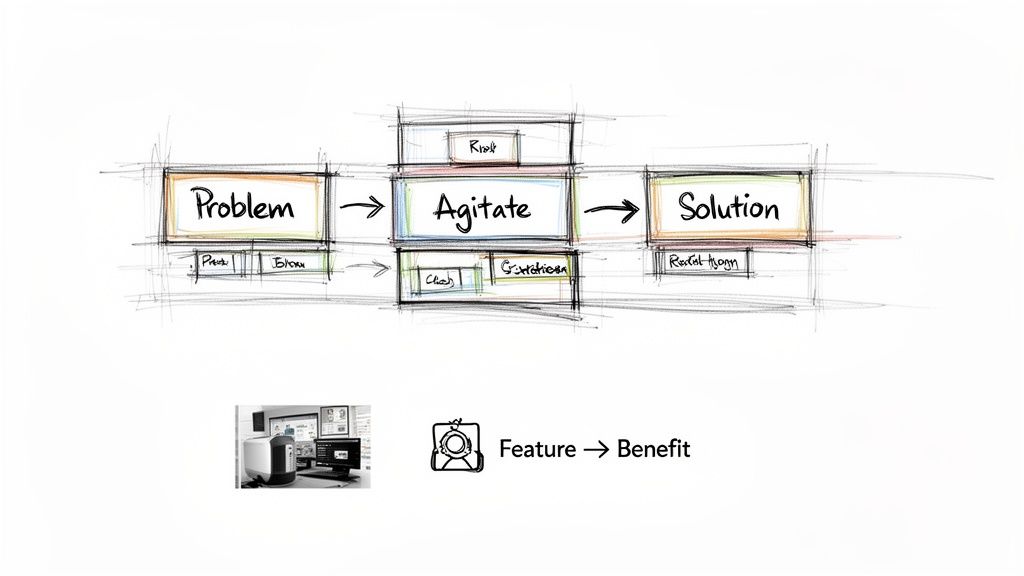
One of the most reliable structures in any marketer's playbook is the Problem-Agitate-Solution (PAS) framework. It’s incredibly powerful because it follows a natural thought process, making your pitch feel intuitive, not salesy. You're aligning with a pain point they already feel and then presenting your product as the clear way out.
Here’s the breakdown:
- Problem: Start by calling out a specific, relatable pain point your audience knows all too well. (e.g., "Tired of your phone dying by 3 PM?")
- Agitate: This is where you twist the knife a little. Remind them of the frustration and consequences that come with that problem. (e.g., "It always happens right when you need GPS or have an important call.")
- Solution: Finally, you introduce your product as the hero that saves the day. It’s a moment of relief. (e.g., "Meet the PowerBank X, the charger that lasts for three full days.")
PAS is a killer framework for products that solve an obvious, tangible problem. It creates tension and then offers a satisfying release, making your solution feel that much more desirable.
From Features to Benefits
Here’s a mistake I see all the time: marketers get so excited about their product's specs that they forget to explain why anyone should care. Customers don’t buy features; they buy what those features do for them. They buy better versions of themselves.
A feature is what your product has. A benefit is what your customer gets. The ad body must build this bridge. For instance, a "50-megapixel camera" is a feature. "Capturing crystal-clear memories of your family that you'll cherish forever" is the benefit.
An easy way to force this translation is to state a feature and then ask yourself, "so what?" That simple question pushes you to articulate the real-world value for your customer.
| Feature (What it is) | Benefit (What it does for me) |
|---|---|
| Waterproof up to 50 meters | "You can wear it swimming without a second thought." |
| AI-powered noise cancellation | "Take important calls from a busy coffee shop with perfect clarity." |
| One-click integration | "Save hours each week by connecting your tools instantly." |
This simple shift in perspective—from your product to your customer's life—makes your message hit home. If you want to see how the best brands do it, these ad copy examples are a masterclass in translating features into benefits.
The Modular Approach to Ad Bodies
The best performance creative teams don't build one-off, monolithic ads. They think in modules. The ad body becomes a swappable component in your creative arsenal.
This is a core principle of modern creative strategy. You might create one ad body using the PAS framework, a second that’s a straight-up feature-benefit demo, and a third that uses a listicle format. Then, you can test each of them against your winning hooks and CTAs.
This modular approach is the secret to scaling up your creative production and accelerating your learning. You can rapidly find winning combinations without having to re-edit entire videos from scratch.
With Sovran, you can assemble these different narrative structures in minutes, mixing and matching them with various hooks and CTAs to find the most profitable ad anatomy for your campaigns. It turns creative development into a systematic process, helping you beat creative fatigue and consistently find your next winner.
The Call to Action That Actually Converts
So you've nailed the hook and built some serious desire in the body of your ad. Great. But now comes the moment that actually pays the bills: the Call to Action (CTA). This is where you turn a passive viewer into an actual customer, and it's shocking how many advertisers fumble right at the goal line.
All that hard work getting their attention goes to waste if your CTA is weak, confusing, or uninspired.
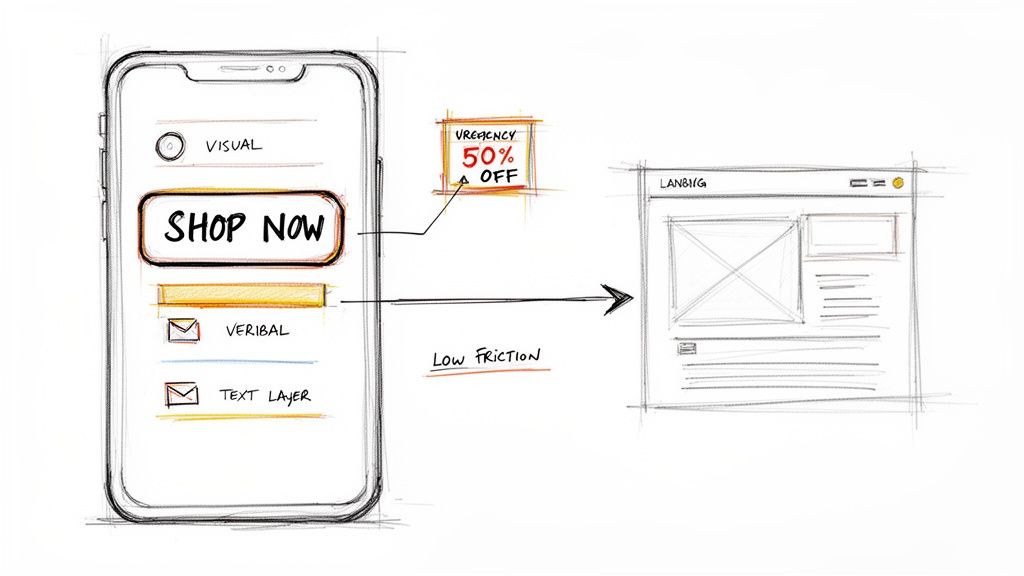
A truly killer CTA isn't just a button. It’s a clear, unmissable message that hits the viewer from three directions at once: what they see, what they hear, and the text on their screen. If these don't align, you’re creating friction. Friction kills conversions.
Think of it as a perfectly timed triple-threat. The voiceover says "Shop Now," an on-screen text overlay reinforces "Shop Now," and the platform’s clickable button prompts them to "Shop Now." This alignment makes the next step feel like the only logical thing to do.
The CTA Trifecta: Visual, Verbal, and Text
To really nail a CTA that gets clicks, you need to sync up these three core elements. Each one has a job to do, and they work best when they're all pushing in the same direction.
- Verbal CTA: The voiceover needs to explicitly tell the viewer what to do next. It's a direct command that cuts through any confusion and guides their focus. No room for ambiguity here.
- Visual CTA: The final scene of your video has to support the action. This might be a slick shot of your product, a graphic pointing toward the "Shop Now" button, or an offer card that's too good to ignore.
- Text CTA: This covers both the text overlays you bake into the video and the native CTA button the ad platform provides (like on Meta or TikTok). Make the text big, clear, and action-focused.
When these three are in perfect sync, clicking becomes a natural reflex. It just feels right. Getting this part of your performance video ad anatomy down is a non-negotiable for success.
CTA Strategies That Actually Work
Let's be clear: not all CTAs are created equal. The right one for you will depend on your product, your offer, and the specific psychological trigger you're aiming for. The ultimate goal is always to make the action feel both valuable and urgent.
Your CTA isn't just an instruction; it's the final piece of your value proposition. It should answer the viewer's silent question: "What's in it for me if I click?"
Here are a few proven strategies we see working day in and day out:
The Direct Command: This is your bread and butter. Simple, clear, action-oriented verbs like "Shop Now," "Download Now," or "Sign Up." This works best when the value proposition is already crystal clear.
The Benefit Lead: Frame the action around what the user gets. Phrases like "Start Your Free Trial," "Get Your Custom Plan," or "Claim Your Discount" focus on the reward, not the click itself. It's much more compelling.
The Urgency Play: Nothing motivates like a little FOMO (fear of missing out). CTAs like "Limited Time Offer," "50% Off Ends Today," or "Shop Before It's Gone" create a sense of scarcity that pushes people to act now instead of later.
For example, our data shows that product-focused video ads drive 42% more conversions than vague, lifestyle-based ads. This tells us that a direct, benefit-oriented CTA that clearly ties back to the product is often your safest and most effective bet. If you want to geek out on more data like this, check out the latest video marketing statistics.
Remember, the journey doesn't end with the click. The ad-to-landing page experience needs to be completely seamless. Your landing page must deliver on the exact promise made in the ad, continuing the conversation without missing a beat. To really dial in this part of the funnel, take a look at our guide on how to improve click-through rates. A strong CTA gets the click, but a congruent landing page is what closes the deal.
Adapting Your Creative for Meta and TikTok
One of the biggest mistakes we see in performance advertising is treating every social platform like it's the same audience. The perfect ad for Meta can, and often will, completely bomb on TikTok.
While the core elements of your performance video ad anatomy—the Hook, Body, and CTA—don't change, how you piece them together absolutely has to. You need to tailor your approach to fit the platform's unique culture and what its users expect to see.
Think of it this way: Meta is like a digital town square. People are there browsing content from friends, family, and brands they follow. TikTok, on the other hand, is a loud, fast-paced, immersive talent show where authenticity and of-the-moment trends are everything. Your ad can't be an awkward commercial break; it has to feel like it’s part of the show.
A winning ad feels like it belongs. On TikTok, that means raw, user-generated content (UGC) that looks like it was made in the app. On Meta, it means slightly more polished creative that gets a clear value prop across to a browsing audience.
Failing to adapt your creative is like showing up to a backyard barbecue in a full tuxedo. You might have something great to say, but no one's going to listen because you just don't fit in. The environment dictates the approach.
Key Differences for TikTok Ads
TikTok’s "For You Page" is a firehose of short, instantly gratifying videos. To have any chance of success, your ad needs to blend in perfectly with all the other organic content. That means embracing a low-fi, authentic vibe.
- Pacing and Audio: You need fast cuts, quick zooms, and popular trending audio. Your very first second has to be a pattern interrupt. A slow, cinematic opening is the kiss of death on TikTok.
- Style: Raw, phone-shot UGC or creator-led videos crush it here. Avoid glossy, over-produced corporate ads at all costs. Seriously.
- Text and Captions: Use the native-style text overlays with emojis and keep them short and snappy. The goal is to look like a video someone filmed and edited right inside the TikTok app.
When you're adapting your ads for TikTok, you also have to get the timing just right. Understanding the optimal TikTok ad lengths is a game-changer, as even a few seconds can make or break your performance.
Key Differences for Meta Ads
While Meta (Facebook and Instagram) is also all-in on short-form video, its users are still used to seeing a wider range of ad styles. You have a bit more wiggle room for polished creative, as long as it gets to the point fast.
- Pacing and Visuals: The pace can be a little slower than TikTok's controlled chaos. Clear, high-quality visuals and direct-to-camera testimonials work really well. Don't sleep on carousel videos either; they're great for showing off multiple products or features.
- Clarity: Your value proposition needs to be crystal clear. Since many users browse with the sound off, you have to lean on bold on-screen text that communicates your key benefits without needing audio.
- CTAs: The call to action is typically more direct. A benefit-driven CTA like "Get 50% Off Today" paired with Meta's big "Shop Now" button creates a super simple path for the customer to follow.
Your Platform-Specific Adaptation Checklist
Before you hit "publish" on any campaign, run your creative through this quick checklist. A few simple tweaks can make your ad feel native to each platform and have a massive impact on your results.
And for a full technical breakdown, check out our guide to social media video specs. It’s an awesome resource.
Platform Adaptation Checklist
| Element | Meta (Facebook & Instagram) | TikTok |
|---|---|---|
| Aspect Ratio | 4:5 for Feed, 9:16 for Stories/Reels | 9:16 is mandatory. Anything else sticks out like a sore thumb. |
| Pacing | Moderate pace; you can build a bit of a story. | Extremely fast; hook them in the very first second. |
| Audio | Design for sound-off; make text do the heavy lifting. | Sound is critical; use trending audio or an authentic voiceover. |
| Visual Style | Polished UGC, high-quality brand assets are fine. | Raw, authentic, lo-fi UGC style is king. |
| On-Screen Text | Clear, bold, benefit-driven headlines. | Native-style text, often mixed in with emojis and stickers. |
How to Measure and Scale Your Video Ads
Making a great video ad is really just the first step. If you're looking for real, sustainable growth, it won't come from a single lucky creative. It comes from having a solid system for measuring, testing, and iterating that turns creative development into something predictable.
Without data, you're flying blind. A good testing framework lets you stop relying on gut feelings and start pinpointing exactly which part of your video is driving results—and which part is tanking your performance. This is how you stop gambling on creative and start building a reliable learning cycle, letting you find more winning ads faster and scale your ad spend with confidence.
Matching Metrics to Ad Components
To figure out what’s working, you have to connect the right metrics to each part of your ad. Think of your ad as a mini-funnel. Each section has a specific job, and you can measure its success with a key performance indicator (KPI).
A big part of this is understanding your core business metrics, like Cost Per Acquisition (CPA). This tells you the ultimate financial efficiency of your entire ad funnel from start to finish.
Here’s a simple way to break it down:
The Hook (Seconds 0-3): Its only job is to stop the scroll. The main metric you need to watch here is Hook Rate—the percentage of people who watch at least the first three seconds. If your hook rate is low, your opener isn't strong enough to cut through the noise on the feed.
The Body (Middle of the Ad): This is where you need to hold attention and build desire. Look at Average Watch Time and View-Through Rate (VTR). If you see a big drop-off right after the hook, the body of your ad isn't delivering on the promise your hook made.
The Call to Action (End of the Ad): The CTA's purpose is to get someone to do something specific. Your most important metric here is the Click-Through Rate (CTR). A high VTR with a low CTR is a classic sign of a weak or unclear call to action.
A Practical Framework for A/B Testing
Systematic testing is what drives creative improvement. Instead of just pitting two completely different ads against each other, a modular approach gives you faster, clearer learnings. You isolate one variable at a time to see exactly what impact it has.
The goal isn’t just to find one winning ad. It’s to build a library of winning components—hooks, bodies, and CTAs—that you can mix and match to consistently produce high-performing creative.
For example, a typical testing sprint might go something like this:
- Start with one complete ad (let's call it Hook A + Body A + CTA A).
- Test different hooks: Create new versions by testing Hook B, Hook C, and Hook D, but keep Body A and CTA A the same.
- Find the winning hook: Let's say Hook C gets the best Hook Rate. It now becomes your new control.
- Test different CTAs: Now, you test CTA B and CTA C against your winning combo (Hook C + Body A).
This process lets you improve each piece of your ad methodically. The power of video really shines here, especially when you consider that viewers retain 95% of a message through video compared to just 10% from text. And with 87% of marketers confirming that video directly increases traffic and sales, having a rigorous testing system is how you squeeze every drop of potential out of your budget.
The diagram below shows what this looks like in practice, mapping out a workflow for adapting and iterating ads across platforms like TikTok and Meta.
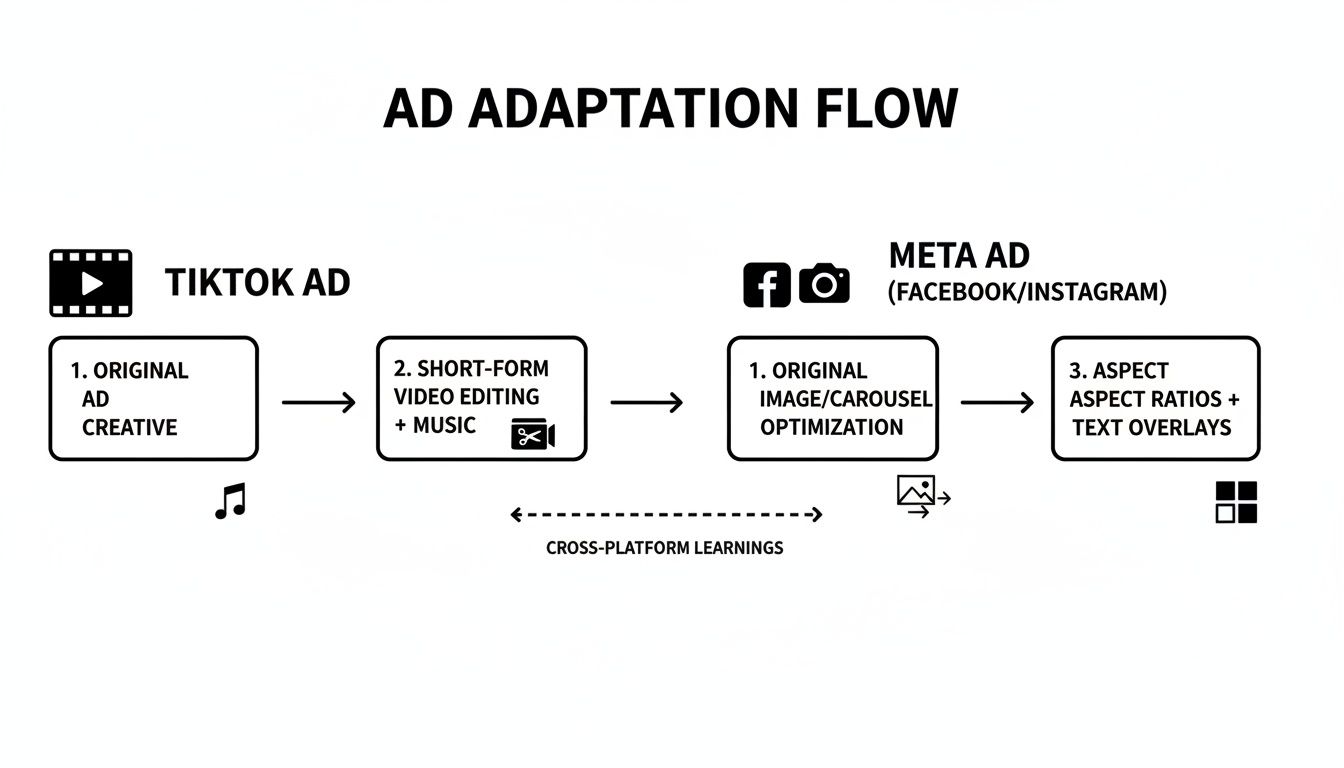
You can see how learnings from one platform can feed back into the creative strategy for another, creating a flywheel of continuous improvement.
Frequently Asked Questions
Okay, we've covered the theory behind building a high-performing video ad. But how does this all work in the real world, especially when you're up against deadlines and budgets?
Let's tackle some of the most common questions that pop up when marketers start putting these frameworks into practice.
What Is the Ideal Length for a Performance Video Ad?
Everyone wants to know the magic number, but the honest answer is: it depends. The "perfect" length is dictated by your platform and your goal.
That said, for feed-based platforms like Meta and TikTok, shorter is almost always better. We consistently see the best results from ads in the 15-30 second range. It’s just enough time to land a solid hook, deliver your core message, and hit them with a clear CTA before they lose interest.
Just remember, those first 3 seconds are everything. If you don't grab them there, the rest of the ad doesn't matter.
How Can I Test Creatives With a Small Budget?
You don't need a massive budget to find a winning ad; you just need to be smart about how you test. The secret is a modular approach. Instead of blowing your budget on five completely different ad concepts, build one solid ad and test 3-4 different hooks against it.
The hook has the single biggest impact on whether your ad lives or dies, so it’s the most efficient place to focus your spend. Once you find a hook that works, you can start testing other variables like the CTA or different body concepts. This method gives you clean, actionable data without burning through your cash.
Key Takeaway: If your budget is tight, pour it all into testing your hooks. It’s the highest-leverage move you can make to improve performance and learn what actually gets your audience to stop scrolling.
How Important Is Audio and Sound Design?
Audio is a huge piece of the puzzle, and it's one that marketers overlook all the time. Yes, a lot of people watch ads on Meta with the sound off, so captions are non-negotiable. But just relying on captions is playing defense, not offense.
On TikTok, using trending audio can make your ad feel completely native and give you a massive organic boost. On any platform, a great voiceover can inject emotion and clarity that text on a screen just can't match. Always design for sound-on, but make sure the ad still makes perfect sense with the sound off.
Ready to stop guessing and start engineering video ads that convert? Sovran automates the assembly, iteration, and launching of high-performance video ads for Meta and TikTok. Start your 7-day free trial and find your next winning creative 10x faster.

Manson Chen
Founder, Sovran
Related Articles
Demographic Targeting: A Performance Marketer's Guide 2026
- demographic targeting
- meta ads
- 3 more
Create Video Ads with AI That Perform in 2026
- create video ads with ai
- ai video advertising
- 3 more

AI UGC Video: A Guide to Scale Ads on Meta & TikTok
- ai ugc video
- performance creative
- 3 more