How to Improve Click Through Rates: Proven Tips for Ads
Learn how to improve click through rates with proven strategies: diagnose low CTR, test creatives, and optimize Meta and TikTok campaigns.
Jump to a section

Before you can fix a low click-through rate (CTR), you have to figure out what’s actually broken. Trying to improve your CTR is a bit like being a detective—it's about a systematic diagnosis of your creative hook, audience targeting, ad placements, and copy. Once you've identified the culprit, you can run prioritized, data-driven experiments to see what truly connects with your audience.
Diagnosing the Root Cause of Low Click-Through Rates
Jumping straight into A/B testing without a clear diagnosis is like throwing darts in the dark. You might get lucky, but a structured approach saves a ton of time and money while delivering results you can actually repeat. The first move is always to establish a clear baseline. What’s your current CTR, and how does it really stack up against your benchmarks?
This whole process breaks down into four core pillars: creative, targeting, placement, and copy.
This flowchart maps out the diagnostic process, starting with the element that usually has the biggest impact (your creative) and moving down to the finer details like ad copy.
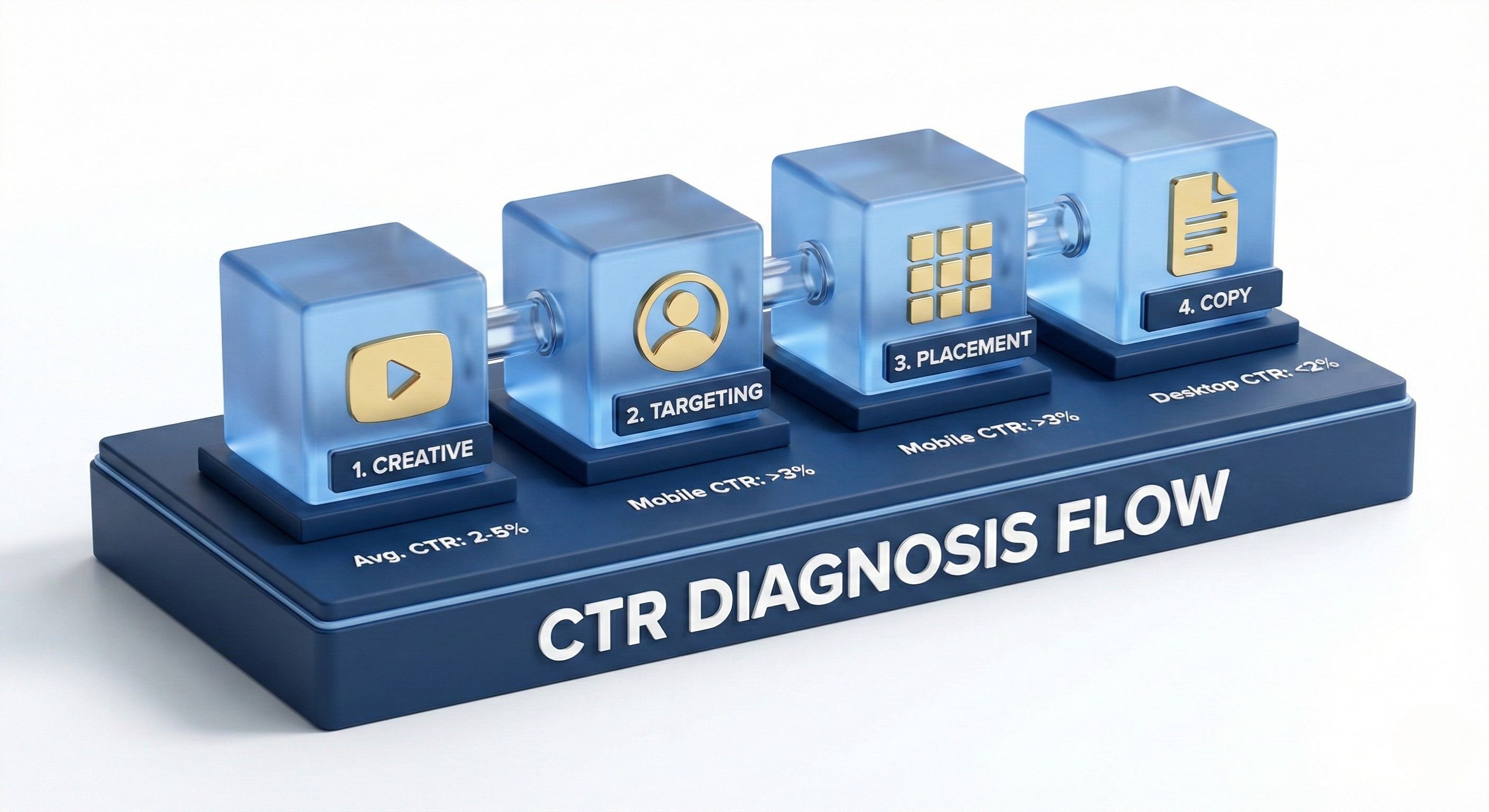
Following this flow ensures you methodically isolate each variable. It stops the random testing chaos and focuses your energy where it's most likely to make a real difference.
Analyzing Your Creative Hook
Your ad creative is, without a doubt, the single biggest lever you can pull. In a fast-scrolling feed on Meta or TikTok, the first three seconds determine whether you earn a view or get completely ignored. Is your opening a true pattern-interrupt?
Take a hard look at your video ads and ask these critical questions:
Does it stop the scroll? The initial frame has to be visually arresting or just plain weird enough to break someone's hypnotic scrolling trance.
Is the hook crystal clear? Does it immediately signal the ad's value or spark enough curiosity to keep them watching? A vague opening is a death sentence for your CTR.
Does it feel native to the platform? An ad on TikTok that looks like a polished TV commercial is going to stick out like a sore thumb—and not in a good way. It needs to feel authentic and blend in with the organic content around it.
A common mistake is to blame the algorithm when the real issue is a weak creative hook. Your ad must earn attention before it can ever hope to earn a click.
Auditing Your Audience Targeting
Even the world's best creative will fall flat if it's shown to the wrong people. A low CTR is often a flashing neon sign of a mismatch between your message and your audience.
Maybe your targeting is way too broad, blasting your niche message to a general population that simply couldn’t care less. On the flip side, your audience might be too narrow and suffering from serious ad fatigue. If the same small group has seen your ad a dozen times, they've tuned you out. Check your frequency metrics; if they're sky-high, it’s time to find new audiences or at least give them some fresh creative to look at.
Evaluating Ad Placement Performance
Heads up: not all placements are created equal. An ad that crushes it in Instagram Stories might be a total dud in the Facebook Feed or Audience Network. Lumping all your placements together in your reporting can easily hide poor performance in specific areas, dragging down your overall CTR.
Dive into your ad platform's reporting and break down performance by individual placement. You’ll often find that a few low-performing spots are eating up most of your impressions but delivering a tiny fraction of your clicks. By simply turning off these underperforming placements, you can often see an immediate lift in your campaign's average CTR.
Dissecting Your Ad Copy
Finally, let's talk about the words themselves. Your headline, body text, and call-to-action (CTA) all need to work in harmony to create clarity and urgency.
Does your headline actually grab attention and line up with the creative? Does the body copy clearly explain the benefits? Is your CTA a compelling command or a passive suggestion? A vague "Learn More" almost never performs as well as a specific, action-oriented CTA like "Get Your Free Trial." Every single word should be guiding the user toward that click.
This diagnostic framework is exactly how modern ad platforms are thinking. For instance, data from 2025 shows that Google's Performance Max campaigns, which use AI to mix and match creative elements, achieve an average CTR of 4.2%. That's a whopping 32% better than traditional search campaigns. This just goes to show how essential AI-driven testing across different assets—hooks, copy, and visuals—is for finding the winning combinations that drive clicks. You can explore the full report to see the full impact of AI on modern ad performance.
To help you put all this into practice, here's a simple checklist to guide your investigation.
CTR Diagnostic Checklist: Key Areas to Investigate
Use this checklist to systematically diagnose the root causes of underperforming click-through rates across your ad campaigns.
Diagnostic Area | Key Question to Ask | Example Metric to Check |
|---|---|---|
Creative Hook | Does the first 3 seconds grab attention and interrupt scrolling? | 3-Second Video Play Rate (Hook Rate) |
Audience Targeting | Is there a mismatch between the ad's message and the audience? | Audience Overlap, Frequency |
Ad Placements | Are certain placements underperforming and dragging down the average? | CTR by Placement (e.g., Feed vs. Stories vs. Reels) |
Ad Copy | Is the headline, body text, and CTA clear, compelling, and aligned? | Link Click-Through Rate vs. Outbound CTR |
Landing Page | Does the post-click experience match the ad's promise? | Landing Page Conversion Rate, Bounce Rate |
By working through these areas one by one, you can move from guessing to knowing, turning a low CTR into a problem you can solve methodically.
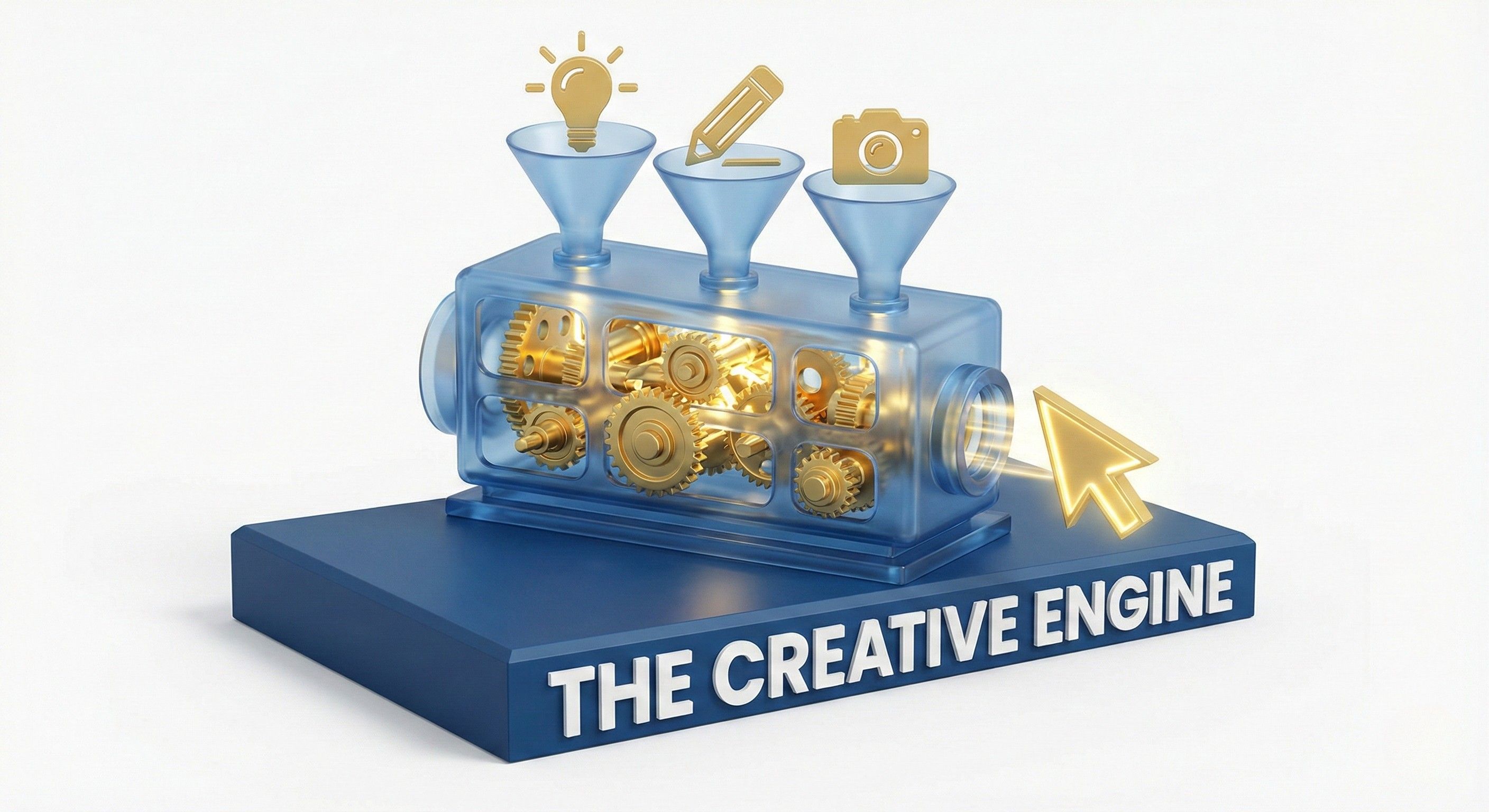
Your Creative is the Engine Driving Clicks
Once you’ve dug into the data and spotted the bottlenecks, it's time to pull the single biggest lever you have for improving click-through rates: your creative. In a noisy, crowded feed, your ad isn't just another asset; it's the entire engine that grabs attention and sparks action. Building a powerful creative engine is less about one-off viral hits and more about systemizing your production to test ideas at high speed.
It all starts with getting inside your customer's head and understanding what makes them stop scrolling.
Nail the First Three Seconds with a Powerful Hook
The first three seconds of your ad decide its fate. A weak start is a guaranteed scroll-past. But a powerful hook? That can stop someone in their tracks and make a click almost inevitable. This isn't about blind luck; it's about using proven formulas to break patterns and create instant curiosity.
Give these hook strategies a try:
Pattern-Interrupts: Open with something unexpected, jarring, or just plain weird. If you're selling durable phone cases, show a phone being dropped from a ridiculous height. It instantly proves the product's value.
Question-Based Openings: Ask a direct question that hits on a real pain point. A finance app could lead with text that says, "Still tracking your budget in a spreadsheet?" It creates immediate relevance.
Intriguing Statements: Make a bold, even counterintuitive, claim. A productivity app could start with, "You're using your calendar all wrong," which immediately makes the viewer wonder why.
A strong hook doesn't just get a view; it frames the entire ad. It tells the user, "This is for you, and it's worth your time," which is the first step toward earning a click.
The difference is night and day. A boring hook for a gaming app might just show some generic gameplay. A great hook shows a player failing a level with the text, "97% of players can't beat this boss." One is passive; the other creates a challenge.
Assemble Ads with a Modular Creative Framework
To really scale your testing, stop thinking about ads as single, monolithic videos. Treat them like LEGOs. Each ad is an assembly of building blocks: a Hook, a Body, and a Call-to-Action (CTA). This modular framework is the key to systematic testing and rapid iteration.
Imagine you have three solid hooks, two different body segments (one showing features, another with user testimonials), and two distinct CTAs. By mixing and matching, you can instantly generate 12 unique ad variations without starting from scratch.
This is exactly how platforms like Sovran operate. You upload your assets, and the AI tags them into these building blocks. From there, you can quickly assemble ads using proven frameworks like Problem-Agitate-Solution (PAS) or create mashups of User-Generated Content (UGC) without ever opening a video editor. It’s a massive accelerator for your testing velocity. For more inspiration, check out our guide on compelling https://sovran.ai/blog/ad-copy-examples to pair with your visuals.
Leverage AI for Scalable Creative Production
The latest AI tools are completely changing the creative game. Generative AI like Sora or Veo can create high-quality, compelling B-roll footage from a simple text prompt. Need a shot of someone happily using your app on a busy street? You can generate it in minutes instead of organizing a whole video shoot.
This isn't just about saving time; it’s about expanding your creative toolkit. You can generate an endless stream of fresh hooks and dynamic visuals to keep your ads from going stale. For small startups or indie developers without big creative teams, this tech enables a level of production that was completely out of reach just a couple of years ago.
The data backs this up. Video campaigns consistently blow static images out of the water. Recent benchmarks show that well-optimized video ads on Meta and TikTok can hit exceptional 2.5%+ CTRs. As the team at Quimby Digital points out, video and carousel ads can outperform static formats by up to 3x. It's a clear signal of the power of engaging, motion-based creative.
Ultimately, mastering your creative engine means building a system. It’s about combining strong hooks, a modular framework, and AI-powered tools to churn out a high volume of testable ads. This lets you learn what resonates with your audience faster, fight off creative fatigue, and consistently push your CTRs higher.
Building a High-Velocity Creative Testing Framework
Let's be real: improving your click-through rates isn't some one-and-done task you can just check off a list. It's a continuous game of iteration, learning, and staying one step ahead. The only way to get sustainable growth is by building a structured, high-velocity testing program that consistently churns out insights and performance wins. This means getting way past slow, simple A/B tests and embracing a framework for rapid, smart experimentation.
The whole idea is to create a predictable system for finding out what actually works. Instead of just throwing wildly different ads against a wall to see what sticks, you learn to isolate specific variables. That precision is everything—it's how you figure out why one ad smoked another, giving you killer insights you can roll into every campaign from here on out.

Prioritize Your Tests for Maximum Impact
Your team's time is gold, so you can't afford to chase down every single idea. A prioritized testing roadmap is your best friend here, helping you zero in on the experiments most likely to actually move the needle. I like to run this in a simple backlog, scoring each test idea on two key things:
Potential Impact: How big of a performance lift could we see if this hypothesis is right? Testing a totally new value proposition is high-impact. Tweaking a button color? That's probably low-impact.
Effort Required: How much time and resources will it take to get the assets made and the test live? A copy change is low-effort. A full-blown video production is high-effort.
Always, always go for the high-impact, low-effort ideas first. These are your quick wins. They build momentum, prove the value of testing to the higher-ups, and can even fund your more ambitious experiments down the road.
A well-oiled testing backlog flips your creative strategy from being reactive to proactive. You’re not just putting out fires; you're always working on the highest-leverage opportunities to boost that CTR.
Isolate Variables for Clean Learnings
If you want clean, reliable data, you have to test one thing at a time. It’s that simple. When you change the hook, the copy, and the CTA all at once, you have absolutely no idea which change was responsible for the lift (or the tank in performance).
Here’s what I mean by properly isolated tests:
Hook vs. Hook: Keep the ad body, copy, and CTA totally identical. Just test three different opening hooks to see which one grabs the most eyeballs.
CTA vs. CTA: Use the exact same creative and headline. The only thing you change is the call-to-action text, like "Shop Now" vs. "Get 20% Off."
Audience vs. Audience: Take your winning ad creative and run it to different audience segments. This tells you who your message is really resonating with.
This kind of disciplined approach is what makes your learnings compound. A win on a hook test informs the next batch of creative you make, making your entire program smarter over time.
Leverage Automation to Scale Your Efforts
So, what's the biggest bottleneck in a high-velocity framework? It's almost always the manual grind of creating all the ad variations. This is where automation becomes an absolute game-changer, letting you compress weeks of mind-numbing work into minutes.
Tools like Sovran are literally built for this. Instead of sitting in CapCut editing videos one by one, you can bulk-render hundreds of creative permutations automatically. Think about testing 10 different hooks against 5 body variations and 4 CTAs. Doing that by hand is a nightmare—it's just not going to happen. With an automated system, you can generate all 200 unique videos in seconds. This lets you test way more hypotheses and find winning combos exponentially faster. To see this in action, check out our complete guide on using an ad creative experimentation tool.
Keep Your Campaign Structure Squeaky Clean
A high volume of tests can turn your ad account into a hot mess, fast. If you're not careful, it becomes impossible to find, analyze, or trust your results. Clean campaign structures and strict naming conventions aren't just nice-to-haves; they are non-negotiable.
A solid naming convention should tell you the story of the ad at a glance. Something like this works well:
[Date]_[CampaignObjective]_[Audience]_[CreativeConcept]_[VariableTested]
This structure lets you filter and analyze performance in seconds without having to click into every single ad. Your ad account transforms from a junk drawer into an organized library of experimental data.
Interpret Results and Feed the Flywheel
Finally, analyzing your results is more than just picking the ad with the highest CTR. You have to make sure your results are statistically significant—meaning the performance difference is real, not just a random fluke. Most ad platforms have tools for this, but a third-party calculator works just as well.
Once you have a clear winner, you're not done. The insights from that test need to feed directly back into your testing backlog. If a certain hook style crushed it, your next test should be all about iterating on that theme. This creates a continuous feedback loop. Every test makes the next one smarter, building a powerful flywheel that consistently drives better and better performance.
Advanced CTR Tactics for Meta and TikTok
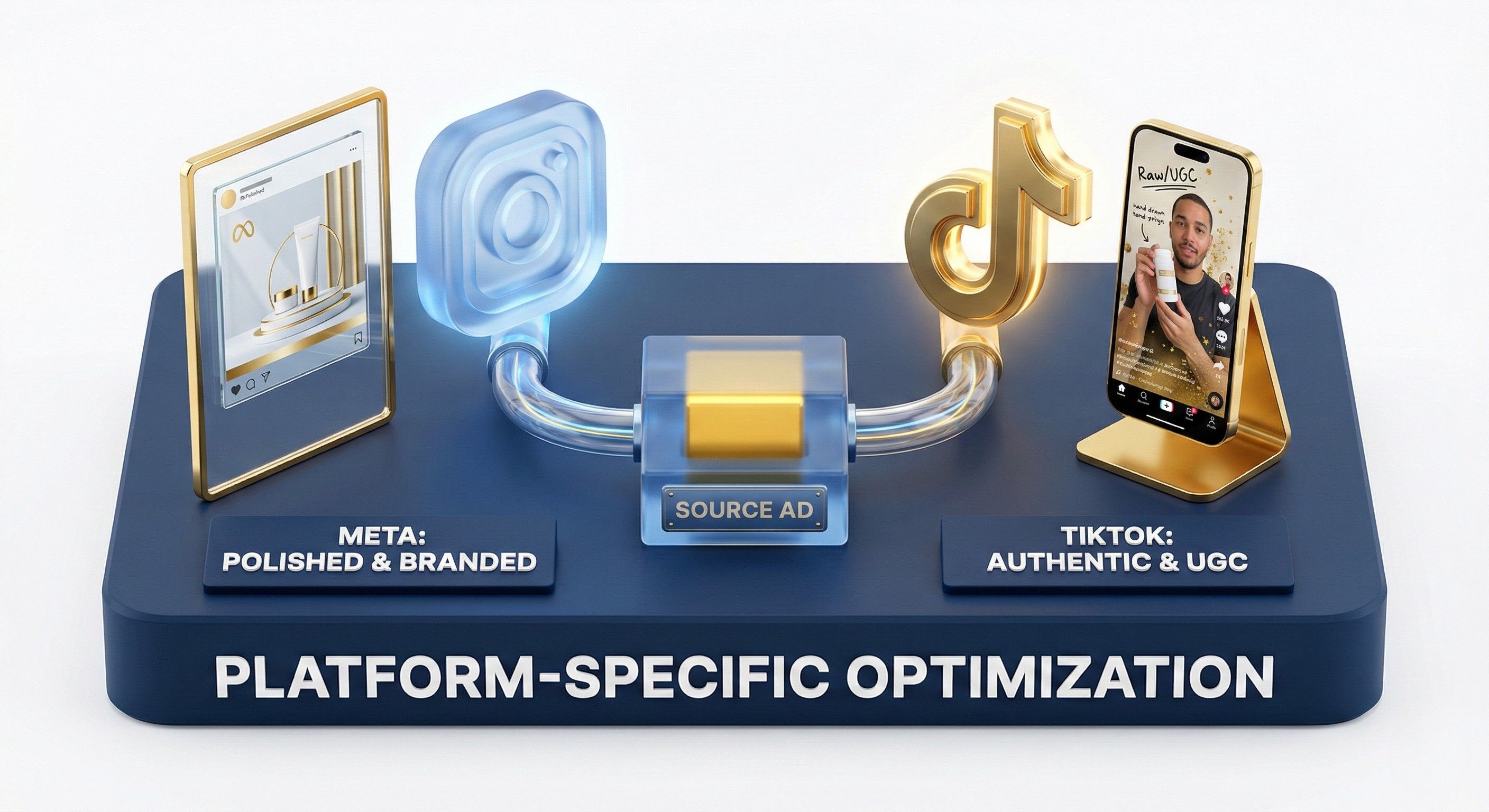
While the core principles of improving CTR apply everywhere, the real wins come from knowing the playbook for each specific platform. You simply can't treat Meta and TikTok the same and expect great results. They're entirely different worlds, each with its own user behavior, content style, and algorithm quirks.
A super polished, high-production ad that crushes it on an Instagram Feed will likely get ignored on TikTok. By the same token, a raw, user-generated-style video might feel jarringly out of place on a professional Facebook Feed. Getting these nuances right is where you unlock serious performance gains.
Driving Clicks on Meta
On Meta’s turf—Facebook and Instagram—users are generally in a "lean-back" or discovery mode. They’re catching up with friends, following brands they like, and casually browsing. Your ads need to feel like a natural part of that experience, not an annoying interruption.
One of the most powerful levers you have here is Advantage+ Placements. Instead of guessing where your ads will perform best, let Meta’s algorithm do the heavy lifting. It automatically shifts your budget to the highest-performing spots in real-time, whether that's Reels, Stories, or the good old Feed. This almost always results in a better overall CTR.
Your creative and copy also need to be in perfect sync. The visual's job is to stop the scroll, but it's the headline and primary text that give context and actually push someone to click. Lean into social proof with lines like, "Join 50,000+ happy customers" to build instant credibility. A crystal-clear, benefit-focused headline isn’t optional—it’s essential.
Winning on TikTok
TikTok is a completely different ballgame. Users are in a "lean-forward" mode, actively looking for entertainment. The number one rule is simple: Don't make ads. Make TikToks. Your creative has to feel like it belongs on the For You Page, blending in seamlessly with organic content.
This means you need to embrace a lo-fi, user-generated content (UGC) vibe. Slick, corporate-style commercials are a fast pass to getting swiped. Instead, you should be focused on:
Trending Sounds and Effects: Tapping into a popular audio track makes your ad feel relevant and familiar from the jump.
Text-on-Screen Storytelling: Most people watch without sound. Use bold text overlays to tell your story and land your main points visually.
Real Testimonials: Nothing beats a real customer sharing their genuine experience in a casual, self-shot video. It's infinitely more powerful than a paid actor reading a script.
That first second is everything on TikTok. You have a split second to grab attention. Lead with a strong visual hook, a controversial statement, or a question that makes them stop and think.
On TikTok, authenticity is the ultimate currency. An ad that feels like a genuine recommendation from a creator will always outperform one that feels like a corporate sales pitch. This shift in creative style is fundamental to improving your click through rates on the platform.
Meta vs. TikTok A CTR Optimization Cheat Sheet
Knowing the key differences in user intent and creative style is half the battle. This quick cheat sheet breaks down how to adapt your strategy for each platform to get those clicks.
Optimization Lever | Meta (Facebook/Instagram) Strategy | TikTok Strategy |
|---|---|---|
Creative Style | Polished, high-quality visuals. Lifestyle imagery and professional video tend to do well. | Raw, lo-fi, and authentic. UGC-style content that feels native to the For You Page is the gold standard. |
Hook Strategy | A visually striking image or a compelling opening scene that clearly introduces the product or problem. | An immediate pattern-interrupt. Use trending sounds, jarring edits, or bold text overlays in the very first second. |
Ad Copy & Text | Benefit-driven headlines and primary text that complement the visual. Social proof and clear offers work. | Minimal text within the "safe zones." The story is told visually or through captions, keeping it clean and easy to read. |
Call-to-Action | Direct and clear CTA buttons like "Shop Now" or "Sign Up" are standard and effective. | Softer, more integrated CTAs. Often feels like a suggestion in the video, like "Hit the link in my bio to see for yourself!" |
When you respect the unique culture of each platform, you stop just running ads and start creating content that actually connects. This tailored approach is one of the fastest ways to improve your click-through rates, making sure your message doesn't just reach people, but truly lands with them.
Measuring Success and Scaling Your Winning Ads
A high click-through rate is a great sign. It means you’ve grabbed attention. But let's be real—CTR doesn't pay the bills. The real win is turning those clicks into actual business results.
This is where we transition from testing ideas to making money. It’s all about analyzing your test results with confidence, then strategically putting your budget behind what works to fuel real growth. This last step is about building a system that turns short-term CTR wins into long-term profit.
Validating Winners and Looking Beyond CTR
Before you pop the champagne and shift your entire budget to a new "winner," you have to be sure the uplift is real and not just a random fluke. This means letting your tests run long enough to gather enough data to hit statistical significance—I always aim for a 95% confidence level, minimum.
But even then, a killer CTR can be a vanity metric. You have to look further down the funnel to see if those clicks are actually valuable.
Cost Per Install (CPI): For app marketers, a high CTR is completely useless if it drives expensive, low-quality installs. Your winning ad needs to hold or improve your target CPI.
Return on Ad Spend (ROAS): If you're in e-commerce, this is your north star. Is the ad actually making you money? A better CTR should, in theory, lead to stronger ROAS.
Uploading image...
A winning ad isn't just the one with the highest CTR. It's the creative that delivers the best downstream results for your primary business goal, whether that's efficient installs, profitable sales, or qualified leads.
Tracking these deeper funnel metrics is how you confirm that all your hard work on improving CTR is actually making an impact on the bottom line. For a much deeper look at this, our guide on how to measure your creative tests in Facebook Ads reporting gives you a complete framework.
Scaling Budgets on Winning Ad Sets
Once you’ve confidently ID'd a winner, it's time to scale. But hold on—don't just crank the budget to the max. That's a surefire way to shock the platform's algorithm and send your performance into a nosedive.
The smart way to scale is slow and steady. A good rule of thumb is to increase your ad set budget by no more than 20-30% every 24-48 hours. This gradual increase gives the algorithm time to find new pockets of your audience without kicking you out of the learning phase.
As you scale, keep a close watch on your KPIs. Is your Cost Per Acquisition (CPA) starting to creep up? Is ROAS taking a dip? These are the early warning signs of audience saturation or the beginning of creative fatigue.
Combating Creative Fatigue Proactively
Here's a hard truth: no ad works forever. Creative fatigue is what happens when your audience has seen your ad so many times they just tune it out. Your CTR will drop, costs will rise, and your star performer will quickly become a dud.
The best defense is a good offense. This is where a high-velocity testing process becomes your secret weapon. Being able to rigorously understand how to analyze content performance is essential.
By constantly feeding new, high-potential creative into your campaigns, you'll always have a validated backup ready to go. When one ad starts to fade, you simply swap in the next winner. This proactive rotation is the key to keeping your messaging fresh, your audience engaged, and your CTR consistently high.
Common Questions I Get About CTR
Even with the best playbook, you're going to have questions pop up when you're in the weeds trying to nudge that CTR number up. Let's tackle a few of the most common ones I hear from marketers.
What’s Actually a Good Click-Through Rate?
Honestly, the only right answer is: "it depends." Chasing some universal "good" CTR is a waste of time. A 2% CTR could be incredible for a super competitive e-commerce keyword on Google Search, but that same 2% would be a total flop for a branded campaign where you'd expect sky-high intent.
Context is king. What's "good" for you comes down to a few things:
Channel: The benchmarks are completely different across Meta, TikTok, and Google. Don't even try to compare a TikTok video ad CTR to a Google search ad. It's apples and oranges.
Industry: Some niches are just naturally clickier. Arts and entertainment can see CTRs around 10.67% on search, while a technical B2B field might average closer to 2.09%.
Campaign Goal: Are you running a top-of-funnel awareness campaign? Your CTR will naturally be lower than a retargeting campaign hitting people who abandoned their carts five minutes ago.
Forget industry benchmarks. The only number that matters is your own. Look at your historical performance and focus on making consistent, steady improvements from there.
How Long Do I Need to Run an A/B Test?
Patience is a virtue here. The biggest mistake I see is people calling a test the second one ad variation pulls slightly ahead after a day or two. You absolutely have to let it run long enough to hit statistical significance—that means aiming for a 95% confidence level.
As a general rule, give any test at least 7-14 days. This helps you ride out the weird daily ups and downs (weekend traffic is never the same as weekday traffic). More importantly, you need enough raw data—impressions and clicks—on each variation to know the result wasn't just a fluke.
Rushing an A/B test is just guessing with extra steps. You're making decisions based on random noise, not real data. Let the numbers roll in until you have a clear, statistically backed winner.
Why Is My CTR High but My Conversions Are Terrible?
Ah, the classic. This is one of the most frustrating problems in paid media, and it’s almost always a sign of one thing: a massive disconnect between your ad and your landing page.
Think about it. Your ad did its job perfectly—it made a promise that was compelling enough to earn the click. But the moment they landed, that promise was broken. The experience on the other side of the click didn't deliver.
Your ad is the headline; your landing page is the story. If the headline is clickbait, people will bounce the second they realize the story doesn't match.
Look for these common culprits:
Message Mismatch: The offer, headline, or even the vibe of the landing page is totally different from the ad.
Horrible UX: The page is molasses-slow, a nightmare to use on a phone, or just plain confusing.
Surprise Friction: You hit them with a giant form, unexpected shipping costs, or ask for way too much info upfront.
The fix is to create a seamless, consistent journey. The messaging, visuals, and offer need to flow perfectly from the ad to the landing page. That's how you turn that hard-earned click into an actual conversion.
Stop wasting hours on manual video editing and start scaling your ad performance. With Sovran, you can automate the production of hundreds of ad variations, test more ideas, and find winning creative up to 10x faster. Start your 7-day free trial today!

Manson Chen
Founder, Sovran
Related Articles
10 Actionable Ad Creative Ideas That Convert in 2026
Discover 10 actionable ad creative ideas for Meta & TikTok. Get hooks, scripts, and testing frameworks to boost your ROAS and combat creative fatigue.
A Modern Guide to High-Performing Facebook Ad Creative
Struggling with Facebook ad creative? This guide reveals proven frameworks, scripting formulas, and AI workflows to create ads that actually convert.
Restaurant Facebook Ads: A 2026 ROI Playbook
Master restaurant Facebook ads with real-world tactics to boost reservations, optimize targeting, and maximize ROI.