How to Create Marketing Videos That Actually Convert
Learn how to create marketing videos that drive real results. This guide covers scripting, AI-powered creation, and optimization for Meta and TikTok ads.
Jump to a section
- Why Your Video Marketing Needs A Modern Playbook
- Building Your Foundation with Strategy and a Creative Brief
- Scripting and Assembling High-Impact Video Ads
- Getting Your Assets & Production Dialed In
- Automating Editing and Variant Generation at Scale
- Optimizing and Testing Your Videos on Meta and TikTok
- Your Top Questions About Making Marketing Videos, Answered
Here's the thing: making marketing videos that actually move the needle isn't about chasing one viral hit. It's about building a repeatable system. You need to nail your audience and goals, write scripts using frameworks that work, grab your assets efficiently, and then test like crazy.
This is especially true on platforms like Meta and TikTok, where it’s all about finding what drives performance and doubling down on it.
Why Your Video Marketing Needs A Modern Playbook
The old approach of sinking a huge budget into a single, polished brand video and just hoping it works? That's over. Today's game is all about velocity, testing, and learning.
Performance-focused video marketing is a different beast. We're fighting for scraps of attention, and ad fatigue is very, very real. You can't just guess what will work; you need a systematic process for cranking out creative, seeing how it lands, and iterating on the fly.
This playbook is built for just that. It's for the growth marketers, user acquisition managers, and in-house creative teams who are on the hook for delivering measurable results. We're going way beyond basic production tips and diving into a scalable system that helps you find winning ads faster.
Before we jump in, it’s worth getting grounded in some essential video marketing best practices to make sure you've got a solid foundation.
The Core Workflow
The modern video creation process isn't linear—it's a cycle of continuous improvement. Think of it in three key phases: Strategy, Create, and Analyze. Together, they form a feedback loop that just keeps making your results better and better.
This diagram breaks down the simple but powerful workflow we're talking about.
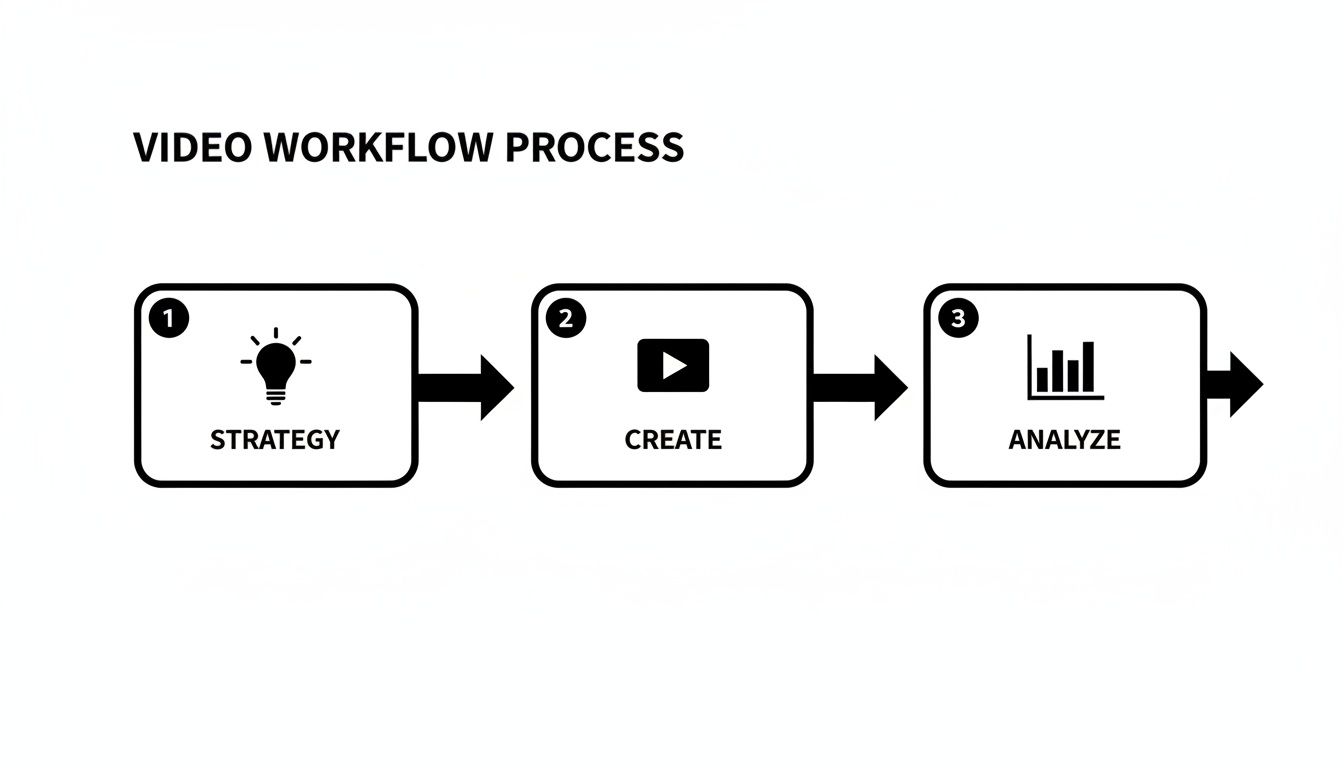
Each stage directly informs the next. This ensures your creative decisions are always backed by real data, turning video creation from a guessing game into a strategic growth engine.
Here’s a quick overview of how these pieces fit together.
The Performance Video Creation Workflow at a Glance
Phase | Objective | Key Activities |
|---|---|---|
1. Strategy | Define what success looks like and who you're talking to. | Set clear KPIs, define audience segments, create a detailed creative brief, and brainstorm core concepts. |
2. Create | Produce and assemble video assets based on the strategy. | Write scripts, capture footage (UGC, studio), source B-roll, edit videos, and generate multiple variants for testing. |
3. Analyze | Measure performance and identify what works to inform the next cycle. | Launch A/B tests, monitor key metrics (Hook Rate, CPA, ROAS), analyze winning elements, and feed insights back into the strategy phase. |
This table shows how each phase builds on the last, creating a repeatable process for finding winning ads.
What This Guide Covers
We're going to walk through the whole process, from that first spark of an idea all the way to post-launch optimization.
Here’s what you’ll learn:
Build a Solid Foundation: How to set clear goals and write a killer creative brief that keeps everyone aligned.
Script for Engagement: Using proven frameworks like Hook-Body-CTA and modular storytelling to stop the scroll.
Automate Tedious Tasks: Using tools like Sovran to handle asset tagging, video assembly, and bulk rendering automatically, which will save you a ton of time.
Test and Iterate at Scale: How to spin up hundreds of video variants to rapidly test hooks, CTAs, and messaging to find what really connects with your audience.
The goal here isn't just to "make videos." It's to build a system that consistently uncovers and scales winning creative, turning your video marketing into a predictable engine for growth.
Building Your Foundation with Strategy and a Creative Brief
Look, you can't just hit record and hope for the best. Jumping straight into filming without a plan is like setting sail without a map—you might create something that looks slick, but it won’t actually get you anywhere.
Before a single frame is shot, a solid strategy is your most valuable asset. It's the difference between a video that just exists and one that drives real business outcomes. This whole foundational stage is about asking the hard questions first. Who are we really talking to? What, exactly, do we want them to do? The answers to these questions will shape every creative decision you make, from the hook you choose to the final call-to-action.
Define Your Audience and Set Clear Goals
Your video's success completely hinges on how well it connects with a specific audience. Generic videos aimed at "everyone" almost always resonate with no one.
Start by getting into the weeds of your ideal viewer. Build a detailed persona. What are their pain points? What kind of content are they already binging on TikTok and Instagram? Knowing this is half the battle.
Once you know who you're talking to, you need to define what success actually looks like. Vague goals like "increase brand awareness" don't cut it in performance marketing. You need clear, measurable objectives.
App Installs: Trying to drive downloads for a new mobile game? Your life revolves around Cost Per Install (CPI).
Lead Generation: Is the goal to get sign-ups for a webinar? You'll be watching Cost Per Lead (CPL) and lead quality like a hawk.
Sales: Driving e-commerce purchases? Return On Ad Spend (ROAS) is your North Star, period.
A well-defined goal transforms your video from a fun creative exercise into a powerful business tool. It ensures every second of footage is working toward a measurable result, making it a hell of a lot easier to justify budgets and prove ROI.
Craft a Powerful Creative Brief
With your audience and goals locked in, it’s time to create the campaign's single source of truth: the creative brief. Don't think of this as just bureaucratic paperwork. It’s a crucial alignment tool that keeps your entire team—from copywriters to editors—pointed in the same direction. It prevents those costly, time-sucking revisions and makes sure the final video is strategically sound from the get-go.
Your brief should be concise but loaded with everything needed to guide production. It's the blueprint.
Key Components of a Creative Brief:
Objective: The single, measurable goal of the video (e.g., "Achieve a CPI of $2.50 or less").
Target Audience: A detailed description of the persona you’re going after.
Core Message: The one key takeaway. What’s your unique value proposition?
Brand Voice and Tone: Are you witty, authoritative, empathetic, or playful? Show, don't just tell—provide examples.
Mandatories and Restrictions: Include any essential brand guidelines, logos, taglines, or legal disclaimers that absolutely must be in there.
If you're looking for a better way to structure this whole brainstorming process, you can learn more about using mind maps for creative strategy to organize these ideas visually. It's a game-changer.
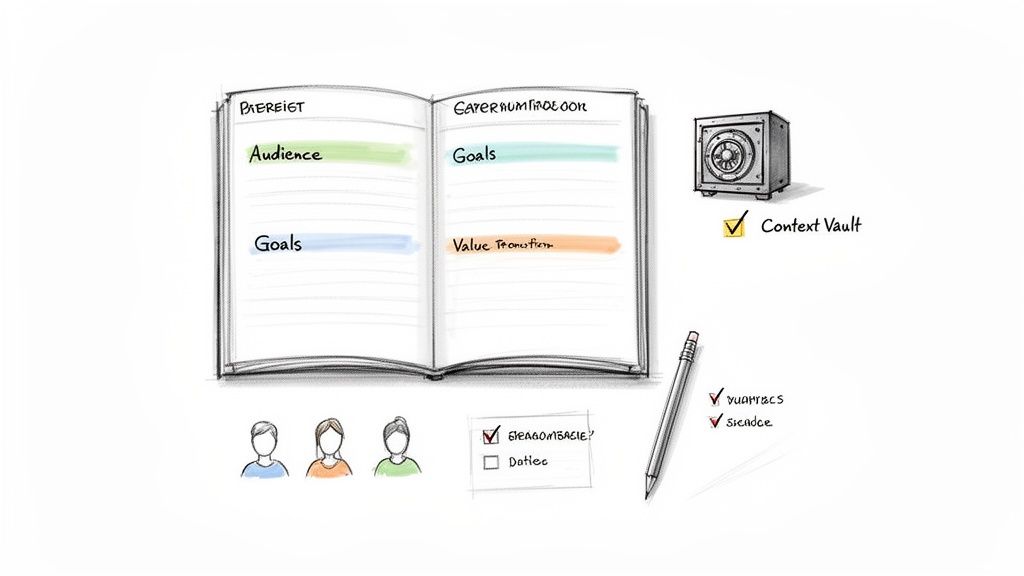
Establish Your Context Vault
To really scale your video production and keep everything consistent (especially when using AI tools), you need a centralized asset library. We call this a Context Vault.
This isn't just a dusty folder of logos. It's a living, breathing repository of everything that makes your brand unique and, more importantly, effective.
Think of it as the "brain" for your marketing. It stores your best-performing assets, ensuring that every new video is built on a foundation of what's already proven to work. This is absolutely critical for platforms like Sovran, which use this context to generate on-brand, conversion-focused video concepts for you automatically.
Your Context Vault should include:
Winning Scripts: A collection of past scripts that crushed it.
Customer Testimonials: Authentic quotes and video clips from happy users.
Brand Assets: Logos, color palettes, fonts, and style guides.
Product B-Roll: High-quality footage of your product or service in action.
By centralizing these elements, you create a powerful feedback loop. Every successful campaign enriches the vault, giving you more high-quality ingredients for the next batch of videos. This systematic approach is how you keep every piece of content on-brand and laser-focused on performance.
Scripting and Assembling High-Impact Video Ads
Once your brief is locked in, the real creative work can start. The best performance videos are almost always built on simple storytelling frameworks that grab attention immediately and push the viewer toward one specific action.
This isn't about making a short film. It's about crafting a persuasive, almost hypnotic argument in just a few seconds.
You don't need to reinvent the wheel here. Proven script structures work because they tap into basic human psychology. They create a little tension, present a clear solution, and make the next step feel like the only logical choice. Nailing these frameworks is a core skill for creating marketing videos that actually deliver.
Mastering the Hook Body CTA Framework
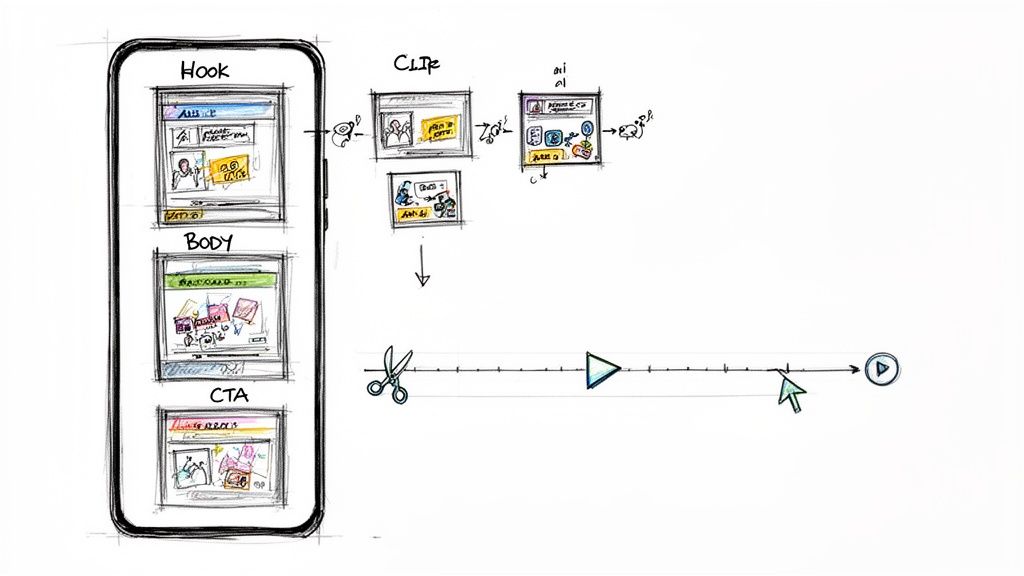
The absolute bedrock of any social media video ad is the Hook-Body-CTA framework. It’s brutally simple, wildly effective, and you can adapt it to anything.
The Hook (0-3 seconds): Your only job here is to stop the scroll. Ask a provocative question, show a surprising stat, or use a visually jarring clip. Whatever it takes to break their trance.
The Body (3-15 seconds): Now you deliver the goods. This is where you quickly explain the value, show the product in action, or build on the promise you made in the hook.
The Call-to-Action (last 2-3 seconds): Tell them exactly what to do next. Be blunt. "Download Now," "Shop the Sale," "Learn More."
This isn't just a random formula; it’s a psychological sequence. The hook buys you a few seconds, the body provides the justification, and the CTA cashes in that attention for an action.
Your hook has one job: make the viewer pause their mindless scrolling for just a moment. If it fails, the rest of your video—no matter how brilliant—might as well not exist. It's the most critical 3 seconds of your entire ad.
Proven Scripting Formulas
Within that basic Hook-Body-CTA structure, you can layer on more specific storytelling formulas to frame your message. Two of the most powerful for performance marketing are Problem-Agitate-Solution (PAS) and User-Generated Content (UGC) mashups.
Problem-Agitate-Solution (PAS)
This classic copywriting formula is lethal in video format.
Problem: State a pain point your audience feels right now. For a language app, it could be, "Tired of language apps that feel like homework?"
Agitate: Pour a little salt in the wound. Remind them of the frustration. "You spend weeks memorizing words you never use and still can't hold a real conversation."
Solution: Introduce your product as the obvious, simple answer. "Our app uses AI to create lessons from real-world conversations, so you start speaking confidently in days."
This framework hits hard because it validates the viewer's frustration first, making them much more receptive to the relief you're offering.
UGC-Style Mashups
Authenticity is the ultimate currency. UGC-style videos feel less like polished corporate ads and more like genuine recommendations from a friend. The approach is simple: just stitch together short, authentic-looking clips of different people using or raving about your product.
This format builds instant social proof. Seeing multiple people enjoy a product makes it feel like a genuine trend, not just a single paid actor. For a mobile game, you could show a rapid-fire montage of players reacting to a crazy level. For skincare, a series of "unboxing" or "before-and-after" clips works wonders.
The absolute dominance of short-form video shows why these tactics are king. New data reveals 29.18% of marketers are prioritizing formats like TikTok, Reels, and YouTube Shorts. Better yet, 63% of consumers prefer these clips to learn about products. With short-form content driving the best ROI for 49% of marketers, these quick, authentic formats are non-negotiable for hooking users fast.
How AI Changes the Assembly Game
Manually assembling these videos is a massive bottleneck, especially when you need dozens of variants for testing. Splicing different hooks, body segments, and CTAs in a tool like CapCut is painfully slow and simply doesn't scale.
This is where AI platforms are making a huge difference. Instead of thinking about your assets as finished videos, tools like Sovran treat them as modular building blocks.
You can upload all your raw footage—customer testimonials, screen recordings, product shots—and the AI automatically tags and categorizes everything. An asset is no longer "clip_04.mp4"; it's a "customer testimonial about easy setup" or a "product demo of key feature."
With this tagged library, putting together new ads becomes ridiculously fast. You can just tell the system, "Create five videos using the PAS framework. Use these three hooks, these two body segments, and this one CTA." The platform instantly assembles all possible combinations, renders them, and gets them ready to launch.
For a deeper dive into structuring your ad copy, check out our guide on how to write a compelling script for advertising. This process turns hours of manual editing drudgery into a few clicks, freeing you up to focus on strategy instead of tedious production.
Getting Your Assets & Production Dialed In
Alright, you’ve got your scripts mapped out. Now it's time to gather the raw visual ingredients for your videos. This is the asset capture phase, and it’s where a lot of teams freeze up, thinking they need a massive budget to compete.
Let's clear that up right now: you don't.
The goal here isn't cinematic perfection. It's about getting authentic, varied footage. Think of yourself as building a library of modular clips—hooks, product demos, user reactions—that you can mix and match later to create dozens, even hundreds, of ad variations.
Nailing High-Quality Footage In-House
The move to in-house production is happening for a reason. A staggering 91% of businesses now rely on video for their marketing, and 59% of them are doing it all themselves. This shift gives creative strategists and growth marketers the control they need to move at the speed of platforms like Meta and TikTok without waiting on an agency. If you want to dive deeper into the data, check out these content marketing stats.
You don't need a fancy RED camera to get killer footage. Your smartphone probably shoots in 4K, which is more than enough for social feeds. Just focus on the fundamentals.
Lighting Is Everything: Natural light is your best friend. Seriously. Find a window, and you'll get soft, flattering light that makes your footage look clean and professional. Whatever you do, avoid harsh overhead lighting.
Audio Can't Be an Afterthought: People will forgive video that’s a little grainy. They absolutely will not tolerate bad audio. A cheap lavalier mic that plugs into your phone is a game-changer. Crisp, clear audio instantly makes your videos feel more premium.
Keep It Steady: Nobody wants to watch shaky-cam footage. A simple tripod is great, but even propping your phone against a stack of books will make a world of difference.
These small tweaks can dramatically lift the quality of your raw footage without costing you much at all.
Building a Killer B-Roll Library
Your b-roll—all that supplemental footage you cut away to—is what breathes life into your videos. It’s what keeps people watching when you're explaining something, shows your product in action, and adds visual punch. A deep and varied b-roll library is one of the most powerful assets you can have for rapid-fire testing.
When you're shooting, think beyond the main shot. Get different angles of your product. Record your screen while using your app. Capture your team working. The more clips you have in your arsenal, the more creative combinations you can test down the line.
Think of your b-roll library as a visual vocabulary. The more "words" you have, the more compelling your video "sentences" can be. A rich library is the secret to churning out endless creative variations without having to reshoot every single time.
The Power of AI B-Roll and Smart Asset Management
So, what happens when you’ve used all your footage, or you need a specific visual you just don’t have? This is where AI-generated b-roll is becoming a massive unlock. Tools like Sora or Veo can create unique, high-quality video clips from a simple text prompt, giving you a nearly infinite supply of fresh content.
Need a shot of someone happily using a budgeting app on a train? You can generate it in seconds. This is a game-changer for keeping ads from going stale.
Ultimately, your biggest challenge won’t be capturing footage, but managing it. A messy folder full of files named final_v2_final.mp4 is a creative bottleneck. This is exactly why modern platforms like Sovran are built around intelligent asset management.
By automatically tagging every clip with descriptive metadata as you upload it, your library becomes a searchable database. Instead of digging through folders, you can just search for "woman smiling while unboxing product" and instantly see every relevant clip. This is how you transform video production from a chaotic, manual chore into a streamlined system built for high-velocity testing.
Automating Editing and Variant Generation at Scale
Manual video editing is where creative velocity goes to die. It turns every project into a slow grind, chaining you to repetitive chores in tools like CapCut while your competitors sprint ahead with fresh tests.
Thankfully, automation can rescue your workflow. By offloading the bulk of edits, you not only reclaim hours but also ramp up your output dramatically. In a world where speed matters, moving past manual edits is more than a “nice-to-have”—it’s essential for performance marketers.
Right now, AI-driven video tools are reshaping the industry. By 2025, 51% of video marketers will rely on AI for creation or editing—up from just 18% in 2023. The market itself is on a rocket ship, growing from $534.4 million in 2024 to over $2.5 billion by 2032. Even more telling: 96% of marketers expect AI personalization to redefine creative work. Explore more about the rise of AI in video marketing and see how teams are adapting.
Moving Beyond Manual Drudgery
The easiest win? Batch processing. Instead of opening and exporting each clip one at a time, you apply the same change across dozens of files in a single action.
Think of those recurring, time-sucking edits:
Text Overlays: Drop headlines or key value props onto your entire library with one click.
Subtitles Generation: Auto-transcribe and embed captions so your ads land even when muted.
Branding Consistency: Stamp every clip with your logo or watermark in one go.
What used to eat up hours now happens in minutes, clearing space for the creative work that really moves the needle.
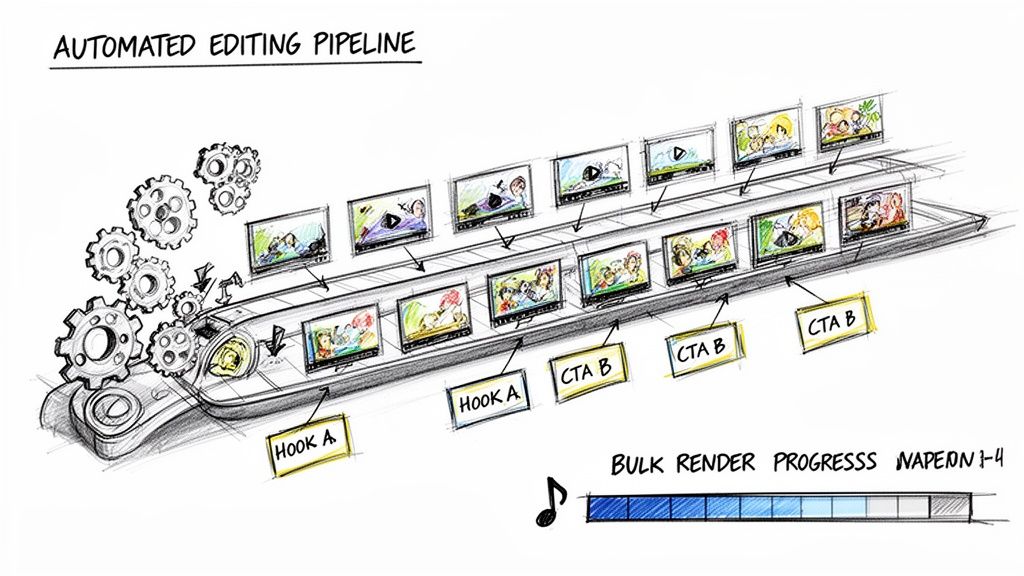
The Real Game Changer Bulk Video Rendering
Batch tweaks boost efficiency, but bulk rendering unlocks scale. Here, your tagged assets become building blocks for hundreds of unique videos—assembled in seconds.
Rather than dragging and dropping hooks, body segments, and CTAs by hand, you define each component once. Then the system grinds away, churning out every combination automatically. That shift—from crafting a single video to generating 100 testable hypotheses—is what separates the leaders from the pack.
“By treating your video assets as modular building blocks, you transform your mindset from ‘How do I make one great video?’ to ‘How do I generate 100 testable hypotheses?’”
Imagine:
5 Different Hooks: A question teaser, a shocking stat, a testimonial moment, and two other grabs.
3 Body Segments: Each spotlighting a unique product benefit.
2 Calls-to-Action: One direct “Download Now” and one softer “Learn More.”
Manually, that’s 5 x 3 x 2 = 30 videos—a soul-crushing task. But with Sovran, it’s a single command. The platform stitches together all 30 variants, fully edited and platform-ready. For a deeper dive, check out our complete guide on video ad automation software.
Unlocking Unprecedented Testing Capacity
Speed isn’t the only benefit. Automated variant generation fundamentally expands what you can test. Suddenly, you can:
Experiment with Pacing and Shot Duration: Does a rapid-fire edit beat a more measured cut?
Swap Music and Sound Design: Compare an upbeat track to an ambient score.
Tweak Visual Styles: Native, UGC flair versus polished, brand-centric footage.
With hundreds of variants at your fingertips, you’ll uncover winning creative pockets in a fraction of the time. No more guesswork—just data-backed clarity that helps you find your next winning ad 10x faster.
Optimizing and Testing Your Videos on Meta and TikTok
Alright, you've got your video variants. Now the real fun begins.
Winning at performance video isn't about just producing content; it’s a constant game of launching, learning, and iterating. This last phase is where you turn all that creative work into hard numbers on fast-moving platforms like Meta and TikTok.
Success here means optimizing every last detail for each platform's unique vibe and building a system to rapidly figure out what’s working. This is how you close the loop, turning raw data into killer insights that fuel your next creative sprint.
Platform-Specific Formatting and Best Practices
Look, Meta and TikTok are not the same playground. Each platform has its own rules, user expectations, and technical specs. Ignoring these nuances is the fastest way to get your ad ignored.
Make sure you nail these basics every single time:
Aspect Ratio is King: Go with a 9:16 vertical format, period. This takes up the most screen real estate on mobile, which is where your audience is.
Respect the Safe Zones: Both apps slap UI elements all over your video—usernames, captions, like buttons, you name it. Keep your important text and visuals away from the edges and the bottom third of the screen so nothing gets cut off.
Use Native-Style Captions: Don't just burn in boring subtitles. Use fonts and styles that look like they were made inside the app. This makes your ad feel less like an ad and more like part of the feed, which can seriously bump up engagement.
Building a Rapid Learning Loop
The whole point of this is to stop guessing what works and start knowing what works. That demands a systematic approach to testing built on clean data and quick turnaround times.
This might sound tedious, but a standardized naming convention is your best friend. It’s the foundation of clean data analysis and can save you from a world of headaches when you're sorting through dozens of campaigns.
Try a simple structure like this:[CampaignObjective]_[Date]_[Audience]_[Concept]_[HookID]_[CTA_ID]
A format like this tells you the whole story at a glance, making it easy to spot patterns. For instance, you might quickly see that Hook_03 (the question-based hook) is crushing it across multiple audiences. That’s a powerful insight you can immediately pour more budget into.
If you're targeting the App Store, you can apply similar testing principles. For a deeper dive on that, check out this guide on Mastering iOS App Store Previews for Apple's ecosystem.
Building this rapid learning loop transforms your team from a content factory into a growth engine. You’re no longer just shipping videos; you’re deploying strategic tests designed to uncover what truly motivates your audience to act.
This relentless cycle—launching variants, digging into the data, and feeding those insights back into your next creative brief—is the soul of performance-focused video marketing. It’s how you beat creative fatigue, consistently improve ROI, and stay miles ahead of the competition.
Your Top Questions About Making Marketing Videos, Answered
Even with a detailed playbook in hand, questions always come up. I get it. Here are some quick, no-fluff answers to the common hurdles teams face when they start creating performance-focused marketing videos.
What Are the Most Important KPIs to Track for Video Ads?
It's easy to get caught up in vanity metrics like views and likes, but in performance marketing, we need to be ruthless with our focus. The only KPIs that truly matter are the ones tied directly to your business goals.
For an e-commerce brand, that’s almost always Return On Ad Spend (ROAS). For a mobile app, you’re looking at Cost Per Install (CPI) or Cost Per Action (CPA) for a key in-app event.
That said, you should also keep a close eye on leading indicators like Hook Rate (the percentage of people who watch the first three seconds) and Click-Through Rate (CTR). These metrics tell you if your creative is actually doing its job—grabbing attention and getting people to act.
How Long Should My Marketing Videos Be?
This is one of the most common questions, and the answer is always: it depends entirely on the platform and placement.
For fast-paced feeds like TikTok and Meta Reels, you need to be quick. Aim for 15-30 seconds, max. These platforms are built for short, punchy content that delivers value immediately.
On YouTube, you have a little more breathing room with pre-roll ads, but those first 5-10 seconds are make-or-break. You have to earn the viewer's attention before they can hit that "skip" button.
The golden rule is this: be as long as you need to be to land your message, and not a second longer. Always, always prioritize a killer hook and a crystal-clear CTA over a longer runtime.
Can I Create Good Marketing Videos on a Small Budget?
One hundred percent, yes. In fact, you might be surprised by the results. On social feeds, authenticity often crushes high production value. Users are savvy, and they can spot a slick, overproduced ad from a mile away.
All you really need to get started is a modern smartphone, some good natural light (a window works wonders), and an inexpensive lavalier mic. That’s your capture kit right there.
The real budget savings, however, come from your workflow. Forget about massive, expensive shoots. The smart play is to build a library of reusable assets—UGC clips, screen recordings, simple product shots—and remix them into dozens of ad variations. It's about efficiency, not budget.
Ready to stop the manual grind and start shipping winning video ads faster? With Sovran, you can automate your entire creative workflow—from asset tagging and script-based assembly to bulk rendering and variant testing. Find your next winning ad 10x faster. Start your 7-day free trial on sovran.ai.

Manson Chen
Founder, Sovran
Related Articles
10 Actionable Ad Creative Ideas That Convert in 2026
Discover 10 actionable ad creative ideas for Meta & TikTok. Get hooks, scripts, and testing frameworks to boost your ROAS and combat creative fatigue.
Your Ultimate Guide to UGC Style Video Ads
Master UGC style video ads for Meta and TikTok. This guide reveals proven frameworks, scripts, and scaling tactics to boost your ROAS in 2026.
8 High-Converting Static Ads Examples for 2026
Discover 8 high-performing static ads examples from top apps. Learn to create text-overlays, testimonials, and lifestyle ads that convert.