Facebook Ads for Dropshipping Your 2026 Profit Playbook
Master Facebook ads for dropshipping in 2026. This playbook covers winning campaign structures, audience targeting, creative strategies, and profitable scaling.
Jump to a section
- Why Facebook Is Your Unfair Advantage in Dropshipping
- Building a Modern, Simplified Ad Campaign Structure
- Mastering Audience Targeting and Smart Ad Spend
- Unlocking Explosive Growth with High-Velocity Creative
- How to Analyze Ad Performance and Scale Your Winners
- Common Facebook Ads Questions for Dropshippers
When it comes to dropshipping, Facebook ads are still the most reliable way to find customers and build a profitable business. The platform's powerful algorithm and massive user base give you a direct line to people ready to buy, turning your ad spend into a real revenue stream.
Why Facebook Is Your Unfair Advantage in Dropshipping
Let's get one thing straight. While shiny new platforms pop up all the time, real success in dropshipping still comes down to one ecosystem: Meta. Facebook and Instagram aren't just for getting traffic; they are sophisticated customer acquisition machines that have gotten incredibly good at finding people who are ready to pull out their wallets.
Thinking about launching a dropshipping store without it? You might as well be leaving most of your potential customers on the table.
The numbers don't lie. A staggering 68% of dropshipping stores get the majority of their traffic from Meta's platforms, making it the undisputed king for e-commerce. Even better, dropshippers who run targeted campaigns see 32% more revenue than those who don't. You can dig into more dropshipping statistics to see the whole picture.
The real magic is in the machine learning. Once you install the Meta Pixel, you start feeding the algorithm data. It quickly learns to spot the patterns and behaviors that signal someone is about to buy, turning your ad budget from a wild guess into a calculated investment.
The Power of Creative Velocity
In today's crowded market, the single biggest thing separating struggling stores from seven-figure brands is creative velocity. This is your ability to quickly produce, test, and improve your ad creatives. The stores that win are the ones that never stop finding new, exciting ways to show off their products.
Creative is the new targeting. With broad audiences becoming the norm, the ad itself does the heavy lifting of sorting through users to find your next customer. Your ability to test more creatives is directly tied to your ability to scale.
This might sound like a lot of work, but it’s easier than ever to get up to speed. It's not about spending a week perfecting one video anymore. The focus now is on efficiency, allowing you to:
Test multiple hooks to find out what actually stops the scroll in the first three seconds.
Run different ad formats like user-generated content (UGC), problem-solution videos, or listicles.
Swap out calls to action to see what language gets people to click.
Getting this process down is how you beat ad fatigue and unlock new customer segments. The faster you test, the faster you learn, and the faster you can pour fuel on your winning ads. Nailing a few core Facebook Ads best practices from the start will give you a massive head start.
Building a Modern, Simplified Ad Campaign Structure
Let's cut through the noise. Forget those overly complicated, multi-campaign setups that just burn cash and leave you confused. When it comes to Facebook ads for dropshipping, simplicity is your best friend. A clean, streamlined campaign structure is the fastest way to find winning products and get predictable results.
The whole point is to create a methodical testing ground. This lets you quickly see what’s working and, just as importantly, what isn't—without setting your budget on fire. Instead of juggling dozens of campaigns, we're going to use a single, organized campaign to test audiences and creatives. This keeps your data clean and makes your next move obvious.
Nail the Technical Foundation First
Before you even think about spending a single dollar, your tracking has to be perfect. Seriously. Without accurate data, you’re just gambling.
Your Meta Pixel is the brain of your entire advertising operation. It’s a snippet of code that tracks what people do on your site—viewing products, adding to cart, and making a purchase. Installing it correctly is non-negotiable.
Most e-commerce platforms like Shopify have simple, one-click integrations for the Pixel. But once it's installed, you have two more crucial steps inside your Facebook Business Manager:
Domain Verification: This simply proves to Meta that you own your store’s domain. It's a required step before you can configure your conversion events.
Aggregated Event Measurement: Thanks to privacy updates like Apple's iOS 14, you have to tell Meta which conversion events matter most. For dropshipping, you'll want to prioritize your events, always putting Purchase at the very top of the list.
The flow you're aiming to build looks something like this—turning social media scrollers into paying customers.
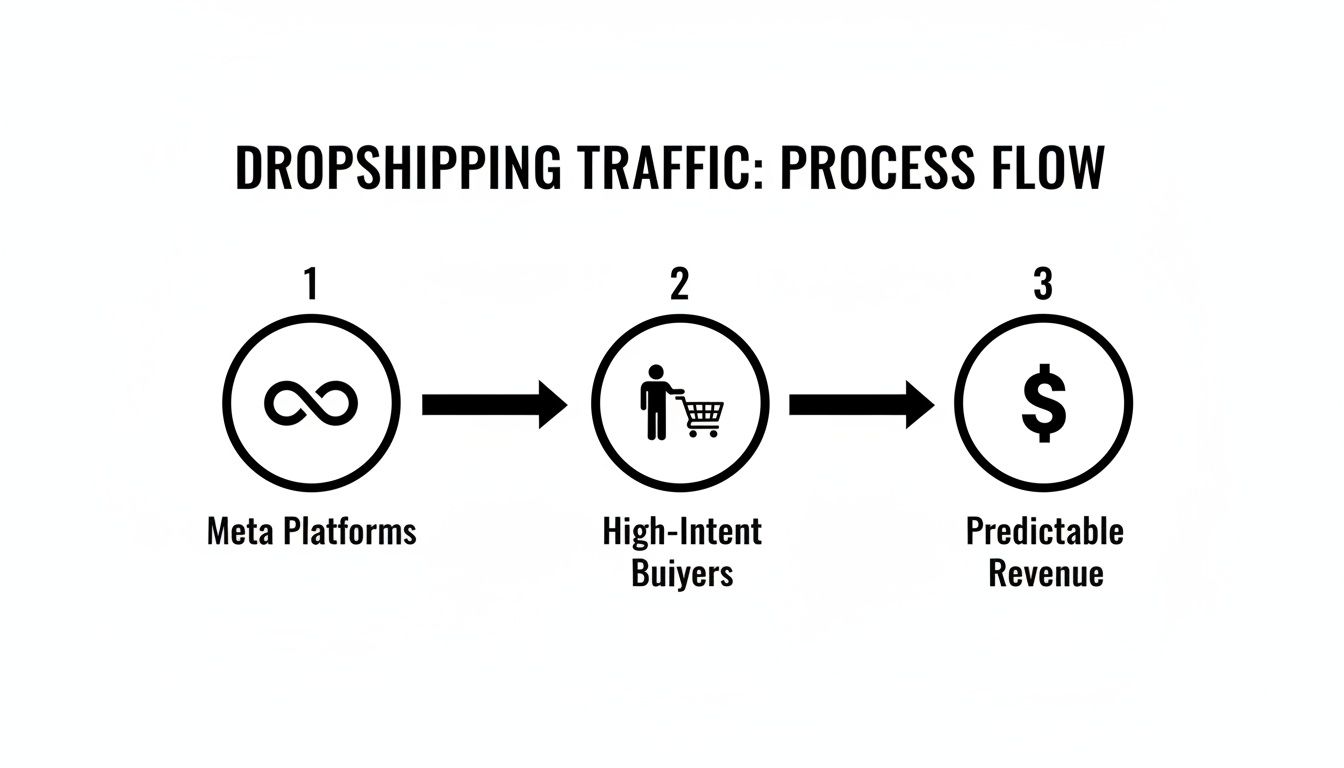
This is the end goal: using Meta's massive user base to find high-intent buyers and create a predictable revenue stream for your store.
The CBO vs. ABO Debate: Testing vs. Scaling
One of the biggest hang-ups for new advertisers is whether to use Campaign Budget Optimization (CBO) or Ad Set Budget Optimization (ABO). They each have a very specific job in a modern ad account.
Ad Set Budget Optimization (ABO): With ABO, you set a specific daily budget for each ad set. This is exactly what you want for your initial testing phase. By giving each audience a fixed budget (say, $20/day), you guarantee every audience gets a fair shot. This stops Facebook's algorithm from picking a favorite too early.
Think of ABO as your science lab. It creates controlled conditions to gather clean data on which audiences actually respond before you start pouring more money in.
Campaign Budget Optimization (CBO): With CBO, you set one budget at the campaign level, and Meta’s algorithm automatically pushes the money to the best-performing ad sets in real time. This is purely for scaling, after you’ve already found your winning ad sets and creatives through ABO testing.
Your First Dropshipping Campaign Structure
Here’s a proven, simple structure for your first testing campaign. Remember, the goal here is to gather data, not get rich overnight.
1 Sales Campaign (ABO): Start with a single campaign using the "Sales" objective. Keep it set to ABO.
3-5 Ad Sets: Each ad set will target a different audience. Don't overthink it. A good starting mix looks like this:
Ad Set 1: Broad (just age, gender, and location—that's it).
Ad Set 2: Interest Stack (e.g., "Online Shopping" + "Gadgets").
Ad Set 3: Layered Interest (e.g., "Hiking" AND "Patagonia"). This narrows the audience to people who like both.
3-5 Creatives Per Ad Set: This is key. Use the exact same set of your best video and image ads in each ad set. This way, you can see which creative works best across different audiences.
Set a daily budget of $15-$25 per ad set. This is enough to get meaningful data within 3-4 days without breaking the bank. Watch your metrics closely, looking for early winners with high click-through rates (CTR) and low cost-per-click (CPC).
Once you find an ad set and creative combination that's clearly working, you can move it into a brand new CBO campaign and start scaling up.
Mastering Audience Targeting and Smart Ad Spend
Alright, let's talk about where the real money is made on Facebook: finding your ideal customer. This isn't just about picking a few interests and hoping for the best. It's a game of starting with smart guesses and then letting your data guide you to pockets of people who are ready to buy.
We're going to build a funnel right inside your audience strategy, moving from broad cold traffic to razor-sharp retargeting and Lookalike audiences. This is how you create a predictable conversion machine.
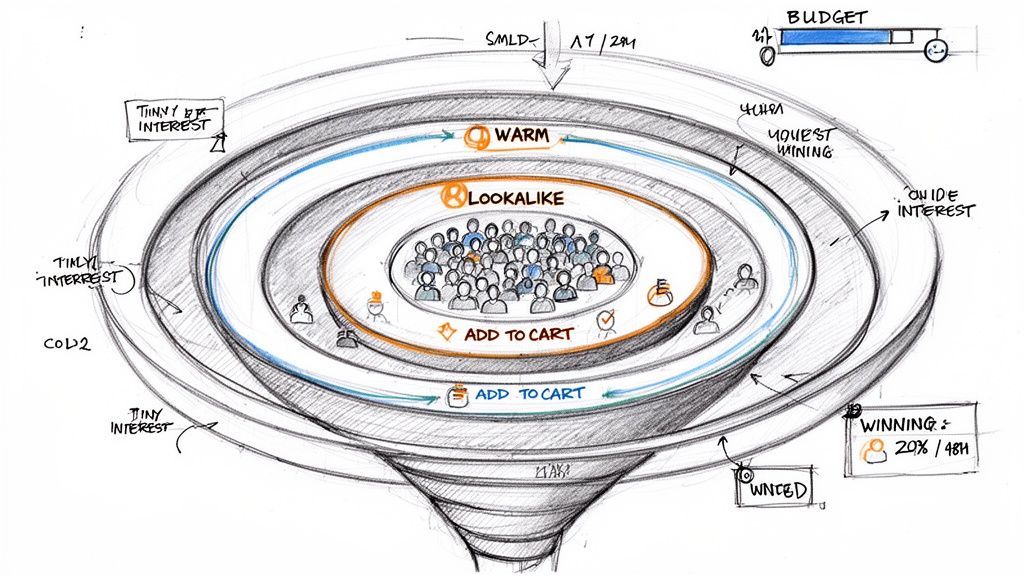
As your Pixel starts gathering data, this journey evolves fast. You'll quickly move from prospecting into building powerful Lookalike and retargeting segments that do the heavy lifting for you.
Crafting Hyper-Targeted Cold Audiences
When you're just starting out, you have zero data. Cold audiences are your only play. But "cold" should never mean "random."
Forget targeting huge, generic interests like "Shopping." That audience is filled with millions of low-intent window shoppers. The secret is to get specific by layering your interests. This just means you tell Facebook to find users who match Interest A AND Interest B. This one "and" condition is a game-changer for refining your audience quality.
Let's look at a real-world example. Say you're dropshipping a high-end portable coffee grinder.
Poor Targeting: "Coffee" (Way too broad)
Good Targeting: "Coffee" + "Camping" (Better, but still a bit wide)
Hyper-Targeted: Users interested in "James Hoffmann" (a coffee authority) AND also interested in "Backpacking" (a very specific outdoor activity).
See the difference? This layered approach finds that small but passionate overlap between two niches. You're putting your product in front of people who are practically guaranteed to be interested.
Graduating to Data-Driven Lookalike Audiences
Once your Pixel has some data cooking, your main focus should shift to Lookalike Audiences. For scaling a dropshipping store, these are hands-down the most powerful tool in Facebook’s entire arsenal. You're essentially giving Facebook a list of your best customers and telling it, "go find me millions more people just like them."
You should start building these as soon as you hit some key data milestones. Don't wait.
"Add to Cart" Lookalike: Build this as soon as you get 100-200 Add to Cart events. This is your first real step into higher-quality prospecting.
"Initiate Checkout" Lookalike: Once you have a similar number of checkout initiations, create this audience. These people are even one step closer to buying.
"Purchase" Lookalike: This is the absolute gold standard. As soon as you hit at least 100 purchases from a single country, create a 1% Lookalike Audience from that list. This will almost always become your top-performing cold audience.
Key Takeaway: A 1% Purchase Lookalike Audience is a literal blueprint of your perfect customer. The algorithm reverse-engineers a new audience of people who look and act just like your existing buyers. It’s the closest thing to a "money button" you'll find.
Smart Budget Management: A Rule-Based System
Incredible targeting means nothing if you blow your budget on losing ads. You need a strict, rule-based system for when to kill an ad set and when to scale a winner. This takes the emotion out of media buying and forces you to follow the data.
First, you have to know your numbers. Specifically, your break-even ROAS (Return On Ad Spend). If your product costs you $25 to source and you sell it for $75, your profit is $50. Your break-even ROAS is 1.5x (that's $75 revenue / $50 ad spend). Anything above that is pure profit.
With your break-even number locked in, here are the simple rules for managing your ad sets:
The Kill Rule: If an ad set spends 1.5x your target CPA (Cost Per Acquisition) without a single sale, turn it off. Immediately. No "waiting to see what happens."
The Scaling Rule: If an ad set is solidly profitable (let's say over 3x ROAS) for 48 straight hours, increase its budget by 20%. Don't get greedy and double it—slow and steady increases keep the algorithm happy and stable.
The Observation Rule: What about ad sets that are just breaking even or slightly profitable? Let them run. They're gathering valuable data and might find their groove. Don't touch them unless they start consistently losing money.
This systematic approach to your budget and audiences is the core of any successful paid social media strategy. It gives you a reliable framework to grow your store without just gambling your money away.
Unlocking Explosive Growth with High-Velocity Creative
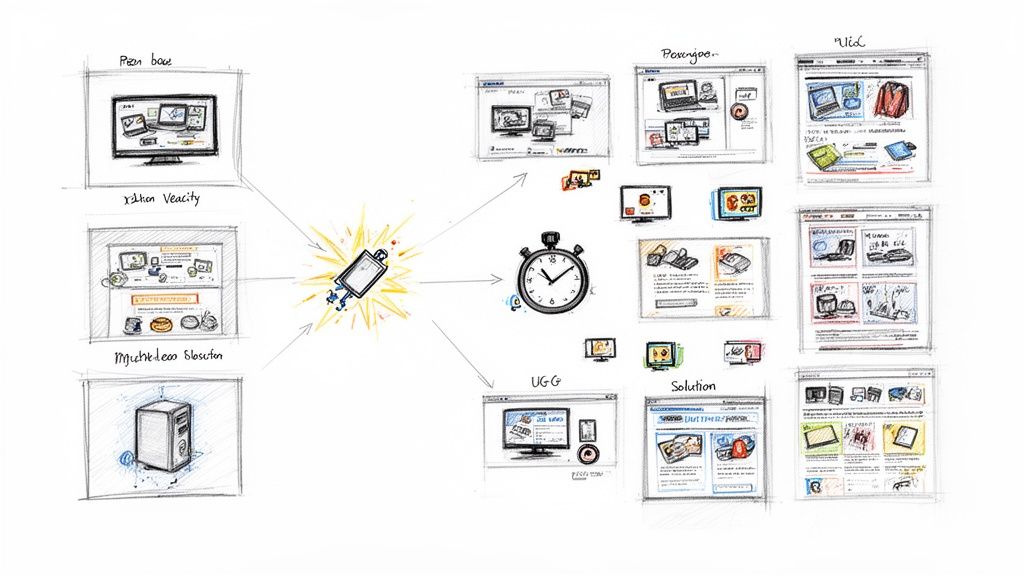
We've all been told that audience targeting is everything. But in today's crowded feed, your single biggest advantage isn't just who you target—it's what you show them. The ad creative itself has become the primary tool for sifting through users and finding your next customer.
This is why a relentless pace of testing new ads is absolutely essential for scaling.
Welcome to the concept of high-velocity creative. This is the engine that powers modern, scalable Facebook ads for dropshipping. Forget about spending a week trying to create one perfect, cinematic ad. It's about rapidly producing and deploying a huge volume of creative variations to fight ad fatigue, discover new winning angles, and unlock scaling opportunities you'd otherwise miss.
Why Speed Beats Perfection
Let's be real: the average user's attention span is brutally short. An ad that crushes it today could be totally invisible in two weeks. This quick decay, what we call ad fatigue, is the biggest killer of any scaling campaign.
The only way to beat it is to consistently feed the algorithm fresh, engaging content.
High-velocity creative is your answer. The whole point is to shift from spending days manually editing a single video to launching dozens of data-driven tests in just a few minutes. This approach massively increases your chances of finding a breakout ad that just clicks with the algorithm and your audience.
Creative is now doing the heavy lifting that targeting used to. A powerful video ad can make a broad audience profitable, while a weak creative will fail even with the most specific targeting. Your ability to test more creatives is directly tied to your ability to scale.
Winning Video Ad Formulas for Dropshipping
The good news? You don't need a film degree to make ads that convert. The most successful dropshipping ads almost always follow proven formulas designed to grab attention and push for a sale.
Here are a few high-impact frameworks you can build your ads around:
Problem-Solution Narratives: Kick things off by showing a relatable problem your ideal customer deals with. Agitate that problem a bit to make it feel urgent, then immediately present your product as the perfect, must-have solution.
User-Generated Content (UGC) Compilations: This is gold. Stitch together short clips from real customers (or influencers who look like customers) using your product. UGC builds instant trust and social proof, making it one of the most powerful formats for Facebook ads for dropshipping.
Viral-Style Listicles: Think "3 Reasons This Kitchen Gadget is Going Viral" or "5 Ways I Use My New Travel Pillow." This format feels native to social media feeds and hooks viewers with pure curiosity.
The real key here is to test endless variations of each. Try a different problem hook, feature another customer testimonial, or just change the headline on your listicle. Every single variation is another shot at finding a massive winner.
Achieving Creative Velocity with AI
So, how in the world do you produce this much content without burning out your team or your budget? The answer is using modern AI-powered creative platforms. These tools are built for one thing: speed and iteration. They turn the creative process from a frustrating bottleneck into a genuine growth accelerator.
Imagine uploading a handful of raw product clips and instantly generating hundreds of ad variations. AI can automatically remix these clips into different ad formulas, testing countless combinations of:
Hooks: Different first-three-second scenes to see what actually stops the scroll.
Body: Showcasing a variety of product features and benefits.
Calls to Action (CTAs): Swapping out end cards to test different offers or commands.
This is a fundamental shift in workflow. Instead of being a manual video editor, you become a creative strategist. You're the one guiding the AI to produce tests based on your data and insights. Curious about how this works in practice? You can learn more about how an AI shorts maker can automate much of this process.
To keep a rapid testing cycle going for your ad creatives, you can also lean on modern solutions like using AI generated models to quickly produce diverse product showcases. This allows you to generate fresh, high-quality visuals on demand, which perfectly complements your high-velocity workflow by giving you an endless supply of new imagery for your campaigns. When you automate asset production, you get to focus on strategy and scaling your winners.
How to Analyze Ad Performance and Scale Your Winners
Getting your ads live is just the first step. The real money in dropshipping is made by knowing how to read the data, make smart calls, and scale your winners without tanking their performance. This is where you transform the numbers in Ads Manager into a predictable profit engine.
It's easy to get lost in a sea of data, but honestly, you only need to keep an eye on a few key metrics to know what's really going on. Forget the vanity stuff; focus on the numbers that directly impact your bank account.
These are the metrics I live by when evaluating ad performance:
ROAS (Return On Ad Spend): Your north star. It’s the simplest way to see if you're making more than you're spending.
CPA (Cost Per Acquisition): How much you're paying for a single sale. You have to know your product margins cold to know what a "good" CPA is for your store.
CTR (Click-Through Rate): This tells you if your creative is doing its job and stopping the scroll. A CTR under 1% is usually a red flag that your ad is boring.
CPC (Cost Per Click): How much each click costs. High CPCs can drain your budget and kill your profitability, even if you have a decent conversion rate.
Together, these numbers give you the complete story, from the first impression right through to the final sale.
Decoding Your True Profitability
One of the biggest traps for new dropshippers is trusting the ROAS inside Facebook Ads Manager as gospel. It's not. With all the privacy updates and attribution delays, Facebook almost always underreports your sales. I've seen it time and time again—your actual ROAS is often 15-30% higher than what the dashboard shows.
This is what we call the "attribution gap." It means an ad set that looks like a failure at 1.5x ROAS in Ads Manager could actually be hitting your 2x break-even target. To get a real grip on your numbers, you absolutely must implement server-side tracking like the Meta Conversion API. It helps close that gap by capturing more conversion data, giving you a much clearer picture of what's actually working.
Pro Tip: Before you even think about launching an ad, calculate your break-even ROAS. Say your product costs you $20 and you sell it for $60. Your profit is $40. If you spend $40 on ads to get one sale, you break even. That’s a 1.5x ROAS ($60 revenue / $40 ad spend). You have to know this number.
Looking ahead, scaling dropshipping ads in 2026 requires hitting a 3–4x ROAS benchmark. In today’s competitive markets, anything less is a slow bleed. With average ecommerce conversion rates hovering around 2–3%, your $5–$20 CPMs need to turn into clicks that cost $0.50–$1.50 to stay profitable. As a rule of thumb, you often need to put about £100 behind an ad set to get enough data. If you’re seeing a 4x ROAS by day 5–7, that’s a green light to start scaling up toward £450.
Rule-Based Scaling Methods
Okay, so you've found a winning ad set. Now what? The worst thing you can do is just double the budget and pray. That’s how you send a good ad set straight back into the learning phase and destroy its momentum.
Instead, you need a disciplined, rule-based system.
Here are the two main ways we scale:
Vertical Scaling: This is the most straightforward method. You just slowly increase the budget on your winning ad set. The key here is slowly. As a general rule, never increase the budget by more than 20-30% every 48 hours, and only if your ROAS is holding strong above your target. This keeps the algorithm happy.
Horizontal Scaling: This is where you take your winning ad (the creative and audience combo) and duplicate it to find new customers. You can launch the winner into new, but similar, interest audiences. Even more powerful is duplicating it into new Lookalike Audiences. For example, taking a winner from a 1% Purchase LAL and launching it in a new ad set targeting a 1-2% Purchase LAL.
This approach takes the emotion and guesswork out of scaling. You’re not making decisions based on a gut feeling; you’re following a clear set of rules based on hard data. This is how you take one winning ad and turn it into a consistent, long-term source of growth for your store.
Common Facebook Ads Questions for Dropshippers
Even with the best playbook, you're going to hit roadblocks with Facebook ads. It's just part of the game. Questions pop up, campaigns stall, and it can feel like you're just lighting money on fire.
Let's tackle some of the most common questions we see from dropshippers every day. These are the straightforward, no-fluff answers you need to get unstuck and back to scaling.
How Much Should I Spend on Facebook Ads When Starting?
When you first launch, your job isn't to get rich overnight—it's to buy data. You need to feed Facebook's algorithm enough information to find your ideal customer, and that costs a little bit of money.
A solid starting budget is $20-$50 per day for each ad set you're testing. We typically see success running 3-5 different ad sets at $20/day each, which puts your total daily spend around $60-$100. Let it run for at least 3-5 days before you touch anything. You need that time to get a clear picture.
Watch your metrics like a hawk during this phase. If an ad set is getting cheap clicks and a bunch of "Add to Carts," let it ride. If it turns profitable, you've got a winner you can start scaling. But be aggressive with the losers—if an ad set eats up more than your target cost-per-purchase without a single sale, kill it. No mercy.
What Is a Good ROAS for Dropshipping?
For dropshipping, a 3x Return on Ad Spend (ROAS) is generally the magic number. This means for every $1 you put into ads, you get $3 back in revenue. Hitting 3x usually means you're breaking even after accounting for your product costs, shipping, and other overhead.
A ROAS below 2x is almost always a red flag. It’s a sign that something in your funnel is broken—it could be the ad creative, the audience targeting, or a conversion killer on your product page.
Now, if you see a ROAS of 4x or higher, that's your green light. It’s a powerful signal to start pouring fuel on that fire and scaling that ad set aggressively. Also, keep in mind that Facebook Ads Manager isn't perfect; it often underreports sales. Your true ROAS could easily be 15-30% higher than the dashboard shows, so factor that into your decisions.
My Ads Get Clicks but No Sales. What Should I Do?
This is probably the most frustrating problem in e-commerce, and the culprit is almost always after the click. If your ads are getting clicks, your targeting and creative are doing their job. The breakdown is happening on your website.
Here’s a quick audit to run when this happens:
Look at Your Landing Page: Is it professional? Does it load quickly on mobile? You absolutely need high-quality product images, a description that sells the outcome (not just the features), and real social proof like customer reviews.
Check Your Pricing & Shipping: Surprise shipping costs at checkout are the #1 reason people abandon their carts. Be upfront and transparent about all costs.
Review Your Message Match: The ad makes a promise. Your landing page has to deliver on it instantly. If someone clicks an ad for a "50% Off" sale and can't find it on the page, you've lost their trust and the sale.
Re-evaluate Your Audience: You might be attracting people who are just curious, not ready to buy. Try tightening your interest targeting to people with higher purchase intent, or build Lookalike Audiences from valuable events like "Add to Cart" or "Initiate Checkout."
How Can I Make Better Video Ads Without Being an Editor?
The secret to winning with video ads isn't becoming a master video editor. It’s about achieving creative velocity—your ability to test ideas and variations at speed. You don't need to spend hours in complex software.
This is where AI-powered creative platforms have become a total game-changer. The workflow is simple: you upload your raw product clips, and the AI instantly generates hundreds of ad variations using proven frameworks like Problem-Agitate-Solution or UGC-style edits.
It lets you test dozens of different hooks, calls-to-action, and music tracks in minutes. This shifts your job from being a manual editor to a creative strategist, focusing on the big picture while the machine handles the tedious work. It’s how you discover what actually resonates with your audience and drives sales, faster than ever before.
Ready to stop wasting time in video editors and start testing at scale? Sovran is an AI platform that automates the production and iteration of performance-focused video ads for Meta. Upload your clips, and our AI generates hundreds of variants in minutes, helping you find winning creatives up to 10x faster. Start your 7-day free trial today at Sovran and see the difference.

Manson Chen
Founder, Sovran
Related Articles
A Modern Guide to High-Performing Facebook Ad Creative
Struggling with Facebook ad creative? This guide reveals proven frameworks, scripting formulas, and AI workflows to create ads that actually convert.
Restaurant Facebook Ads: A 2026 ROI Playbook
Master restaurant Facebook ads with real-world tactics to boost reservations, optimize targeting, and maximize ROI.
10 Facebook Ads Best Practices for Unstoppable Growth in 2026
Discover 10 actionable facebook ads best practices for 2026. Master targeting, creative, and bidding to scale your campaigns and maximize ROI. Read now!