A Paid Social Media Strategy That Actually Scales
Build a paid social media strategy that delivers real ROI. Learn how to master audience targeting, creative testing, and campaign scaling on Meta and TikTok.
Jump to a section
- Building a Foundation for Profitable Paid Social
- Mastering Audience Targeting on Meta and TikTok
- Developing a High-Velocity Creative Workflow
- Structuring Campaigns for Clarity and Scale
- Implementing a Rigorous Testing and Iteration Loop
- Measuring Performance and Scaling Your Winners
- Your Top Paid Social Strategy Questions, Answered
A paid social media strategy isn't just about boosting a few posts here and there. It’s a detailed plan—a playbook, really—that maps out your advertising goals, who you’re talking to, your creative angle, and your budget for platforms like Meta and TikTok. Think of it as the blueprint for turning ad spend into actual, profitable growth.
Building a Foundation for Profitable Paid Social
Before you even think about launching your first ad, you need to build a solid foundation. Honestly, this is the single most important step. It’s what separates the campaigns that generate predictable returns from the ones that just burn through cash with nothing to show for it. It all comes down to being intentional from the very start.
This means getting specific. Forget vague goals like "more engagement." We need to define concrete business objectives. What’s an acceptable Customer Acquisition Cost (CAC) for your business? What Return on Ad Spend (ROAS) do you need to hit to actually be profitable? These numbers will become the north star for your entire strategy.
Define Your Objectives and KPIs
Your business goals are what anchor your campaign’s Key Performance Indicators (KPIs). For example, if your main objective is to drive sales for a new product, you’ll be obsessing over ROAS and Cost Per Purchase. But if you're trying to generate leads for a high-ticket service, your focus shifts to Cost Per Lead and Lead Quality Rate.
It breaks down pretty simply:
Awareness: Here, you're looking at metrics like Reach, Impressions, and Ad Recall Lift.
Consideration: Now you're tracking KPIs such as Link Clicks, Landing Page Views, and Video View-Through Rate.
Conversion: This is where the money is. You’re measuring ROAS, CAC, Purchases, and Add to Carts.
When you connect these high-level objectives to specific, measurable KPIs, every dollar you spend is held accountable to a real business outcome.
Audience Research and Tech Setup
You absolutely have to know your audience on Meta and TikTok. And I mean really know them. Go deeper than basic demographics and uncover their actual pain points, what motivates them, and how they behave on each platform. What kind of content do they actually stop scrolling for? This research will inform every single creative asset you make.
To really set yourself up for success, it's crucial to understand the different high-impact social media marketing strategies that resonate with different audiences and drive real growth.
Just as important is getting your tech infrastructure right. A proper setup is non-negotiable for accurate tracking and optimization. At a minimum, this means installing the Meta Pixel and setting up the Conversions API (CAPI) to get more reliable data, especially with all the privacy changes happening. Another piece people often overlook is a well-organized creative library; it lets you find assets quickly so you can test and iterate at the speed the platforms demand.
The proof is in the numbers: a staggering 79% of advertisers call paid social vital for their growth, with social ads now making up 33% of all digital spend. It’s clear this is where the action is.
Mastering Audience Targeting on Meta and TikTok
Nailing your targeting is what separates a profitable paid social campaign from one that just burns cash. It's the difference between shouting into the void and having a quiet, compelling conversation with your ideal customer. Forget just ticking a few demographic boxes; the real wins come from building a layered audience architecture that walks users from "who are you?" to "take my money."
This whole process has to start with a solid foundation. Every decision you make, especially who you target, needs to tie back directly to your main business goals and campaign KPIs.
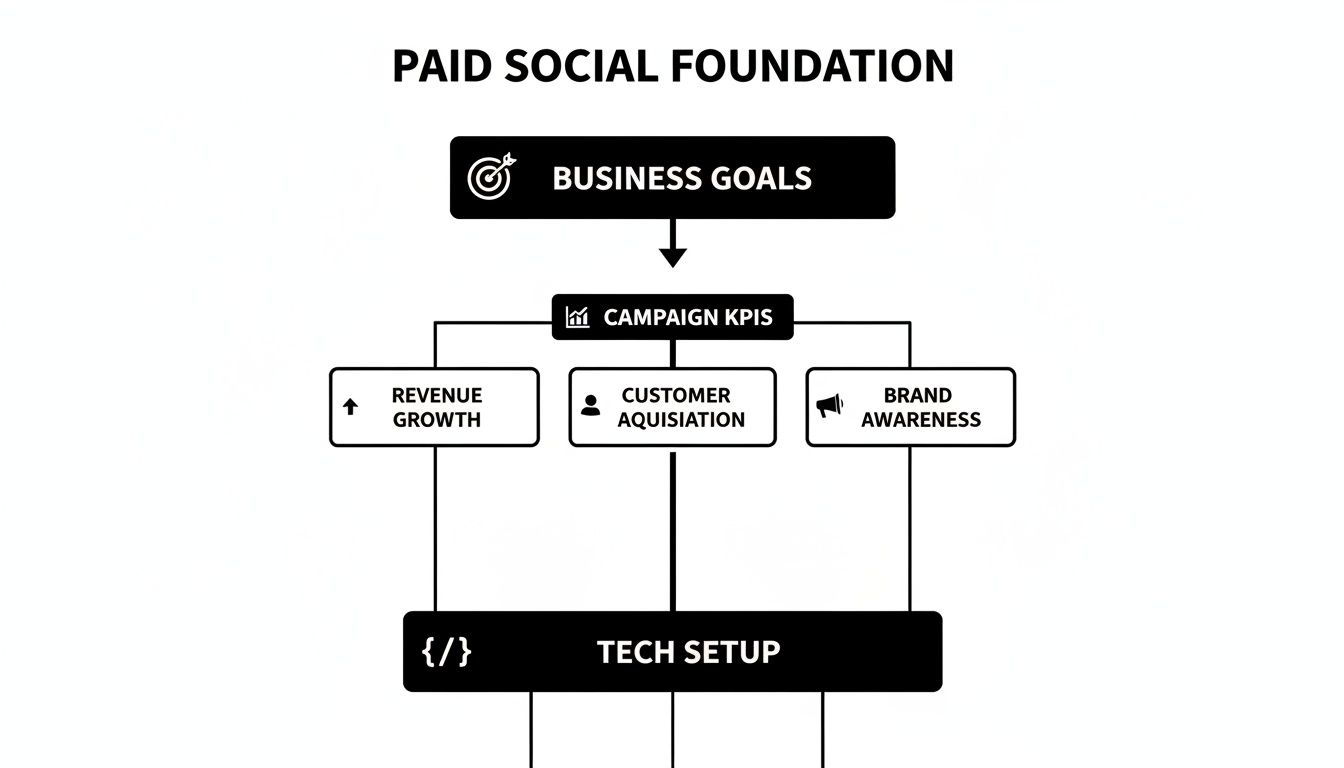
As you can see, your targeting strategy isn't an island—it's a direct extension of your overarching business objectives.
Prospecting With Broad and Interest-Based Audiences
First things first, you need to cast a wide but intelligent net. This is where broad and interest-based targeting on platforms like Meta and TikTok really shines.
Instead of just targeting a generic interest like "fitness," a savvy approach for a new protein supplement would be to layer more specific interests. Think "marathon running," "CrossFit," and followers of well-known fitness influencers.
This top-of-funnel strategy is all about discovery. You're giving the algorithm clues about who your ideal customer looks like and letting it go find pockets of users you'd never uncover on your own. At this stage, it’s less about immediate sales and more about feeding your pixel with high-quality data for what comes next.
The goal in prospecting isn't just to find buyers; it's to gather data. Every click and page view from these broad audiences helps you build the high-intent custom audiences that will power your retargeting.
Building High-Intent Custom Audiences
Once you've got some traffic flowing, it's time to build your most valuable targeting groups: Custom Audiences. These aren't strangers; they're people who have already shown a direct interest in your brand. They've essentially raised their hand and said they want to know more.
You can pull these audiences from several powerful first-party data sources:
Website Visitors: Target everyone who has hit your site in the last 30, 60, or 90 days.
Specific Page Viewers: Get more granular by creating audiences of users who viewed key pages, like a specific product or your pricing page. This signals much higher intent.
Video Viewers: Group together users who watched a significant chunk (say, 75%) of your video ads.
Email List Uploads: Take your existing email subscribers and past customers and target them directly on social platforms.
These audiences are absolute gold for your mid-funnel campaigns, designed to nudge people from consideration to purchase. You can get deeper into refining these groups in our detailed guide on Facebook ads best practices.
Scaling With Lookalike Audiences
Ready to pour some gas on the fire? This is where you really start to scale. Lookalike Audiences let platforms like Meta analyze the common traits of your best customers and then find millions of new users who share those exact characteristics.
The secret here is the quality of your source audience. A lookalike built from your "Top 10% Lifetime Value Customers" is going to crush one built from "All Website Visitors." It's not even a fair fight.
To manage your budget and reach effectively, I always recommend tiering your lookalikes by percentage. This creates a waterfall-style targeting structure:
1% Lookalike: This is your most potent audience. It’s the top 1% of users in your target country who most closely match your source audience. This should be your go-to for core prospecting campaigns.
1-3% Lookalike: Slightly broader, but still highly relevant. You can expand into this audience once you've started to saturate the 1% group or just need to open up your reach a bit.
3-5% Lookalike: This gives you the broadest reach of the bunch. Use this tier for top-of-funnel awareness campaigns or when you really need to scale your spend.
By layering broad, custom, and lookalike audiences, you’re creating a full-funnel machine. It efficiently finds new customers, nurtures their interest, and ultimately converts them into loyal buyers—all while maximizing your ROAS at every single step.
Developing a High-Velocity Creative Workflow
In the world of paid social, your creative is the single biggest lever you can pull. Seriously. But the old agency model of spending weeks to perfect one ad concept is completely dead. If you want to win on platforms like Meta and TikTok, you need a workflow built for speed, volume, and relentless testing.
This isn't about churning out low-quality garbage. It’s about building a scalable engine that lets you produce more data-driven creative, faster. Success today is all about your ability to out-learn the competition, and that means taking more shots on goal.
Adopt Modular Creative Frameworks
The secret to moving fast is to stop thinking in terms of monolithic ads and start thinking in modules. When you break your creative down into reusable components, you can mix and match elements to generate dozens of variants in the time it used to take to create one from scratch.
Two of the most reliable frameworks we see working right now are:
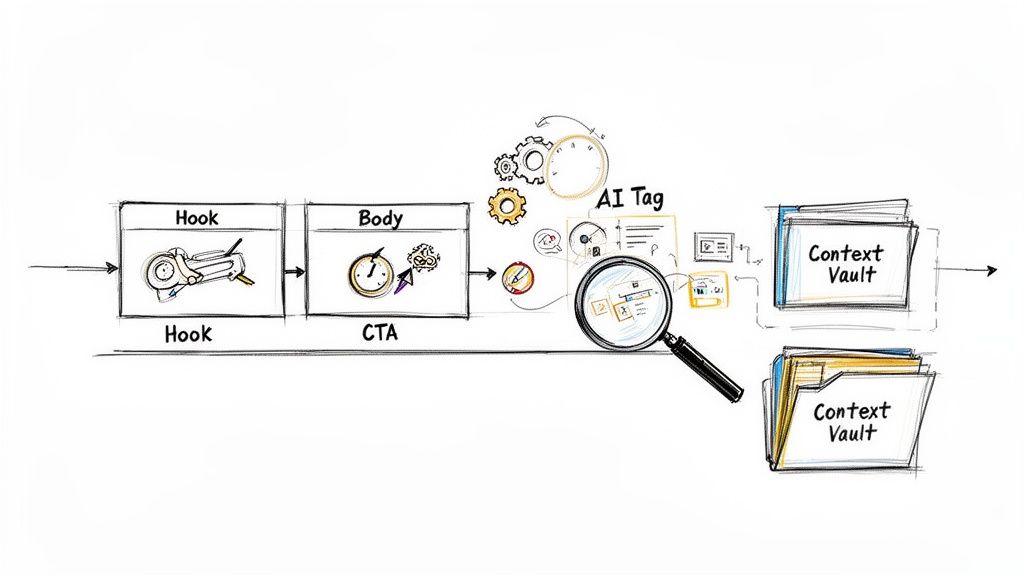
Hook-Body-CTA: This is your classic direct response structure. You grab attention with a killer hook in the first 3 seconds, deliver your core message in the body, and then drive action with a super clear call-to-action. Simple, effective.
Problem-Agitate-Solution (PAS): This one’s a storytelling powerhouse. You start by calling out a customer's specific pain point, agitate it to make it feel more urgent, and then position your product as the only logical solution.
These frameworks give your creative team a repeatable structure, which is absolutely essential for scaling up production. For a deeper dive into managing these moving parts, check out our guide on video production project management. By standardizing the format, you stop reinventing the wheel and start iterating on the pieces that actually move the needle.
Accelerate Production With AI Tools
Let's be honest, manually scrubbing through hours of footage to find that one perfect clip is a massive bottleneck. This is where AI really becomes a game-changer for your creative process. The right tools can turn your messy folder of raw assets into an intelligent, searchable library.
Imagine using AI-powered asset tagging to automatically analyze and label your entire video library. Instead of digging through folders named "Final_V2_Draft," you can just search with natural language like "woman smiling while using our product" and instantly get what you need. This can shrink your production time from hours down to minutes.
This approach lets you:
Find Assets Instantly: No more manual hunting.
Generate Fresh B-Roll: Use AI to spin up new visual concepts when your library starts feeling stale.
Maintain Brand Consistency: Set up a 'Context Vault' to store brand guidelines, winning scripts, and customer testimonials. This ensures every AI-generated concept stays perfectly on-brand.
Treat your creative assets like a database. Once you do that, you unlock the ability to assemble high-performing ads at machine speed. This isn't just about being efficient; it's about building a system to constantly beat creative fatigue.
To really support a high-velocity workflow, services like Social Media Video Transcription are a must. Adding accurate subtitles is non-negotiable, especially since so many people watch videos with the sound off.
To illustrate how you can structure your testing with a modular approach, here’s a simple matrix. The goal is to systematically test different combinations to find out what really resonates.
Modular Creative Testing Matrix Example
Ad Concept | Hook Variant | Body Variant | CTA Variant |
|---|---|---|---|
Pain Point Angle | "Tired of X?" (UGC) | Problem-Agitate-Solution | "Shop Now & Save 20%" |
Pain Point Angle | "This trick solves X" (Demo) | Problem-Agitate-Solution | "Shop Now & Save 20%" |
Pain Point Angle | "Tired of X?" (UGC) | Feature/Benefit Breakdown | "Learn More" |
Social Proof Angle | "See why 50k people love..." | Testimonial Montage | "Get Yours Today" |
Social Proof Angle | "TikTok made me buy it" | Testimonial Montage | "Shop The Collection" |
This organized approach ensures you're not just guessing. You're building a clear feedback loop where data from one test directly informs the next.
Master Bulk Rendering and Rapid Iteration
The final piece of this high-speed puzzle is scaling the actual creation of your ad variations. Once you have your modular frameworks and your AI-tagged assets ready to go, you can use bulk rendering to generate hundreds of ad variations at once.
Think about a single ad concept. Maybe you have three different hooks, two body messages, and two CTAs. Manually exporting each of those twelve combinations is a soul-crushing task. With bulk rendering, you can set up these combos in a matrix and spit them all out in minutes.
This kind of volume is non-negotiable for video. Video is king— 78% of consumers prefer short videos to discover new products. TikTok is delivering an average 2.4x ROAS, and formats like Reels and Shorts are driving 15% higher CTR on Facebook than static images. The numbers don't lie: a video-first strategy is critical.
By committing to a high-velocity workflow, you stop treating creative production like a slow, manual chore and start running it like a data-driven system. You'll test more ideas, find your winners faster, and create a powerful feedback loop that keeps you miles ahead of the competition.
Structuring Campaigns for Clarity and Scale
Your campaign structure is the invisible engine driving your entire paid social strategy. I've seen it time and time again: a messy, disorganized account is a one-way ticket to confusing data, wasted ad spend, and a complete inability to scale what’s actually working.
On the flip side, a clean structure gives you crystal-clear insights, tight budget control, and a predictable path to growth. Think of it as the difference between a cluttered workshop and a surgeon’s operating room. Both have tools, but only one is set up for precise, repeatable success.
Getting this right is non-negotiable. With global spending on social media ads projected to hit a staggering $276.7 billion—that's about 30% of all digital ad spend—you can't afford to be inefficient. You can find more social media statistics that highlight these trends and more.
Building a Clean Funnel-Based Hierarchy
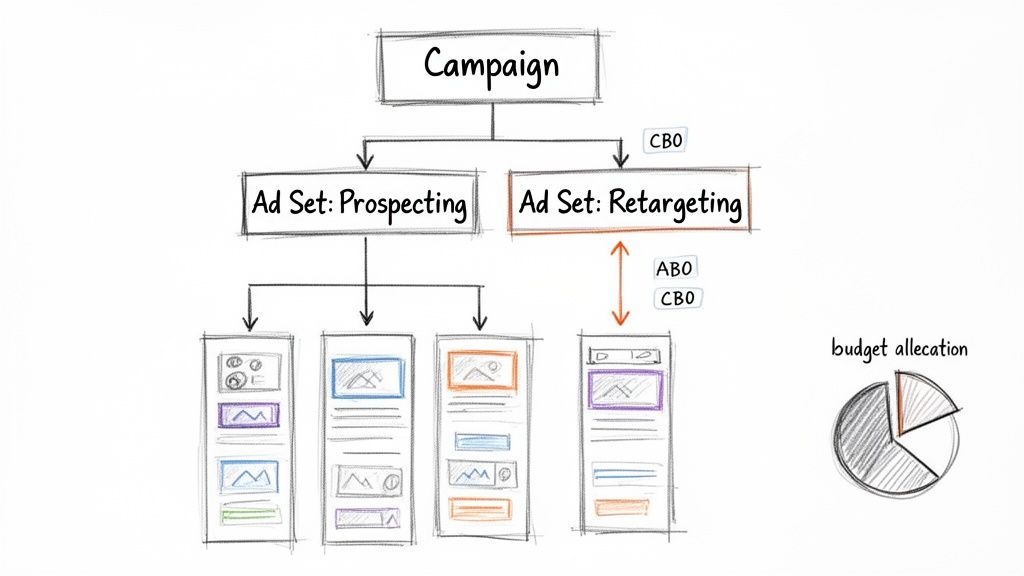
The most effective way I've found to structure an ad account is to mirror the customer journey. This is non-negotiable. You have to separate campaigns by their objective and where they sit in the funnel.
Top-of-Funnel (Prospecting): This is all about first impressions. These campaigns introduce your brand to new audiences who have likely never heard of you. Your goal here is discovery and data collection, not immediate sales.
Mid-Funnel (Consideration/Retargeting): Now you’re talking to people who’ve shown some interest—maybe they visited your website, engaged with a post, or watched a video—but didn't convert.
Bottom-of-Funnel (Conversion/Retargeting): This is where you target your highest-intent audiences, like people who abandoned their cart. The goal is simple: close the deal.
This separation is crucial because it stops you from mixing cold and warm audiences in the same ad set, which completely muddies your performance data and makes it impossible to know what’s truly driving results.
Choosing Your Budgeting Strategy: CBO vs. ABO
One of the biggest levers you can pull at the campaign level is how you manage your budget. Meta gives you two main options: Campaign Budget Optimization (CBO) and Ad Set Budget Optimization (ABO).
Campaign Budget Optimization (CBO)
With CBO, you set one overarching budget for the entire campaign. Meta’s algorithm then does the heavy lifting, automatically distributing spend to the best-performing ad sets in real-time.
When to use it: CBO is fantastic for scaling. Once you've identified winning audiences and creatives, you can pop them into a CBO campaign and let the algorithm efficiently allocate your budget to maximize results. It’s also a lifesaver for simplifying account management.
Ad Set Budget Optimization (ABO)
With ABO, you’re in the driver's seat. You manually set a specific budget for each individual ad set, giving you direct control over how much is spent on each audience.
When to use it: ABO is your go-to for testing. When you're trying to find new winning audiences or creatives, ABO ensures each ad set gets a fair shot with a dedicated budget. This prevents the algorithm from prematurely favoring one ad set over another before you have conclusive data.
My rule of thumb: Use ABO for your lab experiments to find winning formulas. Once you have a proven winner, move it to a CBO campaign to mass-produce it at scale.
Selecting the Right Bidding Strategy
Your bidding strategy tells the platform how to spend your money to hit your goal. Understanding these options is critical for controlling your costs and performance.
Lowest Cost (or Highest Volume): This strategy tells the platform, "Get me the most results possible for my budget." It's great for maximizing volume but can lead to volatile costs per acquisition (CPA). Use it when you're just starting out or need to gather data quickly.
Cost Cap: Here, you set a desired average CPA, and the platform tries its best to stay at or below that number. This gives you way more cost stability than Lowest Cost, making it a solid choice for maintaining profitable customer acquisition.
Bid Cap: This is for the control freaks (like me, sometimes). You set the absolute maximum amount you’re willing to bid in any single auction. It gives you the most control but can seriously limit your ad delivery if your bid is too low to win auctions. This is best for experienced media buyers who need to manage bids with surgical precision.
For most advertisers, a reliable path is to start with Lowest Cost during testing. Once you have a baseline CPA, switch to a Cost Cap to maintain profitability as you scale.
The Power of Naming Conventions
This might sound tedious, but a disciplined naming convention is your best friend for quick, painless analysis. An account filled with ad sets named "Audience 1 - Test 2" is a reporting nightmare.
Instead, create a standardized system that tells a story.
A great template is: Date_CampaignObjective_Audience_Platform_CreativeConcept
For example: 20241028_Conversions_LAL1-Purchasers_IG-Stories_UGC-Testimonial
Just by reading that name, you know everything you need to without clicking into the ad set. It saves so much time. Platforms like Sovran can even automate this process, ensuring every campaign you launch is perfectly organized from the get-go, saving you hours of mind-numbing manual work.
Implementing a Rigorous Testing and Iteration Loop
The real gap between a good and a great paid social strategy isn't some secret growth hack. It’s a relentless, almost obsessive, commitment to testing. Stagnation is your biggest enemy here. If you aren't constantly trying to beat your best-performing ads, you're already falling behind.
A proper testing process gives you a framework for continuous improvement. It’s all about creating a structured feedback loop where live data directly fuels your next wave of creative. This is how you stop guessing what works and start knowing.
Designing Methodical A/B Tests
Effective testing isn’t about throwing random ideas at the wall and hoping something sticks. It’s more like a scientific process where you isolate one variable at a time to generate clean, actionable learnings. You have to be methodical.
Start by prioritizing your tests based on potential impact. Sure, you can test button colors, but that rarely moves the needle like a completely new value proposition or a different creative angle.
Focus your energy on testing these high-impact variables:
Creative Concepts: Test completely different angles against each other. For example, pit a user-generated content (UGC) testimonial against a polished, feature-focused product demo to see what resonates.
Hooks and Headlines: The first three seconds are everything. Test a question-based hook ("Tired of slow WiFi?") against a bold statement ("This device triples your WiFi speed").
Audiences: Run a winning ad set against a new lookalike audience. You could test a 1% lookalike of purchasers against a broader 3-5% lookalike of website visitors to see if you can scale efficiently without tanking performance.
Landing Pages: Your ad is only half the battle. Test sending traffic to a short-form product page versus a long-form educational page to see which one actually converts better for that audience.
The golden rule is to change only one thing at a time per test. If you change the creative, the headline, and the audience all at once, you’ll have no idea which element was responsible for the lift (or the drop) in performance.
Establish a Testing Cadence and Define Success
Consistency is everything. You need to establish a regular testing cadence—whether that's weekly or bi-weekly—to ensure you always have fresh insights flowing in. This turns testing from something you do "when you have time" into a core operational habit.
Before you even think about launching a test, you must clearly define what success looks like. Pick one primary KPI to be your ultimate judge. Usually, this will be Cost Per Acquisition (CPA) or Return on Ad Spend (ROAS).
Don't get trigger-happy and stop a test a few hours in just because one ad has a lower Cost Per Click (CPC). Wait for a statistically significant number of conversions to make a decision based on the metric that actually impacts your bottom line.
Statistical significance is non-negotiable. A few early conversions don't mean you have a winner; it could just be luck. Use a sample size calculator to figure out how much data you need before you can confidently declare a result. Rushing this step leads to false positives and, ultimately, wasted ad spend. For those looking to streamline this, using a dedicated ad creative experimentation tool can automate a lot of these calculations for you.
Introduce a Creative Learning Agenda
A "Creative Learning Agenda" is one of the most powerful tools in any performance marketer’s arsenal. It’s basically a living document—a simple spreadsheet is perfect—that tracks every single test you run.
For each test, log this info:
Hypothesis: What do you believe will happen and why? (e.g., "We believe a UGC-style ad will outperform our studio ad because it feels more authentic and native to TikTok.")
Test Details: Note the variables being tested (creative, audience, etc.) and the campaign structure you used.
Results: Record the final performance data for your primary KPI (e.g., CPA, ROAS).
Key Takeaways: This is the most important part. What did you learn? (e.g., "UGC drove a 30% lower CPA. Our audience responds better to raw, less-polished creative, confirming our authenticity hypothesis.")
This simple agenda prevents that hard-won knowledge from getting lost when team members change or priorities shift. It becomes your team's single source of truth, ensuring the insights from one test directly inform the hypotheses for the next. This is how you create an ever-improving loop of performance.
Measuring Performance and Scaling Your Winners
You can't scale what you don't measure. This is where the rubber meets the road—transforming raw performance data into smart, profitable scaling decisions. It’s how you separate the one-hit wonders from the campaigns that can truly grow your business.
First things first: you have to monitor the right Key Performance Indicators (KPIs) for each stage of the customer journey. Trying to judge a top-of-funnel campaign by its Return on Ad Spend (ROAS) is a classic mistake, and it's a recipe for shutting down a potential winner way too early. You need to align your metrics with your objectives to get a clear, honest picture of performance.
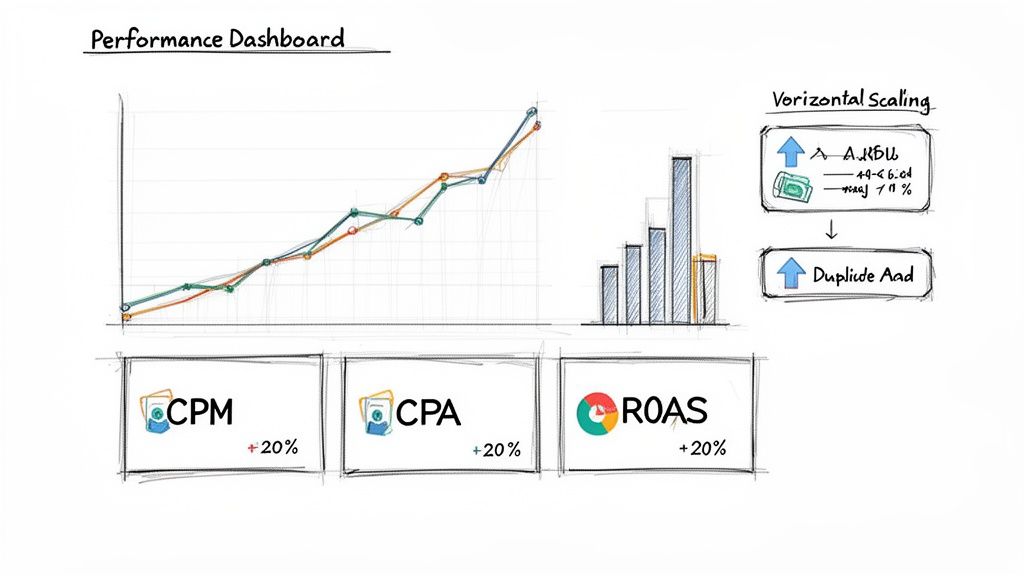
A simple dashboard that visualizes these trends is non-negotiable. It’s what allows you to quickly spot winning ads and audiences that are ready for a bigger budget.
Choosing the right metrics for each funnel stage is crucial for making informed decisions. Here’s a quick breakdown of how we think about it:
Funnel Stage | Primary KPIs | Secondary KPIs |
|---|---|---|
Top of Funnel (TOFU) | CPM, Hook Rate (3s Video Views/Impressions), Video Completion Rate | Impressions, Reach, Frequency |
Middle of Funnel (MOFU) | Outbound CTR, CPC, Cost per Landing Page View | Add to Cart Rate, Cost per Add to Cart |
Bottom of Funnel (BOFU) | CPA (Cost per Acquisition), ROAS, Purchase Conversion Rate | Cost per Initiate Checkout, Average Order Value |
This framework ensures you're evaluating each part of your strategy based on its specific job, from grabbing initial attention to closing the sale.
Scaling Your Campaigns Intelligently
Once you've identified a consistently performing ad set—one that's reliably hitting your target Cost Per Acquisition (CPA) or ROAS—it's time to give it more fuel. But be careful. Aggressive, sudden budget increases can shock the algorithm, reset the learning phase, and completely tank your performance.
I've learned this the hard way. Instead, think in terms of two distinct scaling methods:
Vertical Scaling: This is all about gradually increasing the budget of an existing, successful ad set. A safe and effective rule of thumb is to increase the budget by no more than 20% every few days. This slow-and-steady approach gives the algorithm time to adjust and find more customers without introducing wild volatility.
Horizontal Scaling: Here, you're expanding your reach by duplicating a winning ad set into new, relevant audiences. For instance, if your "1% Lookalike of Purchasers" is crushing it, duplicate that ad set and test it against a broader "3-5% Lookalike" or a completely new interest-based audience you've been wanting to try.
This dual approach lets you both deepen your investment in proven audiences and broaden your reach to discover untapped pockets of customers.
The key to a successful paid social media strategy is patience. Don't make knee-jerk reactions based on a single day's data. Wait for statistically significant results, then scale your winners methodically.
Recognizing and Combating Ad Fatigue
As you ramp up spending, you'll inevitably run into ad fatigue. This is what happens when your audience has seen your ad so many times that they start tuning it out, and performance drops off a cliff.
You'll see the warning signs in your metrics: a rising Cost Per Mille (CPM) and a falling Click-Through Rate (CTR).
When you spot these signs, it's time to introduce fresh creative. This doesn’t mean you have to start from scratch. Often, a simple swap—a new hook, different background music, or a refreshed call-to-action—is all it takes to reignite performance.
By constantly monitoring your KPIs, scaling winners with a structured approach, and refreshing creative to combat fatigue, you build a sustainable growth engine. This is how you transform your paid social efforts from a gamble into a predictable and scalable revenue channel.
Your Top Paid Social Strategy Questions, Answered
If you're in the trenches running paid social campaigns, you know it’s a constant stream of questions. Let's dig into some of the most common ones that pop up and get you some clear, actionable answers.
One of the first things everyone wants to know is, "How much should I be spending?" Honestly, there's no magic number here. Your budget has to be tied directly to your business goals.
The best way to start is by figuring out your acceptable Customer Acquisition Cost (CAC). If you know you can profitably acquire a new customer for $50, you can work backward from there. Set a test budget that’s big enough to actually gather enough data to see if you can hit that $50 target.
Keeping Up With Algorithms and Picking the Right Platform
Another huge one is dealing with the never-ending algorithm changes on platforms like Meta and TikTok. The hard truth? You can't control the algorithm. But you can control what you feed it.
Focus on what the algorithms are always hungry for: high-quality, engaging creative that keeps people on the platform longer. If you build a consistent testing rhythm, you’ll naturally adapt faster than your competitors who are just guessing.
As for choosing where to spend your money, it all comes down to your audience and your product.
B2B or selling a high-ticket item? LinkedIn is probably your best bet because of its powerful professional targeting.
A visual-first B2C brand in fashion or beauty? You absolutely need to be on Instagram and maybe even Pinterest to let your products shine.
Targeting a younger crowd and want to jump on fast-moving trends? Nothing beats TikTok for its massive reach and viral potential.
The smartest paid social strategy isn't about being loyal to one platform; it's about being obsessed with your audience. Go where they are, and create ads that feel like they belong there. Don’t ever try to make a LinkedIn-style ad work on TikTok—it just won’t.
Ultimately, you have to stay flexible and let the data guide you. Never dump your entire budget into one platform right out of the gate. Run small, controlled tests across a couple of channels, see what gets traction, and then pour your resources into what's actually working.
Ready to stop the manual grind and accelerate your creative testing? Sovran uses AI to automate video ad production, helping you generate hundreds of variants, find winning ads faster, and scale your campaigns with data-driven confidence. Start your free 7-day trial today!

Manson Chen
Founder, Sovran
Related Articles
How to Turn Link Into Video: Ads That Convert in 2026
Learn how to turn link into video for Meta & TikTok ads. Leverage AI to scale creation, boost ROI, and succeed in 2026.
- ai-video-generation
- link-to-video-ads
- 6 more
10 Actionable Ad Creative Ideas That Convert in 2026
Discover 10 actionable ad creative ideas for Meta & TikTok. Get hooks, scripts, and testing frameworks to boost your ROAS and combat creative fatigue.
- ad-creative-ideas
- video-marketing
- 6 more
Your Ultimate Guide to UGC Style Video Ads
Master UGC style video ads for Meta and TikTok. This guide reveals proven frameworks, scripts, and scaling tactics to boost your ROAS in 2026.
- ugc-video-ads
- social-media-advertising
- 4 more