10 Facebook Ads Best Practices for Unstoppable Growth in 2026
Discover 10 actionable facebook ads best practices for 2026. Master targeting, creative, and bidding to scale your campaigns and maximize ROI. Read now!
Jump to a section
- 1. Hook-Based Creative Structure for Maximum Engagement
- 2. Problem-Agitate-Solution (PAS) Framework Implementation
- 3. Video Ad Segmentation and Audience-Specific Creatives
- 4. Continuous A/B Testing and Creative Rotation Strategy
- 5. User-Generated Content (UGC) and Authentic Testimonial Integration
- 6. Mobile-First Video Format Optimization and Platform-Specific Adaption
- 7. Brand Guidelines Consistency and On-Brand Creative Guardrails
- 8. Landing Page Experience and Post-Click Optimization Alignment
- 9. Audience Layering and Lookalike Expansion for Scale
- 10. Budget Allocation, Performance-Based Spend Reallocation, Analytics and Attribution
- 10-Point Facebook Ads Best-Practices Comparison
- From Best Practices to Best Performance
In the ever-evolving ecosystem of paid social, simply knowing the fundamentals of Facebook advertising is no longer enough to guarantee success. As Meta's algorithms grow more sophisticated and audiences become more discerning, performance teams must move beyond generic advice. A more advanced, creative-led approach is now essential for sustainable growth and profitability. This shift requires a deep understanding of what truly captures attention and drives action in a crowded feed.
This article cuts through the noise to deliver 10 battle-tested, actionable Facebook ads best practices designed for modern UA managers and growth marketers. We're skipping the obvious tips and diving straight into advanced strategies that make a tangible impact. You will learn how to structure video creative for maximum engagement, implement powerful psychological frameworks, and build a systematic testing engine that consistently uncovers winning ads. For a broader perspective on strategic approaches that can also inform your Facebook ad campaigns, consider these social media marketing best practices.
We will cover specific, practical implementation details for:
Creative Excellence: Mastering hook-based video, leveraging user-generated content, and ensuring mobile-first optimization.
Audience Targeting: Utilizing advanced layering techniques and Lookalike expansion to find and convert high-value users at scale.
Performance Optimization: Implementing rigorous A/B testing frameworks, optimizing budget allocation, and aligning ad creative with post-click landing page experiences.
Whether you're battling creative fatigue, struggling to scale your campaigns, or looking for your next profitable strategy, these insights provide a clear roadmap. The following best practices will help elevate your Meta campaigns from good to unstoppable, providing the framework needed to drive significant results.
1. Hook-Based Creative Structure for Maximum Engagement
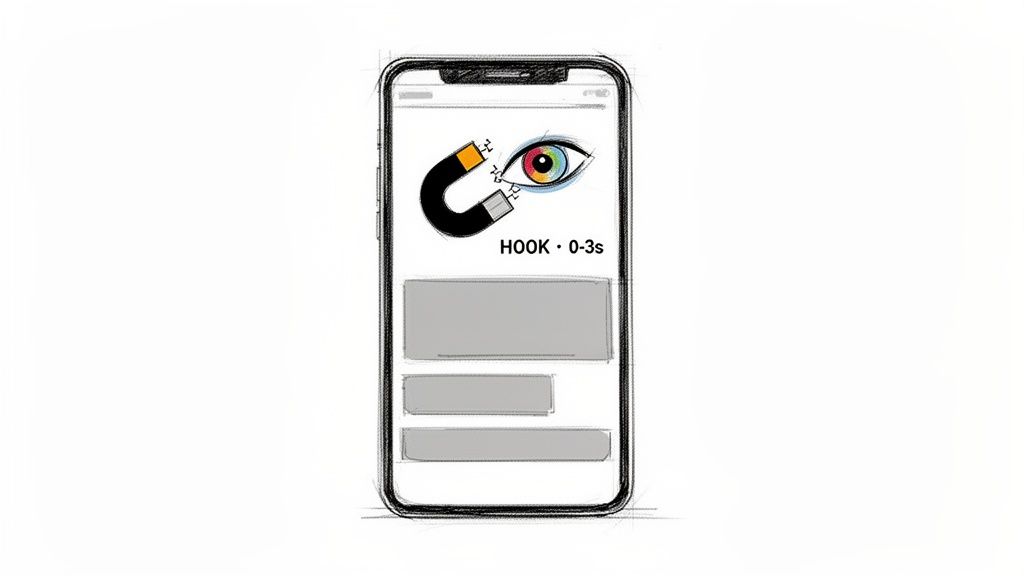
In the fast-scrolling world of social media feeds, the first three seconds of your ad determine its fate. This is the "hook," a powerful opening designed to interrupt a user's scrolling pattern and command their attention. An effective hook uses surprising visuals, bold on-screen text, or a provocative question to create immediate intrigue, making it one of the most critical facebook ads best practices for performance marketers.
The core principle is simple: if you don’t earn the viewer's attention instantly, the rest of your ad’s message is irrelevant. Facebook's algorithm rewards creatives that hold user attention, correlating higher view-through rates with lower CPMs and better overall performance. Research consistently shows that ads with a strong, optimized hook can boost watch time and engagement, directly impacting your campaign’s return on investment (ROI).
How to Implement Hook-Based Creatives
To apply this strategy effectively, you must shift your focus from the entire ad to a modular structure: Hook, Body, and Call-to-Action (CTA). By separating these components, your team can rapidly test different opening variations against a proven ad body.
Pattern Interrupts: Start with an unexpected visual or audio element. A classic example is Skillshare’s “You’re doing [common task] wrong” opening, which immediately challenges the viewer and creates a curiosity gap.
Bold Statements & Transformations: Showcase a dramatic "before and after" result within the first few frames. Glossier excels at this by instantly displaying the powerful effect of its beauty products.
Native-Style Openings: Mimic the look and feel of organic user-generated content (UGC). This approach lowers the viewer's natural ad resistance, making them more likely to engage with the content.
Key Insight: Don’t just test different ad concepts; test multiple hook variations for your winning ads. A simple change in the first three seconds can turn a break-even campaign into a highly profitable one.
Leveraging the right content creation tools for social media can make producing these diverse hooks more efficient, allowing you to quickly generate high-quality visuals and text overlays. For a deeper dive into structuring your entire ad narrative around this principle, explore our guide on crafting a high-impact script for advertising that systematically builds on a powerful opening.
2. Problem-Agitate-Solution (PAS) Framework Implementation
While a strong hook grabs attention, the narrative that follows determines whether a user converts. The Problem-Agitate-Solution (PAS) framework is a time-tested copywriting formula that structures your ad's story to maximize emotional resonance and drive action. It first identifies a specific pain point (Problem), intensifies the frustration associated with it (Agitate), and finally presents your product as the ideal resolution (Solution), making it a cornerstone of effective facebook ads best practices.
This psychological approach is profoundly effective because it mirrors the human decision-making process. By connecting with a user's existing frustrations, your ad establishes immediate relevance. Studies show that PAS-structured ads can achieve significantly higher conversion rates compared to ads that simply list product features. This framework builds a compelling case for your solution by first reminding the audience why they need one in the first place, moving them from passive viewing to active consideration.
How to Implement the PAS Framework
To successfully deploy the PAS framework, you must deeply understand your audience’s pain points and articulate them in a relatable way. Each stage of the framework serves a distinct purpose in your ad's narrative.
Problem: Clearly state the pain point. Slack’s early ads excelled at this by showing the chaos of managing projects through messy email chains and disconnected chat apps.
Agitate: Magnify the emotional impact of the problem. A Headspace ad might show how a small moment of anxiety (the problem) snowballs into a day of lost focus and overwhelming stress (the agitation).
Solution: Introduce your product as the clear, simple answer. Calm effectively uses this by transitioning from visuals of restless, sleepless nights to serene imagery of a peaceful, deep sleep achieved through their app.
Key Insight: The "Agitate" phase is where most ads fail. Don't just state the problem; make the viewer feel it. Use authentic user-generated content (UGC) or relatable scenarios to show the real-world consequences of leaving the problem unsolved.
By systematically applying the PAS framework, your ads move beyond simple product showcases and become compelling, problem-solving narratives. This structure provides a reliable blueprint for creating high-converting ad scripts that resonate deeply with your target audience and consistently drive results.
3. Video Ad Segmentation and Audience-Specific Creatives
In high-competition feeds, a single “hero” video rarely speaks to every viewer. Video ad segmentation tailors messages, visuals, and value propositions for distinct audience groups. By aligning creative execution with demographics, interests, behavior, or funnel stage, this facebook ads best practices approach drives higher relevance and engagement.
Meta research shows that audience-specific creatives deliver 2–4x better ROI than one-size-fits-all videos. Mobile app marketers and performance media buyers can allocate budget toward messages that resonate most with high-intent segments while reducing wasted spend on misaligned creatives.
How to Implement Audience-Specific Creatives
Segment by funnel stage
Awareness: Use broad storytelling or brand narratives
Consideration: Highlight features or social proof
Conversion: Focus on clear CTAs and offers
Define demographic and behavioral clusters
Age, gender, location, device type
Interests, app usage patterns, purchase history
Develop 3–5 variations per segment
Vary hooks, visuals, and value props
Optimize for vertical formats and sound-on/off
Leverage Sovran’s natural language asset search
Quickly match b-roll or overlays to each segment
Ensure consistent tone and messaging
Set segment-specific benchmarks
Compare CTR, watch rate, and ROAS by audience
Avoid global targets that mask underperformers
Store mappings in Context Vault
Maintain a centralized library of segment-creative pairs
Streamline future campaign launches
Key Insight: Investing in segmented video ads not only boosts relevance but also uncovers high-value audiences faster. Tracking segment-level KPIs lets you double down on top performers.
For more examples on creative segmentation, explore Meta Creative Shop case studies or visit Sovran’s website for advanced asset management workflows.
4. Continuous A/B Testing and Creative Rotation Strategy
Even the most effective Facebook ad eventually loses its power due to a phenomenon known as "creative fatigue." When an audience sees the same ad repeatedly, its performance degrades as users become desensitized. A continuous testing and rotation strategy is one of the most vital facebook ads best practices to combat this inevitable decline and maintain campaign momentum.
The core principle is to systematically introduce new creative variations before fatigue sets in, while isolating variables to understand what truly drives performance. Data from Meta indicates that ads running for over six weeks can see a 20-30% drop in effectiveness. For performance marketers, establishing a rigorous testing cadence is not just about finding a single winner; it's about building a sustainable system for discovering the next winner.
How to Implement a Testing and Rotation Framework
Building this framework requires a shift from sporadic testing to a disciplined, ongoing process. The goal is to create a high-velocity creative pipeline that consistently feeds new, data-informed assets into your campaigns.
Establish a Clear Hypothesis: Every test should begin with a structured hypothesis, such as: "We believe a UGC-style hook will outperform our polished studio creative for our target audience because it feels more authentic and trustworthy."
Isolate a Single Variable: To get clean data, test only one element at a time. This could be the hook, the call-to-action (CTA), the primary ad copy, the headline, or the value proposition being highlighted.
Define Success Metrics: Set a minimum sample size or conversion threshold before declaring a winner. For example, a variant must achieve at least 1,000 conversions and a statistically significant lift in CPA before it is scaled.
Systematize Creative Rotation: Proactively introduce fresh creatives every 2-4 weeks, even for winning ads. This prevents performance cliffs caused by sudden fatigue and keeps your ad account healthy.
Key Insight: Don’t just test to find a single champion creative. Instead, build a perpetual system of hypothesis, execution, analysis, and iteration. This operational excellence is what separates good advertisers from great ones.
By creating a "creative graveyard" to document and retire failed concepts, you avoid redundant tests and build a powerful knowledge base over time. For a more detailed guide on building this system, explore our deep dive into effective Facebook ad creative testing methodologies that top advertisers use to scale their campaigns.
5. User-Generated Content (UGC) and Authentic Testimonial Integration
In an era of high-production ads and dwindling consumer trust, authenticity has become one of the most powerful currencies in advertising. User-Generated Content (UGC), which includes any content created by real customers, cuts through the noise of polished corporate messaging. Integrating authentic testimonials, unboxing videos, and raw user experiences is a core component of modern facebook ads best practices because it provides immediate social proof and lowers viewer skepticism.
The effectiveness of UGC lies in its relatability. When potential customers see people who look and sound like them genuinely enjoying a product or service, it builds an instant connection that professionally produced content often fails to achieve. Meta's own data consistently shows that ads featuring real people and customer voices outperform those with high production value or celebrity endorsements, leading to significantly higher engagement and lower acquisition costs.

How to Implement UGC and Testimonials
Successfully leveraging UGC requires a system for sourcing, managing, and testing this uniquely powerful creative asset. The goal is to maintain authenticity while aligning the content with your campaign objectives.
Incentivize Content Creation: Encourage your existing customers to create content by offering discounts, rewards, or the chance to be featured on your social channels. Brands like Warby Parker effectively use real customer photos and styling feedback in their ads.
Batch Testimonials into Mashups: Combine several short, impactful customer testimonials (15-30 seconds each) into a single, fast-paced video ad. This "mashup" format rapidly showcases multiple points of social proof, as seen with brands like Ritual that feature a chorus of positive customer voices.
Test Against Polished Creative: Run A/B tests pitting your best UGC against professionally produced ads. This will not only prove the performance lift of authentic content to stakeholders but also reveal which audience segments respond best to it.
Provide Clear, Simple Guidelines: Give your creators or customers a clear brief on what makes great testimonial content, but avoid overly restrictive scripts. The goal is to guide them, not to strip away their genuine voice and perspective.
Key Insight: The most effective UGC ads feel like they belong in the user's feed, not like an interruption. Prioritize content that looks and feels native to the platform to maximize its impact and blend in seamlessly with organic posts.
Building a scalable system for this type of content is crucial for long-term success. To develop a robust pipeline for sourcing and deploying authentic creative, explore our detailed guide on creating a comprehensive user-generated content strategy.
6. Mobile-First Video Format Optimization and Platform-Specific Adaption
With the vast majority of Facebook users engaging on mobile devices, creating ads designed for the small screen is no longer optional. A mobile-first approach means abandoning desktop-centric formats and building video creative from the ground up for vertical viewing. This is one of the most impactful facebook ads best practices because it directly aligns your content with how users actually consume it, improving everything from watch time to conversion rates.
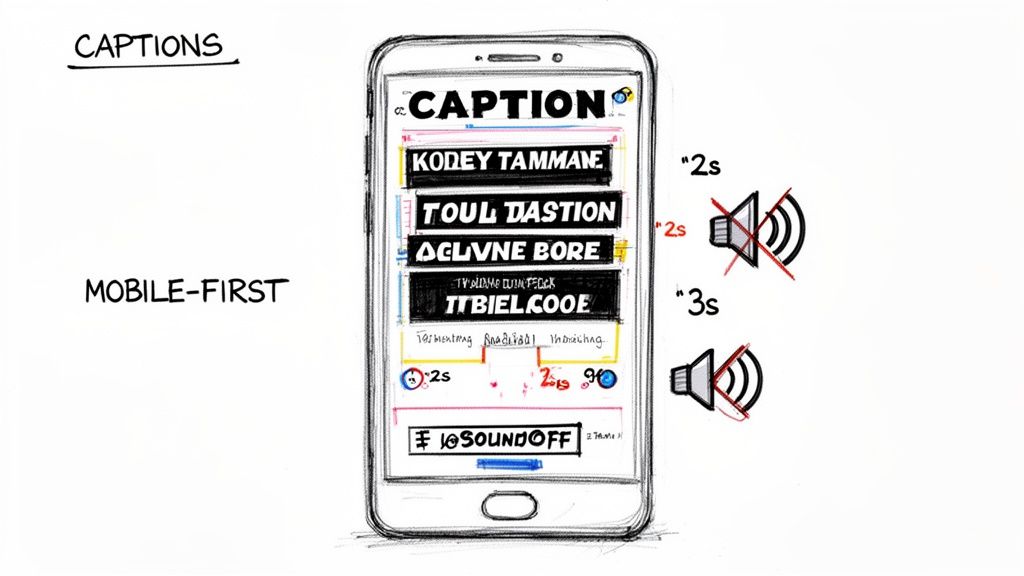
The core principle is to optimize for the sound-off, fast-scrolling, and vertically-oriented nature of the mobile feed. Ads that ignore these behaviors, such as un-cropped horizontal videos or those reliant on audio, face an immediate disadvantage. Meta’s algorithm favors content that users engage with, and mobile-optimized formats are inherently more engaging, leading to better ad delivery and lower costs.
How to Implement Mobile-First Creative
Adapting a desktop ad is not enough; you must produce creative natively for the mobile environment. This involves thinking about aspect ratios, pacing, and on-screen text from the very beginning of the production process.
Embrace Vertical Video: Design all creatives in a 9:16 (for Reels/Stories) or 4:5 (for Feed) aspect ratio. This maximizes screen real estate and feels native to the platform. Mobile game ads showing vertical gameplay are a perfect example.
Assume Sound is Off: Since a high percentage of users watch without sound, burn-in captions are essential. Use large, high-contrast fonts to convey your message visually. Headspace does this well by showing scrolling benefit lists.
Accelerate Pacing: Mobile attention spans are short. Keep scenes to 2-4 seconds and use quick cuts to maintain momentum and hold viewer interest.
Adapt by Placement: Acknowledge that a Reels ad needs a different creative approach than a Feed ad. Tailor your hooks, CTAs, and overall style to match the user's expectation in each specific placement for the best results.
Key Insight: Test your ads on an actual mobile device before launching. What looks good on a large desktop monitor can be unreadable or visually cluttered on a 6-inch phone screen. This simple quality check can prevent wasted ad spend.
7. Brand Guidelines Consistency and On-Brand Creative Guardrails
As creative volume skyrockets with rapid testing and iteration, maintaining a cohesive brand identity becomes a significant challenge. Establishing clear on-brand creative guardrails is a critical practice to prevent brand dilution while scaling your ad campaigns. These guidelines, which dictate color palettes, fonts, tone of voice, and logo placement, ensure that every ad variation feels like it comes from the same trusted source, making this one of the most vital facebook ads best practices for long-term growth.
The core principle is to build brand equity with every ad impression, not just chase short-term conversions. When ads are consistently recognizable, it builds audience trust and familiarity. Research shows that brands maintaining consistency see higher recall rates and stronger brand perception, which in turn improves baseline ad performance and customer lifetime value. This framework allows for creative freedom within defined boundaries, enabling high-volume testing without sacrificing brand integrity.
How to Implement On-Brand Creative Guardrails
To apply this strategy, you must operationalize your brand identity for your entire marketing and creative team. The goal is to make consistency the path of least resistance, not a bureaucratic bottleneck that slows down creative production.
Centralize Brand Assets: Create a single, accessible repository for all approved brand materials. This includes a documented guide with color codes, font files, logo variations, and approved visual styles. Companies like Slack master this by applying their playful yet professional purple branding across all ad experiments.
Develop a Tone of Voice Guide: Go beyond visuals by providing clear examples of approved and disapproved ad copy. This helps writers and AI tools alike capture the brand's personality, whether it's Nike's motivational tone or Apple's minimalist and benefit-driven language.
Establish Review Checkpoints: For high-volume campaigns, implement a lightweight review process. This isn’t about approving every single creative but rather auditing batches of ads to ensure they align with the guidelines and correcting any drift before it becomes widespread.
Use an Approved Asset Library: Maintain a curated library of pre-approved images, video clips, and icons. This speeds up creative development while ensuring that all visuals meet brand standards, preventing the use of off-brand or low-quality assets.
Key Insight: Brand consistency and performance testing are not mutually exclusive. The most successful advertisers test different messaging angles and creative formats within a consistent brand framework, creating a powerful synergy between direct response and brand building.
8. Landing Page Experience and Post-Click Optimization Alignment
A high-performing ad is only half the battle; if it leads to a slow, confusing, or misaligned landing page, you're essentially paying to frustrate potential customers. Post-click optimization ensures that the journey from ad to conversion is seamless, which is a critical yet often overlooked aspect of facebook ads best practices. Your ad makes a promise, and your landing page must deliver on it instantly and intuitively.
Meta’s algorithm doesn’t stop analyzing performance at the click. It incorporates post-click signals into its Quality Ranking, meaning a poor landing page experience can actively penalize your ad delivery, leading to higher CPMs and reduced reach. A frictionless path from interest to action is essential for maximizing ROI, as every second of load time or moment of confusion dramatically increases user drop-off.
How to Implement Post-Click Alignment
The goal is to create a unified experience where the landing page feels like a natural extension of the ad. This requires meticulous alignment of messaging, design, and user intent from the first impression to the final conversion.
Message & Visual Match: Ensure your landing page headline, copy, and imagery directly reflect the ad creative and value proposition. If an ad promotes a 20% discount on a specific product, the landing page must prominently feature that same product and discount.
Mobile-First Design: With the vast majority of Facebook traffic coming from mobile devices, your landing page must be optimized for small screens. This means large, tappable buttons (at least 44x44 pixels), readable fonts, and a simple, single-column layout.
Streamlined Conversion Path: Minimize friction by reducing the number of form fields required. Each additional field can decrease conversion rates. For SaaS or app sign-ups, like Calendly does, leading to a simple, one-click scheduling or pre-registration page can dramatically boost performance.
Key Insight: Treat your landing page as a direct continuation of your ad creative. Create and test dedicated landing page variants for each of your primary ad angles or audience segments to ensure maximum message congruence and conversion lift.
Optimizing this post-click experience is just as vital as testing ad creatives. Tools like Google PageSpeed Insights can help you diagnose and fix load time issues, while A/B testing platforms allow you to validate changes to headlines, CTAs, and form layouts, ensuring your ad spend isn't wasted at the final step.
9. Audience Layering and Lookalike Expansion for Scale
Scaling campaigns beyond your core customer base is a fundamental challenge for growth. This is where Audience Layering and Lookalike Expansion become indispensable, allowing you to systematically reach new, high-potential users who mirror the characteristics of your best customers. This strategy is one of the most powerful facebook ads best practices for achieving scalable and efficient growth.
The process involves leveraging your first-party data (e.g., email lists, website visitors, high-LTV purchasers) to create Lookalike Audiences. Meta's algorithm analyzes the attributes of your source audience and finds new users with similar traits. While core retargeting audiences deliver the highest ROI, Lookalikes can achieve a significant portion of that performance while dramatically increasing your addressable market and unlocking new pockets of growth.
How to Implement Lookalike Expansion
The key to successful scaling is a tiered approach that matches creative messaging to audience intent. You start with the highest-fidelity audiences and methodically expand outwards as performance proves successful.
Start with 1% Lookalikes: Begin by creating a 1% Lookalike Audience from your highest-intent source, such as paying customers or users with high average order values. This group represents the closest match to your ideal user profile and generally yields the best performance.
Gradually Expand Audience Size: Once you have validated performance with the 1% Lookalike, test broader audiences like 3%, 5%, and up to 10%. Monitor your key performance indicators (KPIs) closely, as performance often dilutes as the audience size increases.
Adapt Creative for Broader Audiences: Core audiences respond to niche, pain-point-specific creative. In contrast, broader Lookalike audiences require more benefit-focused and top-of-funnel messaging. Your ad creative must evolve from "why us" for warm audiences to "why this category" for colder, expanded audiences.
Test Different Source Audiences: Don't limit yourself to just one Lookalike source. Create and test Lookalikes from various segments, such as engaged free trial users, high-frequency website visitors, or video viewers, to find new performance pockets.
Key Insight: Structure your campaigns in tiers: Tier 1 (Core Retargeting), Tier 2 (High-Intent Lookalikes), and Tier 3 (Broad Interest/Lookalike Expansion). This organization allows you to allocate budget effectively and tailor your creative strategy to each stage of the user journey.
For a comprehensive understanding of how to structure these tiered campaigns within Facebook's platform, exploring detailed guides on campaign budget optimization can provide a solid foundation. Similarly, to master the segmentation needed for creating powerful source audiences, delve into strategies for building effective customer segments.
10. Budget Allocation, Performance-Based Spend Reallocation, Analytics and Attribution
Your campaign's success is not just about what you show users, but where you allocate your money. Dynamic budget reallocation, guided by robust analytics and attribution, ensures your spend is always working its hardest. This practice involves systematically moving funds from underperforming campaigns, ad sets, and creatives to your top performers based on real-time data, making it one of the most crucial facebook ads best practices for maximizing ROI.
The core principle is to treat your ad budget like a fluid investment portfolio, not a fixed expense. By establishing clear performance benchmarks, such as a target Cost Per Acquisition (CPA), you can make disciplined, data-driven decisions daily or weekly. This agility prevents wasted spend on assets that aren't delivering results and allows you to aggressively scale what works, directly impacting your bottom line and campaign efficiency.
How to Implement a Dynamic Budget & Attribution Strategy
To execute this effectively, you need a two-part system: a disciplined process for reallocating spend and a reliable attribution model to ensure your data is accurate. This combination prevents you from prematurely cutting off high-funnel ads or misinterpreting the true value of a specific touchpoint.
Performance-Based Reallocation: Create a simple tiered system for your ad assets. For instance, the bottom 20% of performers get their budget reduced or paused, the middle 60% are maintained for stability, and the top 20% receive increased investment. High-growth teams at companies like Airbnb use this method to scale campaigns based on strict CPA targets.
Implement Robust Attribution: Don't rely solely on Facebook's default reporting. Implement the Conversions API (CAPI) for accurate server-side tracking that bypasses iOS 14+ signal loss. Pair this with consistent UTM parameter usage and multi-touch attribution modeling to understand the entire customer journey, not just the last click.
Set Clear Thresholds: Avoid making decisions on insufficient data. Establish a minimum spend threshold (e.g., $50-$100 per ad variation) or a minimum conversion count (e.g., 500-1000 events) before making significant budget shifts. This ensures your decisions are based on statistically significant results.
Key Insight: Adopt a 70/20/10 budget allocation model. Dedicate 70% of your budget to proven, winning campaigns, 20% to scaling promising tests, and 10% to pure exploration of new audiences, creatives, or angles. This balances stable returns with continuous innovation.
10-Point Facebook Ads Best-Practices Comparison
Strategy | 🔄 Implementation Complexity | ⚡ Resource Requirements | 📊 Expected Outcomes | Ideal Use Cases | ⭐ Key Advantages / 💡 Tips |
|---|---|---|---|---|---|
Hook-Based Creative Structure for Maximum Engagement | Medium–High — rapid testing needed | Moderate creative design + test volume (3–5s opens) | ↑ view-through rates ~30–50%; better algorithmic delivery | Top-of-funnel, short social formats, mobile-first feeds | ⭐ Boosts completion & lowers CPA; 💡 Test many hooks weekly; avoid misleading hooks |
Problem-Agitate-Solution (PAS) Framework Implementation | Medium — requires customer insight & narrative design | Strong copywriting, customer research, 15–60s vids often | 2–3x higher conversions vs feature-focused ads | Consideration→conversion stages, SaaS, wellness, e‑commerce | ⭐ Drives emotional engagement & clear positioning; 💡 Use testimonials in agitate; keep relatable |
Video Ad Segmentation & Audience-Specific Creatives | High — many variants & campaign complexity | High production volume, segmentation & A/B infra | 2–4x better ROI; lower CAC when aligned | Multi-audience programs, apps, products with varied personas | ⭐ Increases relevance & ROI; 💡 Create 3–5 variations per segment; store mappings |
Continuous A/B Testing & Creative Rotation Strategy | High — statistical discipline and cadence | High creative velocity + analytics and test management | Prevents creative fatigue; avoids 20–30% degradation over time; finds winners | Growth teams, high-frequency campaigns, scaling creatives | ⭐ Maintains performance & uncovers drivers; 💡 Test one variable at a time; refresh 2–4 weeks; require sample size |
User-Generated Content (UGC) & Authentic Testimonials | Medium — rights & quality control needed | Customer outreach, curation, licensing/legal processes | 2–5x higher engagement; lower production cost | Brands needing trust/social proof; younger demographics; mobile apps | ⭐ Builds credibility cost‑effectively; 💡 Incentivize creators; batch short testimonials; manage rights |
Mobile-First Video Format Optimization & Platform Adaptation | Medium — format-focused production changes | Native 9:16/1:1 production, captioning, fast edits | Completion +15–25%; improved CPI/CPR and accessibility | Mobile-heavy audiences, Reels/Stories/TikTok placements | ⭐ Better mobile engagement & accessibility; 💡 Create natively vertical; caption all; 2–4s scene cuts |
Brand Guidelines Consistency & On-Brand Guardrails | Medium — governance + review processes | Documentation, asset library, review checkpoints | 20–30% higher recall; 3–4x stronger brand perception | High-volume programs, agencies, multi-campaign brands | ⭐ Preserves brand equity at scale; 💡 Centralize guidelines; audit creative output regularly |
Landing Page Experience & Post-Click Optimization Alignment | Medium–High — cross-team coordination required | Web dev, CRO tools, analytics, mobile optimization | Conversion ↑30–50%; reduced CPA; improved ad delivery | Conversion-focused ads, lead gen, SaaS signups, app installs | ⭐ Converts ad traffic efficiently; 💡 Align messaging, reduce form fields, test landing variants |
Audience Layering & Lookalike Expansion for Scale | Medium — audience strategy & testing | High-quality core data, segmentation tools, monitoring | Scales reach; lookalikes often deliver ~50–70% ROI of core audiences | Scaling acquisition beyond core users, apps, e‑commerce | ⭐ Efficient scale while retaining performance; 💡 Start 1% lookalike; exclude converters; match creative breadth |
Budget Allocation, Performance-Based Reallocation & Attribution | High — analytics, discipline & technical setup | Real-time dashboards, Conversions API, attribution tooling, analytics team | Maximizes ROI; reveals true LTV; prevents premature pauses | Large-scale programs, multi-channel funnels, long LTV cycles | ⭐ Optimizes spend and measurement; 💡 Use 70/20/10 allocation; set benchmarks; wait for significance; implement CAPI |
From Best Practices to Best Performance
Navigating the complex landscape of Meta's advertising ecosystem can feel overwhelming, but mastering it is not about finding a single secret hack. Instead, sustainable success is built upon a systematic, strategic application of proven principles. We've journeyed through ten foundational pillars, from the critical importance of a hook-based creative structure to the analytical rigor of performance-based budget allocation. Each of these Facebook ads best practices represents a lever you can pull to drive meaningful growth, reduce wasted ad spend, and consistently outperform your competition.
The core theme connecting these strategies is a shift from isolated tactics to an integrated growth engine. Your creative strategy cannot exist in a vacuum; it must be intrinsically linked to your audience targeting, your bidding strategy, and your post-click landing page experience. Likewise, a brilliant audience segmentation plan is useless without a continuous pipeline of fresh, tailored creative to prevent ad fatigue and resonate with each specific group.
Synthesizing Strategy into Action
The ultimate takeaway is that modern performance marketing is a game of velocity and iteration. The teams that win are not necessarily the ones with the largest budgets, but those who can test, learn, and adapt the fastest. This requires a workflow that embraces experimentation and operational efficiency.
Consider the most critical takeaways from our discussion:
Creative is the Primary Driver: Your ability to rapidly produce and test compelling, hook-driven video content is your most significant competitive advantage. Frameworks like Problem-Agitate-Solution (PAS) provide a reliable blueprint, but success hinges on your capacity to generate diverse variations.
Audience and Creative Must Align: Generic, one-size-fits-all creative is a recipe for high CPAs and low relevance scores. The practice of segmenting video ads for specific audience layers, from broad lookalikes to hyper-targeted retargeting pools, is non-negotiable for scaling profitably.
Data-Driven Iteration is Key: Your campaign data is a roadmap for improvement. A disciplined approach to A/B testing, creative rotation, and budget reallocation based on real-time performance metrics transforms your advertising from a guessing game into a predictable system for acquiring customers.
Building a Scalable Advertising Machine
Ultimately, implementing these Facebook ads best practices is about building a resilient and scalable system. It’s about moving beyond simply knowing what to do and creating the operational capacity to do it consistently. The bottleneck for most teams isn't a lack of knowledge; it's the sheer manual effort required to produce enough high-quality creative variants to feed the algorithm and keep campaigns fresh.
When your team is empowered with the right strategies and the right tools, you can finally focus on high-level analysis and strategic planning instead of getting bogged down in repetitive production tasks. This is where true performance breakthroughs happen. By internalizing these principles and structuring your workflow to support them, you are not just running better ads; you are building a powerful, long-term growth asset for your business. The path from best practices to best performance is paved with disciplined execution, relentless testing, and a commitment to creative excellence at scale.
Tired of the creative bottleneck slowing down your growth? Sovran automates high-performance video ad production, enabling your team to implement these Facebook ads best practices at scale. Turn your winning concepts into dozens of testable ad variations in minutes, not days, and finally achieve the creative velocity you need to win on Meta. Learn more and see how it works at Sovran.

Manson Chen
Founder, Sovran
Related Articles

Your Ultimate Guide to UGC Style Video Ads
Master UGC style video ads for Meta and TikTok. This guide reveals proven frameworks, scripts, and scaling tactics to boost your ROAS in 2026.
- ugc-video-ads
- social-media-advertising
- 4 more
Your Guide to a Social Media Ad Generator in 2026
Discover how a social media ad generator revolutionizes creative production. Learn to automate video ads, scale testing on Meta & TikTok, and drive performance.
- social-media-ad-generator
- ai-video-creation
- 4 more
10 Actionable Ad Creative Ideas That Convert in 2026
Discover 10 actionable ad creative ideas for Meta & TikTok. Get hooks, scripts, and testing frameworks to boost your ROAS and combat creative fatigue.
- ad-creative-ideas
- video-marketing
- 6 more