Create Video Ads with AI That Perform in 2026
Jump to a section
Half of advertisers were already using generative AI to build video ads in 2025, and 86% of buyers said they were using or planning to use GenAI for video ad creative, according to the IAB's 2025 video ad findings. That should change how you think about AI video immediately.
The question isn't whether you can create video ads with AI. You can. The harder question is whether your workflow can turn that capability into a repeatable testing system for Meta and TikTok without flooding your account with weak variations.
That distinction matters. Teams often lose, not due to a lack of generation tools, but because they treat AI like a shortcut to finished creative instead of a production layer inside a disciplined testing process. On performance channels, volume helps only when it's organized. If you produce more ads but can't isolate why one hook works, why one body underperforms, or why one CTA scales, you've just created more noise.
The strongest AI video workflows are modular, searchable, and controlled. They let a team recombine existing footage, generate missing scenes, swap voiceovers, adjust pacing, and launch structured variants fast enough to keep up with creative fatigue. That's the operational advantage.
Why AI in Video Ads Is No Longer Optional
By 2026, GenAI creative is projected to account for a large share of video ads, according to the IAB's 2025 video ad findings. In practice, the shift is already here. Teams running Meta and TikTok at volume are using AI to increase testing output, shorten turnaround time, and keep creative refresh cycles from stalling on edit capacity.
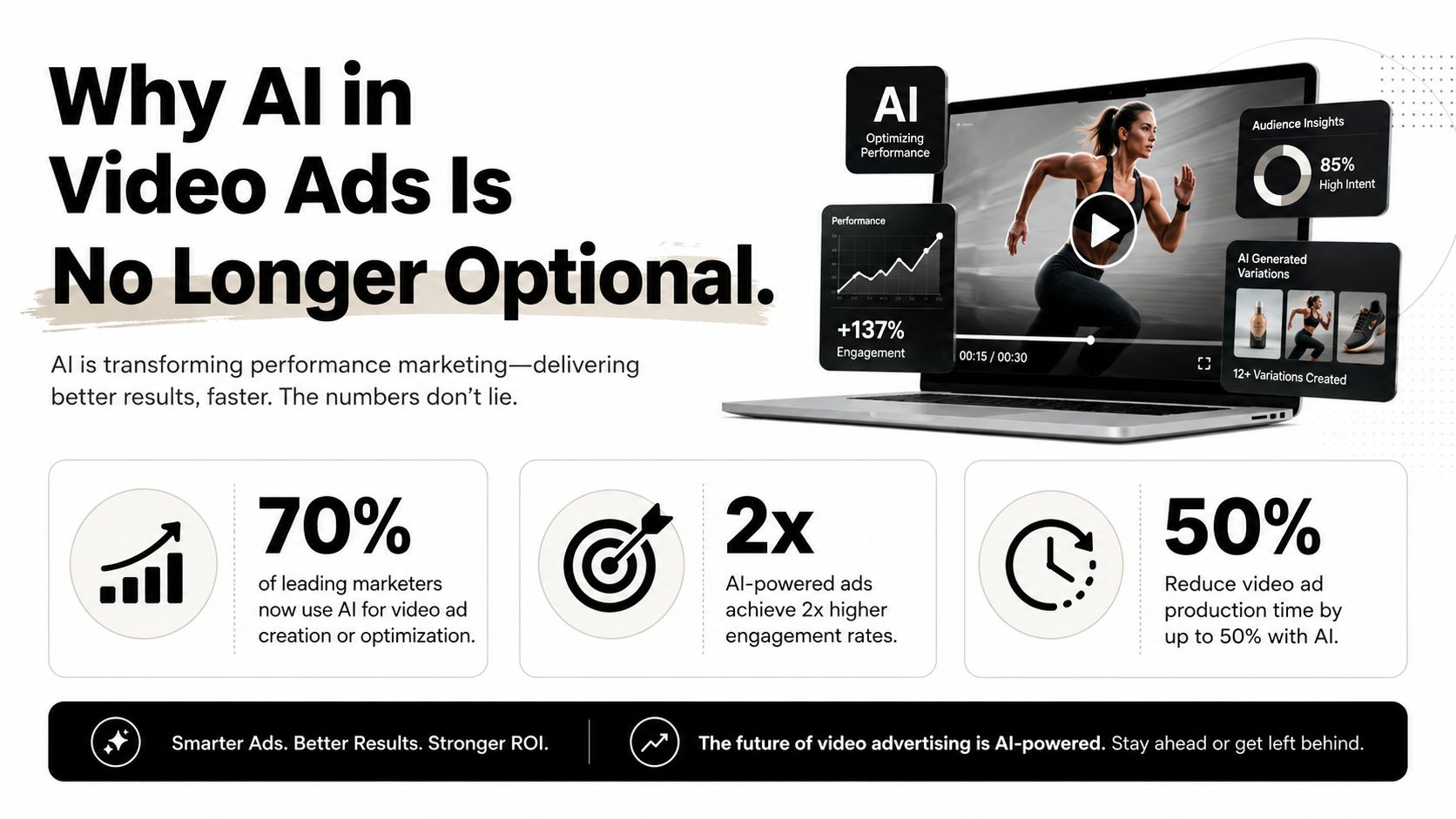
This change is operational. AI video is no longer a novelty tool for making one polished asset faster. It is production infrastructure for generating, adapting, and testing many controlled variations across audiences, placements, and creative angles.
On performance channels, speed alone does not help. Useful speed does. If a team can produce 30 new ads in a week but cannot tell whether performance came from the hook, proof segment, voiceover, pacing, or CTA, that output creates more confusion than learning. Strong AI workflows solve that by increasing variation while keeping the test structure clean.
That is why the biggest advantage is not raw generation. It is adaptation at scale.
The IAB findings point in the same direction. Advertisers are using GenAI to create different versions of the same video for different audiences, adjust visual style, and improve contextual relevance. That lines up with what drives account performance on Meta and TikTok. A concept that works in broad prospecting often needs a different first three seconds for retargeting. A TikTok-native cut may need looser framing, faster payoff, and creator-style delivery, while the Meta version may perform better with clearer branding and product visibility earlier in the edit.
Manual teams usually break at the same points:
- New angles depend on fresh edit requests, so strategy outpaces production.
- Editors spend time exporting hook swaps, caption versions, aspect ratios, and length cuts instead of improving winning ads.
- Media buyers get batches of “new” creative where too many variables changed at once, which makes results harder to interpret.
I see the constraint less as idea generation and more as throughput discipline. Good teams already know what they want to test. They struggle to turn that plan into enough clean variants before fatigue hits, CPMs rise, or frequency starts eroding response.
AI helps close that gap. It can fill missing B-roll, generate alternate voiceovers, localize scripts, resize assets, and produce first-pass variations fast enough for weekly or even daily testing cycles. The trade-off is quality control. Without a system for naming, reviewing, and assembling assets, AI also makes it easier to flood an account with cheap-looking creative that burns spend and teaches you nothing.
So the requirement is not “use AI” in the abstract. The requirement is to build a workflow that turns AI into a controlled creative engine. For teams working through that shift, this guide on AI for advertisers gives useful context on how the operating model changes, not just the asset count.
Designing Your Ad Strategy for AI-Powered Testing
A small lift in click-through rate matters when you are testing at scale. The difference between a clean test plan and a messy one often decides whether 50 new ads teach you something useful or just spend budget faster.
The common mistake is starting with prompts, avatars, or auto-generated scenes. Performance teams need a test architecture first. On Meta and TikTok, AI works best when every ad is built from parts you can swap, measure, and reuse without changing three other variables at the same time.
Write scripts as modules, not as one polished edit
A script for AI-powered testing should be built as interchangeable blocks. The baseline is hook, body, and CTA. In practice, I usually break it down further into proof, objection handling, offer framing, and visual treatment, because each of those can change hold rate, thumb-stop rate, CTR, and downstream CPA.
A linear script is harder to scale. One change forces a rewrite, a re-edit, and often a new export set across placements. A modular script lets the team test the opening angle against the same body, or test a proof segment without touching the close.
| Framework | Structure | Best For | AI Testing Application |
|---|---|---|---|
| Hook Body CTA | Opening pattern, core value delivery, direct close | Broad prospecting and fast iteration | Swap hooks or CTAs while keeping the body constant |
| Problem Agitate Solve | Pain point, consequence, resolution | Products with a clear before-and-after story | Test different pain-led openings against one solution segment |
| Proof Benefit CTA | Evidence first, benefit framing, ask | Warmer audiences and skeptical buyers | Rotate proof assets while holding the offer steady |
| UGC Testimonial Flow | Personal opening, use case, result, recommendation | TikTok-style native ads | Recut scene order and delivery style without changing the core claim |
That structure is what turns AI from a content generator into a testing system.
Define the variable before production starts
Researchers cited in the MIT Initiative on the Digital Economy article on personalized AI video ads from MIT's Initiative on the Digital Economy found higher engagement for personalized video formats than less customized alternatives. The practical lesson for ad teams is straightforward. Relevance helps, but only if the test is clean enough to show what truly improved performance.
If one variation changes the hook, visual style, proof sequence, and CTA, the result is hard to trust. Media buyers cannot scale that insight with confidence.
Use a simple planning grid before anyone writes prompts or renders drafts:
Choose one test variable
Hook angle, problem framing, proof type, CTA, pacing, voiceover style, or visual format.Lock the control version
Keep the rest of the ad as stable as possible so the outcome is interpretable.Write a real hypothesis
Example: “Messy morning pain-point hooks will beat taste-led hooks for cold TikTok traffic.”List the assets each version needs
Script line, matching footage, captions, voiceover, on-screen text, and end card.
Good AI testing starts with a learning goal, not a generation prompt.
Build a brief AI can actually execute
Vague briefs produce vague ads. “Make it punchy” and “make it feel native” do not help an editor, a prompt operator, or a rendering workflow.
A usable brief for AI-assisted production should specify:
- Audience state: Cold prospect, returning site visitor, warm engagers, existing customer
- Message hierarchy: What the viewer needs to understand first, second, and third
- Platform context: TikTok-native pacing, Meta feed readability, Story or Reel safe zones
- Brand rules: Approved claims, compliance limits, restricted terms, required product visibility
- Asset constraints: Founder face in first three seconds, captions always on, logo only in closing frames, no generated hands touching product
That document is not a creative formality. It is the operating spec for scaled production.
For teams tightening their test design, this framework for testing video ad creatives systematically pairs well with the modular approach.
Example of a modular brief
Here is a practical version for a DTC coffee subscription with a low first-order offer and a clear repeat-purchase model.
Product: Monthly specialty coffee subscription
Goal: Acquire new customers on TikTok and Meta Reels
Primary objection: “It is overpriced compared to store-bought coffee”
Testing variable: Hook angle only
Control body: Same demo, same offer, same CTA across all versions
Hook set
- “I stopped buying stale grocery store coffee after trying this.”
- “My cheapest habit got weirdly expensive, so I tested a coffee subscription.”
- “If your coffee tastes different every week, this is probably why.”
Body set
- Show beans arriving.
- Show brewing close-up.
- Call out freshness, roast date, and subscription flexibility.
- Add one customer quote about taste and convenience.
CTA set
- “Try your first box for $10.”
- “Pick your roast and get your first shipment.”
- “Start with one box and skip anytime.”
This is the level of specificity that makes bulk testing useful. The team can produce ten hook variants against one stable selling argument, read the signal quickly, and scale only the angles that improve thumb-stop rate, CTR, and purchase efficiency.
AI does not replace strategy here. It increases output once the strategy is clear enough to test on purpose.
Building an Intelligent Asset Bank
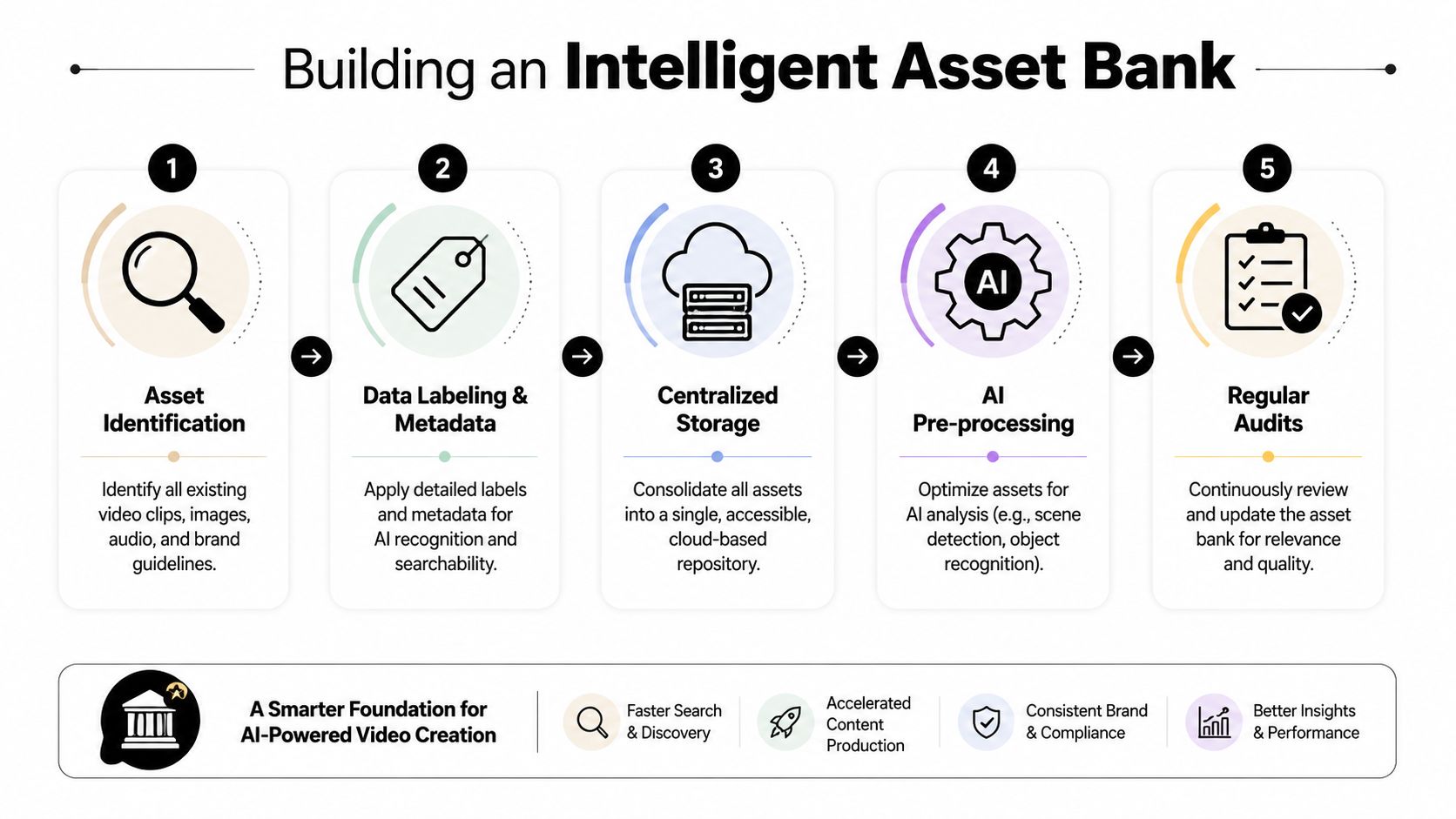
Most AI video workflows fail in a less glamorous place. It's not prompting. It's storage. Teams can't scale ad variation when footage sits in random folders, old campaign exports aren't searchable, and no one knows where the usable UGC clips live.
A workable system starts with an asset bank that treats every clip like a reusable building block.
Organize by function, not by shoot date
Date-based folders are useful for archiving. They're weak for production. A strategist building a new ad doesn't think, “I need the March 14 folder.” They think, “I need a strong demo shot, a reaction clip, and a proof moment.”
Structure the library around how assets get used:
- Hooks: Scroll-stopping openers, strong facial reactions, bold first lines, surprising visuals
- Bodies: Demos, problem-solution sequences, lifestyle footage, feature explainer clips
- Proof: Testimonials, reviews, social proof overlays, before-and-after visuals
- CTAs: End cards, offers, product close-ups, app UI, branded resolves
That turns your footage into inventory instead of archive material.
Add metadata your team can actually search
An intelligent asset bank needs more than folder names. Every useful clip should be easy to find by scene type, speaker, product angle, and context.
At a practical level, that usually means tagging for:
- Shot type such as selfie, studio, unboxing, handheld demo, screen recording
- Message category such as pain point, feature, benefit, objection, social proof
- Platform fit such as TikTok-native, Meta feed-safe, Story-ready
- Creative quality such as strong hook, clean VO, usable b-roll, rough but authentic
Transcripts matter too. Once spoken footage is transcribed, a team can search by phrase, benefit, objection, or line delivery instead of scrubbing manually through raw clips.
A searchable library changes production speed more than a new generation model does.
If your current setup is still a pile of exports and unlabeled raw footage, these asset management best practices are a good benchmark for tightening the system.
Audit for gaps, not just volume
A large library can still be weak. The issue is usually imbalance. Teams often have plenty of polished product footage and almost no authentic transitions, proof moments, or bridge scenes that make modular assembly feel natural.
Look for missing categories such as:
- Short reaction clips that can open an ad cleanly
- Neutral b-roll that connects two ideas without a jarring cut
- Multiple CTA visuals so every ad doesn't end the same way
- Raw UGC fragments that feel native on TikTok and Reels
Once you see the gaps, AI generation becomes much more useful because you're filling specific production holes instead of generating content aimlessly.
AI-Powered Generation for B-Roll and Voiceovers
Creative volume breaks down on the small missing pieces. A script is ready, the testing matrix is clear, and then production stalls because the ad needs one bridge shot, two alternate intros, a tighter crop for 9:16, and a new VO read for a different audience angle. AI is useful here because it keeps the test plan moving without sending every minor request back into a full edit cycle.

The highest-value use cases are rarely the flashy ones. Generated transition shots. Product cutaways. Alternate backgrounds. Voiceover variants. Caption passes. Resizing. These production tasks decide how many ads a team can launch this week, and how cleanly each test isolates a variable.
Generate b-roll to fill a production hole
AI b-roll performs best when the request is tied to a job inside the ad. A vague prompt like "create a cool product clip" usually gives you footage that looks fine on its own and fails inside the sequence. A useful prompt defines what the shot needs to do, where it sits in the edit, and what constraints it has to respect.
Use prompts that specify:
- Scene function: hook support, transition, demo support, proof moment, CTA close
- Visual format: UGC-style handheld, studio macro, lifestyle setup, app UI simulation
- Composition rules: 9:16 framing, caption-safe space, product centered, face visible early
- Motion style: slight handheld movement, quick push-in, casual pan, pacing that can survive fast cuts
That level of detail matters because generated footage is easy to overproduce and hard to place. The goal is not prettier assets. The goal is to create clips an editor can drop into 20 ad variants without fixing them by hand.
For teams using generated filler shots and support scenes to increase testing volume, this guide to AI b-roll for ad creative workflows is a practical reference.
Treat voiceovers as a variable you can test
AI voiceover is most useful when you need controlled variation across the same message. Change pacing. Change emphasis. Change the first line. Change tone by platform. That gives you a clean way to test whether performance shifts because of the offer, the hook, or the delivery.
In practice, the strongest use case is message testing before you commit creator time. If a script concept dies with three different VO styles, the problem is usually the message. If one cadence lifts hold rate or CTR, that read becomes the human recording brief.
A few rules help:
- Write for the ear: short sentences, direct wording, one idea per line
- Use punctuation as direction: commas, periods, and line breaks shape pacing
- Match platform behavior: TikTok can support a looser read, while Meta often rewards clearer delivery
- Benchmark against a human read: approve only if the AI version sounds credible next to real creator footage
Field note: A polished AI voice with no tension or point of view will depress performance faster than a slightly imperfect human read.
Use platform tools where speed matters
Platform-native AI is getting better at production assistance, especially for versioning and adaptation. Amazon's Video Generator documentation describes a workflow built around producing multiple ad-ready variations quickly. Google Ads also highlights fast trimming and short-form adaptation inside its own toolset. The common pattern is clear. These tools are strongest when you use them to produce more testable outputs from existing inputs, not when you expect them to invent a winning concept.
That same logic should guide your stack:
| Task | Good AI Use | Weak AI Use |
|---|---|---|
| B-roll | Filling a missing scene or transition | Building the full ad idea from thin prompts |
| Voiceovers | Testing delivery and language variations | Replacing creator reads in ads that depend on trust and personality |
| Captions | Bulk subtitle creation and styling | Publishing auto-captions without review |
| Resizing | Adapting 9:16, 1:1, and feed-safe crops | Assuming every auto-crop keeps the focal point |
Later in the workflow, short-form adaptation matters as much as generation. This example is worth watching because it shows how quickly AI-assisted edits become usable when the source material is already structured for performance:
Keep the rough edges that help ads convert
The main failure mode is over-smoothing. AI can clean an ad until it loses the texture that made it believable in the first place. Perfect transitions, polished voice, and generic support shots often reduce the native feel that helps Meta and TikTok creative hold attention.
Use AI for repeatable production tasks and controlled variation. Keep human judgment on hook strength, creator believability, comedic timing, and the kind of visual imperfection that makes an ad feel like content instead of output.
Modular Assembly and Rapid Bulk Rendering
The workflow begins to act like a system rather than a production queue. Once your scripts are modular, your asset bank is searchable, and the missing pieces are generated, assembly becomes a combinatorial process.
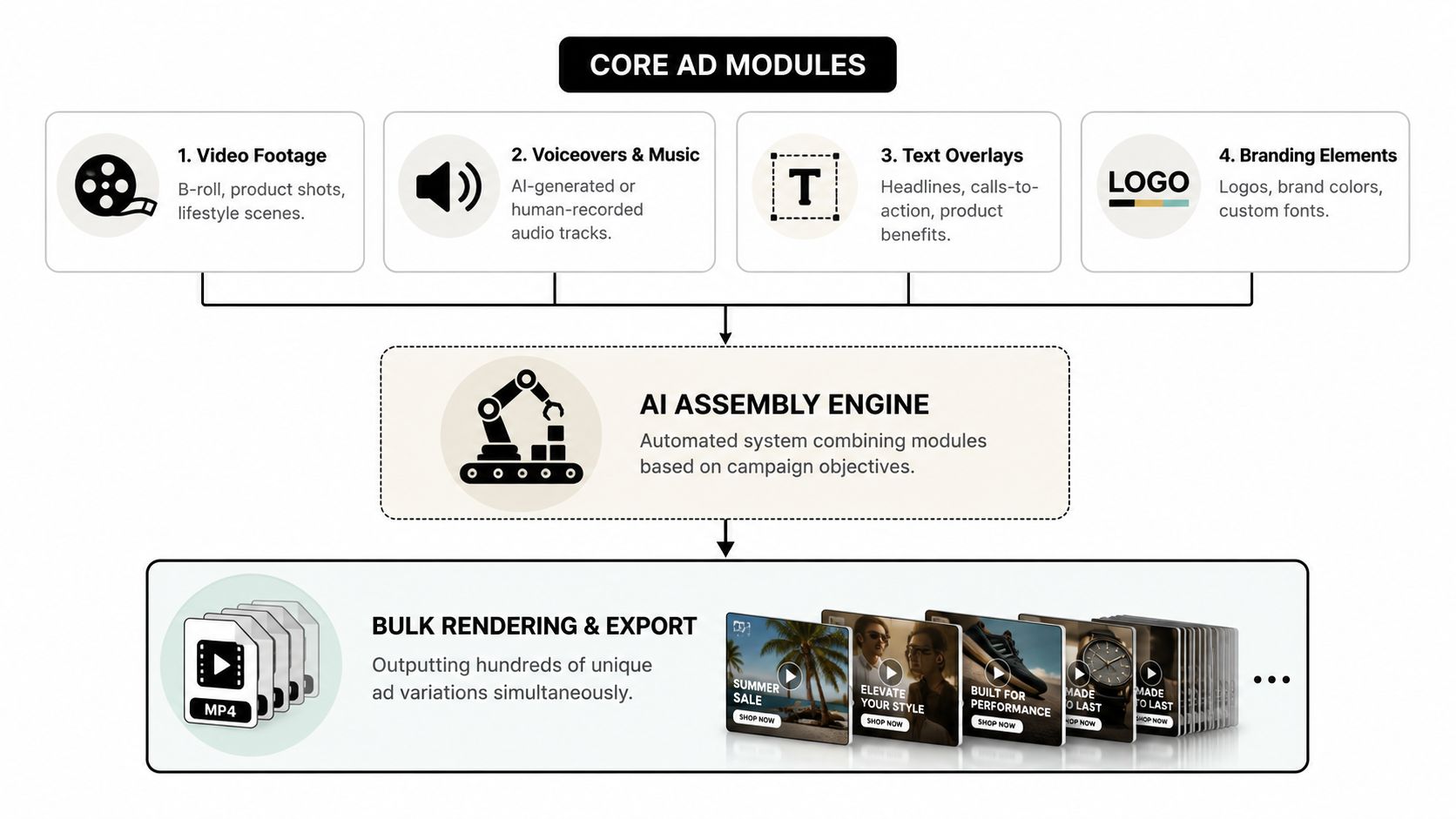
The practical model is straightforward. First, inventory existing footage into reusable modules such as product features, benefits, and social proof. Then generate missing components. Then assemble standardized templates while testing one variable at a time so the result is interpretable, as outlined in this modular AI video workflow.
Think in combinations, not finished edits
Most editors are trained to perfect one timeline. Performance teams need a different mindset. Build a repeatable structure once, then change the inputs methodically.
A simple assembly template might look like this:
Opening slot
Hook clip, hook text, and hook audioMiddle slot
Demo, explanation, or proof sequenceSupport slot
Caption treatment, overlays, benefit callouts, cutawaysClose slot
CTA line, branded frame, product shot, or offer frame
Once those slots exist, the timeline becomes a controlled testing environment.
Bulk rendering is only useful when combinations are intentional
It's easy to generate a pile of exports. That isn't the same as a useful test matrix. What matters is whether the combinations reflect a hypothesis.
Here's a practical way to structure assembly:
Phase one Test multiple hooks against one stable body and one CTA. This isolates the opening.
Phase two Keep the winning hook and test body variations. This isolates message framing.
Phase three Keep the winning message structure and test CTA framing or end-card presentation.
That sequence keeps learning cumulative. You're not just creating volume. You're narrowing uncertainty.
The best bulk-rendering workflow doesn't ask, “How many videos can we make?” It asks, “How many clean comparisons can we launch this week?”
Use the timeline as a rules engine
Modern assembly tools increasingly act less like classic editing software and more like variation engines. You set defaults for text styles, safe zones, caption behavior, and audio balance, then push many combinations through that logic.
That matters because quality often breaks in the same places at scale:
- Text overlays drift across safe zones between formats
- VO timing mismatches create awkward dead space
- CTA cards feel repetitive because every export resolves identically
- Visual logic breaks when clips are swapped without transition planning
A rules-based template catches a lot of that before launch.
For teams building high-volume testing pipelines, this modular video ad framework shows how to structure reusable ad components for cleaner assembly. Platforms such as Sovran also support this kind of workflow by recombining hooks, bodies, and CTAs into large numbers of ad variations and pushing them into Meta Ads Manager.
Make variation look deliberate
The final creative trap is sameness. Modular assembly can produce many exports that are technically different but feel identical to a viewer. If your first three seconds all rely on the same framing, same subtitle treatment, and same tone, the ad family won't cover enough creative ground.
To avoid that, build diversity into the modules themselves:
| Module | Weak Variation Pattern | Strong Variation Pattern |
|---|---|---|
| Hooks | Same sentence, new background | Different opening mechanisms such as question, claim, confession, demo |
| Bodies | Same proof in a different order | Different message angles such as benefit, objection, social proof |
| CTAs | Same ask with color changes | Different levels of intent such as shop now, learn more, try it yourself |
| Visual treatment | One caption style across every ad | Distinct native styles matched to placement behavior |
Bulk rendering should feel like accelerated creative testing, not duplicated editing.
Ensuring Quality Control and Brand Alignment
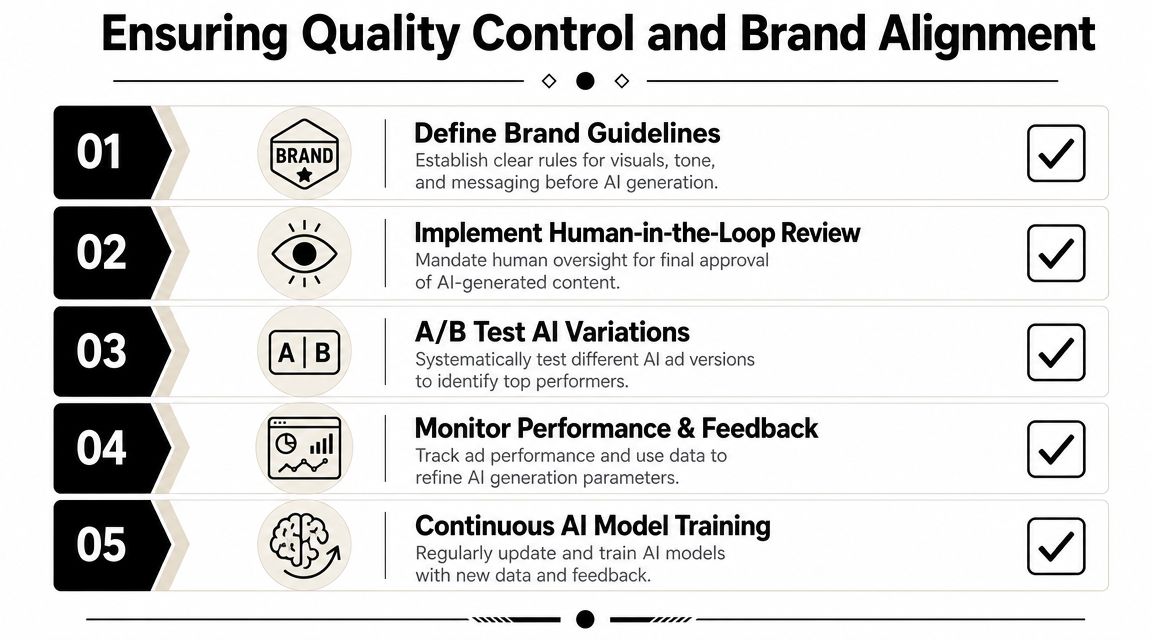
AI makes it easy to produce enough creative to damage your own account with mediocre inputs. That's why quality control matters more after automation, not less.
The strongest teams keep a human-in-the-loop review process. They don't hand final judgment to a generator, a captioning model, or an auto-assembly engine. They use those systems to speed up production, then apply clear approval criteria before launch.
Human review catches the failures that AI creates
A lot of AI-generated ads are technically competent and strategically weak. Others are strategically fine and visually off. The review layer has to catch both.
The most common issues are familiar:
- Visual artifacts: Strange hands, warped objects, unnatural motion, broken perspective
- Brand drift: Wrong color balance, off-tone messaging, generic-looking scenes
- Platform mismatch: Ads that feel like polished commercials instead of native short-form content
- Logic breaks: A voiceover mentions one benefit while the footage shows something unrelated
These problems usually survive automation because each component looks acceptable in isolation. They become obvious only when a human watches the ad like a user, not like an operator.
Build a context vault for brand control
If your team regularly creates video ads with AI, store approved context in one place. Logos, fonts, color constraints, on-screen language rules, approved product shots, restricted claims, and messaging examples should all sit in a shared reference system.
That gives editors, strategists, and AI-assisted tools the same source of truth.
A lightweight context vault should answer questions like:
- What can appear in the first frame
- What language is approved for benefits and claims
- How captions should look on Meta versus TikTok
- What kinds of creator-style footage are on-brand
- Which visual shortcuts are not acceptable
Without that layer, AI accelerates inconsistency.
Native beats polished on Meta and TikTok
One of the most useful creative rules right now is simple: keep the thinking human. Recent creator guidance emphasizes that the strongest AI ads often use AI where it saves time, such as supporting visuals or scene variations, while relying on human judgment for concept, pacing, and authenticity. The same guidance stresses fast cuts, captions, and native-feeling UGC structure to preserve authenticity and fight ad fatigue on Meta and TikTok, as discussed in this creator-focused breakdown of AI ad production.
That lines up with what most performance teams see in practice. AI-generated polish isn't the goal. Native watchability is.
If the ad looks machine-made before the value proposition lands, the viewer is already gone.
QA checklist before launch
A simple approval pass should check four areas:
| Review area | What to check |
|---|---|
| Message clarity | Is the main claim understandable without sound and within the opening seconds? |
| Visual authenticity | Do the scenes feel believable and native to the placement? |
| Brand fit | Are the tone, overlays, and product cues aligned with brand standards? |
| Test cleanliness | Did this version change only the variable we intended to test? |
This last point is easy to miss. Good QA isn't only about aesthetics. It's also about experiment design. A visually strong ad can still be a bad test asset if it changed too many elements at once.
From Ad Creator to Creative Engine
The shift is bigger than adding AI tools to your editing stack. The core change is operational. You're no longer trying to produce one strong ad at a time. You're building a creative engine that can generate, assemble, review, and test many clear variations without losing strategic control.
That engine has a few essential parts. A modular scripting approach. A searchable asset bank. AI generation for the missing production layers. A rules-based assembly process. Human QA that protects authenticity, brand fit, and test quality.
When those pieces work together, creative stops being a bottleneck. It becomes a faster feedback loop. Buyers get cleaner tests. Strategists learn faster. Editors spend less time rebuilding the same structure from scratch. And the account gets more chances to find the message, angle, and delivery style that scales.
That's the practical reason to create video ads with AI now. Not because AI can make ads on command, but because it can help a team test more ideas with more discipline than a manual workflow usually allows.
If you want to turn this kind of workflow into a repeatable system, Sovran is built for performance marketers who need to organize footage into reusable modules, generate missing creative elements, assemble large batches of video variations, and push them into Meta-ready testing pipelines without losing control of quality.

Manson Chen
Founder, Sovran
Related Articles

Storyboard Development: Scale Video Ad Production in 2026

8 Pattern Interrupt Techniques for Video Ads