Demographic Targeting: A Performance Marketer's Guide 2026

Jump to a section
- What Is Demographic Targeting in 2026
- Why and When to Use Demographic Targeting
- Platform-Specific Setup for Meta and TikTok
- Advanced Segmentation Strategies to Find Your Niche
- How to Measure and Optimize by Demographic
- Aligning Creative Testing with Demographic Segments
- Common Pitfalls and Privacy Considerations
The scale of social media usage is frequently underestimated. Social media usage is projected to reach 5.24 billion people in 2026, or about 63% of the global population, which is exactly why broad audience assumptions break down fast in paid media according to Piktochart's social media demographics roundup. At that size, demographic targeting stops being a checkbox in Ads Manager and becomes a control system for spend, relevance, and creative direction.
Most guides treat demographic targeting as setup hygiene. That misses where the primary advantage lies. The strongest teams use demographic insights to shape what they test, how they structure creative variants, and where they reallocate budget once signal appears. That's the difference between “targeting” and performance management.
What Is Demographic Targeting in 2026
Demographic targeting is the practice of segmenting audiences using measurable characteristics such as age, income, gender, and geographic location. In 2026, that definition is still true, but it's incomplete.
What matters in practice is this: demographic targeting gives media buyers a fast way to narrow a market into groups that can receive different messages, different bids, and different creative treatments. It's the first filter that keeps campaigns from paying to talk to the wrong people.
A lot of teams still use demographics too loosely. They pick an age range, maybe split by gender, and call it done. That usually leads to generic ads, muddy reporting, and weak conclusions. Strong operators treat demographics as a starting layer, then decide whether each segment deserves its own budget, landing page, or creative package.
The role demographics actually play
Demographics aren't the whole targeting strategy. They're the part that creates initial structure.
That structure matters because audiences don't behave the same way just because they share a broad interest. A person in one age band, income bracket, or region may respond to a different value proposition than someone who clicks the same topic elsewhere. The campaign only gets cleaner when the audience definition and the message move together.
Three practical uses show up over and over:
- Audience qualification: Use demographics to remove obviously irrelevant groups before the algorithm spends against them.
- Creative direction: Build different hooks, proof points, or visual cues for different segments.
- Reporting clarity: Break performance down by audience slices you can act on.
Practical rule: If a demographic split won't change your bid, budget, or creative, it probably doesn't deserve its own ad set.
What changed in 2026
The big shift isn't that demographics became obsolete. It's that they became more valuable when paired with faster testing systems. Platform automation can find pockets of demand, but buyers still need a framework for deciding what message to put in front of which people.
That's why demographic targeting still sits near the center of paid social strategy. It gives teams a stable planning layer inside noisy auction environments, especially when they're running multiple creatives across Meta and TikTok. If you're building a broader acquisition framework, this paid social media strategy guide is a useful companion to the targeting side.
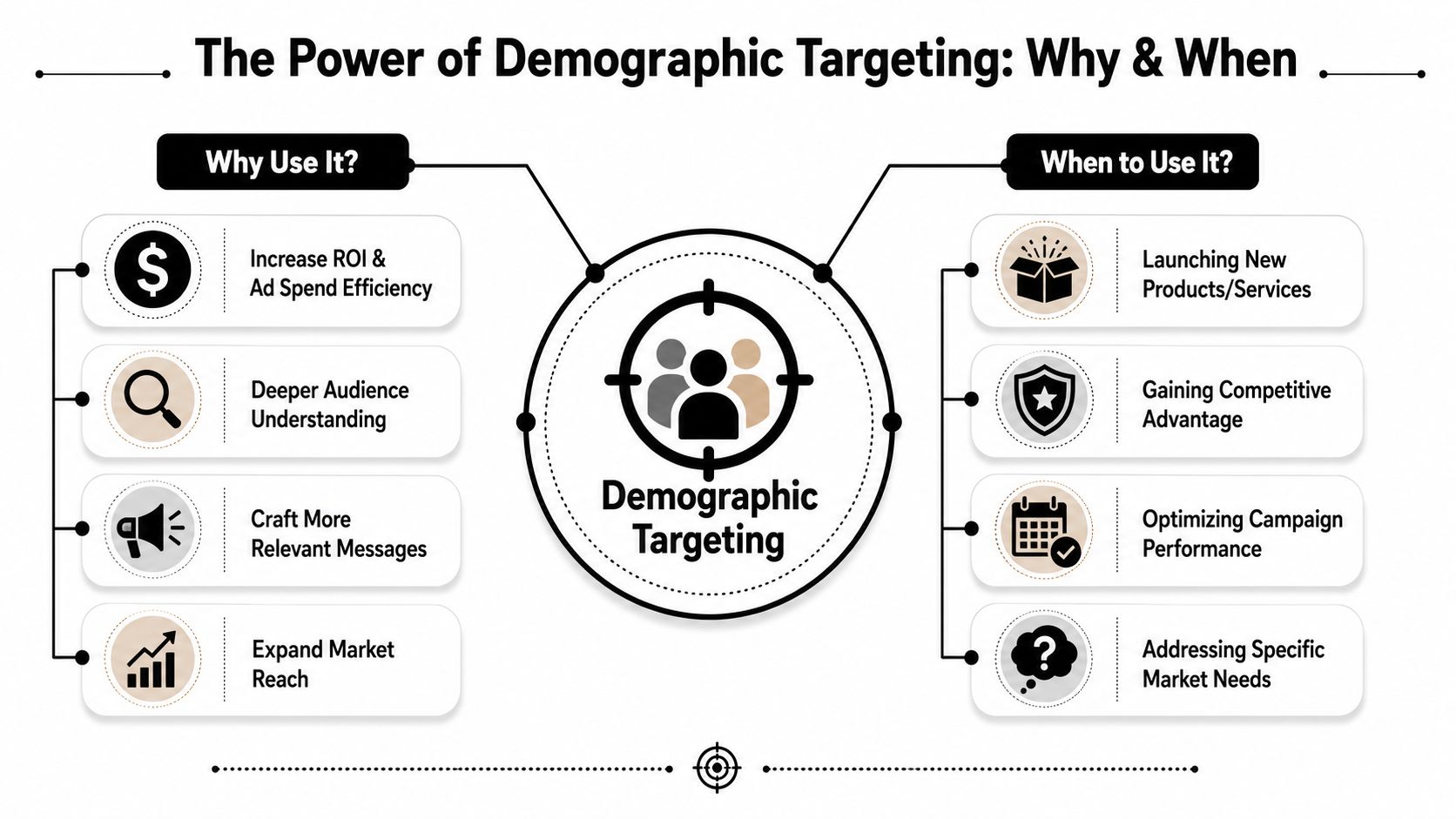
Why and When to Use Demographic Targeting
Demographic targeting works like using the right key for the right lock. Broad targeting can open some doors, but it also wastes motion. When you know a segment is more likely to care about a specific problem, promise, or purchase context, demographics help you stop speaking to everyone at once.
The business reason is simple. Relevance affects attention, and attention affects downstream performance. Research published in PLOS ONE found that demographically targeted ads attract more visual attention, including stronger dwell time and number of fixations, than non-targeted ads in the study. For media buyers, that matters because creative only has a chance to persuade if the right people pay attention to it.
Why it earns a place in the plan
Demographic targeting is most useful when it sharpens one of three things: message fit, spend efficiency, or diagnosis.
Here's where it tends to earn its keep:
- Message fit improves: A benefit-led hook for one age group may feel flat or irrelevant to another.
- Waste drops: Excluding groups that are unlikely to convert keeps spend from leaking into low-intent traffic.
- Analysis gets cleaner: When performance slips, demographic breakdowns often reveal whether the problem is audience quality, creative mismatch, or both.
The biggest mistake is treating demographics as a static persona exercise. They're better used as operating constraints. They tell you where to start, where to separate tests, and where not to overgeneralize.
When to prioritize it
Some situations make demographic targeting especially valuable.
| Scenario | Why demographics matter |
|---|---|
| New market entry | You need an initial structure before platform data matures |
| Scaling a winning ad | You need to see which audience slices carry performance |
| Diagnosing weak conversion | You need to isolate whether the issue is the message or the audience |
| Launching multiple angles | You need a way to map each angle to a likely responder group |
Teams usually get the best result when they ask one operational question: which demographic differences actually justify different creative?
That's the right standard. If the answer is “none,” keep the audience broader. If the answer is “clear differences in pain point, aspiration, or buying context,” demographics should influence the test design from day one.
Platform-Specific Setup for Meta and TikTok
Meta and TikTok both let you target by demographic traits, but they don't reward the same setup habits. The difference isn't just interface design. It's how much confidence you should place in each audience input.
On Meta, the useful distinction is between high-confidence and moderate-confidence demographic signals. Age and gender are considered high-confidence inputs, while parental status and job titles sit in the moderate-confidence bucket. Meta-focused analysis also notes that stacking too many demographic assumptions into a small audience tends to hurt performance, while pairing one high-confidence demographic signal with one buying-context signal usually works better than pure demographic stacking as described here.
How to build on Meta without choking delivery
The common failure mode is overbuilding the audience.
A setup like “women, narrow age band, parents, manager title, high-income area, one interest” looks precise. In reality, it often creates a brittle audience built on mixed-quality assumptions. Delivery gets constrained, signal gets noisy, and the buyer ends up blaming creative when the targeting was the actual issue.
Use this simpler framework instead:
- Start with one strong demographic filter. Age is usually the cleanest first move.
- Add one buying-context signal. That could be an interest, behavior, or custom audience seed.
- Let creative carry more of the specificity. Don't force all nuance into targeting.
- Break out reporting later. Separate age or gender views only when the data shows meaningful differences.
If your team is wiring infrastructure before launch, connect the account cleanly and keep reporting access centralized through this Meta connection workflow.
How TikTok should change your setup logic
TikTok usually rewards looser audience framing and stronger creative iteration. Demographics still matter, but the platform is less forgiving of weak creative and less dependent on heavy interest layering.
That means your demographic choices on TikTok should act more like guardrails than a cage. Use them to avoid obvious mismatches, then test multiple hooks aggressively inside the approved audience range. For teams building that motion from scratch, this overview of digital marketing with TikTok ads is a solid practical reference.
A useful comparison:
- Meta: Better when you want tighter control over audience construction and detailed breakdowns.
- TikTok: Better when you want fast creative discovery inside a broader demographic frame.
- Both platforms: Strongest when demographics inform the test plan instead of replacing it.
Don't ask demographic targeting to do the job of positioning. The audience filter should narrow who sees the ad. The creative should explain why they should care.
Advanced Segmentation Strategies to Find Your Niche
Most advertisers don't lose because they missed a targeting option in Ads Manager. They lose because they keep chasing the same obvious segments as everyone else.
The better opportunity is often in underserved demographic combinations. Not exotic personas. Just groups whose needs are visible if you look beyond standard category assumptions. Circana's guidance on affordable market discovery points to several practical methods: analyze total basket data across entire stores, study cross-purchase habits, watch Google Trends for niche keyword spikes, and monitor Reddit or Facebook groups for unfiltered complaints in this breakdown.
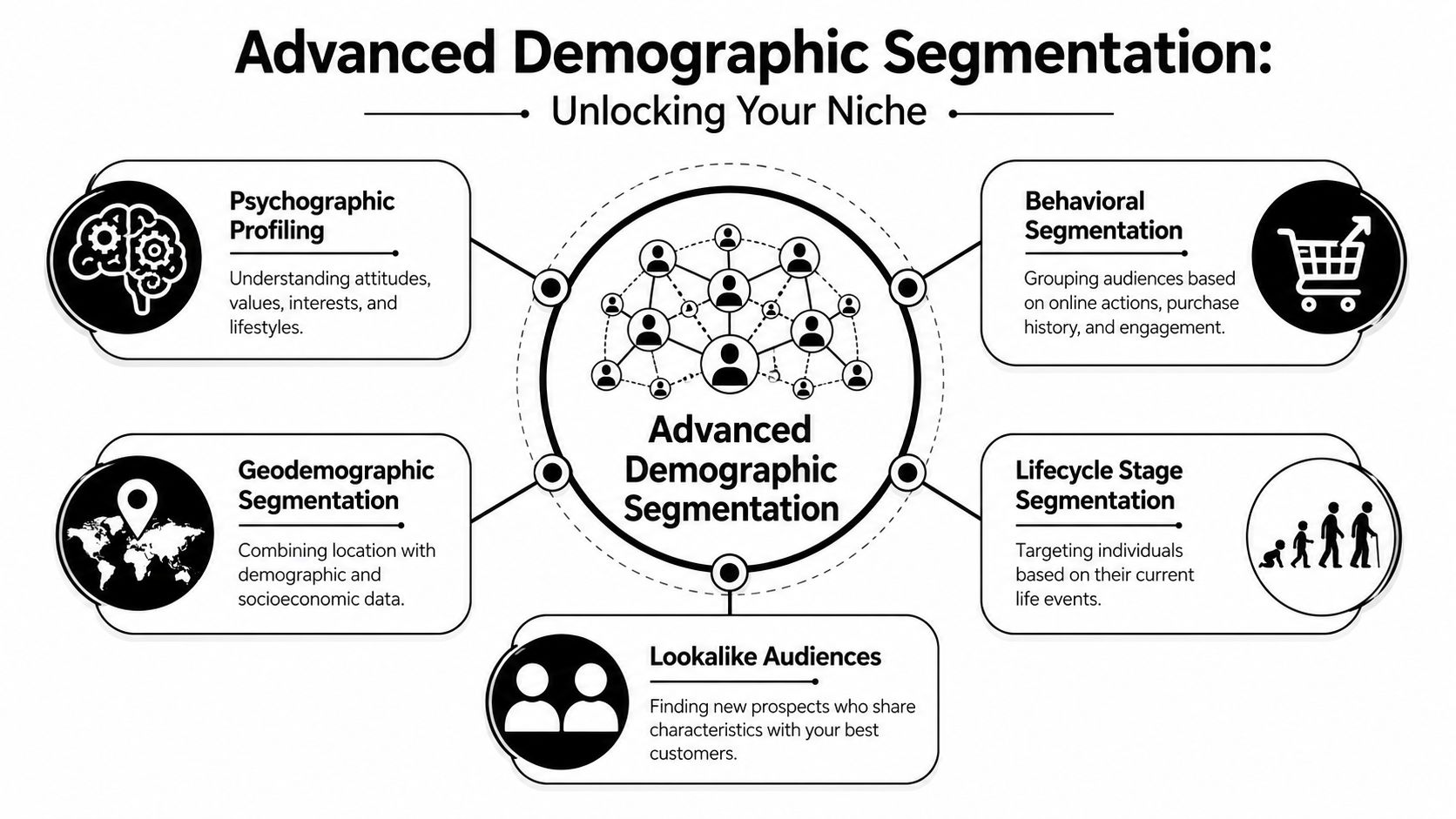
Where niche segments actually come from
The signal usually appears outside the ad platform first.
A Reddit thread full of complaints can tell you more about segment-specific friction than a polished brand survey. Google Trends can reveal that a niche use case is spiking in language your ad account would never surface on its own. Cross-purchase patterns can show that buyers don't behave the way your category stereotypes suggest.
That matters because niche segments are often discovered through contradiction. The segment you want may not act like the segment the market expects.
Try this research pattern:
- Start with basket logic: Look at what people buy together, not just what category they shop in.
- Check language drift: Search Trends for adjacent phrases, not only your core product term.
- Read complaint-heavy communities: Look for repeated frustrations, workarounds, and product compromises.
- Map the complaint to a demographic angle: Ask who is feeling this problem most sharply.
Turning niche insight into campaign structure
Once you find a possible white space, don't rush into hyper-segmentation. Build a testable hypothesis.
For example, if community research suggests a product solves a problem for a life stage or income context that competitors ignore, reflect that in the ad concept first. Change the hook, example, or objection handling. Then decide whether the demographic deserves its own audience split.
Here's a clean decision grid:
| Signal discovered | Best first move |
|---|---|
| New complaint pattern | Build a creative angle around the pain point |
| Cross-purchase behavior | Test buying-context signals alongside core demographics |
| Search language shift | Rewrite hook and headline language |
| Region-specific need | Split geography only if the offer or framing changes |
White space usually appears before the platform labels it. Good demographic targeting starts with observation, not interface filters.
How to Measure and Optimize by Demographic
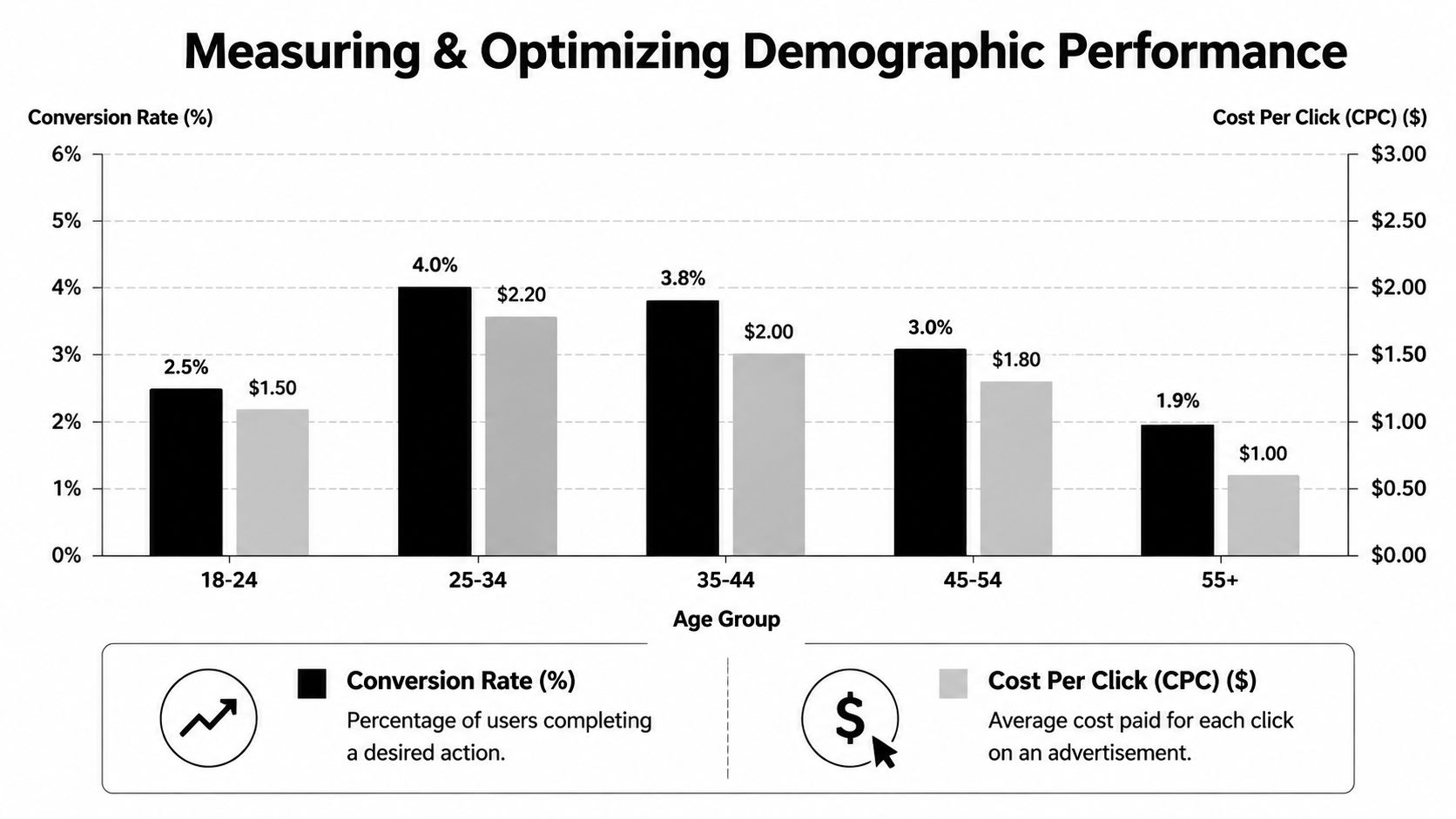
Demographic targeting only becomes valuable when it changes economic outcomes. If the audience split never affects bids, exclusions, budget, or creative allocation, it's just extra reporting.
The clearest operational use is segment-level optimization. Benchmark performance marketing data shows that applying bid modifiers by demographic group, based on conversion analysis, can shift CAC by 15–30% and improve ROAS by 20–40% when strong segments are identified and weaker ones are excluded or downweighted according to Lyr PPC's summary. That's not a reason to over-segment. It is a reason to review demographic performance systematically.
What to look at first
Start with the breakdowns that can trigger action.
For most Meta and TikTok accounts, that means reviewing performance by age, gender, and geography alongside core business metrics. Don't stop at clickthrough rate. A demographic group can click enthusiastically and still destroy payback.
Focus on a short stack of questions:
- Which segments convert efficiently? Those are candidates for budget expansion.
- Which segments spend without moving down funnel? Those are candidates for downweighting or exclusion.
- Which segments need different creative before you cut them? Weak results may reflect message mismatch, not low intent.
If your team needs a stronger reporting discipline around test outcomes, this guide to measuring creative tests in Facebook Ads reporting is worth using as a workflow reference.
A practical optimization loop
Don't optimize demographics in isolation. Pair the audience view with a creative view.
A reliable loop looks like this:
- Pull demographic breakdowns after enough conversion signal exists.
- Mark segments as scale, hold, or suppress.
- Check which creatives drove each segment's result.
- Apply bid adjustments or budget reallocation.
- Retest with revised creative where the segment still looks strategically important.
This keeps the team from making a lazy mistake: assuming a low-performing demographic should be cut immediately. Sometimes it should. Other times the audience is viable and the ad is wrong.
If one age group buys at a healthy rate and another stalls, don't just move budget. Check whether both groups saw the same promise, proof, and CTA.
That's where demographic optimization gets sharper. It stops being a spreadsheet exercise and starts shaping the next round of creative production.
Aligning Creative Testing with Demographic Segments
Most demographic targeting advice falls apart when it tells you how to choose the audience but then says almost nothing about changing the ad.
That's backwards. The biggest gains usually come from matching creative variation to demographic context. The segment isn't just a media filter. It's a clue about what to emphasize, what to remove, and what kind of proof will feel credible.
Stop testing one ad against many people
A common workflow problem shows up in scaling accounts. The team finds one winning video, launches it into broader audiences, then wonders why performance gets uneven across age bands or regions. The answer is usually simple. The ad was built for one context and pushed into five.
A better system uses modular creative. Instead of producing one finished ad at a time, the team creates swappable components:
- Hooks built for different motivations or attention styles
- Bodies that emphasize different objections, features, or use cases
- CTAs matched to the audience's level of intent
That structure makes demographic targeting useful at the creative level. One segment may respond to direct utility. Another may need social proof or a lifestyle frame. Same product. Different assembly.
A workable testing model
Use demographic segments as a lens for hypothesis design, not just media slicing.
For example:
| Demographic insight | Creative change worth testing |
|---|---|
| Younger audience needs faster recognition | Shorter hook, quicker payoff, stronger visual movement |
| Higher-consideration buyer needs reassurance | More proof, calmer pacing, clearer product context |
| Region or location changes use case | Different examples, settings, or on-screen text |
| Gender split shows divergent objections | Separate opening angles, not just different thumbnails |
A thoughtful framework for creative strategy for AI and Web3 is useful here because it reinforces the same principle: strategy sits in the message architecture, not just the target definition.
The production side matters too. If your team can't create and compare many structured variations quickly, demographic insights stay trapped in a slide deck. That's why modular workflows are so important for paid social. This is also the logic behind dedicated systems for Meta ads creative testing, where hooks, bodies, and CTAs can be recombined into many testable ads without rebuilding everything manually.
Here's a simple walkthrough of the kind of testing motion creative teams should study:
Creative fatigue is often a segmentation problem in disguise. The ad didn't just wear out. It reached people who needed a different argument.
When teams internalize that, demographic targeting stops being just audience setup. It becomes a briefing tool for creative iteration.
Common Pitfalls and Privacy Considerations
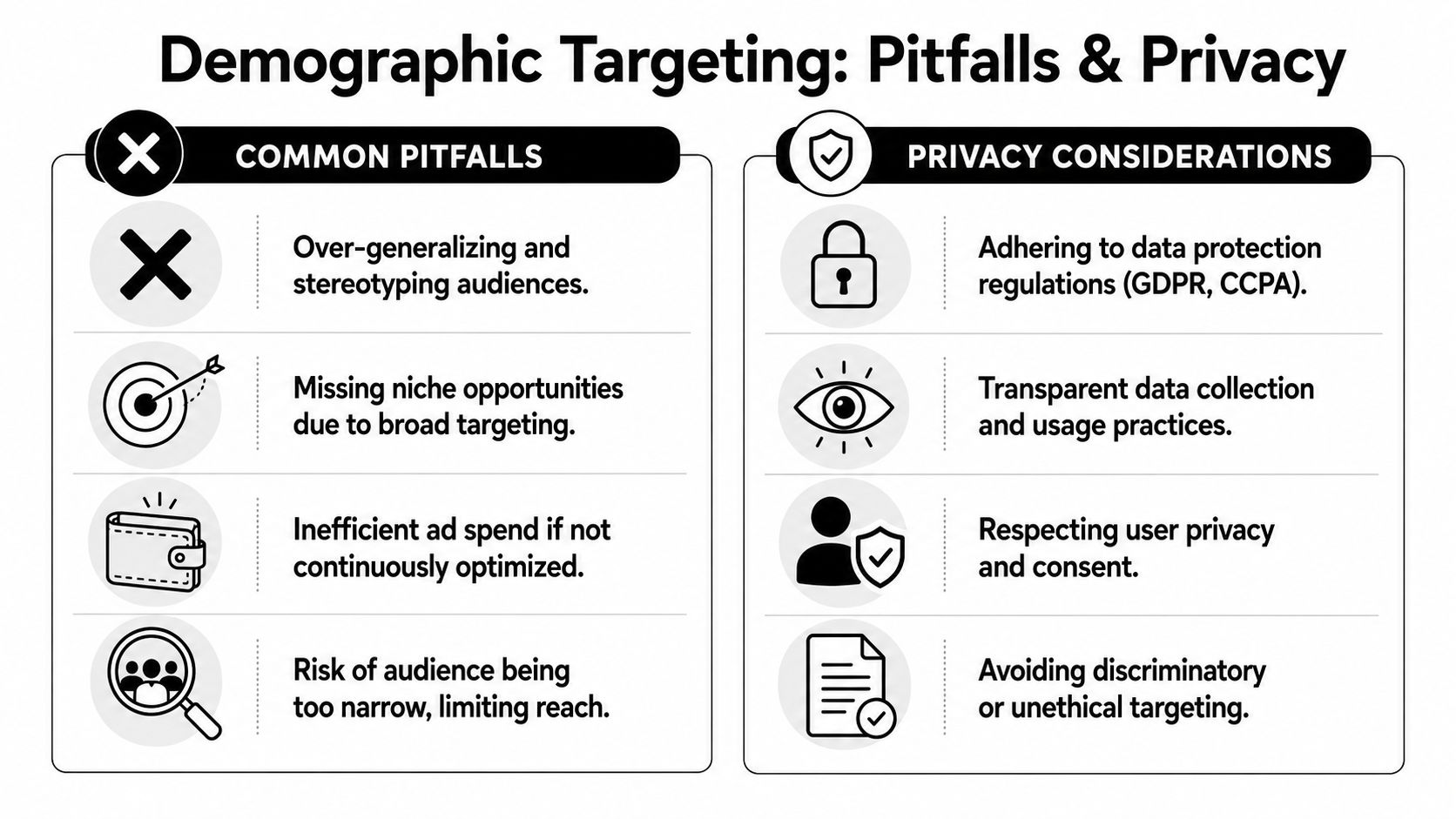
The fastest way to break demographic targeting is to confuse data with certainty. A demographic signal can suggest relevance. It doesn't prove motive, intent, or fit on its own.
That's why some of the most expensive mistakes come from false precision. Buyers build tiny audiences around stacked assumptions, read too much into short-term performance, or let stereotypes substitute for testing. A segment can underperform because the targeting is wrong, the creative is wrong, the offer is wrong, or the measurement window is misleading. Demographics don't resolve that automatically.
Common mistakes that hurt performance
These show up repeatedly in real accounts:
- Over-segmentation: Audiences get so narrow that delivery, learning, and stable comparison all suffer.
- Lazy persona logic: Teams assume an age group or gender must care about a message without validating it in creative tests.
- Correlation errors: One segment performs well during one period, and the team treats it as a permanent rule.
- Targeting as a crutch: Instead of improving the ad, the buyer keeps adding filters.
A good discipline is to ask whether each demographic split creates a different action. If it doesn't, collapse it.
Privacy and compliance aren't optional
Demographic targeting also sits inside a legal and ethical boundary. Marketers still need to handle audience data carefully, document consent practices, and avoid discriminatory or exploitative targeting choices.
That means being clear about data collection, using compliant tracking and consent flows, and making sure internal teams understand what can and can't be inferred from platform data. It also means respecting the difference between a useful audience segment and a sensitive category.
A few practical standards help:
- Use transparent collection practices: People should understand what data is collected and why.
- Limit unnecessary granularity: Don't gather or retain more audience detail than the campaign needs.
- Review targeting assumptions with legal and brand teams: Especially in regulated categories.
- Keep privacy documentation accessible: Your policy shouldn't be hard to find or hard to read. This privacy page is the kind of baseline accessibility users expect.
Good demographic targeting improves relevance without crossing into manipulation or exclusion.
That's the standard worth keeping. Precision is useful. Respect is paramount.
Demographic targeting works best when it shapes both media decisions and creative testing. If your team needs a faster way to turn audience insights into large-scale video experiments, Sovran helps performance marketers build modular ad variations, test hooks, bodies, and CTAs at speed, and push more structured creative into Meta without slowing production.

Manson Chen
Founder, Sovran
Related Articles

8 Pattern Interrupt Techniques for Video Ads
- pattern interrupt techniques
- video ad hooks
- 3 more

Customer Journey Mapping for Performance Marketing
- customer journey mapping
- performance marketing
- 3 more
Production Schedule Optimization for Scalable Ad Testing
- production schedule optimization
- creative testing
- 3 more