Who Is the Target Audience and Why It Matters
Jump to a section
- The Expensive Mistake of Skipping Audience Clarity
- What a Target Audience Actually Means
- Why Target Audience Definition Changes Performance
- A Four-Step Path From Broad Market to Testable Segment
- Demographic, Psychographic, and Behavioral Lenses Compared
- How Audience Definition Changes the Ad Itself
- Three Mistakes That Quietly Break Audience Work
- Your 30-Day Audience Definition Sprint
You're staring at a dashboard full of creative variations, and the numbers still don't tell a clean story. The team shipped fast, the edits were sharp, and the ad account still feels noisy because nobody agreed on the single person each ad was meant to move. That's usually the problem behind “good creative, bad results.”
Who is the target audience is not a branding question. It's the first performance decision that shapes the hook, the body, the CTA, the budget split, and the way your team interprets every test. If the audience is fuzzy, the creative brief is fuzzy, and the test turns into expensive guesswork.
The Expensive Mistake of Skipping Audience Clarity
A growth team can do everything “right” on paper and still waste money. They can write thirty ad variations, rotate fresh hooks, swap thumbnails, and tighten the CTA language, yet still end up with a dashboard full of weak signals because the ads were aimed at a vague crowd instead of a defined person. That's what happens when creative optimization moves faster than audience definition.
The mistake is easy to make because the work feels productive. Designers are busy, media buyers are busy, and everyone can point to output. But output isn't the same as direction, and audience clarity is the direction piece that determines whether a hook lands with the right person or just gets impression volume.

A useful test is simple. If the team can't say who the ad is for in one sentence, it doesn't matter how polished the edit is. The problem isn't that the creative team lacked effort, it's that the message had no sharp edge.
For performance teams, audience clarity sits upstream of everything else. It decides whether you lead with speed, proof, novelty, or reassurance. It also determines where budget should go, because a broad audience definition makes it harder to know which signal deserves more spend and which one is just noise.
Practical rule: if the audience can't be described clearly, every creative choice becomes a gamble.
That's why audience work isn't a separate exercise to do “someday” in a persona deck. It belongs close to the brief, close to the test plan, and close to the people choosing hooks. A good starting point is to define the audience well enough that your next round of creative has a reason to exist.
For a concrete example of what happens when campaigns drift without that clarity, see this internal breakdown on why Facebook ads stop working. The pattern is familiar, the creative starts to feel stale, but the deeper issue is usually a missing audience decision.
What a Target Audience Actually Means
A target audience is the specific group of people most likely to want what you offer, reached through a channel you can measure. That sounds simple, but it's easy to blur it into “everyone in marketing” or “all users who might care.” A better mental model is this, if you could only run one ad and had to choose one slice of the market, who would it be designed for?
The word “target” matters. It means selection, not hope. You are not describing the entire market, you are narrowing the market until a single message can make sense to a real person with a real context.
The most useful audience profiles usually stack three layers. The first is demographic. The second is psychographic. The third is behavioral.
The three layers that give the audience shape
Demographics answer who the person is in practical terms, things like role, age, income, location, or household situation. That's why major ad platforms can filter by measurable attributes such as age, gender, parental status, and household income, as noted in the Harvard Business School overview of target audience definition and platform targeting. The point isn't that demographics tell the whole story, it's that they give you an initial frame.
Psychographics answer what matters to the person. What are they trying to fix, avoid, prove, or speed up? These traits are less visible in a platform dashboard, but they're often what make the difference between a generic ad and one that feels uncannily relevant.
Behavioral signals answer what the person has already done. Did they click something similar, watch a related video, search for a category, or engage with a competitor? Behavior matters because it turns an assumption into evidence.
If you're teaching a junior creative team, this is the easiest way to explain it. Demographics tell you who's in the room. Psychographics tell you what they care about. Behavior tells you what they've already been leaning toward. For a working operator audience, that combination is what turns a broad market into a usable segment.
The paid social media strategy guide is useful here because it shows how audience definition connects to execution, not just theory. The audience is never an abstract exercise if you're planning ads that need to ship.
Why Target Audience Definition Changes Performance
Audience clarity changes performance because it changes relevance. A hook only feels strong when it matches the reason someone is already paying attention, and a CTA only feels natural when it lines up with the outcome that person wants next. Without that fit, even a clean creative can feel disconnected.
A performance marketer should think about audience definition the same way a chef thinks about seasoning. The ingredients can be good, but if the flavor profile doesn't match the diner, the dish misses. In ads, the “flavor profile” is the audience context, and it affects what you emphasize in the first second, what you prove in the middle, and what you ask for at the end.
When you can't describe the audience in one sentence, every creative decision becomes a coin flip.
That's the practical reason audience work belongs inside testing. If you know the audience, you can make sharper bets on the hook. If you know what they've already done, you can write a body that meets them at the right level of familiarity. If you know what they need next, the CTA feels obvious instead of forced.
The same product can also be evaluated very differently depending on how the audience was defined. A demographic-only audience gives you a rough starting point, but a behavior-and-needs audience lets you test for actual intent. That difference matters because ad performance isn't just about reach, it's about whether the people reached were ready for the message you chose.
Teams often get tripped up on testing. They want to compare creatives without first agreeing on the audience hypothesis, so the results look messy and the learning is weak. Understanding statistical significance matters only after the audience question is sharp enough to test cleanly.
The key takeaway is operational. Audience definition shouldn't live in a document no one opens. It should sit in the creative brief, because the brief is where the hook, the body, and the CTA get their marching orders. If the audience isn't there, the creative team is left improvising.
A Four-Step Path From Broad Market to Testable Segment
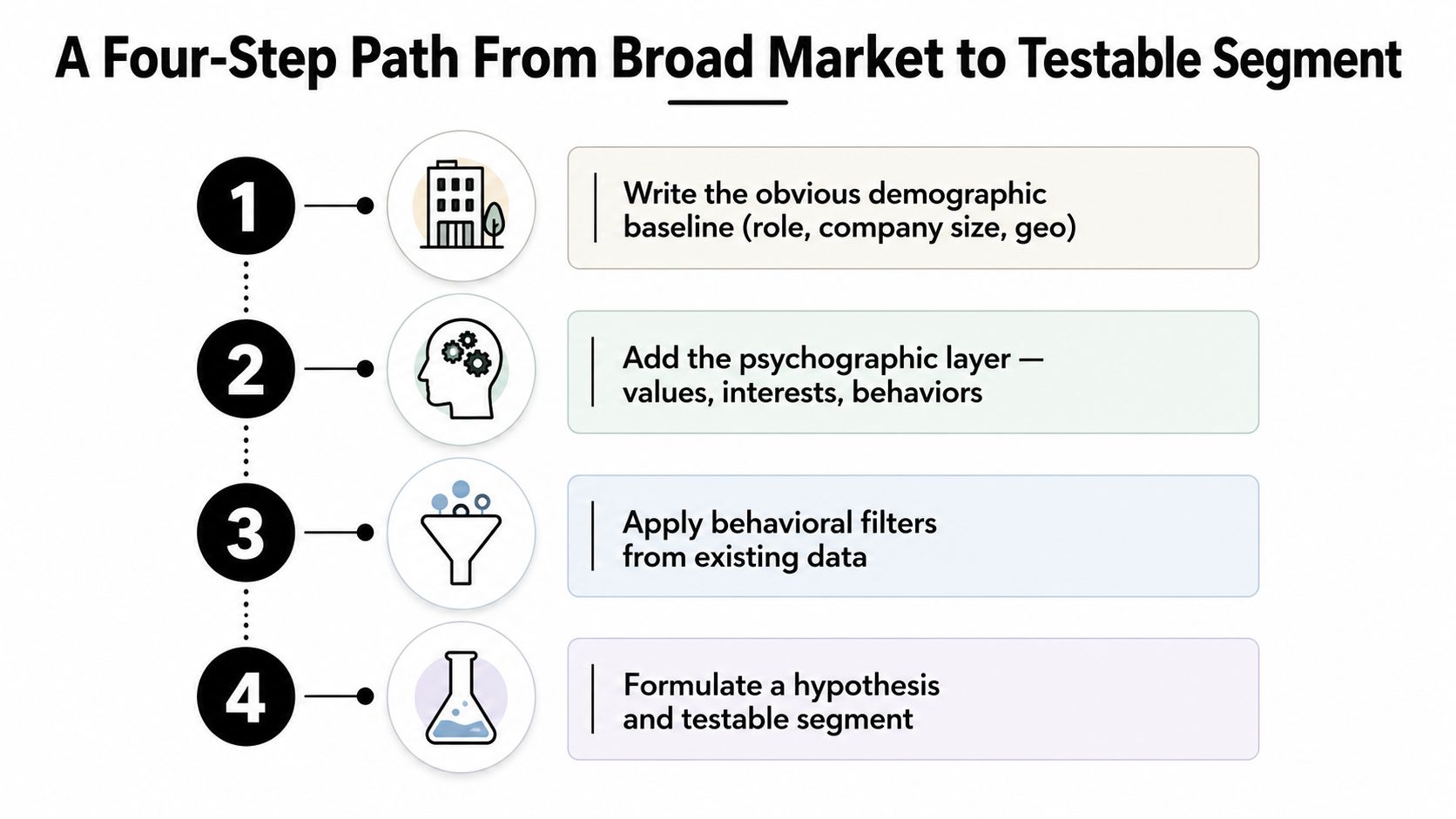
The fastest way to get from “we sell to marketers” to a segment you can test is to build the definition in layers. Start broad enough to avoid fantasy, then narrow it enough to guide creative. The goal is not perfection, it's a first hypothesis that your media and creative teams can both read without confusion.
Step one, write the obvious baseline
Start with the visible facts. Role, company type, geo, and maybe team size if that's relevant to the offer. This is the part many teams skip because it feels too simple, but it's useful because it keeps the audience grounded in reality.
Step two, add the motivation layer
Now ask what the person is trying to accomplish and what's frustrating them about the current approach. For performance teams, this often means time pressure, creative fatigue, testing bottlenecks, or a need to explain results to stakeholders. That framing gives your message a human reason to exist.
Step three, anchor the audience in behavior
Look at what the person has already done. That might be ad account activity, search behavior, content engagement, support interactions, or past purchases. Behavior is the part that tells you whether the audience is theoretical or already in motion.
Step four, compress it into one sentence
Now combine the pieces into a statement a buyer and a creative strategist can both use. A useful working example is, UA managers at mobile gaming studios who spend heavily on Meta, are frustrated by creative fatigue, and already test weekly but need faster iteration. That's not the final truth, it's a testable hypothesis.
The sentence should do one job. It should tell the team who the ad is for, what pressure they're under, and why the message should be framed a certain way. If the sentence can't do that, it's too vague for creative testing.
This guide on how to calculate sample size helps when you're ready to judge whether a segment deserves a real test or just a quick exploratory run. Audience definition and test design should move together.
Demographic, Psychographic, and Behavioral Lenses Compared
Each audience lens answers a different question, so the mistake isn't choosing one. The mistake is using only one and pretending it explains the whole market. A good team knows when a lens is useful and what it leaves out.
The demographic targeting guide is a helpful anchor for this because it reinforces that demographics are usually the starting point, not the ending point. They're fast to apply and easy to target, but they don't reveal much about intent.
| Lens | What it answers | Best used for | Limitation |
|---|---|---|---|
| Demographic | Who the person is in measurable terms | Early filtering, platform setup, delivery constraints | Doesn't explain why they would care |
| Psychographic | What they value, fear, or want to solve | Hook framing, angle selection, message tone | Harder to gather and validate quickly |
| Behavioral | What they've already done | Testing intent, prioritizing audiences, building retargeting logic | Can be noisy if the signal set is small |
The strongest audience work usually starts with behavior, then adds psychographic context, then uses demographics to make delivery practical. That order helps because behavior tells you what's already real, psychographics help you explain the motivation, and demographics help you place the message where it can run.
A junior marketer can think about this as three filters. Demographics shrink the universe. Psychographics sharpen the angle. Behavior tells you whether the message has a chance. If you reverse that sequence, you often end up with a polished audience profile that looks nice in a slide deck but doesn't help the creative team choose a hook.
The decision rule is simple. Use demographics when you need reach boundaries. Use psychographics when you need resonance. Use behavior when you need evidence. If you're building a testing system, behavior deserves the first pass because it's closest to what people do.
How Audience Definition Changes the Ad Itself
A good audience definition doesn't just sit in a planning doc. It changes the ad. The hook becomes more specific, the body covers the right objections, and the CTA feels like a next step instead of a generic prompt.
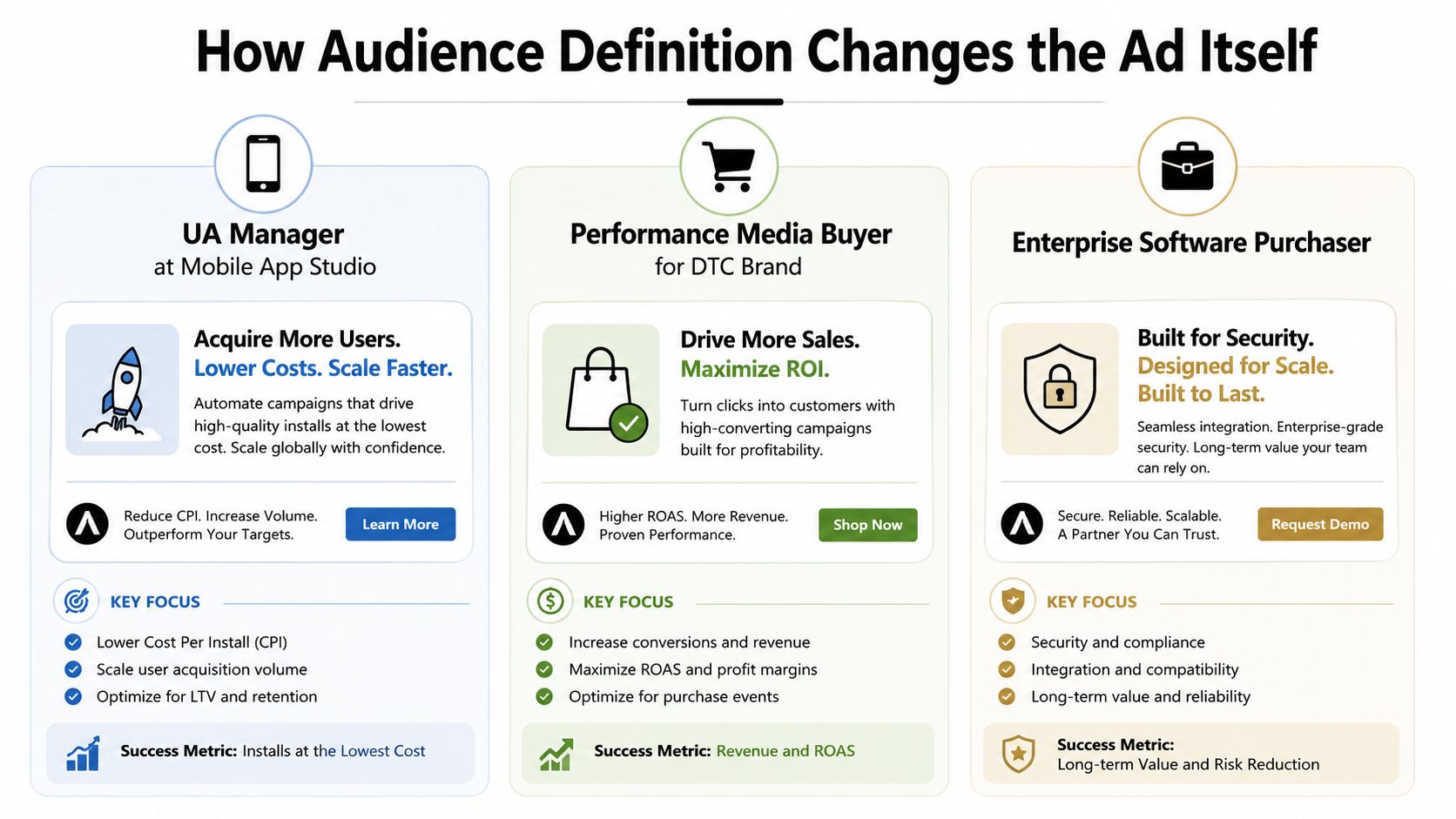
Take three different buyer types. A UA manager at a mobile app studio wants faster iteration, cleaner testing, and a way to keep creative fresh without slowing the pipeline. A performance media buyer running Meta and TikTok for a DTC brand wants efficient testing, fast feedback, and clearer conversion signals. A creative strategist at an agency juggling multiple accounts wants reusable modules, collaboration, and a structure that helps teams move without chaos.
For a tool like Sovran, which helps teams produce modular ad variations and manage creative testing workflows, the same product needs different framing for each of those people.
Three audience-specific creative directions
UA Manager at a mobile app studio. Lead with the pain of creative fatigue and the need for rapid iteration. The body should emphasize modular testing and speed in production. The CTA can ask them to build variations from existing footage.
Performance media buyer for DTC. Open with efficiency and conversion pressure. The body should focus on testing different combinations of hooks, bodies, and CTAs without rebuilding every asset from scratch. The CTA should feel like an invitation to launch and compare.
Creative strategist at an agency. Start with workflow and coordination. The body should focus on shared workspaces, asset reuse, and managing multiple client accounts without losing consistency. The CTA should point them toward organized production rather than just raw output.
That is the core payoff of audience clarity. The more precise the audience, the easier it is to produce modular variations that speak directly to the right person. In a creative testing system, that means fewer wasted combinations and faster learning because every variant has a clear job.
A vague audience creates generic ads. A specific audience creates a different message architecture. Once the team sees that, the brief stops being a description and starts being a decision tool.
Three Mistakes That Quietly Break Audience Work
The first mistake is treating everyone who might buy this as the audience. That usually means the team hasn't made a choice yet, so the creative gets built for nobody in particular. The fix is to shrink the segment until it can be described in one sentence and used in a brief.
The second mistake is confusing demographics with intent. Knowing someone is 28 and lives in Berlin doesn't tell you what will make them click, what they fear, or what they're trying to solve. The correction is to layer in behavior and motivation, then check whether the message matches the reason they'd care.
The third mistake is skipping validation. Teams can spend hours refining a persona that never touches a test, then wonder why the account still feels random. A better move is to turn the audience definition into the brief that every creative variant has to satisfy.
A wrong audience definition is still more useful than no definition, because at least you can measure it and change it.
That last point matters more than it sounds. Bad audience work creates confusion, but undefined audience work creates paralysis. If you have a testable guess, the data can teach you something. If you have nothing, the team just keeps debating opinions.
The habit to build is simple. Write the audience statement, attach a behavioral signal, and force every creative concept to answer it. If a variant doesn't speak to that audience in a believable way, it doesn't belong in the test.
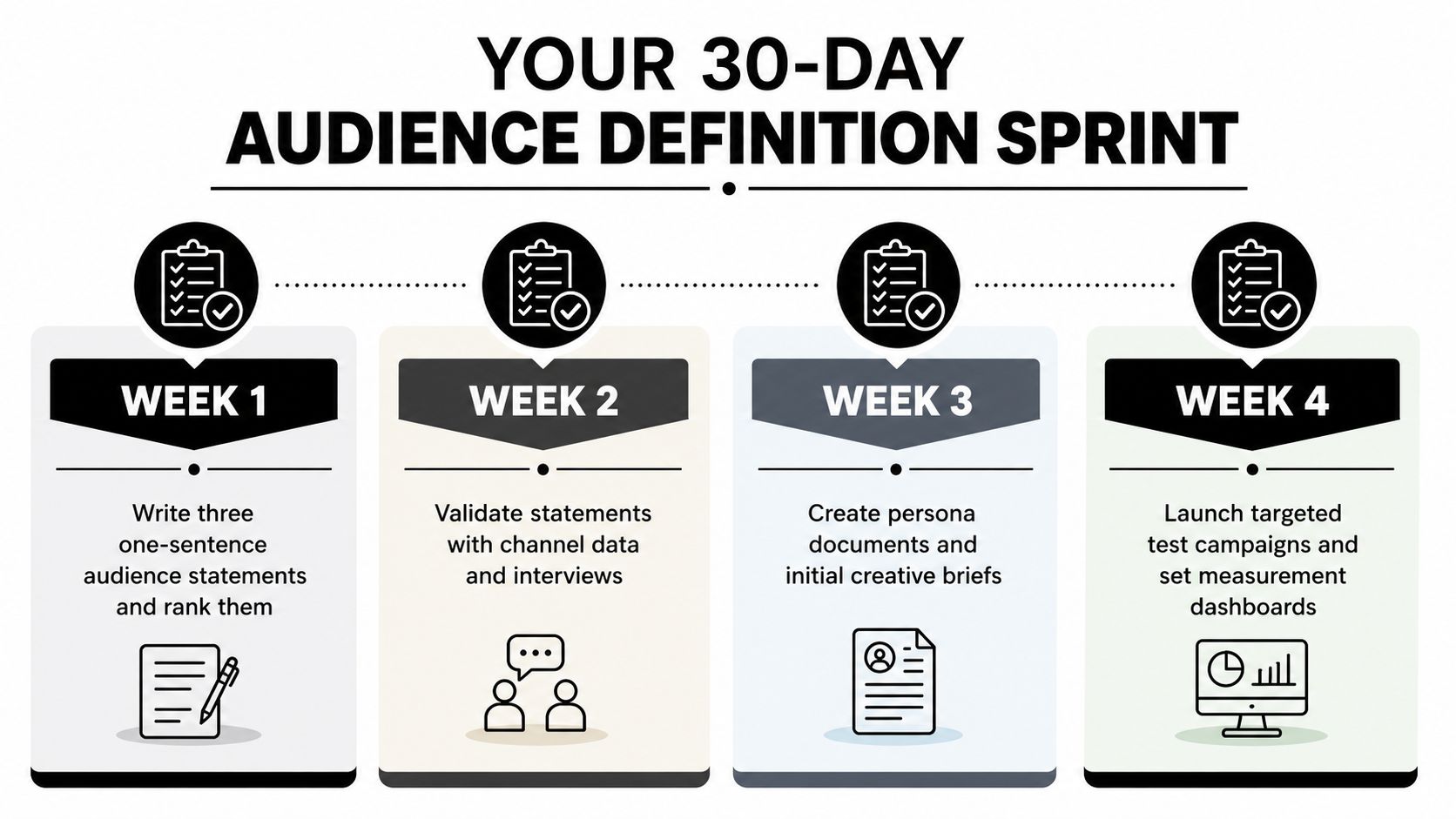
Your 30-Day Audience Definition Sprint
A month is enough time to move from vague market language to a working audience system. You don't need a giant research project. You need a disciplined rhythm that connects audience thinking to creative production and live testing.
Week one
Write three one-sentence audience statements for the product or feature. Don't try to perfect them, rank them by how testable they are. The strongest one is usually the one that names a real operator, a real problem, and a real context.
Week two
Pull behavioral evidence from places your team already trusts. Ad account signals, search terms, support tickets, and sales notes usually reveal which audience statement has the best support. If one statement keeps showing up in multiple sources, that's a sign it deserves a real test.
Week three
Create two creative concepts per audience statement. Each one should use modular hooks, bodies, and CTAs so the audience gets a distinct angle instead of a recycled ad. Keep the concepts simple enough that the team can swap parts without losing the message.
Week four
Review early signals by audience, not just by creative. Look at hook rate and thumb-stop ratio at the segment level, keep the statement that earned the strongest signal, and rewrite the weaker ones. The goal isn't to crown a winner forever, it's to tighten your next round of hypotheses.
If you want a quick screenshot checklist, use this one. One sentence. Three lenses. Two creatives per audience. One measurable signal. That's enough structure to keep the team focused without slowing down production.
Sovran helps teams turn those audience decisions into modular ad variations, so the brief, the creative, and the test stay aligned. If you're ready to move from broad audience labels to faster creative testing, visit Sovran and see how the workflow fits into your next campaign sprint.

Manson Chen
Founder, Sovran
Related Articles

8 Pattern Interrupt Techniques for Video Ads

Customer Journey Mapping for Performance Marketing