A Winning Direct Response Video Ad Formula
Jump to a section
A direct response video ad formula is a repeatable, modular system for creating ads that drive immediate action, built on a core Hook-Body-Call to Action structure. This approach moves beyond random creative concepts by using proven frameworks like Problem-Agitate-Solution and UGC Mashups to consistently convert viewers into customers.
The Modern Direct Response Video Ad Formula
Let's be real. In the hyper-competitive ad space of Meta and TikTok, every single second of a user's attention has to be earned. The challenge isn't just making a "good" video; it's about engineering an asset that can stop the scroll, instantly communicate value, and force a specific action—all in about 15 seconds.
This is exactly where a repeatable direct response video ad formula becomes your most valuable asset. It’s the critical difference between chaotically throwing creative at the wall and running a streamlined, data-driven system that actually generates profitable campaigns.
This isn't some abstract theory. It's a practical blueprint I’ve personally used to help brands stop burning ad spend on pretty videos that go nowhere, and start turning passive viewers into paying customers. The secret is that the modern formula is entirely modular.
The Power of a Modular System
Instead of seeing each video ad as a single, massive project, we break it down into its core, interchangeable parts: a hook, a body, and a call to action. This simple shift is what unlocks rapid, high-volume testing. When you understand that different parts of your ad have different jobs, you can start systematically improving performance.
We go into more detail on this in our complete guide to performance video ad anatomy, but the core concept is powerful.
A modular approach is a game-changer for a few key reasons:
- Beating Creative Fatigue: When a winning ad starts to die out, you don't have to start from scratch. You can simply swap in a fresh hook or a new CTA to breathe life back into the campaign.
- Scaling Campaigns Profitably: Found a killer body section that perfectly demonstrates your product's value? Great. Now you can test ten different hooks against it to find new winning combinations that unlock new audiences.
- Making Data-Driven Decisions: This system lets you isolate variables. You'll know with certainty that your CTR jumped because of that new hook, not just because of random luck.
The core idea is simple: stop guessing and start engineering your ads for success. A formula provides the structure, and your creativity provides the spark within that structure.
Below is a quick overview of some of the most effective frameworks you can plug into this system.
Key Direct Response Video Ad Frameworks
A quick look at four essential video ad frameworks that form the foundation of a successful direct response strategy.
| Framework | Best For | Key Psychological Trigger |
|---|---|---|
| Hook-Body-CTA | The foundational structure for all DR ads. | Clarity & Direction |
| Problem-Agitate-Solution | Highlighting a specific pain point. | Empathy & Urgency |
| Listicle (e.g., "3 Reasons Why") | Educating viewers in a digestible format. | Curiosity & Logic |
| UGC Mashup | Building trust and social proof quickly. | Authenticity & FOMO |
These frameworks aren't just abstract ideas; they are powerful psychological triggers you can deploy systematically.
Thinking beyond video, it's also crucial to understand the foundational principles that make any ad successful. Studying what works, like the examples in 10 Ecommerce Ads That Made Millions, will sharpen your direct response instincts.
Ultimately, frameworks like Problem-Agitate-Solution (PAS) and User-Generated Content (UGC) Mashups become plug-and-play modules within your master Hook-Body-CTA sequence. This gives you a virtually endless supply of testable creative variations. This guide will walk you through exactly how to build and operationalize this system.
Crafting Your Hook Body And CTA
Almost every high-performing video ad I've ever seen follows a simple, powerful sequence: the Hook-Body-Call to Action. When you nail this flow, you have a reliable formula for turning passive scrollers into paying customers.
Think of it as a micro-story. You have a dramatic opening to stop the scroll, a middle section that builds interest, and a clear finale that tells the viewer exactly what to do next. Each part has a specific job, and getting the timing right is everything.
The First Three Seconds: The Hook
Let's be real: you have, at most, three seconds to earn someone's attention. If your hook whiffs, the rest of your ad is just wasted budget. Its only job is to break the viewer's scrolling pattern and create enough curiosity to get them to watch just a few seconds longer.
The best hooks I've seen are what we call "pattern-interrupts." They shatter the visual monotony of a social feed with something unexpected.
A few types consistently deliver:
- Visual Hooks: A dramatic before-and-after shot, a super-satisfying product application, or a split-screen that shows a clear transformation. These work instantly.
- Question Hooks: Hit your audience with a direct, relatable question. "Still struggling with [common pain point]?" This immediately qualifies your viewer and makes them feel seen.
- Auditory Hooks: Especially on TikTok, a surprising sound or a bold voiceover like, "Stop scrolling if you..." can be incredibly effective at grabbing attention.
The golden rule here is to show, not just tell. A powerful visual that demonstrates the outcome will always beat a line of text stating it. This is your one shot to make an impression.
Here’s a simple timeline showing how these pieces fit together in a typical 15-second ad.
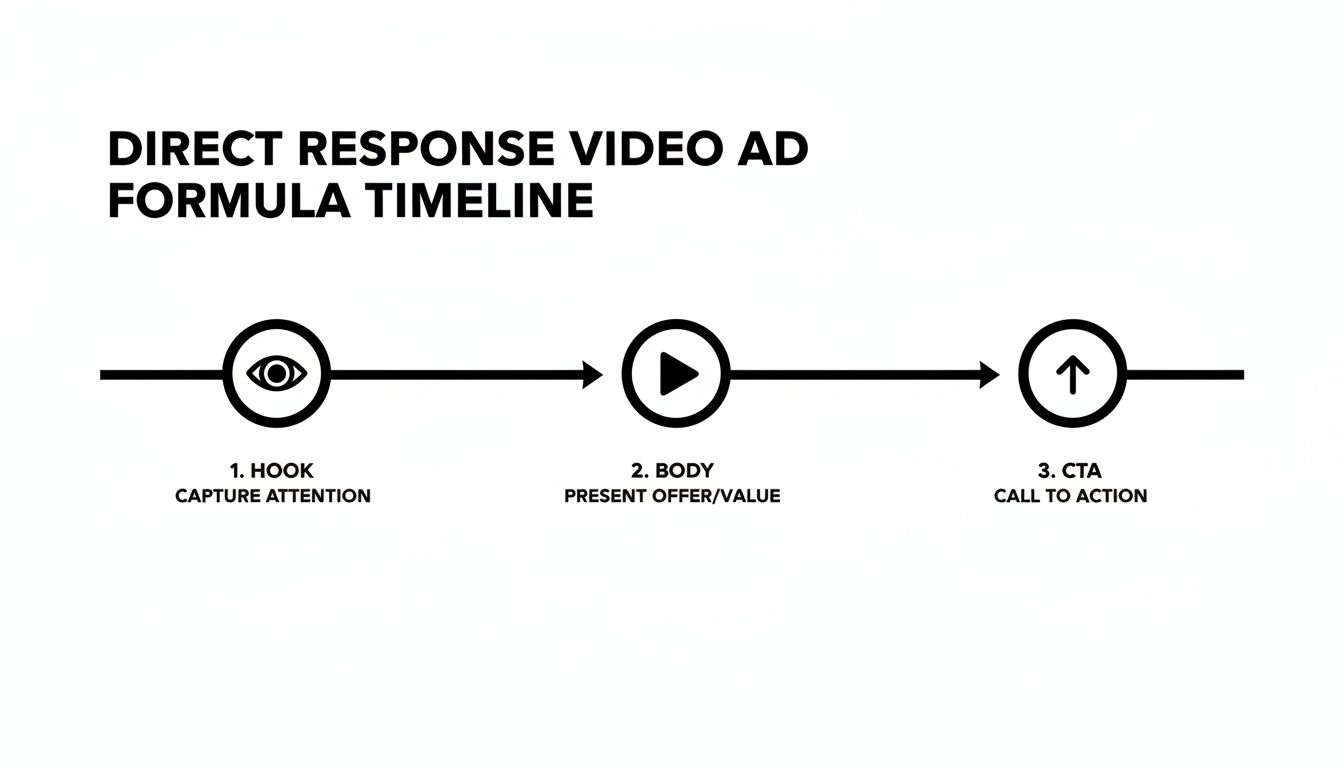
As you can see, the timing is tight. The hook grabs attention instantly, the body has to deliver value fast, and the CTA drives that final, crucial action.
The Next Nine Seconds: The Body
Okay, you’ve hooked them. Now, the body of your ad—from roughly second 4 to second 12—needs to deliver on that initial promise. This is your chance to rapidly show value and convince the viewer your product is the solution they need.
This is not the time for a long-winded brand story. You have to be direct and laser-focused on the benefits. One of the most effective ways to structure this section is with the classic Problem-Agitate-Solution (PAS) framework.
For example, a skincare brand could use the body to:
- Show the Problem: A quick, relatable shot of someone frustrated with their skin.
- Agitate the Pain: Flash text overlays like "Tired of breakouts?" or "Tried everything?" to twist the knife a little.
- Present the Solution: A satisfying clip of their product being applied, followed by a clear shot of healthy, glowing skin.
The goal is to connect the dots for the viewer in a flash. The body must build on the hook's momentum and lead them straight into your call to action.
The Final Push: The Call To Action
The last few seconds of your ad, typically from the 13-second mark on, are all about the Call to Action (CTA). Its job is to give the viewer a clear, compelling, and super-simple next step. A weak or confusing CTA will kill the performance of an otherwise great ad.
Your CTA has to be both verbal and visual. Reinforce your offer with on-screen text, a clear voiceover, and the platform’s native button. Don’t make them guess what to do.
Here are a few tactics for a CTA that actually converts:
- Create Urgency: Use phrases like "Shop Now Before It Sells Out Again!" or "Limited Time Offer." Give them a reason to act now, not later.
- Reduce Friction: Mentioning "Free Shipping" or "Easy Returns" lowers the perceived risk and makes the decision to buy that much easier.
- Be Specific: Ditch the generic "Learn More." Use a direct command like "Tap to Get Yours" or "Download the Guide."
A strong CTA doesn't just ask for a click; it gives the viewer a powerful reason to click right now. Combining a great offer with a dose of urgency is the final piece of the puzzle.
While this covers the core sequence, you can find more tactical advice and specific scripts in our dedicated guide to the Hook-Body-CTA video ad structure. Once you get a feel for how these three elements work together, you'll have a repeatable engine for turning attention into action.
Finding the Optimal Video Ad Length
Media buyers ask me this question all the time: "How long should my direct response video ad be?" It’s a great question, but the answer shouldn't come from a gut feeling. It needs to be a strategic decision, driven by data, platform dynamics, and your specific campaign goals.
If you get this wrong, you're essentially burning cash by losing your audience before you can even make your pitch.
On fast-paced platforms like Meta and TikTok, attention is everything. Users are hardwired for quick, snappy content, and the algorithms reward videos that get to the point and hold interest fast. This has carved out a very clear "sweet spot" for direct response ads, especially in the e-commerce and mobile app worlds.
That's why the 11-20 second video has become the go-to format for top-performing campaigns. It’s the perfect length to execute a full Hook-Body-CTA sequence without dragging on or feeling rushed, fitting right into how people actually watch videos on these platforms.
The Data-Backed Sweet Spot
Guesswork doesn't scale, but data does. There's a solid reason so many winning ads land in this exact time frame—it forces you to be ruthlessly efficient. You have just enough time to tell a compelling story but no room for fluff. It’s the core of the modern direct response formula.
The data backs this up completely. A 2026 MarTech review of thousands of gaming creatives found that a whopping 62% of top-performing ads were squarely in that 11-20 second range. They just flat-out delivered higher conversion rates. For e-commerce, the money spot was even more specific, hitting around 16-20 seconds. You can dig into the specifics by reading the full research on video ad length performance on Martech.org.
This gives you a powerful starting point for your creative briefs. Instead of guessing, you're launching your campaigns with a video length that's already statistically proven to have an edge.
Key Takeaway: Kick off your tests with an ad length between 11 and 20 seconds. This duration forces you to be clear, respects the user's short attention span, and plays nice with platform algorithms that reward quick engagement.
When Longer Formats Can Win
Now, while the 11-20 second rule is a fantastic starting point, it’s not an unbreakable law. I've seen plenty of scenarios where slightly longer ads—specifically in the 26-35 second range—absolutely crush it, sometimes even outperforming their shorter cousins. The trick is making sure every extra second is earned and packed with value.
Longer ads tend to work best when you're using:
- Strong Narratives: If you’re running a Problem-Agitate-Solution (PAS) ad that needs a bit more runway to build empathy and really twist the knife on the pain point, those extra seconds can make all the difference.
- User-Generated Content (UGC): Authentic testimonials and customer stories just feel more real when they aren't chopped down to nothing. A 30-second mashup of real people loving your product can build incredible social proof.
- Complex Product Demos: For products that have a real "wow" factor that isn't immediately obvious, a slightly longer demo can be far more persuasive than a few quick cuts.
The same MarTech analysis found that these longer 26-35 second ads trailed the top performers by only 10-15% in aggregate. That's not a huge drop-off. It proves that if your creative is compelling enough to hold attention, you can still drive serious results. Just make sure every single second serves your one true goal: getting that conversion.
Ultimately, your ad's length should be dictated by the story you need to tell and the action you want to drive. For more on the nitty-gritty of prepping your videos for each platform, check out our comprehensive guide on social media video specs. It has all the technical details you need to make sure you're optimized for every single placement.
Advanced Frameworks to Drive Immediate Action
Alright, so you’ve got the basic Hook-Body-CTA sequence down. That's the foundation. But if you want to go from running good ads to running ads that consistently crush your targets, you need to layer in some battle-tested psychological frameworks.
These aren't just creative theories; they're proven formulas that plug directly into the "Body" of your ad. They tap into viewer emotions and compel them to take action. Let's break down three of the most powerful ones we use all the time: Problem-Agitate-Solution (PAS), the Listicle, and the UGC Mashup.
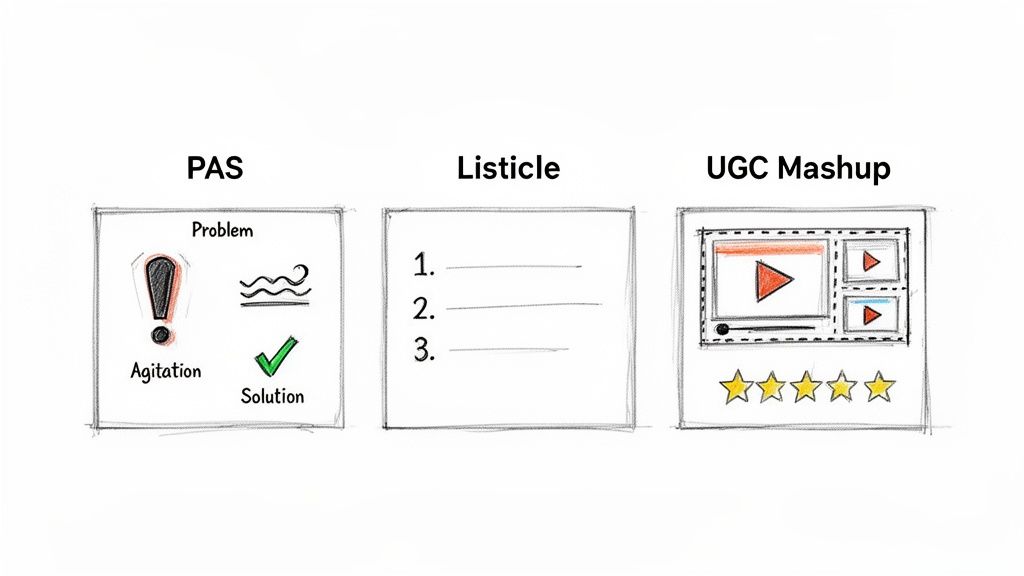
Think of these as repeatable, testable systems for building ads that hit home. Each one uses a different trigger to get a specific response from your audience.
The Problem-Agitate-Solution Framework
There’s a reason the Problem-Agitate-Solution (PAS) framework is the undisputed champion of direct response. It just works. It’s a simple, three-act story that connects with a viewer's pain point before positioning your product as the ultimate hero.
Here’s how we break it down:
- Problem (0-4 seconds): Kick things off with a highly relatable problem. A visual of someone wrestling with a messy spreadsheet or looking totally frustrated by a slow-loading app is perfect. Make it instantly recognizable.
- Agitate (5-9 seconds): Now, you twist the knife a little. This is where you amplify their pain with quick text overlays like, "Wasting hours on manual data entry?" or "Losing customers to a slow site?" You’re reminding them just how deeply annoying this problem really is.
- Solution (10-15+ seconds): Once the pain is front and center, you swoop in with your solution. Show a clean, satisfying shot of your product in action, making the problem disappear. Then, hit them with a clear CTA.
This structure is so effective because it mirrors how we naturally think about solving problems. The key is making the "agitate" step feel urgent and personal, creating a real desire for the relief your product offers.
PAS works because it creates an emotional gap between the viewer's current pain and their desired future. Your product becomes the bridge to close that gap.
This framework is a core part of so many winning campaigns. While old-school direct mail considered a 1% response rate solid, digital video has changed the game. We've seen punchy hooks on TikTok, paired with a PAS structure, spike response rates by 20-30% over longer, more traditional formats. For a deeper analysis of response rate benchmarks, check out this study from Mighty Roar.
The Engaging Listicle Framework
You’ve seen this everywhere for a reason. The Listicle, framed as "Top 3 Reasons Why" or "5 Hacks That Changed My Life," is perfect for showing off multiple features or benefits in a super fast, digestible format. It taps into our natural curiosity and our love for organized, easy-to-digest info.
Here’s what a Listicle ad for a meal-kit service could look like:
- Hook: A bold text overlay reading: "3 Reasons This Meal Kit Is a Weeknight Game-Changer"
- Point 1 (Visual): A gorgeous close-up of fresh, vibrant ingredients being unpacked. (Text: "Farm-Fresh Ingredients")
- Point 2 (Visual): A quick cut of someone whipping up a fancy-looking meal in what looks like no time. (Text: "Ready in 20 Mins")
- Point 3 (Visual): A shot of a family actually enjoying dinner together, laughing and stress-free. (Text: "Gourmet Meals, Zero Stress")
- CTA: End with a strong offer: "Get 50% Off Your First Box!"
This direct response video ad formula is a winner because it feels like you're giving value and teaching something, not just hard-selling. Each point builds on the last, making a compelling case for your product before you ever ask for the sale.
The Authentic UGC Mashup Framework
Let's be honest: there is no marketing more powerful than legitimate social proof. The User-Generated Content (UGC) Mashup leverages this by stitching together short, genuine video clips from real customers. It’s the digital equivalent of a crowd of happy people shouting about how great your product is.
People don’t just want authenticity; they crave it. Seeing real people—not polished actors—using and loving a product builds instant trust and a powerful sense of FOMO (fear of missing out). The secret is to keep it feeling raw and real.
A strong UGC Mashup usually involves:
- A rapid-fire sequence of different customers holding or using the product.
- Quick cuts of genuine, unscripted reactions, like unboxing moments or audible "wows."
- Short, punchy testimonial quotes displayed as on-screen text to reinforce the visuals.
This framework is an absolute killer for e-commerce and app installs because it feels native to social feeds. It tears down the wall between an "ad" and organic content.
For more ideas on how to script these out, take a look at our guide on effective ad script examples. When you start operationalizing these formulas, you stop relying on inconsistent creative hits and start building a reliable system for driving action.
How to Scale Your Creative Production and Testing
Look, having a killer direct response video ad formula is a great start, but it's only half the story. If you can't pump out and test creative variations quickly, even the best framework will burn out from creative fatigue. The real advantage today isn't just knowing the formula; it's building a machine to execute it at scale.
This is where you stop thinking like a one-off video creator and start acting like an ad system architect. The goal is to build an engine that can take one winning idea and spin it into dozens, or even hundreds, of testable ad variants—fast.
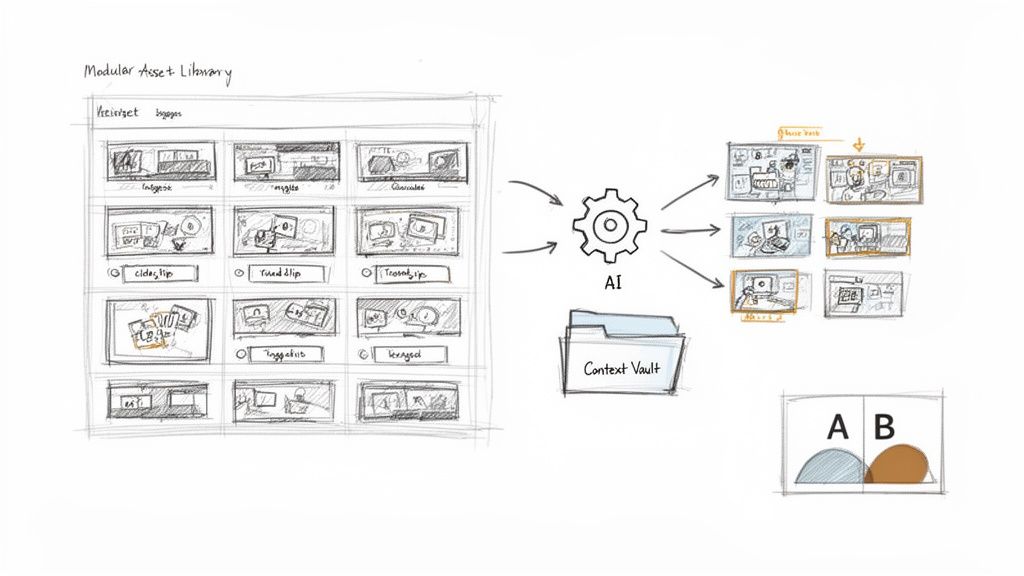
It all begins with a total rethink of how you manage your creative assets.
Building Your Modular Asset Library
First things first: stop digging through folders named "Final_Ad_V2_final." That approach just doesn't scale. What you need is a modular asset library. This is basically a single, organized home where every video clip, image, and audio file is tagged and sorted.
Think of it as a box of creative LEGO bricks.
Your library should be broken down into components you can easily grab and assemble:
- Hooks: Tag them by style, like "visual hook," "question hook," or "UGC unboxing."
- Body Clips: Sort these by the feature or benefit they show, such as "product demo" or "pain point visual."
- CTA Sequences: Organize them by the offer, like "Shop Now" or "Limited Time."
- B-Roll: Use descriptive labels that make sense to you, like "satisfying texture" or "happy customer."
When you combine this library with a Context Vault—a place to store brand guidelines, top-performing scripts, and testimonials—you've built something incredibly powerful. It’s the foundation that lets AI-powered tools like Sovran instantly find the right "bricks" to build countless ad combinations. To see exactly how this works, check out the massive benefits of dedicated performance video ad software.
A Practical Plan for A/B Testing
Once you have a system for lightning-fast production, you can finally run a high-velocity A/B testing plan that actually gives you answers. The trick is to be methodical and isolate one variable at a time. This is how you stop guessing and start learning what really drives performance.
Here’s a simple, battle-tested plan for a new campaign:
- Set Your Control: Kick things off with your current best ad or a new creative you’re confident in. This is your baseline.
- Test the Hook First: Create 3-4 new versions of that control ad. The only thing you should change is the hook—keep the body and CTA exactly the same. The hook has the biggest impact on stopping the scroll, so it's always the best place to start.
- Analyze and Find a Winner: Launch the ads. Keep a close eye on the 3-second view rate and Click-Through Rate (CTR). As soon as one hook clearly outperforms the others, it becomes your new "control" ad.
- Move to the CTA: Now, using your new winning hook, make 2-3 more variants that test different calls to action (e.g., "Shop Now" vs. "Get 50% Off").
- Roll Out and Repeat: Once you’ve landed on a winning Hook + CTA combo, you can start testing other elements like different body sections or background music.
This systematic process ensures you're always building on your wins, compounding improvements over time and keeping creative fatigue at bay.
Don’t just test for the sake of testing; test to learn. By isolating one variable at a time, you build a library of proven creative elements you can mix and match with confidence in future campaigns.
This focused approach is all about maximizing your return on ad spend. As you scale, understanding platform-specific rules is also key. To get the most out of your budget, dive into these Facebook Ads best practices and make sure your video ads are set up to win on social.
At the end of the day, relevance is what drives results. We know that nearly 45% of viewers will buy a product after seeing a benefit-focused ad. Right now, for mobile app campaigns on Meta and TikTok, we're seeing short UGC mashups hit 2-5% conversion rates—that's up to 3x the industry average. This just proves that when you combine a strong formula with a scalable testing system, you create a nearly unbeatable advantage.
Common Questions About Video Ad Formulas
Even with a solid formula, theory is one thing, but putting it into practice under pressure is another. Questions always pop up when the rubber meets the road.
Here are my answers to the most common questions I hear from media buyers and growth teams who are deep in the trenches, trying to make these frameworks work.
How Many Video Ad Variants Should I Test Per Week?
There's no magic number here, but based on what I’ve seen work, a growth-focused team should aim for 10-20 new variants per week, per channel. The real objective isn't just hitting a number; it's about your learning velocity. You need to test with a clear, specific purpose.
The smartest way to do this is by isolating one variable at a time. It's a simple, scientific approach.
- Start by testing three different hooks against your best Body/CTA combo.
- Once you find a clear winning hook, lock it in.
- Now, test three different CTAs against that new winning hook.
This methodical process lets you build on your wins and truly understand what’s driving performance. It’s the difference between just throwing spaghetti at the wall and actually engineering a winning ad.
What Are The Most Important Metrics To Track?
Vanity metrics like views and likes feel good, but they don't pay the bills. When you're using a direct response video ad formula, you have to stay laser-focused on the KPIs that measure profitability and user intent.
I always look at metrics in order, from the top of the funnel down:
- Hook Rate (3-Second View Rate): Is your creative even stopping the scroll? A strong hook rate is the first signal you might have a winner on your hands.
- Click-Through Rate (CTR): This tells you how compelling the ad is after the hook. It’s a great gauge of initial interest and their desire to learn more.
- Cost Per Action (CPA) or Cost Per Install (CPI): This is all about efficiency. It tells you exactly what you're paying for each sale, lead, or install.
- Return On Ad Spend (ROAS): The ultimate bottom line. This is the direct measure of revenue you're generating for every dollar you spend. It's your north star for profitability.
Tracking these in this order gives you a complete picture of your creative's performance through the entire funnel.
A low ROAS with a high hook rate and CTR usually means the problem isn't your ad—it’s probably your landing page or the offer itself. On the other hand, a high hook rate but a dismal CTR tells you the hook worked, but the body of your ad failed to deliver on that initial promise.
Can This Formula Work For B2B Or High-Ticket Items?
Absolutely. The core principles are universal, but your strategy and the "action" you're trying to drive have to adapt. A 15-second video won't close a $50,000 software deal on the spot, but it's incredibly effective for filling your pipeline with qualified leads.
For B2B, you’re not pushing for a "Shop Now" click. Your Call to Action is geared toward a lower-commitment, top-of-funnel action, like:
- Downloading a whitepaper or case study
- Registering for a webinar
- Booking a quick 15-minute demo
The Problem-Agitate-Solution (PAS) framework is especially potent for B2B. You can use a short video to zero in on a huge industry pain point, really twist the knife on the frustration it causes, and then position your product or service as the clear solution.
What If I Have No Video Assets To Start With?
This is a really common fear, but you almost always have more assets than you think. You don't need a Hollywood budget to get started. Far from it.
Here’s how you can get scrappy and build from scratch:
- Screen Recordings: If you have an app or software, screen recordings are gold. They're easy to make and perfect for demos.
- User-Generated Content (UGC): Just ask! Reach out to your happiest customers and offer them a nice incentive for a short video testimonial. This kind of content builds incredible social proof.
- Stock Footage: High-quality, relevant stock footage can work wonders, especially when you pair it with strong text overlays and a compelling voiceover.
- AI-Generated B-Roll: Tools available in 2026 can create custom b-roll from a simple text prompt, giving you professional-looking visuals without ever touching a camera.
The key is to be resourceful. You don't need a perfect asset library to start testing; you build one over time as you learn what works.
Ready to stop the manual grind and start scaling your creative production? Sovran uses AI to automate the entire process—from asset organization to rendering hundreds of testable variants in seconds. Find your next winning ad up to 10x faster. Get started at Sovran.ai and see the difference for yourself.

Manson Chen
Founder, Sovran
Related Articles

8 Pattern Interrupt Techniques for Video Ads
- pattern interrupt techniques
- video ad hooks
- 3 more

Customer Journey Mapping for Performance Marketing
- customer journey mapping
- performance marketing
- 3 more
Production Schedule Optimization for Scalable Ad Testing
- production schedule optimization
- creative testing
- 3 more