AI UGC Video: A Guide to Scale Ads on Meta & TikTok
Jump to a section

Teams that win on Meta rarely win because they found one great ad. They win because they can launch new variants before creative fatigue pushes CAC up and before the account loses momentum.
That is the core value of AI UGC video. It gives performance teams a way to build a repeatable creative system instead of waiting on one creator draft, one round of revisions, and one narrow test window. The work shifts from sourcing videos to managing throughput: hooks, scripts, avatars, voice tracks, edits, approvals, and naming conventions that map cleanly into Ads Manager.
I see the bottleneck in the same place across growth teams. Media buyers need fresh inputs every week, but creative production still runs like a custom project. AI UGC closes that gap when the process is modular. One winning angle can become ten new ad variants with different openings, personas, CTAs, and cuts, then move straight into a structured test plan.
If you are already running UGC-style video creative for paid social, the next step is not more volume for its own sake. It is a workflow that produces usable variation, filters out low-quality generations fast, and feeds results back into the next batch so ROAS stays healthy and creative testing does not stall.
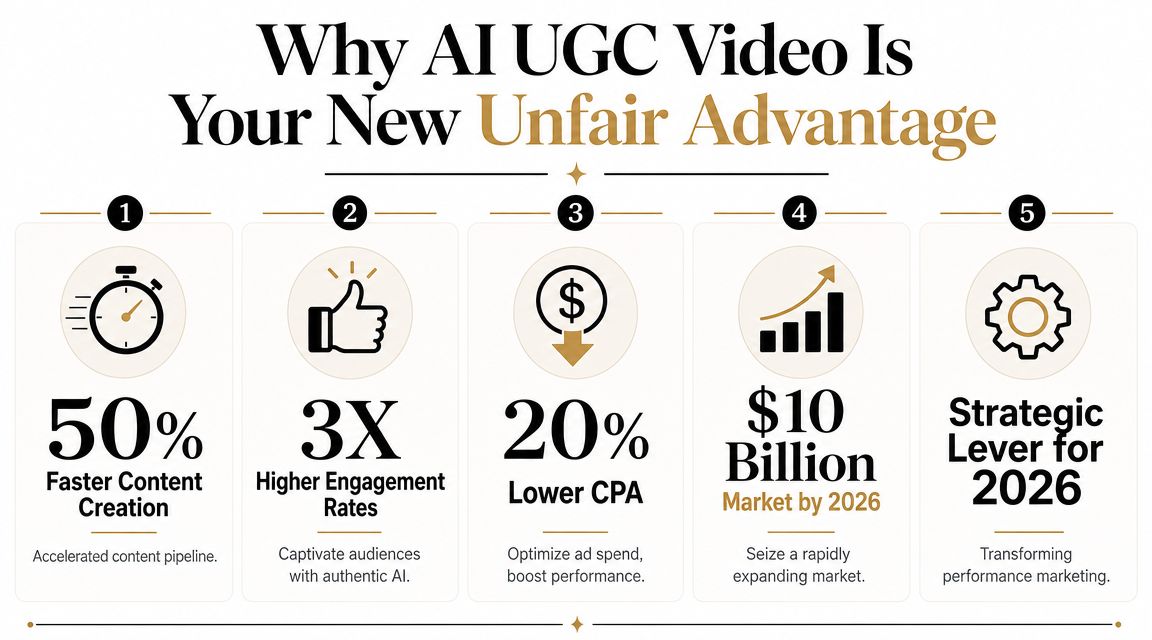
Why AI UGC Video Is Your New Unfair Advantage
Meta accounts often lose efficiency long before targeting breaks. Creative fatigue hits first, and teams that cannot replace ads fast enough usually watch CAC rise while spend pools around aging winners.
AI UGC video gives performance teams a faster production system for native-looking creative. The format covers the same assets buyers already need for paid social: short vertical testimonials, product demos, problem-solution clips, and spokesperson-style videos built to blend into TikTok, Reels, Shorts, and Meta feeds. The practical benefit is not novelty. It is throughput.
Cost pressure changed the equation
Traditional UGC production is slow in all the places that hurt media buying. Creator outreach, briefing, draft review, reshoots, usage rights, and edit requests all sit outside the ad account, so the learning loop breaks. By the time a revised video is ready, the original test may already be stale.
AI shortens that cycle enough to make structured variation realistic. Instead of betting on one creator deliverable, teams can build multiple versions of the same angle, swap hooks, test different avatars or voice tracks, and push fresh cuts into Meta Ads Manager while the offer is still relevant.
Practical rule: If your account depends on a handful of hero ads, your results are fragile.
The edge comes from system design
The strongest AI UGC programs do not treat generation as the finish line. They treat it as the middle of an operating system.
That changes how the work is scoped. One message angle becomes a small creative matrix: three hooks, two bodies, two CTAs, two personas. The team reviews outputs, kills weak variants early, tags usable assets by angle and audience, and assembles new combinations without restarting the whole brief. If your team already runs this process with existing UGC-style video creative workflows, AI extends the same logic and removes a large part of the production delay.
AI UGC is especially useful in three conditions:
- Refresh cycles are short and the account needs new ads before performance decays.
- The brand has multiple offers or audience segments that require distinct messaging in market at the same time.
- The team wants tighter feedback loops between creative testing and media buying inside Meta Ads Manager.
That is the unfair advantage. Faster production helps, but operational efficiency is what scales. Teams that build AI UGC into a modular testing workflow can launch more iterations, read results faster, and keep creative velocity high without turning every new ad into a custom project.
Mastering Ideation for Scalable AI Creative
Most AI UGC output fails before generation. The problem isn't the rendering model. The team started with weak inputs.
Meta's 2025 creative guidance, summarized in this UGC video guide for app founders, points to the core issue. Creative fatigue matters, but ad systems respond to clear value propositions, distinct angles, and high-quality native-looking assets rather than simple volume. The practical question isn't whether AI can make lots of videos. It's whether those videos express meaningfully different hooks, bodies, and CTAs.
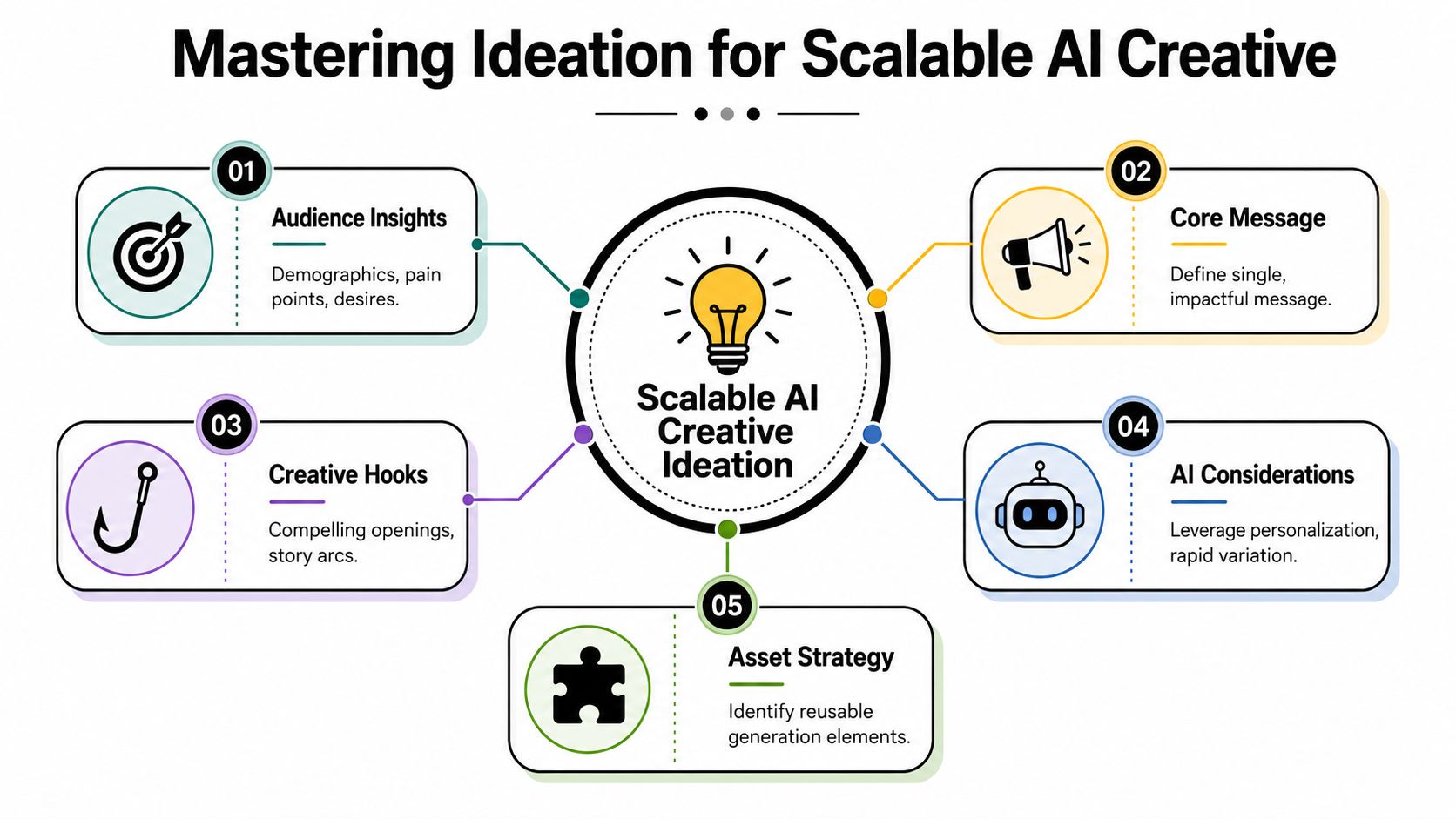
Build an angle bank before you write scripts
Start with language already proven to exist in the market. Don't brainstorm in a vacuum.
Use these input pools:
- Customer reviews for emotional phrasing. Look for repeated patterns like frustration, skepticism, surprise, convenience, speed, or relief.
- Support tickets and chat logs for objections. These often become stronger hooks than marketing copy because they reveal what buyers hesitate over.
- Sales call notes for problem framing. Sales teams hear the “why now” trigger more clearly than many marketing teams.
- Competitor ad libraries for category norms. You're not copying. You're mapping what everyone else is already saying so you can find whitespace.
- Creator comments under organic posts for audience vernacular. Such comments reveal how people describe outcomes.
From there, write hypotheses, not scripts. A hypothesis is sharper than “make a video about convenience.” It sounds like this: “Users convert when the first line reframes the product as a time-saver rather than a premium upgrade.”
Organize ideas as modules
A scalable AI UGC video system needs interchangeable parts. I usually separate ideation into three columns:
| Module | What belongs here | What you're testing |
|---|---|---|
| Hook | First line, first visual, interruption pattern | Thumb-stop power |
| Body | Proof, demo, benefit framing, pain-agitation-solution | Retention and conviction |
| CTA | Offer framing, urgency style, expectation setting | Click intent |
This structure forces discipline. Teams stop thinking “we need another ad” and start thinking “we need another skeptical hook” or “we need a softer CTA for broad traffic.”
For teams needing more starting points, video ad hook examples are useful because they show how one offer can be opened from multiple angles without changing the product itself.
Distinct angles beat cosmetic edits. A new background, new avatar, or new subtitle color doesn't create a new test if the promise is still the same.
A simple ideation filter
Before any script gets approved for generation, run it through three checks:
- Is the claim clear in one sentence? If not, the body will ramble.
- Does this angle differ from the current control? If not, you're generating duplicates.
- Would a media buyer know why this variation exists? If not, reporting gets messy and learning disappears.
The teams that scale AI UGC well don't confuse output with experimentation. They build a bank of testable creative hypotheses first, then let AI help with production volume.
Scripting AI Videos That Don't Sound Robotic
The fastest way to tank an AI UGC ad is to write like a landing page. Most robotic scripts aren't caused by bad models. They're caused by copy that no real person would say on camera.
Recent walkthroughs recommend messy desks, kitchens, handheld shots, and minimal polish to make AI UGC feel native to TikTok and Instagram Reels, while also acknowledging the unresolved line between believable and deceptive in this 2026 tutorial reference. The same principle applies to writing. If the words sound over-processed, the visual realism won't save the ad.
Write for speech, not for reading
Phone-native UGC follows spoken rhythm. That means:
- Short sentences.
- Incomplete thoughts that still sound natural.
- Specific nouns instead of abstract brand language.
- One idea per beat.
- Slight asymmetry in phrasing so it doesn't feel machine-balanced.
Bad AI scripts explain too much too early. Good ones open with tension, then release information in layers.
Here's the difference.
| Robotic Script Example | Authentic AI UGC Revision |
|---|---|
| “I recently discovered an innovative wellness product that has significantly improved my daily routine.” | “I didn't expect this to help, but it actually made my routine easier.” |
| “This solution offers premium functionality and delivers impressive results for users.” | “It does the one thing I needed it to do, and it does it fast.” |
| “If you are seeking a reliable option, I highly recommend considering this product today.” | “If you've been putting this off, this is probably the one to try.” |
| “The quality exceeded my expectations and I was very satisfied with the experience.” | “I thought it'd feel cheap. It didn't.” |
Script modularly from the start
A strong AI UGC video script should be separable without losing coherence. That means each hook, body, and CTA can stand alone.
Use this pattern:
- Hook block that introduces the angle in one line.
- Body block with one proof mechanic only. Demo, testimonial, comparison, or objection handling.
- CTA block that matches buyer temperature. Cold traffic needs lower-pressure framing than retargeting.
That modularity gives editors and media buyers room to remix without requesting a full rewrite every time.
Keep the imperfections intentional
Natural doesn't mean sloppy. It means controlled roughness.
Use conversational fragments such as “I kept seeing this,” “I was skeptical,” or “this part surprised me.” Let the avatar or voice pause where a person would pause. Don't stuff every sentence with benefits. One believable observation often does more than five polished claims.
A quick internal resource on creating scripts online can help standardize this if multiple copywriters are feeding the same generation workflow.
If the script sounds like it came from a brand deck, the audience will treat it like an ad before your hook has a chance to work.
The best scripts don't chase perfection. They preserve enough texture to feel like a person talking to one friend, not a company addressing a segment.
The AI Generation and Quality Control Workflow
Generation is the noisiest part of the process. It feels productive because assets are appearing fast. In practice, many teams lose time at this stage.
Independent practitioner reporting makes that clear. One published case found that nearly 400 AI generations produced only 15 usable clips, or roughly 4% to 5% yield, and broader commentary says 10 to over 40 prompts per final usable video is normal according to this AdMonsters analysis. That's why the critical KPI in AI UGC production isn't generation count. It's usable asset yield.
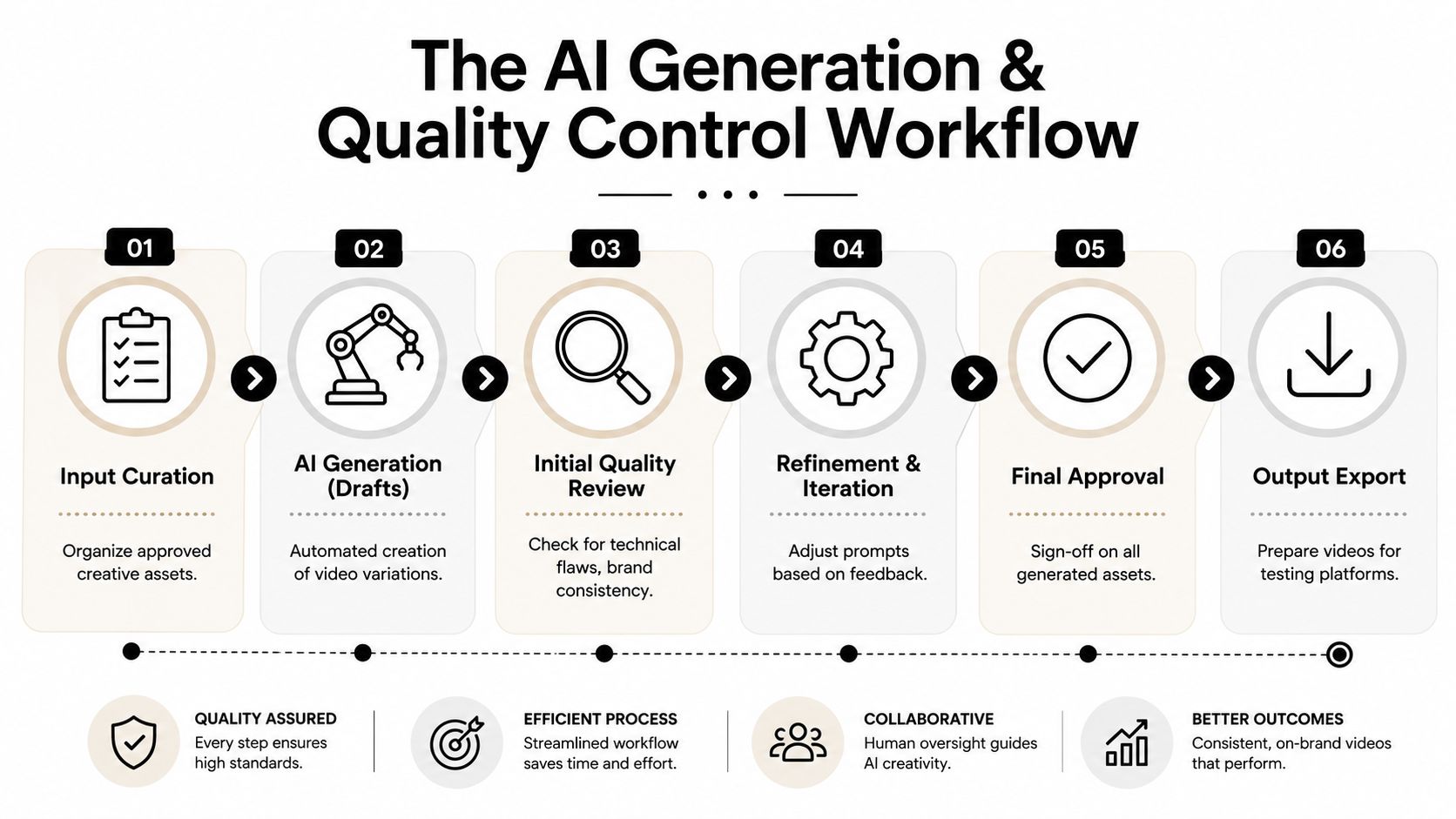
Treat generation like a funnel
The workflow should look like this:
- Approved inputs go in. Script blocks, visual references, brand guardrails, disclaimer language.
- Draft generations fan out. Multiple versions per angle, not one “perfect” render attempt.
- Technical QC removes obvious failures. Lip sync drift, broken hands, wrong product depiction, unusable pacing.
- Brand QC scores the survivors. Tone fit, claim safety, demographic match, native feel.
- Editors refine only the top tier. Caption cleanup, trims, overlays, CTA swaps.
- Final exports get tagged for testing. Hook type, body theme, CTA style, offer, audience.
That sequence matters. If senior team members review everything manually from the top, the workflow clogs immediately.
Use a pass-fail rubric
QC gets faster when everyone uses the same filter. I like a simple rubric with these checks:
- Visual integrity means no distracting artifacts and no confusing object behavior.
- Script fidelity means the video communicates the intended angle.
- Platform nativeness means it looks plausible in-feed, not like a glossy ad trying to cosplay as UGC.
- Compliance safety means claims, disclosures, and product depiction don't create avoidable risk.
- Editability means the clip can accept captions, overlays, and modular assembly without falling apart.
Teams dealing with synthetic actors or voice assets should also train reviewers on detecting deepfake synthetic media, especially if client approvals involve legal or brand stakeholders. That's not just a trust issue. It's part of basic QA when your workflow mixes real and generated footage.
Low yield doesn't mean AI UGC is broken. It means unmanaged generation is expensive in a different way.
Keep the asset library structured
Once clips pass QC, store them in a searchable system. Tag by hook theme, persona, setting, product angle, objection handled, CTA tone, and status. That's where platforms like AI video ad workflows become useful because they help teams organize, remix, and export modular assets instead of leaving files trapped in random folders.
The point of QC isn't to slow production down. It's to stop weak assets from poisoning your testing data.
Assembling and Testing Ad Variations at Scale
Once you have approved modules, assembly becomes a media function as much as a creative one. At this stage, AI UGC starts acting like a system instead of a pile of clips.
A 2025 comparison reported that AI UGC delivered up to 350% higher engagement on some TikTok campaigns, with 18.5% engagement versus 5.3% for human UGC, while a 2026 benchmark found traditional human-created UGC scored 81% authenticity versus 63% for AI-generated UGC in this AI versus traditional UGC comparison. That trade-off is exactly why testing structure matters. AI UGC can generate strong top-of-funnel response, but not every variation will preserve trust equally well.

Build a testing matrix, not random combinations
Don't mix everything with everything. Build constrained combinations so results stay interpretable.
A practical matrix looks like this:
| Variable layer | Example question | What you learn |
|---|---|---|
| Hook set | Does skepticism beat urgency? | Which opening earns attention |
| Body set | Does demo beat testimonial? | Which proof style holds viewers |
| CTA set | Does soft framing beat direct ask? | Which close converts without hurting trust |
If you have three approved hooks, three body styles, and two CTAs, you already have a meaningful test grid. The key is labeling each asset so Meta Ads Manager reporting can map outcomes back to the creative component.
Watch the right signals first
In early spend, I care less about headline conversion efficiency and more about whether the ad earned the right to continue spending. Useful reads include:
- Hook strength, based on whether the opening stops the scroll.
- Hold rate, which tells you if the body is delivering on the promise of the hook.
- Click intent, which often exposes mismatched CTAs.
- Downstream conversion quality, where fake curiosity gets filtered out.
If an ad gets attention but sends weak traffic, the hook may be overselling. If it holds viewers but doesn't click, the CTA is probably too vague or the offer isn't clear enough.
Push winners into iterative rounds
The most impactful move is not finding one winning ad. It's isolating the winning component.
If Hook B wins across multiple body variants, that hook becomes a control. Then you build another round around it. Same for bodies and CTAs. Over time, you're not guessing. You're stacking validated components.
For teams doing this at scale, making 50 ads from one video is the right mindset. You're extracting combinational value from approved footage and approved messaging, not rebuilding the whole creative process every time.
One tactical note on tools. If you need a system that can manage modular hooks, bodies, CTAs, bulk renders, and direct pushes into Ads Manager, Sovran is one option built for that workflow.
The fastest path to lower CAC usually isn't a brand new concept. It's a better-performing component inside a concept that already works.
Teams that scale AI UGC effectively don't celebrate volume alone. They use volume to surface creative patterns the account can spend behind.
Answering Critical AI UGC Video Questions
Should AI UGC replace human creators?
No. It should cover different jobs.
AI UGC is strongest when you need speed, controlled variation, and fast creative refreshes. Human creators still matter when credibility, community response, and nuanced delivery are central to the campaign. If the product needs lived experience, deeper trust, or a recognizable point of view, real creators usually carry more weight.
How realistic should AI UGC look?
Realistic enough to feel native in-feed, not so engineered that it creates distrust once a viewer pays attention. Messy environments, phone-native framing, and minimal polish can help. But if realism crosses into deception, the brand takes on unnecessary risk.
A good internal standard is simple. If the ad implies a real personal experience, your team should be comfortable defending that creative choice to a client, platform reviewer, or customer.
What rights and compliance checks matter?
Review the licenses and usage permissions tied to every AI face, voice, music track, stock element, and training-dependent asset in your workflow. Teams often focus on output quality and forget governance.
At minimum, approve:
- Avatar and voice usage terms before launch
- Claim substantiation for every testimonial-style line
- Disclosure requirements based on category and market
- Platform policy fit for synthetic or manipulated media
Legal review doesn't need to touch every draft. It should define the guardrails before generation starts.
Could platforms penalize AI content?
Platforms are more likely to respond to low-quality, misleading, or policy-violating creative than to AI as a category by itself. The safer approach is to build around native quality, honest framing, and clean QA.
If your workflow can only scale by making synthetic content that looks suspicious, you don't have a durable advantage. You have a temporary loophole.
What's the biggest mistake teams make?
They optimize for output instead of learning.
A scalable AI UGC video program should answer clear questions: Which hook lowers CAC? Which proof style improves hold? Which CTA preserves conversion quality? If your system can't answer those, it's generating noise.
If your team wants a cleaner way to turn hooks, bodies, and CTAs into launch-ready ad variations, Sovran is built for that workflow. It helps performance marketers organize modular assets, remix them into large test matrices, and push variations into Meta without turning creative production into a spreadsheet problem.

Manson Chen
Founder, Sovran
Related Articles
Demographic Targeting: A Performance Marketer's Guide 2026

Create Video Ads with AI That Perform in 2026