Create a Script Online for High-Converting TikTok and Meta Ads
Learn how to create a script online with AI for viral video ads. Our guide covers proven frameworks, testing strategies, and tools to scale your campaigns.
Jump to a section
Before you write a single word of your script, you need a game plan. The best video ads aren't just creative—they're built on a solid foundation of clear goals and a deep understanding of who you're talking to. This upfront work is what separates a viral, high-converting ad from one that just gets scrolled past.
The Strategic Foundation for Viral Video Ads
Jumping straight into writing hooks and calls-to-action without a clear objective is like trying to drive across the country without a map. You'll burn a lot of fuel, but you probably won't end up where you want to go. The same goes for your ad campaigns. Your script's entire vibe—its tone, structure, and what it says—hinges on what you're trying to achieve.
This strategic legwork ensures every creative choice you make is tied directly to a business outcome. It’s the difference between making a video that just looks cool and one that actually drives sales or brings in qualified leads.
Define Your Campaign Objectives
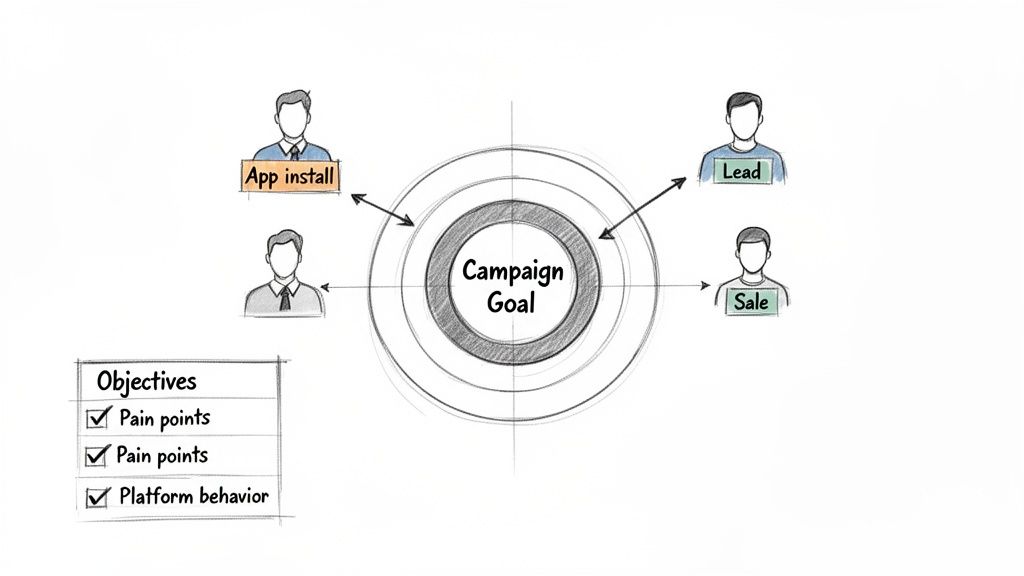
First things first: what is the one single action you want someone to take after watching your ad? Nailing this down defines your entire creative direction. A fuzzy goal like "brand awareness" is a recipe for a generic, forgettable script. A specific, sharp objective is what leads to killer performance.
Your objective dictates your call-to-action (CTA), the emotional tone, and which product features you spotlight. An ad designed to drive app installs is going to feel completely different from one meant to generate leads for a high-ticket service.
For example, look at how different goals change the script:
App Installs: The script needs to be high-energy, showing off the best parts of the app's gameplay or features. It all builds to a direct, no-nonsense CTA like "Download Now" or "Play for Free."
Product Sales: Here, you want to zero in on a specific pain point your product solves. A framework like Problem-Agitate-Solution (PAS) is perfect for building that tension before you reveal your product as the only logical fix.
Lead Generation: You're offering something valuable in exchange for their info. Your script should highlight a free guide, a webinar spot, or a consultation, and end with a CTA like "Learn More" or "Get Your Free Quote."
This level of clarity is everything. It's the North Star for every word you'll write.
A script without a clear objective is just a story. A script with a clear objective is a conversion tool.
Build Your Ideal Customer Profile
Once you know your goal, you have to know who you're talking to. And I mean really know them. A detailed Ideal Customer Profile (ICP) is non-negotiable, and it goes way beyond basic demographics like age and location. You need to get inside their head.
What are their biggest frustrations? What do they secretly aspire to? What kind of content are they already binging on TikTok and Meta? Answering these questions helps you find the right slang, cultural references, and emotional buttons to push so your ad feels like it belongs in their feed, not like it’s interrupting it.
This process transforms how you create a script, grounding it in real human insights. The diagram below shows how these foundational steps—setting objectives and knowing your audience—are the essential inputs for the scripting process itself.
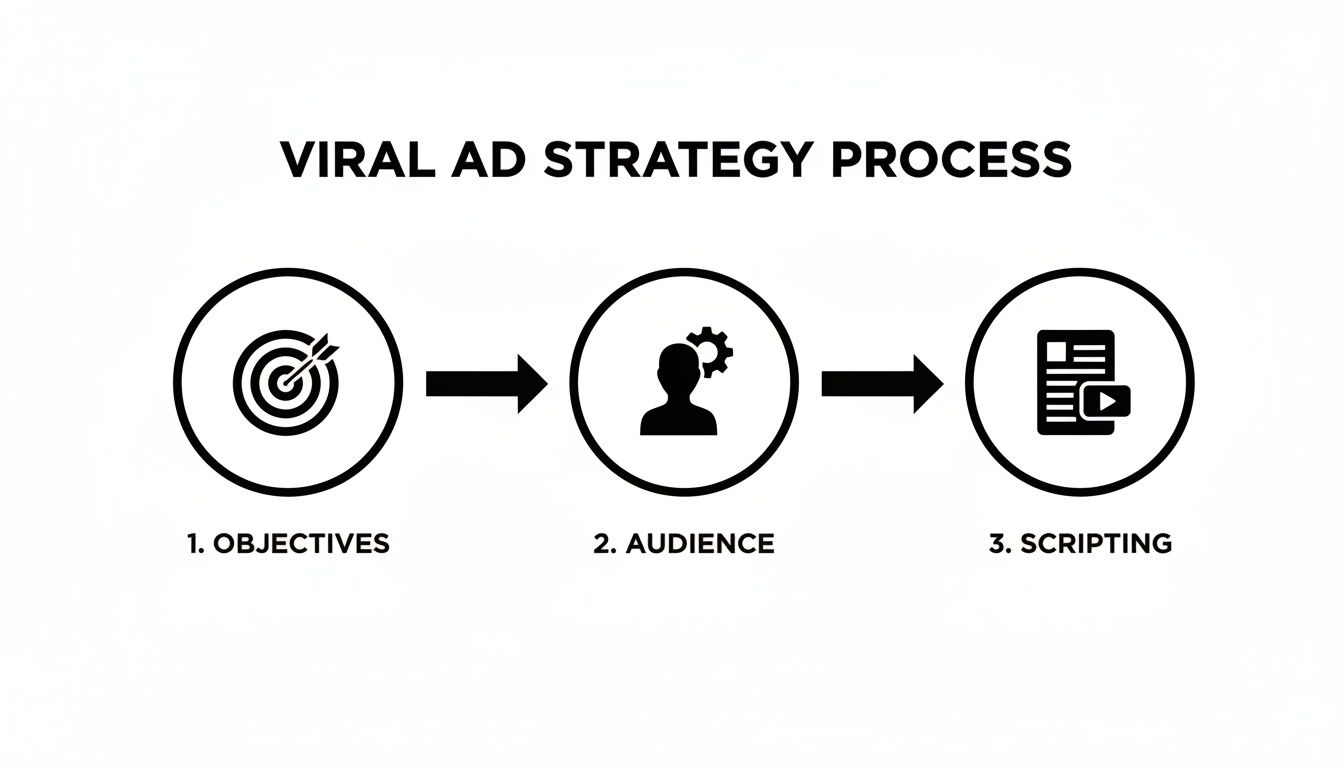
This strategic flow ensures your script is perfectly tuned to both your business goals and your customer’s mindset. When you lay this groundwork, online script creation becomes your secret weapon for scaling ad performance. It's why 95% of marketers have seen success with short-form video where AI-powered scripts really shine, as highlighted in recent video marketing statistics.
Choosing a Script Framework for Maximum Impact
Alright, you've locked in your goals and know who you're talking to. Now it’s time to pick the right structure for your message. Think of a script framework as the skeleton of your ad—it sets the pace, shapes the emotional journey, and guides your viewer straight to the call-to-action.
On fast-paced platforms like TikTok and Meta, your framework is everything. It can be the difference between an ad that gets scrolled past and one that actually converts.
These frameworks aren't rigid rules you have to follow to the letter. They're more like proven storytelling recipes, each designed to connect with a specific viewer mindset or nail a particular marketing goal. Moving past a one-size-fits-all approach is how you strategically create a script online that’s perfectly tuned to your campaign.
Here's a quick rundown of some of the most reliable frameworks we see working right now.
Framework | Core Components | Best For | Example Use Case |
|---|---|---|---|
Hook-Body-CTA | 1. Attention-grabbing intro | Direct-response, simple offers, warm audiences, high-volume testing. | A mobile game ad showing a "fail" clip, followed by epic gameplay, and a "Download Now!" button. |
Problem-Agitate-Solution (PAS) | 1. Identify a known pain point | Products that solve a nagging, emotional problem. Great for building empathy. | A productivity app ad starting with "Tired of endless to-do lists?" and ending with the promise of a clear mind. |
Listicle | 1. Promise of numbered tips | Positioning your brand as a helpful expert, educating the audience. | A fintech app running an ad on "3 Common Money Mistakes You're Making." |
User-Generated Content (UGC) | 1. Real customer footage | Building trust and social proof, creating native-feeling ads. | A skincare brand showing a montage of customers' video reviews with their glowing results. |
Let’s dig a little deeper into how you can put these frameworks into action for your own ads.
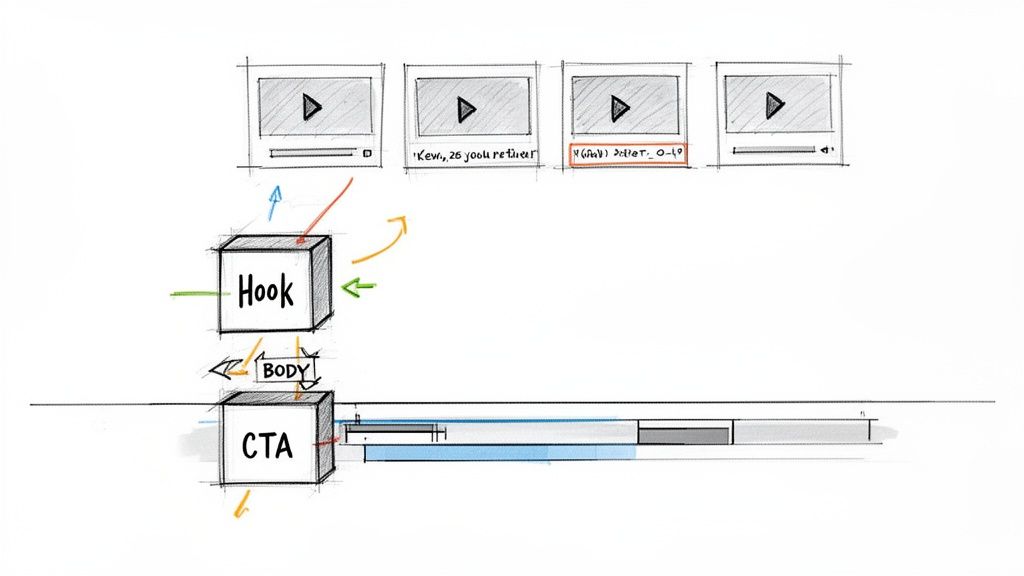
The Direct and Punchy Hook-Body-CTA
This is the workhorse of direct-response advertising for a reason. It’s simple, it’s clear, and it gets straight to the point. It works best for audiences who are already problem-aware or for offers with an obvious, immediate benefit. No need for a complex emotional journey here; you just need to communicate value fast.
Hook (1-3 seconds): Grab them with a bold claim, a surprising visual, or a question they can't ignore.
Body (5-15 seconds): Show the product in action, highlight a key benefit, or flash a few user testimonials. Keep it quick.
CTA (3-5 seconds): Tell them exactly what to do next. Be direct.
For instance, that mobile game ad works because it follows this perfectly: "Fail" scene (Hook), thrilling gameplay (Body), and a "Download and Play Free!" button (CTA). It’s all about efficiency. To see how top brands nail this, check out these powerful ad scripts examples.
The Empathetic Problem-Agitate-Solution Formula
The Problem-Agitate-Solution (PAS) framework is built on pure empathy. It works by tapping directly into a viewer's known pain points, making them feel like you get them before you even mention your product. This is a killer approach for anything that solves a nagging, frustrating problem.
You start by stating a problem your ideal customer has. Then, you agitate it by poking at the emotional fallout and frustrations it causes. Only after they're nodding along, feeling that pain, do you slide in with your product as the perfect solution.
Key Takeaway: The PAS framework doesn't sell a product; it sells relief from a problem. The emotional connection is established before the solution is ever mentioned, making the final pitch feel like a helpful discovery rather than a hard sell.
Imagine you're selling a productivity app. Your script could be as simple as:
Problem: "Is your to-do list a mile long and you still feel like you're getting nothing done?"
Agitate: "You end the day exhausted, stressed, and even further behind. Important projects are slipping through the cracks."
Solution: "The [App Name] helps you focus on what truly matters. Reclaim your time and hit your goals. Download now."
The Scannable and Shareable Listicles and UGC
Not every ad needs to feel like a commercial. Sometimes the best way to get through is by delivering genuinely useful content that educates or entertains. Listicles ("3 Ways to...", "5 Mistakes You're Making...") are perfect for this. They promise structured, easy-to-digest info and instantly position your brand as a helpful expert.
User-Generated Content (UGC) is another absolute powerhouse. It works by showing real customers using and loving your product, which is the ultimate form of social proof. A simple UGC script could just be a mashup of positive customer videos with text overlays pulling out their best quotes.
This format feels native to social feeds, which helps it fly under the "ad" radar and build massive trust. It's no surprise that 79% of people say UGC highly impacts their purchasing decisions.
If you want to get better at telling a compelling story no matter the format, it helps to understand the fundamentals. This guide on how to write a script for YouTube videos that gets views has some great insights. The principles of engagement are universal, whether you're making a 10-minute video or a 15-second ad.
Using AI to Create a Script Online at Scale
Alright, we've got the strategy down. Now it's time to shift gears from planning to actually making the ads. If you want the volume and speed needed to win with video ads today, writing every script by hand just won’t fly. This is where AI steps in, becoming your most valuable creative partner. It takes all your strategic inputs and churns out an arsenal of ad scripts ready for testing.
Using AI isn’t about hitting a button and letting a robot take over your job. It's about amplifying your own creativity. Instead of burning hours brainstorming a few ideas, you can generate hundreds of on-brand, conversion-focused scripts in minutes. This lets you test way more concepts, find winning angles faster, and stay one step ahead of creative fatigue.
Honestly, this isn't some future-is-coming talk; it's happening right now. The latest data shows that 75% of video marketers are already using AI to help create content, which drastically cuts down the time from a spark of an idea to a live campaign. For businesses, this is huge. 63% of them report that AI video tools have slashed their production costs by an average of 58% compared to the old-school way of doing things.
Crafting Prompts That Actually Work
Here’s the thing about AI: the scripts it spits out are only as good as the prompts you feed it. A lazy command like "write a script for a skincare ad" will get you a generic, unusable mess. To create a script online that actually converts, you have to give the AI specific, high-quality ingredients.
Think of it like briefing a junior copywriter. You wouldn't just toss a topic at them and walk away. You'd give them a detailed creative brief. Your AI prompt is that brief.
For maximum impact, here’s what you need to include:
Your Ideal Customer Profile: Who are you actually talking to? Describe their biggest pain points, what they're trying to achieve, and even the kind of slang they use.
The Framework: Be specific about the structure. Do you want a Problem-Agitate-Solution script? Or a straight-up Hook-Body-CTA? Tell the AI.
Your Unique Value Proposition: What makes your product the one to choose? Why you over all the others?
The Tone of Voice: Do you want the script to be funny? Urgent? Empathetic and reassuring? Give the AI examples to work from.
When you provide this level of rich context, you transform the AI from a simple text generator into a strategic creative assistant.
Building Your Context Vault
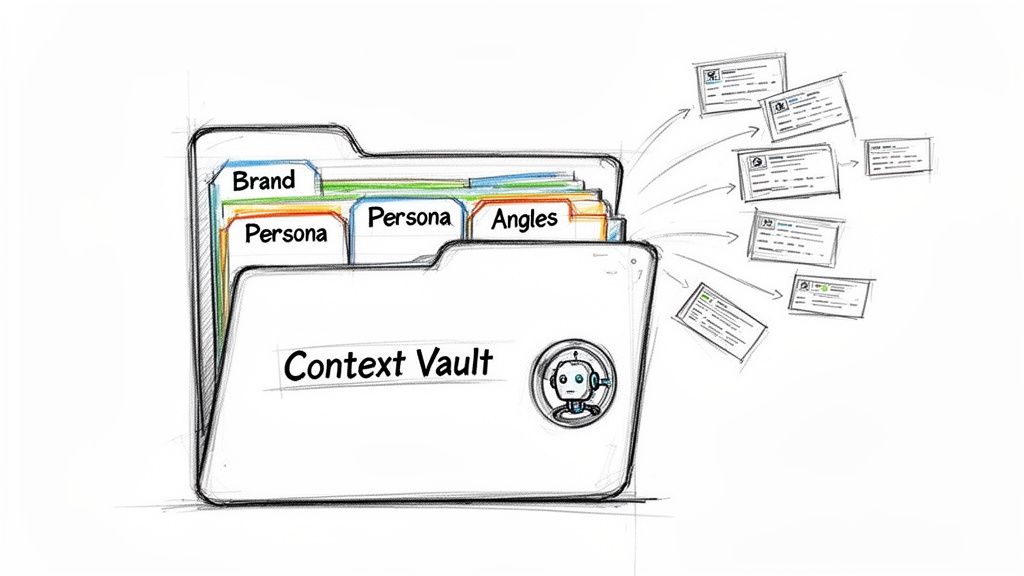
Copying and pasting all this detailed info for every single prompt gets old, fast. That's where a 'Context Vault' comes in. It’s a central hub where you store all your core brand and customer information, and it's a total game-changer for keeping your brand consistent when you're moving at scale.
Your Context Vault should be the single source of truth for the AI. It permanently holds all the critical inputs that define your brand.
A Context Vault ensures your AI doesn't just write a script; it writes your script. It internalizes your brand's DNA, customer insights, and winning formulas to produce consistently on-brand creative every single time.
This repository should be loaded up with assets like:
Brand Guidelines: Your mission, tone of voice, and a simple list of words to use and words to avoid.
Customer Personas: Detailed profiles of your key audience segments.
Winning Angles: A record of past hooks, messaging themes, and ad concepts that crushed it.
Product Details: Key features and, more importantly, the specific benefits they deliver to your customers.
With a system like this in place, every time you ask the AI to create a script online, it's already primed with the essential background knowledge. This is a core feature in powerful platforms like our AI video ad creator, which leans on this stored context to make sure every single output is strategically on point.
From Prompts to Production-Ready Variants
Once you've loaded your prompt with rich context, you can start generating script variants at an incredible pace. The objective here isn't to find one single "perfect" script. It's to produce a wide range of creative options you can test against each other.
For instance, you could ask the AI to generate:
10 different hooks for the exact same product benefit.
5 variations of a call-to-action, each using a slightly different psychological trigger (like urgency vs. social proof).
3 versions of a PAS script, with each one targeting a different customer pain point.
This process flips your role from a writer to a creative director. You're now curating and refining the best options from a pool of strong contenders. As you get ready to scale up your script creation, it's worth exploring the best AI tools for content creation to see what fits your team's workflow. This is how you build a high-velocity testing machine that constantly learns, adapts, and improves.
Putting It All Together: Assembling and Iterating Your Video Ads
A killer script is a great starting point, but let's be real—it's just a document. The magic happens when you pair those words with visuals and sound that stop people mid-scroll. This is where you turn your carefully crafted script into a tangible video ad.
But here’s the secret: success isn't about making one "perfect" video. It's about building a system that lets you pump out dozens of variations, fast.
This is what we call modular creative assembly, and it's the engine behind the highest-performing ad campaigns. Instead of producing one video from start to finish, you create a library of interchangeable parts—hooks, body segments, and CTAs. This lets you mix, match, and test what actually works, turning ad creation from a painful, manual process into a high-speed production line.
Build Your Modular Asset Library
Before you assemble anything, you need the building blocks. Your asset library is the foundation of this whole system. Think of it as a well-organized toolbox filled with video clips, images, testimonials, and audio you can grab at a moment's notice.
And don't just think about your polished, high-production brand commercials. Some of the best-performing assets are the most authentic.
Existing Brand Clips: Got longer marketing videos? Chop them up into punchy 3-5 second clips that hammer home one specific feature or benefit.
User-Generated Content (UGC): Get serious about collecting and organizing video testimonials. Real customers talking about your product in a raw, unpolished way builds trust way faster than a slick corporate ad.
Stock Footage: Use high-quality stock video to fill in the gaps. It's perfect for establishing shots or illustrating a common pain point your customers face.
AI-Generated B-Roll: Need a very specific visual you can't find anywhere? AI video generators can create custom clips that perfectly match your script's needs.
Having these assets ready to go is a game-changer. It means you can move from a fresh AI script to a finished video in minutes, not days. That speed is what lets you test more and learn faster than your competition.
Let AI Handle the Asset Management
A giant, unorganized folder of video files is almost as useless as having no assets at all. Trying to find that one perfect clip can feel like searching for a needle in a haystack. This is where AI-powered asset management becomes indispensable for anyone trying to create a script online and then quickly bring it to life.
Modern platforms can automatically analyze and tag every clip you upload. That means you can search your library using plain English. Forget hunting for "clip_final_v3.mp4." Just type "woman smiling while using our app on a couch," and the AI will pull up every relevant video you have.
This completely removes the friction from the creative process, letting you focus on the story and the build instead of getting bogged down in file management hell.
The whole point of a modular system is speed. AI asset management eliminates the biggest bottleneck—finding the right visual for the right moment—so you can assemble and test ads at the pace your campaigns demand.
Assemble and Customize at Scale
Okay, your scripts are generated and your assets are organized. Now for the fun part: assembly. This is where you combine all your modular pieces to create a whole fleet of ad variations. A powerful video creation platform lets you do this without ever opening complex editing software like CapCut or Premiere Pro.
Imagine you've created 5 hooks, 3 body segments, and 3 CTAs. With a modular system, you can instantly combine these to generate 45 unique video ads (5 x 3 x 3). That's the kind of volume you need for serious testing to find the winning combos.
As you assemble, you should also be able to apply customizations across all your variants at once:
Subtitles: Over 85% of social media videos are watched with the sound off. Clear, readable subtitles are absolutely non-negotiable.
Text Overlays: Use these to reinforce the script's key messages, highlight a special offer, or call out a major benefit.
Branding: Instantly add your logo and brand colors to every video to keep things consistent.
This modular, AI-assisted workflow completely changes your creative operation. You can go from a single idea to a full-blown campaign with dozens of testable assets in a fraction of the time. That’s a serious competitive edge.
Testing and Scaling Your Winning Scripts
So you've created a bunch of killer video ads. Hitting "publish" feels like the finish line, but it’s really just the start. This is where the real work begins, and it’s all driven by data. The process to create a script online isn't done until you've proven it works with real-world performance. This is how you separate the ads that just look good from the ones that actually make money.
A systematic testing framework is what turns your creative ideas into a predictable growth engine. It’s how you find the winners, understand why they work, and scale them up with confidence. Without a solid testing plan, you’re just gambling with your ad spend.
The goal here is to create a tight feedback loop. The data from your live campaigns should directly inform the next batch of scripts you write. This cycle of learning and iterating is the secret to long-term success on platforms like Meta and TikTok.
Structuring Your A/B Tests for Clear Results
To get clean, actionable data, you absolutely have to test variables in isolation. It's tempting to just launch a dozen completely different ads to see what sticks, but that’s a rookie mistake. It leaves you guessing about what actually drove performance. Was it the hook? The offer? The visual? Who knows.
Instead, you need to be methodical. The single highest-leverage element to test first is almost always the hook. That initial three-second window is everything—it determines whether your ad gets watched or skipped.
Here’s a practical way I like to set up initial tests:
Isolate the Hook: Start by testing 3-5 different hooks against the exact same body and call-to-action. This will tell you, without a doubt, which opening message is best at stopping the scroll.
Test the Body/Angle: Once you have a statistically significant winning hook, lock it in. Now, test 2-3 different body variations against that winning hook. This helps you figure out which angle or benefit really connects with your audience.
Optimize the CTA: Finally, with the winning hook and body combo, test 2-3 different calls-to-action. You’d be surprised how a small tweak in wording here can dramatically impact your conversion rate.
This disciplined approach ensures you’re making data-backed decisions every step of the way, gradually building a "god-tier" ad from proven parts.
Monitoring Key Metrics in the First 72 Hours
The first three days of a campaign will tell you almost everything you need to know. You don’t need to wait weeks to make a call. Keep a close eye on your ad performance during this initial window, focusing on the metrics that matter most for creative.
Here are the vital signs to watch:
Hook Rate (First 3-Second Views / Impressions): This tells you how effective your opener is. A high hook rate means you’re grabbing attention.
Hold Rate (ThruPlays / Impressions): This measures how many people watch past the 15-second mark. It’s a great indicator of how engaging your ad’s body is.
Cost Per Result (CPR): This is your bottom line. Are you getting purchases, leads, or installs at a cost that makes sense for your business?
Click-Through Rate (CTR): While not the only metric, a high CTR is a strong signal that your ad is compelling enough to make people take action.
Don’t be afraid to kill underperforming ads quickly. If a variant has a terrible hook rate and a sky-high CPR after 72 hours, turn it off. Reallocate that budget to your potential winners. Emotional attachment to creative has no place in performance marketing.
Building an Automated Ad Launching Pipeline
As you start testing more, organization becomes everything. Trying to manage dozens of ad variants manually is a recipe for chaos and expensive mistakes. This is where a streamlined launching pipeline with strict naming conventions becomes your best friend.
A clear naming system ensures your test results are easy to find, analyze, and compare. For example, a convention like [Date]\_[Campaign]\_[Angle]\_[HookID]\_[CreativeID] lets you see every variable at a glance.
Checking out an ad creative experimentation tool can give you some great ideas for setting up these efficient workflows. This structure is essential for building that feedback loop, allowing you to easily identify top-performing script elements and feed those insights right back into your AI script generator for the next round.
Frequently Asked Questions
Diving into video ad creation, especially when you need results fast, always brings up a few questions. We get these all the time from marketers trying to crack the code for high-performing ads on platforms like TikTok and Meta. Here are some of the most common ones.
How Long Should a Video Ad Script Be?
For fast-paced feeds like TikTok and Instagram Reels, you should aim for a script that translates into a 15 to 30-second video.
The most important part? The first 3-5 seconds. Your hook has one job: stop the scroll. If it fails, nothing else matters.
Get your main message and value prop out immediately after that hook. Then, finish with a crystal-clear call-to-action that tells people exactly what you want them to do. While longer, story-driven ads have their place, keeping it under 30 seconds for top-of-funnel campaigns is the way to go. It just fits how people actually watch content on these platforms.
What Is the Biggest Mistake When Using AI to Create a Script Online?
The single biggest mistake is feeding the AI generic, lazy prompts. If you give it garbage input, you're going to get garbage output. It's that simple. To get scripts that actually convert, you have to spoon-feed the AI specific, rich context.
That means giving it details like:
A Deep Customer Persona: Who are you really talking to? What keeps them up at night? What are they trying to achieve?
Your Unique Selling Proposition: What makes your product the only choice? How is it different from everything else they've seen?
Your Brand Voice: Are you witty? Authoritative? Empathetic and reassuring? Be specific.
The Framework You Want: Literally tell the AI, "Write this using the Problem-Agitate-Solution framework."
The best way to get consistent, quality scripts is to use a tool with a 'Context Vault.' This is where you store all your core brand and audience info once. That way, the AI always has the background it needs to nail the script without you having to re-type everything, every single time.
How Many Script Variations Should I Test at Once?
This really depends on your budget, but a solid place to start is testing 3-5 different hooks against the same video body and CTA. The hook is by far the highest-leverage part of your ad, so you want to get that right first.
Once you find a clear winner based on the data, you can start testing 2-3 variations of the body or the CTA. The key is to test one thing at a time—hooks first, then body, then CTA. This methodical approach is the only way to get clean data and know for sure what’s driving performance. This is where AI tools that can bulk-render variations really shine; they make this whole process incredibly fast.
Can I Write Effective Video Ad Scripts Without Being a Copywriter?
Absolutely. You don't need to be a professional copywriter anymore. Proven frameworks and modern tools have leveled the playing field for everyone. When you start with a battle-tested structure like Problem-Agitate-Solution (PAS), you're not starting from a blank page; you have a roadmap.
AI script generators are like having a creative partner on call 24/7. They can take your rough ideas, customer research, and product features and spin them into compelling, persuasive copy. The most critical skill isn't writing fancy taglines—it's having a deep, genuine understanding of your audience's problems and dreams. If you can articulate that, AI can help you turn it into a script that connects and converts.
Ready to stop guessing and start scaling? Sovran is the performance-focused AI platform that automates the entire video ad production pipeline. Go from idea to hundreds of testable ad variants 10x faster. Start your 7-day free trial today at https://sovran.ai.

Manson Chen
Founder, Sovran
Related Articles
Your Ultimate Guide to UGC Style Video Ads
Master UGC style video ads for Meta and TikTok. This guide reveals proven frameworks, scripts, and scaling tactics to boost your ROAS in 2026.
How to Turn Link Into Video: Ads That Convert in 2026
Learn how to turn link into video for Meta & TikTok ads. Leverage AI to scale creation, boost ROI, and succeed in 2026.
8 High-Converting Static Ads Examples for 2026
Discover 8 high-performing static ads examples from top apps. Learn to create text-overlays, testimonials, and lifestyle ads that convert.