How to Make 50 Ads From One Video: Boost Campaigns
Jump to a section

You already know the pattern. A team ships one polished video, launches it on Meta or TikTok, gets a short burst of signal, then performance softens. CTR drops. CPA climbs. The response is usually more production, more approvals, more waiting, and another round of edits on a “new” creative that’s mostly the same ad with slightly different text.
That workflow breaks because the actual problem isn’t a shortage of videos. It’s a shortage of testable creative variables.
If you want to know how to make 50 ads from one video, stop treating the source file as a finished asset. Treat it like raw material. One shoot can produce hooks, proof moments, demos, objections, overlays, CTAs, voiceovers, captions, and cutdowns. Once those pieces are modular, AI becomes useful. Before that, it mostly helps you make more versions of the same mistake.
The Shift from One Video to a Creative Testing Engine
Most ad teams don’t lose because they can’t make content. They lose because they can’t refresh and test fast enough once the first wave of ads stalls.
That’s why the jump from “one video” to “50 ads” matters. It isn’t a volume game for its own sake. It’s a way to give the platform more meaningful creative options, so you can learn faster and replace fatigued ads without restarting production every week.
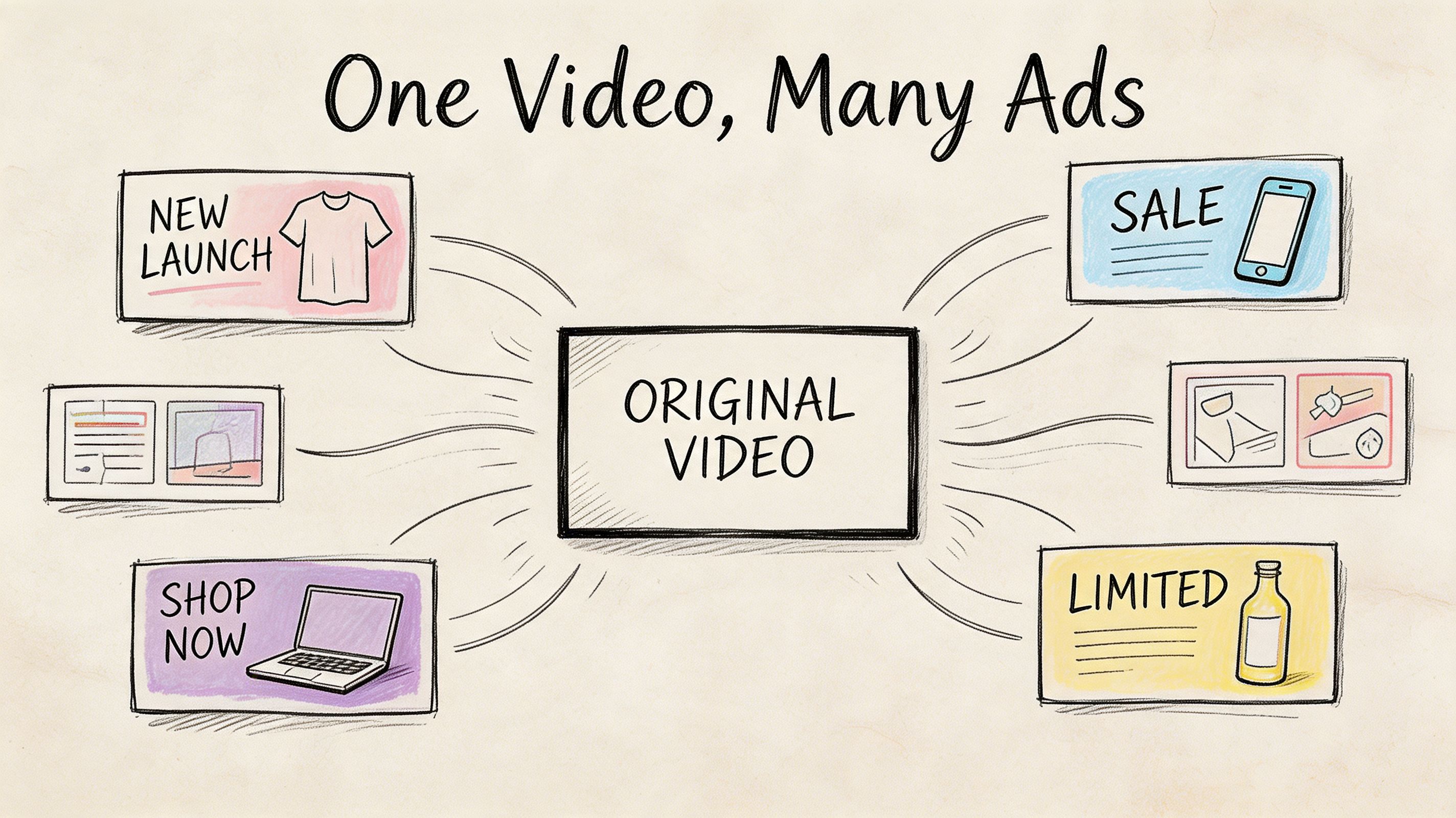
Teams that move from producing only a handful of ads each week to a system that generates 50 variations from one video often see 135% ROI, driven by a 43% uplift in click-through rates from finding winning combinations faster, as shown in this video case study on modular ad variation workflows.
Why the old hero-video model fails
A single finished edit locks too many decisions too early. The opening angle, pacing, proof sequence, and CTA are all bundled together. If performance is weak, you don’t know what failed.
Was the hook wrong?
Did the body drag?
Did the CTA ask too much too soon?
Did the creator style work, but the message miss?
When everything is fused into one timeline, you can’t isolate variables cleanly.
That’s also why smart teams increasingly borrow workflows from content repurposing. If you’ve ever seen a strong framework for how to repurpose webinar content, the underlying logic is the same. Break one long-form asset into reusable components, then redistribute those components in formats built for specific channels and goals.
Practical rule: Don’t ask, “How do we make one better video?” Ask, “How many distinct tests can this footage support?”
What a creative testing engine actually looks like
A creative testing engine has a few defining traits:
- Modular inputs: hooks, body segments, proof clips, B-roll, and CTAs live as separate pieces.
- Repeatable scripting: each variation changes a clear variable, not random details.
- Fast assembly: editors or AI tools can recombine assets without rebuilding from scratch.
- Structured launch: ads go live in a way that preserves learning.
Teams either gain an advantage or create chaos at this stage. More ads only help if the system behind them is organized.
A good framework for that operational side is this creative testing framework for Meta ads. The important shift is mental before it’s technical. You’re no longer producing isolated ads. You’re building a library of messages that can be assembled into many ads.
Deconstructing Your Video into a Modular Asset Bank
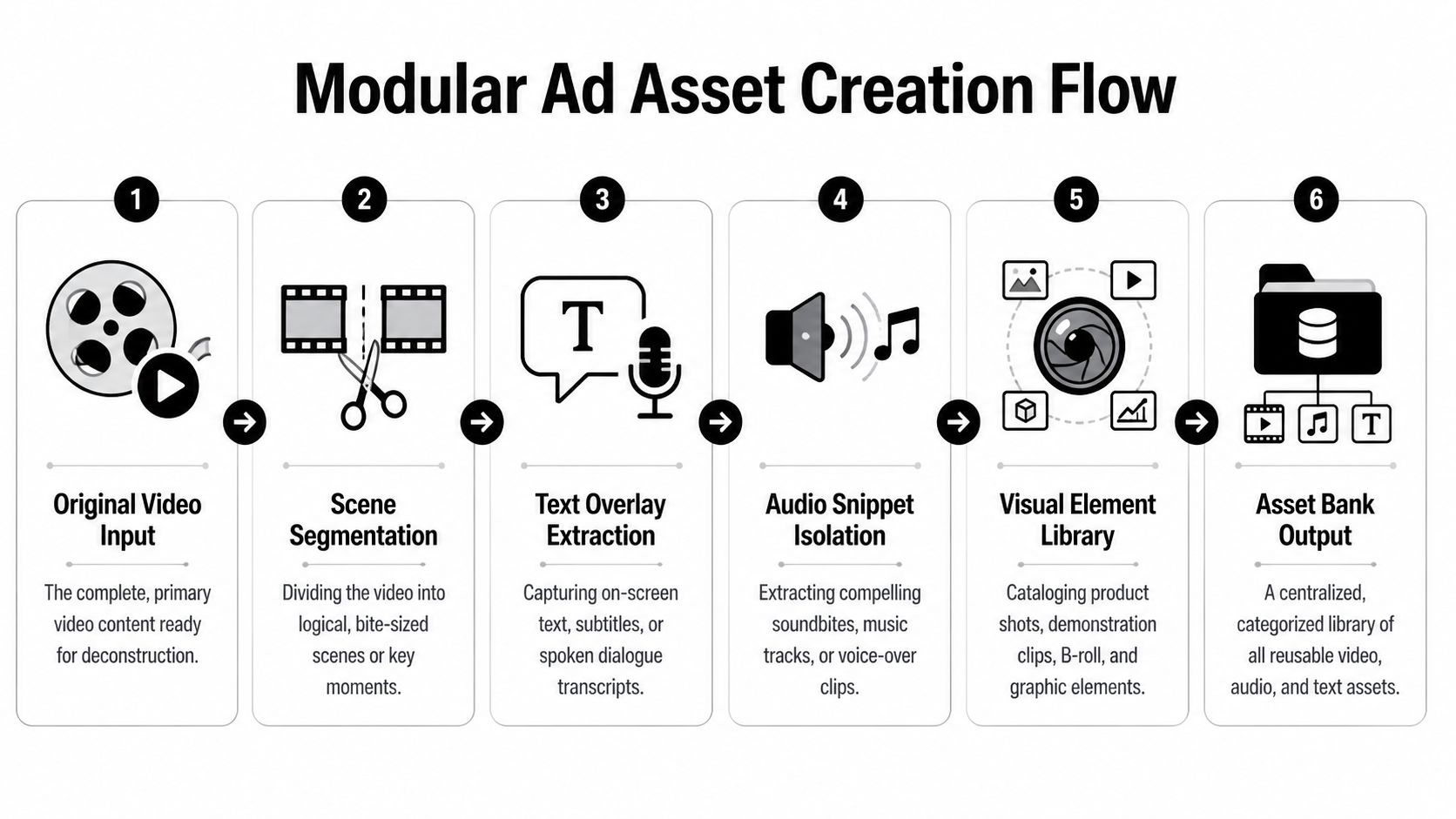
Before you can make 50 ads, you need to stop looking at your video as a single file. It’s a collection of scenes, claims, reactions, product moments, and sound bites. The fastest teams pull those elements apart and store them in an asset bank that’s searchable and reusable.
That asset bank is the foundation. If it’s messy, every downstream step becomes slow.
What belongs in the asset bank
At minimum, pull your source video into these buckets:
- Hook candidates: first lines, visual interruptions, strongest claims, problem statements, pattern breaks.
- Body segments: demos, before-and-after moments, feature explanations, testimonials, use cases.
- CTA options: direct asks, softer next steps, urgency-driven closes, benefit-led closes.
- Support footage: B-roll, UI captures, product closeups, lifestyle shots, reaction clips.
- Audio assets: founder voice, creator voice, testimonial snippets, alternate voiceover reads.
- Text assets: captions, headline overlays, offer language, objection-handling text.
The point isn’t perfect categorization. The point is retrieval. If your editor or media buyer can’t find “strong proof clip with product in use” in seconds, your library isn’t working.
How to break the video down
Start with the transcript. That gives you a rough map of claims, moments of emphasis, and natural cut points. Then review the visual sequence separately, because strong ad modules often come from what’s shown, not just what’s said.
I usually look for three kinds of extraction opportunities:
Verbal hooks
A founder says something sharp in the first sentence. A customer says the problem in plain language. A creator asks a direct question that can stand alone.Proof blocks
This can be a product demo, a result-oriented use case, a comparison shot, or a moment where the value becomes obvious without extra explanation.Closing moments
These are your CTA building blocks. Button-clicks, app-store visuals, product held to camera, offer overlays, checkout screens.
A modular workflow gets easier when every clip is labeled by function, not just file name.
Where AI helps and where it doesn’t
AI is useful here because it reduces manual sorting. Tools built for ad production can auto-detect scene changes, generate transcripts, identify spoken sections, and tag visual elements for search. That’s much faster than having an editor hand-slice every shot.
But AI tagging still needs human judgment. It won’t reliably know whether a line is a strong hook or just the first sentence. It also won’t understand your testing plan unless someone defines it.
A practical review pass should answer:
- Would this clip stop someone quickly?
- Does this segment prove the claim or just repeat it?
- Can this CTA close multiple ad angles, or only one?
- Does the clip feel native to feed behavior on Meta or TikTok?
For teams formalizing this process, these asset management best practices for creative teams are worth applying early. Naming conventions, tagging rules, and shared retrieval standards sound boring until you’re trying to build and launch dozens of ads under deadline.
A simple naming system that works
Use names that describe role + angle + format.
| Asset type | Example naming pattern |
|---|---|
| Hook | Hook_problem_direct-camera_vertical |
| Body | Body_demo_feature-screen-record_square |
| Proof | Proof_testimonial_creator-selfie_vertical |
| CTA | CTA_trial-benefit_text-overlay_4x5 |
That’s enough structure to keep scale from turning into clutter. If you skip this step, “how to make 50 ads from one video” turns into “how to lose a week rebuilding files you already had.”
Scripting Variations for Hooks, Bodies, and CTAs
Output quality is largely determined at this point. Plenty of teams can cut clips. Far fewer can write variations that are meaningfully different.
A strong modular system starts with a simple truth: the ad doesn’t need 50 totally different stories. It needs a manageable set of distinct hooks, clear body angles, and compatible CTAs that can be recombined without feeling stitched together.
Hooks need contrast, not cosmetic changes
The first mistake is writing five hooks that all say the same thing in slightly different words. That gives you volume without diversity.
Your hooks should come from different strategic angles, such as:
- Problem-first: call out the pain point in direct language.
- Curiosity-first: open on a surprising claim or setup.
- UGC-style question: sound like a person talking, not a brand reading copy.
- Direct outcome: lead with what the user gets.
- Objection-first: address skepticism immediately.
A good hook changes the frame of the ad. It doesn’t just swap adjectives.
Bodies should do one job well
The middle of the ad often gets overloaded. Teams try to fit in every feature, every proof point, and every brand message. That usually weakens performance because the body loses shape.
A body segment should usually do one of these jobs:
- Show the product in action
- Explain how it works
- Prove credibility
- Demonstrate ease
- Handle one objection
If you try to do all five at once, you get an ad that feels dense and generic.
Working standard: One hook should raise one question. One body should answer it. One CTA should tell the viewer what to do next.
A useful reference for building scripts this way is this hook body CTA video ad structure guide, especially if your team tends to overwrite.
CTAs are more than button language
“Shop now” and “learn more” aren’t strategy. They’re labels.
Your CTA should match the promise made by the hook and body. If the ad leans hard into ease, the CTA should reinforce ease. If the ad is offer-led, the CTA should close around urgency or value. If it’s educational, the CTA can invite a lower-friction next step.
Here’s a simple recombination example.
| Hook (1-3s) | Body (10-15s) | CTA (2-4s) |
|---|---|---|
| “Still editing every ad by hand?” | Fast walkthrough of a modular editing workflow | “Launch your next round with a cleaner testing setup.” |
| “This is why your winning ad died.” | Explain creative fatigue with fresh angles from one source video | “Build more variations before spend gets wasted.” |
| “We stopped filming new ads every week.” | Show one source video split into proof, demo, and testimonial modules | “Use the footage you already have.” |
| “Most teams don’t need more shoots.” | Product demo focused on recombining existing clips into new sequences | “Turn one video into a full test batch.” |
| “Your first three seconds are doing all the work.” | Compare weak opening footage to stronger hook-led cuts | “Rewrite the opening before replacing the whole ad.” |
| “One creator video can carry a full campaign.” | Use testimonials, overlays, and alternate CTAs from the same source | “Scale the angle that’s getting attention.” |
Three hooks, three bodies, and two CTAs already create a meaningful test matrix. The goal isn’t to hit a mathematically impressive number. The goal is to create combinations that answer different buyer motivations while preserving production efficiency.
What doesn’t work
A few patterns consistently underperform in modular systems:
- Minor hook rewrites that keep the same underlying angle
- Bodies that explain instead of demonstrate
- CTAs that don’t match the promise of the ad
- Over-scripted UGC that sounds approved by six stakeholders
- Recombination without quality control
If a variation feels mechanically assembled, the audience will feel it too. Modularity should create range, not Frankenstein edits.
Assembling and Enhancing Ads with AI Assistance
Once your scripts and asset bank are in place, assembly becomes a production problem, not a blank-page problem. That’s the point where AI starts earning its keep.
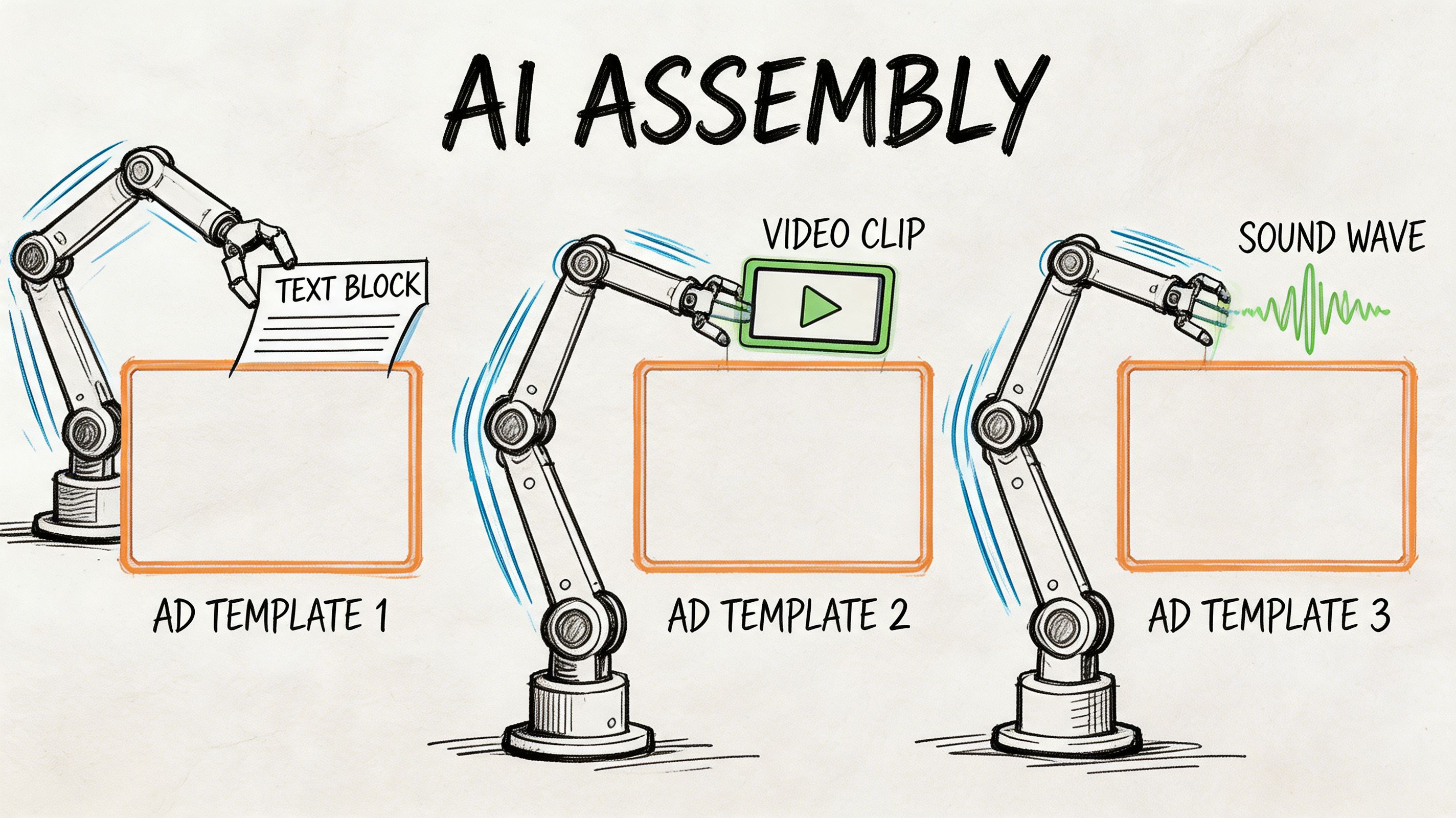
The practical workflow is straightforward. Pull a hook module into the opening. Add a body clip that answers the hook. Close with a CTA that matches the angle. Then duplicate the sequence and swap one element at a time.
According to VEED’s guide to creating video ads, advanced AI workflows can extract 10 to 15 modular clips from a single video, amplify them 5x with prompt-driven variations for tone and style, and help teams identify winning creatives 4x faster in testing.
The assembly stack that actually helps
You don’t need a giant post-production setup for this. You need the right types of tools:
- A modular timeline editor for drag-and-drop sequence building
- Captioning tools that auto-time subtitles and let you restyle them fast
- Voiceover generation for alternate reads, pacing, or persona changes
- B-roll generation or retrieval when the source footage is missing support shots
- Format adaptation so the same sequence can fit vertical, square, or 4x5 placements
This is one place where a platform like Sovran can fit. It structures video into reusable hook, body, and CTA modules, supports AI-generated B-roll, voiceovers, and captions, and assembles variations for ad testing workflows.
Use AI to fill gaps, not hide weak strategy
AI can generate a lot of surface-level variation. Different voice tones. Alternate captions. Synthetic B-roll. New background music. Those are useful accelerants, but they don’t rescue a weak concept.
If the original body doesn’t prove the claim, a new voice won’t fix it. If the hook is vague, better subtitles won’t make it sharp.
Good uses of AI in this stage include:
- Creating alternate voiceover styles for the same script
- Generating caption treatments that fit different ad personas
- Adding supportive visual context where the source footage is thin
- Creating multiple text overlay variants without rebuilding the edit
- Speeding up resize and format adaptation
If you also need supporting audio options that fit different cuts, this guide on how to generate music for YouTube with AI is useful for understanding where AI audio can add variety without forcing a full manual sound design pass.
Don’t ask AI to invent your strategy. Ask it to speed up the repetitive parts of a strategy that already makes sense.
A deeper walkthrough of the tool category is in this AI video ad tool overview, especially if your team is comparing editing software against platforms built specifically for modular ad production.
Here’s what this looks like in motion.
Quality control before export
Before you render a large batch, check for the issues that most often slip through automated assembly:
- Abrupt transitions: modules fit logically but not emotionally
- Mismatched energy: the CTA is calmer or louder than the body
- Caption clutter: too much text competing with the visual
- Fake-looking inserts: AI-generated footage that doesn’t match the rest of the ad
- Repetitive rhythm: all variants feel like clones despite different modules
The best modular ads still feel intentional. The viewer should experience one coherent ad, not a stack of interchangeable parts.
Bulk Deployment and Structured Experimentation
Making 50 ads is only useful if launch speed matches production speed. Many teams frequently give back the gains they made upstream. They build variations quickly, then spend hours uploading, renaming, editing copy, fixing links, and fighting ad manager friction.
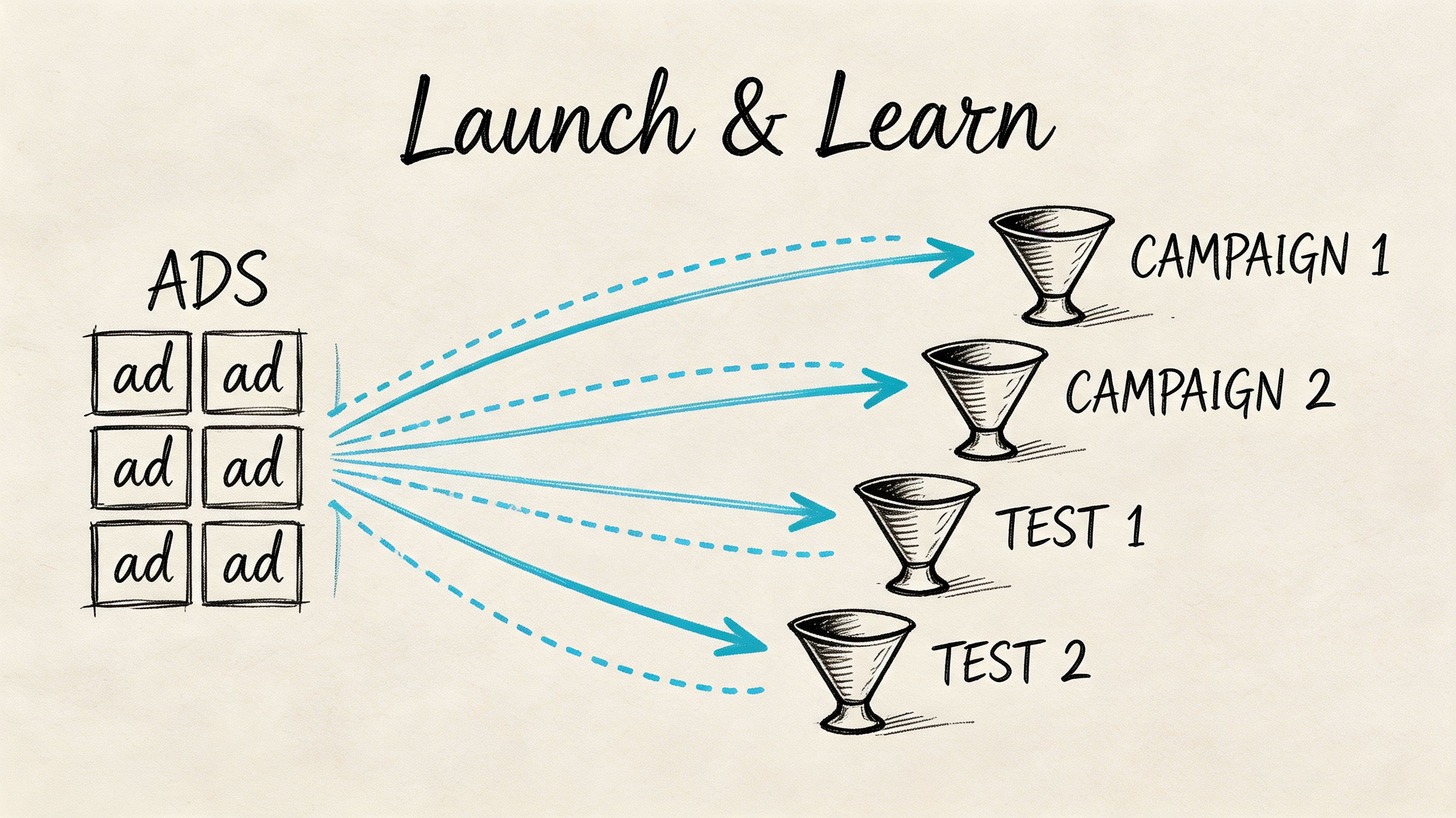
The advantage of a modular workflow isn’t just more output. It’s the ability to get structured experiments live while the source insight is still fresh.
Using one-click launch tools, marketers can deploy 50+ ad creatives in under 5 minutes, which used to take hours. That speed supports 1,000+ ads monthly, and some teams have seen CTR increases of up to 230% and 28% lower CAC through faster iteration and broader testing, based on this tutorial covering bulk ad launches and modular Meta workflows.
Launch in batches that preserve learning
Don’t dump all your variations into one messy campaign and hope the algorithm sorts it out. Structure matters.
A simple operating model looks like this:
- Batch by concept family: keep problem-first ads together, demo-led ads together, and testimonial-led ads together.
- Hold one variable steady: if you’re testing hooks, don’t also rewrite the body and CTA in the same subset.
- Use naming conventions that reflect the module stack: HookA_Body2_CTA1 is boring, but it’s readable.
- Map copy fields in bulk: headlines, primary text, and URLs should be editable outside the ad platform when possible.
Real time is saved through spreadsheet-driven workflows and direct integrations. Bulk editing in a sheet is cleaner than touching every ad one by one in Ads Manager.
A testing structure that keeps signal clean
The popular 3-2-2 logic is useful because it forces discipline. You create a small number of organized campaign and ad set containers, then scale variation through duplication and asset swaps rather than by inventing a chaotic account structure.
That matters because the objective isn’t “launch many ads.” The objective is identify what kind of ad wins.
Fast launch only matters when the test design lets you trust the result.
A practical checklist before pushing live:
Confirm every ad has a unique purpose
If two ads differ only by cosmetic text, cut one.Make sure naming survives export
If your file names collapse during upload, reporting becomes painful.Check destination consistency
Broken URLs and inconsistent landing pages contaminate results.Review first-frame quality
Thumbnail and opening frame still matter, even for feed-first video.Verify format fit
Some edits look fine in one ratio and weak in another.
Teams trying to remove manual editing from the launch step often benefit from tutorials on how to create professional AI videos without editing, especially when the bottleneck is operational rather than creative.
If your account is still relying on hand-built ad creation, this bulk create Facebook ads workflow is the more relevant process shift to study. Bulk deployment is where modular production becomes a competitive edge instead of a nice internal system.
What usually goes wrong after launch
The most common post-launch mistake is reacting too early to isolated ad-level noise. The second is failing to look across modules.
You don’t just want “the winner.” You want answers like:
- Which hook family keeps earning attention?
- Which body type sustains interest after the opening?
- Which CTA style closes better for a given angle?
- Which creator or voiceover style fits the offer?
That’s the payoff. A modular system doesn’t just produce ads. It produces reusable learning.
Adopting a High-Velocity Testing Mindset
The teams that get the most from this approach don’t see it as a production hack. They treat it as account infrastructure.
That’s the bigger shift behind learning how to make 50 ads from one video. You’re replacing a campaign-by-campaign mindset with a system that keeps generating fresh tests from existing footage, existing scripts, and existing proof. That lowers the creative burden on the team and raises the speed of learning inside the ad account.
The old model depends on hero assets. It asks one video to carry too much weight. When it works, the team feels relief. When it fades, everyone scrambles. The modular model is steadier because it assumes fatigue will happen and builds the replacement cycle into the workflow.
That changes how you brief shoots, how you script creators, how you tag footage, and how you review results. You stop asking for “one final edit.” You ask for components that can survive recombination.
It also creates better pressure on the team. Instead of debating whether one polished ad is good enough, you can test multiple credible approaches and let performance decide which angle deserves more spend. That’s a healthier way to operate on Meta and TikTok, where speed, iteration, and creative diversity matter more than perfection.
The goal isn’t to manufacture variation. It’s to build a repeatable system for discovering what persuades different audiences.
If your current workflow still depends on new filming every time performance dips, the bottleneck isn’t just creative output. It’s creative design. Once you fix that, AI becomes an accelerator instead of a distraction.
If you want to turn existing footage into a modular testing workflow, Sovran helps teams organize source video into reusable assets, assemble hook-body-CTA variations, and push large batches of ads into Meta without rebuilding everything by hand.

Manson Chen
Founder, Sovran
Related Articles
Production Schedule Optimization for Scalable Ad Testing

8 Pattern Interrupt Techniques for Video Ads