Scale Your Video for Product Launch With Our Playbook
Jump to a section

The most common advice on video for product launch is also the most outdated. Teams still get told to make one polished hero asset, launch it everywhere, and trust that strong storytelling will carry the campaign. That worked better when distribution was slower, platforms were less crowded, and media teams could let a single creative run longer before fatigue set in.
On Meta and TikTok, that approach usually creates a bottleneck before launch day even arrives. You spend weeks refining one narrative, one edit, one CTA, then discover the market wanted a different hook, a different proof point, or a different opening frame. By then, the campaign is already paying for that lesson.
The better model is to treat launch video as a testing system, not a finished artifact. You still need strong messaging and sharp production. You just need them packaged in a way that lets the team learn fast, replace weak components quickly, and scale what converts.
Rethinking Your Launch Video Strategy
The hero-video mindset breaks because ad platforms don't reward creative perfection. They reward relevance, speed, and variation. A launch asset that feels excellent in review rounds can still fail in market because a different audience segment responds to a different problem statement, visual style, or proof mechanism.
That matters even more on Meta, where creative is the #1 factor in performance, with some internal benchmarks indicating it drives 70% of campaign lift from fresh variants, while 85% of marketers struggle with production velocity according to Vidico survey coverage discussed by ScreenStory. If creative drives performance and many organizations can't make enough of it fast enough, then the actual launch problem isn't "how do we make one better video?" It's "how do we build enough strong variations to discover what works before spend is wasted?"

Why one launch video underperforms
A single asset forces too many decisions into one cut:
- One opening angle: You choose one hook even though different buyers respond to different pains.
- One proof style: Demo-heavy edits appeal to some audiences. Testimonial-first edits work better for others.
- One pace: Fast cuts can lift retention in one placement and hurt clarity in another.
- One CTA frame: “Shop now,” “start trial,” and “see how it works” don't behave the same way.
Most launch teams also overestimate how much internal consensus predicts market response. The cleanest storyboard often reflects what stakeholders agree on, not what users stop scrolling for.
The portfolio approach works better
A modern launch library should include multiple hooks, several middle sections, and a range of CTAs. That doesn't mean lowering the bar. It means shifting quality control from a single edit to a modular system where each piece has a job.
One hook can lead with the problem. Another can open with the product in use. A third can foreground social proof. Once you start thinking this way, "video for product launch" stops being a film project and becomes a message architecture problem.
Practical rule: If your launch plan depends on one video being right for every audience, you've built a brand asset, not a performance system.
For teams that need a useful baseline on ecommerce-specific video fundamentals, NanoPIM's ecommerce video guide is worth reviewing. It helps frame the distinction between product storytelling and conversion-focused video execution, which is where many launch plans drift off course.
There's also a big strategic difference between launch storytelling and launch testing. Storytelling creates coherence. Testing creates signal. You need both, but only one of them tells you which claim, scene, and CTA deserve more budget. That's the discipline behind a scalable workflow like the one described in this Sovran article on video product marketing.
Designing Your Modular Video Blueprint
If the old way starts with a storyboard for one finished ad, the better way starts with a component map. Build the launch around parts that can stand alone and combine cleanly.
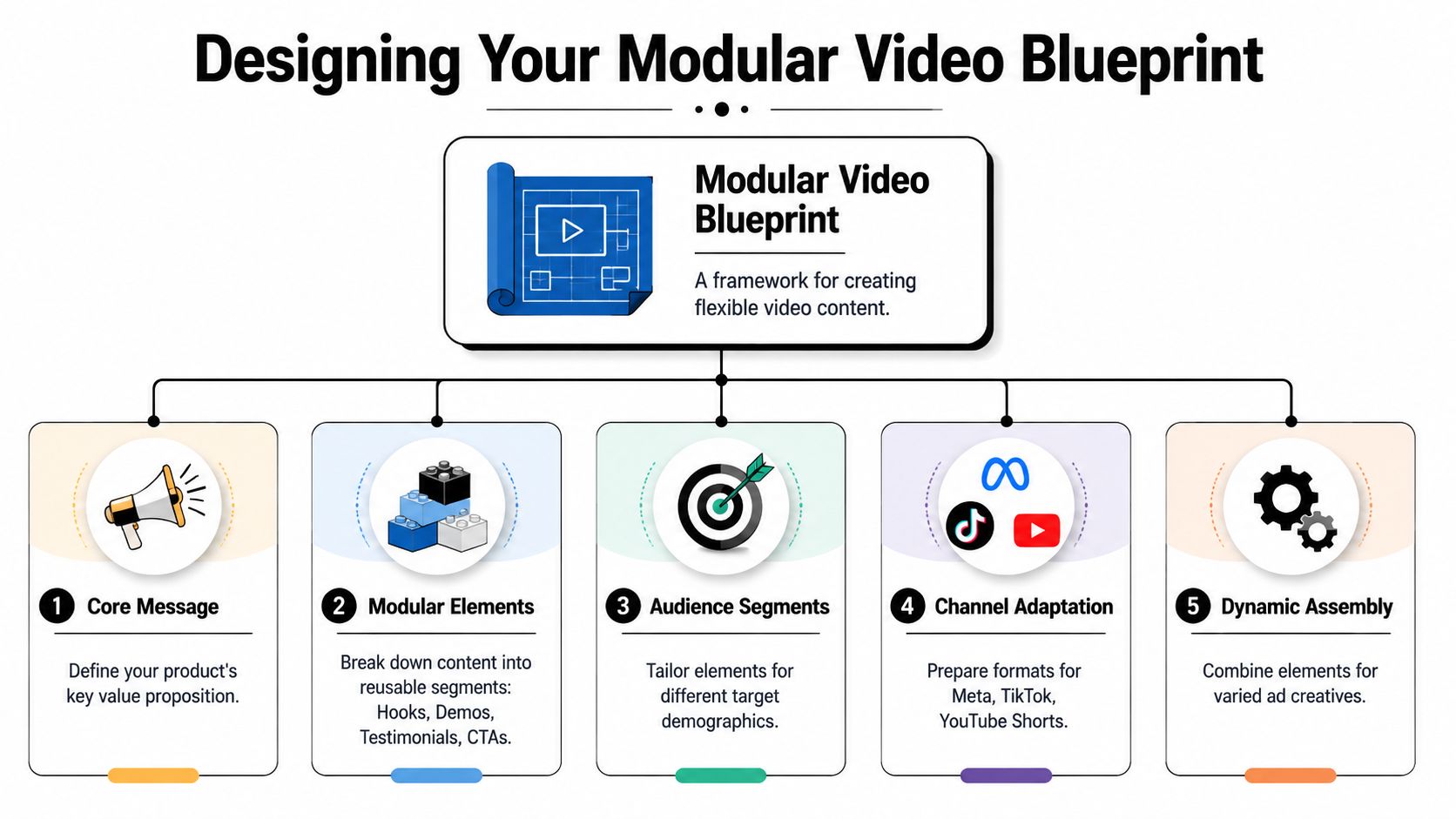
The reason this structure matters is simple. Videos on social media generate 1200% more shares than text and images combined, and the strongest setups adapt content to platform-native lengths, with 15 to 30 second hooks for TikTok and Reels and 1 to 2 minute bodies for YouTube and Facebook according to N2 Productions' product launch video guidance. If shareability is high but viewing contexts differ, your blueprint has to support multiple cuts from the same core message.
Build around modules, not scenes
Think in three layers.
Hooks are your pattern interrupts. They earn the next few seconds. These can be problem-led, outcome-led, curiosity-led, or demo-led.
Bodies carry the proof. In this section you show the product, explain the mechanism, or frame the before-and-after.
CTAs convert attention into action. They should match intent level, not just campaign goals.
A simple planning table looks like this:
| Module | What it should do | Common options |
|---|---|---|
| Hook | Stop the scroll and frame relevance | Pain point, bold claim, product-in-use, testimonial opener |
| Body | Prove the product matters | Demo, feature walkthrough, use case, founder explanation |
| CTA | Tell the viewer what to do next | Start trial, learn more, shop now, book demo |
Write a brief that supports recombination
Most creative briefs fail at scale because they describe one linear narrative. For launch testing, the brief needs separate instructions for each module.
Include:
Audience-specific problems
Don't write "target audience: founders and marketers." Write the distinct frustrations each group has and how those frustrations show up in language.Value props by priority Rank them. If everything is a key message, nothing is. Pick the top few angles you want to test.
Proof assets already available
Product UI capture, customer soundbites, creator footage, founder talking points, motion graphics, UGC-style clips.CTA by funnel stage
Cold traffic may need "see how it works." Warm retargeting can handle "start free trial" or "buy now."
Plan combinations before production
A good modular plan creates optionality before cameras roll. You don't need to film more for the sake of volume. You need to capture footage that can answer multiple questions later.
A weak launch brief asks, "What's our story?" A strong launch brief asks, "Which variables are we testing first?"
That means shooting multiple openings, multiple product-use moments, and alternative end cards. It also means planning for vertical framing, larger text, and clean cut points so editors can swap parts without rebuilding the whole timeline.
If you want a deeper framework for mapping hooks, bodies, and CTAs into reusable systems, this modular video ad framework is a practical reference.
Building a High-Velocity Production Engine
Once the blueprint is set, the next failure point is operations. Teams often understand modular strategy in theory, then fall back into a messy post-production process where files live across drives, naming conventions break down, and every new variation requires manual rebuilding.
A high-volume launch needs an assembly line.
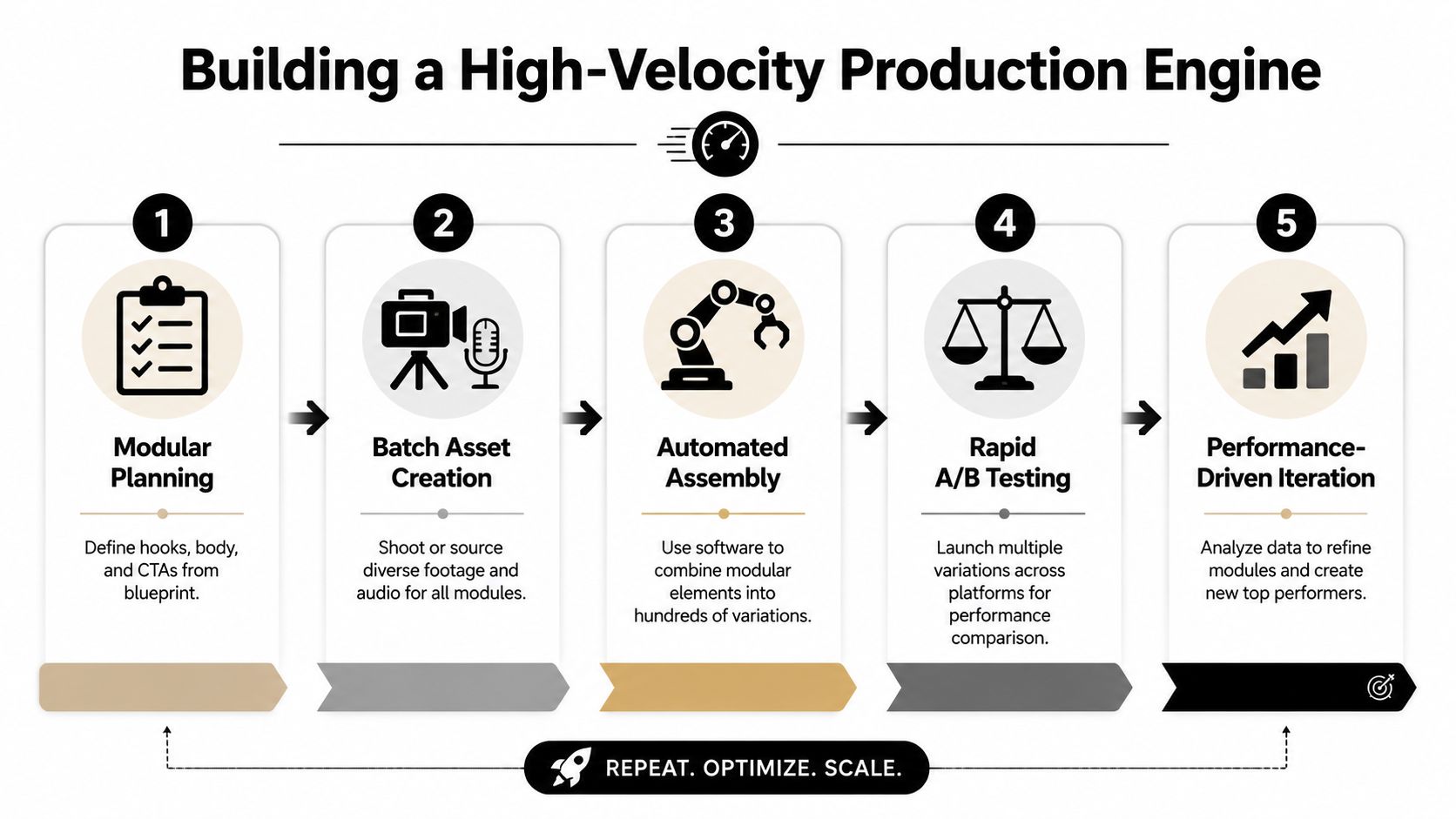
A structured approach matters because a modular workflow can boost launch success by 30%, using AI-powered asset ingestion, multivariate recombination that generates 100+ variations, and direct ad-platform integration for rapid A/B testing, based on the methodology summarized by Brainkraft.
What the production engine actually looks like
The workflow usually works best in five stages.
Asset ingestion
Bring every usable piece into one system. Raw footage, screen recordings, creator clips, voice tracks, stills, testimonials, and previous ads should all be searchable. The point is to stop hunting through folders every time a buyer asks for "that clip where the product solves the problem in the first few seconds."
Scene and transcript tagging AI improves throughput through this process. Instead of manually labeling clips, the platform detects scenes, reads transcripts, and tags footage by message, format, product angle, or visual type. That makes it possible to search for "demo," "social proof," "pricing objection," or "creator reaction" and assemble new cuts fast.
Multivariate assembly
Editors and strategists should be able to combine modules without starting over. Swap Hook A with Hook C. Pair the founder explanation with a tighter demo. Replace the CTA card for a retargeting version. This is the operational core of high-volume testing.
Batch adaptation
Every variation should be easy to resize, caption, and restyle for placement. Vertical crops, text-safe zones, burned-in captions, and alternate end cards shouldn't require separate edit projects.
Direct deployment The faster you can move from creative idea to live ad, the faster you learn. Export friction slows iteration more than is often realized.
What breaks in real teams
Production speed usually collapses in three places:
- Briefs aren't modular enough, so editors have to invent structure after the shoot.
- Assets aren't tagged clearly, so strong footage becomes effectively lost.
- Feedback isn't tied to modules, so teams keep revising full ads instead of replacing the underperforming component.
That's where a platform built for this workflow matters. In practice, teams use tools like Adobe Premiere Pro or CapCut for editing, but they need a system above the editor to manage modular assembly and testing operations. Sovran fits in that layer by auto-detecting scenes and transcripts into an asset bank, structuring clips as hooks, bodies, and CTAs, generating variations, and pushing assets into ad workflows without forcing the team to manually rebuild every version.
The trade-off most teams need to accept
You usually can't optimize for handcrafted uniqueness in every ad and still keep launch velocity high. That's fine. For performance launch work, consistency and speed often beat one-off polish.
A practical setup looks like this:
- Shoot broadly, edit narrowly in pre-launch. Capture more raw material than you think you'll need.
- Standardize overlays and captions so the team isn't redesigning each variation.
- Keep modules short and interchangeable so you can recombine them without awkward pacing.
- Separate brand campaign assets from testing assets because they serve different jobs.
The teams that launch fastest don't always film more. They organize footage so each usable moment can live in several ads.
For production leads managing multiple stakeholders, this guide to video production project management is a helpful way to think about approvals, asset structure, and handoff discipline before launch week gets messy.
Activating Your Launch on Meta and TikTok
A launch library only matters if deployment is disciplined. Most wasted spend comes from muddy test design, not from bad editing. Teams mix too many variables, let weak ads run too long, or change messaging before they've learned enough from the first round.
Start with a clean rollout structure.

Structure tests so results mean something
For Meta and TikTok, I prefer to launch with clearly separated creative hypotheses rather than one giant mixed pool. That usually means grouping ads by opening angle first, then letting body and CTA variants compete inside that angle.
A practical setup often looks like this:
- Hook test set with one shared body and CTA
- Body test set using the strongest early hook
- CTA test set only after message-market fit starts to show
- Retargeting set that uses deeper demos, objections, and testimonials
This avoids a common mistake. If every ad changes everything at once, you get winners, but you don't know why they won.
Pace the rollout by intent
Not every launch video should hit at once. Teaser cuts, problem-led cuts, product demos, and proof-heavy ads each serve different moments in the first weeks.
Use shorter ads to open demand and identify high-response hooks. Then introduce more explanatory videos once the platform has enough signal on audience response. If you need examples of TikTok-specific launch formats and how brands structure bigger rollout sequences, HiveHQ's guide to $1M+ GMV TikTok launches is a useful companion read.
A useful creative review in the middle of this process can help align the team before scaling spend:
Match the asset to the placement
Creative that works in Stories placement may need different text density and pacing than a feed asset. TikTok often rewards immediacy and native-feeling cuts. Meta placements usually need clearer framing and stronger readability across more contexts.
That means checking:
| Platform need | What to watch |
|---|---|
| Opening clarity | Does the first beat make sense without audio? |
| Text treatment | Is the message readable on a phone without clutter? |
| Product visibility | Does the product appear early enough to orient the viewer? |
| CTA fit | Does the action match user intent in that placement? |
If your team is building launch assets specifically for TikTok and adjacent vertical placements, these TikTok video ad specs are worth keeping close during export and QA.
Don't judge launch creative by whether stakeholders like the ad. Judge it by whether the platform can learn from it quickly.
Measuring What Matters and Iterating Faster
Most launch teams still overvalue ad-level winners and undervalue component-level insight. That's expensive. If Ad 7 wins, but you don't know whether it was the opening claim, the product demo, the testimonial, or the CTA card that drove the result, you can't scale learning. You can only scale spend on one ad until it fades.
The better approach is to read launch data like a parts inventory.

For performance video ads, top-quartile campaigns should target an engagement rate over 2.5%, a CTR between 1% and 3%, and a ROAS greater than 3x within the first 7 days, according to Product Leadership's product launch failure analysis. Those numbers matter less as vanity thresholds than as operating signals. They help you decide whether the creative is earning attention, moving traffic, and converting quickly enough to justify more testing.
Read the ad by layer
When reviewing results, break performance into three questions:
Did the hook earn attention?
If engagement is weak and drop-off is obvious, the opening angle probably missed. Keep the body for another test if it still has strategic value.
Did the body build conviction? If the hook gets interest but clicks stay soft, the middle section may not prove the claim well enough. Demos, testimonials, and founder explanation usually need work in this section.
Did the CTA convert intent?
If traffic quality looks decent but conversion lags, the CTA may be too aggressive, too vague, or mismatched to funnel stage.
A useful review grid looks like this:
| Signal | Likely issue | Next move |
|---|---|---|
| Strong engagement, weak CTR | Hook works, body under-explains | Test new proof section |
| Good CTR, weak return | CTA or landing mismatch | Align offer and next step |
| Weak engagement across variants | Core opening angle is off | Replace hook family |
| One element wins across multiple ads | Modular signal found | Rebuild around that component |
Bring customer language back into the loop
Performance metrics tell you what happened. They don't always tell you why. That's where qualitative inputs matter. Comments, sales-call notes, creator feedback, and support tickets often reveal the phrasing that makes a product click.
If your team needs a structured way to collect and use that language, Bulby's guide to voice of customer is a solid resource. It helps sharpen the raw language that often produces better hooks and clearer proof sections than internal brainstorming does.
Good iteration doesn't ask, "Which ad won?" It asks, "Which building block kept winning, even when everything around it changed?"
Turn reporting into new creative
The fastest teams run a closed loop:
- Tag each ad by modules used
- Review winners by repeated element
- Retire weak modules, not just weak ads
- Produce new versions around the strongest signal
That last step is where many teams stall. They find a winner, spend behind it, and stop making new variants until fatigue appears. A better rhythm is to treat every winner as a prompt for the next branch of tests. Strong problem-led opening? Make five more. Demo segment lifts clicks? Rebuild it with tighter pacing, alternate proof, and different CTA framing.
If you want a stronger process for this feedback loop, this video ad iteration strategy lays out a practical way to connect reporting with new creative production.
Your First 90-Day Launch Roadmap
A scalable video for product launch plan works best when the team treats production, testing, and iteration as one calendar, not three separate projects. The timeline below keeps that discipline intact.
Days 90 to 31
Define the launch message architecture first. Lock the audiences, objections, value props, and proof types you want to test. Build your modular brief around hooks, body sections, and CTAs rather than one linear script.
Then capture assets with recombination in mind. Shoot product footage, demos, testimonials, founder soundbites, UGC-style clips, and alternate openings. This is also where you prepare the longer body modules. Research indicates that product launch videos of 1 to 3 minutes achieve optimal conversion rates, which makes that range a strong planning reference for your core explainer sections, as noted by SkyBlue Creative.
Days 30 to 1
Edit the first testing library. Create distinct hook families, body variants, and CTA versions. Prepare placement-specific exports for Meta and TikTok, then load the assets into a naming system that makes performance review easy later.
Before launch week, pressure-test the library operationally. Check caption readability, opening clarity, product visibility, and landing-page alignment. If a variation wins attention but doesn't fit the post-click experience, it's not ready.
Days 1 to 30 and beyond
Launch with structured tests, not creative chaos. Read results by component. Keep the parts that repeatedly work. Replace the parts that don't. Then rebuild the next wave from the strongest signals rather than chasing fresh ideas that haven't earned their place.
This is the shift that changes launch outcomes. You stop asking whether the team made a great launch video. You start asking whether the team built a system that can keep finding better ones.
If your team needs a practical way to turn one launch shoot into a reusable testing pipeline, Sovran is built for that workflow. It helps performance teams organize footage into modular assets, generate variations from hooks, bodies, and CTAs, and move faster from creative idea to live test without rebuilding every ad by hand.

Manson Chen
Founder, Sovran
Related Articles

8 Pattern Interrupt Techniques for Video Ads

Customer Journey Mapping for Performance Marketing