Your Guide to Building a Modular Video Ad Framework
Jump to a section

If you've spent any time in performance marketing, you know the drill. You pour time, money, and creative energy into producing a single, polished video ad. You launch it, hold your breath, and... it flops. Now you're back to square one.
There's a better way. It's called a modular video ad framework, and it's less of a single tactic and more of a complete shift in how you think about creating ads.
What Is a Modular Video Ad Framework?
Forget about making one-off video ads. Instead, think of your creative assets as a set of digital LEGO bricks. You have different types of bricks: a pile of hooks, a stack of product demos, a collection of testimonials, and a few powerful calls-to-action (CTAs).
With a modular framework, you stop building single ads and start building a library of these reusable components. You can then snap these "bricks" together in countless combinations to rapidly build and test new ads.
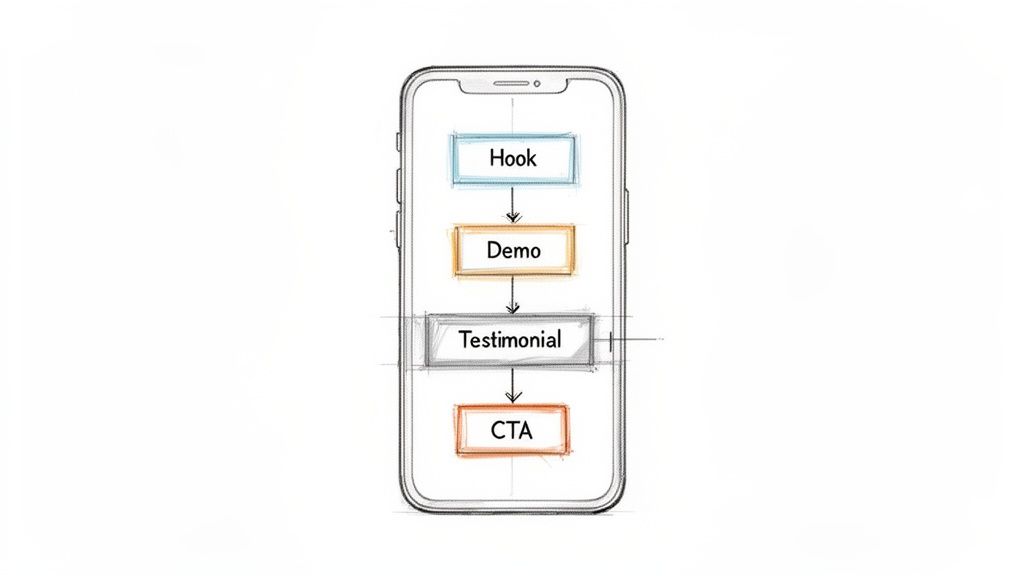
This method empowers performance marketing teams to move with the speed the market demands.
Shifting From Monolithic to Modular
The traditional ad creation process is linear and painfully slow. You come up with a concept, write a script, schedule a shoot, and send it to an editor. The final product is a single, monolithic video. If that one ad doesn't hit its numbers, the entire investment is wasted.
A modular approach breaks down that rigid workflow. It understands that different parts of your ad have different jobs. The first three seconds (the hook) need to stop the scroll. The middle (the body) has to build interest and deliver the message. The end (the CTA) must drive a specific action.
By treating these components as separate, swappable parts, you gain the power to test each one on its own. You can try a new hook without re-shooting the entire body or A/B test two different CTAs on the same core video to see what really gets your audience to click.
This lets you find the winning elements with surgical precision.
The LEGO Analogy in Action
Let’s get practical. Imagine you have a library with five different hooks, three product demos, four customer testimonials, and two distinct CTAs.
By mixing and matching these components, you can instantly assemble 120 unique ad variations. All without a single day of reshooting.
This is a game-changer for user acquisition (UA) managers and creative strategists. It gives you the volume needed to fight creative fatigue and test effectively on platforms like Meta and TikTok. The benefits are clear:
- Speed: Go from idea to dozens of test-ready ad variants in minutes, not weeks.
- Scale: Transform a handful of clips into a massive inventory of fresh ad concepts.
- Performance: Systematically find your winning components and double down on what works, fast.
To give you a clearer picture, here’s how the two approaches stack up.
Modular Vs Traditional Ad Creation at a Glance
| Attribute | Traditional Video Production | Modular Video Ad Framework |
|---|---|---|
| Creation Speed | Weeks or months for a single ad | Hours or days for dozens of variations |
| Cost | High per-video production cost | Low cost per variation after initial asset creation |
| Scalability | Very low; each new ad is a major project | Extremely high; create new ads by remixing assets |
| Testing | Difficult and expensive to A/B test concepts | Easy and efficient to test hooks, bodies, and CTAs |
| Adaptability | Slow to react to trends or performance data | Quick to adapt by swapping out components |
| Creative Fatigue | High risk; one ad gets stale quickly | Low risk; continuous stream of fresh variations |
As you can see, the modular approach isn't just a minor improvement—it’s a fundamental change designed for the realities of modern advertising.
The market data backs this up. The global video advertising market is on track to hit USD 90.88 billion by 2026, and this growth is fueled by agile methods that let marketers iterate quickly. Mobile video ads are leading the charge, holding a 67.58% market share and fitting perfectly with the short-form, component-based content that dominates social feeds. You can see a full breakdown of these video advertising trends in this market analysis.
This is exactly why platforms like Sovran exist—to accelerate this entire process. We help teams build, tag, remix, and scale their creative library, turning this powerful framework into a practical, day-to-day workflow. If you're curious, you can learn more about the features that enable modular video ads on our platform. Ultimately, this framework gives you the speed and data-driven insight you need to win in today's ad environment.
Understanding The Core Creative Components
To really get the hang of modular video ads, you first have to know what they're made of. We're not talking about complicated tech stuff, but simple, strategic pieces that each have a specific job to do in your ad. Think of it like building with LEGOs—each block is simple on its own, but you can combine them in endless ways to create something amazing.
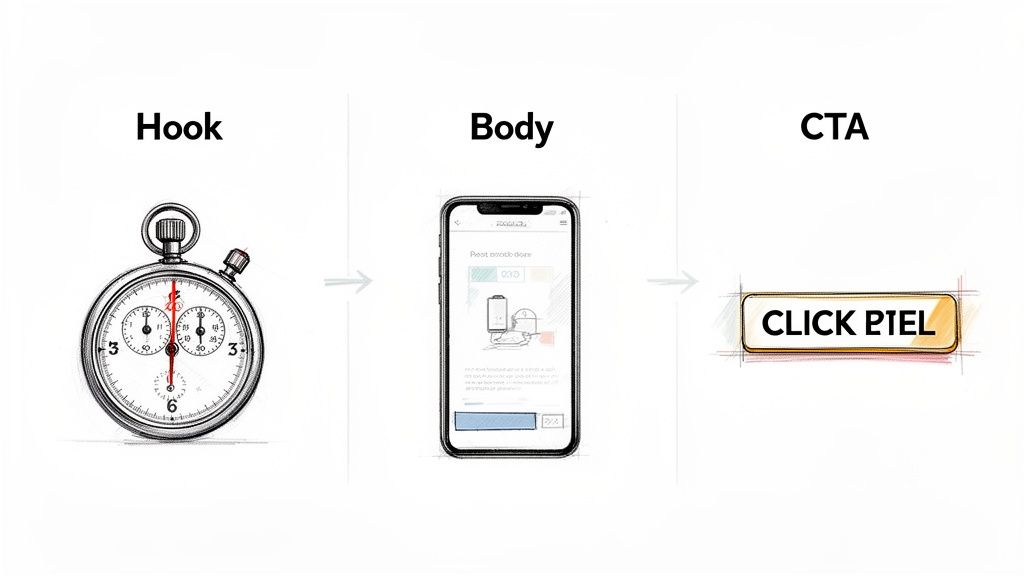
This system breaks your video down into three core parts: the Hook, the Body, and the Call-to-Action (CTA). When you start treating these as individual, swappable pieces, you unlock the ability to test, tweak, and optimize your ads with incredible speed.
The Hook: The First Three Seconds
In the fast-scrolling world of social media, the first three seconds of your ad are everything. The hook has one job and one job only: stop the scroll and grab the viewer's attention.
If your hook doesn't land, the rest of your ad—no matter how great it is—might as well be invisible. It's the bouncer at the door of your marketing message.
Good hooks are designed to spark curiosity, make a bold statement, or hit on a relatable problem. Since they're short and powerful, you can create and test a ton of them.
- UGC-Style Hooks: This is often a person talking right to the camera, maybe starting with a question like, "Did you know you could do this?" or a statement like, "Stop what you're doing and look at this."
- Problem-Focused Hooks: Here, you visually show a common frustration. Think of a messy spreadsheet or a clunky user interface on a competitor's app.
- Visual Shock Hooks: An unexpected or oddly satisfying clip works wonders. This could be a unique product unboxing or a jaw-dropping "before and after" reveal.
By treating the hook as its own modular part, you can quickly find out which opening lines or visuals give you the highest Thumbstop Ratio—a metric that's absolutely critical for ad performance.
The Body: The Core Message
Once you've hooked them, the body of the ad takes over. This is the main event where you deliver your core message, show off your value, and build real interest. The body can be anything from a quick product demo to a compelling user story. Its goal is to convince the viewer that your product is the solution they need.
And just like hooks, bodies can be categorized and swapped out to test different ways of telling your story.
The real power of a modular video ad framework emerges when you realize the body isn't a single, monolithic block. It can be further broken down into smaller scenes—a feature highlight, a customer testimonial, a benefit explanation—that can also be remixed.
Think about building a library with these common body types:
- Feature-Benefit Segments: Short clips that quickly show a product feature and immediately connect it to a direct benefit for the user.
- Storytelling Demos: A screen recording or user-shot video that walks through solving a problem with your app, creating a little story.
- Social Proof Mashups: A fast-paced montage of short testimonial clips, glowing reviews, or shout-outs from the press.
This way of thinking is a game-changer. Our guide on the Hook, Body, CTA video ad structure dives deeper into how these pieces work together to create a powerful narrative.
The CTA: The Final Push
Finally, the CTA tells the viewer exactly what to do next. A great ad can build a ton of interest, but without a clear, compelling CTA, all that energy just fizzles out. This is the final, crucial step that turns a viewer into a customer.
Your CTA needs to be direct and actionable, reinforced with on-screen text and graphics. It's also essential for accessibility and reaching more people, so efficiently generating captions for your CTA and the whole video ensures your message hits home, even with the sound off.
Examples of Modular CTA Components:
- Direct Offer: A simple end card with your app icon and text like, "Download Now for a Free Trial."
- Benefit Reinforcement: An animation that reminds them of the main benefit before asking for the click, such as, "Start Organizing Your Life. Tap to Install."
- Urgency-Driven: A final screen that adds a little pressure with a limited-time offer or a countdown timer to get them to act now.
By categorizing your existing footage and planning new shoots around these three core components—Hooks, Bodies, and CTAs—you stop making one-off ads. Instead, you start building a powerful, interconnected library of creative assets. This is the foundation of a truly scalable modular video ad framework.
How AI Puts Your Modular Ad Production on Autopilot
Think of a modular framework as the blueprint for your ads. So, what’s the engine that actually builds them at scale? That's where Artificial Intelligence comes in. AI takes over the most time-sucking parts of video production, transforming your workflow from a slow, manual grind into an automated creative factory. This is what bridges the gap between a great idea and actually getting it live.
It's not just about a little efficiency boost—it changes the entire game for your workflow. Platforms built on a modular video ad framework use AI to handle the tedious tasks that creative teams hate. This frees up your strategists to think about the big picture, not get stuck in the weeds.
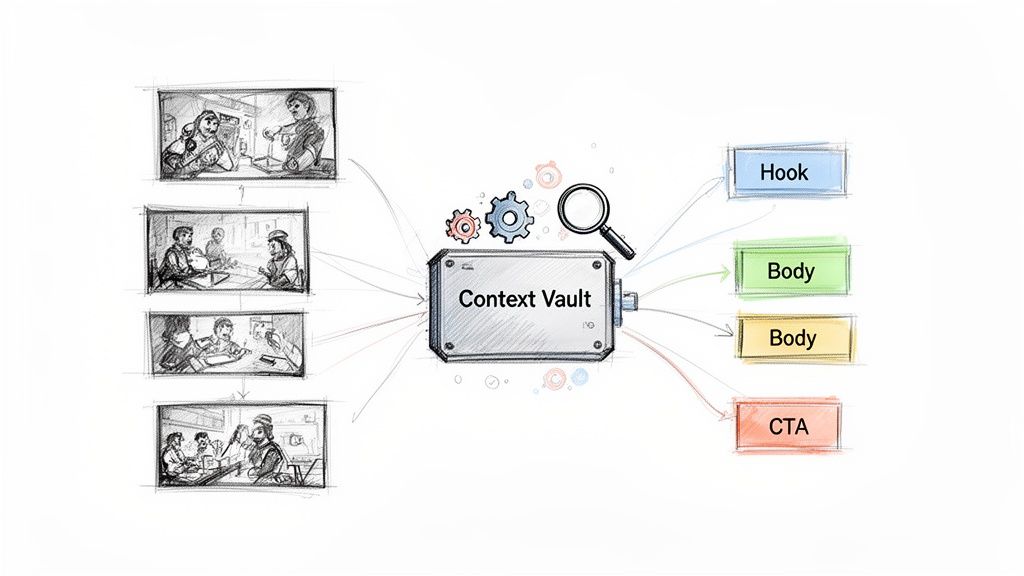
The diagram above shows you exactly how a modern AI workflow operates. It takes all your raw inputs and systematically cranks out the building blocks you need for an endless supply of ad variations. This is where the true power of a modular system really kicks in.
From Raw Clips to Smart Assets
Imagine dropping a folder of raw video—talking heads, screen recordings, B-roll, you name it—and having an AI system instantly watch, analyze, and tag every single clip. This is one of the most powerful ways AI is changing ad production today.
Instead of a human editor spending hours scrubbing through footage, an AI can do this kind of work in a flash:
- Component Tagging: It identifies and categorizes clips as potential Hooks, Bodies, or CTAs based on what's happening in them.
- Scene Detection: It intelligently chops up longer videos into bite-sized, usable scenes that can stand alone as modular components.
- Content Analysis: It transcribes all the speech and identifies key themes, objects, and actions, making everything completely searchable.
This automated tagging turns a messy media library into a structured, intelligent database. Suddenly, finding "a 5-second clip of a user smiling while using the app" is as easy as typing a search query.
The Power of a Context Vault
One of the biggest headaches for creative teams is keeping every ad variation on-brand and on-message. This is where an AI-powered Context Vault becomes your best friend. Think of it as the central brain for your entire brand advertising strategy.
A Context Vault is where you store all your mission-critical marketing info—brand guidelines, winning ad copy, customer personas, and even competitor intel. The AI then uses this vault to guide every creative decision, from dreaming up new ad angles to writing on-brand text overlays.
This is how you ensure consistency, even when you're producing hundreds of ads. When the AI assembles a new video, it’s not just mashing clips together. It checks back with the Context Vault to make sure the final ad reflects your proven messaging and brand voice, which massively increases its chances of working.
For any team juggling multiple campaigns, an AI's ability to generate winning concepts is a huge leg up. If you want to go deeper on this, our guide on using AI for video ads is a great resource for building a brand-aware creative engine.
Generating Variations in Minutes, Not Days
The final piece of the puzzle is creating all those ad variations in bulk. Once your assets are tagged and your Context Vault is ready to go, AI can spit out hundreds of test-ready ad variations in the time it takes to grab a coffee. A human editor would need days, maybe even weeks, to do the same.
Here’s what that process looks like:
- Remixing Components: The AI systematically combines different Hooks, Bodies, and CTAs, often following proven advertising formulas like Problem-Agitate-Solution.
- Applying Overlays: It automatically slaps on brand-approved text overlays, subtitles, and background music for each version.
- Rendering at Scale: It renders out all these unique videos into final files, complete with smart naming conventions that make them easy to find and track in your ad platform.
To get the most out of your ad production, you have to use the right tools. It's worth exploring some of the best AI video creation tool options to see how different platforms tackle this.
The financial impact here is massive. The market for AI-powered video advertising is on track to hit USD 9.1 billion by 2026, which will be 12% of all digital video ad spend. This huge shift shows just how critical AI has become to staying competitive. Platforms like Sovran are leading the charge, making this a practical reality for performance-driven teams.
By letting AI do the heavy lifting, you unlock a level of testing speed that was simply impossible before.
Alright, theory is one thing, but results are what keep the lights on. Let's get practical and talk about the modular frameworks that are actually working right now on platforms like Meta and TikTok.
Think of these not as strict rules, but as proven storytelling recipes. Instead of staring at a blank canvas, you can grab one of these structures, plug in your creative components, and have a solid foundation for your next ad.
The Classic Problem Agitate Solution Framework
The Problem-Agitate-Solution (PAS) framework is a direct-response legend for a single reason: it flat-out works. It’s a masterclass in tapping into a viewer's pain point and positioning your product as the only logical answer. This is your go-to for anything that solves a clear, nagging problem.
Here’s how you assemble a PAS ad using your modular components:
- Hook (The Problem): Kick things off by showing the problem in a way that feels real and relatable. Think a quick UGC-style clip of someone groaning in frustration, a screen recording of a competitor’s confusing app, or even a visual metaphor for the pain they're feeling.
- Body (The Agitation): Don't rush to the solution just yet. This is where you twist the knife a little. Use fast cuts to show the consequences of the problem—wasted time, mounting frustration, missed deadlines. You’re building tension that makes the viewer desperate for a fix.
- CTA (The Solution): Now, your product swoops in as the hero. This part should feel like a satisfying release of all that tension. A clean, quick demo showing your product making the problem disappear, followed by a direct call-to-action like, "Stop Struggling. Download Now."
This structure creates a powerful little emotional journey that grabs viewers and makes them ready to act.
The UGC Testimonial Mashup
Social proof is pure gold in advertising. The UGC (User-Generated Content) Testimonial Mashup lets your biggest fans do the selling for you, building instant trust and authenticity that you just can't fake.
The recipe is straightforward but incredibly powerful:
- Hook: Open with your most impactful user quote. Something that stops the scroll, like, "I was skeptical, but this app actually works," or, "I can't believe I didn't find this sooner."
- Body: Hit them with a fast-paced montage of different customers sharing their love for the product. Mix short video soundbites with on-screen text reviews and reaction shots. The goal is to create a wave of positive feedback from real people.
- CTA: Wrap it up with a confident CTA that invites the viewer to join the movement. Try something like, "See What Everyone Is Talking About. Get the App."
This framework is a killer for building brand credibility and works especially well in retargeting campaigns.
The 'Top 3 Reasons Why' Listicle
People love lists. They’re structured, digestible, and promise a clear payoff. The listicle format turns your ad from a hard sell into what feels like helpful, valuable information.
By framing your ad as a "Top 3" or "5 Reasons Why," you set a clear expectation for the viewer. This structure keeps them engaged because their brain naturally wants to see the list through to the end.
Here’s the breakdown:
- Hook: Announce the listicle right away. For example, "Here are the top 3 reasons our app will save you 5 hours this week."
- Body: Dedicate a separate modular scene to each reason. Use big, bold text overlays ("Reason #1") and quick visuals to demonstrate each point. Keep it short, punchy, and focused on the benefit.
- CTA: After you’ve delivered the final point, pivot straight to a CTA that summarizes the core value. Something like, "Ready to Save Time? Download Now."
This is one of the most flexible frameworks out there. It makes it super easy to test which features or benefits connect most with your audience. For even more ways to structure your ads, you can explore our full library of proven video ad templates designed specifically for modular creation.
Now, let's put these ideas into a quick-reference table you can use to brainstorm your next ad.
High-Impact Modular Ad Framework Templates
This table shows how you can mix and match modular components to create ads based on proven advertising formulas.
| Framework Name | Hook Idea | Body Idea | CTA Idea |
|---|---|---|---|
| Problem-Agitate-Solution | UGC clip of a user struggling with a common task. | Quick cuts showing the negative outcomes of the problem (e.g., wasted money, frustration). | A screen recording of your app solving the problem instantly. |
| UGC Testimonial Mashup | A powerful on-screen quote: "This changed everything for me." | A fast-paced montage of 3-5 different users giving positive soundbites. | A confident message like "Join thousands of happy users." |
| 'Top 3 Reasons Why' | Bold text overlay: "3 Reasons You Need to Try This." | A separate scene for each reason, using text callouts and quick demos. | A summary of the main benefit, e.g., "Start saving time today." |
| Before & After | A split-screen showing a clear "before" state (e.g., messy desk). | A short clip showing the product in action. | A split-screen showing the dramatic "after" state (e.g., organized desk). |
These templates are just starting points. The real magic happens when you use a modular approach to test different hooks, body segments, and CTAs to see what truly drives performance for your brand.
How to Measure and Test for Maximum Performance
So, you've used a modular framework to crank out hundreds of ad variations. Great. But that's only half the job. Without a smart, data-driven testing plan, all you have is a lot of creative noise. Now comes the fun part: turning that raw output into real performance gains.
This is where you build a feedback loop that makes every ad dollar you spend smarter than the last. The secret is structuring your campaigns to isolate variables. On platforms like Meta and TikTok, this means setting up tests where you know for a fact whether a specific hook, body, or CTA was the reason for your results.
Structuring Campaigns for Clear Results
If you want clean data, you absolutely cannot test too many things at once. A classic mistake is launching a campaign with a dozen completely different ads. It's impossible to know why one ad won. Was it the hook, the testimonial, or the offer at the end? Who knows.
Instead, you need a more methodical approach.
- Hook Testing: Run a campaign where the body and CTA are identical across all your ads. The only thing that changes is the first three seconds. This is the cleanest way to see which opener actually stops the scroll.
- Body Testing: Once you have a winning hook, lock it in. Now, use it consistently while you test different body segments. You can pit a product demo against a UGC mashup to see which story drives more engagement.
- CTA Testing: Finally, with your winning hook and body combo, it's time to test your call-to-action. See if a direct "Download Now" performs better than a benefit-focused "Start Saving Time."
This disciplined structure is the only way to get clear, actionable results from your tests.
When you isolate each component, you stop just looking for winning ads and start identifying winning ingredients. That knowledge is way more valuable because it informs every single creative you make from now on.
The chart below shows exactly how this cycle of generating, testing, and analyzing your modular ads works.
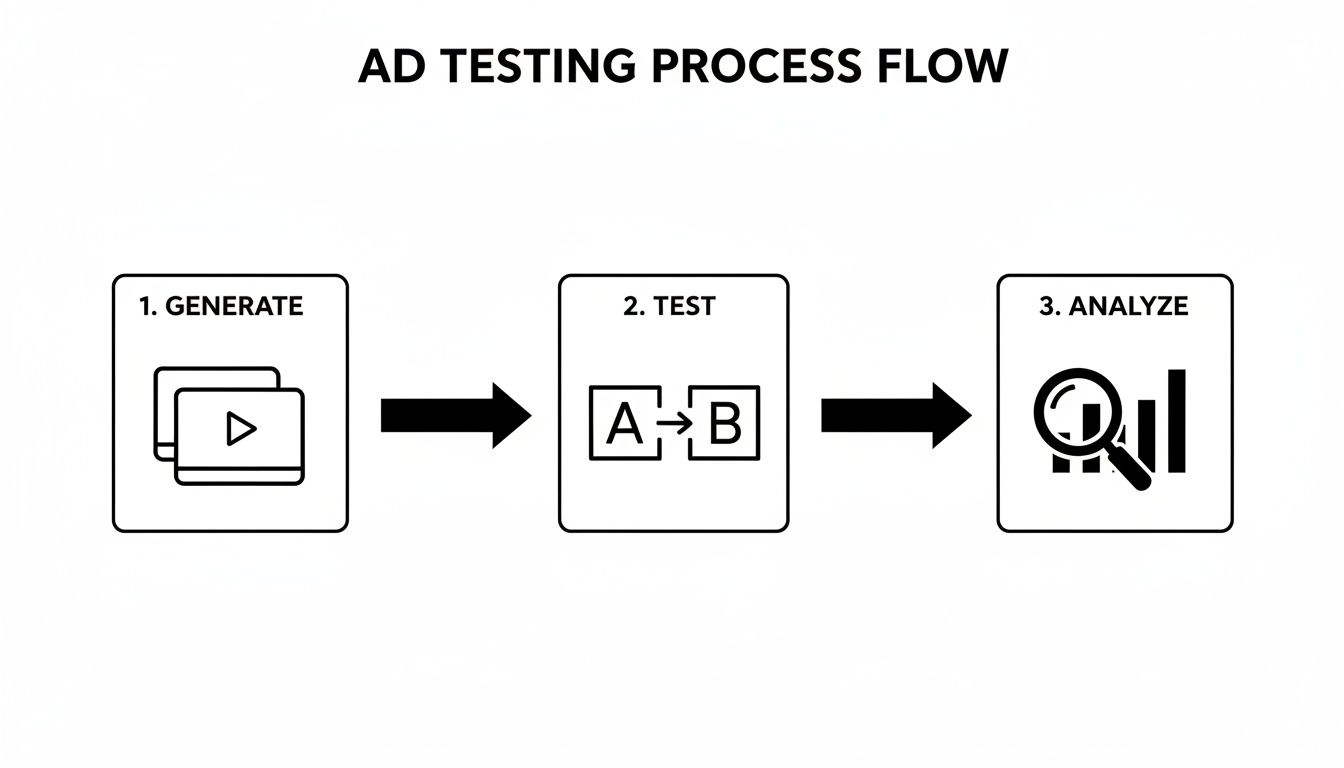
This simple generate-test-analyze loop is the engine that powers a great modular ad strategy. It’s what turns creative volume into a repeatable system for growth.
Metrics That Matter for Each Component
Not all metrics are created equal, and you have to match the right key performance indicator (KPI) to the job of each ad component. Tying performance back to the specific job of each part is how you get real clarity.
Core Metrics for Modular Testing:
| Ad Component | Primary Metric | What It Tells You |
|---|---|---|
| Hook | Hook Rate or Thumbstop Ratio | The percentage of people who watch past the first 3 seconds. A high rate means your opener is successfully stopping the scroll. |
| Body | Watch-Through Rate (WTR) | The percentage of viewers who watch most or all of your video after the hook. Strong WTR means your core message is engaging. |
| CTA | Click-Through Rate (CTR) | The percentage of viewers who click your ad. A high CTR tells you that your final prompt is compelling and drives action. |
| Overall Ad | Cost Per Acquisition (CPA) | The ultimate measure of efficiency. This tells you how much you're paying to acquire a new customer or lead. |
Analyzing these specific metrics gives you a much richer picture of what’s happening. For instance, a low Hook Rate is an immediate red flag that you need to work on your openers, even if the rest of the ad is solid.
This approach gets even more powerful with AI. For user acquisition managers, using AI in short-form videos has been shown to drive 2.7x more engagement. Platforms can now automate creating new variants to fight creative fatigue and find profitable winners up to 10x faster through data-driven remixing. As you can discover in these video marketing statistics, this kind of automation is quickly becoming a must-have.
At the end of the day, a modular video ad framework isn’t just about making more ads. It’s about building a system for learning. It lets you iterate faster, adapt to performance data, and consistently produce creative that doesn't just look good, but actually converts.
Alright, let's bring this all together. A great philosophy is only as good as your ability to actually put it into practice. This is your roadmap for building a modular video ad framework from the ground up, turning your jumbled mess of creative assets into a machine for producing high-velocity ads.
The first move is to centralize your creative. Gather up every video asset you have—old ads, raw B-roll, screen recordings, UGC, you name it—and get it all into a single, organized library.
This is where a platform like Sovran really shines. Its AI automates the most mind-numbing part of this process: tagging. The system scans every clip, figures out its potential role in an ad, and automatically tags it as a hook, body, or CTA.
Suddenly, that chaotic folder of random clips becomes a searchable goldmine. No more scrubbing through hours of footage to find that one perfect 5-second clip you know is somewhere.
Step 1: Infuse Your Brand Intelligence
With your assets neatly organized and tagged, it's time to inject your strategic brain into the system. This is where a Context Vault becomes your single source of truth. Think of it as the central repository for your brand’s DNA, holding everything the AI needs to create on-brand, high-performing ads.
You'll want to populate your Context Vault with all the critical info:
- Brand Guidelines: Your specific fonts, color codes, logo rules, and tone of voice.
- Winning Angles: Proven ad copy, compelling stats, and scripts from past winners.
- Customer Insights: Snippets from positive reviews, customer testimonials, and key pain points you know resonate.
Doing this ensures that every ad variation generated isn't just a random remix. Instead, each one is a strategically informed concept built on what you already know works.
Step 2: Assemble and Render in Bulk
Now, the real speed begins. Forget about painstakingly editing videos one by one. You can start building concepts just by mixing and matching your modular blocks. Want to create a classic Problem-Agitate-Solution ad? Just combine a problem-focused hook, a product demo body, and a direct-response CTA.
Once you have a few concept recipes you like, you can use bulk rendering to spin up hundreds of testable variations in a matter of minutes. The AI can systematically swap out different hooks, apply new text overlays, and even try out different background music across all your chosen frameworks.
This process completely replaces the hours you’d normally spend hunched over editing software. It’s exactly how you generate the sheer volume of creative needed to test effectively on platforms like Meta and TikTok. To get a deeper look at this process, check out our guide on building a modular sequence for your campaigns.
Step 3: Launch and Learn with Clean Data
The final step is getting your finished ads live on the ad platforms. A crucial piece of a solid modular workflow is maintaining clean data from the very beginning. A modern system will handle this for you with automated naming conventions for every single video it renders.
For instance, a file name might look like UGC_Hook_03-Demo_Body_01-Benefit_CTA_02. This kind of clear, consistent naming makes it incredibly easy to see what's happening inside your ad manager.
You’ll know at a glance which specific components are driving your results. This allows you to double down on what's working and kill what isn't, creating a powerful feedback loop that makes every new ad you create smarter than the last.
Frequently Asked Questions
Whenever we talk about switching to a modular workflow, a few practical questions always pop up. Let's tackle the most common ones head-on so you can start building your own framework with confidence.
How Many Video Clips Do I Need to Start?
You don't need a massive library to get going. In fact, starting small is usually the smarter move because it keeps your testing laser-focused.
You can kick things off with just 2-3 strong hooks, 2-3 different body segments, and 2 unique CTAs. This simple setup already gives you between 12 and 18 distinct ad variations to test. The real magic happens when you start building your library with each shoot, tagging every clip so it's easy to find and reuse later.
Will My Ads Look Repetitive If I Reuse Clips?
That's a super common worry, but the short answer is no—not if you're smart about it. The entire point of a modular framework is how you recombine the pieces.
While individual clips get reused, you can create a final ad that feels completely fresh by combining them with different hooks, music, and text overlays. This is the secret to fighting creative fatigue without an endless budget for new footage.
Is This Framework Only for Big Teams with Large Budgets?
Absolutely not. If anything, a modular video ad framework is a game-changer for smaller teams, startups, and even solo advertisers. It's all about getting the maximum value out of every single video asset you produce.
Instead of shelling out for a new, expensive shoot for every campaign, you can remix your existing content into dozens of high-quality ads. This gives you a level of testing speed and creative output that, until now, was really only possible for big companies with huge budgets.
Ready to stop the creative grind and start scaling your performance? Sovran is the AI-powered platform that automates your entire modular ad workflow. Start your 7-day free trial today and discover how to build more, test faster, and find your next winning ad.

Manson Chen
Founder, Sovran
Related Articles

8 Pattern Interrupt Techniques for Video Ads

Customer Journey Mapping for Performance Marketing