Unlocking Performance with AI Video Ads
Discover how AI video ads unlock creative scaling on Meta & TikTok. Our guide covers AI tools, ad frameworks, and testing strategies to drive better results.
Jump to a section
For performance marketers, the term AI video ads probably sounds like another buzzword. But it’s actually a pretty straightforward solution to a problem we all know too well: creative fatigue.
At its core, it’s about using artificial intelligence to automate the grunt work of making video ads, so you can scale production like never before. Instead of being a slow, manual chore, creating ads becomes a fast, data-driven engine that lets you pump out and test tons of variations in a flash.
The New Era of Performance Creative
If you're in performance marketing, you know the grind. The demand for fresh, engaging video ads for platforms like Meta and TikTok is non-stop. Your audience gets bored fast, and the traditional, manual way of creating videos just can't keep up.
This is a massive bottleneck for growth. Every new idea involves a ton of manual labor—finding clips, editing timelines, adding text, and exporting version after version. The whole thing is slow, linear, and expensive. It severely limits how many ideas you can actually get out into the market to test, which means campaigns go stale and performance tanks as people see the same ads over and over.
Shifting from Manual Labor to Smart Production
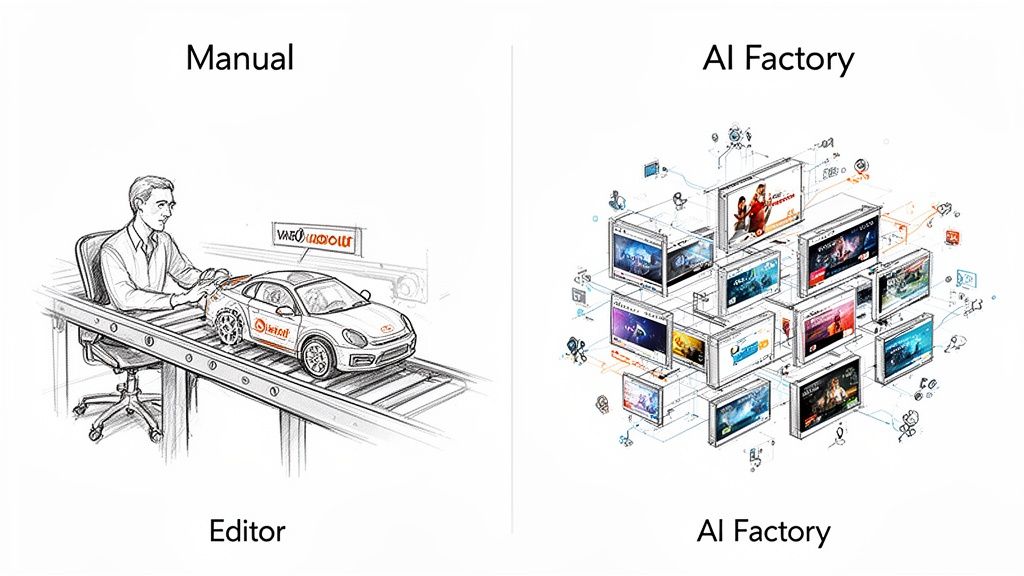
This is where AI video ads completely change the game. Instead of treating each ad like a handcrafted art project, AI turns it into a scalable manufacturing process. Think about it this way: traditional video editing is like building a single car by hand. It works, but it’s painfully slow.
An AI-powered platform like Sovran, on the other hand, is more like a modern smart factory. It doesn't just build one car. It takes a library of pre-approved, interchangeable parts—your video clips, headlines, and calls to action—and assembles hundreds of unique variations all at once. This modular approach is a total game-changer for creative production.
The real power of AI is moving from a one-to-one creation model to a one-to-many generation model. This isn’t just about making things faster; it’s about finally being able to test creative ideas at a scale that was impossible before.
The Impact of AI on Creative Strategy
This new way of working has a huge impact on how marketing teams function. By automating the repetitive, soul-crushing tasks of editing and versioning, AI frees up your team to think bigger. Instead of being buried in production weeds, they can spend their time where it matters: analyzing performance data, spotting winning trends, and coming up with new creative angles.
Ultimately, bringing AI into your video ad workflow gives you a few major advantages:
Massive Scale: Generate hundreds of ad variations from a single batch of assets. This lets you properly test different hooks, body sections, and CTAs to see what really works.
Unprecedented Speed: Cut down production time from days or weeks to just minutes. You can jump on trends and react to campaign data almost instantly.
Data-Driven Iteration: Systematically test every part of your creative to learn what your audience actually responds to, then feed those insights right back into your next round of ads.
By embracing AI, you’re not just getting a new tool. You’re adopting a completely new operating system for performance creative—one that’s built for the speed, scale, and data-driven world we advertise in today.
How AI Actually Creates Video Ads
To really get the power of ai video ads, you have to look under the hood. This isn't about some magic "create ad" button. It’s a smart system that breaks down your creative assets into intelligent, reusable pieces, making it possible to assemble and test ads at a ridiculous speed.
Think about your video library. Right now, it's probably like a giant, messy pile of LEGO bricks with no instructions. Finding that one perfect piece you need is a slow, frustrating nightmare. AI is like having an expert builder who sorts every single brick by color, size, and shape, so you can build whatever you want, whenever you want.
This whole process kicks off the second you upload your raw footage. The AI doesn’t just store your files—it actually watches them.
How AI Sees and Tags Your Content
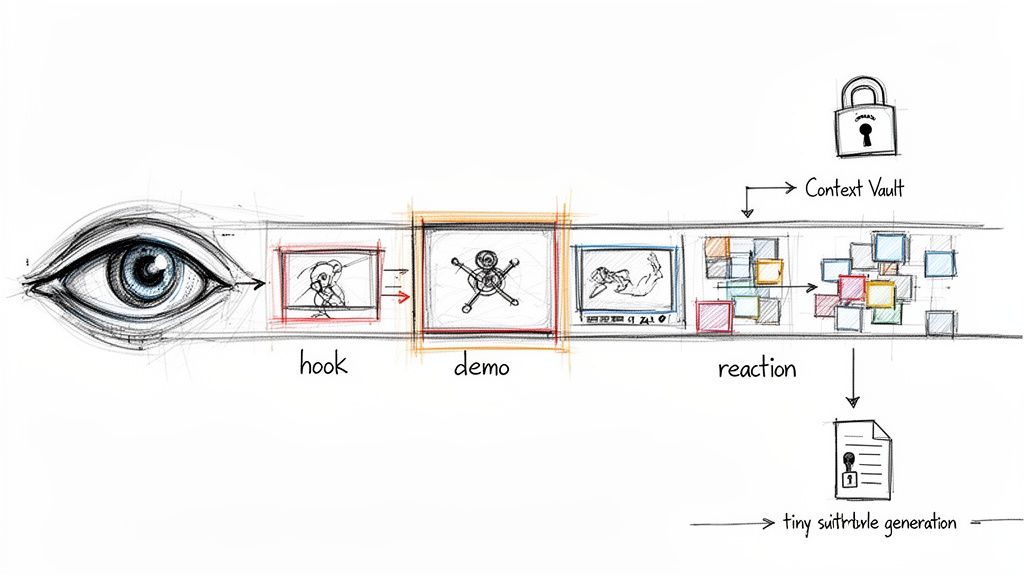
At the core of this is computer vision, a field of AI that basically teaches computers to see and understand the world like a human does. When you upload a UGC clip, the AI gets to work, analyzing it frame by frame to pinpoint the most important moments.
It automatically tags scenes based on their job inside an ad. For example, it can instantly spot things like:
Hooks: Someone unboxing a product with a genuinely excited face.
Product Demos: A crystal-clear shot of a key feature being used.
User Reactions: A smile, a nod of approval, or a "wow" moment after trying the product.
Calls to Action (CTAs): A person pointing right where a "shop now" button would be.
Every single tagged clip becomes a modular building block in your asset library. Instead of scrubbing through hours of footage just to find one perfect shot, you can search for "positive user reaction" and instantly see every clip that fits. This turns your content library from a dusty old archive into a smart, active database that's ready to go.
The Brain Behind the Brand Voice
But visuals are only half the story. The message is just as important, and that's where Natural Language Processing (NLP) steps in. NLP is the tech that lets computers understand and generate human language. It's the engine driving automated scriptwriting, headline ideas, and even those dynamic subtitles you see everywhere.
More importantly, it keeps every ad consistent and on-brand. A platform like Sovran uses a feature called the ‘Context Vault’ to act as your brand’s brain. You feed it all the critical info, like:
Brand Guidelines: Your official tone of voice, words to avoid, and specific phrases you always use.
Customer Testimonials: Text-based reviews and quotes that can be slapped onto the screen as text overlays.
Proven Ad Copy: Your winning headlines and scripts that the AI can learn from and riff on.
By feeding the AI your specific brand rules and winning messages, you ensure that every AI-generated concept feels authentic and aligned with your strategy, not generic or robotic.
This marriage of computer vision and NLP is what makes creating ads at scale a real possibility. At its heart, AI for video creation is changing the game by automating the grunt work and freeing up creatives to focus on strategy.
Bringing It All Together for Rapid Creation
With your footage intelligently tagged and your brand's brain fully loaded, the AI can now act like a creative strategist. It can assemble countless ad variations by mixing and matching the best modular pieces based on ad frameworks that are proven to work.
For example, you could tell it to whip up 50 variations of a Problem-Agitate-Solution ad. The AI would dive into your tagged clips, pull out relevant problem-focused hooks, match them with product demos, and cap them off with strong CTA shots. It would then overlay text pulled straight from your Context Vault, making sure every single ad is unique but perfectly on-brand.
If you want to go deeper on this, check out our guide on AI-powered video creation. It really demystifies the tech and shows how it turns a pile of raw assets into a high-velocity ad production engine.
Actionable Frameworks for High-Converting Ads
Knowing the tech is one thing, but actually making ads that convert? That’s the real game. To win on fast-paced platforms like Meta and TikTok, you can't just throw random clips together and hope for the best. You need a blueprint.
That’s where battle-tested advertising frameworks come in. Think of them as storytelling formulas designed to grab attention, build genuine interest, and push people to act. They give your ai video ads a reliable structure, making sure every single second serves a purpose. Best of all, they’re perfectly built for a modular, AI-powered workflow.
The Power of Modular Ad Construction
Instead of creating one-off videos, start thinking of your ads as systems built from interchangeable parts. Each piece—the hook, the body, and the call to action—can be swapped out, tested, and remixed. An AI platform like Sovran is built for this modular approach, letting you assemble and rearrange these components at lightning speed.
This shift in mindset is already happening. A whopping 51% of video marketers are now using AI tools for creation or editing. The trend is even more pronounced for businesses, where 41% use AI to produce videos—that’s a massive 128% jump from just 18% in 2023. And it's paying off. Businesses are seeing an 82% boost in ROI and a 40% lift in conversion rates from AI-generated product demos. You can find more details in these video marketing statistics on SellersCommerce.com.
Let's break down a few of the most effective frameworks you can plug into your strategy today.
The Problem-Agitate-Solution (PAS) Framework
PAS is a classic for a reason: it taps directly into your audience's pain points. It's an absolute killer for products or services that solve a clear, nagging problem.
Here’s how it works:
Problem: Kick things off by showing the problem your customer is dealing with. A relatable UGC clip or a simple visual that instantly signals "I've been there" works perfectly. Think: a shot of someone wrestling with a mess of tangled cables.
Agitate: Don't just point out the problem—twist the knife a little. Show the frustration, the wasted time, the annoyance. A simple text overlay like, "Desk setup ruined by cord chaos... again?" does the trick.
Solution: Now, bring in your product as the hero. A clean, satisfying shot of your product in action instantly resolves the tension. Show that organized desk and the feeling of sweet, sweet relief.
Using AI, you could test 10 different "Problem" hooks against 5 different "Solution" shots, instantly generating 50 unique ad variations to find the combination that hits the hardest.
The Hook-Body-CTA Framework
This is the bread and butter for most direct-response video ads, especially on TikTok and Instagram Reels. Its simplicity is its strength, making it incredibly easy to test and iterate.
Hook (First 3 Seconds): This is make-or-break. Your only job here is to stop the scroll. Use a visually jarring clip, ask a provocative question with a text overlay, or show a surprising "whoa" moment.
Body (4-10 Seconds): You've got their attention. Now deliver your core message. This is where you can show off key features, explain the benefits, or flash some social proof like customer testimonials.
CTA (Last 2-3 Seconds): Tell them exactly what to do next. A clear, action-oriented clip paired with a bold text overlay like "Shop Now" or "Download for Free" is non-negotiable.
A platform like Sovran is built for this. It can tag hundreds of clips as "Hooks," "Demos," or "CTAs," then programmatically stitch them into thousands of complete ads. This unlocks true high-velocity testing that would be impossible to do manually.
UGC Testimonial Mashups
On social media, authenticity is currency. Nothing builds trust faster than seeing real people geeking out over your product. A testimonial mashup takes your best user-generated content and turns it into a social proof machine.
The structure is a rapid-fire sequence of short, punchy clips:
Start with a bold claim: Hit them with a powerful text overlay like, "This literally changed my routine."
Show, don't just tell: Rapidly cut between different happy customers using the product. The more diverse, the better.
Reinforce with text: Overlay key phrases from their reviews directly onto the footage to drive the message home.
End with a clear CTA: Encourage viewers to get the same amazing results for themselves.
Sovran’s Context Vault is perfect for this. You can dump all your best text reviews into it and tell the AI to automatically create text overlays, pairing them with the right UGC clips from your library. This turns a tedious editing job into an automated workflow, letting you spin up dozens of trust-building ai video ads in minutes.
Diving into these modular frameworks is the key to unlocking scalable creative performance. Instead of guessing what might work, you can build a system that constantly tests and learns.
Here’s a quick breakdown of how these frameworks stack up and where an AI tool like Sovran can dramatically speed up your workflow.
Modular Ad Frameworks for Meta & TikTok
Framework | Structure (Hook-Body-CTA) | Best For | AI Application (Sovran) |
|---|---|---|---|
Problem-Agitate-Solution (PAS) | Hook: Show the pain point. | Products that solve a clear, relatable problem. Think gadgets, skincare, or organizational tools. | Automatically test dozens of "Problem" hooks against different "Solution" clips to find the most resonant emotional trigger. |
Hook-Body-CTA | Hook: Scroll-stopping visual/question. | General direct-response ads for e-commerce, apps, and lead generation. It's the universal standard. | Programmatically assemble thousands of ad variations by combining tagged assets from a "Hook," "Body," and "CTA" library. |
UGC Testimonial Mashup | Hook: A powerful quote/review. | Building trust and social proof for any product, especially in crowded markets like beauty, wellness, and fashion. | Instantly generate text overlays from a database of customer reviews and pair them with corresponding UGC clips from the asset library. |
By adopting these frameworks, you're not just making ads; you're building a creative engine that can consistently produce high-performing content at scale. This systematic approach is what separates the brands that struggle with creative fatigue from those that dominate their feeds.
Implementing a Scalable AI-Powered Testing Strategy
Making ads with AI is only half the job. The real unlock is building a systematic, high-velocity testing strategy that just wasn't possible before. This is where you graduate from simply making ads faster to actually learning faster, finding what works, and scaling your campaigns with cold, hard data.
An AI-powered testing strategy isn't about just throwing more spaghetti at the wall. It’s about creating a structured learning agenda where you isolate key variables, then let AI spin up all the variations you need to get crystal-clear insights. This disciplined approach finally turns creative into a science.
Isolating Variables for Clearer Insights
The golden rule of effective creative testing has always been to change only one thing at a time. Do that, and when you see a performance lift, you know exactly what caused it. A modular ad structure is perfect for this.
You can build entire tests around specific parts of your ad:
Hook Testing: Test five different opening clips against the same body and call to action. This quickly tells you which visuals or opening lines are best at stopping the scroll.
Value Proposition Testing: Keep the visuals identical but test three different headlines or text overlays in the body. This isolates which benefit truly clicks with your audience.
CTA Testing: Use the same hook and body but swap out different closing clips or button text. Does "Shop Now" outperform "Learn More"? Now you'll know for sure.
Trying to create all these versions manually would be a complete nightmare for any creative team. But an AI platform like Sovran uses features like Bulk Video Renders to turn this into a simple, automated process. You just set the rules, and the AI generates hundreds of testable ad variations in minutes.
The rapid adoption of this approach speaks for itself. Ad buyers are jumping on generative AI, with projections showing 30% of all digital video ads in 2025 will be built or touched by AI. That number is expected to hit 39% by 2026. Smaller and mid-sized brands are actually leading the way, expecting AI to build up to 45% of their video ads by 2026. You can find more data on the rise of generative AI in advertising on MarketingDive.com.
The Importance of Automated Naming Conventions
A mountain of ad variations is totally useless if you can't track what’s what. Clean data is everything. Without it, your Meta Ads Manager becomes a chaotic mess, and trying to analyze performance is a lost cause.
This is why automated naming conventions are so critical. A smart AI platform will automatically name each video based on the components used to build it.
For instance, a file name might look like this:
Hook04_Body02_CTA01_FemaleVO_EDMTrack
That simple string tells you everything you need to know at a glance. When you upload hundreds of these variations, your reports are instantly organized. You can easily filter your results to see if Hook04 is crushing Hook02 across all the other combinations.
An automated naming convention isn't just a "nice-to-have." It's the operational backbone of a scalable testing strategy. It ensures every dollar you spend generates clean, usable data to fuel your next creative sprint.
This flowchart shows how the modular ad framework comes together for testing.
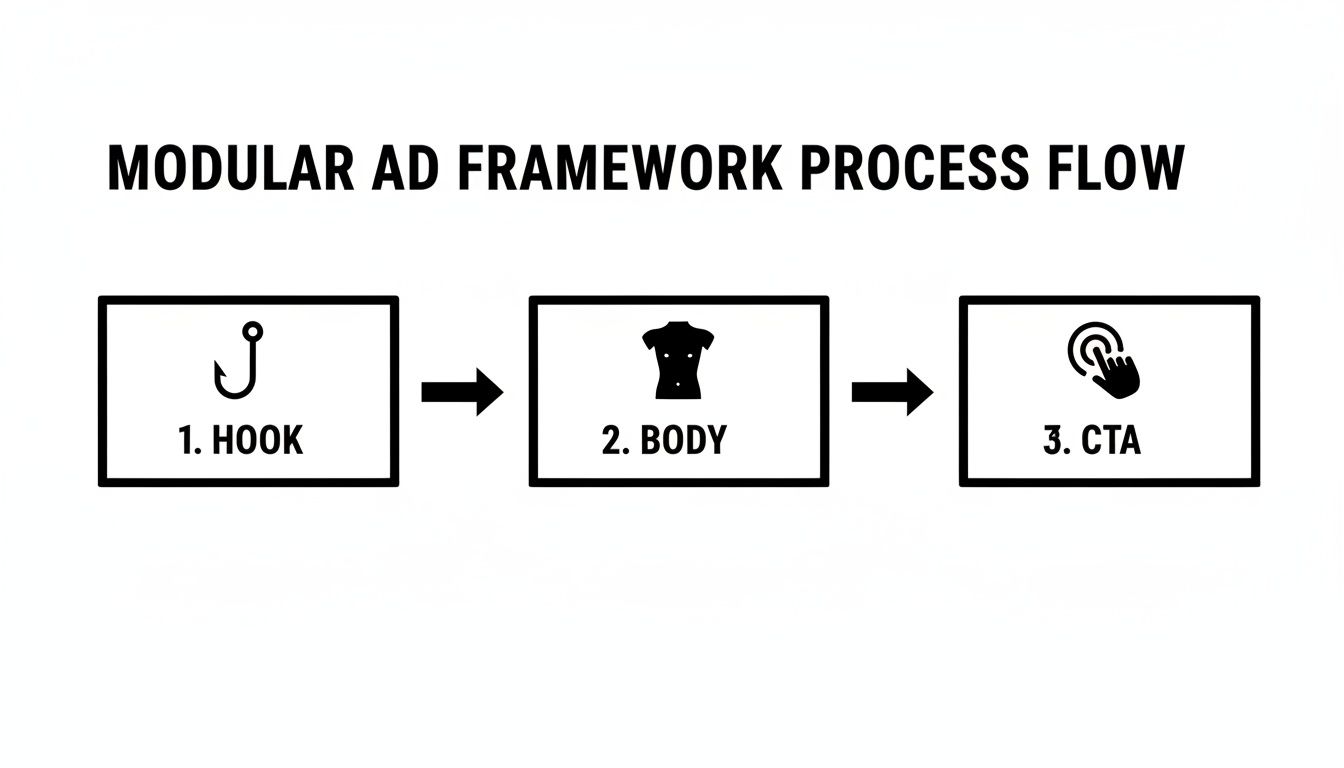
By breaking ads into these distinct Hook, Body, and CTA modules, you can methodically test and dial in each part of the customer journey.
Building Your Creative Learning Agenda
Once you can generate and track hundreds of ai video ads, you can build a powerful learning agenda. Think of this as a roadmap for what you want to learn from your campaigns over the next few months.
Your agenda might look something like this:
Month 1: Go all-in on hook testing. The only goal is to find the top three scroll-stopping concepts that consistently grab attention in the first three seconds.
Month 2: Take your winning hooks and test them against five different value propositions in the ad body. Now, you’re trying to find the most persuasive message.
Month 3: Lock in your winning hook-and-body combo and test four different CTAs to see which one maximizes your click-through and conversion rates.
This systematic approach creates a continuous feedback loop. The performance data from each test feeds directly back into your creative strategy, telling you exactly what kind of ads to generate next. To get a deeper look at setting up these tests, check out our guide on using an ad creative experimentation tool.
By combining modular frameworks, AI-powered generation, and clean data tracking, you transform ad creation from a creative guessing game into a repeatable, data-driven process that finds and scales winning ads.
Choosing the Right AI Video Ad Platform
Once you have a solid testing strategy, the next big question is what tech to use. The market for ai video ads is getting crowded, but honestly, not all platforms are cut out for the intense, data-driven world of performance marketing.
The goal isn't just to find a faster way to edit a single video. You need a tool that treats ad creation like a modular, scalable system—a central hub for your entire creative operation. It has to go beyond simply stitching clips together and intelligently manage your assets, lock down brand consistency, and let you test at high velocity without everything turning into a mess.
Essential Features for Performance-Focused Teams
When you're looking at different AI video ad platforms, some features are just non-negotiable for teams obsessed with driving conversions and learning fast. These are the things that separate a basic online editor from a true performance creative engine.
Here’s what you should be looking for:
Modular Editing Capabilities: The entire system needs to think of ads as collections of interchangeable parts—hooks, bodies, and CTAs. This is absolutely fundamental if you want to isolate variables and run clean, structured tests.
Intelligent Asset Management: Your platform should use computer vision to automatically tag and sort your raw footage. Being able to search your library with natural language like, "find clips of happy customers unboxing," is a massive time-saver.
Brand Consistency Controls: Something like Sovran’s ‘Context Vault’ is critical here. It’s where you store your brand guidelines, approved ad copy, and customer testimonials, making sure every AI-generated video still feels like it came from you.
Bulk Rendering and Remixing: The platform has to be able to spit out hundreds of ad variations based on a single template or set of rules. This is the core engine that powers a scalable testing strategy.
Integrations and Workflow Automation
A powerful AI platform can't be an island. Its real value comes from how seamlessly it plugs into your existing marketing workflow, especially with ad networks like Meta and generative AI tools.
Direct integration with Meta Ads Manager, for example, is a game-changer. It lets you push hundreds of ad variations straight into your campaigns with automated naming conventions already applied. No more manual uploads, no more messy data. On top of that, connections to generative models like Sora or Veo can give you an endless supply of fresh B-roll, keeping creative fatigue at bay.
The right platform doesn't just automate tasks; it automates learning. By connecting asset management, modular creation, and direct ad platform integration, it creates a seamless feedback loop where performance data directly informs your next creative sprint.
To really put a scalable, AI-powered testing strategy into motion, many marketers are turning to advanced AI tools for bulk video ad creation, which can dramatically ramp up creative output.
Before settling on a platform, it's worth running through a checklist to make sure it can handle the demands of performance creative.
Feature Checklist for AI Video Ad Platforms
Here are the key features to evaluate when choosing an AI platform designed for creating and testing performance video ads.
Feature | Why It Matters | Example in Sovran |
|---|---|---|
Modular Editing | Allows you to swap hooks, bodies, and CTAs independently to isolate variables and test scientifically. | Create a base video, then generate 20 variations by testing 5 hooks and 4 CTAs without re-editing the body. |
AI-Powered Asset Tagging | Saves countless hours by automatically categorizing raw footage, making assets searchable with natural language queries. | Upload a batch of UGC and have the system auto-tag clips for "unboxing," "product in use," or "customer smile." |
Brand Consistency Vault | Ensures all AI-generated content adheres to brand guidelines, tone, and messaging, maintaining brand integrity at scale. | The 'Context Vault' stores logos, fonts, color palettes, and approved copy for the AI to reference. |
Bulk Rendering Engine | The core of scalable testing. Generates hundreds of unique ad variations from a single creative concept in minutes. | Set up rules for swapping backgrounds, headlines, and clips, then render 100+ unique ads for a campaign launch. |
Direct Ad Platform Sync | Eliminates manual uploads and reduces human error by pushing creatives directly to Meta or TikTok Ads Manager. | Push 50 new video ads to a Meta campaign, complete with UTMs and standardized naming conventions, in one click. |
Performance Analytics | Closes the feedback loop by showing which creative elements are driving results, informing future creative decisions. | View a dashboard that connects creative assets directly to CPA or ROAS, highlighting winning hooks or visuals. |
A platform that checks these boxes is built not just for creation, but for systematic improvement and scaling.
Tailoring the Platform to Your Team
The right solution also depends on how your team is set up. An in-house creative team at a big brand has different priorities than a scrappy agency or a solo app developer.
In-House Teams: Need robust brand controls and collaboration features to keep a larger team aligned and on-brand.
Agencies: Require multi-account management and hyper-efficient workflows to service a diverse roster of clients at scale.
Indie Developers: Benefit most from speed and simplicity, letting them churn out high-quality ads without a dedicated creative department.
Ultimately, picking a platform like Sovran gives you the flexibility to meet these different needs, all while staying focused on the main goal: producing, testing, and finding winning ai video ads faster than ever before.
Scaling Your Ads with the Sovran Platform
Alright, so we’ve covered the theory. But how do you actually turn these ideas into live campaigns that get results? Getting started with an AI-powered workflow is a lot less complicated than it sounds. With Sovran, you can go from a folder of raw footage to a full-scale test campaign in a few quick steps, taking all the mystery out of creating AI video ads.
The first move is simple: upload your existing raw footage. This is where the magic starts. The AI immediately gets to work, analyzing every single clip and tagging it into a searchable library. Think of it as instantly organizing a messy hard drive into a smart, structured database of hooks, product demos, and customer reactions.
Building Your Brand's Creative Hub
Next, you’ll set up your Context Vault. This is basically the operational brain for your brand, making sure every single AI-generated ad stays authentic and on-point. You’ll load it up with all the essentials:
Brand Rules: Lock in your tone of voice, fonts, and color palettes.
Proven Copy: Feed it your winning headlines and scripts for the AI to learn from.
Customer Reviews: Drop in your best text-based testimonials to be used as compelling overlays.
Once your assets are tagged and your brand rules are set, you're ready to build your first ad. You can pick a proven framework like Problem-Agitate-Solution and start slotting in your tagged clips. This isn't about fussy timeline editing; it’s more like a drag-and-drop process where you mix and match your best components to build a powerful story. If you want to dive deeper into this method, you can explore the benefits of modular video ads and see how they speed up testing.
From a Single Concept to a Full Campaign
Okay, so you have a solid ad template. Now it’s time to scale. This is where the Bulk Video Renders feature becomes your new best friend. Instead of grinding out one variation at a time, you can tell Sovran to generate a whole batch of variants for your first test campaign.
You can set rules to automatically swap out different hooks, test various text overlays from your Context Vault, and try multiple calls to action. The platform then renders a complete set of test-ready ads, each with a unique combination of elements.
This automated process turns a task that would normally take days into a matter of minutes. You go from a single creative concept to a full-blown campaign designed for systematic learning. The goal is simple: get your ads live, gather data quickly, and start figuring out which creative elements actually drive performance. It’s time to stop guessing and start scaling.
A Few Common Questions About AI Video Ads
Whenever new tech enters the scene, there are always questions. And when it comes to your creative—the lifeblood of your campaigns—the stakes are pretty high. Let's tackle some of the most common questions performance marketers have about using AI for video ads.
Will AI Replace My Creative Team?
This is the big one, the question on everyone's mind. The short answer? No. AI video ad platforms aren't here to replace human creativity; they're here to supercharge it.
Think of an AI tool as the ultimate creative assistant. It’s built to handle the tedious, repetitive parts of video production that drain your team's energy. We're talking about the 80% of grunt work—slicing up clips, resizing for every platform, and churning out hundreds of variations for testing.
This frees up your creative strategists and editors to focus on the high-impact 20% that actually moves the needle: brainstorming new angles, digging into performance data, and making the big strategic calls. The human is still the director; AI is just the crew that executes that vision at a scale we couldn't dream of before.
How Can I Ensure AI Ads Stay On-Brand?
Keeping your brand's look and feel consistent is non-negotiable. It's a totally valid concern when you start automating creative production. This is where the idea of a "brand brain" or a ‘Context Vault’ comes into play. A solid AI platform lets you feed it your brand guidelines right from the start.
AI doesn't have to be a creative wild card. By providing it with your official fonts, color palettes, logo usage rules, and approved messaging, you set clear boundaries. Every ad it generates will operate within that framework, ensuring consistency across hundreds of variations.
This actually turns AI into a brand guardian, not a risk. It programmatically applies your rules every single time, cutting down on the potential for human error and making sure every ad—no matter how small the test—is perfectly on-brand.
Is the Creative Quality Actually Good Enough for Paid Social?
Yes, but we need to be clear about the goal here. AI-generated video isn't trying to win an Oscar; it's designed to win conversions on platforms like Meta and TikTok. And let’s be honest, the top-performing ads in these feeds are rarely the slick, high-budget productions.
The winners are authentic, direct, and feel native to the platform. AI is perfectly suited to create this exact style of content.
Remixing UGC: It can instantly stitch together user-generated content into raw, believable testimonial ads that build trust.
Optimizing for Mobile: AI automatically formats for vertical screens, adds punchy subtitles, and uses quick cuts to keep thumbs from scrolling.
Testing What Works: The real "quality" comes from data. Instead of guessing, AI lets you test dozens of hooks and value props to discover what your audience actually wants to see.
By focusing on what drives performance instead of cinematic polish, AI produces creative that’s built for the fast-paced, scrappy world of paid social.
Ready to stop guessing and start scaling your creative strategy? With Sovran, you can automate the production of high-performing AI video ads, test ideas 10x faster, and finally conquer creative fatigue. Start your free 7-day trial today and see how quickly you can find your next winning ad.

Manson Chen
Founder, Sovran
Related Articles
How to Turn Link Into Video: Ads That Convert in 2026
Learn how to turn link into video for Meta & TikTok ads. Leverage AI to scale creation, boost ROI, and succeed in 2026.
- ai-video-generation
- link-to-video-ads
- 6 more
8 High-Converting Static Ads Examples for 2026
Discover 8 high-performing static ads examples from top apps. Learn to create text-overlays, testimonials, and lifestyle ads that convert.
- static-ads
- performance-marketing
- 5 more

Your Ultimate Guide to UGC Style Video Ads
Master UGC style video ads for Meta and TikTok. This guide reveals proven frameworks, scripts, and scaling tactics to boost your ROAS in 2026.
- ugc-video-ads
- social-media-advertising
- 4 more