Hook Body CTA Video Ad Structure: A Modern Playbook

Jump to a section
The hook-body-CTA video ad structure is a simple but powerful formula that breaks down a winning video into three parts: a hook to stop the scroll, a body to persuade, and a call to action (CTA) to drive a specific behavior.
This isn't just some marketing theory. It’s the battle-tested architecture behind pretty much every successful video ad you see today because it’s built for how real people watch content on fast-paced feeds.
Why The Hook Body CTA Structure Is Your Secret Weapon
Let's get straight to it. The Hook-Body-CTA framework isn't just a trend—it's a reliable system for building video ads that actually work. With attention spans getting shorter every day, this structure gives you a logical flow that respects the viewer's time while guiding them from curiosity to conversion.
Better yet, it gives you a powerful diagnostic tool. When an ad underperforms, you don't have to guess why. You can break it down into its three core pieces and see exactly where the problem is.
Is the hook rate low? Your first three seconds aren't grabbing attention. Time for a new hook.
Is watch time dropping off in the middle? Your body isn't delivering on the hook's promise or isn't engaging enough.
Is the click-through rate in the gutter? Your CTA isn't strong or clear enough.
The Numbers Behind The Framework
This structure is king because it’s built around the single most important metric in video ads today: the hook rate. The first three seconds are the absolute make-or-break moment for performance on Meta and TikTok.
Benchmarks show that a strong hook rate—the percentage of viewers who watch past the 3-second mark—should be above 30%. The top-tier ads are hitting 40-50%.
On Meta, median hook rates are around 28%, but the top 10% of ads climb to 45%. TikTok's median is even higher at 33%, with its top performers reaching a massive 55%. You can explore more data on how to refresh your hook library and nail these metrics.
By focusing on the Hook-Body-CTA model, you shift from making random ads to building a system. This modular thinking allows for smarter, faster, and more data-driven creative testing.
Ultimately, mastering this structure means you're not just making ads; you're engineering persuasion. You learn to control the pacing, build momentum, and deliver a clear, actionable message that turns passive scrollers into active customers. This is the foundation that separates ads that just get views from ads that drive real revenue.
Crafting Hooks That Genuinely Stop The Scroll
If the first three seconds of your ad don't hit, the rest is invisible. It’s a harsh truth. In a feed where thumbs are conditioned to move at lightning speed, your hook isn't just an intro—it's the gatekeeper to your entire message.
Its only job? Earn the next three seconds.
This isn’t about guesswork; it's about systematically breaking a user's scroll pattern. The success of the entire hook-body-CTA video ad structure hinges on this single moment. If your hook blends in, your ad is already dead in the water.
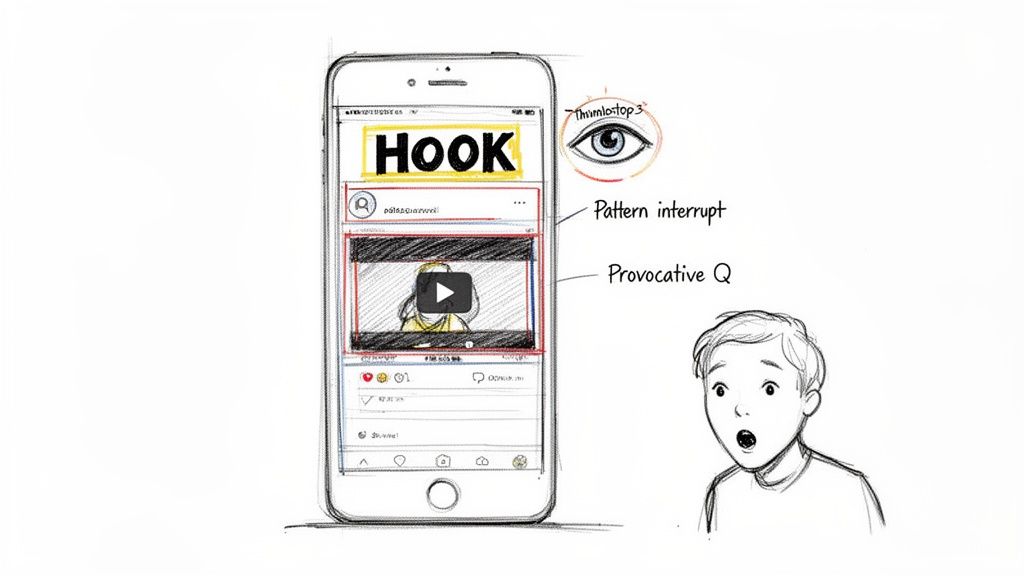
Proven Hook Formulas For Meta & TikTok
To consistently create these scroll-stopping moments, you need a go-to library of proven formulas. Different angles resonate with different audiences and platforms, so having a range of options ready to test is non-negotiable.
Here are a few battle-tested approaches we see win time and time again.
Proven Hook Formulas For Meta & TikTok
This table breaks down some of the most effective hook types we use, complete with examples to get your creative juices flowing. Think of it as a starting point for your next campaign.
Hook Type | Description | Example (for a language learning app) |
|---|---|---|
Pattern Interrupt | Disrupts expectations with an unexpected statement or visual, forcing the viewer to re-evaluate what they're seeing. | "Stop using Duolingo. It's not making you fluent." |
Provocative Question | Poses a direct question that taps into a viewer's pain point, desire, or curiosity, making them mentally answer it. | "What if you could be conversational in Spanish in just 30 days?" |
UGC-Style Opening | Starts with an authentic, low-fi clip that feels like a native post from a friend or creator, not a polished ad. | A shaky, selfie-style video opens with: "Okay, I'm in Paris and I just ordered coffee entirely in French. Here's how I did it..." |
Use these as a base, but always adapt them to your brand's voice and your audience's specific pain points.
And remember, to really dominate on a platform like Instagram, you have to stay current with Instagram Reels best practices. A hook that feels native will always outperform something that screams "AD!" from the first frame.
Combining Techniques For Maximum Impact
The best hooks rarely rely on a single tactic. The real magic happens when you layer multiple formulas into the first few seconds for maximum psychological impact. I call this 'hook stacking.'
By stacking techniques, you're hitting the viewer from multiple angles, dramatically increasing the odds that one of them will grab their attention. For instance, you could pair a jarring visual cut (a pattern interrupt) with a voiceover that asks a provocative question.
A powerful stacked hook might look like this: A rapid zoom-in on a frustrated person staring at a textbook, with bold text overlay saying "90% of language learners quit." The voiceover immediately asks, "Are you one of them?" This combines a shocking statistic with a direct, personal question.
This approach creates a dense, attention-grabbing opening that’s incredibly hard to scroll past.
When you start testing your video ad hooks scientifically, begin by isolating individual formulas to find a winner. Once you have a clear champion, try stacking another proven technique on top to see if you can push your hook rate even higher.
Building A Body That Holds Their Attention
You’ve landed the hook. You’ve earned a few precious seconds. Now what? The body of your video ad is where the real work begins. This is where you have to deliver on the hook's promise, keep that fragile attention, and smoothly guide the viewer toward your call to action.
Think of it this way: if your hook is the promise, the body is the proof. Any disconnect between the two is the number one reason I see for mid-ad drop-offs. The pacing, tone, and visual style you kicked off in the first three seconds have to carry through. If they don't, viewers will feel like they've been baited and will scroll away without a second thought.
Use Battle-Tested Body Frameworks
Instead of winging it, lean on proven narrative structures to build your case quickly and persuasively. These frameworks give you a reliable template for the middle of your ad, so you're not just improvising.
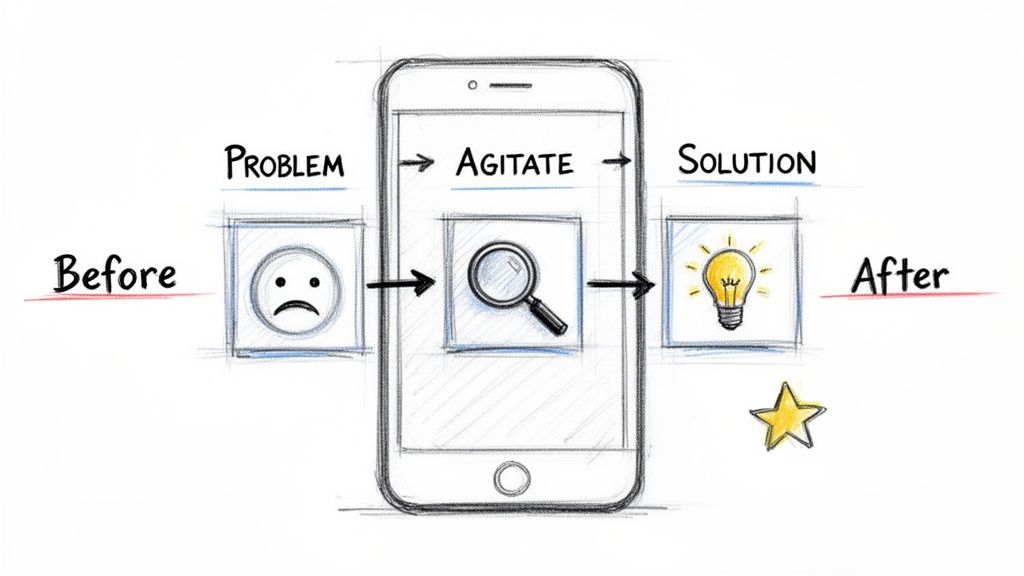
Problem-Agitate-Solution (PAS): Start by hitting on the viewer's problem again. Then, agitate it by showing the frustrations it causes. Finally, you swoop in and introduce your product as the obvious solution.
Feature-to-Benefit Showcase: Don't just list what your product does—that’s a recipe for boredom. Show a feature, then immediately connect it to the direct benefit. For example, show a one-click integration (the feature), then show the user saving 30 minutes of manual work (the benefit).
Before-and-After Reveal: This is a classic for a reason—it’s visually powerful. Show the frustrating "before" state, then hit them with a dramatic reveal of the ideal "after" state they can achieve with your product.
So, how do you choose? It all comes down to your hook. If you hooked them with a problem, PAS is a perfect fit. If your hook teased a surprising result, a before-and-after reveal provides the satisfying payoff.
The goal isn't to cram in every feature. It's to tell a concise story that builds desire. Pick one core message for the body and hammer it home with clarity and speed.
Maintain Momentum and Build Trust
The body needs to move fast. I’m talking quick cuts, dynamic text overlays, and engaging b-roll to keep things visually interesting. This is also your chance to sprinkle in social proof to build credibility without killing the pace.
Try some of these quick-win tactics:
Flash a customer testimonial on screen for just two seconds.
Show a quick shot of your app's 5-star rating.
Use a text overlay that says "Trusted by 50,000+ users."
The body of your ad is a balancing act between speed and persuasion, especially inside the full hook-body-CTA video ad structure. This section usually runs between 15 to 30 seconds. On Meta, we see videos in this range hitting a median CTR of 1.62%, which consistently beats static images. Meanwhile, on TikTok, top-performing videos often have a median CTR of 0.84% and are built on hooks under three seconds followed by an incredibly tight, fast-paced body. You can dig into more creative benchmarks in this 2026 report on ad performance.
Ultimately, every single element in the body has to serve a purpose: hold the attention you just earned and make your final CTA feel like the most natural next step.
Designing Calls To Action That Actually Convert
You’ve nailed the hook and built interest in the body. Now for the most important part: getting the click. Your call to action, or CTA, is where all the attention you’ve earned actually turns into a measurable result.
A weak or confusing CTA is like fumbling the ball on the one-yard line. The entire point of the hook-body-CTA video ad structure is to drive an action, and this is where it all comes together. Your final push has to feel both easy and urgent for the viewer.
Choosing The Right Type Of CTA
Your CTA command is not a one-size-fits-all instruction. The language you choose needs to match your audience's temperature and what you're asking them to do. Get this wrong, and you'll create friction that kills your conversion rate.
Direct CTAs: Think "Shop Now" or "Buy Now." These are high-friction commands that work best with warm audiences who already know and trust you, or for products with a super low barrier to purchase. They are clear, direct, and leave no room for guessing.
Softer CTAs: Phrases like "See How It Works," "Learn More," or "Take The Quiz" are low-friction. They're perfect for colder audiences or more complex products because they spark curiosity without demanding an immediate purchase commitment. This makes them a much safer bet for top-of-funnel campaigns.
A new user might balk at "Buy Now," but they'll almost always click "See How It Works" to satisfy the curiosity your ad just created.
Create A Cohesive CTA Command
The best CTAs aren't just the platform's native button. They create a layered, multi-sensory command that’s impossible to ignore. This means syncing up three key elements in the final moments of your ad.
On-Screen Text: Use big, bold text overlays that spell out the action. An arrow pointing toward the button area is a classic for a reason—it works.
Verbal Cue: The voiceover should say the exact call to action out loud. Hearing "Click the link to get your free trial" reinforces the visual instruction and tells the viewer precisely what to do next.
Platform Button: Make sure the ad's native button text (e.g., "Sign Up," "Learn More") perfectly matches what viewers see and hear. Consistency is everything here.
When all three elements align, you create a powerful moment of clarity. The viewer sees the action, hears the action, and has a clear button to complete the action. This synergy dramatically boosts click-through rates. You can find more strategies for improving click-through rates in our guide.
Adding Urgency Or Exclusivity
To give your CTA that final push, add a layer of urgency or exclusivity. This is a simple psychological trigger that encourages people to act now instead of putting it off for later. In the last few seconds of the ad, just add an overlay or a quick voiceover line that communicates scarcity.
Even simple phrases like "Offer Ends Tonight," "Only 50 Spots Left," or "Exclusive Discount For First-Time Buyers" can give your performance a serious lift. This tactic turns a passive suggestion into an immediate opportunity that viewers feel they'll miss out on if they don't act fast.
Scaling Your Creative Workflow With Smart Tools
Making one great ad is one thing. But systematically finding a scalable winner by testing hundreds of variations of your hook-body-CTA video ad structure? That's a whole different ball game. This is where theory crashes into reality, and trying to keep up with manual editing in tools like CapCut just isn't sustainable. Modern performance marketers aren't just making ads anymore; they're building creative systems.
This fundamental shift, from one-off creations to a full-blown production line, is only possible with smart tools. Platforms like Sovran are built to completely change your workflow by treating your creative assets not as final videos, but as modular building blocks you can assemble and reassemble on the fly. Just imagine uploading all your raw footage once and letting AI do the heavy lifting.
From Raw Clips To Reusable Components
The whole process starts by deconstructing your assets. Instead of you manually scrubbing through hours of footage, an AI can automatically watch, understand, and tag every single clip.
Here’s how that looks in practice:
A 5-second clip of a user unboxing your product gets tagged as a hook.
A 15-second screen recording that walks through a key feature becomes a body element.
A quick shot of someone smiling while using the product is tagged as social proof for the body.
A clear voiceover saying "Download Now" is instantly identified as a CTA.
This creates a searchable library of tagged components, completely changing how you find what you need. Now, you can find the perfect clip just by describing it—think "person looking frustrated at their computer" or "upbeat customer testimonial." This fundamentally changes how you approach iteration.
Instead of thinking, "I need to edit a new video," you start thinking, "I need a new combination of my best hooks and bodies." This modular approach is the key to unlocking high-velocity testing.
Centralizing Brand Knowledge With A Context Vault
One of the biggest headaches in scaling creative is keeping your brand and messaging consistent. This is exactly what a Context Vault solves. It acts as a single, centralized source of truth for all your strategic inputs.
Instead of digging through old strategy docs and Slack channels, you store everything in one place:
Brand Guidelines: Logos, color palettes, and font rules are automatically applied to every video.
Proven Scripts: Your top-performing hook and CTA lines are always ready to be deployed.
Customer Reviews: A library of authentic testimonials can be pulled into ads in an instant.
With this vault in place, every ad variation the system generates is already on-brand and built on messaging that you know works. This is how you ensure quality and consistency at scale. It becomes even more critical as video budgets climb—for creative strategists, decoupling elements with AI enables natural language searches and auto-subtitles, which massively accelerates learning cycles. That's a necessity when 94% of marketers are increasing video spending because of creative fatigue.
Generating Hundreds Of Variants In Minutes
Now for the magic. With your tagged components and Context Vault ready, you can use Bulk Video Renders to assemble hundreds of testable ad combinations in minutes. Want to mix your top three hooks with your two best body sections and a new CTA? That’s six new ads ready for testing, generated almost instantly. To make the process even smoother, you can feed scripts directly into an AI like the ShortGenius AI text-to-video generator to create new visual assets.
This flow chart shows how different CTA elements can be combined for maximum impact.
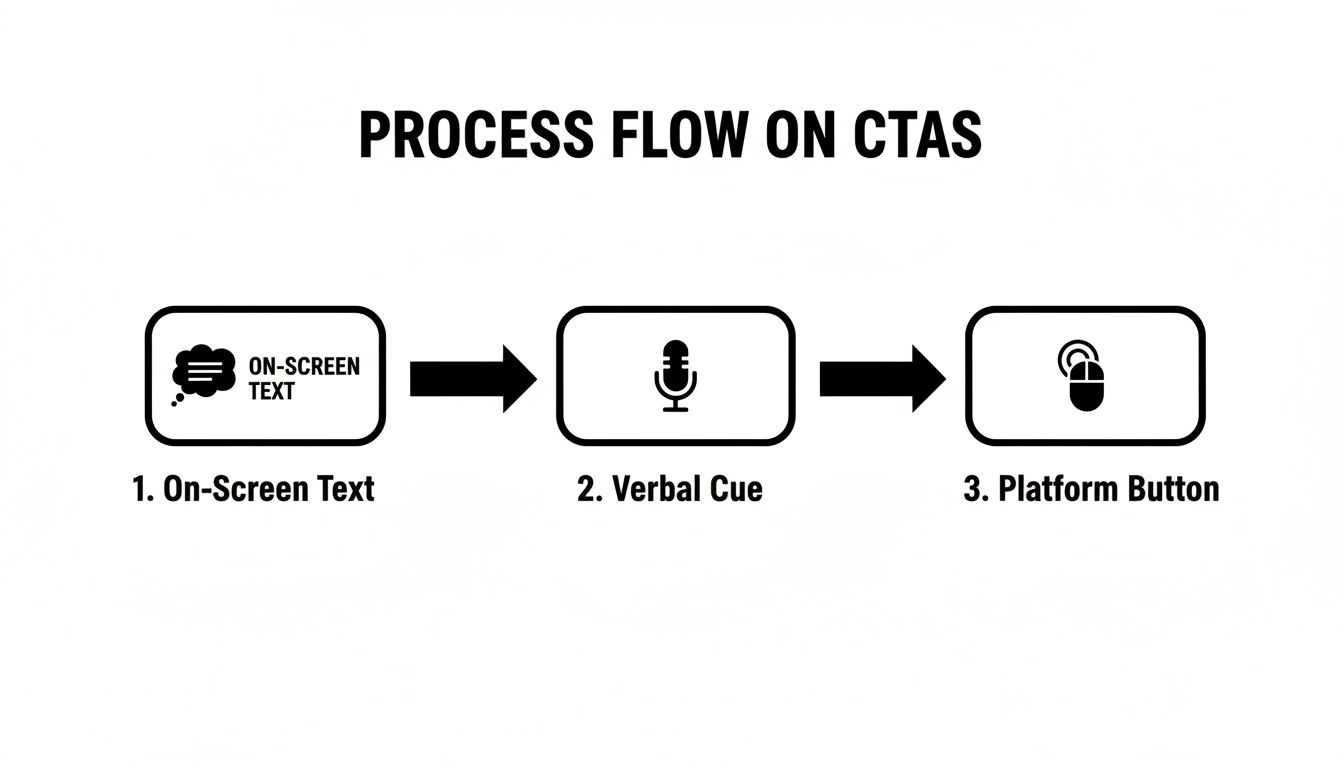
The diagram really highlights how the most effective CTAs layer on-screen text, a verbal cue, and the platform button into one cohesive command. This is how modern teams accelerate their testing velocity, find winning ads 10x faster, and finally get ahead of creative fatigue. For anyone interested in the nuts and bolts, our guide on automatic video editing dives deeper into the technology powering this workflow.
Common Questions About Video Ad Structure
Even when you have a solid framework, you're bound to run into specific questions once you're in the trenches, actually building and testing ads. Getting straight answers to these common hurdles is the key to sharpening your strategy and not burning cash on your hook-body-CTA video ad structure.
So, let's dive into some of the most frequent questions we get from fellow performance marketers.
How Many Hooks Should I Test For A New Concept?
When you’re kicking off a brand new ad concept, your number one job is to nail the hook. The smart way to do this is by starting with 3-5 distinct hooks running against your single best body and CTA.
This method isolates the hook's performance, giving you clean, undeniable data on what actually stops the scroll. You get a direct line of sight into its impact on crucial metrics like thumb-stop and hook rate.
Once you land on a hook that consistently beats your benchmark (we always shoot for over a 30% hook rate), then you can start A/B testing variations of the body. It’s a methodical process, but it’s the fastest way we've found to land a winning ad without getting your data messy by testing too many variables at once.
What Is The Ideal Video Length For Meta And TikTok?
Both platforms are all about short-form video, but the sweet spot for ad length has some slight but important differences. The main thing is to tell a complete story with zero fluff.
For Meta Reels: We generally aim for a runtime between 15-30 seconds. This gives you just enough real estate to run a full Hook-Body-CTA narrative that can educate and persuade effectively.
For TikTok Ads: Here, the algorithm often rewards even shorter ads. A 15-20 second video is a great target. Ads on TikTok need to feel quick, native, and get straight to the point.
The universal rule is simple: your ad should only be as long as it needs to be to get the message across and drive an action. Every extra second is a chance for someone to scroll away.
A classic mistake we see all the time is a "hook-body mismatch." This is when you have a killer hook rate but a terrible click-through rate (CTR). It means your opener grabbed attention, but the body of the ad completely failed to deliver on that promise, and viewers bailed before the CTA.
Why Is My Hook Rate High But My CTR Low?
This is a dead giveaway that there’s a major disconnect inside your ad. Your hook is doing its job perfectly, but something in the body is breaking the spell and killing the viewer's journey. Your first move should be to pull up your ad’s retention graph and pinpoint exactly where they’re dropping off.
The problem is almost always one of these culprits:
The body is too slow and doesn't match the energy of the hook.
The message in the body feels totally disconnected from what the hook promised.
You failed to show value or social proof quickly enough.
To fix this, go back to the editing board. The goal is to re-edit the body to be faster and more engaging, making sure it directly pays off the promise your hook made in the first three seconds.
Ready to stop guessing and start scaling? With Sovran, you can automate the entire hook-body-CTA workflow. Upload your clips, let our AI tag them into reusable blocks, and generate hundreds of on-brand ad variations in minutes. Find out how top performance marketers are building winning ads 10x faster at https://sovran.ai.

Manson Chen
Founder, Sovran
Related Articles
CTA Overlay vs Verbal CTA: A 2026 Performance Guide
- CTA overlay vs verbal CTA
- video ad creative
- 3 more
A Guide to Performance Video Ad Anatomy
- performance video ad anatomy
- video ad creative
- 3 more
Demographic Targeting: A Performance Marketer's Guide 2026
- demographic targeting
- meta ads
- 3 more