Hook Rate for Meta Ads: Formula, 2026 Benchmarks and 10 Hooks to Test
Hook rate shows how many people watch the first three seconds of your video ad. Learn the formula, compare 2026 Meta benchmarks by industry, read it with hold rate, and test 10 hook formats.
Jump to a section
Hook rate tells you how many people who saw your video ad watched at least the first three seconds. It is the quickest read on whether your opening stops the scroll. It does not tell you whether the ad sells.
Quick answer: hook rate = 3-second video plays ÷ impressions × 100. Across 88,329 Meta sales video ads that ran from January to June 2026, Billo found an average hook rate of 25.44%. Industry averages ranged from 21.32% to 28.79%. Compare each ad with your own account first, then with your industry.
What is hook rate?
Hook rate, also called thumb-stop ratio, is the share of impressions that turn into 3-second video plays. It measures the opening of a video ad: the first frame, the first line, and any on-screen text. Meta Ads Manager does not show it as a standard column, so you add it as a custom metric.
You can track hook rate on Meta, TikTok, and YouTube Shorts. Each platform counts views differently, so compare rates within one platform. The benchmarks below cover Meta only.
Hook rate formula
Hook rate = 3-second video plays ÷ impressions × 100
Example: an ad with 10,000 impressions and 2,800 three-second video plays has a hook rate of 28%. If a new opening earns 3,100 plays from the same number of impressions, its hook rate is 31%. That is a gain of three percentage points.
Some tools divide by video starts or by reach instead of impressions. Those rates are not comparable with this formula, so check the denominator before you compare reports.
How to add hook rate in Meta Ads Manager
- In Ads Manager, open the Columns menu and choose Customize columns.
- Select Create custom metric.
- Name the metric Hook rate and enter the formula: 3-second video plays divided by Impressions.
- Set the format to percentage, save it, and add the column to a saved column preset.
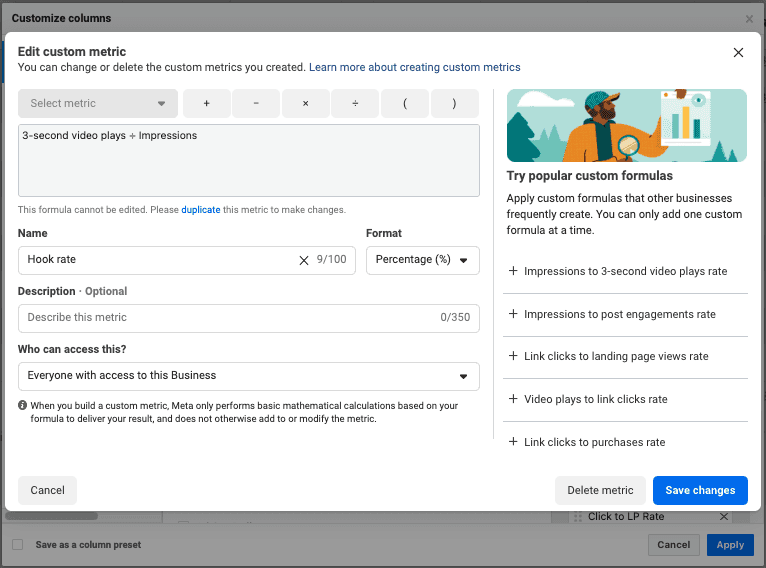
Add hold rate the same way, so you can read the opening and the rest of the video side by side.
What is a good hook rate?
A good hook rate is one that beats your account's recent average for the same objective and placement. Industry averages show whether that baseline is low. Billo's H1 2026 data covers Meta video ads with a sales objective and more than 1,000 impressions each.
| Industry | Average hook rate, Meta sales ads, Jan–Jun 2026 |
|---|---|
| All industries | 25.44% |
| Toys & Games | 28.79% |
| Business & Industrial | 28.74% |
| Health & Beauty | 28.11% |
| Sporting Goods | 26.89% |
| Food & Beverages | 26.14% |
| Home & Garden | 25.06% |
| Services | 23.86% |
| Other | 23.59% |
| Arts & Entertainment | 23.02% |
| Apparel & Accessories | 22.94% |
| Software | 22.90% |
| Baby & Toddler | 22.56% |
| Electronics | 22.21% |
| Animals & Pet Supplies | 21.32% |
Source: Billo, Video Ad Hook Rate Benchmarks H1 2026. See hook rate benchmarks by industry for the sample details and limits.
For planning, our hook rate calculator treats 25–35% on Meta as a baseline, 35% or more as strong, and 45% or more as a breakout. These are Sovran planning bands, not platform benchmarks. Placement matters too, so compare Reels with Reels and Feed with Feed.
Hook rate vs hold rate
Hook rate covers the first three seconds. Hold rate covers what happens next. A common version divides ThruPlays by 3-second video plays. A ThruPlay is a play to 15 seconds, or to the end of a shorter video. Other tools use 15-second plays or average watch time, so check the formula before you compare.
Read the two together:
- High hook rate, low hold rate: the opening earns attention that the body does not keep. Check that the first seconds match what follows.
- Low hook rate, high hold rate: people who stay are interested, but too few stay. Test new openings on the same body.
- Both low: the concept or the audience may be the problem, not only the hook.
Why hook rate matters, and where it misleads
If people scroll past the first three seconds, they never see your product, proof, or offer. That makes hook rate a useful early signal when you test new creative.
It is still an attention metric. In Billo's data for the same period, Toys & Games had one of the highest average hook rates (28.79%) and an average return on ad spend (ROAS) of 1.62. Baby & Toddler had a lower hook rate (22.56%) and an average ROAS of 4.99. These are category averages, not proof about any single ad. Still, judge a winning hook on cost per purchase or ROAS as well as hook rate.
How to find what is working in your hooks
- Compare like with like. Use the same objective, placement, and date range. Wait until each ad has enough impressions, because rates on small samples swing a lot.
- Study the first three seconds. Note the first frame, the first spoken line, the on-screen text, and the thumbnail of your best and worst ads. In one account we reviewed, the highest hook rate came from an ad whose thumbnail sat on a blacked-out frame, which stood out in the feed.
- Change one thing at a time. Keep the body and CTA the same and swap only the opening. Then you know the hook caused the difference.
10 hook formats to test
These openings come from ads we have reviewed. Treat each one as a test idea, not a guarantee.
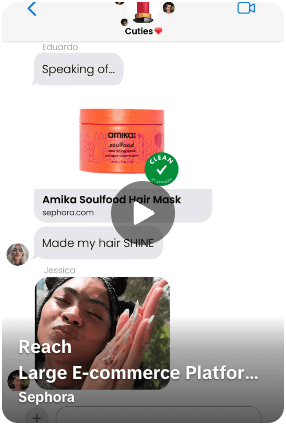
1. iMessage-style hooks
Open on a text-message conversation. It feels personal, and viewers want to read the next message. Keep the messages short enough to read in three seconds.
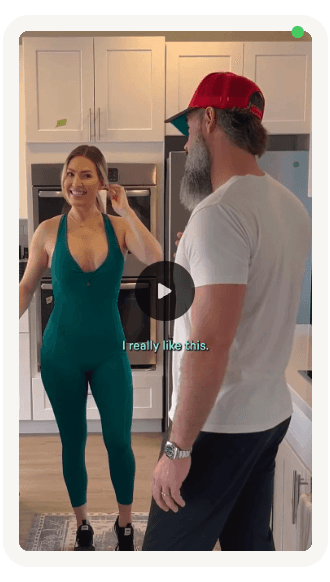
2. Compliment hooks
Open with someone noticing the result, such as a partner commenting on a change. The ad shows the outcome before it explains the product.
3. TikTok trend hooks
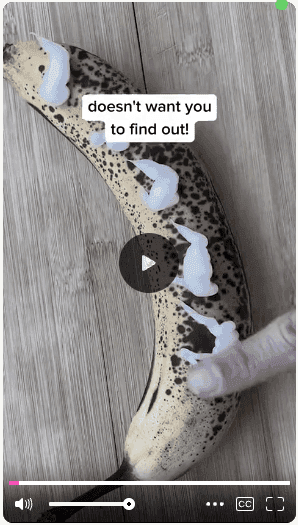
Formats such as "TikTok made me buy it", "What I ordered vs. what I got", and "Three reasons why" are familiar to viewers. A familiar format helps people decide quickly to keep watching.

4. Exaggeration hooks
Spill, drop, or throw the product, or show an over-the-top reaction. Surprise or humor can stop the scroll.

5. Comparison hooks
Show the problem and the solution one after the other, such as a struggle followed by relief. The contrast makes the benefit clear without many words.

6. Green screen hooks
Put a review, comment, or result behind the speaker with a green screen. The social proof is visible in the first frame.

7. Split screen hooks
Show the before and after at the same time. The improvement is obvious at a glance.

8. Pain point hooks
Name the problem in the first line, then show it. Viewers who have that problem can see right away that the ad is for them.
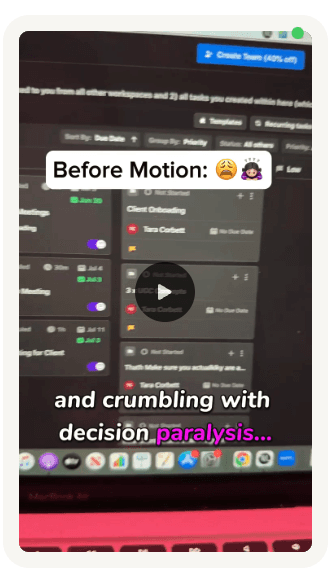
9. Oddly satisfying visual hooks
Use close-ups, bright colors, unboxings, or textures being squeezed or poured. Satisfying motion holds the eye.
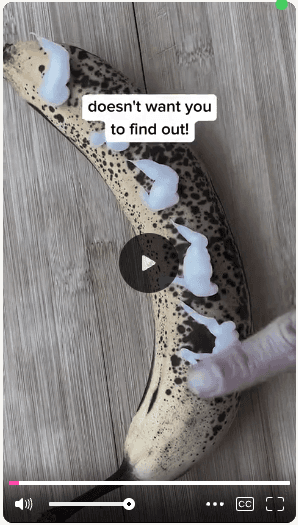
10. Comment reply hooks
Open with a comment bubble that asks a question, then answer it. Keep the tone casual. This works well for common objections.

Test more hooks without re-editing every video
The fastest way to raise hook rate is to test more openings against the same body and CTA. We build Sovran for this work. With modular video ads, you swap hooks independently of the body and CTA, so ten openings do not mean ten separate edits. Compare Sovran plans.
Sources
- Billo, Video Ad Hook Rate Benchmarks H1 2026, published August 6, 2026. Checked October 24, 2026.
- Billo, Video Ad ROAS Benchmarks H1 2026. Checked October 24, 2026. Billo averages each ad's ROAS instead of dividing total purchase value by total spend.
Turn the hook-rate benchmark into a concrete next test
Use the guide to understand the signal, then calculate your result and build a controlled set of new openings.
Calculate and benchmark your hook rate
Measure three-second attention, compare directional Meta and TikTok planning bands, and get the next hook-testing action.
Calculate hook rate- Next testGenerate hooks
Generate the next hook angles
Create new opening lines, first frames, overlays, and test groups for the same body and CTA.
- Testing workflowBuild the matrix
Put the winning openings into a test matrix
Combine hooks with controlled bodies and CTAs, apply clean names, and download the launch plan as CSV.
Frequently asked questions

Manson Chen
Founder, Sovran
Related Articles

10 High-Impact Marketing Video Examples for Your 2026 Strategy
In performance marketing, scrolling is the enemy. On platforms like Meta and TikTok, you have less than three seconds to stop a potential customer from swiping...
- Marketing
- Video Ads
- 1 more

Master AI Video Ad Production Workflow
Imagine whipping up a video ad in minutes, without sacrificing quality. That’s the promise of AI video ads—they draft scripts, select visuals, handle...
- AI
- Video Ads
- 1 more
A Guide to Facebook Automated Ads That Drive Real Results
So, what exactly are Facebook's Automated Ads? Think of them as Meta's AI-powered system designed to take the guesswork out of running campaigns. It automates...
- Facebook Ads
- Automation
- 1 more