British Text to Speech: A Marketer's Guide for Ads
Jump to a section
- Why Your UK Ad Campaigns Need More Than a Generic Voice
- Understanding Modern British Text to Speech Technology
- Choosing the Right UK Accent for Your Audience
- Key Criteria for Selecting a British TTS Provider
- Tuning Voice Performance with SSML
- Integrating TTS into High-Volume Ad Workflows
- From Generic Audio to a Strategic Creative Asset
You've localized the copy. You've swapped dollars for pounds. The offer fits the UK market. But the ads still feel off once the audio starts.
That usually happens because the voiceover got treated like a production detail instead of a targeting choice. In UK campaigns, voice matters the same way visuals, hooks, and landing page tone matter. A generic “British” voice can make a well-built ad sound imported, overly formal, or just culturally vague. If you're trying to improve ROAS and keep CAC under control, that mismatch hurts.
British text to speech works best when you use it like a creative variable. The accent, delivery, pacing, and licensing setup all affect whether an ad feels native to the audience you're buying. Used well, it gives teams a fast way to test localized voiceovers at scale without booking talent for every iteration.
Why Your UK Ad Campaigns Need More Than a Generic Voice
A lot of UK campaigns stall in the same place. The media buyer sees acceptable clickthrough at the top of funnel, but the ad doesn't build enough trust to convert efficiently. The copy may be right, but the voice sounds like a default setting.

Audio creative does a quiet but important job in paid social. It signals who the ad is for. It tells the viewer whether the brand understands their market or is just reusing a script with a new currency symbol. That's why British text to speech shouldn't be framed as “we need a UK voice.” It should be framed as “which voice helps this message feel native to this audience?”
Where generic British voices fail
The common mistake is picking a polished Received Pronunciation voice because it sounds safe. Safe often means bland. In some categories, it can also sound too expensive, too detached, or too institutional for the audience you're trying to reach.
That matters most in channels like Meta and TikTok, where users decide fast whether content feels relevant. If the visual says casual DTC and the voice says corporate explainer, the ad loses cohesion.
A stronger approach is to treat voice the same way you treat visual casting and UGC framing:
- Match social context: A mobile-first offer needs a voice that sounds like it belongs in-feed, not in a museum audio guide.
- Match category cues: Finance, luxury, gaming, education, and impulse ecommerce all benefit from different levels of polish.
- Match audience identity: Regional familiarity can matter as much as script clarity.
Practical rule: If your UK ad sounds like it could target “everyone,” it usually resonates with no one in particular.
Teams already apply this thinking to visual personas and AI character voices. Voiceover deserves the same strategic attention. Once you start hearing accent as a trust signal instead of a finishing touch, British text to speech becomes a lever for creative performance rather than just a cheaper way to make audio.
Understanding Modern British Text to Speech Technology
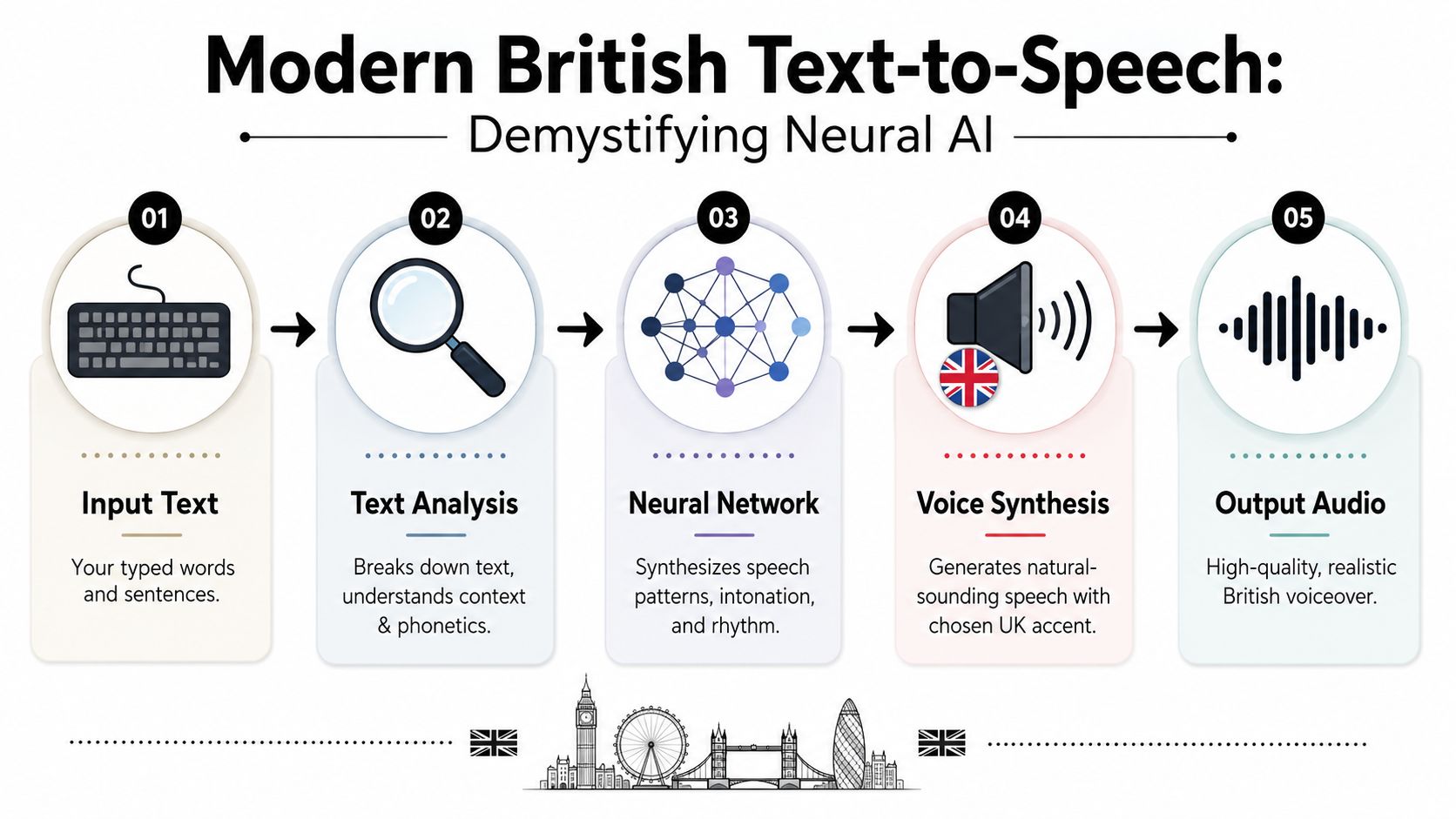
A UK ad can fail on audio before anyone notices the offer. If the pacing feels stiff, the stress lands on the wrong word, or a supposedly British voice sounds imported, viewers register friction fast. That is why modern text to speech matters in performance marketing. It is no longer just a production shortcut. It is a controllable audio system that can improve speed to launch without sacrificing fit.
British text to speech has a long technical history. Text-to-speech development stretches back over 250 years, from Wolfgang von Kempelen's mechanical speaking machine in 1791 to Bell Labs' VODER in 1939, then to computer-based synthesis at Bell Labs in 1961, where John Kelly and Louis Gerstman used an IBM 704 to recreate “Daisy Bell.” As noted in this history of text-to-speech, commercial TTS became far more practical with DECtalk in the early 1980s, which helped establish speech synthesis as usable assistive technology.
That background explains the current gap between legacy synthetic audio and neural systems used in ad production. Older tools assembled speech in a way that often sounded flat or mechanical. Modern models predict phrasing, timing, stress, and pronunciation with much better consistency, which makes them usable for paid social, landing page explainers, creator-style ads, and fast-turn creative testing.
What makes a British voice sound British
A convincing UK voice is built from specific speech patterns, not a flag on a dropdown menu. According to SpeechGen's British English TTS overview, British TTS systems using 70+ neural voices model phonetic traits such as the non-rhotic /r/, the broad /ɑː/ in words like “bath,” and glottal stops in words like “bottle.” The same source describes common voice quality tiers as Standard, PRO Neural, and HD.
For ad teams, that detail matters because audiences rarely praise a voice for being accurate. They just disengage when it sounds slightly off.
Use the quality tiers based on job type, not vendor branding:
| Tier | Best use | Main trade-off |
|---|---|---|
| Standard | Fast testing, rough cuts, internal approvals | Lower warmth and less nuance |
| PRO Neural | Most paid social ads | Better naturalness with manageable production speed |
| HD | Brand films, audiobook-style reads, polished hero assets | Higher production expectations, more time spent tuning |
The trade-off is straightforward. Higher-fidelity voices usually sound better on first pass, but they also expose weak scripts, awkward punctuation, and poor pacing choices more clearly. In direct response, a polished voice is only useful if it helps the message land faster and supports stronger click-through and conversion efficiency.
Provider evaluation should start with real campaign copy. Test hooks, price points, disclaimers, offer lines, and retargeting variants inside an AI text to speech workflow instead of relying on a vendor demo script designed to flatter the engine.
The voice is only half the system
Campaign performance depends on control as much as voice quality. Teams need to change emphasis, pace, pauses, and pronunciation without sending every revision back through a slow production loop. That is what makes TTS viable for high-volume testing across Meta, TikTok, YouTube, and landing page variants.
A usable production setup also reduces legal and operational risk. Marketers can create variation from approved synthetic voices instead of drifting into unclear permissions around cloned voices or one-off freelancer recordings that are hard to version. A documented AI voiceover workflow gives creative teams a repeatable process for approvals, updates, and scale.
A quick demo helps make the process concrete:
Modern British text to speech is strong enough for serious ad production when three pieces line up: the right underlying accent model, reliable pronunciation behavior, and enough control to adapt the read to the campaign instead of forcing the campaign to fit the tool.
Choosing the Right UK Accent for Your Audience
The strategic mistake isn't using text to speech. It's using one British accent as a stand-in for the whole UK.
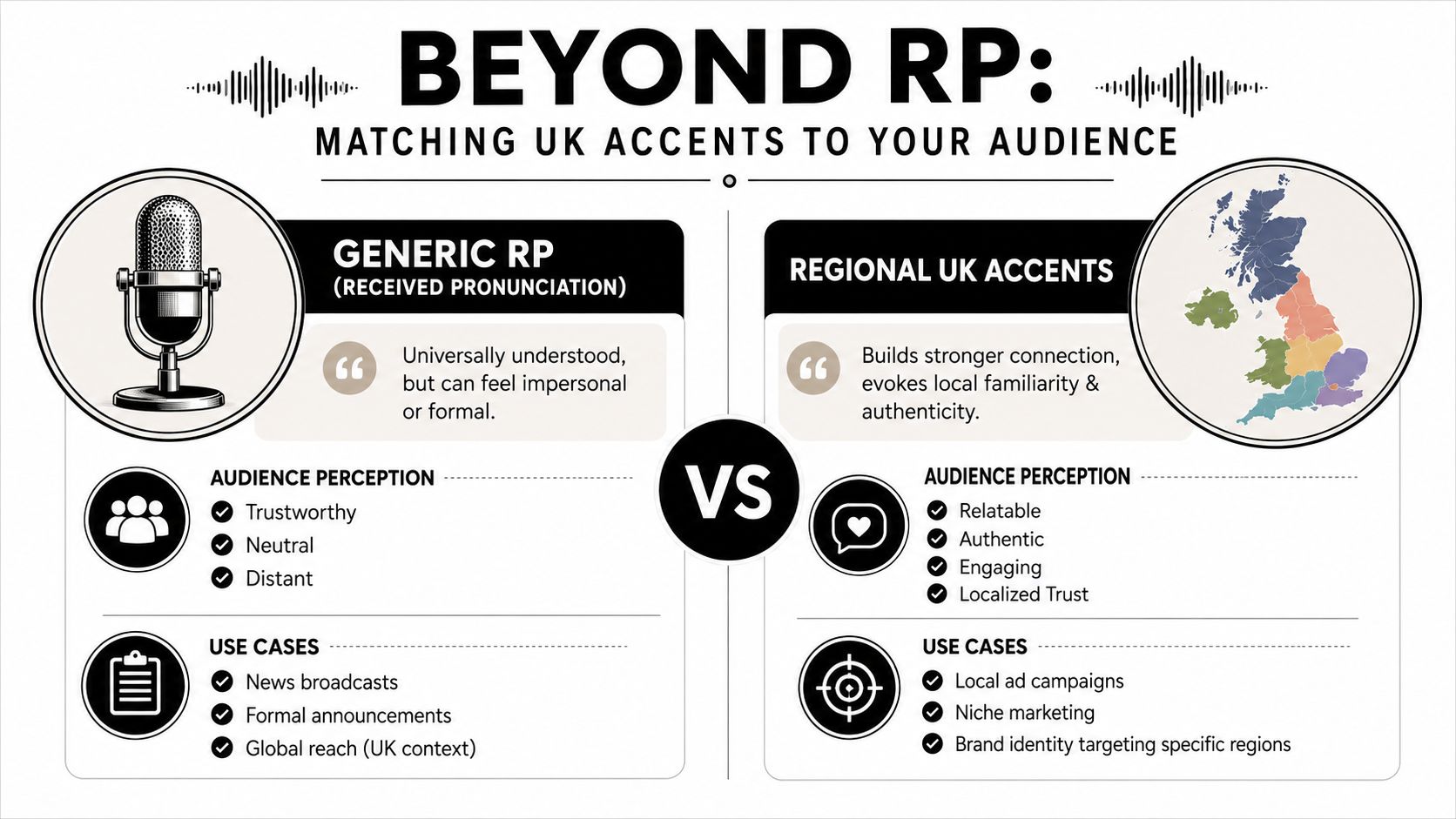
Most vendor pages flatten the market into “British English,” as if that's enough detail to guide a campaign. It isn't. Maestra's British English accent page notes that 70% of UK users prefer regionally accurate voices over Received Pronunciation for authentic engagement. That's the strategic opening most ad teams miss.
If your targeting is regional, your voice can be regional too. If your product positioning depends on familiarity, warmth, or local trust, default RP may be the wrong choice.
A better accent selection framework
Start with the audience, not the voice library.
Ask four questions before you pick anything:
Who is the ad trying to reassure?
Some products need authority. Others need friendliness. Others need to sound like a peer recommendation.What does the product promise?
A premium investing app, a betting offer, a beauty subscription, and a local trades platform shouldn't sound like they share the same narrator.Where will the ad run?
TikTok often rewards a more conversational read. Meta prospecting can tolerate a bit more polish if the visual style supports it.What kind of trust do you need?
Institutional trust and local trust aren't the same thing.
How accents map to campaign roles
This isn't a rigid chart. It's a working lens for creative decisions.
| Accent style | Where it often fits | Risk if misused |
|---|---|---|
| Received Pronunciation | Luxury, finance, formal explainers, broad UK reach | Can sound distant or class-coded |
| Regional English accents | DTC, retail, local offers, brands selling familiarity | Can feel forced if the script tone is too polished |
| Scottish or Welsh voices | Market-specific campaigns, local relevance, strong identity cues | Narrower fit if targeting all-UK audiences |
| Neutral conversational British | App ads, ecommerce, creator-style reads | Can become generic if it lacks a distinct audience cue |
Regional targeting in audio works best when the rest of the creative agrees with it. A local accent over stock footage and stiff copy still feels assembled.
What usually works in practice
When I review UK creative, the strongest voice choices usually follow one of three paths:
- Luxury or high-consideration brands keep a cleaner, more refined delivery because control and credibility matter more than relatability alone.
- Value-focused consumer offers do better with a warmer, more grounded accent that sounds accessible rather than unapproachable.
- Performance creative built for short-form feeds often benefits from voices that feel conversational first and “professional” second.
That doesn't mean every campaign needs a strong regional identity. Sometimes broad reach is the right move. But broad reach should be a deliberate trade-off, not a default inherited from the voice picker.
A useful creative exercise is to brief voice the same way you brief visuals. Don't ask for “British.” Ask for “Northern, conversational, credible for price-sensitive home fitness buyers” or “refined but not stiff for affluent fintech users.” The difference in output is substantial.
If your team already experiments with synthetic presenters and female voice emulation, apply the same segmentation logic here. Voice is not just format. It's targeting.
Key Criteria for Selecting a British TTS Provider
Choosing a British TTS provider gets easier once you stop comparing demo reels and start comparing workflow fit. The right tool for paid social is rarely the one with the flashiest landing page. It's the one your team can use repeatedly, legally, and at production speed.
What to evaluate before you commit
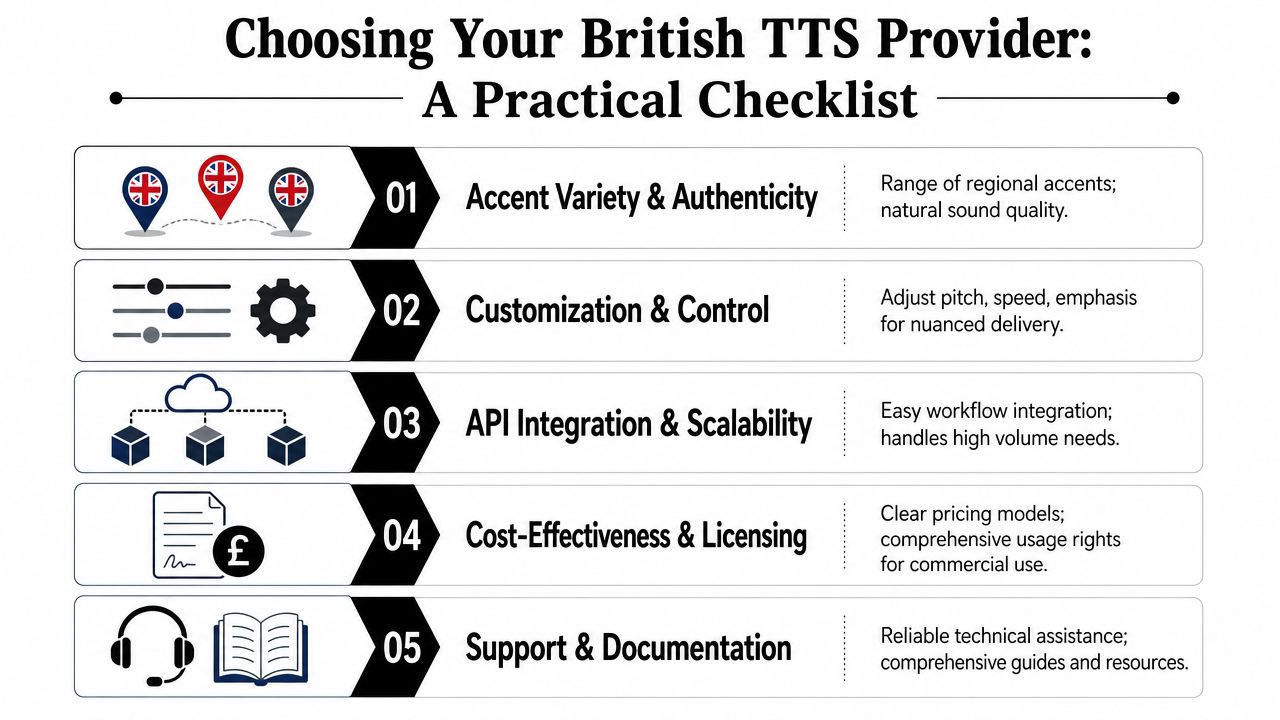
Use a shortlist based on operational criteria, not marketing copy.
- Accent depth: You want more than one polished RP voice. Check whether the provider offers usable regional variation and whether those voices sound distinct rather than cosmetically relabeled.
- Control layer: If you can't fine-tune pace, emphasis, or pronunciation, your team will end up editing scripts to fit the model instead of directing the performance.
- Scalability: API access matters when you're generating many variations for testing, approvals, or localization.
- Commercial usage clarity: Paid ads need explicit commercial rights. If the terms are vague, assume the risk is yours.
- Consistency: A provider that sounds great one day and unstable the next will slow production, especially when you need to update winning ads fast.
The voice cloning trap
Many teams face pitfalls: vendor messaging often makes voice cloning sound like a simple extension of TTS. For ad production, it's not simple.
According to MiniMax's British TTS page, a 2025 industry report found that 62% of performance marketers attempted voice cloning for British accents, but only 28% succeeded legally due to unclear vendor policies and the need for explicit consent under UK/EU IP laws. That gap tells you everything important. Interest is high. Clean execution is not.
Compliance check: If the voice is recognizably based on a real actor, creator, or public figure, get explicit permission before you build a campaign around it.
In practice, three things usually derail cloning projects:
- The provider's terms don't clearly cover paid advertising use.
- The source audio isn't good enough to reproduce subtle prosody.
- The marketing team assumes “available in the tool” means “safe to publish.”
A quick decision filter
Ask these questions in procurement calls or trial reviews:
| Question | Why it matters |
|---|---|
| Can we use this voice in paid ads and client work? | Commercial licensing has to be unambiguous |
| Can we batch-generate many versions? | Essential for creative testing and refresh cycles |
| Can we control pronunciation and pacing? | Needed for brand names, offers, and hooks |
| What happens if we need a replacement voice later? | Voice continuity affects active campaigns |
| Do you document consent requirements for cloning? | This separates serious vendors from loose claims |
Teams that need a broader framework for choosing production AI tools can compare these criteria against a wider best AI for marketing stack, then decide whether TTS is a standalone purchase or part of a larger creative pipeline.
Tuning Voice Performance with SSML
Most weak AI voiceovers aren't ruined by the voice model. They're ruined by flat direction.
SSML gives you that direction layer. It stands for Speech Synthesis Markup Language, but marketers don't need to treat it like a developer tool. Think of it as the notes you'd give a voice actor in session. Pause here. Stress this phrase. Slow down before the offer. Fix the pronunciation of the brand name.
Before and after pacing
A raw script often reads too quickly because the model has no reason to pause where a human naturally would.
Flat version
“Get your first order delivered today with lower fees and instant tracking across the app.”
Tuned version
“Get your first order delivered today... with lower fees... and instant tracking across the app.”
In SSML, that usually means adding brief breaks around benefit clusters. The result is more digestible and more persuasive, especially in direct response scripts that stack claims.
Emphasis changes what the viewer remembers
If every word carries equal weight, nothing lands. You need hierarchy.
Use emphasis on the thing that makes the ad worth hearing:
- Offer-led ads should stress the incentive.
- Problem-solution ads should stress the pain point first.
- Brand credibility ads should stress the outcome or differentiator.
A simple practical method is to mark one phrase in the hook, one in the body, and one in the CTA. Any more than that often sounds theatrical.
Don't use SSML to make a synthetic voice “perform.” Use it to make the message easier to process.
Pronunciation saves brands from avoidable errors
This matters more in UK campaigns than many teams expect. Product names, founder names, place names, and category terms can all be misread. One wrong pronunciation can make the whole ad sound outsourced.
Use phonetic controls or pronunciation tags when:
- Brand names are coined or stylized
- Acronyms need a specific reading
- Place names matter to local targeting
- Financial or medical terms need precision
For example, if a brand uses a name that could be read in an Americanized way, lock it before you render dozens of variants.
A marketer-friendly SSML workflow
You don't need an elaborate process. Keep it simple:
- Write the script for natural speech, not for on-screen reading.
- Render a plain version.
- Listen once for speed, once for emphasis, and once for pronunciation.
- Add only the tags needed to fix those issues.
- Export naming conventions that make version testing easy.
The goal isn't perfection in one pass. It's controllable variation. A cleaner pause before the CTA or stronger emphasis on the core benefit can make a version feel much more native to the platform.
Integrating TTS into High-Volume Ad Workflows
One polished UK voiceover is useful. A repeatable system for generating many credible UK voiceovers is where British text to speech starts affecting performance operations.
The teams that get the most from TTS don't treat audio as a final export step. They treat it as one interchangeable component inside modular creative production. That means the voiceover sits alongside the hook, body segment, visual proof, offer framing, captions, and CTA as a testable element.
What a scalable workflow looks like
At a practical level, the workflow is usually this:
- Script in modules: Write multiple hooks, multiple body variants, and multiple CTAs.
- Assign voice hypotheses: Pair each script variant with a chosen accent and delivery style.
- Tune selectively: Apply SSML only where pacing or emphasis materially changes comprehension.
- Render in batches: Export voiceover variations using consistent file naming.
- Assemble against multiple visuals: Test the same audio across creator footage, product demos, and motion-led edits.
- Read performance by combination: Look for patterns between voice style and visual context, not just asset-level winners.
This is how you move beyond simple A/B testing. You learn whether a regional accent helps only with UGC visuals, whether a more formal delivery improves finance hooks, or whether conversational reads outperform polished ones in retargeting.
Where teams waste time
Most production delays happen because the workflow wasn't designed for volume.
Common bottlenecks include:
| Bottleneck | What it causes |
|---|---|
| Manual file handling | Slow versioning and naming confusion |
| No pronunciation standard | Inconsistent brand reads across ads |
| Voice chosen too late | Scripts and edits have to be redone |
| No modular structure | Hard to isolate which variable improved performance |
A better system starts by deciding the voice strategy at brief stage, not after edit lock.
How to connect voice choices to CAC and ROAS
Audio rarely works alone, but it does influence whether the ad earns attention and trust fast enough to carry the click. When voice aligns with audience, script, and visual context, the creative tends to feel more coherent. Coherent ads usually survive longer in rotation and give buyers more stable foundations for scaling.
That's especially relevant in multivariate pipelines. If your team is already building modular assets and exploring how to scale ad creative production, British text to speech can slot in as another structured variable instead of an ad hoc production shortcut.
The key operational shift is this: don't ask, “Can AI make this voiceover?” Ask, “Which voice variation belongs in this test matrix?” That framing leads to better creative decisions and cleaner learnings.
From Generic Audio to a Strategic Creative Asset
British text to speech's primary value isn't that it saves studio time. It's that it gives performance teams a faster way to make voice more relevant.
A generic British read can still work in some campaigns. But in competitive UK markets, generic usually means less specific, less local, and less persuasive than it should be. The stronger approach is to treat accent as a targeting signal, SSML as direction, provider selection as a legal and workflow decision, and voiceover generation as part of a structured testing system.
That's where British text to speech starts acting like a strategic asset. You can match tone to product category, match accent to audience expectation, and test delivery across visual concepts without rebuilding your process every time. That improves creative throughput and gives media teams more meaningful variants to learn from.
If you're reworking your production stack, it's also worth reading how generative AI in advertising is changing timelines and creative operations more broadly. The useful lesson isn't “replace people.” It's “give teams more controllable ways to produce, test, and refine.”
British text to speech is one of those controllable ways. Used carelessly, it sounds generic. Used strategically, it helps ads feel local, deliberate, and built for the audience you're paying to reach.
If your team wants to turn voiceovers, hooks, visuals, and CTAs into a repeatable testing system, Sovran helps you build and launch modular video ad variations at scale without slowing down creative quality.

Manson Chen
Founder, Sovran
Related Articles
Storyboard Development: Scale Video Ad Production in 2026

8 Pattern Interrupt Techniques for Video Ads