My Facebook Ads Stopped Working: Quick Fixes
Jump to a section
If you're searching my facebook ads stopped working because a campaign that carried your account last week is suddenly bleeding cash, you're in the same spot a lot of media buyers hit sooner or later. The ugly part is how fast it happens. One day the ad set looks stable. The next day delivery slows, CTR falls off, conversions get inconsistent, and every change feels like it makes things worse.
Advertisers often react the same way. They start touching everything. Budget. audience. bids. placements. attribution. Sometimes that helps. Often it just destroys whatever signal the campaign still had.
The right move is calmer than that. First, rule out the account and tracking issues that can shut delivery down fast. Then look at auction pressure, landing page friction, and campaign structure. But in 2026, the root cause usually isn't hidden in a bid cap or some obscure toggle. It's creative fatigue, and the fix isn't one fresh ad. It's a system that can keep feeding Meta new variations before your current winners burn out.
That Sinking Feeling When Your Best Campaign Dies
The worst version of this problem isn't a campaign that was mediocre and stayed mediocre. It's the campaign that worked. It had momentum, clean economics, and enough consistency that you started trusting it. Then it stalled.
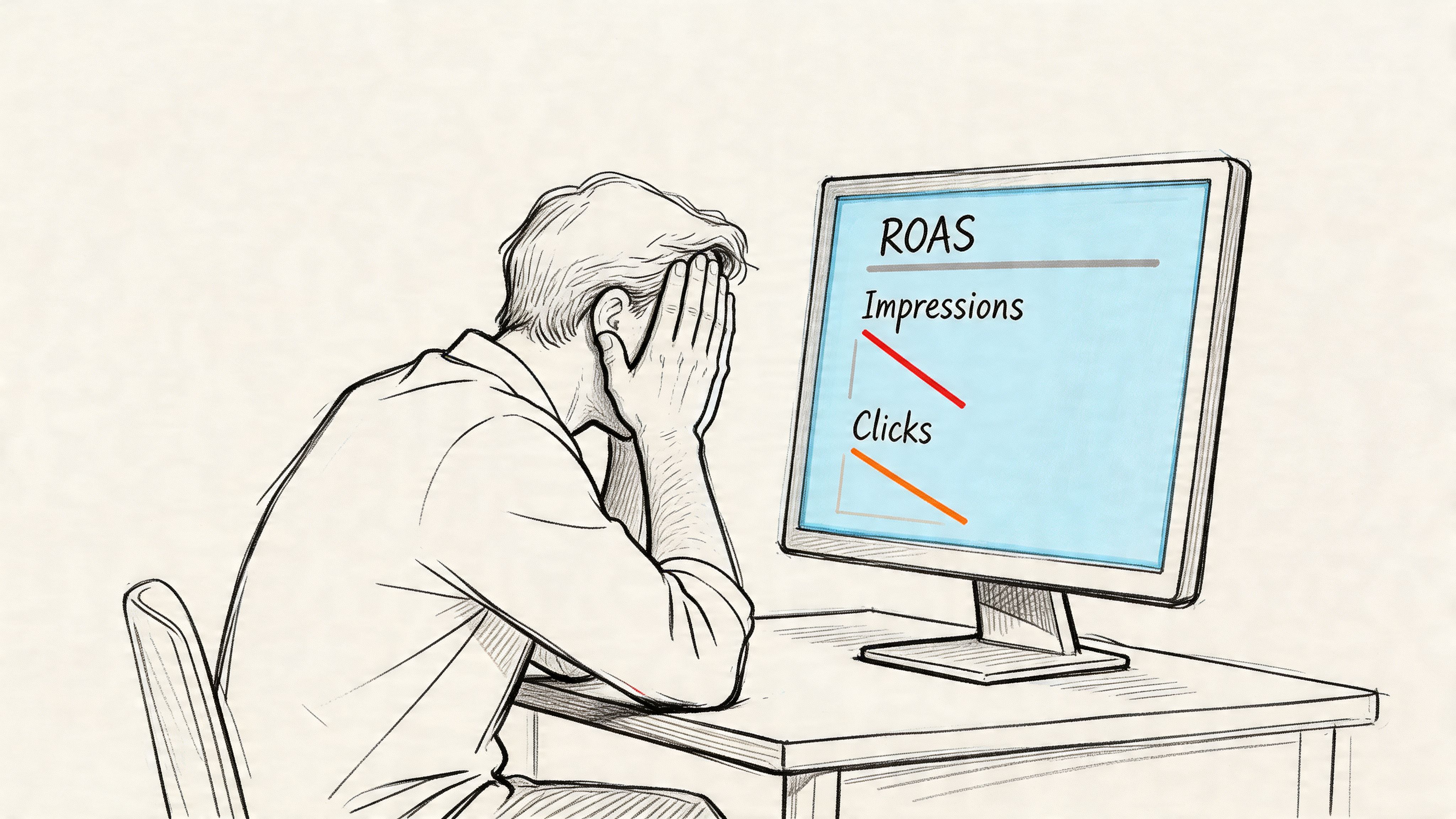
That moment creates bad decisions because the dashboard makes everything look urgent. Delivery dips. CPM moves. CPC rises. Your first instinct is to hunt for a settings mistake. Sometimes that's correct. A paused ad, a cap, a broken event, or a review issue can absolutely choke a campaign. But once you've managed enough Meta spend, you learn that "sudden" underperformance usually has layers.
What most buyers get wrong first
The common mistake is treating every stall as a technical problem. They assume the machine broke. In a lot of accounts, the machine is doing exactly what it was trained to do. It stopped getting strong enough signals from the creative.
That's why ad diagnostics need to start broad. The ad itself, the post-click experience, and the economics of scaling all matter. If you're refreshing your thinking on Meta video formats, this breakdown of Facebook Video Ads is a useful reference point because format choice still shapes how quickly fatigue sets in.
Practical rule: Don't rebuild the account in a panic. Confirm whether you've got a delivery problem, a tracking problem, or a creative problem before you make structural changes.
Why this happens more now
Meta has become less forgiving of stale creative. A campaign can look healthy right up until the point your audience has seen the same angle too many times, stopped reacting, and the system starts finding weaker impressions. That's one reason older "set it and scale it" playbooks keep failing.
A lot of the failure pattern also comes from teams repeating avoidable account mistakes. If you want a quick gut check on that side of the equation, five mistakes brands and agencies make in Facebook ads is worth reviewing before you touch your live campaigns.
Your Immediate 15-Minute Triage Checklist
You open Ads Manager at 9:07 a.m. Yesterday's winner is still spending, but CPA has jumped, CTR is sliding, and conversions look thin. That moment pushes buyers into random edits. Resist that urge for fifteen minutes.
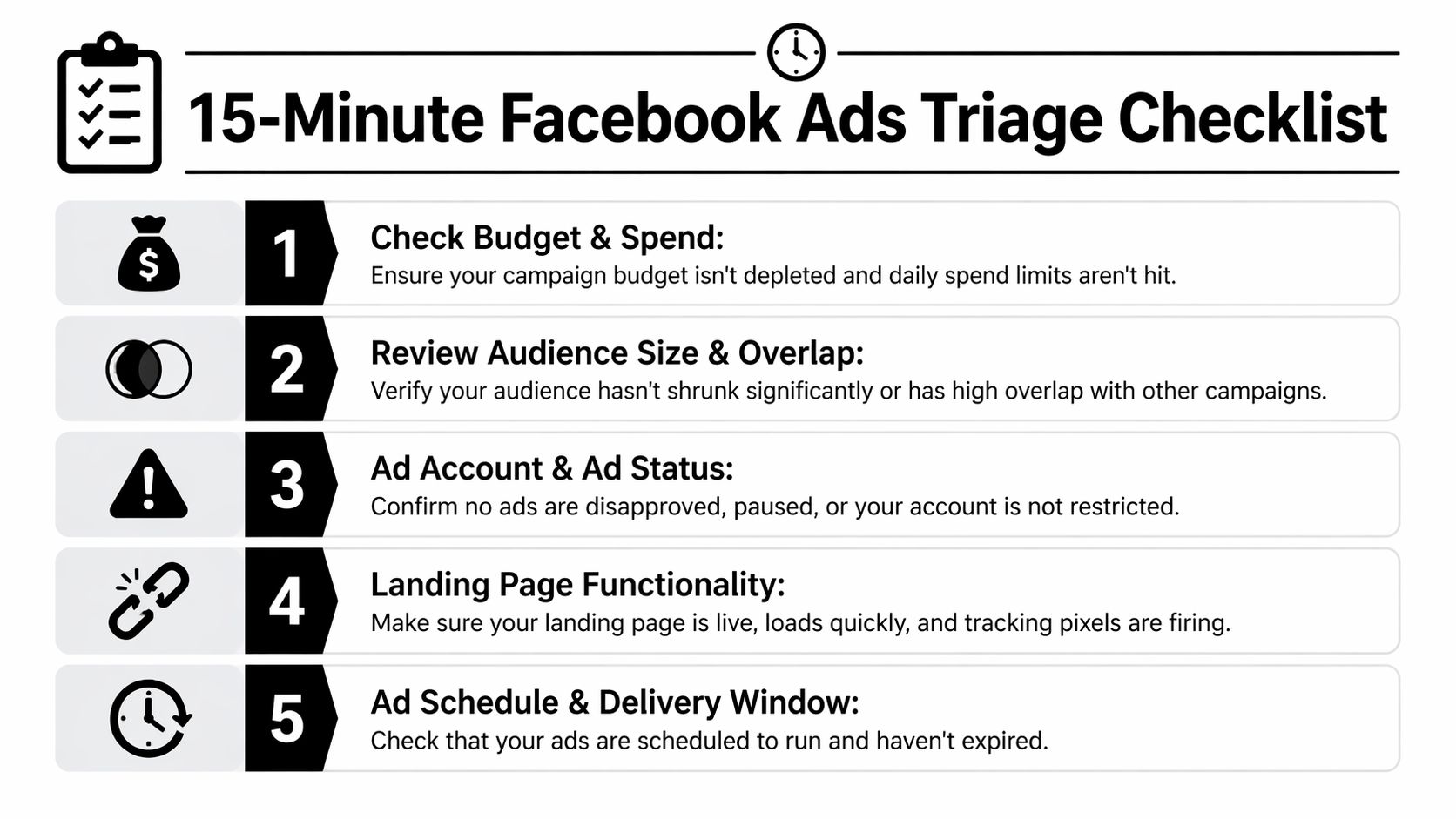
Run a clean check first. The goal is simple: confirm whether the campaign is blocked, broken, or just wearing out. A lot of accounts have more than one issue at once, and if you change structure before you verify the basics, you lose the trail.
Check delivery status first
Start with the delivery column at every level: campaign, ad set, and ad.
Look for anything inactive, limited, in review, rejected, or scheduled outside the current time window. Then check account activity history. Automated rules, a teammate's edit, a rejected duplicate, or an expired schedule can shut off delivery without much warning.
If several campaigns dipped at the same time, treat that as an account signal, not a single-ad problem.
Check account-level limits and payment issues
This takes two minutes and saves a lot of wasted diagnosis.
Spending limits, failed card charges, billing thresholds, and account quality restrictions can stop delivery across the board. If spend fell off a cliff in multiple campaigns on the same day, check billing before you touch bids or budgets.
Confirm your events are still firing correctly
A campaign can stay live while optimization loses the signal it needs.
Open Events Manager and test the exact events tied to the campaign objective. Confirm the right event fires on the right page, action events are not firing on load, and deduplication is working if you're using Pixel with Conversions API. If your team needs a setup reference, use this guide to connecting Meta through Pixel and Conversions API.
Bad tracking makes diagnosis messy fast. It can make strong creative look weak and hide a landing page problem behind inflated platform numbers.
Inspect ad review, destination, and asset issues
A lot of stalled ads are technically "live" but fail somewhere between the creative and the destination.
Check these first:
- Catalog integrity: Broken product IDs, unavailable variants, or out-of-stock items can interrupt delivery for catalog campaigns.
- Destination health: Landing pages that 404, redirect badly, load slowly, or fail on mobile can tank results even when delivery looks normal.
- Post and permission issues: Deleted posts, changed permissions, and inherited post problems can break an ad that used to work.
- Asset formatting: Wrong aspect ratios and low-quality crops can hurt placement coverage. If you need a quick fix, use a tool to resize images for Facebook.
Check frequency with response, not by itself
Frequency is a triage metric because it helps separate delivery trouble from ad fatigue.
Pull frequency next to CTR, CPC, and conversion rate. If frequency is rising and response is falling, the ad is probably losing its grip on the audience. If frequency is up but CTR and CPA are stable, the problem may be somewhere else. That distinction matters because technical fixes will not revive a tired angle for long.
In 2026, this is the failure pattern I see most. The account is usually still capable of spending. The creative just stopped earning attention.
Review budget, bid controls, and schedules
Now look for restrictions you or the system added earlier for a good reason that no longer applies.
- Budgets: Tiny daily budgets can keep ad sets stuck in weak delivery patterns.
- Bid caps and cost controls: These can protect efficiency, but they also choke spend when the auction gets tighter.
- Schedules: Narrow run windows often reduce delivery more than buyers expect, especially on smaller audiences.
The trade-off here is simple. Controls protect downside, but too many controls can prevent recovery.
Freeze major edits until the checklist is done
Do not duplicate campaigns, reset learning, or launch a new structure before you finish the check.
The first fifteen minutes should tell you whether Meta stopped delivering, your measurement broke, or the ad has run out of room. And in a lot of accounts, that last one is the actual answer.
Diagnosing Deeper Technical and Bidding Issues
If a campaign clears the first triage pass and still stays weak, stop treating it like a simple spend problem. At that point, the job is to isolate failure by layer. The cleanest way to do that is the A.W.S. framework: Ads, Website, and Strategy. This A.W.S. diagnostic explanation lays out that structure well, and it matches how broken campaigns usually show up in real accounts.
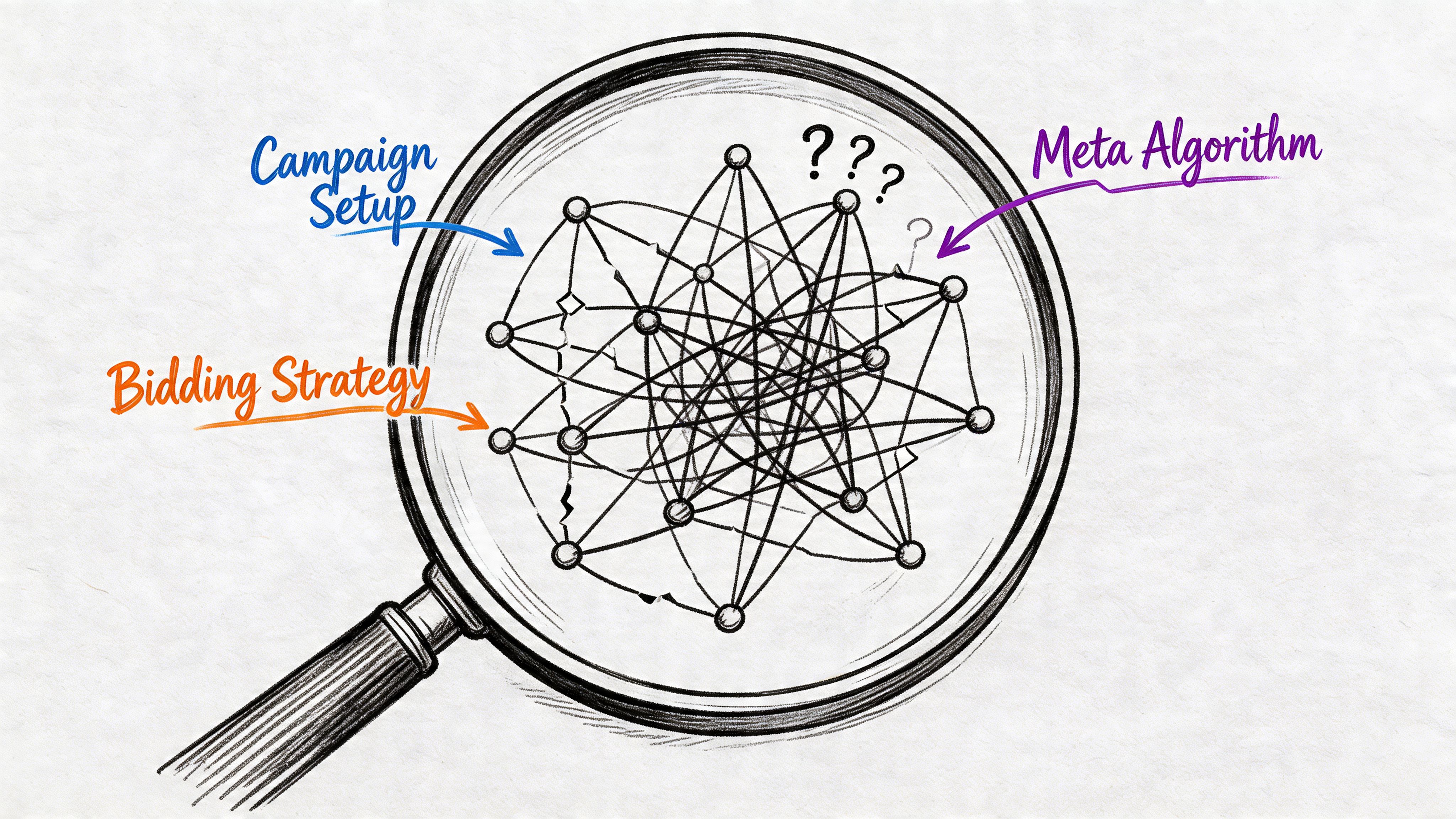
The reason this framework helps is simple. The dashboard can show the same symptom for three different causes. CPA rises whether the hook got weak, the landing page started leaking intent, or the account structure stopped giving Meta enough signal to optimize.
Ads quality and thumbstop problems
Start with the ad, because buyers still spend too much time adjusting bids around weak creative.
Thumbstop rate matters here, but not as a vanity metric. It tells you whether the opening earned enough attention to let the rest of the ad work. In a lot of accounts, product-first openings lose people before the pitch even starts. Hook-first openings usually hold longer because they create tension, identify a pain point, or show a clear outcome before the viewer files it under "ad."
Review the dead campaign with that in mind:
- Weak opening: The first beat explains the product instead of earning attention.
- Flat message: The copy repeats a claim the category has already worn out.
- Offer mismatch: The click promise and the landing page ask for two different mental commitments.
- Format drift: The concept may still be sound, but the execution no longer fits how the audience is consuming Reels, Stories, or feed placements.
If you want a quick outside view of how your creative mix and account patterns look, tools that analyze your Facebook account can help surface what you've stopped noticing inside your own workflow.
This is also where buyers misdiagnose the core issue. They call it technical because the campaign used to work. Often the ad merely stopped earning attention, and the platform had no reason to keep giving it favorable inventory. That matters because technical fixes can stabilize delivery for a while, but they rarely restore a tired message. In 2026, that is usually the bigger problem.
Website friction and post-click drop-off
Sometimes the click is healthy and the sale dies after the page loads.
Slow pages, weak mobile UX, missing proof, confusing layouts, and checkout friction can make a media problem look worse than it is. The ad did its part. The site failed to continue the argument. A strong ad creates momentum. The landing page either carries that momentum forward or wastes it by forcing the user to re-interpret the offer.
A simple audit question helps here: does the page feel like the next sentence after the ad, or a different conversation entirely?
A click is not proof the ad worked. It's proof the promise was interesting enough to test.
Post-click issues also distort bidding decisions. Buyers often react to poor conversion rates by tightening budgets or adding controls, when the better fix is cleaning up the page path and restoring signal quality.
Strategy and scaling economics
The last layer is strategy. Some campaigns stop working because the account structure, optimization path, or spend level no longer fits the economics of the offer.
That shows up a few different ways. A campaign may be profitable at $300 a day and unstable at $1,000 because the account runs out of high-intent inventory. A narrow segmentation plan can also starve the pixel of conversion data, especially if the budget is split across too many ad sets. If you're reviewing that side of the account, this guide on Meta ad campaign structure is a useful reference.
Here is the faster read on common patterns:
| Signal | What it often means |
|---|---|
| Strong click performance but poor conversion | Website or offer friction |
| Weak early engagement | Creative issue |
| Delivery instability after scaling | Strategy or auction pressure |
| Good branded traffic, poor cold traffic | Message does not carry beyond warm awareness |
There is a real trade-off here. More control can protect efficiency, but too much segmentation, too many constraints, and too little budget concentration can leave the system half-blind. The campaign looks broken when the account is underfeeding the algorithm.
Later in the analysis, it helps to review the mechanics visually:
If Ads, Website, and Strategy all check out, stop hunting for a hidden settings issue. The more common answer is that the market has already absorbed the message. At that point, recovery comes from new creative angles and faster testing, not another round of bid tinkering.
Creative Fatigue: The Primary Culprit in 2026
Once tracking, site friction, offer problems, and auction setup are ruled out, the pattern is usually simpler than people want it to be. The account has shown the same message too many times, to too many similar people, for too long.
That is why strong campaigns stall now. Creative fatigue is not a side diagnosis in 2026. It is the default diagnosis until the account proves otherwise.
Why fatigue is hitting faster
Meta rewards advertisers who give the system more creative options to match against different pockets of demand. A single winner can still work, but its shelf life is shorter than it used to be. What looked like a stable control a year or two ago now behaves more like a temporary match between one angle, one audience state, and one moment in the auction.
That shift changes the job. Media buying used to leave more room to squeeze performance from structure, bids, and budget distribution. Those still matter. They just stop carrying the account once the market has absorbed the message.
Creative velocity is now the requirement.
What fatigue looks like inside the account
Fatigue rarely announces itself with a clean failure. Spend continues. Delivery looks normal enough. The campaign keeps running while efficiency slips.
The pattern usually shows up like this:
- CTR drops before anything else. The hook no longer earns attention from the same audience.
- CPM can rise as Meta searches harder for responsive impressions.
- CPA drifts up even if the landing page and offer have not changed.
- Frequency climbs, or impression quality falls, or both.
- New spend produces weaker incremental results than earlier spend on the same ad.
This is why teams misread it. The campaign is alive, but the message is stale.
If conversion tracking is clean, the site still converts, and performance decays across spend, clicks, and efficiency, treat creative fatigue as the lead suspect.
Why a single replacement ad stops working as a fix
A one-off refresh can buy time. It does not solve the operating problem.
If the team can only ship one or two polished ads every few weeks, fatigue will keep catching up. The auction now favors accounts that can introduce new hooks, proof styles, edits, offers, and story angles on a steady cadence. The winning setup is not one hero creative protected for as long as possible. It is a repeatable system that produces enough variation to keep learning.
That is the trade-off. More creative volume means looser attachment to any single ad and a messier production workflow. Less creative volume feels cleaner, but it leaves the account exposed the moment the current winner burns out.
If your team is already seeing that pattern, this guide to creative fatigue solutions is useful because it treats fatigue as an operating issue, not just a copy problem.
What holds up now is intentional variation. New openings. Different claims. Different emotional entry points. Different proof. Different edits. The buyer who can test those consistently usually outlasts the buyer still trying to rescue one ad with targeting and bid tweaks.
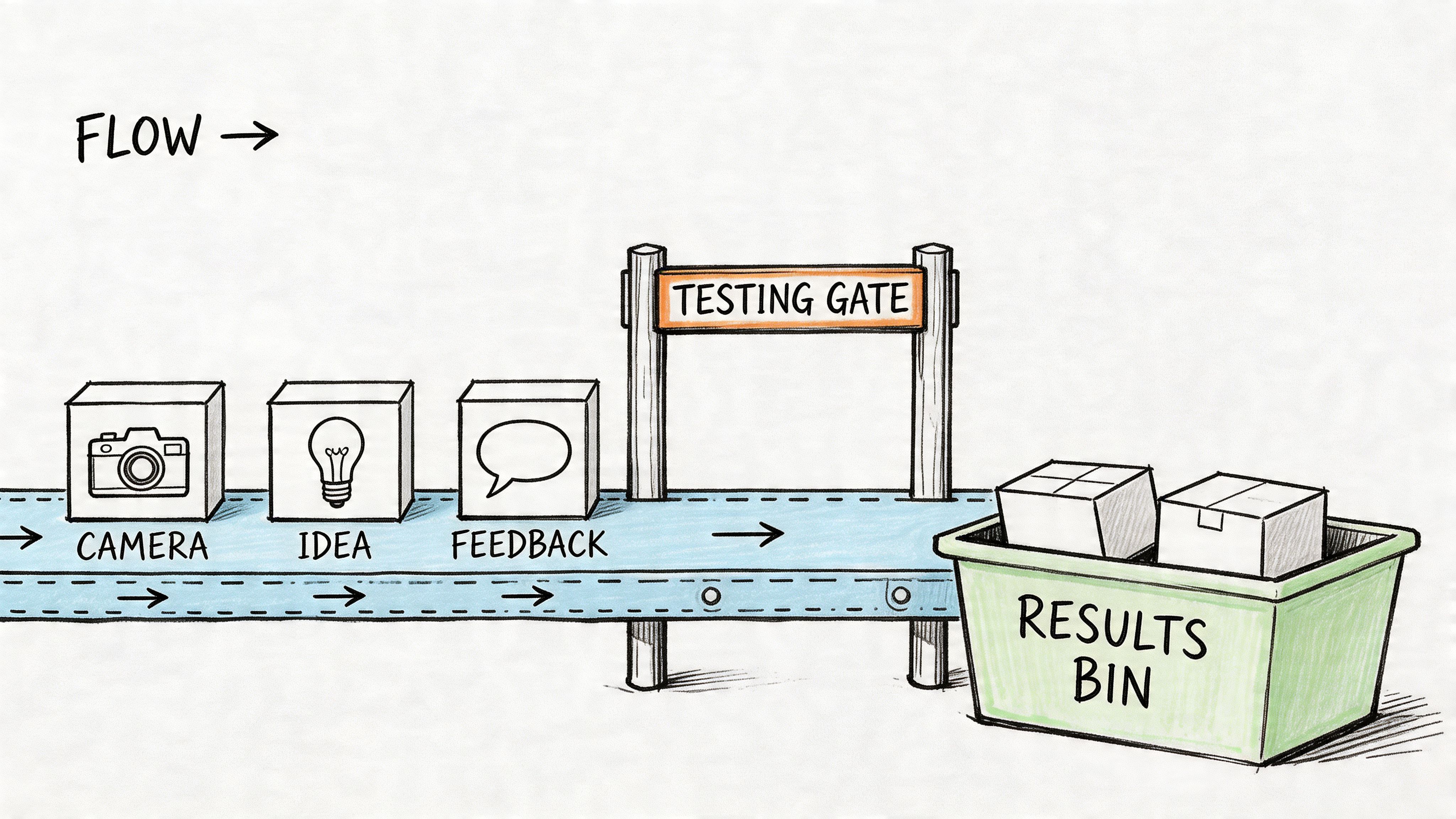
Building a High-Velocity Creative Testing Engine
A stable Meta account in 2026 needs a way to produce, ship, and learn from new creative every week. If that system is missing, performance depends too heavily on one winner staying alive longer than it should.
Build creatives as parts, not finished objects
The practical shift is to stop treating each ad as a one-off deliverable. Build from components that can be swapped, reused, and tested in combinations:
- Hooks: the first visual, claim, question, or spoken line that wins attention
- Bodies: the demo, explanation, proof, offer context, or story
- CTAs: the close, next step, or purchase framing
That approach changes the unit of work. Instead of producing five fully separate ads, the team can produce three hooks, two bodies, and two closes, then test the combinations that make sense. You get more shots on goal without rebuilding from zero every time.
A simple testing matrix looks like this:
| Creative element | What to vary |
|---|---|
| Hook | Pain point, curiosity, objection, social proof, contrast |
| Body | Demo, founder voice, UGC-style explanation, before-after, testimonial framing |
| CTA | Direct buy, soft learn-more, urgency, benefit-led close |
Structure tests so the results mean something
Creative volume only helps if the account can learn from it.
Start by separating concept tests from spend tests. One campaign should answer, "Does this angle earn attention and qualified clicks?" Another should answer, "Can this angle keep efficiency as budget rises?" Mixing both goals inside the same setup muddies the read.
Then control the rate of change. Swap hooks faster than bodies. In my experience, the opening usually burns out first, while the middle of the ad often stays usable longer than teams assume. Keep a clear naming system so you can trace what won. If Hook B plus Demo 2 worked, that matters more than labeling the whole ad a winner and forgetting why it worked.
One more practical rule. Carry over components, not just full ads. Sometimes the best asset in the account is a three-second opener or a tighter CTA, not the entire edit.
Make production fit the team you actually have
A lot of testing plans die in operations. The strategy sounds right on paper, then the team has to cut every version manually, rename files, rebuild timelines, and upload assets one by one. Velocity disappears in the handoffs.
Tooling starts to matter at that stage. A documented Meta creative testing framework for modular ad production helps teams decide what to vary, how to name assets, and how to judge winners without turning the workflow into chaos. Platforms such as Sovran support that model by organizing footage in an asset bank, tagging scenes and transcripts, letting teams recombine hooks, bodies, and CTAs in a timeline editor, and pushing batches of variations into Ads Manager.
That does not remove the hard part. The hard part is still having enough raw material, enough customer insight, and enough editorial discipline to produce angles people have not tuned out yet. But the right workflow removes the admin drag that slows testing to a crawl.
The real trade-off
High-velocity creative testing is less tidy than protecting one polished control. Creative reviews get messier. Naming discipline matters more. Some variations will look ordinary and still win because they catch attention in-feed better than the ad everyone in the room preferred.
That is the trade. Give up a little aesthetic control to get faster learning, quicker fatigue recovery, and fewer weeks spent trying to rescue an ad that already peaked. In the current Meta market, that trade is usually profitable.
Frequently Asked Questions
How long should I wait before deciding an ad is dead
Don't use one bad day as the verdict. Look for a pattern across delivery quality, click behavior, and conversion quality. If the campaign is spending normally but attention signals are fading and replacements consistently beat the incumbent on hook strength, it's usually time to rotate rather than wait.
Should I duplicate the campaign or fix the existing one
If the issue is a broken setting, fix the existing campaign. If the issue is fatigue, duplication rarely solves the root problem because you're often pushing the same creative back into the same market. Duplicate when you need a clean test condition. Don't duplicate as a superstition.
Does broad targeting fix creative fatigue
Usually not by itself. Broad targeting can buy room if your audience is cramped, but stale ads still stay stale. Better targeting can improve distribution. It can't manufacture fresh attention.
Is my landing page still worth checking if the ads were working before
Yes. Pages break, load behavior changes, products go out of stock, and friction compounds subtly. A campaign can degrade from both sides at once. That's why buyers who only look inside Ads Manager miss easy wins.
How many creative variations do I actually need
Enough to keep learning without exhausting the same angle. The exact number depends on your spend, audience size, and production capacity. The bigger point is structural: one hero ad is fragile, while a system of variations is resilient.
Should I pause ads during learning if performance looks weak
Usually no. Mid-learning edits can make diagnosis harder. If the setup is valid, let the campaign collect signal unless there's a clear technical fault or obvious budget waste.
Common questions for stalled Facebook Ads
| Question | Answer |
|---|---|
| My facebook ads stopped working overnight. What's the first thing to check? | Delivery status, account limits, payment issues, and event tracking. Confirm the campaign is eligible to serve before changing strategy. |
| If tracking looks fine, what's the likely cause? | In many accounts, it's creative fatigue. The ad can still spend while the hook loses power. |
| Should I change bids and budgets right away? | Only after ruling out simple blockers and reviewing whether the issue is actually creative. |
| Can one new ad fix the problem? | Sometimes briefly. It usually won't fix the workflow issue that caused the stall. |
| What's the durable solution? | A high-velocity testing system built around modular creative variation. |
If your team is tired of reacting every time a winner burns out, take a look at Sovran. It's built for marketers who need a practical way to turn existing footage into many testable Meta variations, manage modular assets, and publish faster without rebuilding the whole production process every week.

Manson Chen
Founder, Sovran
Related Articles
How to Fix Ad Fatigue Meta Ads: The 2026 Playbook
- how to fix ad fatigue meta ads
- meta ads
- 3 more
Ad Creative Refresh Strategy: A Tactical Playbook
- ad creative refresh strategy
- creative fatigue
- 3 more

Storyboard Development: Scale Video Ad Production in 2026
- storyboard development
- video ads
- 3 more