How to Fix Ad Fatigue Meta Ads: The 2026 Playbook
Jump to a section
- Your Winning Ad Is Dying and Ad Fatigue Is Why
- Diagnosing Ad Fatigue with Data Not Guesswork
- The Creative Refresh A Tiered Approach to Recovery
- Adjusting Audiences and Placements to Extend Creative Life
- Using Advanced Levers Like Budget Pacing and Optimization
- Build a System to Prevent Fatigue with Sovran
A Meta ad rarely dies all at once. It fades in a pattern you’ve probably seen too many times. The creative that carried the account last week starts missing targets, link CTR softens, CPA drifts upward, and the team keeps asking the same question: is this a bad day, a bad audience, or a fatigued ad?
Most accounts treat that moment as a creative problem. Swap the thumbnail. Write new primary text. Duplicate the ad set and hope delivery resets. Sometimes that buys time. Often it doesn’t, because ad fatigue on Meta isn’t just a creative issue. It’s a systems issue. If you can’t detect fatigue early, isolate whether the problem is creative or saturation, and ship enough usable variations fast enough, you end up reacting late and overpaying for every lesson.
That’s the core answer to how to fix ad fatigue meta ads. You need tactical recovery moves, but you also need a production engine behind them. Without that, every “refresh” becomes a scramble.
Your Winning Ad Is Dying and Ad Fatigue Is Why
The usual sequence is predictable. You launch a strong concept, Meta finds responsive pockets of demand, and performance climbs fast. Then the same ad keeps serving into the same market, the novelty wears off, and the response rate drops before its replacement is ready.
That’s ad fatigue. Not the vague version people talk about when any campaign underperforms. The practical version. The audience has seen the same message enough times that the ad stops earning attention at the same rate.
Industry guidance puts some structure around that pattern. Mild fatigue often shows up as a 15-20% CTR decline, while severe fatigue can reach 30%+ CTR declines, often after 7-14 days or around 500,000 impressions in major markets like the US and EU, according to Pixis on data-driven ways to combat ad fatigue. That’s why the old habit of “just let winners run” gets expensive faster than many teams expect.
Why most fixes fail
The first mistake is treating every dip like a creative emergency. The second is waiting until the ad is fully burned out before changing anything. Both kill efficiency.
What works is a repeatable operating model:
- Detect fatigue early: watch for decay before the ad collapses.
- Decide what’s worn out: the hook, the visual, the audience, the placement, or the delivery path.
- Refresh with the lightest viable change: don’t rebuild a concept if one component is the issue.
- Keep a queue of replacement assets ready: if production starts after fatigue hits, you’re already late.
Fatigue is expensive because it rarely looks dramatic at first. It looks like a winner becoming average, then average becoming unscalable.
If your team is already feeling that pressure, this is the right point to tighten your workflow around creative fatigue solutions for performance marketers. The accounts that stay stable aren’t the ones with one brilliant ad. They’re the ones with a system that replaces brilliance before it burns out.
Diagnosing Ad Fatigue with Data Not Guesswork
Teams often diagnose fatigue too loosely. They “feel” an ad is tired because results are off, then they pause it without proving whether the issue is creative wear-out, audience saturation, or simple delivery noise. That habit kills good ads early and lets bad ones linger.
The fix is straightforward. Judge each creative against its own fresh-state baseline, not the account average.
Set a baseline before you optimize anything
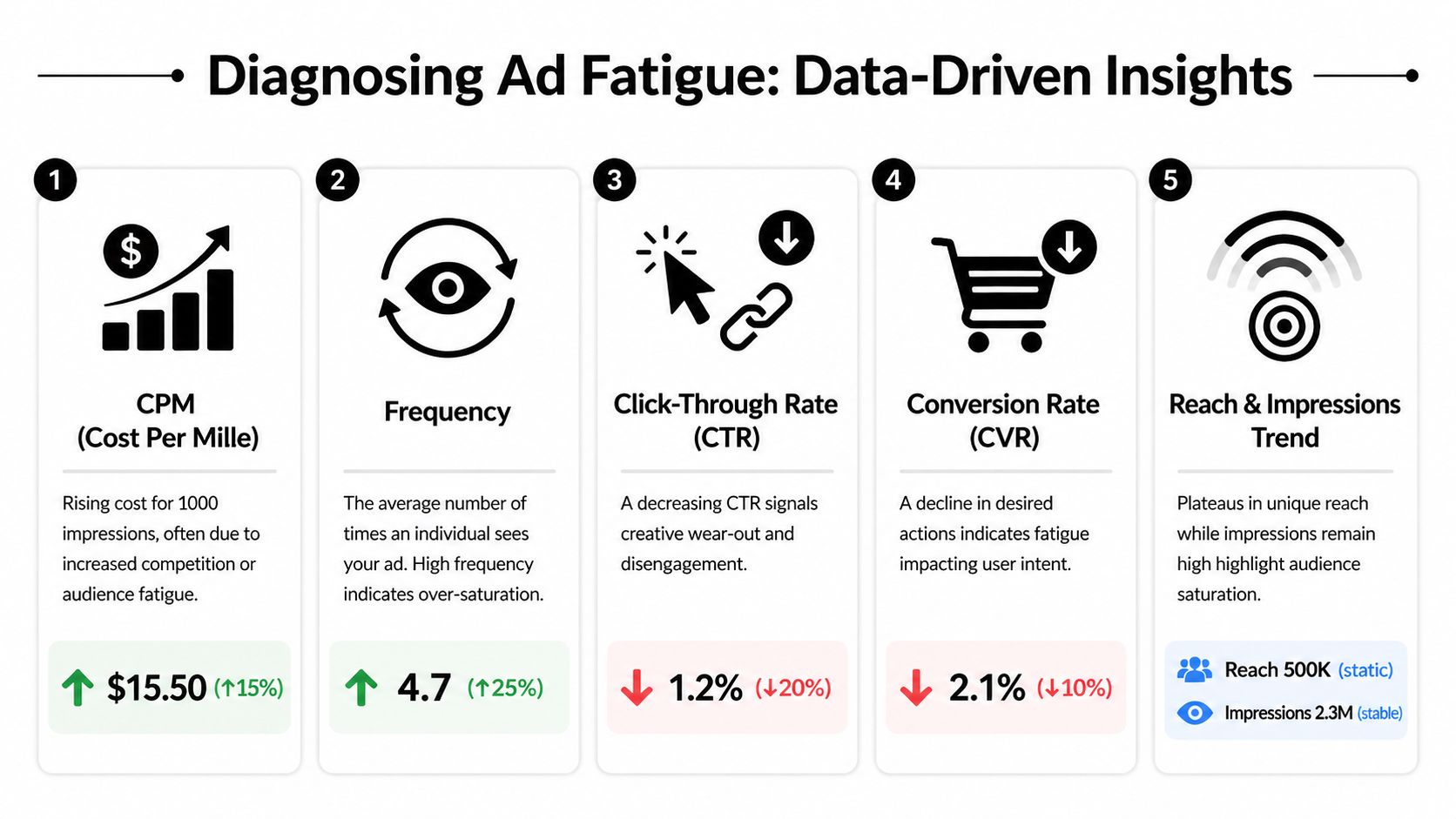
Record each ad’s CTR during its first 3-5 days. Then compare its current 3-day CTR against that original baseline. When the current CTR drops 20-30% below its own baseline, the ad has entered the fatigue zone, based on The Optimizer’s baseline methodology for Meta ad creative fatigue.
That sounds simple, but it changes how you manage the account. A mediocre ad can still be healthy relative to its own norm. A former hero can be badly fatigued even if the blended account CTR still looks acceptable.
Read the pattern, not a single metric
Ad fatigue is easiest to confirm when several signals line up. I look at the relationship between delivery, engagement, and downstream efficiency.
| Signal | What it tells you | How to interpret it |
|---|---|---|
| Per-creative CTR trend | Whether the ad is still earning attention | A sustained drop versus its own baseline is the clearest early signal |
| Frequency | How concentrated delivery has become | Rising repetition increases the odds that the same users are tuning it out |
| CPA trend | Whether fatigue is now affecting acquisition efficiency | This is usually a lagging confirmation, not the first warning |
| Placement breakdown | Where the ad is wearing out fastest | Some placements burn faster than others |
| Audience segment view | Which cohort is tired of the message | Cold, warm, and geographic cohorts don’t fatigue at the same pace |
Practical rule: If you can’t explain performance at the creative level, don’t make account-level decisions yet.
For broader context on how delivery costs vary across categories, it helps to benchmark your account against Meta ads CPM by industry. That won’t diagnose fatigue by itself, but it helps separate market pressure from creative decay.
Common diagnostic mistakes
A few patterns show up in almost every struggling account:
- Using blended averages: account-level CTR hides which ad is failing.
- Calling every performance drop fatigue: sometimes the issue is audience overlap or a weak landing page session.
- Ignoring cohort-level differences: a warm audience can be saturated while a cold audience is still responsive.
- Waiting for CPA to spike first: by then, the ad has already wasted budget.
The practical goal isn’t perfect certainty. It’s acting early enough that you still have options.
The Creative Refresh A Tiered Approach to Recovery
Creative is still the most impactful fix. But “refresh the ad” is too blunt to be useful. You need a tiered recovery model that matches the size of the problem.
Best practice recommends rotating 4-8 creative variations per ad set, but most in-house teams don’t have the production bandwidth to maintain that volume consistently, according to Influee’s discussion of Facebook ad fatigue and creative volume. That’s why so many teams know the right answer and still can’t execute it.
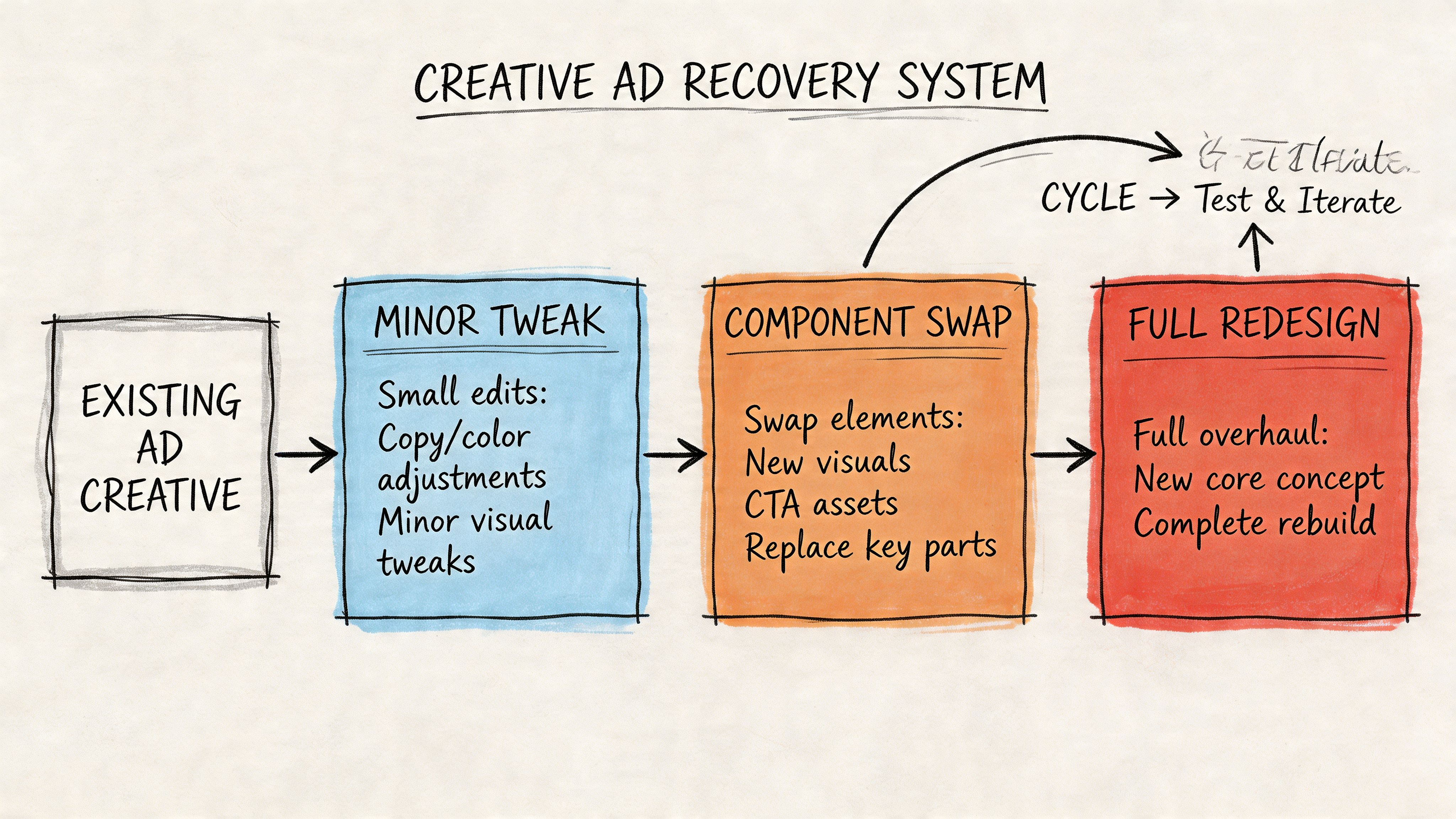
Tier 1 for fast saves
Start with low-friction edits when the concept still has life.
You swap the headline, rewrite the first line of primary text, change the CTA framing, or change the opening caption treatment. These moves don’t create a new idea. They restore contrast and make the ad feel less stale to users who’ve half-seen it before.
Use this tier when the body of the ad is still sound but the top of the funnel response is weakening. Don’t use it when the whole concept has clearly flattened.
Tier 2 for modular recombination
This is the workhorse tier for serious accounts. You keep the winning assets that still pull, then swap the pieces that audiences are ignoring.
That usually means recombining:
- New hooks with the same proof segment
- The same visual with a different offer angle
- A familiar body with a new CTA ending
- The same footage recut for another format or pacing style
If your team is building a proper short-form pipeline, resources on content repurposing strategies for short-form video are useful because they map well to paid social reality. Most winning Meta ads don’t come from net-new shoots every week. They come from better recombination of footage you already own.
If a team can only refresh by producing from scratch, it will always refresh too slowly.
Tier 3 for concept replacement
Sometimes the ad is done. No amount of line edits or modular swaps will bring it back. That’s when you replace the concept entirely.
Teams frequently overcorrect and throw out everything. Don’t. Log what the old winner taught you first. Which hook pattern worked? Which proof device held attention? Which CTA framing converted? Keep those learnings, even if the final asset is retired.
A good ad creative refresh strategy for Meta accounts turns these tiers into operating rules rather than last-minute debates. That matters because the primary bottleneck is almost never creative strategy alone. It’s production velocity. If your team needs a full briefing, edit cycle, and approval chain for every refresh, fatigue will outpace you every time.
Adjusting Audiences and Placements to Extend Creative Life
Not every tired campaign needs a new ad. Sometimes the creative is still strong, but delivery has over-concentrated in one segment, one market, or one placement. When that happens, creative changes alone won’t solve the problem.
Disciplined audience management is what earns its keep.
Measure fatigue by cohort
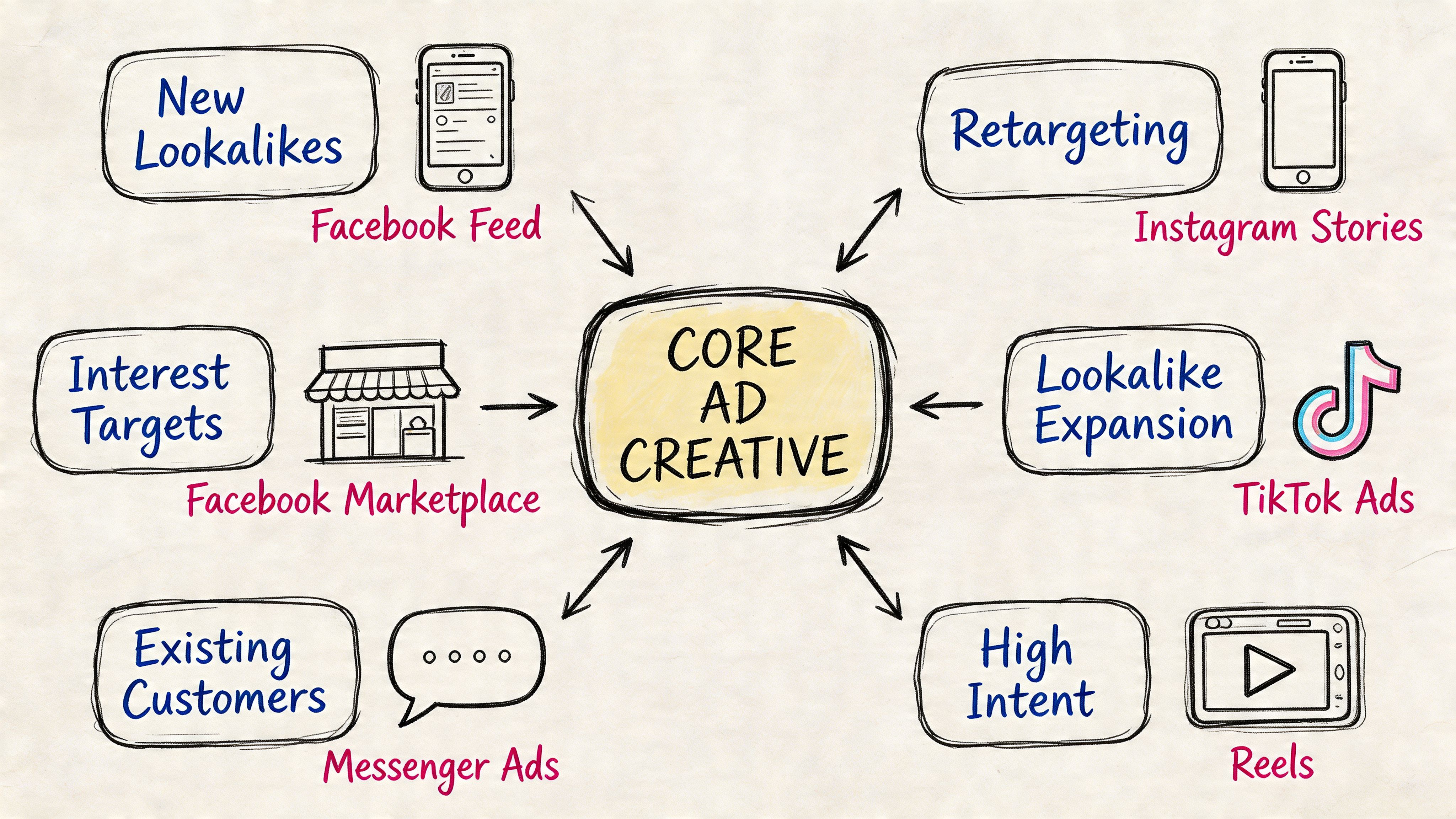
A universal refresh schedule sounds tidy, but it’s a blunt tool. Guidance that recommends refreshing every 7-14 days often ignores how fatigue velocity differs across cold and warm audiences or across geographic segments, as noted in Revel Interactive’s analysis of the ad fatigue measurement gap.
That matters because one creative can be exhausted in retargeting while still viable in prospecting. The same ad can also hold in one region and soften early in another.
Instead of asking “is this ad fatigued,” ask:
- Which audience is fatigued?
- Which campaign stage is fatigued?
- Which placement is fatigued?
Fix overlap before blaming the ad
One of the easiest ways to accelerate fatigue is to show identical messaging across multiple funnel stages without proper exclusions. Users don’t care that one campaign is labeled prospecting and another is labeled retargeting. They just know they’ve seen the same ad again.
That’s why exclusions matter. Prospecting campaigns should avoid chewing through users who are already deep in your retargeting pool, and retargeting campaigns shouldn’t keep inheriting the same stale assets as top-of-funnel.
A clean Meta campaign structure for scaling and testing helps because structure controls exposure. If the same users are hit from multiple angles, fatigue gets misdiagnosed as creative failure.
A lot of “creative fatigue” is really delivery concentration with bad audience hygiene.
Use placement-level judgment
Placement fatigue is real. A creative can go stale in Stories while still working in Feed, or vice versa. The wrong move is turning off the whole ad before checking where the impressions are clustering and where performance is dropping.
Try a simple review rhythm:
- Check placement breakdowns regularly: look for one surface absorbing too much delivery.
- Split out formats when needed: if vertical creative is still alive in one placement, protect it.
- Match edit style to surface: quick cuts, captions, and framing behave differently across placements.
Audience rotation and placement discipline won’t save a dead concept. But they often buy enough time to keep a good ad profitable while creative ops prepares the next wave.
Using Advanced Levers Like Budget Pacing and Optimization
A common failure pattern looks like this. One ad set carries the account for two weeks, efficiency starts slipping, and the team keeps increasing budget because the ad was the last clear winner. Costs rise, delivery gets more concentrated, and the account burns through the remaining life of the creative faster than the production team can replace it.
Budget pacing is how you stop that spiral.
If a fatigued ad is still taking a disproportionate share of spend, the job is to slow it down and redirect delivery into fresher paths. That does not mean slashing budget blindly. It means controlling how fast Meta spends, where it spends, and whether the current optimization setup is still giving the algorithm enough room to find efficient conversions.
Know when to reallocate spend
The trigger is not emotion. It is performance decay relative to that ad’s own baseline.
Once CTR, CPA, or conversion rate starts breaking down in a sustained way, keep spend off the ad that is losing elasticity. Shift budget toward adjacent variants that still have room to scale, or isolate fresh combinations in a separate ad set so they can win delivery cleanly. Keeping everything bundled together often lets the old ad keep hogging impressions because it has more history.
A simple operating model works well:
| Condition | Better move |
|---|---|
| Metrics soften, but the concept still converts | Cap spend growth and test a close variant with a new hook, angle, or first frame |
| The winner is absorbing spend while efficiency drops | Pull budget back and push delivery into newer ads that need impression share |
| Performance has clearly reset lower | Retire the asset from scale campaigns and replace it with a fresh build |
Teams waste money by treating budget as a reward for past performance instead of a constraint on future decay.
Use optimization settings to change the delivery path
Sometimes the account does not need a dramatic reset. It needs a different optimization path.
If Meta has optimized into a narrow conversion pocket, small setup changes can widen delivery enough to stabilize results while new creative is being produced. That might mean testing a different conversion event, changing attribution settings based on actual sales latency, or separating a rescue campaign from the main scale campaign so learning behavior is easier to read. The trade-off is real. Every optimization change introduces noise, and weak teams change too many variables at once.
Keep the test controlled:
- Adjust one major variable per test: budget, bid strategy, optimization event, or attribution window
- Protect fresh ads from legacy winners: if needed, give new creative its own environment
- Use dayparting carefully: pacing spend into stronger hours can help, but only if performance differences by hour are clear and repeatable
- Document why the change was made: otherwise every recovery attempt turns into folklore
For a useful outside reference on how these controls affect delivery, FB Ads Optimization covers the mechanics well.
Pacing only works if creative operations can keep up
This is the part many accounts miss. Budget pacing is not a cure for fatigue. It is a buffer that gives your system time to replace what is wearing out.
That is why advanced optimization should sit inside a larger performance creative platform for Meta teams, not as a set of one-off rescue tactics. If the team cannot ship new variants fast enough, pacing just spreads the same problem across a longer timeline. If the team can produce and test modular replacements every week, pacing becomes useful because it buys time without forcing bad spend into dead ads.
Used well, these levers protect margin. Used poorly, they hide creative debt for another few days.
Build a System to Prevent Fatigue with Sovran
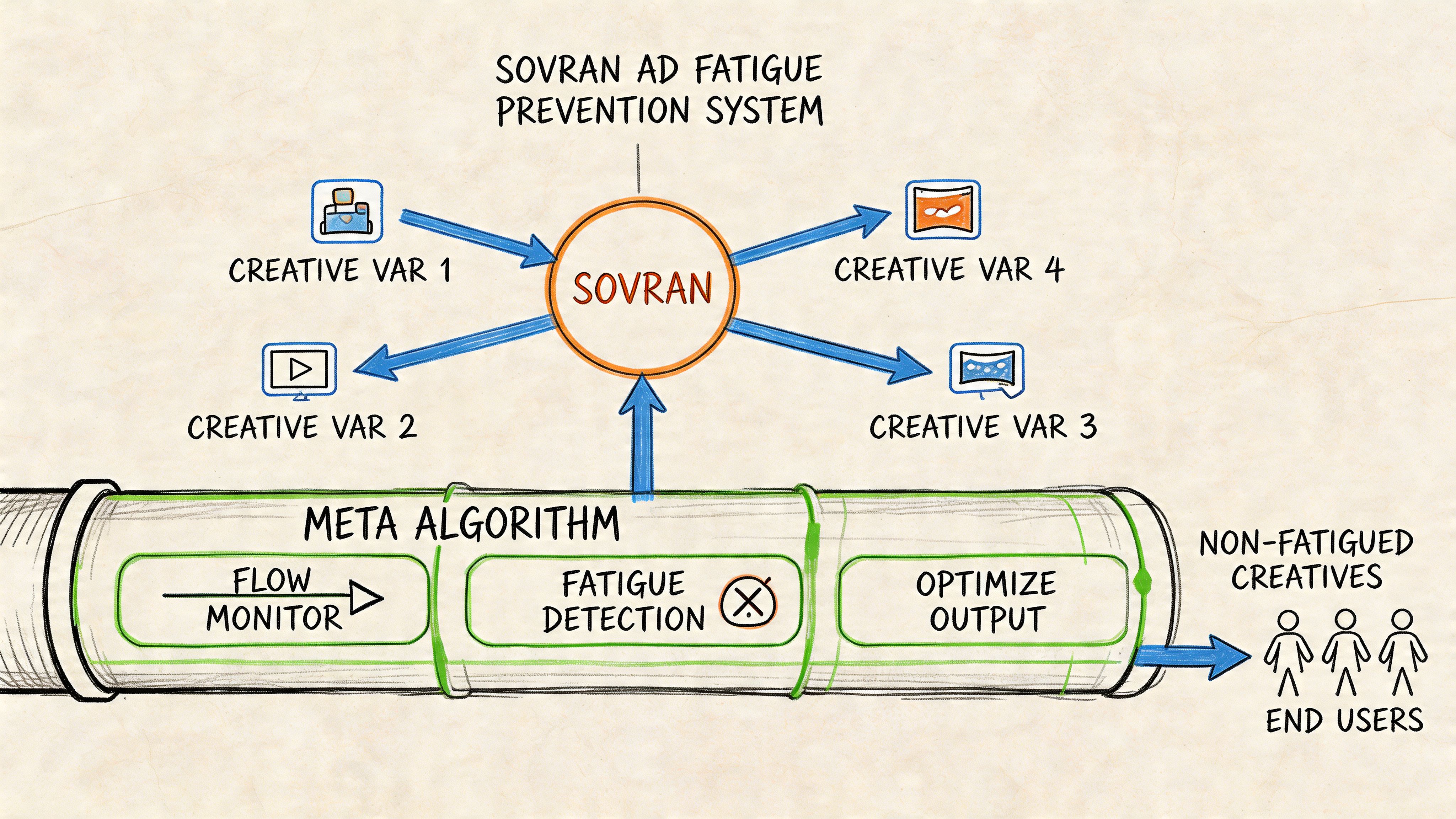
Reactive fatigue management is always messy. The cleaner approach is to build a system where creative replacement is routine, not urgent. That requires asset organization, modular production, testing discipline, and a way to connect performance signals back to creative components.
Build around components, not finished ads
Finished ads are hard to scale. Components are scalable.
A better system stores and tags hooks, bodies, proof segments, CTAs, visual motifs, and formatting variants separately. Then when a creative starts weakening, the team can replace only the tired part instead of rebuilding the entire ad.
That matters because surgically iterating on specific ad elements can extend creative lifespan by 3-7 days, according to Ryze on detecting and fixing Meta ad fatigue with AI. In practice, that means a fatigued hook can be refreshed while the winning visual stays in place.
Turn testing into a production workflow
The operational difference between struggling teams and stable teams is simple. Stable teams don’t brainstorm every refresh from zero. They run a loop.
Tag assets by component Organize raw footage and edited clips by hook type, message angle, proof style, CTA style, and format.
Track performance at the component level Don’t just log which ad won. Track which opening line, which body structure, and which ending pattern kept working.
Queue the next variants before the current winner dies If you only start producing after fatigue is obvious, the account will spend time under-rotated.
Publish variants in batches Small, modular batches are easier to learn from than one-off launches.
If you’re also tightening reporting discipline, practical guides on FB Ads Optimization can help align the creative side with performance review habits. That’s useful because fatigue prevention is partly creative ops and partly measurement hygiene.
Use software when volume becomes the bottleneck
Once a team is managing multiple offers, audiences, and placements, spreadsheets and folders stop being enough. At this stage, a platform like Sovran’s performance creative platform fits. It’s designed to structure footage into modular assets, tag hooks, bodies, and CTAs, and generate large sets of video variations for direct testing in Meta Ads Manager.
That doesn’t replace strategy. It makes strategy executable.
The system you want is simple in principle:
- A tagged asset bank
- A repeatable variation framework
- A testing cadence tied to real fatigue signals
- A production workflow that can keep up
Once that exists, ad fatigue stops being a constant fire drill. It becomes a managed variable.
If your Meta account keeps leaning too hard on a few winning ads, Sovran gives your team a practical way to build the production side of fatigue prevention. You can organize footage into modular assets, generate high volumes of ad variations, and keep a steady testing pipeline moving without rebuilding every refresh from scratch.

Manson Chen
Founder, Sovran
Related Articles

Demographic Targeting: A Performance Marketer's Guide 2026
- demographic targeting
- meta ads
- 3 more

Is Threads Worth It? Performance Marketing Guide 2026
- is threads worth it
- threads for business
- 3 more

Create Video Ads with AI That Perform in 2026
- create video ads with ai
- ai video advertising
- 3 more