Creative Fatigue Solutions for 2026: Stop Rising CPAs & Scale Ads
Jump to a section
Looking for creative fatigue solutions that actually work? If you’re a performance marketer, you know the feeling. A campaign is crushing it, ROAS is high, and then… it just stops working. The numbers tank, and you're left scrambling. This is creative fatigue, and it’s a silent killer of profitable campaigns.
The thing is, most marketers only act when the damage is done. They see a high CPA and immediately hit the panic button. But by then, you've already burned through a good chunk of your budget. The real pros know how to get ahead of it. They spot the warning signs before the campaign flatlines.
How to Spot Creative Fatigue Early
Think of creative fatigue like a slow leak in a tire. It doesn't happen all at once. Performance erodes gradually, and if you're only looking at your final destination (ROAS or CPA), you'll miss the subtle signs that you're losing air.
To stop wasting ad spend, you need to shift from reacting to a bad CPA to proactively monitoring the leading indicators. It's about building an early warning system that tells you when your audience is starting to tune out.
Go Beyond Obvious Metrics
Relying on CPA alone is like driving by only looking in the rearview mirror. It tells you what already happened, not what’s coming up. To truly get ahead of creative fatigue, you need to watch a few key metrics that act as your canary in the coal mine.
These are the numbers that show you how your audience's engagement is changing in real-time.
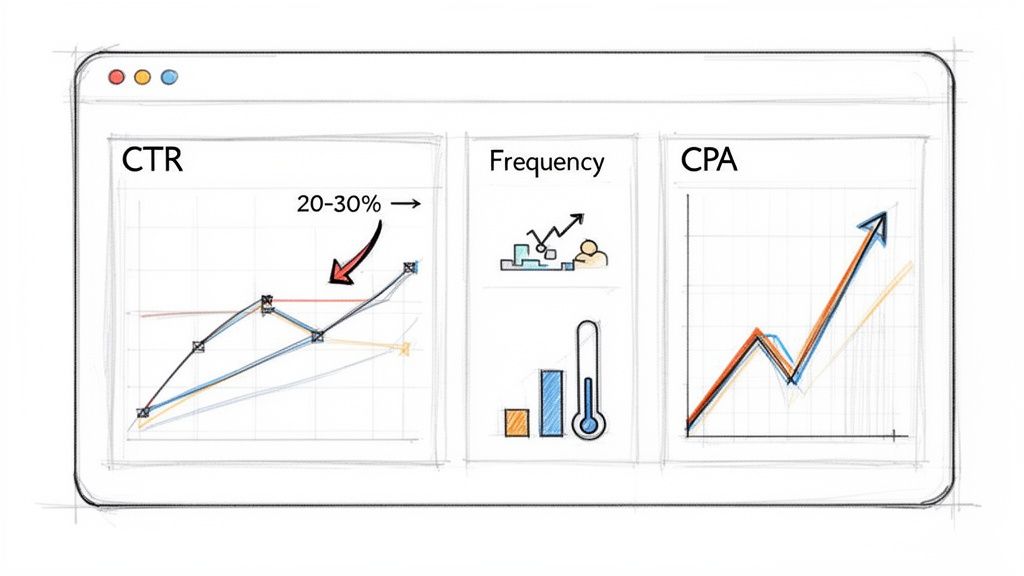
Click-Through Rate (CTR) Dip: A 20-30% drop in CTR from its peak is one of the biggest red flags. This is your audience telling you they’re getting bored, even if they haven't stopped converting just yet.
Rising Ad Frequency: Are you seeing frequency climb without a matching lift in conversions? That means you're just hammering the same people with an ad they've already decided to ignore. They've gone "ad blind."
Negative Social Proof: Don't just live in Ads Manager; check the comments. A spike in feedback like "I've seen this ad a hundred times" is a crystal-clear sign that fatigue has set in. The qualitative feedback almost always precedes the quantitative decline.
Key Takeaway: Creative fatigue is a gradual process, not a sudden event. By creating a "fatigue dashboard" that tracks CTR, frequency, and audience sentiment, you can spot the trouble long before your CPA goes through the roof.
The following chart breaks down how these metrics are connected.
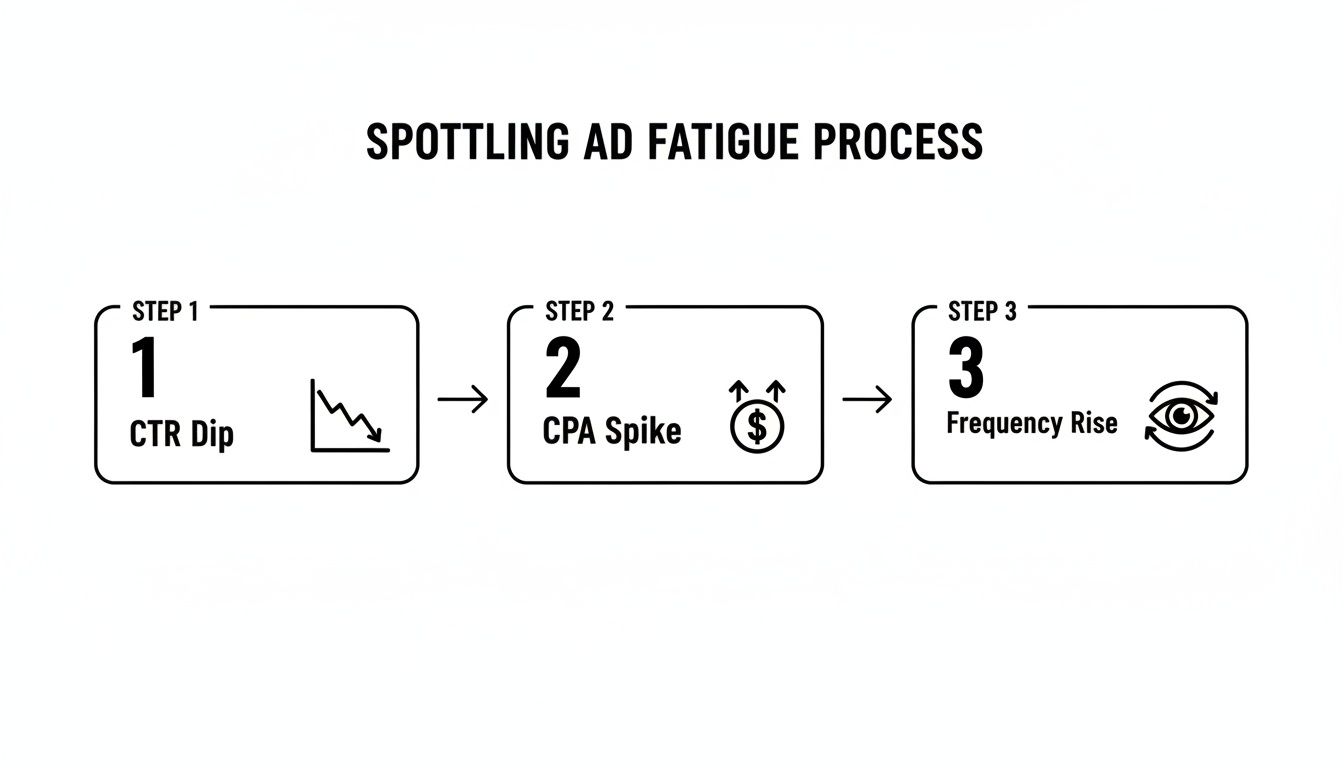
As you can see, the CTR dip is your first signal. It’s the warning shot that gives you time to act before your costs spiral.
To make this even more practical, here’s a quick-reference table you can use to diagnose fatigue in your own accounts.
Early Warning Signs of Creative Fatigue
This table outlines the key metrics, their healthy ranges, and the specific thresholds that should trigger an immediate response.
Metric | Healthy Range | Fatigue Indicator | Action to Take |
|---|---|---|---|
CTR | Stable or increasing | 20-30% drop from peak | Refresh creative, test new hooks |
Ad Frequency | Below 3 (in 7 days) | Climbing without conversion lift | Rotate in new ads, refine targeting |
CPA | Within target goal | Doubling or consistently rising | Investigate CTR/Frequency, swap creative |
Social Proof | Neutral to positive comments | Spike in negative/repetitive feedback | Acknowledge feedback, introduce new angles |
Keeping a close eye on these numbers helps you move from a reactive "firefighting" mode to a proactive, strategic approach to creative management.
A Real-World Scenario
Let's put this into practice. Imagine you're running ads for a DTC shoe brand on TikTok. Your best-performing video ad starts out strong, hitting a $12 CPA. Life is good. But two weeks later, you check in and the CPA has quietly crept up to $22.
What happened? A savvy media buyer would have seen this coming. They would have noticed that after the first week, the CTR (which was holding strong at 2%) started to dip. Then, ad frequency began to climb. Those were the signals.
In this scenario, the brand waited too long. A proactive marketer would have caught that initial CTR drop a week earlier, swapped in fresh creative, and kept the CPA from doubling. That's the difference between a profitable campaign and wasted ad spend.
For a deeper dive into setting up your reports to catch this, check out our guide on how to measure your creative tests in Facebook Ads reporting.
Building a Proactive Creative Refresh Cadence
It’s one thing to spot creative fatigue, but the real pros build their systems around prevention, not just reaction. This means shifting your mindset away from firefighting when your metrics tank and toward a structured, predictable workflow that anticipates audience boredom.
Instead of scrambling when performance drops, you need a creative refresh cadence. This isn't a rigid, one-size-fits-all calendar. Think of it as a flexible rhythm that’s tailored to the platforms you’re on and the people you’re trying to reach.
The goal is to make creative swaps a routine part of your campaign management, not an emergency measure. This approach protects campaign performance and turns a constant threat into a manageable part of your growth engine.
Setting Your Platform-Specific Cadence
Let's be honest, creative decay hits differently across platforms. The breakneck speed of content consumption on TikTok means your ads will tire out way faster than on a platform like LinkedIn.
Fatigue hits especially hard and fast on platforms where ads are cycled through audiences at an insane speed. We’ve seen consumer-facing campaigns on TikTok reach saturation in just a few days. You can explore the research on creative fatigue timelines to get a deeper dive into the data here.
Based on our experience managing high-spend accounts, here’s a practical breakdown:
Fast-Paced Platforms (TikTok, Instagram Reels, Snapchat): Plan for a 10-14 day refresh cadence. The short-form, discovery-based nature of these channels means users see a massive volume of content, and your ads will wear out quickly.
Slower-Paced Platforms (Meta Feed, LinkedIn, Pinterest): You can often stretch this to a 4-6 week cycle. Here, users scroll at a more leisurely pace and ad exposure is less concentrated, giving your creative a much longer lifespan.
Key Takeaway: Map your creative refresh schedule to platform speed. A 10-14 day cycle for TikTok and a 4-6 week cycle for Meta is a strong starting point. Let your performance data refine this over time.
This kind of proactive scheduling keeps your ads feeling fresh and helps you avoid the audience annoyance that leads to nasty comments and plummeting engagement.
Building Your 'Ready-to-Launch' Creative Library
A proactive cadence only works if you have new creative ready to go when you need it. The heart of this system is maintaining a library of approved, ready-to-launch ad variations for every one of your winning creatives. The magic number we aim for is two to three variations.
This doesn't mean you need to come up with three entirely different concepts from scratch. You can create powerful variations simply by iterating on a single ad that’s already a winner. This is where a modular approach to creation becomes a superpower.
Think of it like this: for every "winner" ad currently killing it in your ad account, you should have a backup bench of related, but distinct, ads ready to deploy. These backups could feature:
A Different Hook: Swap out the first 3 seconds to grab attention in a totally new way.
New B-Roll: Keep the same script or voiceover but change the background visuals.
An Alternate CTA: Test a different call-to-action to see if it inspires a new segment of users.
A UGC Remix: Splice in a different user-generated clip that validates your core message.
When you have these assets organized and waiting, you completely eliminate the frantic scramble to produce something new when performance inevitably dips. Effective creative pipelines rely on solid organization, which is why we always recommend these asset management best practices to keep your library in top shape.
This "backup bench" approach ensures that when your primary ad starts to fade, you can swap in a fresh variation with zero downtime. You’ll save your ROAS and keep the platform algorithms happy with a steady stream of new content.
Accelerate Creative Iteration with a Modular Framework
Keeping your creative fresh is non-negotiable, but it introduces a huge bottleneck: how do you pump out enough high-quality ad variations without completely burning out your team? The answer isn't to work harder; it's to work smarter. This is where a modular creative framework comes in.
This approach flips the script on ad creation. Instead of treating every ad like a single, massive project, you break it down into reusable, swappable components. By thinking in modules, you build a scalable system that can spin up dozens of testable ad concepts from a handful of core assets.
Deconstructing Ads into Reusable Building Blocks
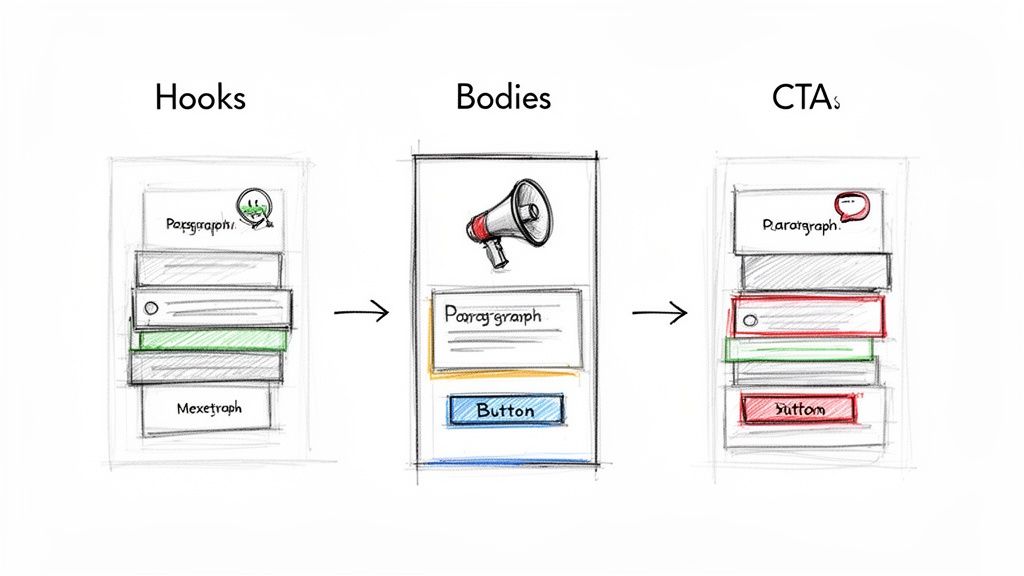
At its heart, a modular framework dissects any video ad into three basic parts:
Hooks (The First 3 Seconds): This is your make-or-break moment. A hook has one job: stop the scroll and earn the viewer's attention. A single ad concept can, and should, have multiple hooks.
Bodies (The Core Message): This is where you deliver your value proposition, tell your story, or show the product in action. It’s the meat of your ad.
Calls-to-Action (CTAs - The Final Push): The grand finale. This is where you tell the viewer exactly what to do next. Think "Shop Now," "Download the App," or "Learn More."
When you start bucketing your creative assets this way, the math starts to get exciting. One solid body clip paired with five different hooks and three different CTAs instantly gives you 15 unique ad variations to test. This is how you find powerful solutions to creative fatigue without starting from scratch every single time.
A modular approach turns ad production from a painful art project into a scalable system. By mixing and matching hooks, bodies, and CTAs, you can multiply your creative output without a linear increase in effort or budget.
Applying Proven Formulas with Modular Blocks
The real magic happens when you combine this framework with classic, battle-tested advertising formulas. These formulas give you the narrative structure, and your modular blocks fill in the blanks.
To keep creative fatigue from derailing your workflow, it's so important to have a clear, organized system. Learning how a structured content creation process can end the chaos and speed up creative iteration is a game-changer for any team.
Let's see what this looks like in the real world.
Modular Creative Frameworks for Rapid Testing
Think of your modular blocks as ingredients and marketing formulas as recipes. The table below shows just how easy it is to construct proven ad concepts using the Hook-Body-CTA structure.
Framework | Hook Example | Body Structure | CTA Example |
|---|---|---|---|
Problem-Agitate-Solution | "Tired of your phone dying by 3 PM?" | Show frustrating clips of a dead phone, then introduce your power bank saving the day. | "Get 50% off your forever-lasting charger." |
UGC Testimonial | A customer looks into the camera and says, "I was skeptical, but this app actually works." | Show screen recordings of the customer using the app and achieving their desired result. | "See what all the hype is about. Download free." |
Feature-Benefit Listicles | "Here are 3 reasons your old water bottle is holding you back." | A fast-paced montage showing each feature (e.g., insulation, self-cleaning) and its direct benefit. | "Upgrade your hydration. Shop the collection now." |
Before-and-After | A messy room followed by the text overlay: "This took me 5 minutes to clean." | A time-lapse video showing your cleaning product transforming the space quickly and easily. | "Get your weekend back. Try it today." |
This systematic approach demystifies high-volume creative production. It's a clear playbook that gives your team a way to generate a ton of diverse ad concepts, all rooted in psychological triggers that we know work.
The AI-Powered Workflow for Modular Assembly
Now, trying to manually catalog, find, and combine all these clips can quickly become a logistical nightmare. This is exactly where AI platforms like Sovran give you a massive edge.
An AI-powered workflow automates the most tedious parts of this modular process.
For instance, you can dump hundreds of raw video clips—B-roll, testimonials, product shots—and the AI can automatically tag each clip based on its content and potential use case. It can identify which clips would make great hooks, which ones work as body content, and which are perfect for CTAs.
Suddenly, you have a searchable, intelligent library of creative assets. Your team no longer has to scrub through hours of footage. They can just ask the system, "Show me all the UGC clips where a customer mentions 'easy to use'," and instantly get a list of options. This is a core part of building a truly scalable system for generating creative at a pace that keeps fatigue from ever setting in. For a complete overview, check out our deep-dive into the modular video ad framework.
Using AI to Scale Your Creative Output and Testing
This is where you can build a serious competitive edge. While a modular creative framework helps you stay organized, trying to scale it all by hand is a fast track to burnout—the exact problem we’re trying to solve. The smartest creative fatigue solutions don't just use AI to replace human work; they use it as a force multiplier to automate the most soul-crushing parts of the workflow.
Modern AI platforms are built to crush the biggest bottlenecks in creative production. They give small teams the power to match the output and testing speed of an agency ten times their size. We're not talking about generic AI toys here. We're talking about systems purpose-built for performance marketers who need results.
Generate On-Brand Assets in Seconds
One of the first walls you hit when refreshing creative is simply running out of fresh visuals. You've recycled the same B-roll a dozen times, and your user-generated content (UGC) library is looking pretty thin. AI provides a direct fix by generating brand new, high-quality video clips to mix in with your existing footage.
Say you need a new clip for a travel app ad. Instead of planning a pricey shoot, you can prompt an AI to generate a shot of a "couple packing their bags for a sunny vacation, bright and airy lighting." Just like that, you have an endless supply of fresh B-roll to assemble new ad variations, keeping your visuals from getting stale.
But AI can do a lot more than just create new footage. It can also remix and improve what you already have.
AI augmentation is all about speeding up specific parts of the media cycle. When you tackle the workflow bottlenecks, you free up your team to think bigger. Their focus shifts from "How do I get all this done?" to "How can I make this even better?" That’s where the real strategic wins happen.
Introducing the Context Vault
A common (and valid) fear is that AI will churn out generic, off-brand junk. This is where the concept of a Context Vault comes in. Think of it as your brand's brain, living right inside the AI platform.
A Context Vault is an intelligent library where you feed the AI your most important brand assets:
Brand Guidelines: Your logos, color palettes, and fonts.
Customer Reviews: All those 5-star testimonials and glowing comments.
Winning Ad Scripts: The exact copy from your absolute best-performing campaigns.
Product Information: Key features, benefits, and core messaging pillars.
With this context locked in, every asset the AI generates is automatically on-brand and laser-focused on conversion. When it writes a script, it pulls from the language of your best ads. When it adds a text overlay, it uses your brand fonts and colors. This is how you ensure creative stays consistent and effective, even at massive scale. It's a core function of a true AI creative automation platform.
Bulk Rendering and Rapid Iteration
Manually creating dozens of ad variations in a tool like CapCut is painfully slow and tedious. This is where AI delivers a massive leap in productivity. Platforms like Sovran offer bulk video rendering, letting you remix your modular components into hundreds of unique ads in seconds.
For example, imagine you have:
5 different hooks
3 different body clips
4 different CTAs
10 customer testimonials for text overlays
An AI can instantly combine these elements, rendering hundreds of testable ad variants complete with subtitles, text overlays, and your logo. A process that would take a video editor days of mind-numbing work is done in minutes. And to keep your copy fresh across all this content, a good AI caption generator can be a lifesaver for scaling your social posts without hitting writer's block.
This huge volume of creative isn't just for show—it's the fuel for an aggressive testing strategy. By launching so many variants, you can accelerate your learning cycles by up to 10x. You let the ad platform algorithms quickly find the winning combinations of hooks, messages, and CTAs, giving you data-backed insights to pour into your next creative sprint. This is how you build a system that constantly outsmarts creative fatigue.
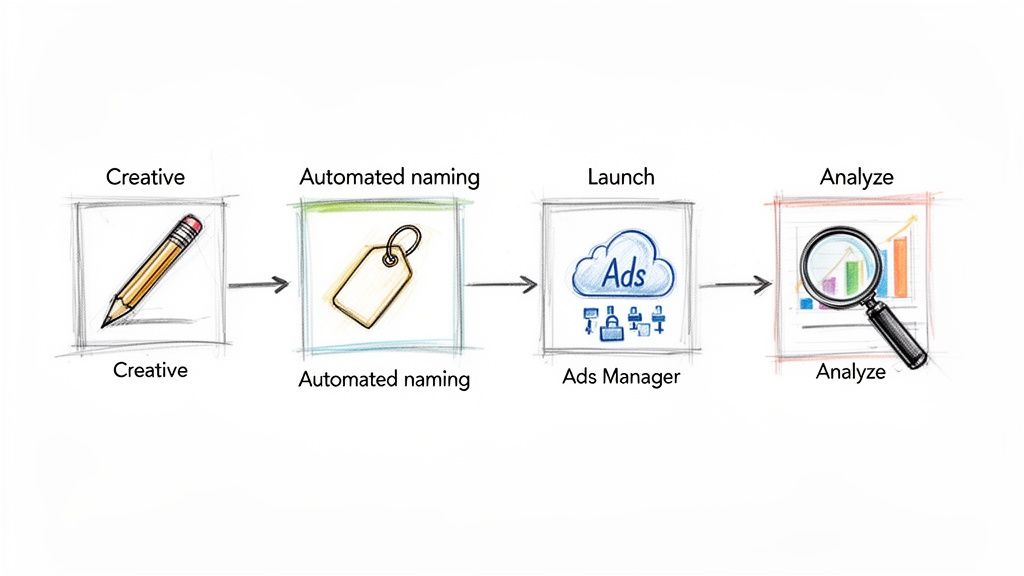
Streamlining Your Ad Launch and Analysis Workflow
So you've cranked out a ton of ad variations. That's a huge win, but it's only half the job. If your process for launching and analyzing those ads is a free-for-all, you’ll never figure out what’s actually working. Any gains you made in production will be lost in the chaos.
This is where we need to close the loop. We have to build a smooth, repeatable system that connects creative production, campaign launch, and performance analysis. This is how you make high-volume testing truly data-driven instead of just… high-volume.
Keep Your Data Clean with Automated Naming Conventions
The quickest way to lose the plot with your ad testing is messy naming. I've seen it a thousand times. When you have hundreds of ad variants running, a name like "Video Ad Final v2" is completely useless. You have no idea what hook, body copy, or angle you’re even looking at without clicking into every single ad.
A structured naming convention is non-negotiable for anyone serious about testing. It turns your Ads Manager from a confusing junk drawer into a searchable, powerful database. This makes it incredibly easy to spot performance patterns at a glance.
Your naming structure should automatically spell out the core components of each ad. Here's a template we use that works wonders:
Structure:
[Date]_[Campaign]_[Concept]_[Hook]_[Body]_[CTA]Example:
20260715_SummerSale_UGC_Hook3-Testimonial_Body1-Unboxing_CTA2-ShopNow
When your ad names are this descriptive, you can instantly see which creative elements are driving results. You can filter your reports to see if "Hook3-Testimonial" consistently crushes other hooks, giving you a crystal-clear direction for your next creative sprint.
Push Ads Directly from Platform to Pixels
Manual uploads are a massive time-suck and a perfect recipe for human error. The whole dance of downloading a video, navigating to Ads Manager, uploading it, and then copy-pasting all the details is a huge bottleneck. When you're managing dozens of new ads, this can easily eat up hours of your day.
This is exactly why modern creative platforms like Sovran integrate directly with ad networks like Meta. This setup lets you push finished, correctly named ads straight from where you built them into a live campaign. It takes just a few clicks.
Key Insight: The goal here is to kill as many manual steps as possible. Every minute you save on admin tasks is a minute you can reinvest in strategy, analysis, and actual creative thinking. Automation isn't a luxury for scaling; it's a flat-out necessity.
This direct push doesn’t just save you a ton of time; it also guarantees your meticulous naming conventions are perfectly preserved. It closes the gap between production and launch, turning a clunky, error-prone process into a seamless workflow. To see how this fits into a bigger strategy, you can explore our guide on setting up a proper campaign structure for Meta Ads.
Integrate Analytics for Clear ROI Breakdowns
The final step is bringing performance data back into your creative workflow. You need to know not just which ad won, but which components inside that ad were responsible for the win.
Connecting your ad accounts directly to your creative platform gives you a clear ROI breakdown for every individual creative asset—every hook, every B-roll clip, every testimonial. This creates a powerful feedback loop that lets you:
Quickly spot winning components: Instantly see which hooks are driving the highest CTR or which CTAs are bringing in the most conversions.
Catch creative decay at the asset level: Notice the exact moment a specific testimonial or piece of user-generated content starts to lose its magic.
Feed insights directly back into production: Use hard data to inform your next round of creation. You’ll be able to confidently double down on what works and ditch what doesn't.
This integrated approach turns creative testing from a guessing game into a data-driven science. You stop throwing spaghetti at the wall and start building a predictable engine for finding winning ads and keeping creative fatigue from ever taking hold.
Your Top Questions, Answered
We get a lot of questions from performance marketers and media buyers about tackling creative fatigue. Here are our straight-to-the-point answers to the most common ones we hear, packed with practical advice you can use today.
How Often Should I Refresh My Ad Creative for TikTok vs. Meta?
The big difference here is the speed of the platform. On a firehose of content like TikTok, you need to be way more proactive. We recommend a fresh batch of creative every 7-14 days. Audiences there burn through content so fast that your ads get old in the blink of an eye.
For Meta (Facebook and Instagram), you usually have a bit more breathing room—think a 3-4 week cycle. But don't just set it and forget it. The real pro move is to watch your leading indicators. A 20% drop in CTR or a steady rise in frequency are your warning signs. Jump on those before your CPA starts to skyrocket.
Is Just Changing Ad Copy Enough to Beat Creative Fatigue?
Honestly, it’s a band-aid fix at best. While fresh copy might give you a tiny, temporary bump, it almost never solves the core problem of visual fatigue.
Your audience has already seen the ad's visual a dozen times. They develop a kind of "banner blindness" to it, recognizing the image or video instantly and scrolling right past before they even have a chance to read your brilliant new headline.
The real wins come from refreshing the visual elements. This could mean a new hook, different B-roll footage, or a totally new concept. A modular approach is your best friend here, letting you test new visuals and copy variants at the same time to find what really moves the needle.
How Many Ad Variations Should I Test at Once?
Don't get hung up on a magic number. Instead, focus on testing fundamentally different "concepts" or "angles." A great starting point is to have 3-5 distinct creative concepts running at all times. This gives you a true read on what value props or stories actually resonate with your audience.
Once you have a winning concept, that's when you can use AI tools to spin up dozens of micro-variations. Take one great ad and generate 10 versions with different hooks, for example. This lets the platform's algorithm do the heavy lifting to find the absolute best-performing combination.
The most effective testing strategy combines human-led conceptual thinking with AI-driven variation at scale. Test a few big ideas, then let technology find the small tweaks that maximize performance for each one.
Will Using AI-Generated Video Hurt My Brand's Authenticity?
This is a huge concern for a lot of brands, but it's totally avoidable if you're smart about it. The key is to use AI to supplement your content, not replace it entirely. It's about augmenting your team's creativity, not automating it away.
For instance, you can use AI to generate new B-roll clips that perfectly match your brand's aesthetic, or to quickly remix a bunch of existing UGC into a fresh montage. By feeding the AI a "Context Vault" filled with your brand guidelines, customer reviews, and winning scripts, you make sure its output always sounds and feels like you.
Done right, AI becomes a tool to scale your brand’s authentic message, not dilute it.
Ready to stop creative fatigue from killing your campaign performance? Sovran automates the entire creative workflow, from modular production and bulk rendering to direct campaign launches. Accelerate your testing and find profitable winners 10x faster. Start your free trial at https://sovran.ai today.

Manson Chen
Founder, Sovran
Related Articles
Storyboard Development: Scale Video Ad Production in 2026
- storyboard development
- video ads
- 3 more

8 Pattern Interrupt Techniques for Video Ads
- pattern interrupt techniques
- video ad hooks
- 3 more
Customer Journey Mapping for Performance Marketing
- customer journey mapping
- performance marketing
- 3 more