Customer Journey Mapping for Performance Marketing
Jump to a section
- Why Most Journey Maps Never Reach the Ad Account
- Aligning Stakeholders Before You Draw a Single Box
- Mapping Touchpoints and Stages for a Performance Funnel
- Signals, Metrics, and Creative Hypotheses per Stage
- Turning Journey Stages into Modular Creative Variants
- Feeding Journey-Driven Variants into High-Velocity Testing
- Troubleshooting the Maps That Never Move the Numbers

You're staring at a clean Miro board, the stakeholders have nodded through the workshop, and the deck is already getting comments like “great alignment.” Then the campaign brief lands, the media buyer needs hooks by tomorrow, and none of the insights have made it into a live Meta or TikTok test. That gap is why customer journey mapping too often becomes an internal artifact instead of a performance system.
The fix is simple to say and hard to do. Treat the map as the input to creative testing, not the deliverable. Once a stage has a signal, a friction point, and a buyer state attached to it, it can turn into a hook, body, and CTA hypothesis that's ready for the ad account.
Why Most Journey Maps Never Reach the Ad Account
The most common failure is not bad mapping, it's beautiful mapping with no operational path. Teams spend weeks color-coding stages, labeling pain points, and polishing a slide, then leave the file open in the tab nobody revisits. By the time the next sprint starts, the map has become evidence that a workshop happened, not a tool that changed a campaign.
A working map looks different from the first draft. It uses the language of the media buyer, so stage names line up with what gets tested, like awareness hooks, objection-handling bodies, or conversion CTAs. It also attaches a signal and a KPI to each stage, then exports testable hypotheses fast enough to feed the next creative cycle, not the next quarter.
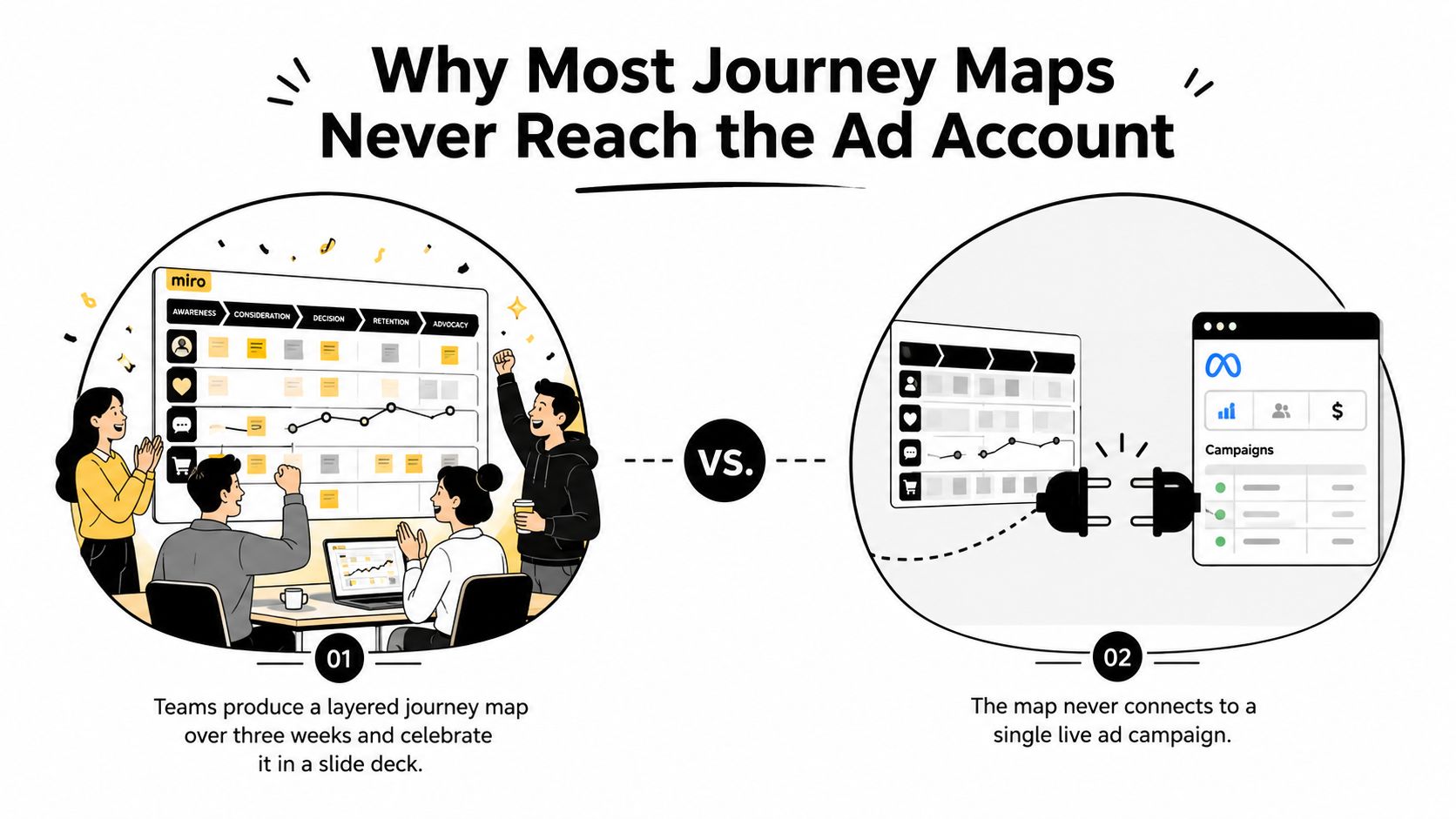
Practical rule: if a journey map can't produce a test brief, it's still just a planning artifact.
The old habit is to think of the map as the finish line. In performance marketing, it's the handoff document between customer insight and creative execution. That's why the map has to live close to the ad workflow, not in a separate folder.
A good companion process is production schedule optimization, because the map only matters when production can turn insights into assets on time. If the team can't move from stage insight to asset request quickly, the map is already decaying.
Aligning Stakeholders Before You Draw a Single Box
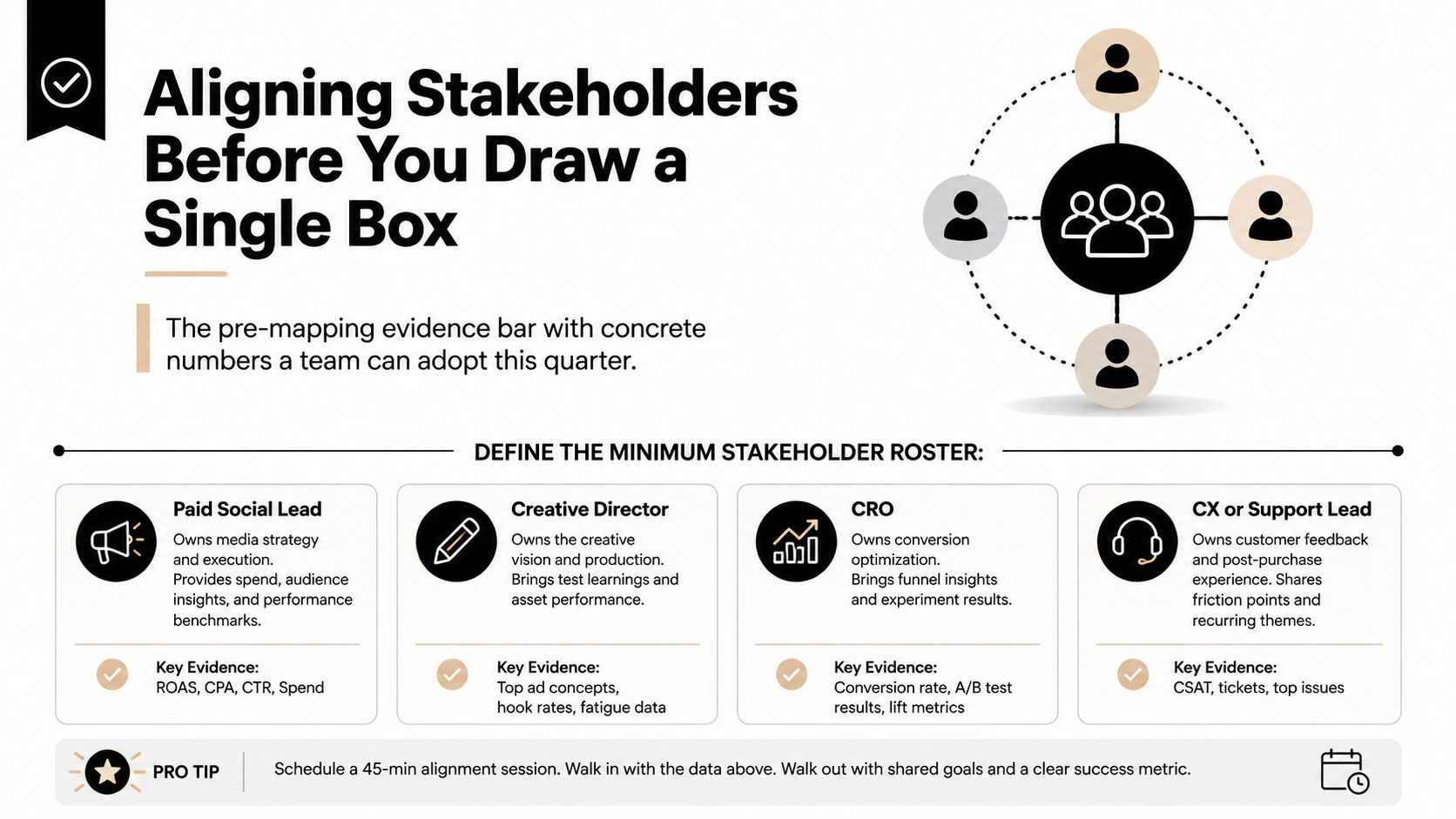
The best maps start before the whiteboard, with a small group that owns the journey in practice. At minimum, bring in the paid social lead, creative director, CRO, CX or support lead, and one frontline salesperson or CSM. Each person should contribute a different layer of truth, because no single function sees the whole journey clearly.
The paid social lead names where the journey shows up in the ad account. The creative director translates friction into angles and formats. CRO and CX catch what happens after the click, while sales or CSM teams expose the objections that never appear in analytics.
Practical rule: if support, sales, and retention haven't reviewed the draft, you're probably mapping assumptions, not behavior.
Use an evidence bar before the first box is final. A practical baseline is 6 to 8 recent customers per segment, 3 to 5 lost deals, and 2 to 3 frontline conversations per channel. That's close to the guidance that high-quality maps need real customer input, not internal guesses, and it lines up with independent recommendations to gather 8 to 12 customer interviews plus frontline review before treating a map as reliable (Heart of the Customer guidance).
Before the workshop, collect four inputs and don't start without them.
- Persona source docs: Use customer definitions, not internal wish lists.
- Last 90 days of attribution data: Focus on what drove attention and conversion.
- Support ticket clusters: Surface repeated complaints and recurring confusion.
- Creative brief archive: Pull the angles that worked, and the ones that died fast.
Keep the meeting honest with a frontline review ritual. Read the draft stage by stage to support, sales, and retention before anything is finalized. If they immediately say “that's not how customers phrase it” or “that's not where they get stuck,” the map is doing its job by failing fast.
For teams building a repeatable operating model, how to scale a performance creative team is a useful companion process because stakeholder alignment only matters if the team can act on it.
Mapping Touchpoints and Stages for a Performance Funnel
A useful map starts with a real person, not a generic funnel diagram. Use a 34-year-old project manager researching performance marketing tools, because that persona naturally moves between scrolling, comparing, requesting proof, and checking whether the promise holds after signup. The point is to see the journey from the customer's side, then translate it into ad work.
Awareness through retention in one journey
In awareness, she sees a TikTok clip while scrolling, hears a podcast mid-roll, or gets a peer Slack mention. The dominant signal is curiosity mixed with skepticism, and the emotional state is light resistance, not commitment. Paid social often carries the message here, especially when Meta or TikTok introduces the problem before she has a search intent.
In consideration, she reads a comparison blog, checks a G2 page, and notices a retargeted carousel that repeats the same promise in a different format. The signal changes to active comparison, and the emotional state becomes cautious evaluation. At this stage, paid social usually supports an organic trigger rather than creating the intent from scratch.
In conversion, she lands on the pricing page, books a demo, and gets on a sales call. The signal is commitment with hesitation, and the emotional state is “prove it.” Here, the ad account should mirror the sales conversation, not invent a new one.
In retention, the journey shifts to onboarding email, in-app prompts, and a quarterly check-in. The signal is product usage and whether the buyer feels the value quickly enough to stay engaged. Ads can still help, but the message should reinforce the handoff that customer success already started.
Practical rule: the channel mix matters less than the job each touchpoint is doing, introduce, compare, close, or reassure.
The format below keeps that distinction visible.
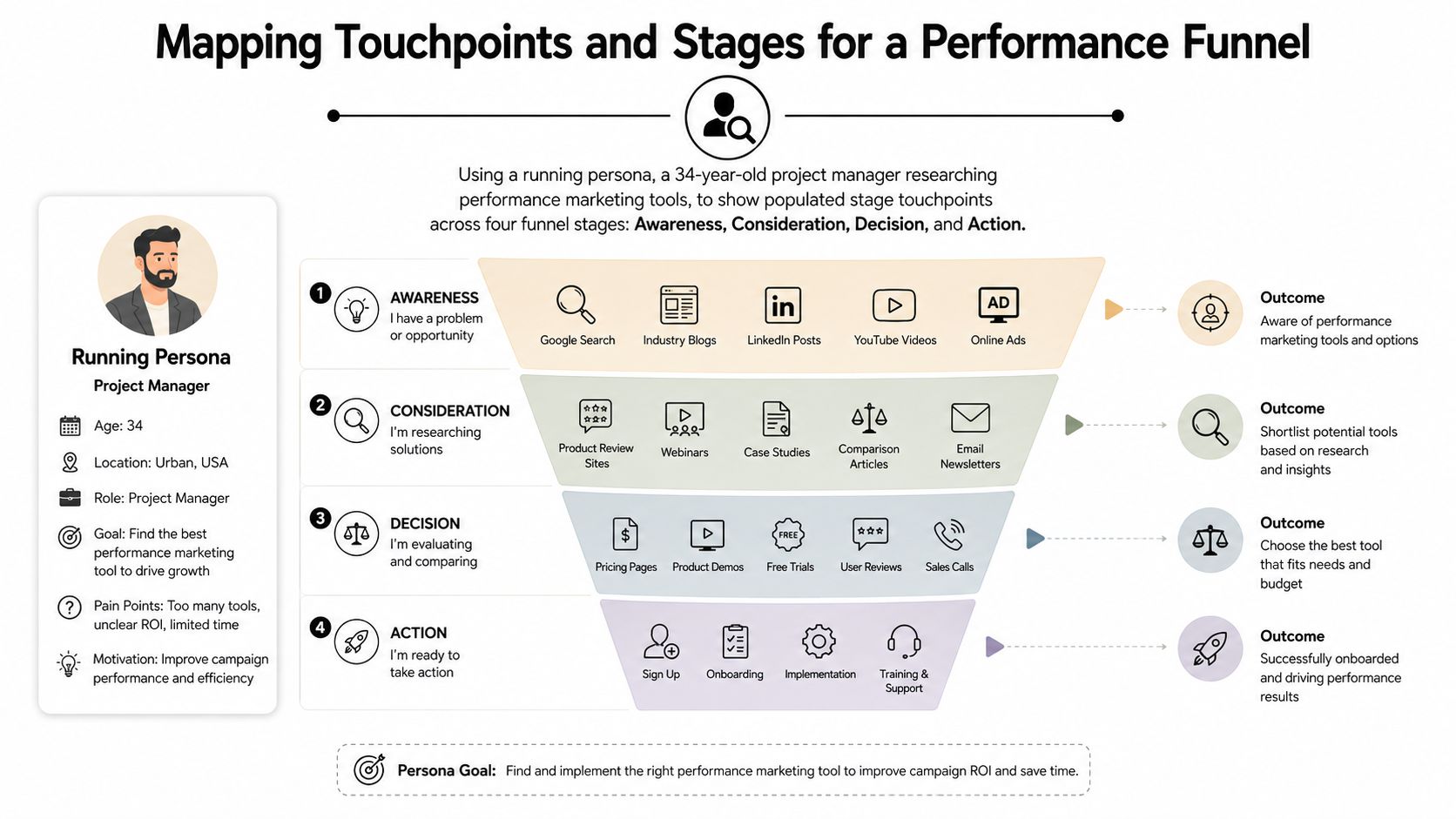
The ad team should read the map as a sequence of states, not a list of channels. If the same person needs proof in one stage and reassurance in the next, the creative needs to change with her. That's where most brand ads fail, they keep the same tone even when the buyer's intent has already shifted.
Signals, Metrics, and Creative Hypotheses per Stage
Each stage should tell you what to watch and what to test next. That means the map isn't just a journey diagram, it's a decision tree for creative work. If the signal isn't clear, the stage is too vague to act on.
Match the signal to the creative job
Awareness lives or dies on the first few seconds. Watch thumbstop rate, 3-second hold, and brand search lift when the creative is meant to interrupt scrolling and create enough curiosity to keep attention. The matching hypothesis is usually a problem-flavored hook, a sharp pattern interrupt, or a first line that names the pain better than the competitor does.
Consideration is a proof stage. The strongest signals are VTR, profile visits, and deeper site engagement, because the buyer is trying to determine fit. The creative job here is objection handling, so the hypothesis should test evidence, demos, comparisons, or specificity that reduces uncertainty. For a practical framework on reading these outcomes, use how to read test results as the operating reference after each launch.
Conversion is where the team should focus on CTR, ROAS, and CAC payback. The buyer already knows the category, so the ad has to make the decision easier with urgency, scarcity, or clearer offer framing. Weak conversion creative usually fails because it still sounds like consideration content.
Retention creative needs different proof. Look at repeat purchase behavior, usage signals, and the unsubscribe curve rather than pretending the same ad metric answers every question. The hypothesis here is reassurance, habit formation, or a nudge toward the next action, not another awareness-style pitch.
| Stage | Primary Signal | Action Threshold | Creative Hypothesis Type |
|---|---|---|---|
| Awareness | Thumbstop rate | Kill hooks that fail to hold attention early | Problem hook, pattern interrupt |
| Consideration | VTR | Promote bodies that keep attention and answer objections | Proof-of-fit, objection handling |
| Conversion | CTR | Scale CTAs that improve decision efficiency | Urgency, scarcity, offer clarity |
| Retention | Repeat engagement | Refresh messaging when satisfaction or reuse stalls | Onboarding reassurance, repurchase prompt |
The point of the table is not to make measurement pretty. It's to keep the team from testing a hook when the body is the core problem, or changing an offer when the issue is a weak top-line angle. That kind of mismatch burns time and makes the map look broken when the test design is what failed.
Turning Journey Stages into Modular Creative Variants
Stages are useful only if they become parts you can recombine. A performance team shouldn't brief one giant ad per journey stage, it should build a modular library where each concept is split into hook, body, and CTA. That structure keeps the work testable and makes it easier to scale without re-editing everything from scratch.
Build the asset system around slots
The hook owns the first 3 seconds and should be designed for thumbstop and early hold. The body carries proof, demo, or story, and it should be long enough to answer the specific objection tied to that stage. The CTA should do one job only, whether that's demo booking, trial start, or pricing-page click.
A consideration-stage body sounds different from a conversion-stage body because the buyer is different. The first one says, in effect, “here's why this fits you,” while the second one says, “here's why now is the right time.” If those two get mixed together, the ad usually feels generic.
A practical working range is 5 to 10 hooks, 3 to 5 bodies, and 2 to 3 CTAs per stage. That gives enough combinations to test without turning production into chaos. modular video ad framework thinking becomes useful here, because the same footage can support multiple stage-specific recombinations.
Practical rule: write the brief at the slot level, not the ad level.
A shared doc should tag every asset by stage, objection, and intended signal. That keeps the creative team from drifting back to vague brand messaging when the test plan needs something sharper. It also makes handoffs cleaner when the same source footage needs to serve multiple journeys.
Some teams use tools like Sovran to assemble hook, body, and CTA combinations from tagged assets, then push those variations into Meta workflows. That only works when the journey map already told the team what each slot should prove. Without that upstream discipline, automation just scales mediocre creative faster.
Feeding Journey-Driven Variants into High-Velocity Testing
Once the slots are built, the workflow should pull from a stocked library, not trigger a scramble. Weekly test planning should start with stage-tagged options already waiting in the asset pool, then route the winning combinations back into the map notes. That turns the journey map into a living input, not a retrospective document.
Run the cycle on a schedule
Set a 7 to 10 day review window so the team can judge early signals without overreacting to noise. Kill hooks that underperform on the benchmark you use for thumbstop, graduate bodies that hold attention better than the rest, and promote CTAs that show the strongest CPA improvement. Then update the map with whatever the market just taught you.
This is also where performance marketing becomes more practical than theoretical. If you need a concise refresher on the operating model, definition of performance marketing for marketplace sellers is a useful reference because it frames the discipline around measurable outcomes rather than broad awareness.
The win is feedback velocity. Every cycle should expand the hook bank, retire weak stage hypotheses, and add fresh objections from sales calls into the consideration bodies. That way, the map doesn't just describe the journey, it evolves with the friction customers encounter.
For teams focused on iteration cadence, video ad iteration strategy is a strong companion read because the map only matters when the creative system can keep pace with it. In practice, the best teams don't ask whether a journey map is finished. They ask whether it has produced a new test worth launching this week.
Troubleshooting the Maps That Never Move the Numbers
If the map isn't changing what gets launched, the problem is usually visible in the workflow. Start with the most obvious failure: no customer conversations. If a stage was built without real interviews, the evidence is thin, and the fastest fix is to schedule customer calls before the next revision.
Use the failure mode as the diagnostic
When stages are built from internal assumptions, ask who said that was the path. If nobody can point to customer language, support tickets, or sales calls, the stage needs to be rewritten. If touchpoints are outdated, the issue is usually that the map hasn't been reviewed against recent channel behavior.
If there's no metric owner per stage, the map won't move because nobody owns the result. If no creative hypothesis is logged, the stage is descriptive but not testable. And if there's no feedback loop back to the ad account, the team is collecting insight without operational memory.
A quick self-audit keeps this honest.
- At least eight customer conversations logged: If not, the map is under-researched.
- Last revision under 90 days old: If not, the journey is probably stale.
- Every stage paired with one KPI and one hypothesis: If not, the map can't be tested.
- Owner named for each stage: If not, accountability is missing.
- Documented handoff to creative testing: If not, the ad team won't act on it.
The rule that matters most is simple. A journey map earns its keep only when it has produced a launched ad variant in the last 14 days. If it hasn't, the map is serving documentation, not growth.
If you want a journey map that reaches the ad account, Sovran can help turn stage insights into modular video variants that are ready for testing. Visit Sovran to see how creative teams use it to assemble hooks, bodies, and CTAs into faster test cycles without rebuilding every asset from scratch.

Manson Chen
Founder, Sovran
Related Articles

8 Pattern Interrupt Techniques for Video Ads
Production Schedule Optimization for Scalable Ad Testing